

Bisphenol A Market Analysis & Forecast: 2026-2033
Bisphenol A Market size is estimated to be valued at USD 15,369.3 Mn in 2026 and is expected to reach USD 22,655.8 Mn in 2033, exhibiting a compound annual growth rate (CAGR) of 5.7% from 2026 to 2033.
Key Takeaways
- By Application, Polycarbonate Resins dominate the Bisphenol A Market, holding 66.5% share. This is due to their widespread use in automotive, construction, and electronics sectors, where demand for lightweight, durable, and impact-resistant materials continues to grow.
- By Region, Asia Pacific dominates the overall market with an estimated share of 40% in 2026 owing to rising demand for consumer electronics.
Market Overview
The global bisphenol a market is expected to grow at a steady pace during the forecast period. This growth is expected to be driven by the increasing demand for the product from the marine industry and its expanding use in photocurable coatings in automotive Industry. Moreover, the growing demand for polycarbonate plastics from wide range of end user industries are electronics, construction, and medical are again propelling the bisphenol a market demand. Furthermore, the increasing demand for epoxy resins from the electrical and electronics industries is further anticipated to foster the market growth.
Current Events and their Impact on the Bisphenol A Market
Current Events | Description and its impact |
Geopolitical and Regulatory Developments |
|
China's Chemical Industry Consolidation and Environmental Policies |
|
Automotive Industry Transformation and Electrification |
|
End User Feedback and Unmet Needs in the Bisphenol A (BPA) Market
Key End User Feedback
- Performance Reliability:
End users generally acknowledge the high mechanical strength, thermal stability, and durability of BPA-based polycarbonates and epoxy resins. These properties remain critical for applications in safety-critical industries such as automotive components and electrical insulation. - Cost Competitiveness:
Many users emphasize BPA’s cost-effectiveness relative to alternatives, particularly in high-volume applications. This price-performance ratio continues to be a key driver of demand. - Supply Chain Stability:
Several large-scale manufacturers have raised concerns regarding supply consistency and price volatility, particularly in light of regulatory uncertainties and increasing environmental scrutiny. Disruptions in feedstock availability or production constraints can impact downstream production timelines.
Unmet Needs
- Sustainability and Regulatory Compliance:
Increasing regulatory pressure—especially in the EU and North America—has prompted growing demand for safer and more sustainable alternatives to BPA. End users report a lack of commercially viable substitutes that offer comparable performance without associated health or environmental concerns. Many are actively seeking BPA-free resins or bio-based alternatives, but these are often limited in availability, costlier, or inferior in function. - Health and Safety Transparency:
Consumer-facing industries, such as food packaging and electronics, report heightened scrutiny and demand for greater transparency about the potential health impacts of BPA-containing products. There is a clear unmet need for more comprehensive safety data and third-party certifications that can reassure downstream users and end consumers. - Innovation in Product Development:
End users have indicated a desire for BPA-based materials that can meet emerging technical requirements, such as higher recyclability, enhanced UV resistance, and lighter weight for mobility applications. The current pace of innovation in BPA derivatives and processing technologies is perceived as insufficient to meet evolving market needs.
- Current Industry Events of 2026
- Market Size Estimation
- Regional Breakdown
- Competitive Landscape
- Customer Intelligence
- Segmental Analysis
- Pricing Analysis
- Key Market Drivers, Challenges & Future Trends
- Customized Insights Section
Segmental Insights
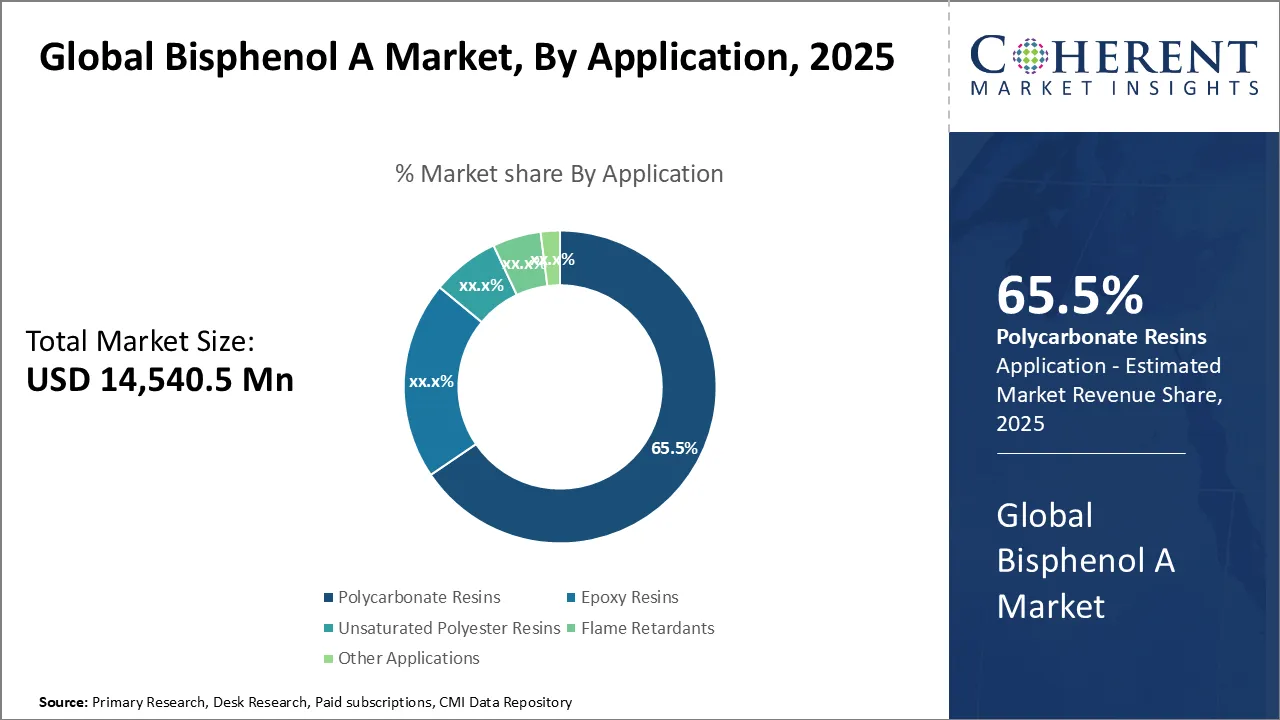
Bisphenol A Market Insights, By Application - Polycarbonate Resins contribute the highest share of the market owing to their versatile use in construction and sustainability efforts
Polycarbonate resins dominate the global BPA market with a share of 66.5% due to escalating demand in industries such as construction—especially for applications like barrel vaults, facades, canopies, stadium roofs, and translucent panels—where their durability and clarity are key drivers. Additionally, manufacturers are innovating; for example, SABIC launched a certified circular polycarbonate resin made via upcycling post-consumer mixed plastic, offering up to a 23 % lower carbon footprint than conventional variants.
Regional Insights
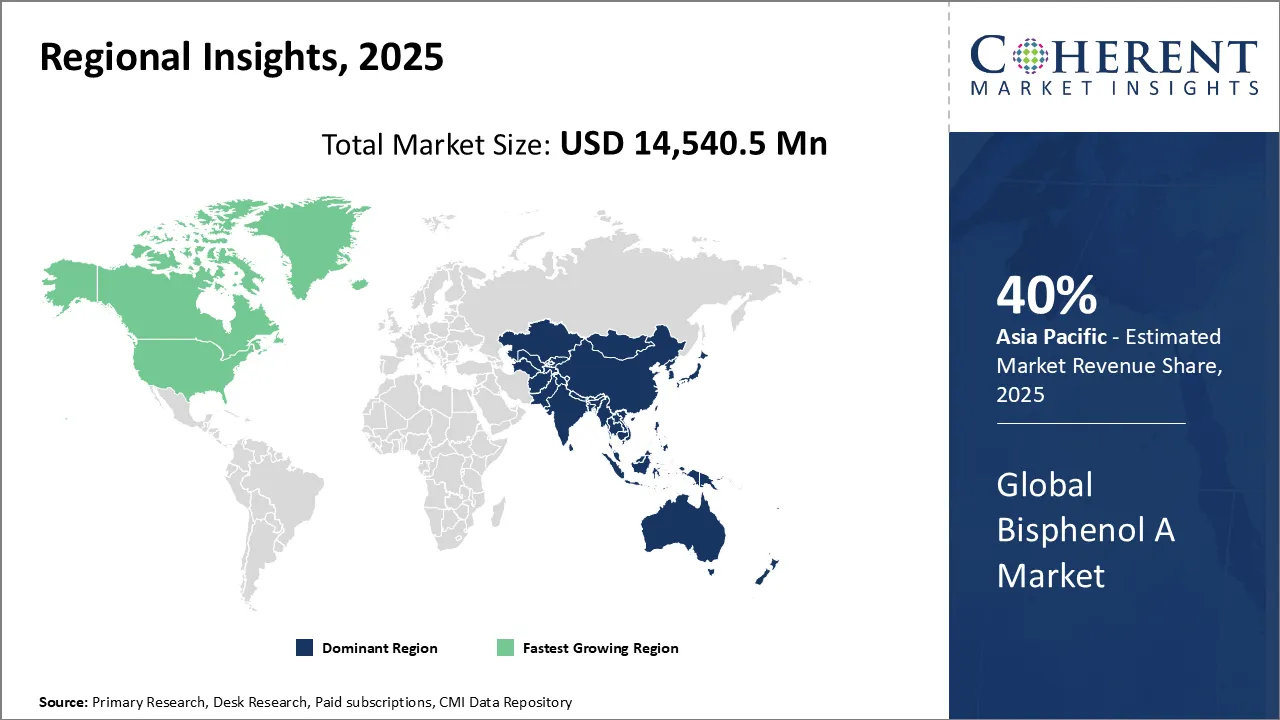
Asia Pacific Bisphenol A Market Trends
The Asia Pacific Bisphenol A (BPA) market dominates the overall market with a share of 40%, driven by expanding automotive, electronics, and packaging sectors, along with increasing urbanization and industrialization. Rising demand for polycarbonate and epoxy resins in consumer goods and construction further fuels this trend. Innovation plays a crucial role; Dr. Jitendra Singh inaugurated the BPA pilot plant at CSIR-NCL, highlighting successful novel process technologies developed under Bulk Chemicals mission programs. These advancements enhance production efficiency and sustainability, strengthening the region’s BPA market amid growing regulatory focus and evolving consumer preferences toward eco-friendly materials. This is further propelling the Bisphenol A market demand.
North America Bisphenol A Market Trends
North America commands a substantial share of 18.4% of the global BPA market, driven by its diversified applications across resilient sectors. In particular, the United States sees strong demand in the automotive sector, where BPA-based polycarbonate plastics are utilized in sunroofs, instrument panels, and headlight lenses—driven by the need for lightweight, energy-efficient vehicles. For instance, in 2024, Mitsubishi Chemical enhanced its BPA production by adopting improved ion exchange resin catalysts, resulting in higher efficiency and quality of high‑purity BPA—critical for polycarbonate and epoxy resin applications—potentially influencing North American supply through improved global product standards and output.
China Bisphenol A Market Trends
China leads global BPA production with massive capacity expansions underway, especially through new plants in Fujian and Jiangsu provinces. Strong demand from automotive, electronics, and construction sectors drives growth. For instance, SABIC’s new Zhangzhou plant, launching in 2026, will add 270,000 tonnes per year to China’s output, reinforcing its market dominance.
India Bisphenol A Market Trends
India’s BPA market is growing steadily, supported by rising demand in automotive and electronics industries seeking lightweight, durable materials. Government-backed investments, like Deepak Chem Tech’s ₹9,000 crore facility in Gujarat, aim to scale up polycarbonate resin production, meeting both domestic and export needs. This expansion is fueling India’s increasing influence in the global BPA landscape.
Market Report Scope
Bisphenol A Market Report Coverage
| Report Coverage | Details | ||
|---|---|---|---|
| Base Year: | 2025 | Market Size in 2026: | USD 15,369.3 Mn |
| Historical Data for: | 2020 To 2024 | Forecast Period: | 2026 To 2033 |
| Forecast Period 2026 to 2033 CAGR: | 5.7% | 2033 Value Projection: | USD 22,655.8 Mn |
| Geographies covered: |
| ||
| Segments covered: |
| ||
| Companies covered: | Chang Chun Group, Mitsui Chemicals, Inc, LG Chem, DOW, Mitsui Chemicals, Inc | ||
| Growth Drivers: |
| ||
| Restraints & Challenges: |
| ||
Global Bisphenol A Market Drivers
- Growing demand for polycarbonate plastics from various industries: The automotive industry, in particular, has been a major driver of the demand for polycarbonate plastics in recent years. With the increasing demand for lightweight and fuel-efficient vehicles, automakers are increasingly turning to polycarbonate plastics as a replacement for traditional materials such as glass and metal. For instance, the automotive sector significantly boosted demand for polycarbonate plastics, driven by the ongoing shift toward lightweight, fuel-efficient vehicle designs. Automakers increasingly adopted polycarbonate materials to replace heavier glass and metal components, enhancing vehicle performance and reducing emissions. This trend was fueled by stricter environmental regulations and consumer demand for greener transportation options, positioning polycarbonate plastics as a critical material in the evolving automotive landscape.
- Increasing demand for epoxy resins from the electronics industry: The electronic industry has indeed been a major contributor to the increasing demand for epoxy resins. Bisphenol A include epoxy resins are widely used in the electronics industry due to their excellent electrical insulation properties, high mechanical strength, and resistance to heat and chemicals. In March 2024, India’s DCM Shriram announced plans to enter the advanced materials sector by establishing a new epoxy resins plant through a greenfield project. Such projects are anticipated to proliferate the bisphenol A market share.
Global Bisphenol A Market Opportunity
Increasing investments in bisphenol A (BPA) are projected to offer significant growth opportunities over the forecast period, driven by rising demand across key end-use industries such as automotive, construction, and electronics. The growing use of BPA in the production of polycarbonate plastics and epoxy resins, which are essential for manufacturing durable and high-performance materials, is expected to further fuel market expansion.
For instance, in July 2024, SABIC began construction of its new BPA production facility in Zhangzhou, Fujian, China, with an annual capacity of 270,000 tons. The plant is expected to begin operations by 2026 and will support the rising demand for BPA-based polycarbonate and epoxy resins in electronics, construction, and automotive sectors. China is leading the global BPA capacity expansion with several large-scale projects underway, accounting for over 90% of upcoming global capacity additions through 2028. Thus, the ongoing and upcoming capacity expansion projects, particularly in Asia, are anticipated to create strong market opportunities for BPA manufacturers.
Bisphenol A Market News
- In January 2025, Mitsui Chemicals and Mitsubishi Chemical disclosed that they are exploring a strategic collaboration concerning phenol-related products, which include BPA. Their joint effort focuses on harmonizing supply during planned maintenance or operational disruptions and optimizing the usage of both companies' storage infrastructure.
Analyst Opinion: Bisphenol A Market
- The global Bisphenol A market faces a complex landscape characterized by contrasting forces shaping its trajectory. Key drivers include robust demand from the automotive and construction industries, where BPA-based polycarbonate plastics and epoxy resins remain essential for lightweight, durable components. The electronics sector continues to fuel growth, particularly in Asia-Pacific regions where manufacturing hubs require high-performance materials for consumer devices and industrial applications.
- However, significant restraints challenge market expansion, primarily stemming from mounting regulatory pressures and health concerns. Stringent environmental regulations across North America and Europe are restricting BPA usage in food contact applications, while growing consumer awareness about potential endocrine disruption effects is driving substitution trends. Major retailers and manufacturers are increasingly adopting "BPA-free" policies, creating additional market constraints.
- Innovation in BPA production technologies offers cost optimization potential, while strategic partnerships between manufacturers and end-users are creating value-added solutions. The fastest-growing demand originates from Southeast Asian markets, where rapid urbanization and industrial expansion continue driving consumption. Market players are adapting through product diversification, geographical expansion, and sustainable manufacturing practices to navigate this evolving landscape effectively.
Speak to the analyst
Want personalized insights?
Take the findings above to one of our principal consultants, or have the report rebuilt around the segments, geographies and competitors you actually track.
Market Segmentation
- Global Bisphenol A Market, By Application (Revenue, USD Mn, 2021 - 2033)
- Polycarbonate Resins
- Epoxy Resins
- Unsaturated Polyester Resins
- Flame Retardants
- Other Applications
- Global Bisphenol A Market, By Geography (Revenue, USD Mn, 2021 - 2033)
- North America
- U.S.
- Canada
- Latin America
- Brazil
- Argentina
- Mexico
- Rest of Latin America
- Europe
- Germany
- U.K.
- Spain
- France
- Italy
- Russia
- Rest of Europe
- Asia Pacific
- China
- India
- Japan
- Australia
- South Korea
- ASEAN
- Rest of Asia Pacific
- Middle East
- GCC Countries
- Israel
- Rest of Middle East
- Africa
- South Africa
- North Africa
- Central Africa
- North America
- Global Bisphenol A Market Key Companies Insights (Revenue, USD Mn, 2021 - 2033)
- Chang Chun Group
- Mitsui Chemicals, Inc.
- LG Chem.
- DOW
Sources
Primary Research Interviews
- Chemical manufacturing executives and production managers
- Raw material suppliers and distributors
- End-user industry representatives (automotive, electronics, packaging)
- Regulatory affairs specialists and environmental consultants
- Others
Databases
- Plastics Industry Trade Database
- Others
Magazines
- Chemical & Engineering News
- Plastics Technology Magazine
- Chemical Processing Magazine
- European Chemical News
- Others
Journals
- Journal of Applied Polymer Science
- Chemical Engineering Journal
- Industrial & Engineering Chemistry Research
- Others
Newspapers
- Chemical Week
- ICIS Chemical Business
- Plastics News
- Chemical Industry Digest
- Others
Associations
- American Chemistry Council (ACC)
- Society of Plastics Engineers (SPE)
- European Chemical Industry Council (CEFIC)
- Plastics Industry Association
- Others
Public Domain Sources
- U.S. Environmental Protection Agency (EPA) reports
- European Chemicals Agency (ECHA) database
- World Health Organization (WHO) publications
- OECD Chemical Safety Reports
- Others
*Definition: Bisphenol A is an organic chemical that is used in the production of polycarbonate plastics, epoxy resins, and other polymeric materials. Polycarbonate plastics are used in a variety of products including plastic containers for food and beverages, microwave ovens, and cookware. Bisphenolic resins are also used as protective linings for food cans.
Get access to 250+ pages report
Every segment, forecast, competitor profile and data table behind the analysis above — available for instant download.
- ESOMAR Member
- ISO 9001:2015 Certified
- D-U-N-S Registered
- GDPR & CCPA Compliant
Missing comfort of reading report in your local language? Find your preferred language:
Transform your Strategy with Exclusive Trending Reports
Frequently Asked Questions
The Bisphenol A Market is estimated to be valued at USD 15,369.3 Mn in 2026, and is expected to reach USD 22,655.8 Mn by 2033.
The CAGR of the Bisphenol A Market is projected to be 5.7% from 2026 to 2033.
The growing demand for polycarbonate plastics from a wide range of industries and the increasing demand for epoxy resins from the electronics industry are fuelling the growth of the market.
The polycarbonate resins segment is the leading component segment in the market.
Increasing regulations on the usage of BPA and increasing environmental issues are the major factors restraining growth of the market.
The key players operating in the market are Chang Chun Group, Mitsui Chemicals, Inc, LG Chem, DOW.