

Polyurethane Adhesives Market Size and Share Analysis- 2026 To 2033
The Polyurethane Adhesives Market size is anticipated to grow at a CAGR of 5.8%, with USD 9.68 Bn in 2026 and is expected to reach approximately USD 14.38 Bn in 2033. The primary drivers are largely defined by the growing use of polyurethane adhesives in automotive and transportation assembly, increasing construction applications, rising adoption of mixed-material bonding, and demand for high-strength yet flexible adhesive solutions. According to 3M, polyurethane reactive adhesives combine rapid handling strength with high final structural strength, while offering flexibility, resistance to temperature extremes, and strong adhesion to substrates such as metals, glass, wood, and selected plastics, supporting their adoption across industrial bonding applications.
Key Takeaways
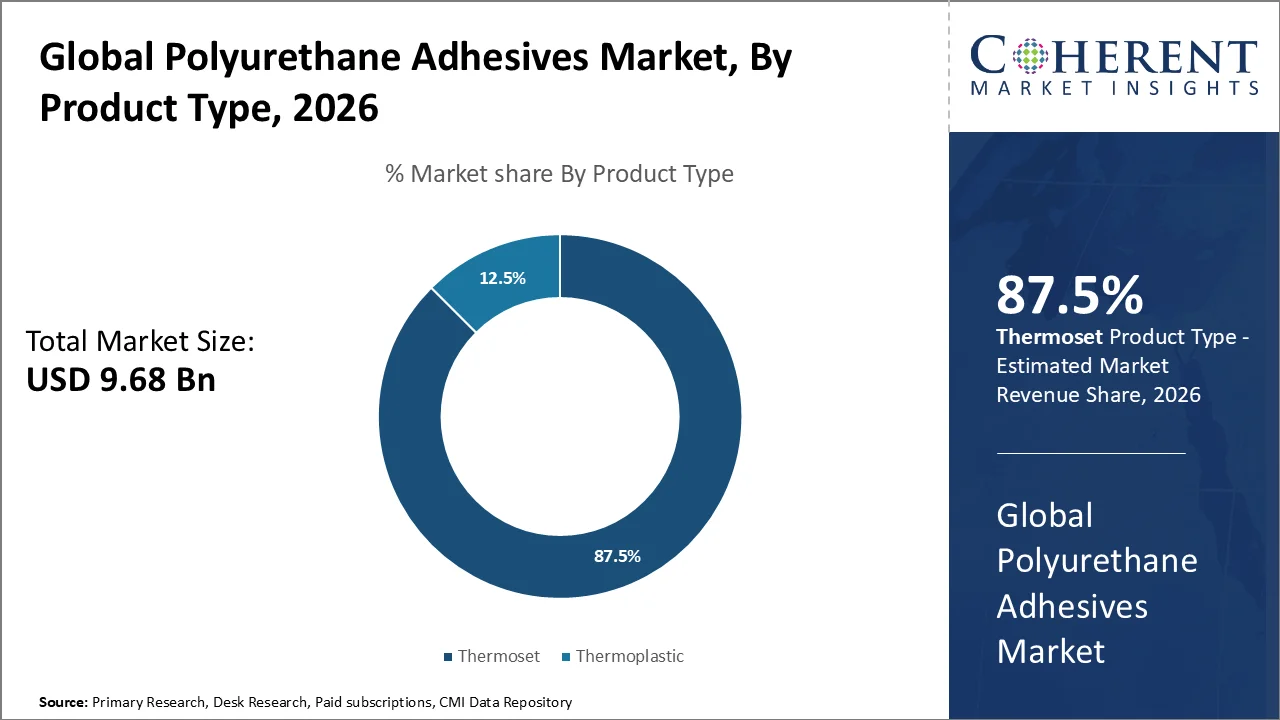
- The thermoset segment is likely to dominate the market with approximately 87.5% in 2026. The segment’s growth is owing to its high bond strength, dimensional stability, chemical resistance, and ability to form durable cross-linked bonds across construction, automotive, furniture, and industrial assembly applications.
- The reactive technology segment is expected to lead with approximately 32.5% in 2026. The segment’s growth is owing to the increasing preference for moisture-curing, solvent-free, high-strength adhesive systems across furniture, packaging, construction, and industrial assembly. Henkel’s latest polyurethane reactive hot-melt systems contain less than 0.1% monomeric isocyanate, can reduce isocyanate vapors by up to 90%, and certain grades provide temperature resistance of up to 150°C, highlighting ongoing improvements in both performance and occupational safety.
- The building & construction segment is expected to account for the leading share of approximately 36.5% in 2026. The segment’s growth is owing to the increasing use of polyurethane adhesives in flooring, roofing, insulation panels, façade components, woodworking, subfloor installation, and bonding of dissimilar construction materials. Supporting infrastructure demand, the Government of India allocated INR 11.21 lakh crore toward capital expenditure in FY2025-26, equivalent to 3.1% of GDP, while effective capital expenditure was estimated at ₹15.48 lakh crore.
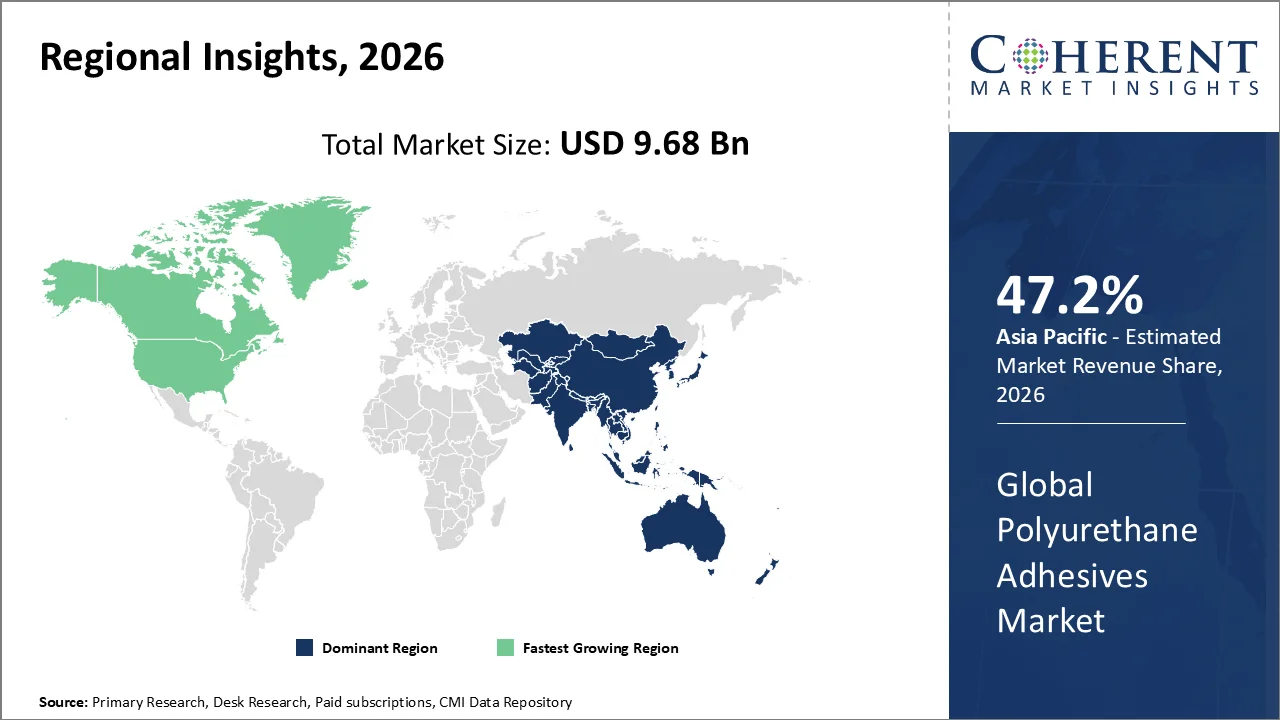
- Asia Pacific is expected to acquire the prominent share of approximately 47.2% in 2026. The region’s growth is owing to large-scale automotive manufacturing, infrastructure development, electronics production, footwear manufacturing, flexible packaging demand, and expanding adhesive production capacity across China, India, Japan, South Korea, and Southeast Asia. According to OICA, Asia-Pacific produced approximately 59.2 million vehicles in 2025, representing more than 61% of global vehicle production, while China alone produced 34.53 million vehicles; Chinese new-energy vehicle production reached 16.63 million units, increasing 29% year-on-year.
Market Drivers
Rapid Growth of Electric Vehicles and Multi-Material Bonding is Driving Polyurethane Adhesives Demand
The Polyurethane Adhesives Market is gaining strong momentum from the rapid transition toward electric vehicles and lightweight automotive structures. Modern EVs require high-performance adhesives for battery-pack assembly, structural bonding, interior lamination, thermal-management components, and joining dissimilar materials such as metals, composites, and plastics.
Covestro notes that the current use of modern automotive polyurethane adhesive solutions in EV battery-pack assembly is an example of structural adhesives supporting the safety and durability of the battery. The company also supplies polyurethane raw materials for thermally conductive structural adhesives, gap fillers and sealants used in EV battery assembly.
Expanding Construction and Infrastructure Investment is Accelerating Polyurethane Adhesive Consumption
Rising investment in infrastructure, commercial buildings, housing, flooring, roofing and prefabricated construction is driving demand for polyurethane adhesives. Polyurethane chemistry is especially ideal for demanding construction bonding applications because of its high adhesion to concrete, wood, ceramics, metals, masonry and insulation materials, and its flexibility, water resistance and weatherability.
Sika identifies polyurethane as a preferred technology for demanding construction bonding due to its combination of strength, flexibility, and durability. Its polyurethane construction adhesives are used on cement-based materials, brick, ceramics, glass, metals, and wood, while selected systems provide waterproof bonding and remain permanently elastic after curing. Increasing adoption of modular construction, insulation systems, and mixed-material building components is therefore widening the application base for polyurethane adhesives.
Current Events and Their Impact on the Polyurethane Adhesives Market
Current Event | Description and its Impact |
EU Packaging and Packaging Waste Regulation (PPWR) Enters into Application (August 2026) |
|
U.S. EPA Finalizes New Air-Toxics Standards for Polyether Polyol Production (March 2026) |
|
- Current Industry Events of 2026
- Market Size Estimation
- Regional Breakdown
- Competitive Landscape
- Customer Intelligence
- Segmental Analysis
- Pricing Analysis
- Key Market Drivers, Challenges & Future Trends
- Customized Insights Section
Segmental Insights
Why is the Thermoset Segment Acquiring the Largest Share?
On the basis of product type, the thermoset segment is projected to account for the largest Polyurethane Adhesives Market share of approximately 87.5% in 2026. The segment’s dominance is owing to its high final bond strength, chemical and moisture resistance, dimensional stability, and ability to retain bonding performance under elevated temperatures across automotive, electronics, furniture, construction, and industrial assembly applications.
Covestro presented its thermoset polyurethane adhesive film Bayfol LR 5902, which is activated at processing temperatures of above 90°C (194°F) and then cures via an irreversible cross-linking reaction. The resultant bond will withstand high and low temperatures, abrasive chemicals and long exposure to water. This allows thermoset polyurethane systems to be used in demanding structural applications.
In April 2026, Henkel launched TECHNOMELT PUR 9015 BV/WV, a new polyurethane hot-melt formulation for bonding glass and large appliance panels. The adhesive provides high initial strength, resistance to creep at 40°C, an open time of approximately 2.5–8 minutes, and high thermal resistance while supporting automated dispensing.
Why is Reactive Technology Acquiring the Largest Share?
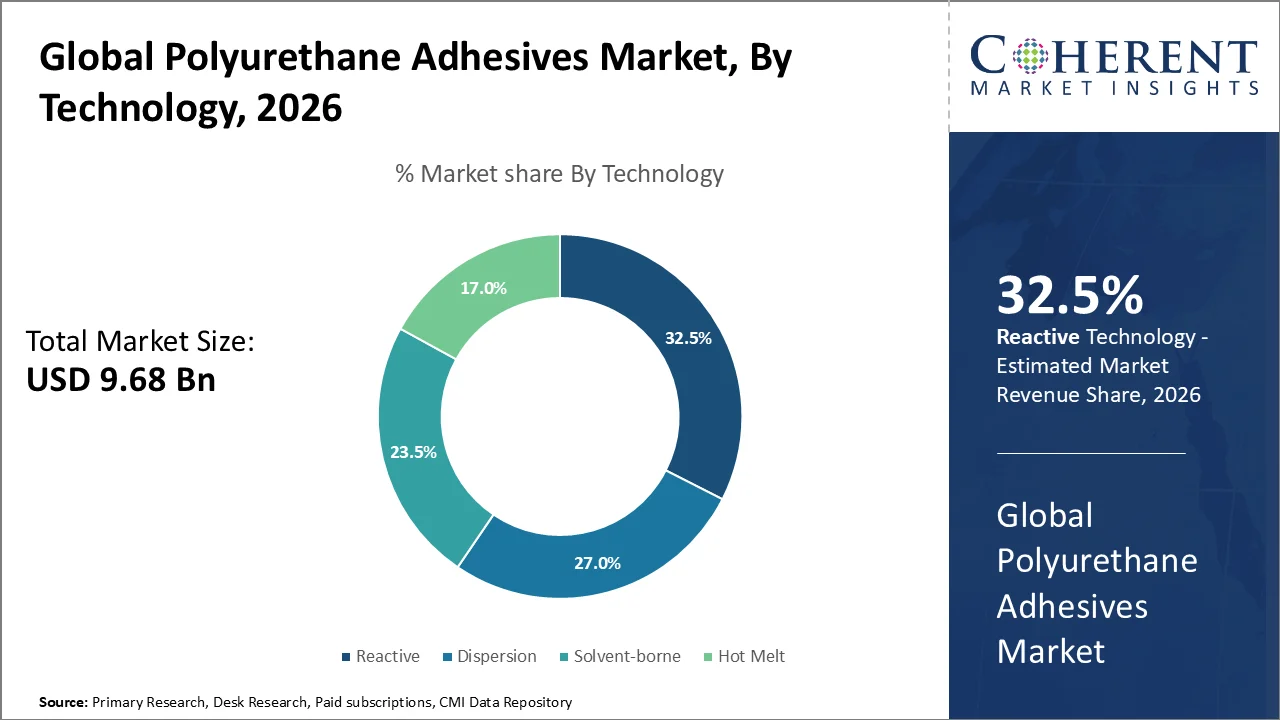
On the basis of technology, the reactive segment is expected to lead the Polyurethane Adhesives Market with approximately 32.5% in 2026. The segment’s growth is owing to its high final bond strength, moisture-curing capability, solvent-free processing, resistance to heat and chemicals, and growing adoption in woodworking, automotive interiors, furniture, panels, packaging, and industrial lamination.
Henkel's TECHNOMELT® PUR 270/9 ME demonstrates how reactive polyurethane technology is evolving toward safer and lower-emission formulations. The adhesive has an isocyanate monomer content of less than 0.1%, and is capable of reducing isocyanate vapors by up to 90% while maintaining temperature resistance up to 150°C (302°F), and high final bond strength.
In April 2025 Sika launched SikaWall-3000 Rapid Bond, a new one-component polyurethane foam adhesive for Exterior Insulation and Finish Systems (EIFS). The product was developed to allow quick setting and durable adhesion, and to reduce installation time.
Why is Building & Construction Holding the Largest Market Share?
On the basis of end-use industry, the building & construction segment is expected to account for the largest Polyurethane Adhesives Market share of approximately 36.5% in 2026. The segment’s dominance is owing to extensive polyurethane adhesive usage in insulation panels, flooring, roofing, façades, doors and windows, engineered wood, prefabricated structures, and bonding of concrete, metals, wood, plastics, and composite building materials.
In July 2026, U.S. construction spending was at a seasonally adjusted annual rate of USD 2.16 trillion, of which USD 859.0 billion was residential construction and USD 755.2 billion was private nonresidential construction. This large construction base facilitates continued consumption of polyurethane adhesives in flooring, insulation panels, roofing, doors, windows, façades and engineered wood applications.
In July 2025, Johns Manville launched JM QuickFoam Adhesive, a two-part, low-rise polyurethane foam roofing adhesive for attaching insulation boards, cover boards and fleece-backed roofing membranes.
Polyurethane Adhesives Market Trends
- As multifunctional thermally conductive polyurethane adhesives continue to develop, their role is expanding beyond traditional bonding into applications such as EV batteries, power electronics, and high-heat assemblies. In May 2026, ITW Performance Polymers launched Plexus DT2430 and DT2630LD polyurethane structural adhesives with thermal conductivities of around 1.1 W/mK and 2.0 W/mK, respectively.
- An increasing trend toward bio-based and lower carbon polyurethane adhesive formulations is decreasing dependency on conventional fossil-derived feedstocks. Henkel’s TECHNOMELT PUR 6260 ECO, launched in November 2025, is made from at least 60% renewable and recycled raw materials, has a 40% lower product carbon footprint than the conventional version and 15°C lower processing temperatures.
- Designing polyurethane adhesives for automotive, electronics, appliances and other durable goods is being transformed by a growing focus on debonding-on-demand and adhesive-enabled recyclability. In April 2025, Evonik introduced a debonding concept compatible with polyurethane adhesive systems that can be activated across a temperature range of approximately 80°C to 150°C, supporting material separation, repair, and recycling.
Regional Insights
Asia Pacific Dominates Owing to the Large Manufacturing Base and Rapid Industrial Expansion
Asia Pacific is expected to account for the prominent 47.2% share of the Polyurethane Adhesives Market in 2026. The region’s dominance is owing to its large automotive manufacturing base, expanding construction activity, electronics production, footwear manufacturing, flexible packaging, and growing consumption of polyurethane-based bonding systems across China, India, Japan, South Korea, and Southeast Asia.
Moreover, India proposed INR 12.2 lakh crore in public capital expenditure for FY2026-27, compared with INR 11.2 lakh crore in FY2025-26. Continued investment in transport infrastructure, urban development, industrial facilities, and housing is further supporting consumption of polyurethane adhesives in flooring, insulation, panels, roofing, engineered wood, and other construction applications.
North America Polyurethane Adhesives Market Trends
North America is expected to witness the fastest growth in the Polyurethane Adhesives Market over the forecast period. The region’s growth is supported by expansion of EV and battery manufacturing, advanced industrial assembly, renovation and construction activity, and increasing demand for high-performance structural and thermally conductive adhesives.
In August 2026, the U.S. Department of Energy announced USD 500 million for seven projects aimed at expanding domestic critical-material processing, battery manufacturing, and recycling capacity.
Strong Automotive, Flexible Packaging, and Industrial Manufacturing Base is Supporting the Polyurethane Adhesives Market in the United States
The U.S. Polyurethane Adhesives Market is witnessing a steady growth owing to the large automotive, aerospace, flexible packaging, electronics and advanced manufacturing industries in the country. Polyurethane adhesives are increasingly used for structural bonding, interior assemblies, flexible laminates, insulation, composite components and applications requiring flexibility and resistance to vibration.
According to the International Organization of Motor Vehicle Manufacturers (OICA) says the U.S. made about 10.24 million vehicles and sold 16.7 million vehicles in 2025. The large automotive manufacturing base continues to drive demand for polyurethane structural and assembly adhesives.
According to the Flexible Packaging Association in April 2026, the U.S. flexible packaging industry’s USD 42.6 billion in annual sales in 2024, rose 2.9% from USD 41.4 billion in 2023. The growing scale of flexible packaging supports consumption of solvent-free and reactive polyurethane laminating adhesives used in multilayer food, pharmaceutical, and consumer-product packaging.
China Polyurethane Adhesives Market Trends
China is expected to remain one of the most significant markets for polyurethane adhesives owing to its massive automotive, electronics, appliance, footwear, packaging, and industrial manufacturing ecosystem. High production volumes of new-energy vehicles and electronic components are increasing requirements for structural bonding, battery assembly, lamination, thermal-management components, and precision adhesive applications.
China's National Bureau of Statistics said new-energy vehicle production was about 8.95 million units in Jan-July 2026, up 9.5% year-on-year. In July 2026 alone, NEV output hit roughly 1.55 million units, up 29.9% year-on-year. This expanding EV manufacturing base is supporting demand for polyurethane adhesives in battery packs, interiors, composite parts, lightweight assemblies, and thermal-management systems.
Who are the Major Companies in Polyurethane Adhesives Industry
Some of the major key players in Polyurethane Adhesives Market include Huntsman Corporation, 3M, Sika AG, Ashland Inc., Arkema S.A., H.B. Fuller, Illinois Tool Works Inc., Henkel AG & Co. KGaA, Scott Bader Company Ltd., and The Dow Chemical Company.
Key News
- In May 2026, Henkel launched LOCTITE TLB 9270APS, a two-component polyurethane-based thermally conductive adhesive developed for next-generation EV battery systems.
- In March 2025, Huntsman announced ISCC PLUS certification for its polyurethane production sites in Jinshan, China and Osnabrück, Germany. The certified TPU materials are used across automotive, footwear, films, and specialized industrial applications and can also serve as raw materials for adhesive formulations, supporting greater adoption of circular and mass-balance polyurethane feedstocks within the adhesive value chain.
Market Report Scope
Polyurethane Adhesives Market Report Coverage
| Report Coverage | Details | ||
|---|---|---|---|
| Base Year: | 2025 | Market Size in 2026: | USD 9.68 Bn |
| Historical Data for: | 2020 To 2024 | Forecast Period: | 2026 To 2033 |
| Forecast Period 2026 to 2033 CAGR: | 5.8% | 2033 Value Projection: | USD 14.38 Bn |
| Geographies covered: |
| ||
| Segments covered: |
| ||
| Companies covered: | Huntsman Corporation, 3M, Sika AG, Ashland Inc., Arkema S.A., H.B. Fuller, Illinois Tool Works Inc., Henkel AG & Co. KGaA, Scott Bader Company Ltd., and The Dow Chemical Company. | ||
| Growth Drivers: |
| ||
| Restraints & Challenges: |
| ||
Analyst Opinion
- The Polyurethane Adhesives Market is witnessing a move away from traditional bonding products toward high-performance structural adhesive systems for engineered wood, prefabricated construction, and load-bearing structures. Henkel said that adoption of polyurethane technology in structural timber construction is increasing, and that its LOCTITE HB S ECO polyurethane adhesive can help reduce the CO₂ footprint per kilogram of adhesive by up to 60%.
- Sustainability is becoming a core requirement, not a niche differentiator, in the adhesives industry in product development. For example, in June 2026, H.B. Fuller announced that close to 60% of its new product development is focused on improving the sustainability profile of end products of its customers.
- Strategic consolidation and manufacturing expansion by major adhesive producer’s signal confidence in the long-term value of specialized bonding technologies. Sika announced in February 2026 that it was acquiring Akkim, a Turkish adhesives and sealants company with sales of around CHF 220 million in 2025.
Speak to the analyst
Want personalized insights?
Take the findings above to one of our principal consultants, or have the report rebuilt around the segments, geographies and competitors you actually track.
Market Segmentation
- By Product Type (Revenue, USD Bn, 2021-2033)
- Thermoplastic
- Thermoset
- By Technology (Revenue, USD Bn, 2021-2033)
- Dispersion
- Solvent-borne
- Reactive
- Hot Melt
- By End Use Industry (Revenue, USD Bn, 2021-2033)
- Building & Construction
- Electrical & Electronics
- Packaging
- Automotive
- Furniture
- Footwear
- By Region (Revenue, USD Bn, 2021-2033)
- North America
- U.S.
- Canada
- Latin America
- Brazil
- Mexico
- Argentina
- Rest of Latin America
- Europe
- Germany
- U.K.
- France
- Italy
- Spain
- Russia
- Rest of Europe
- Asia Pacific
- China
- India
- Japan
- Australia
- South Korea
- ASEAN
- Rest of Asia Pacific
- Middle East
- GCC
- Israel
- Rest of Middle East
- Africa
- South Africa
- Central Africa
- North Africa
- North America
Sources
Primary Research Interviews
- Polyurethane adhesive manufacturers and formulators
- Polyurethane raw material and isocyanate suppliers
- Adhesive technology and application engineers
- R&D and product development managers
- Automotive and EV component manufacturers
- Construction material and insulation manufacturers
- Packaging converters and laminators
- Furniture, footwear, and industrial product manufacturers
- Distributors and specialty chemical suppliers
- Procurement managers and technical decision-makers across key end-use industries
Databases
- World Bank
- Organisation for Economic Co-operation and Development (OECD)
- United Nations Industrial Development Organization (UNIDO)
- UN Comtrade Database
- Eurostat
- U.S. Census Bureau
- U.S. Environmental Protection Agency (EPA)
- National Bureau of Statistics of China
Magazines
- Adhesives & Sealants Industry (ASI)
- European Coatings Journal
- Coatings World
- Chemical & Engineering News
- Chemical Week
- Packaging Europe
- Construction World
Journals
- International Journal of Adhesion and Adhesives
- Journal of Adhesion Science and Technology
- The Journal of Adhesion
- Polymer Testing
- Progress in Organic Coatings
- Polymer Engineering & Science
- Journal of Applied Polymer Science
Newspapers
- The Wall Street Journal
- Financial Times
- Reuters
- Bloomberg
- The Economic Times
- China Daily
Associations
- Adhesive and Sealant Council (ASC)
- FEICA – Association of the European Adhesive & Sealant Industry
- Center for the Polyurethanes Industry (CPI)
- American Chemistry Council (ACC)
- European Diisocyanate and Polyol Producers Association (ISOPA)
- Polyurethane Foam Association (PFA)
- European Association of Flexible PU Foam Blocks Manufacturers (EUROPUR)
- International Organization of Motor Vehicle Manufacturers (OICA)
Public Domain Sources
- Company Annual Reports and Investor Presentations
- Product Data Sheets and Technical Data Sheets from Adhesive Manufacturers
- Company Press Releases and Product Launch Announcements
- Government Construction and Manufacturing Statistics
- Environmental and Chemical Regulatory Publications from EPA, ECHA, and European Commission
- Patent Databases including WIPO, USPTO, EPO, and Google Patents
- Import–Export and International Trade Statistics
- Automotive, Packaging, Construction, and Industrial Production Data
- Sustainability Reports and Product Carbon Footprint Disclosures
Proprietary Elements
- CMI Data Analytics Tool
- Proprietary CMI Existing Repository of Information for the Last 10 Years
Get access to 250+ pages report
Every segment, forecast, competitor profile and data table behind the analysis above — available for instant download.
- ESOMAR Member
- ISO 9001:2015 Certified
- D-U-N-S Registered
- GDPR & CCPA Compliant
Missing comfort of reading report in your local language? Find your preferred language:
Transform your Strategy with Exclusive Trending Reports
Frequently Asked Questions
The Polyurethane Adhesives Market is expected to reach approximately USD 14.38 Bn in 2033, compared with USD 9.68 Bn in 2026.
Major players operating in the Polyurethane Adhesives Market include Huntsman Corporation, 3M, Sika AG, Ashland Inc., Arkema S.A., H.B. Fuller, Illinois Tool Works Inc., Henkel AG & Co. KGaA, Scott Bader Company Ltd., and The Dow Chemical Company.
Volatility in polyurethane raw material prices and stringent VOC and isocyanate regulations are the major factors hampering market growth.
The increasing adoption of polyurethane adhesives in building & construction applications and rising demand for lightweight and multi-material bonding in automotive and electric vehicles are driving market growth.
The Polyurethane Adhesives Market is anticipated to grow at a CAGR of approximately 5.8% between 2026 and 2033.
Asia Pacific is expected to dominate the Polyurethane Adhesives Market, accounting for approximately 47.2% of the global market share in 2026.
Polyurethane adhesives are bonding materials based on polyurethane chemistry that provide high bond strength, flexibility, vibration resistance, moisture resistance, and adhesion to materials such as metals, wood, glass, plastics, ceramics, and composites.