

Foam Blowing Agents Market Size and Forecast — 2026 - 2033
The Global Foam Blowing Agents Market size is estimated to be valued at USD 1.32 billion in 2026 and is expected to reach USD 2.17 billion by 2033, exhibiting a compound annual growth rate (CAGR) of 7.1% from 2026 to 2033.
Overview
Foam blowing agents are substances used to create a cellular (foam) structure in materials such as polyurethane, polystyrene, and polyethylene foams. They work by generating gas—either through chemical reactions or physical evaporation—that forms bubbles within a polymer during processing. As the material solidifies, these bubbles become trapped, creating a lightweight, insulating foam. Blowing agents can be chemical (e.g., azodicarbonamide) or physical (e.g., hydrocarbons, carbon dioxide, hydrofluorocarbons). They play a crucial role in industries like construction, automotive, packaging, and refrigeration by improving thermal insulation, reducing weight, and enhancing cushioning properties while optimizing material usage and energy efficiency.
Key Takeaways
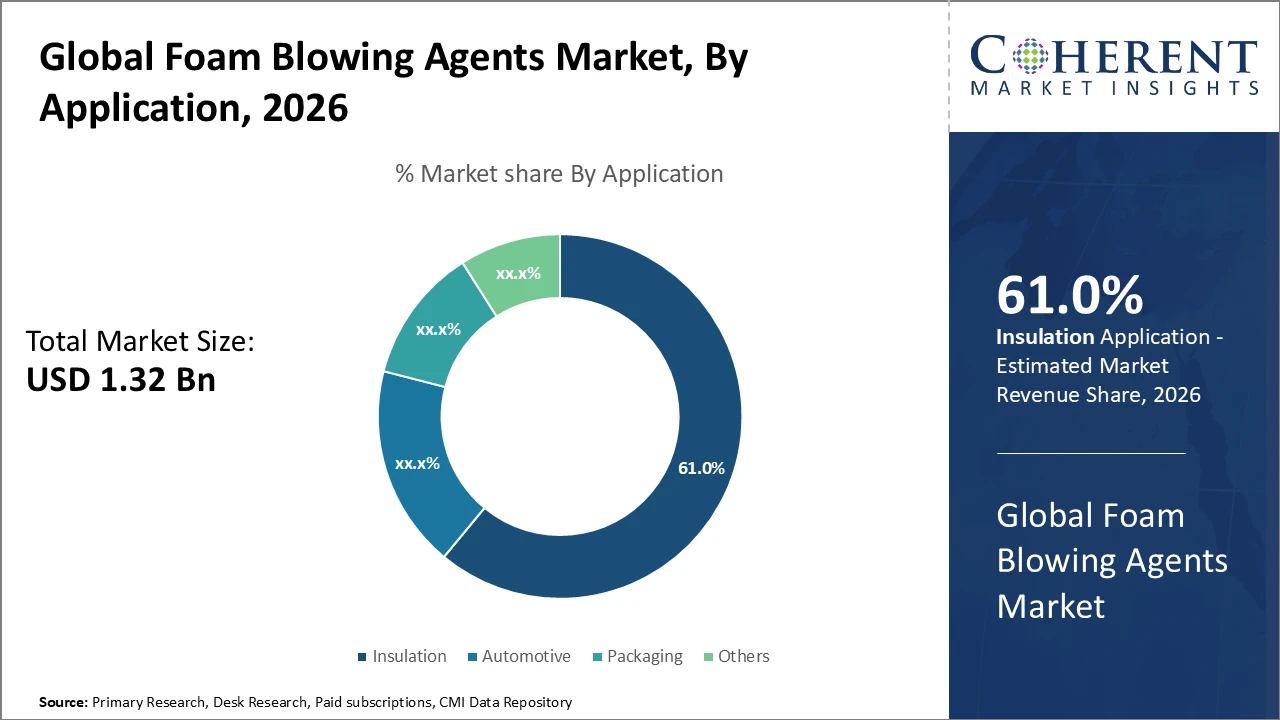
The insulation application segment dominates the foam blowing agents market with 61% industry share, driven by rising demand for energy-efficient construction materials reflecting market trends toward sustainability. Automotive applications are the fastest growing segment, fueled by stringent fuel efficiency standards pushing lightweight foam materials adoption.
Hydrofluoroolefins (HFO) represent the leading type segment with 42% share, driven by regulatory bans on HCFCs and growing environmental awareness; methyl formate types exhibit considerable growth due to their low toxicity and biodegradability.
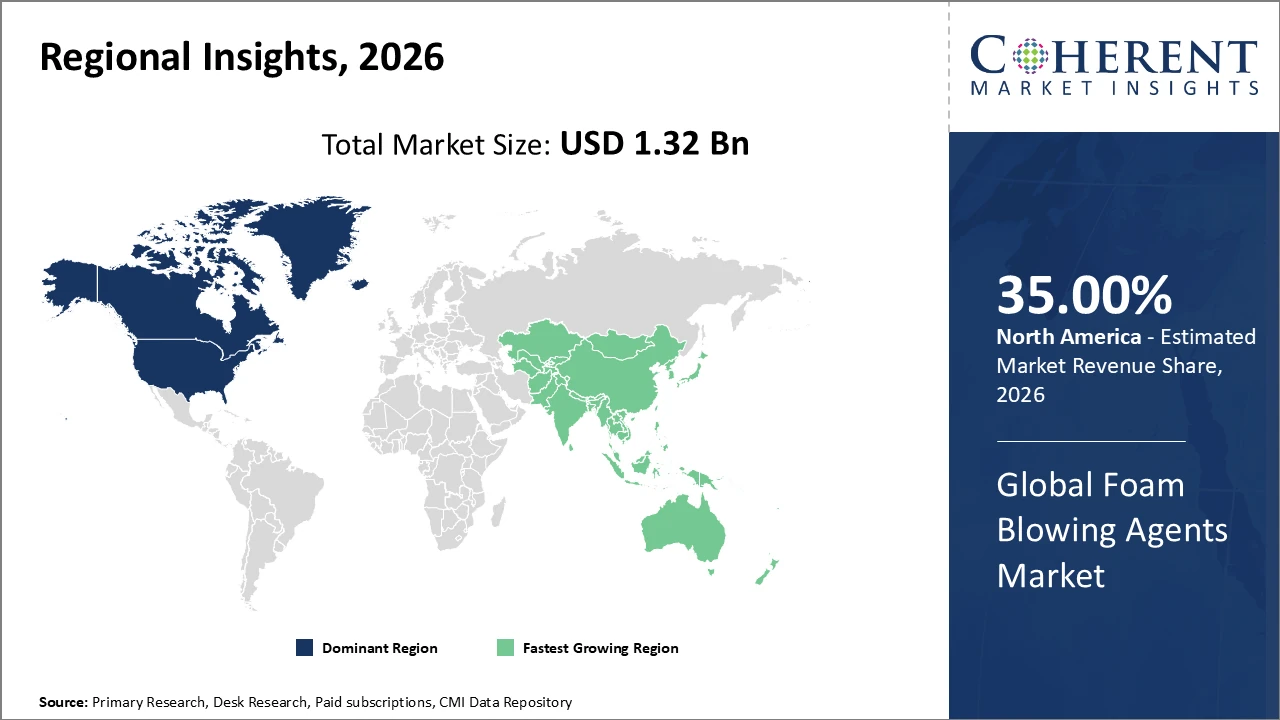
North America holds a commanding position, contributing over 35% to the global foam blowing agents revenue, supported by stringent emission policies and advanced manufacturing infrastructure. Asia Pacific is the fastest-growing region, exhibiting a CAGR of around 9% due to increased construction activity and expanding automotive production in China and India.
Europe maintains steady growth supported by regulatory incentives for low-GWP alternatives and rising R&D investments targeting innovative foam technologies, ensuring market sustainability and future business growth.
Foam Blowing Agents Market Segmentation Analysis
Foam Blowing Agents Market Insights, By Application
Insulation remains the dominant segment in the foam blowing agents market due to strong demand for energy-efficient building materials. Governments worldwide have implemented stringent building codes promoting high-performance insulating foams that utilize low-GWP blowing agents, solidifying insulation as the primary revenue contributor. The fastest-growing segment is automotive, driven by the need for lightweight components that meet evolving fuel efficiency and emission regulations, with advancements in polymer foam technologies further supporting adoption. Packaging applications use blowing agents in cushioning and protective foams; while smaller in volume, growing e-commerce activity sustains steady expansion. Other applications, including furniture and bedding, primarily focus on comfort solutions and contribute modestly but consistently to overall market demand.
Foam Blowing Agents Market Insights, By Type
Hydrofluoroolefins (HFO) dominate the foam blowing agents market due to their low global warming potential (GWP) and strong regulatory compliance, making them the preferred choice for insulation and automotive applications. Their expanding production capacity and improving cost-effectiveness align closely with environmental mandates, supporting significant market share growth. The fastest-growing subsegment is methyl formate, valued for its biodegradability and lower toxicity, with increasing adoption particularly across Europe and Asia. Meanwhile, hydrofluorocarbons (HFCs) continue to see moderate usage in regions where transitional regulations permit, although their share is steadily declining due to phase-down policies. Hydrochlorofluorocarbons (HCFCs) are legacy agents undergoing regulatory phase-out and are now confined to limited specialty applications. The “others” category includes emerging bio-based and experimental blowing agents in early development stages, representing potential future innovations but currently holding minimal influence in the overall market.
Foam Blowing Agents mixture Market Insights, By End-Use Industry
Construction holds the dominant market share in the foam blowing agents market due to the extensive use of insulation foams in commercial and residential buildings, supported by global sustainability initiatives and renovation projects focused on improving energy efficiency. The fastest-growing subsegment is automotive, reflecting the industry-wide transition toward lightweight and fuel-efficient vehicle designs that require advanced foam materials. Rising R&D investments and the adoption of environmentally friendly blowing agents in automotive interiors and cushioning further accelerate this growth. Furniture and bedding represent a stable but comparatively slower-growing segment, driven by demand for flexible foams used in comfort applications. Packaging end-users have witnessed incremental expansion, supported by increased need for protective packaging amid evolving global supply chains. Other end-use industries, including refrigeration and appliances, use foam blowing agents for insulation purposes, contributing modest yet steady demand to the overall market.
Foam Blowing Agents Market Trends
Emerging trends in the foam blowing agent market highlight a strong shift toward sustainable chemicals with low global warming potential (GWP), reflecting global climate commitments and environmental regulations.
Hydrofluoroolefins (HFOs) have gained significant dominance since 2024, primarily due to regulatory mandates such as the American Innovation and Manufacturing Act in the United States and the EU F-Gas Regulation in Europe, which mandate the phasedown of HCFCs and HFCs.
These regulatory frameworks are accelerating demand for next-generation blowing agents that balance high performance with improved environmental profiles, encouraging rapid industry transition.
Technological advancements, including AI-driven process automation in foam production, are improving operational efficiency, optimizing formulation precision, and reducing material waste across manufacturing facilities.
A major manufacturer reported approximately a 20% improvement in production efficiency in 2026 through advanced automation and digital process integration, highlighting the tangible benefits of smart manufacturing adoption.
Foam Blowing Agents Market Insights, By Geography
North America Foam Blowing Agents Market Analysis and Trends
In North America, dominance in the foam blowing agents market is largely driven by advanced regulatory frameworks such as the American Innovation and Manufacturing Act, which promotes the transition toward low-global-warming-potential blowing agents, particularly HFOs. The region holds over 35% of the industry share, supported by major automotive manufacturers increasingly adopting lightweight insulation materials to meet fuel efficiency and emission standards, along with substantial investments in sustainable chemical production. Leading companies including Chemours and Honeywell continue to drive technological innovation and expand production capacities, reinforcing their competitive positions within this high-value regional market.
Asia Pacific Foam Blowing Agents Market Analysis and Trends
Meanwhile, Asia Pacific is the fastest-growing market for foam blowing agents, recording a CAGR of approximately 9%, driven by rapid urbanization and industrialization in China and India. Expanding infrastructure projects, along with the automotive sector’s increasing demand for lightweight components, have significantly boosted foam blowing agent consumption. Collaborations between local manufacturers on regulatory compliance and technological innovation, coupled with investments from multinational companies, further support this strong growth trajectory, positioning the region as a critical hub in the global foam blowing agents market.
Foam Blowing Agents Market Outlook for Key Countries
USA Foam Blowing Agents Market Analysis and Trends
The U.S. market serves as a cornerstone for growth in the foam blowing agents sector, propelled by regulatory mandates such as the American Innovation and Manufacturing Act, which target the phasedown of high-global-warming-potential substances. Production capacity for environmentally friendly agents has steadily increased, with HFO facilities expanding by 25% in 2025 alone. Leading chemical manufacturers, including Chemours and Honeywell, collaborate closely with the automotive and construction sectors to provide tailored, sustainable foam solutions that comply with evolving emission standards, establishing the U.S. as a hub of technological innovation within the global foam blowing agents landscape.
Germany Foam Blowing Agents Market Analysis and Trends
The Germany foam blowing agents market is characterized by steady growth, driven by stringent environmental regulations and strong demand for energy-efficient construction materials. Low-GWP blowing agents, particularly HFOs and methyl formate, are increasingly adopted in insulation, automotive, and packaging applications. Regulatory incentives under the EU F-Gas Regulation promote the phase-down of HCFCs and HFCs, encouraging sustainable alternatives. Automotive lightweighting initiatives and rising green building standards further support market expansion. Key domestic and multinational players focus on R&D and technological innovation to enhance foam performance while reducing environmental impact. Growth is reinforced by collaborations and investment in advanced, eco-friendly production facilities.
Analyst Opinion
The rising adoption of HFO-based foam blowing agents is a key market driver, reflecting supply-side dynamics. Production capacity for HFO compounds increased by approximately 25% in 2025, supported by expansions in North American and European manufacturing hubs. Pricing trends saw moderate upward movement between 2024 and 2026 due to raw material volatility but remained competitive against legacy agents like HCFCs, aligning with efforts to phase out high-GWP substances.
Demand-side trends indicate diversification in applications. Insulation maintains dominance with over 60% market share in 2026, while automotive lightweighting and packaging sectors drove incremental import growth, particularly in Asia Pacific, where imports outpaced local production by nearly 15% in 2025, highlighting evolving industrial and consumer needs for energy efficiency and sustainability.
Regional production collaborations are increasing, notably between manufacturers in China and the Middle East, expanding the export footprint of low-GWP blowing agents. For example, exports of methyl formate-based agents from Asia to Middle Eastern countries grew by 18% between 2024 and 2026, reinforcing a broader trade ecosystem.
Research and development investments indicate a growing pipeline of bio-based alternatives. Patent filings for green foam blowing agents rose by 30% in 2025, largely focused on integration with renewable feedstocks, signaling the industry’s long-term shift toward circular economy and sustainable production practices.
- Current Industry Events of 2026
- Market Size Estimation
- Regional Breakdown
- Competitive Landscape
- Customer Intelligence
- Segmental Analysis
- Pricing Analysis
- Key Market Drivers, Challenges & Future Trends
- Customized Insights Section
Market Scope
| Report Coverage | Details | ||
|---|---|---|---|
| Base Year: | 2025 | Market Size in 2026: | USD 1.32 billion |
| Historical Data for: | 2020 To 2024 | Forecast Period: | 2026 To 2033 |
| Forecast Period 2026 to 2033 CAGR: | 7.1% | 2033 Value Projection: | USD 2.17 billion |
| Geographies covered: |
| ||
| Segments covered: |
| ||
| Companies covered: | Arkema SA, Linde plc, Solvay SA, Mexem Chemicals, Honeywell International Inc., Chemours Company, Diakin Industries, Ltd, AkzoNobel N.V., Dymatic Chemicals, A. Schulman, Inc. | ||
| Growth Drivers: |
| ||
Foam Blowing Agents Market Growth Factors
Industry trends reveal three primary drivers fueling growth in the foam blowing agents market. First, stringent regulatory frameworks in North America and Europe aimed at reducing global warming potential have accelerated the adoption of next-generation blowing agents; for instance, amendments to the U.S. AIM Act significantly restricted HCFC usage beginning in 2024. Second, rising demand for energy-efficient building insulation, particularly in emerging economies, has directly increased consumption, with China’s insulation sector alone reporting a 20% year-over-year volume growth in 2025. Third, technological advancements that reduce processing time and improve foam quality have enhanced production scalability, boosting overall market revenue and size. Additionally, the automotive industry’s shift toward lightweight materials continues to drive demand, as manufacturers seek advanced foam solutions to comply with evolving fuel efficiency and emissions standards.
Foam Blowing Agents Market Development
In 2025, Honeywell expanded its HFO production capacity at its European manufacturing facility by approximately 20% to meet growing demand for low-GWP foam blowing agents in insulation and automotive applications. This expansion was part of the company’s broader strategy to support regulatory compliance under the EU F-Gas Regulation and strengthen its presence in key European markets, ensuring timely supply of environmentally friendly blowing agents to large-scale construction and automotive projects.
Key Players
Leading Companies of the Market
Arkema SA
Linde plc
Solvay SA
Honeywell International Inc.
Chemours Company
Daikin Industries, Ltd.
Mexem Chemicals
Dymatic Chemicals
AkzoNobel N.V.
A. Schulman, Inc.
Competitive strategies in the foam blowing agents market have focused on capacity expansion, portfolio diversification, and targeted R&D collaborations. Arkema invested strategically in low-GWP HFO production facilities in Europe, boosting capacity by 30% in 2025 and reinforcing its leadership position in the region. Honeywell expanded its portfolio through acquisitions of startups specializing in bio-based blowing agents, strengthening its presence in the green foam segment, which contributed over 15% to its revenue growth in 2026. Meanwhile, Chemours intensified R&D partnerships with automotive manufacturers to develop customized agents for lightweight foams, resulting in a 12% increase in its North American market share in 2025.
Foam Blowing Agents Market Future Outlook
The foam blowing agents market is poised for sustained growth, driven by global regulatory mandates favoring low-GWP and environmentally friendly chemicals. Increasing demand for energy-efficient insulation in construction and lightweight materials in the automotive sector will continue to expand consumption. Emerging trends include the development of bio-based and circular-economy-compatible blowing agents, alongside technological innovations that enhance foam performance and production efficiency. Asia Pacific is expected to maintain rapid growth due to urbanization and industrial expansion, while North America and Europe will focus on advanced, sustainable solutions. Strategic collaborations, capacity expansions, and R&D investments will shape the market’s future trajectory.
Foam Blowing Agents Market Historical Analysis
The foam blowing agents market has experienced steady growth over the past decade, driven initially by widespread use in insulation, packaging, and automotive applications. Early reliance on HCFCs and HFCs faced gradual decline due to environmental regulations targeting ozone depletion and high global warming potential. Transition to low-GWP alternatives, particularly HFOs, gained momentum from 2018 onward, supported by policy frameworks like the EU F-Gas Regulation and the U.S. AIM Act. Technological advancements in polymer foams, alongside rising construction and automotive demand, contributed to market expansion. By 2023, sustainable and high-performance blowing agents began capturing significant market share, laying the foundation for future growth.
Sources
Primary Research Interviews:
Foam manufacturers and chemical producers
Insulation material and packaging companies
Automotive component manufacturers
R&D managers and process engineers in polymer/foam sectors
Magazines:
Foam & Polyurethane International
Chemical Week
Plastics News
Insulation Outlook
Journals:
Journal of Cellular Plastics
Polymer Engineering & Science
Journal of Applied Polymer Science
Materials Today: Proceedings
Journal of Polymers and the Environment
Newspapers:
The New York Times – Business & Chemicals
Financial Times – Industrial Materials
The Guardian – Environment & Manufacturing
Reuters – Chemicals & Manufacturing
Associations:
American Chemical Society (ACS)
European Association for the Chemical Industry (CEFIC)
Polyurethane Manufacturers Association (PMA)
International Institute of Foam Technology
European Polymers Association
Get access to 250+ pages report
Every segment, forecast, competitor profile and data table behind the analysis above — available for instant download.
- ESOMAR Member
- ISO 9001:2015 Certified
- D-U-N-S Registered
- GDPR & CCPA Compliant
Missing comfort of reading report in your local language? Find your preferred language:
Transform your Strategy with Exclusive Trending Reports
Frequently Asked Questions
The market is led by established companies such as Arkema S.A., Honeywell International Inc., Chemours Company, and Linde plc, which hold significant market shares driven by their vast product portfolios and strategic global manufacturing bases.
The market size is projected to grow from USD 1.32 billion in 2026 to USD 2.17 billion by 2033, showcasing a CAGR of 7.1% fueled by sustainable product adoption and regulatory policies encouraging low-GWP agents.
The insulation sector currently holds the largest market share, accounting for over 60% of the market, but the automotive industry is displaying the highest growth potential due to increasing lightweight foam applications.
Trends will continue towards eco-friendly HFO and bio-based agents, with increasing integration of smart manufacturing and digitization improving process efficiencies and driving product innovation.
Competition focuses on product innovation, capacity expansions, and regulatory compliance. Challenges include raw material prices volatility and transitioning from legacy blowing agents to greener alternatives amid evolving regulations.
Market players are leveraging strategic expansions, acquisitions, technology partnerships, and regional production hubs to enhance market presence while aligning with sustainable product demand and regulatory frameworks.