

Fluoroelastomer Market Size and Forecast — 2026 - 2033
The Global Fluoroelastomer Market size is estimated to be valued at USD 2.45 billion in 2026 and is expected to reach USD 4.15 billion by 2033, exhibiting a compound annual growth rate (CAGR) of 7.8% from 2026 to 2033.
Overview
The fluoroelastomer market comprises high-performance synthetic rubbers known for exceptional chemical, heat, and oil resistance, making them ideal for demanding industrial applications. Key product types include FKM, FEPM, and FFKM, each tailored for specific operational conditions. FKM is widely used in automotive, aerospace, and chemical processing due to its superior thermal and chemical stability. FEPM offers excellent resistance to fuels and solvents, finding applications in sealing and gasket solutions, particularly in fuel systems. FFKM, a perfluoroelastomer, serves extreme conditions in semiconductor, chemical, and pharmaceutical industries. Growing demand for durable, high-temperature-resistant materials is driving innovation and adoption globally.
Key Takeaways
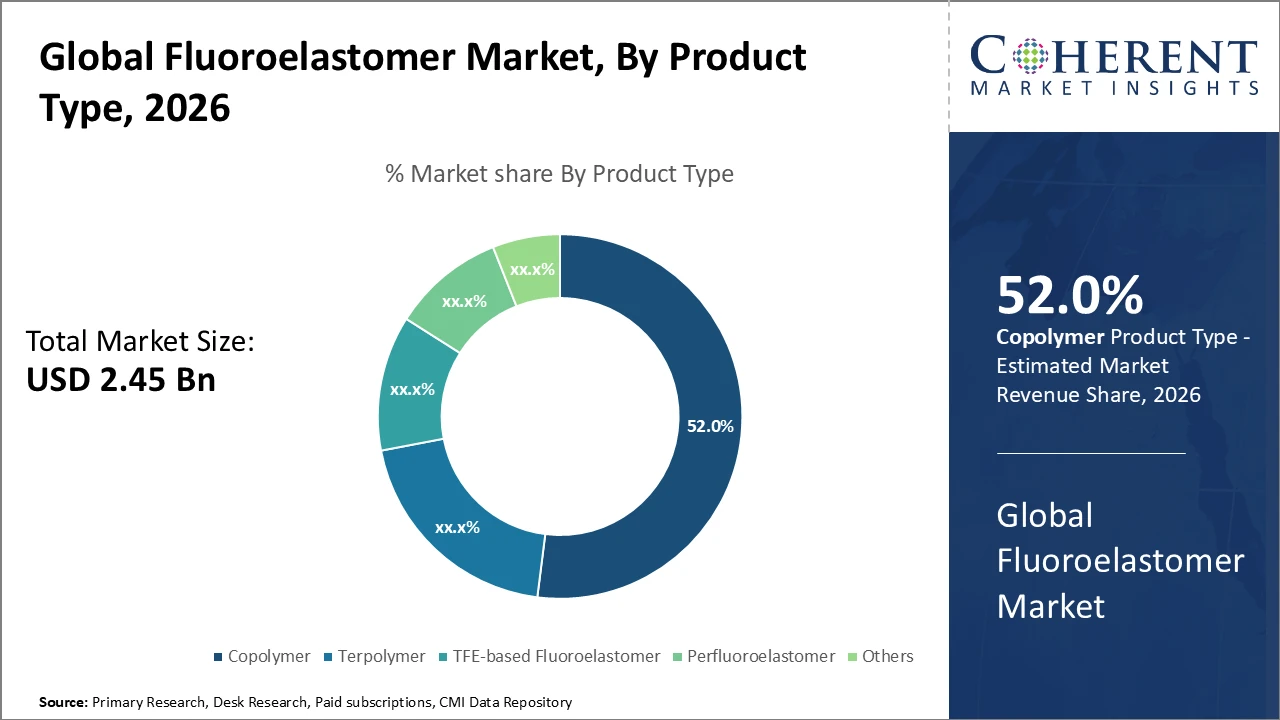
The copolymer product segment dominates the market with a 52% share, driven by its balanced performance and cost-effectiveness across industries. Terpolymers are the fastest-growing segment due to their superior heat resistance, essential for aerospace applications.
Automotive seals and gaskets remain the largest application segment, while aerospace shows accelerated growth fueled by rising air travel and defense contracts.
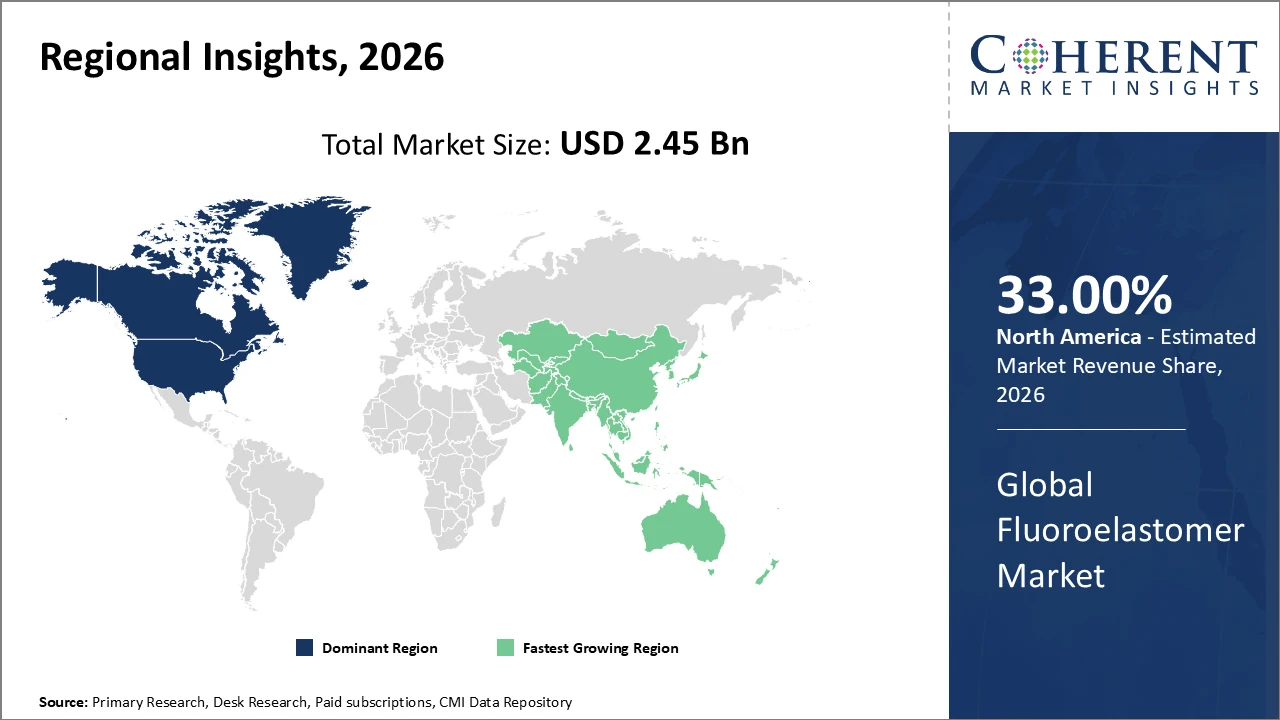
North America holds a dominant market share, supported by extensive aerospace and automotive industries utilizing fluoroelastomer innovations. Asia Pacific offers the highest CAGR, driven by expanding chemical processing and electronics manufacturing hubs.
Fluoroelastomer Market Segmentation Analysis
Fluoroelastomer Market Insights, By Product Type
Copolymer dominates the fluoroelastomer market with a 52% share, owing to its versatile performance in standard chemical and thermal environments, making it widely used in automotive applications. Terpolymers are the fastest-growing subsegment, gaining traction due to their enhanced temperature tolerance and superior sealing properties, particularly in aerospace applications. TFE-based fluoroelastomers serve specialized chemical resistance requirements but occupy a smaller market share. Perfluoroelastomers, while niche, are increasingly adopted for high-end applications in extreme environments. The ‘Others’ category primarily comprises newly developed experimental blends designed to address specific needs in niche industrial sectors.
Fluoroelastomer Market Insights, By Application
Automotive seals and gaskets lead the fluoroelastomer market, driven by stringent emission standards and the demand for durable, long-lasting components, capturing the largest market share. Chemical processing applications show steady growth, benefiting from fluoroelastomers’ excellent compatibility with aggressive chemicals and harsh operational conditions. Electronic components are emerging rapidly, supported by the expansion of semiconductor manufacturing. Oil and gas applications maintain consistent demand due to the need for corrosion- and heat-resistant seals in extreme environments, while the ‘Others’ category includes specialized industrial uses such as pharmaceuticals, food processing, and other niche sectors requiring high-performance elastomers.
Fluoroelastomer Market Insights, By End-Use Industry
The automotive segment currently dominates the fluoroelastomer market, supported by widespread use in fuel system components and emerging electric vehicle applications, reflecting strong industry trends tied to emission regulations and lightweight material requirements. Aerospace is the fastest-growing subsegment, driven by recovering air travel demand and increased government defense spending. Chemical processing maintains prominence due to the need for high-performance sealants in harsh operational environments. The electronics sector is experiencing accelerated adoption as advanced manufacturing processes demand precise sealing solutions, while the oil and gas industry continues to benefit from ongoing global exploration and production activities requiring durable, corrosion-resistant elastomer components.
Fluoroelastomer Market Trends
Advanced material engineering is a key trend, with nanotechnology integration enhancing fluoroelastomer performance in thermal resistance and chemical durability, exemplified by Daikin’s 2025 product line upgrade.
Sustainability initiatives are driving manufacturers to adopt greener production technologies, supporting global emission reduction goals, particularly in Europe and North America.
The rise of electric vehicles is prompting innovation in specialized fluoroelastomers, creating new growth opportunities in automotive and high-performance applications.
Fluoroelastomer Market Insights, By Geography
North America Fluoroelastomer Market Analysis and Trends
North America dominates the fluoroelastomer market, with a CAGR of 9.2%, driven by expanding aerospace manufacturing, stringent environmental regulations, and substantial R&D investments by leading U.S.-based companies. The region benefits from strong end-user demand and the development of innovation-driven fluoroelastomer variants designed for high-performance applications, reinforcing its position as a key growth hub in automotive, aerospace, and industrial sectors.
Asia Pacific Fluoroelastomer Market Analysis and Trends
Asia Pacific experiences fastest growth, driven by rapid industrialization and robust growth in the automotive and electronics sectors, particularly in China and India. Strong demand for high-performance seals and gaskets in automotive fuel systems, aerospace components, and electronic devices underpins market expansion. The region’s competitive advantage is further strengthened by the presence of major chemical manufacturing hubs, cost-efficient production, and government incentives promoting high-tech industry development. Combined, these factors create a favorable ecosystem for innovation, capacity expansion, and sustained adoption of fluoroelastomers across multiple end-use industries, ensuring long-term market growth.
Fluoroelastomer Market Outlook for Key Countries
USA Fluoroelastomer Market Analysis and Trends
The U.S. remains a pivotal market in the fluoroelastomer industry, contributing substantially to global revenue due to a strong presence of aerospace, automotive, and chemical processing companies that require high-performance elastomer materials. Leading players such as Solvay S.A. and 3M have heavily invested in domestic R&D, introducing advanced fluoroelastomer products in 2025 tailored for automotive fuel systems, electric vehicles, and electronics applications. The country’s stringent emissions, safety, and environmental regulations are driving faster adoption of durable, chemically resistant elastomers, while growing aerospace manufacturing and semiconductor production further support demand. Combined, these factors reinforce the U.S. as a key growth hub, fostering innovation, strategic partnerships, and long-term market expansion in the fluoroelastomer sector.
Germany Fluoroelastomer Market Analysis and Trends
The Germany fluoroelastomer market is characterized by steady growth driven by stringent environmental regulations, advanced industrial manufacturing, and strong automotive and chemical processing sectors. High-performance copolymer and terpolymer fluoroelastomers dominate applications in automotive seals, gaskets, and chemical-resistant components, ensuring compliance with EU safety and emissions standards. Aerospace and electronics segments are witnessing accelerated adoption due to rising demand for heat- and chemical-resistant materials. Sustainability initiatives have prompted the development of eco-friendly production processes and low-emission elastomers, while ongoing R&D efforts focus on enhancing thermal stability and chemical durability. Germany’s established chemical manufacturing ecosystem and government incentives for high-tech innovation position the country as a key hub for fluoroelastomer development in Europe.
Analyst Opinion
Increased fluoroelastomer production capacities, particularly in Asia Pacific, have boosted market revenue, with manufacturing outputs rising over 15% in 2024. This supply-side expansion mitigated raw material scarcity seen in 2023, stabilized pricing, and accelerated market share growth.
Growing demand from automotive seals and gaskets drove a 12% increase in market revenue in 2025, fueled by stricter emissions regulations and rising adoption of electric vehicles requiring durable elastomeric components.
Rising applications in the chemical processing industry increased usage by 9% in 2026, as fluoroelastomers enhance equipment life cycles and reduce maintenance costs, expanding market scope.
Pricing dynamics were impacted by raw material costs and trade patterns, with fluorspar export disruptions in 2024 raising prices by 8%, followed by normalization in 2025, ensuring stable market growth.
- Current Industry Events of 2026
- Market Size Estimation
- Regional Breakdown
- Competitive Landscape
- Customer Intelligence
- Segmental Analysis
- Pricing Analysis
- Key Market Drivers, Challenges & Future Trends
- Customized Insights Section
Market Scope
| Report Coverage | Details | ||
|---|---|---|---|
| Base Year: | 2025 | Market Size in 2026: | USD 2.45 billion |
| Historical Data for: | 2020 To 2024 | Forecast Period: | 2026 To 2033 |
| Forecast Period 2026 to 2033 CAGR: | 7.8% | 2033 Value Projection: | USD 4.15 billion |
| Geographies covered: |
| ||
| Segments covered: |
| ||
| Companies covered: | AGC Inc., 3M Company, Solvay S.A., Kureha Corporation, Lanxess AG, Zeon Corporation, Chemours Company, Mitsui Chemicals, Inc., Dyneon, Daikin Industries, Ltd. | ||
| Growth Drivers: |
| ||
Fluoroelastomer Market Growth Factors
Market growth is primarily driven by rising demand for high-performance elastomers in automotive fuel systems, where fluoroelastomers provide exceptional chemical resistance essential for meeting stringent emission standards. The post-pandemic resurgence of aerospace manufacturing, coupled with enhanced quality requirements, has further increased consumption in the aerospace segment. Additionally, expanding investments in semiconductor manufacturing and electronics industries are boosting demand for fluoroelastomer seals capable of withstanding harsh operational environments. The global shift toward sustainable and electric vehicles is also prompting manufacturers to utilize fluoroelastomers in battery and fuel cell components, opening new avenues for revenue growth and reinforcing the material’s strategic importance across multiple high-performance applications.
Fluoroelastomer Market Development
In July 2025, AGC Inc. unveiled new SF grades in its AFLAS™ FFKM fluoroelastomer series. The newly developed grades are produced without the use of surfactants or fluorinated polymerization solvents, reinforcing the company’s commitment to advanced and environmentally responsible material innovation.
Key Players
Leading Companies of the Market
AGC Inc.
3M Company
Solvay S.A.
Lanxess AG
Zeon Corporation
Kureha Corporation
Mitsui Chemicals, Inc.
Chemours Company
Dyneon
Daikin Industries, Ltd.
Several leading companies have pursued aggressive growth strategies to strengthen their presence in the fluoroelastomer market. AGC Inc. expanded its production capacity by commissioning a new manufacturing facility in Japan in 2025, resulting in a 20% increase in product output. Chemours Company introduced a new perfluoroelastomer variant targeting aerospace applications in 2024, significantly boosting its market share in high-performance segments. Additionally, Gujarat Fluorochemicals Limited leveraged partnerships with end-user industries to develop application-specific formulations, achieving notable revenue growth across emerging markets in Asia Pacific and reinforcing its competitive position in key industrial and automotive sectors.
Fluoroelastomer Market Future Outlook
The fluoroelastomer market is expected to experience strong growth driven by increasing demand for high-performance, chemically resistant, and heat-stable materials across automotive, aerospace, chemical processing, and electronics industries. Rising adoption in electric vehicles, particularly for battery and fuel cell components, is creating new growth avenues. Technological advancements, including terpolymer and perfluoroelastomer innovations, are enhancing performance in extreme environments. Sustainability initiatives and stricter emission regulations are prompting greener production methods and eco-friendly elastomer formulations. Expanding industrialization in Asia Pacific, ongoing aerospace recovery, and continuous R&D investments in North America and Europe will collectively sustain long-term market expansion through 2033.
Fluoroelastomer Market Historical Analysis
The fluoroelastomer market has witnessed steady growth over the past decade, driven by increasing industrialization, stringent emission standards, and rising demand for high-performance sealing solutions. Initially dominated by copolymers for automotive and chemical applications, the market gradually diversified with terpolymers and perfluoroelastomers addressing aerospace, electronics, and extreme chemical environments. Automotive seals and gaskets remained the primary revenue driver, supported by stricter fuel system regulations and lightweight vehicle initiatives. North America and Europe led early adoption, while Asia Pacific emerged as a high-growth region due to expanding automotive, chemical, and electronics manufacturing. Continuous innovation and capacity expansions laid the foundation for current market trends.
Sources
Primary Research Interviews:
Chemical Engineers
Electronics and Semiconductor Manufacturing Engineers
R&D Managers in Polymer and Elastomer Companies
Industrial Equipment Designers and Seal Specialists
Databases:
International Energy Agency (IEA) – Industrial Materials Data
OECD Chemical and Polymer Statistics
UN Industrial Development Organization (UNIDO) Reports
World Bank Infrastructure & Automotive Industry Data
Magazines:
Chemical Week
Rubber & Plastics News
Industrial Heating & Processing
Polymer Technology Journal
Water & Wastewater International
Journals:
Journal of Applied Polymer Science
Rubber Chemistry and Technology
Journal of Elastomers & Plastics
Industrial & Engineering Chemistry Research
Polymer Testing Journal
Newspapers:
The Financial Times (Chemicals & Manufacturing)
The Guardian (Industry & Environment)
The Economic Times (Chemicals & Automotive)
Reuters (Industrial Materials & Technology)
The Hindu Business Line (Manufacturing & Infrastructure)
Associations:
American Chemical Society (ACS) – Polymer Division
European Rubber & Plastics Industry Association (ERPIA)
International Association for Fluorine Chemistry (IAFC)
Society of Automotive Engineers (SAE) – Materials Division
Get access to 250+ pages report
Every segment, forecast, competitor profile and data table behind the analysis above — available for instant download.
- ESOMAR Member
- ISO 9001:2015 Certified
- D-U-N-S Registered
- GDPR & CCPA Compliant
Missing comfort of reading report in your local language? Find your preferred language:
Transform your Strategy with Exclusive Trending Reports
Frequently Asked Questions
Leading players include AGC Inc., Chemours Company, Daikin Industries, Ltd., 3M Company, and Zeon Corporation, each excelling through capacity expansion, product innovation, and regional diversification.
The fluoroelastomer market is projected to reach USD 4.15 billion by 2033, reflecting sustained growth driven by expanding applications in automotive and aerospace industries.
The automotive sector, particularly fuel system components and electric vehicle battery parts, presents the largest growth opportunity, supported by tightening emission regulations and technological advancements.
Upcoming trends include increased use of perfluoroelastomers in advanced electronics and battery technologies, expansion of localized production in Asia Pacific, and greater emphasis on sustainability in manufacturing processes.
The competitive landscape is dynamic, with key players focusing on capacity expansions and new product introductions while navigating raw material supply fluctuations and pricing pressures.
Common go-to-market strategies include strategic partnerships with end-users, geographic diversification of production, and continuous innovation aimed at meeting stringent regulatory and performance standards.