

Global Dyestuff for Cotton Market Size and Share Analysis - 2026 To 2033
The global dyestuff for cotton market size is expected to increase from USD 3.85 Bn in 2026 to USD 5.65 Bn by 2033 at a compound annual growth rate (CAGR) of 5.7%. The growth can be attributed to increased demand from the textiles & clothing industry, increasing production of cotton fabric, and preference towards eco-friendly dyes that deliver enhanced performance. For the 2024–25 season, India’s cotton production is estimated at 294–302.25 lakh bales of 170 kg each, with Gujarat leading output in the Central Zone. Globally, 2026/27 cotton production is projected at 116 million bales, with Brazil and the U.S. remaining key exporters.
Key Takeaways from the Global Dyestuff for Cotton Market Report (2026)
- Reactive Dyes segment is forecasted to dominate the market in 2026 with a market share of 49%, primarily due to its excellent wash-fast properties and high binding affinity with cotton fibers.
- Non-Woven segment is forecast to hold the highest market share of 42% in 2026 due to the rising adoption of dyed fiber products in hygiene-based non-woven textile applications like wipes, medical textiles, and disposable textiles. According to WHO observations, increasing investments in healthcare preparedness and infection prevention have significantly raised demand for hygiene products and protective medical textiles.
- Asia-Pacific is forecasted to dominate the market, having an expected 48% share by 2026, owing to its vast presence of cotton textile manufacturing units, including China, India, Bangladesh, and Vietnam. The United Nations Industrial Development Organization estimates that Asia produces over 60% of the world’s textiles and clothing, with China, India, Bangladesh, and Vietnam being some of its largest production centers.
Segmental Insights
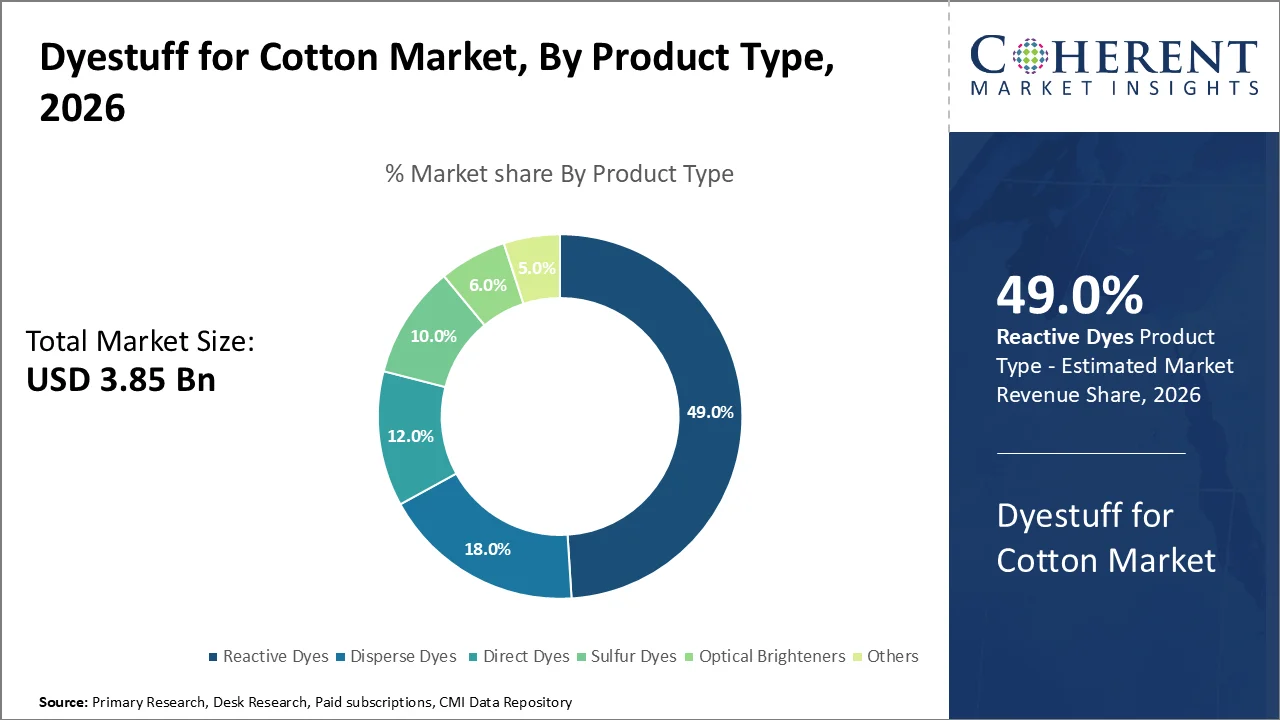
Why is Reactive Dyes Segment Acquiring the Largest Market Share?
The Reactive Dyes segment is anticipated to dominate the global dyestuff for cotton market, with about 49% share in the year 2026, owing mainly to the higher chemical properties, such as covalent bonding with cotton fabrics, good wash fastness, and high color retention property, which makes it more favored dyeing material among all other types used in cotton fabric production.
Innovations in textile dyeing techniques, coupled with the rising global demand for clothing made from cotton fabrics, are contributing to the rapid uptake of reactive dyes, particularly in the Asian Pacific region, which boasts significant dyeing capacities.
In January 2026, Konica Minolta, Inc. launched “O’ROBE”, an inline pretreatment ink for reactive dyes, designed for inkjet textile printing systems used in cotton and other natural fibers.
- Current Industry Events of 2026
- Market Size Estimation
- Regional Breakdown
- Competitive Landscape
- Customer Intelligence
- Segmental Analysis
- Pricing Analysis
- Key Market Drivers, Challenges & Future Trends
- Customized Insights Section
Which End-Use Industry Segment Dominates the Market?
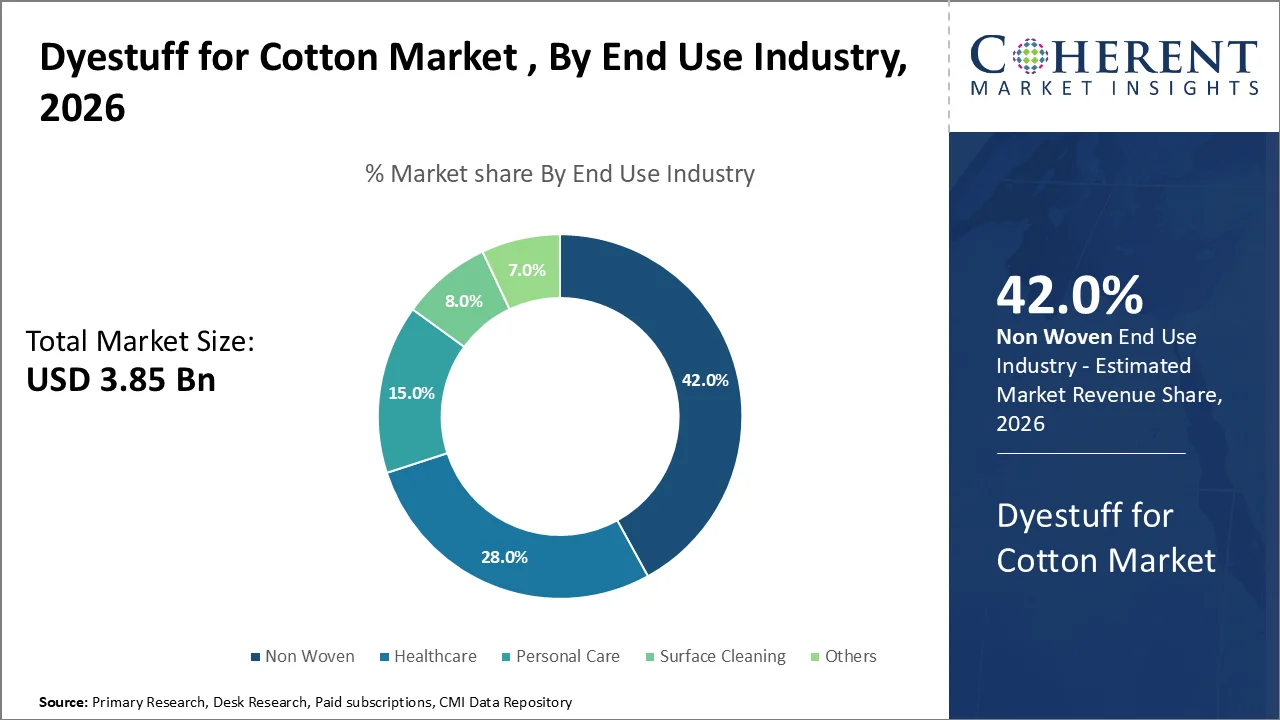
The Non Woven category is expected to contribute to the highest market share of about 42% in 2026, owing to the rising application of dyed fiber in hygiene products such as wipes, medical textiles, sanitation products, and disposables made from cotton.
The development of healthcare facilities, improvement in knowledge about hygiene, and the widespread use of disposable medical fabrics are also contributing to the demand for dyed nonwoven textiles. Moreover, the adoption of one-time use hygiene products in both developed and developing countries is increasing the significance of this category.
In April 2026, BASF SE confirmed its participation at Techtextil 2026 in Frankfurt, where it will showcase advanced binder technologies, textile chemical solutions, and nonwoven material innovations for technical textiles and hygiene applications.
Growth Drivers
Rising global cotton consumption is directly increasing demand for cotton dyestuffs, as cotton remains the most widely used natural fiber in the textile industry.
Based on figures from FAO, the annual production level of global cotton is around 25 million metric tons, ensuring substantial production of textiles and dyeing of such materials.
Growing emphasis on hygiene, medical textiles, and nonwoven uses has boosted the requirement for textile dyes in functional cotton textiles.
As per the WHO, investments in healthcare facilities and infectious disease prevention methods have been growing rapidly, boosting the demand for medical textiles including protective gowns, masks, and surgery-related materials. The need for improved dyeing consistency and performance has accelerated innovation in cotton textile dyeing technologies.
Growing environmental regulations and sustainable movements, innovations are being made in terms of environmentally friendly dyeing techniques and low impact dyes.
As per the UNEP report, textiles are among the industries that are major contributors to water pollution in industrial processes due to which efforts have been initiated worldwide to promote cleaner production practices along with reduced use of chemicals in the dyeing process of textiles.
Current Events and Their Impact on the Dyestuff for Cotton Market
Current Event | Description and its Impact |
Global Push for Textile Sustainability & Chemical Waste Reduction (UNEP ZDHC Expansion) |
|
EU Green Deal & REACH Chemical Restrictions Tightening (Europe Regulatory Shift) |
|
Global Dyestuff for Cotton Market Trends
- The Asia-Pacific region continues to be the dominant production center, contributing over 60% of worldwide textile manufacturing production, leading to significant dye usage in cotton fabrics.
- Trend towards adopting sustainable dyeing processes is gaining momentum since the textile industry constitutes one of the biggest polluters of industrial effluents on a global scale.
- The digital printing of textiles is becoming increasingly common, making it easier to use less reactive dye while reducing water and chemical usage.
- The need for nonwoven and technical textiles is increasing, driven by their applications in healthcare and hygiene that require cotton-based textiles.
- The cotton production variability (about 25 million metric tons per year) is affecting the cycles of dye demand and putting emphasis on dye utilization per each fabric unit.
- The environmental regulations (REACH in Europe) are prompting manufacturers to choose environmentally-friendly and regulated dyes.
Regional Insights
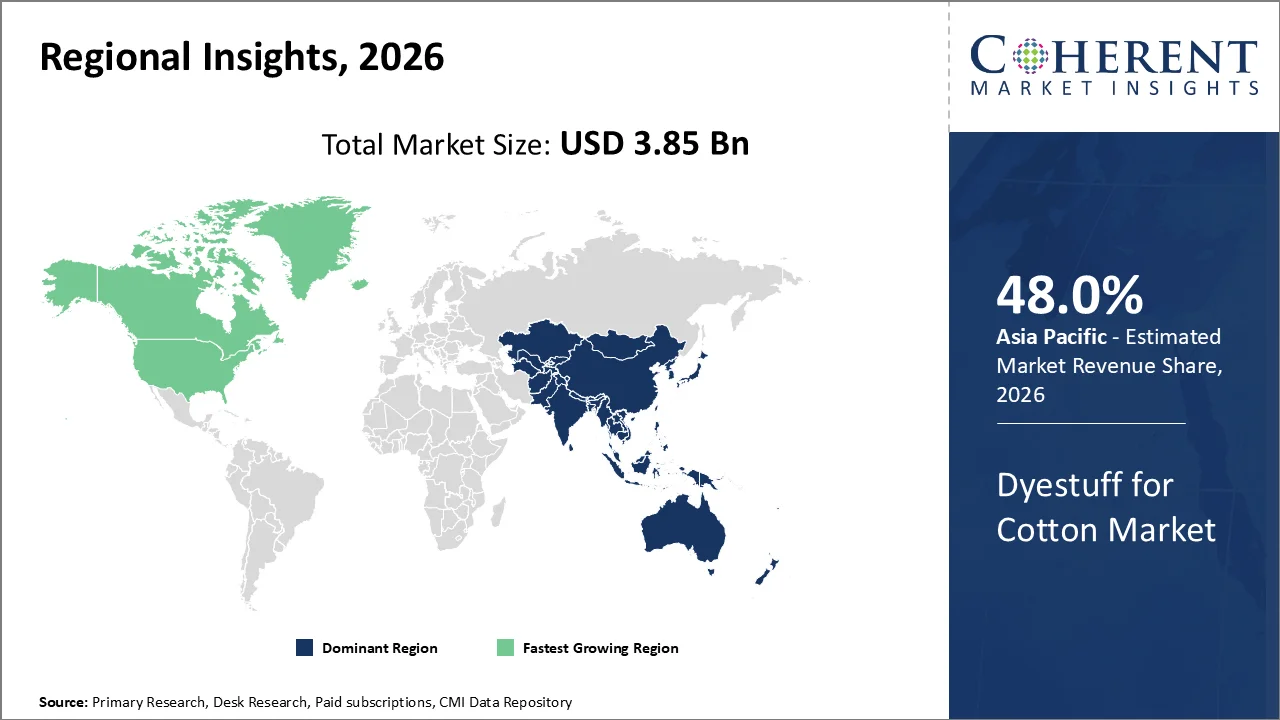
Strong Textile Manufacturing Base Driving Asia-Pacific Market Dominance
The Asia-Pacific region will continue to dominate the global market for cotton dyeing products, representing a 48% share in 2026, due to the presence of major producers of cotton-based textiles such as China, India, Bangladesh, and Vietnam.
The reason for such dominance can be explained by the regional role as the world's leader in textile production. The share of Asia in global textile and apparel manufacturing production exceeds 60%, according to UNIDO.
In addition, rapid expansion of export-based clothing industry and significant capital investments in textile clusters have led to an increased demand for large-scale dyeing, especially with the use of reactive dyes in cotton-based garments. Such countries like China, India, and Bangladesh keep increasing their capacities in terms of textiles manufacturing, strengthening their position as market leaders.
Strong Technical Textile Demand Making North America the Fastest-Growing Market
North America is poised to become the fastest growing region in the global dyestuff for cotton market on account of increasing consumption from domestic textile products, healthcare textiles, and advanced performance wear.
As stated by the Environmental Protection Agency (EPA), USA, the textile industry is one of the major contributors to wastewater pollution from the industries. This has resulted in the need for more stringent compliance, which has necessitated the adoption of better and more sustainable practices in dyeing of cotton fabrics.
U.S. Dyestuff for Cotton Market Trends
The U.S. dyestuff for cotton market is anticipated to experience a stable growth during the forecast period. The major factors driving this growth include robust demand from the textile & apparels industry, rising preference for quality dyed cotton fibers, and increased use of sustainable dyestuffs. Moreover, reshoring of the textile processing industry and demand for luxurious home textiles & fashion wear are contributing to market growth.
In April 2026, Archroma announced its participation at Colombiatex 2026, where it showcased advanced sustainable textile dyeing solutions including AVITERA® SE and other high-performance dye systems for cotton and cellulosic fabrics.
China Dyestuff for Cotton Market Forecast
China is expected to emerge as the largest market and dominate the demand for dyestuff for cotton textile applications over the forecast period. This can be attributed to China's leading position in the global textile manufacturing industry, huge capacity in manufacturing of cotton fabrics, and robust export-oriented apparel industry.
In March 2026, Rudolf Group officially announced its participation in CHINA INTERDYE 2026, scheduled to be held from 15–17 April 2026 at the Shanghai World Expo Exhibition & Convention Center.
Who are the Major Companies in Dyestuff for Cotton Industry
Some of the major key players in Dyestuff for Cotton are Clariant AG, Kemira, Huntsman Corporation, Sumitomo Chemical Company Ltd., Rockwood Pigments Inc., Arkema SA, BASF SE, DuPont, Lanxess AG and Kiri Industries Ltd among others.
Key News
- In May 2026, Clariant AG published its Q1 2026 financial results, reporting group sales of CHF 918 million, down 2.0% in local currency compared to Q1 2025.
- In July 2025, Archroma launched CYCLANON® XC-W e, a washing-off auxiliary designed for reactive dyeing of cotton fabrics, improving color fastness and reducing water and chemical usage by up to 20% in textile processing.
Market Report Scope
Dyestuff for Cotton Market Report Coverage
| Report Coverage | Details | ||
|---|---|---|---|
| Base Year: | 2025 | Market Size in 2026: | USD 3.85 Bn |
| Historical Data for: | 2020 To 2024 | Forecast Period: | 2026 To 2033 |
| Forecast Period 2026 to 2033 CAGR: | 5.7% | 2033 Value Projection: | USD 5.65 Bn |
| Geographies covered: |
| ||
| Segments covered: |
| ||
| Companies covered: | Clariant AG, Kemira, Huntsman Corporation, Sumitomo Chemical Company Ltd., Rockwood Pigments Inc., Arkema SA, BASF SE, DuPont, Lanxess AG and Kiri Industries Ltd among others. | ||
| Growth Drivers: |
| ||
| Restraints & Challenges: |
| ||
Analyst Opinion
- The dye substance for cotton fabrics is an essential ingredient in the world textile industry rather than an optional one. Cotton continues to be one of the most commonly utilized natural fibers, and all aspects of clothing manufacture, interior textiles, and industrial fabrics depend on successful dyeing operations.
- Demand for dye products derived from cotton is structurally based and directly related to worldwide volumes of fabric production, particularly in leading producers such as China, India, Bangladesh, and Vietnam. As long as the world continues using cotton fabric for clothing and household items, demand for reactive and vat dyes will continue unabated.
- Sustainability and regulatory pressure are reshaping the market rather than reducing demand. The stringent environmental standards (e.g., effluent limits and compliance requirements for chemical substances such as ZDHC) have forced manufacturers to use low-impact reactive dyes that produce fewer by-products and increase the need for dye chemistry products.
- Technological innovation is increasing the value intensity of dyestuffs per unit of cotton processed. Modern dyeing processes emphasize low consumption of water, high efficiency of the exhaustion rate of the dye, computerized formulation, and automation of the dye process in textiles, and this is pushing the market away from generic dyes.
- The instability of the supply chain and reliance on raw materials (particularly petrochemical intermediates) cause fluctuations in prices and availability of dyestuffs, but demand is consistent due to the importance of coloring in the production of cotton fabrics. Even during recession periods, the need for clothing and textile products guarantees a constant demand for dyestuffs.
Speak to the analyst
Want personalized insights?
Take the findings above to one of our principal consultants, or have the report rebuilt around the segments, geographies and competitors you actually track.
Market Segmentation
- By Product Type (Revenue, USD Bn, 2021-2033)
- Reactive Dyes
- Disperse Dyes
- Direct Dyes
- Sulfur Dyes
- Optical Brighteners
- Others
- By End Use Industry (Revenue, USD Bn, 2021-2033)
- Non Woven
- Healthcare
- Personal Care
- Surface Cleaning
- Others
- By Region (Revenue, USD Bn, 2021-2033)
- North America
- US.
- Canada
- Latin America
- Brazil
- Mexico
- Argentina
- Rest of Latin America
- Europe
- Germany
- U.K.
- France
- Italy
- Spain
- Russia
- Rest of Europe
- Asia Pacific
- China
- India
- Japan
- Australia
- South Korea
- ASEAN
- Rest of Asia Pacific
- Middle East
- GCC
- Israel
- Rest of Middle East
- Africa
- South Africa
- Central Africa
- North Africa
- North America
Sources
Primary Research Interviews
- Textile dye manufacturers
- Chemical engineers in dyeing and finishing plants
- Textile mill owners and production managers
- Cotton fabric manufacturers
- Apparel brand sourcing managers
- Sustainability and compliance officers (ZDHC / REACH compliance teams)
- R&D heads in textile chemical companies
Databases
- United Nations Industrial Development Organization (UNIDO)
- Food and Agriculture Organization (FAO) – cotton production data
- World Trade Organization (WTO) textile trade statistics
- Eurostat (EU textile and chemical industry data)
- U.S. Environmental Protection Agency (EPA)
- India Ministry of Textiles & Cotton Corporation data
- China National Bureau of Statistics (textile output data)
Magazines
- Textile World
- Textile World Asia
- Chemical Week
- Ecotextile News
- Asian Textile Journal World of Chemicals Magazine
Journals
- Journal of Cleaner Production (textile dyeing sustainability research)
- Dyes and Pigments (Elsevier)
- Coloration Technology (Society of Dyers and Colourists)
- Journal of Textile Engineering & Fashion Technology
- Textile Research Journal
- Industrial & Engineering Chemistry Research
Newspapers
- The Financial Times
- The Wall Street Journal
- The Economic Times (India)
- South China Morning Post
- Reuters Business News
- Bloomberg
Associations
- American Association of Textile Chemists and Colorists (AATCC)
- Society of Dyers and Colourists (SDC)
- European Committee of Textile Chemicals (ETAD)
- Textile Institute (UK)
- ZDHC Foundation (Zero Discharge of Hazardous Chemicals Programme)
- International Cotton Advisory Committee (ICAC)
Public Domain Sources
- Company annual reports and investor presentations (BASF, Huntsman, Archroma, Clariant, Lanxess, Kiri Industries, Sumitomo Chemical)
- Government environmental regulations (EU REACH, EPA, China MEE regulations)
- UN Comtrade database (textile dye import/export data)
- World Bank textile and manufacturing statistics
- Trade fair reports (Interdye China, Techtextil, ITMA exhibitions)
Proprietary Elements
- CMI Data Analytics Tool
- Proprietary CMI Existing Repository of information for last 10 years
Get access to 250+ pages report
Every segment, forecast, competitor profile and data table behind the analysis above — available for instant download.
- ESOMAR Member
- ISO 9001:2015 Certified
- D-U-N-S Registered
- GDPR & CCPA Compliant
Missing comfort of reading report in your local language? Find your preferred language:
Transform your Strategy with Exclusive Trending Reports
Frequently Asked Questions
The Global Dyestuff for Cotton Market is projected to reach USD 5.65 Bn by 2033, growing from USD 3.85 Bn in 2026, at a CAGR of 5.7% during 2026–2033.
Major players operating in the global Dyestuff for Cotton market include Clariant AG, Kemira, Huntsman Corporation, Sumitomo Chemical Company Ltd., Rockwood Pigments Inc., Arkema SA, BASF SE, DuPont, Lanxess AG, and Kiri Industries Ltd.
High environmental compliance costs, volatility in raw material prices, and stricter chemical regulations (such as REACH and ZDHC standards) are limiting growth for conventional dye manufacturers.
Rising global cotton textile production, increasing demand for reactive dyes, expansion of apparel and home textiles, and growing adoption of sustainable and high-performance dyeing technologies are driving market growth.
The Dyestuff for Cotton Market is anticipated to grow at a CAGR of 5.7% between 2026 and 2033.
Among regions, Asia-Pacific is expected to dominate the global Dyestuff for Cotton market over the forecast period, accounting for around 48% market share in 2026, driven by large-scale textile manufacturing in China, India, Bangladesh, and Vietnam.
Cotton dyeing costs vary depending on dye type, process, and scale, but typically range from USD 0.20–1.50 per kg of fabric, with reactive dyeing being the most widely used and cost-efficient method in industrial textile processing.