

Soda Ash Market Analysis & Forecast: 2026-2033
Soda Ash Market is estimated to be valued at USD 21.88 Bn in 2026 and is expected to reach USD 29.78 Bn in 2033, exhibiting a compound annual growth rate (CAGR) of 4.5% from 2026 to 2033.
Key Takeaways
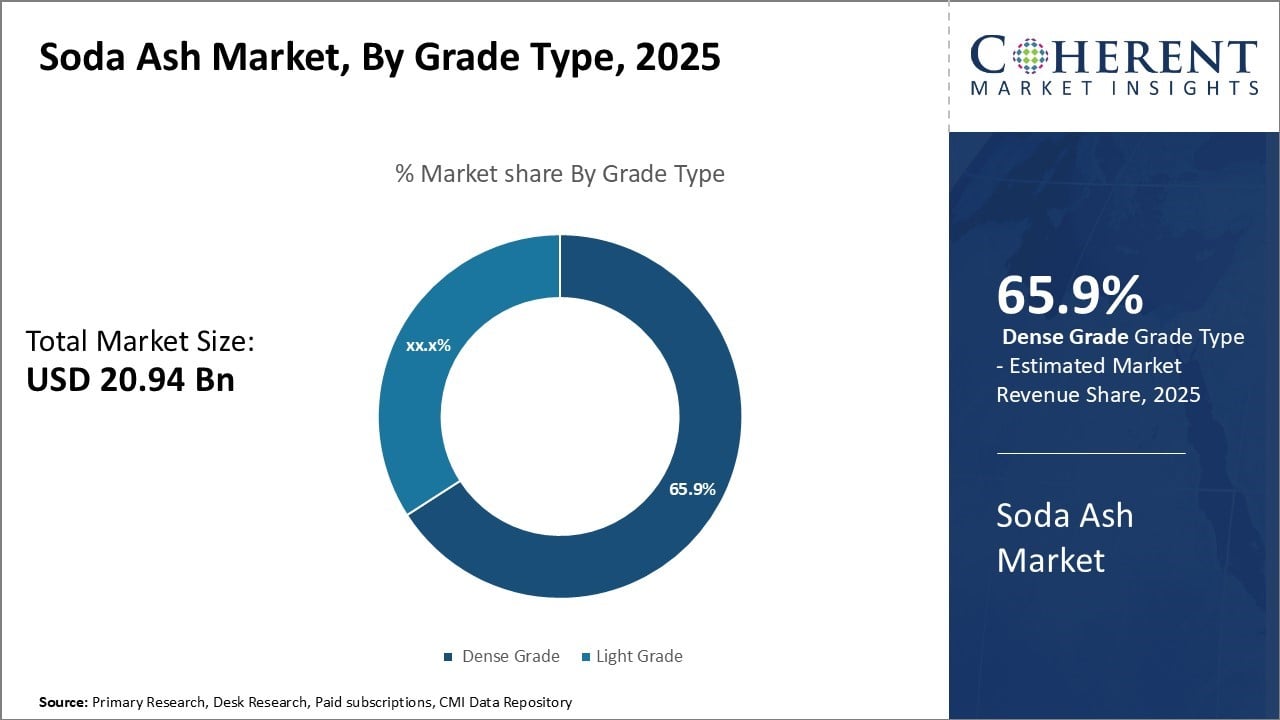
- According to Grade Type, The Dense Grade Category is anticipated to account for the largest share of 66.9% for the Soda Ash market in 2026. Its high density and granular, dust-free character, which make it particularly appropriate for large scale industrial uses, are the reasons for its dominance.
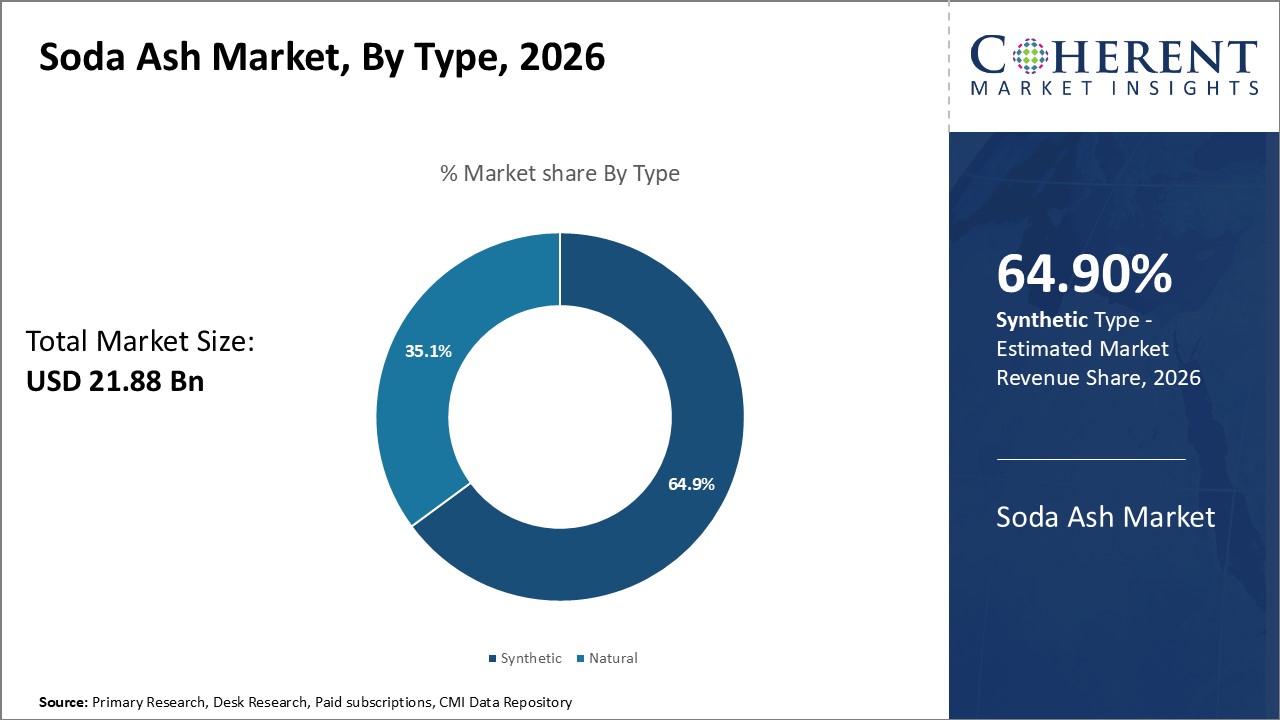
- According to Type, The Synthetic Segment is anticipated to hold 64.9% share of the Soda Ash market in 2026. In comparison to natural soda ash, synthetic soda ash is mostly made using the Solvay or Hou processes, which both provide superior quality control and yeild a more uniform and pure product.
- According to End-Use Application, Soap And Detergents Category is expected to hold 38.2% soda ash market share in 2026. Since soda ash has strong alkalinity and surfactant qualities it is an essential component in the production of powered detergents and soaps.
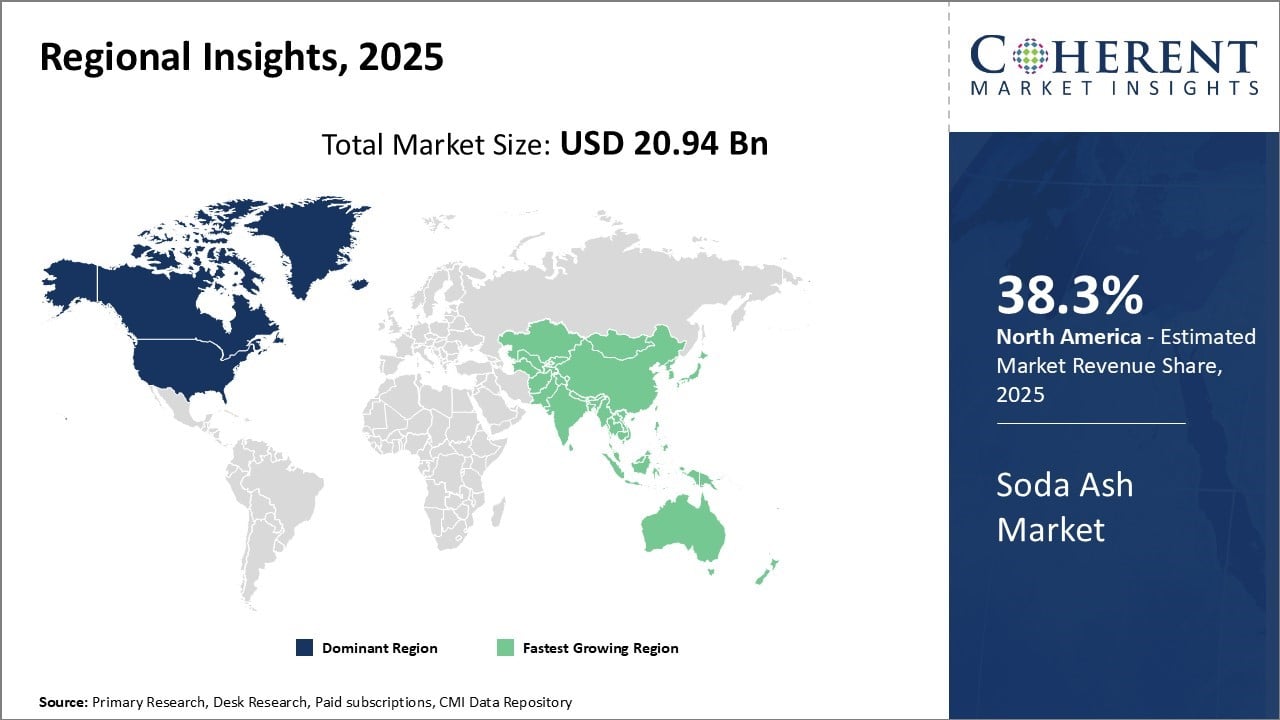
- According to region, North America holds the largest market share of 38.3% for Soda Ash market growth by 2026. The market for soda ash in this region is anticipated to continue growing steadily due to both established industrial demand and new prospects in advanced manufacturing and renewable energy.
Market Overview
The soda ash market size is mostly caused by growing demand from the glass manufacturing sector, particularly in the automotive and construction industries, as well as increased use in chemicals, detergents, and water treatments applications. Rising demand from glass industry and increasing usage of soda ash in chemicals production are expected to drive the market growth. Soda ash or sodium carbonate is a crucial raw material in glass manufacturing industry. Around 70% of total soda ash produced is consumed by glass industry. Growing construction activities especially in Asia Pacific leads to increased glass demand, and this drives the soda ash market growth. Soda ash also finds wide application in chemicals, soap & detergents, metallurgy, water treatment and others.
Current Events and Its Impact on the Soda Ash Market
Event | Description and Impact |
Glass Industry Expansion |
|
Water Treatment Segment Growth |
|
Emergence of New Technology
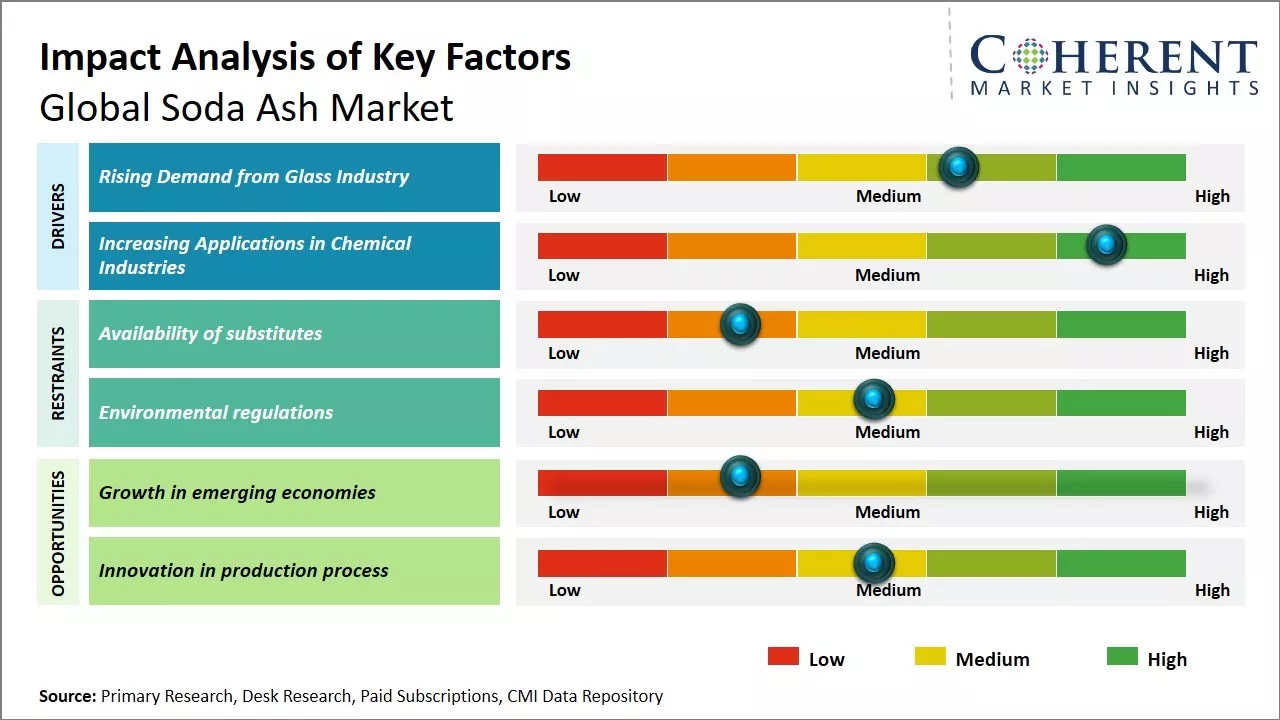
Technological advancements are reshaping the soda ash industry, particularly in production efficiency and environmental sustainability. Companies are investing in greener manufacturing processes, such as energy-efficient kilns, carbon capture integration, and water recycling systems, to reduce the environmental footprint of synthetic soda ash production. However, it is important to note that the cost of setting up a soda ash factory can be substantial, especially when incorporating advanced technologies and meeting stringent environmental regulations, which often requires significant capital investment from manufacturers.
For example, new greenfield projects in India, like GHCL’s facility in Gujarat, are adopting advanced technologies to optimize resource use and minimize emissions. In the US, the use of natural trona ore for soda ash production remains a technological advantage, offering lower energy consumption and fewer emissions compared to the synthetic Solvay process dominant in other regions.
These innovations are not only helping producers comply with stricter environmental regulations but also improving cost competitiveness and supply reliability, positioning the industry for long-term sustainable growth.
- Current Industry Events of 2026
- Market Size Estimation
- Regional Breakdown
- Competitive Landscape
- Customer Intelligence
- Segmental Analysis
- Pricing Analysis
- Key Market Drivers, Challenges & Future Trends
- Customized Insights Section
Pricing Analysis
- The global soda ash market has faced significant pricing volatility in 2025, with notable regional differences. In China, prices dropped sharply—by nearly 40% year-on-year—due to high production capacity utilization, elevated inventories, and sluggish demand, reaching around $178/ton by June 2025.
- India also experienced a steep decline, with prices in Mumbai falling about 45% from their 2022 peak, settling near ₹29.5/kg in June 2025, as oversupply and weak export demand pressured the market.
- In contrast, the United States maintained stable prices at approximately $274/MT in March 2025, supported by robust domestic trona-based production and long-term contracts with major buyers, despite global trade uncertainties.
- European prices showed moderate stability, averaging $489/MT in January and $502/MT in April 2025, reflecting steady demand from the glass sector and fewer supply-side disruptions.
Segmental Insights
Soda Ash Market Insights, By Grade Type - High Density Opens New Applications
In terms of grade type, dense grade segment is estimated to contribute the 66.9% of the market in 2026 due to its diverse use across industries in 2024. Dense grade soda ash, also known as anhydrous soda ash, has a relatively high density that allows it to maintain its crystalline structure even when mixed with liquids. This property enables it to serve as an important ingredient in various industrial processes that involve chemical reactions in solution.
The high-density characteristic provides it an advantage over light grade soda ash for applications involving solubility. A key factor driving the growth of dense grade soda ash is its suitability for detergent production. Dense grade provides excellent performance in surfactant and builder systems used in heavy-duty laundry detergents and cleaners. Its high density allows it to effectively dissolve and activate other ingredients to fight tough stains.
Several detergent manufacturers prefer dense grade for its consistent quality and solubility profile. Rising demand for laundry detergents from industrial and household sectors has significantly boosted consumption of dense grade soda ash over the years. Dense grade has optimal dissolution behavior which allows uniform mixing with other raw materials during glass production. It readily absorbs soda content requirement of different types of glass with consistency.
This ensures higher yield and better quality of final glass products. The booming construction industry and growing consumer preference for fiber glass have amplified the need for dense grade soda ash in the glass industry.
Soda Ash Market Insights, By Type
In terms of type, synthetic segment dominates soda ash market due to its ability to satisfy large volume requirements of industrial buyers with estimated 64.9% share in 2026. Synthetic soda ash production involves conversion of salt (NaCl) into soda ash through the Solvay process, which allows for mass manufacturing. The key advantage of synthetic soda ash lies in its cost-effectiveness for volume-based commercial and industrial applications.
The Solvay process offers highly scalable production that can be expanded according to changing demand patterns. Major synthetic soda ash producers have built very large manufacturing facilities spread across strategic global locations. This ensures consistent supply and supply chain optimization to different market regions. The economies of scale associated with bulk synthetic production transltes to attractive pricing for volume-driven industries.
Factors like bulk procurement abilities, centralized producing locations and supply chain efficiencies make synthetic soda ash attractive for heavy industries. It is the material of choice for key end-use sectors like glass, detergents, chemicals and others, where large volumes are required. Synthetic soda meets the need for bulk soda ash to support mega glass projects and factories of detergent majors. Its cost-advantage feature outweighs issues like marginally lower purity as compared to natural soda ash for such mass consumer needs.
Soda Ash Market Insights, By End-Use Application
Among end-use application, the soap and detergents segment lead the market, owing to its indispensible role as a critical surfactant ingredient with estimated 38.2% share in 2026. Soda ash serves as an important builder in heavy-duty laundry detergents and soaps as it has strong alkalinity properties. It activates surfactants that impart cleaning abilities to these products. The high and persistent demand for surfactant-based cleaning agents continues to stir soda ash needs.
A key factor propelling soda ash demand from soaps and detergents segment is rising living standards in developing countries. Populations now own more garments and other fabrics requiring regular washing. This amplifies volumes of laundry detergents and soaps sold annually.
Growing sales of household cleaning products like dish wash and surface cleaners boosts demand for surfactant-based goods. Stringent focus on hygiene during ongoing pandemic has further stimulated cleaning propensities. There is increased demand for antimicrobial household cleaners and laundry sanitizers.
Manufacturers are innovating formulations with activated soda ash to promote hygiene. This will likely sustain the momentum in soda ash consumption from the soaps and detergents segment in the near future. Potent marketing campaigns by detergent brands have amplified culture of washing clothes at higher frequencies and temperatures.
This pushes usage of more concentrated detergents containing elevated soda ash levels for robust cleaning. Evolving lifestyles and preferences continue broadening home care product lines, keeping up momentum in soda ash demand from soaps and detergents end-use.
Regional Insights
North America Soda Ash Market
North America has established itself as the dominant region in the global soda ash market with estimated 38.3% share in 2026. The U.S. accounts for the largest share of the soda ash market in North America due to strong presence of glass and chemicals manufacturing industries. Majority of soda ash in the U.S. is utilized by the flat glass sector. The region is a key exporter of natural soda ash to other parts of the world.
Asia Pacific Soda Ash Market
Asia Pacific region has been the fastest growing market for soda ash globally. China is both the largest producer and consumer of soda ash in the region as well as worldwide. Factors such as increasing industrialization, rising construction activities and growing population have boosted demand for soda ash in various end-use industries including glass, chemicals, soaps and detergents in the region. The expanding middle-class and their rising disposable incomes have further boosted the sales of detergents, soaps and other household products, thus, boosting demand for soda ash.
Soda Ash Market In Europe
The main cause of this growth is the growing need for soda ash in the glass manufacturing industry, which uses it for about half of all consumption. This need is being pushed by investments in solar panel production, growing building activity, and rising car sales. Stricter EU environmental rules and a move toward sustainable industrial practices have further increased soda ash market demand, which is necessary for the production of detergents, chemicals, and water treatment solutions in addition to glass.
Soda Ash Market Dominating Countries
U.S Soda Ash Market
The U.S. soda ash sector is distinct because it depends on natural trona ore reserves, mostly found in Wyoming, which offer a lesser environmental impact and a financial advantage over synthetic production methods used elsewhere.
India Soda Ash Market
India's growing glass, detergent, and chemical industries are driving the country's quick rise to prominence in the global soda ash industry. Recent greenfield projects like GHCL's 0.5 million metric tonne annual plant in Gujarat, which intends to service both domestic and export needs, are prime examples of the nation's significant investments in new production capacity.
Soda Ash Market In China
China is the world's biggest producer and user of soda ash, meeting more than 60% of the demand in the Asia-Pacific area and dominating the international market. Using soda ash market to alter pH, the Solvay process is the main method used in the large-scale synthetic production of soda ash in China, which supplies the nation's extensive glass, detergent, and chemical manufacturing industries.
Market Report Scope
Soda Ash Market Report Coverage
| Report Coverage | Details | ||
|---|---|---|---|
| Base Year: | 2025 | Market Size in 2026: | USD 21.88 Bn |
| Historical Data for: | 2020 To 2024 | Forecast Period: | 2026 To 2033 |
| Forecast Period 2026 to 2033 CAGR: | 4.5% | 2033 Value Projection: | USD 29.78 Bn |
| Geographies covered: |
| ||
| Segments covered: |
| ||
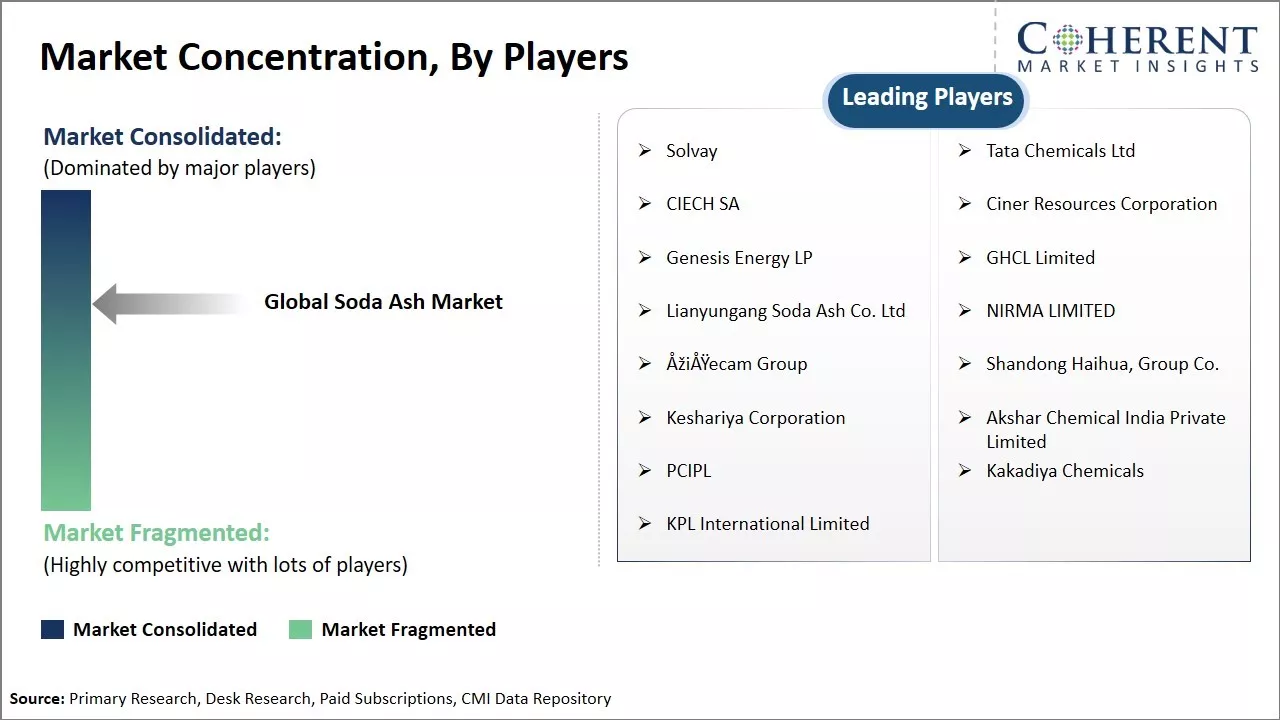
| Companies covered: | Solvay, Tata Chemicals Ltd, CIECH SA, Ciner Resources Corporation, Genesis Energy LP, GHCL Limited, Lianyungang Soda Ash Co. Ltd, NIRMA LIMITED, ÅžiÅŸecam Group, Shandong Haihua, Group Co., Keshariya Corporation, Akshar Chemical India Private Limited, PCIPL, Kakadiya Chemicals, KPL International Limited | ||
| Growth Drivers: |
| ||
| Restraints & Challenges: |
| ||
Market Concentration and Competitive Landscape
Soda Ash Market: Growth Drivers
- Rising Demand from Glass Industry
Glass industry has been one of the major consumers of soda ash globally. Soda ash finds wide application in the manufacturing of flat, container, and specialty glass. It is a key raw material used in manufacturing of different types of glass as it helps to lower the melting point of silica sand, a major raw material for glass.
The worldwide glass industry has witnessed growth over the past few years due to demand from the construction and automotive industries. The growth in the construction industry across major developing economies such as India, China, Indonesia, and others is anticipated to augment the demand for glass in the coming years.
Glass is extensively employed in windows, doors, furniture, and other construction materials. Increasing investments in infrastructure projects involving construction of roads, bridges, airports, and buildings will further drive the glass requirement.
The automotive industry is another prominent end user of glass in various applications such as windshields, side mirrors, rearview mirrors, and windowpanes. With rising vehicle production and sales worldwide, particularly in Asian countries and Central and South America, the consumption of automotive glass is will increase substantially.
- Increasing Applications in Chemical Industries
The use of soda ash or sodium carbonate is growing substantially across various chemical industries globally which is positively impacting the growth of the overall soda ash market. Soda ash finds major applications in industries like glass, chemicals, detergents, metallurgy etc. The glass industry accounts for over 70% of total soda ash consumption worldwide.
Soda ash acts as a crucial raw material for manufacturing glass as it helps lower the melting point of glass. With the rising demand for glass from construction and automotive industries coupled with increasing population, the need for glass packaging and containers is experiencing significant y-o-y gains.
As per United Nations data, the global construction output is projected to increase by 85% from 2015 levels to reach around USD15.5 trillion by 2030. Soda ash is also indispensable for producing chemicals like sodium silicates, sodium Percarbonate, potassium carbonate etc. which further have applicability across an assortment of sectors including agriculture, water treatment, oil and gas.
The demand for chemicals has been rising given the industrialization and urbanization worldwide. The U.S. Environmental Protection Agency data suggest that the global chemical industry output will increase by 84% between 2020 and 2030. This expanding chemical market signifies increased opportunities for soda ash manufacturers.
With sustained growth soda ash market forecast across major application domains that consume soda ash in huge amounts, the global soda ash demand looks poised to climb steadily in the coming years. This improving consumption landscape will continue propelling the soda ash market revenues northwards on the whole.
Soda Ash Market: Trends
The combination of sustainable manufacturing techniques and artificial intelligence in the manufacture of soda ash is a noteworthy trend. For the coloring process, soda ash plays a crucial role in ensuring uniformity and quality in the final product. While sustainability activities are resulting in cleaner manufacturing processes and a less environmental effect, AI-driven solutions are increasing production efficiency, quality control, and inventory management.
Another important factor is regional dynamics: the Asia Pacific area is the one with the quickest rate of growth, driven by rapid industrialization and a growing middle class, while North America, led by the US, continues to dominate the market thanks to its robust glass and chemicals sectors. All things considered, the market for soda ash is expected to keep expanding due to changes in end-use sectors, technology, and worldwide economic trends.
Soda Ash Market: Opportunities
- Growth in emerging economies
Growth in emerging economies provides significant opportunities for expansion in the global soda ash market. With rapidly developing industries and increasing consumer incomes, demand is surging in nations like India, China, Indonesia and others. As incomes rise across vast populations, demand grows for basic necessities as well as products requiring soda ash as an input.
Industries like glass, soaps and detergents see expanding manufacturing and sales in such emerging markets. Greater industrial activity necessitates higher soda ash consumption for uses like water treatment and flue gas desulfurization in coal-fired power plants too. Further, governments are increasingly prioritizing infrastructure development like building projects, highways and urbanization. This bodes well for the cement and concrete industries where soda ash is a primary raw material.
For instance, the Asian Development Bank estimates that developing countries in Asia will require USD 1.7 trillion annual infrastructure investment between 2016-2030. A significant part of this expenditure will come from nations exhibiting high economic growth. As infrastructure building accelerates in the coming years, it will drive global soda ash demand higher through increased cement and aggregates manufacturing.
Soda Ash Market: Key Developments
- April 2025, Chemicals group Solvay, opens new tab launched an expansion to regain its previous strength in processing rare earths, hoping to attract customers after China imposed new barriers. Before investing roughly 100 million euros ($109 million) for a full-scale development, Belgium-based Solvay has committed several million euros in an expansion that is starting with a low level of output while it awaits interest and orders from clients like automakers, Kehren said in an interview.
- May 2025, The Department of Science and Technology (DST) recently unveiled a pioneering national initiative: five Carbon Capture and Utilisation (CCU) testbeds in the cement sector, forming a first-of-its-kind research and innovation cluster to combat industrial carbon emissions. In the direction of the government's objective of having a carbon-neutral economy by 2070, this is a major step in India's climate action to support National Determined Contributions (NDCs) targets and to achieve net zero decarbonization pathways for Industry Transition.
- December 2024, Zhengzhou Vtops Machinery Co., Ltd. (VTOPS) is proud to announce the launch of its latest upgraded 2.5kg milk powder filling and can sealing machines. These two pieces of equipment are specifically designed for filling 2.5kg milk powder into cans with a diameter of 189mm, bringing significant improvements in production efficiency and product quality assurance to milk powder manufacturers.
Analyst Opinion
- Persistent demand from important industries including water treatment, detergents, chemicals, and glass manufacturing supports this growth. Rising construction and automotive output, particularly in emerging nations, continue to be the main drivers of glass production.
- Due to increased industrialization and infrastructure investment, analysts point out that the Asia Pacific region led by China and India will continue to dominate both production and consumption.
- Additionally, there is broad agreement that technology innovation will be crucial in determining the direction of the sector.
- Artificial intelligence is already enhancing inventory management, production efficiency, and quality control in manufacturing operations.
- It also helps businesses adjust to changing market conditions and legal requirements. Costs and supply dynamics may be impacted by manufacturers' adoption of cleaner, more energy-efficient production techniques as a result of anticipated tighter environmental laws.
Speak to the analyst
Want personalized insights?
Take the findings above to one of our principal consultants, or have the report rebuilt around the segments, geographies and competitors you actually track.
Market Segmentation
- By Grade Type (Revenue, USD Bn, 2021 - 2033)
- Light Grade
- Dense Grade
- By Type (Revenue, USD Bn, 2021 - 2033)
- Synthetic
- Natural
- By End-Use Application (Revenue, USD Bn, 2021 - 2033)
- Glass
- Soaps and Detergents
- Chemicals
- Water Treatment
- Industrial
- Others (Sealants and Glues, Soil Preparation, etc.)
- By Region (Revenue, USD Bn, 2021 - 2033)
- North America
- U.S.
- Canada
- Latin America
- Brazil
- Argentina
- Mexico
- Rest of Latin America
- Europe
- Germany
- U.K.
- Spain
- France
- Italy
- Russia
- Rest of Europe
- Asia Pacific
- China
- India
- Japan
- Australia
- South Korea
- ASEAN
- Rest of Asia Pacific
- Middle East
- GCC Countries
- Israel
- Rest of Middle East
- Africa
- South Africa
- North Africa
- Central Africa
- North America
- Company Profiles
- Solvay
- Tata Chemicals Ltd.
- CIECH SA
- Ciner Resources Corporation
- Genesis Energy LP
- GHCL Limited
- Lianyungang Soda Ash Co. Ltd.
- NIRMA LIMITED
- ÅžiÅŸecam Group
- Shandong Haihua, Group Co.
- Keshariya Corporation
- Akshar Chemical India Private Limited
- PCIPL
- Kakadiya Chemicals
- KPL International Limited
Sources
Primary Research Interviews
- FMC Corporation
- Nirma Limited
- OCI Chemical Corporation
- Eti Soda Inc.
- Sahand Industrial Group
- ICI Pakistan Limited
Databases
- IHS Markit (Chemical segment)
- IndustryARC
- Bloomberg Terminal
- Thomson Reuters Eikon
- CMIE Prowess
Magazines
- Chemical & Engineering News
- Speciality Chemicals Magazine
- European Chemical News
- Asia Pacific Coatings Journal
Journals
- International Journal of Chemical Engineering
- Journal of Environmental Chemical Engineering
- Applied Clay Science
Newspapers
- Business Standard
- Financial Times
- The Hindu Business Line
- Mint
Associations
- All India Detergent Association (AIDA)
- Chemical Industries Association (UK)
- China Soda Ash Industry Association
- World Chlorine Council
- The Indian Ceramic Society
Proprietary Elements
CMI Data Analytics Tool, Proprietary CMI Existing Repository of information for last 8 years
*Definition: Global soda ash market consists of the manufacturing and sales of soda ash. Soda ash, also known as sodium carbonate, is an inorganic salt that is natural or synthetic in origin. It is a white powder commonly used in glass manufacturing, chemicals production, water treatment, paper making, soap and detergents.
Get access to 250+ pages report
Every segment, forecast, competitor profile and data table behind the analysis above — available for instant download.
- ESOMAR Member
- ISO 9001:2015 Certified
- D-U-N-S Registered
- GDPR & CCPA Compliant
Missing comfort of reading report in your local language? Find your preferred language:
Transform your Strategy with Exclusive Trending Reports
Frequently Asked Questions
The Soda Ash Market size is estimated to be valued at USD 21.88 Bn in 2026, and is expected to reach USD 29.78 Bn by 2033.
The CAGR of the global Market is projected to be 4.5% from 2026 to 2033.
Rising demand from glass industry and increasing applications in chemical industries are the major factors driving the growth of global market.
Availability of substitutes and environmental regulations are the major factors hampering the growth of global market.
In terms of grade type, dense grade segment is estimated to dominate the market in 2026.
Solvay, Tata Chemicals Ltd, CIECH SA, Ciner Resources Corporation, Genesis Energy LP, GHCL Limited, Lianyungang Soda Ash Co. Ltd, NIRMA LIMITED, ÅžiÅŸecam Group, Shandong Haihua, Group Co., Keshariya Corporation, Akshar Chemical India Private Limited, PCIPL, Kakadiya Chemicals, KPL International Limited are the major players.
North America is expected to lead the global soda ash industry.