

Microfibrillated Cellulose (MFC) Market Size and Share Analysis - (2026 - 2033)
The Microfibrillated Cellulose (MFC) market was valued at USD 1.65 Bn in 2026 and is forecast to reach a value of USD 4.01 Bn by 2033 at a CAGR of 14% between 2026 and 2033.
Key Takeaways
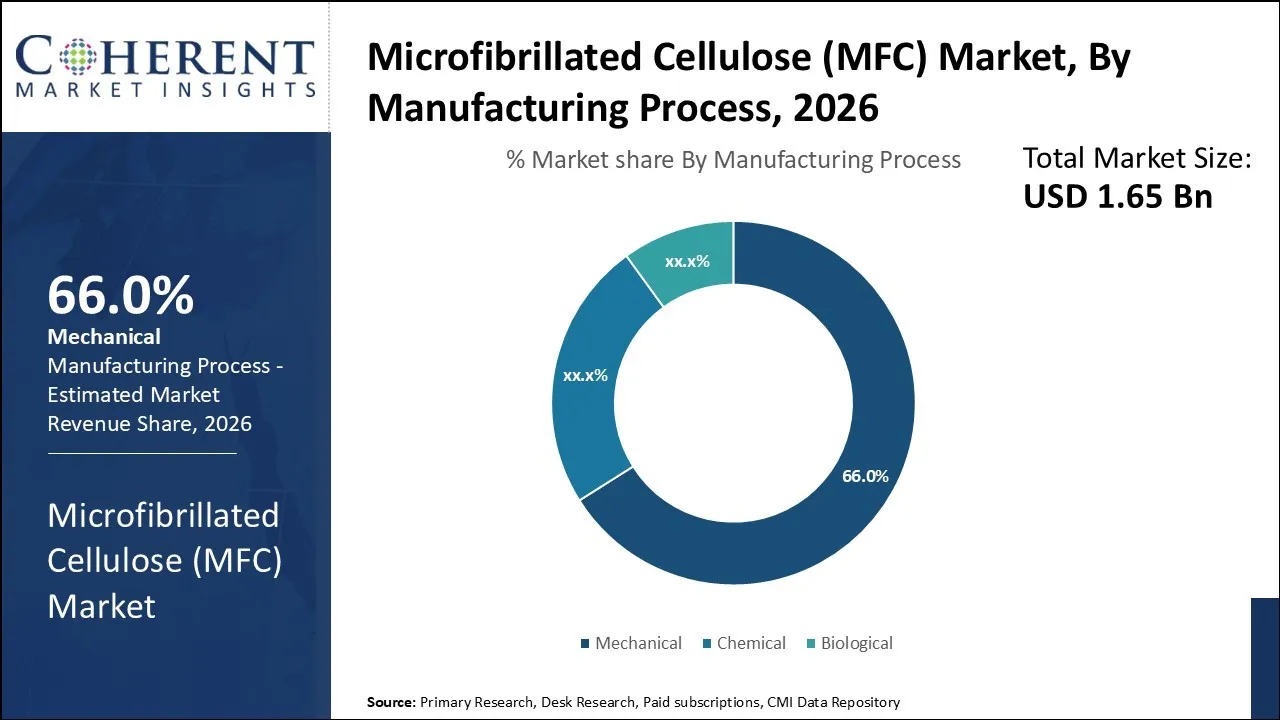
- Based on manufacturing process, the mechanical segment is expected to hold 66.4% share of the market in 2026.
- Based on distribution channel, the packaging segment is projected to account for 37.2% share of the market in 2026.
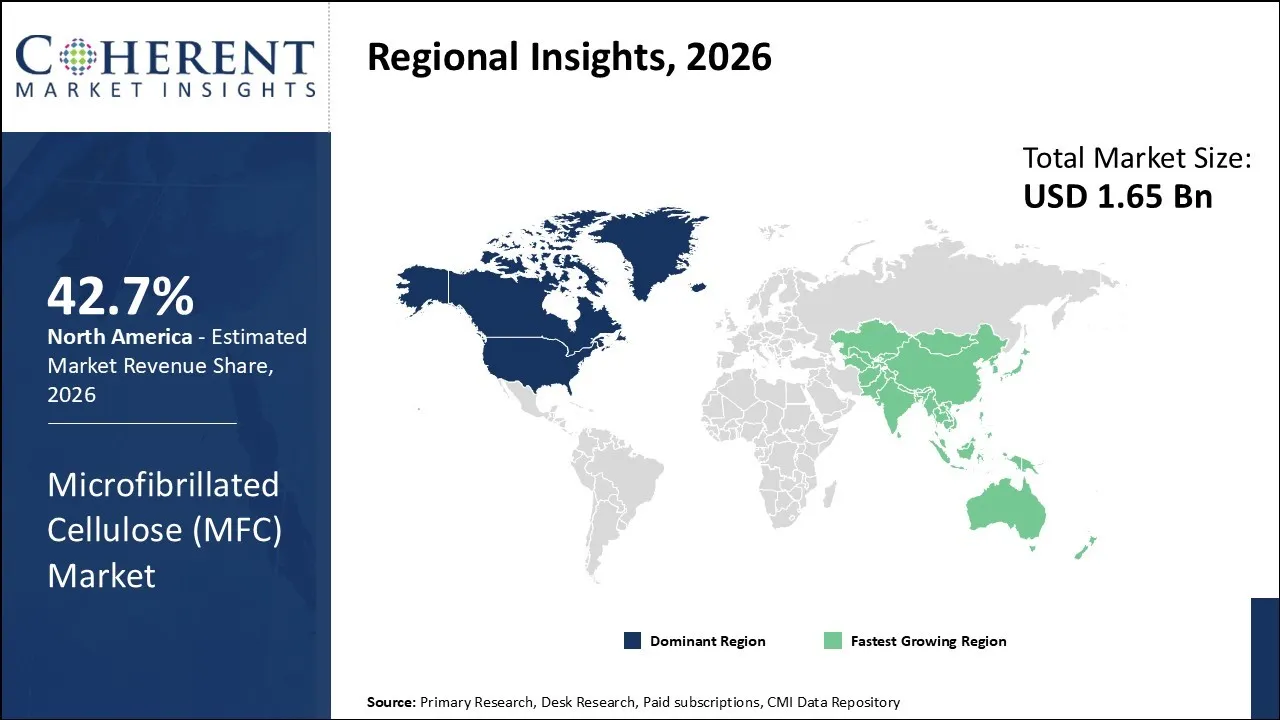
- Based on Region, North America is set to lead the microfibrillated cellulose (MFC) market with 42.7% share in 2026. While, Asia Pacific is anticipated to be the fastest growing region.
Market Overview
Microfibrillated cellulose (MFC) is a renewable commodity and has various applications includes paper, packaging, pharmaceuticals, paints and coatings, personal care & cosmetics. MFC fiber plays a major role in bolstering paper-based products. It is increasingly gaining interest as a substitute to plastic, and thickening agents in paint and coating products. Emerging applications in pharmaceuticals and personal care, though currently representing smaller market segments, demonstrate rapid adoption trajectories and suggest untapped growth potential. The pharmaceutical sector particularly values MFC's advanced drug delivery capabilities, while cosmetics and personal care manufacturers leverage its rheology modification properties.
Current Events and their Impacts on the Microfibrillated Cellulose (MFC) Market
Current Event | Description and its Impact |
Technological Advances in Microfibrillated Cellulose Production |
|
Regulatory and Sustainability Trends Driving Adoption |
|
Segmental Insights
- Current Industry Events of 2026
- Market Size Estimation
- Regional Breakdown
- Competitive Landscape
- Customer Intelligence
- Segmental Analysis
- Pricing Analysis
- Key Market Drivers, Challenges & Future Trends
- Customized Insights Section
Microfibrillated Cellulose (MFC) Market Insights, By Manufacturing Process - Mechanical represent the largest market, because of its Efficiency and Cost-Effectiveness
In terms of manufacturing process, the mechanical segment is expected to lead the market with 66.4% share in 2026, owing to its proven technical feasibility, established scalability, and cost-effectiveness for large-scale industrial production. The mechanical process has emerged as the dominant manufacturing approach because it demonstrates superior commercial viability compared to alternative methods.
For instance, in July 2025, Kadant Lamort unveiled their innovative BioFiber MFC coatings, which are redefining sustainable packaging. With the growing global shift away from plastic, MFC coatings produced via the mechanical process are now offering high-performance barrier properties in paper-based packaging.
Microfibrillated Cellulose (MFC) Market Insights, By Application - Packaging dominate the market due to the growing demand for sustainable packaging solutions
In terms of Application, the packaging segment is expected to hold 37.2% share of the market in 2026. The packaging segment's dominance is fundamentally driven by the growing industrial demand for lightweight yet robust solutions that can maintain structural integrity while reducing overall material weight and environmental footprint. MFC's exceptional mechanical properties play a critical role in this segment's leadership position.
For instance, in March 2025, Lubrizol's pre-launch of Carbopol BioSense polymer in Brazil, developed in collaboration with Suzano, highlights the increasing importance of biodegradable materials in the packaging industry. The Carbopol BioSense polymer is a breakthrough ingredient that combines high performance with sustainability, marking a significant milestone by being the first readily biodegradable polymer in the Carbopol® line. This innovation is aligned with the growing demand for eco-friendly solutions in cosmetics packaging, similar to how Microfibrillated Cellulose (MFC) is redefining sustainable packaging in broader industries.
Regional Insights
North America Microfibrillated Cellulose (MFC) Market Analysis & Trends
North America is expected to dominate the Microfibrillated Cellulose (MFC) market with 42.7% share in 2026, owing to a well-established pulp and paper industry infrastructure combined with a strong regional commitment to sustainable packaging solutions. The region has developed comprehensive research and development capabilities that continue to advance microfibrillated cellulose applications across multiple industrial sectors.
For instance, initiatives like the US Plastic Pact, which set ambitious targets for 2025, such as 100% of plastic packaging being reusable, recyclable, or compostable, and 50% of packaging being recycled or composted, along with 30% recycled or bio-based content, directly support the growing demand for alternative, sustainable packaging materials like MFC.
Asia Pacific Microfibrillated Cellulose (MFC) Market Analysis & Trends
Asia Pacific is expected to exhibit the fastest growth, propelled by the region’s rapid industrialization, expanding downstream applications, and growing environmental regulations favoring sustainable materials. Countries like China, India, Japan, and South Korea are witnessing substantial investments in cellulose-related technologies, supported by government initiatives aimed at reducing plastic consumption and encouraging renewable resource usage.
For instance, as per OECD 2025 report, globally, 91% of companies by market capitalization disclosed sustainability-related information in 2024, up from 86% in 2022, with Asia-Pacific countries (excluding the US) reporting 94% disclosure rates. This growing emphasis on corporate sustainability drives investment and innovation in renewable materials, such as microfibrillated cellulose (MFC), supporting the adoption of eco-friendly solutions across industrial sectors.
Microfibrillated Cellulose (MFC) Market Outlook Country-Wise
The U.S. Microfibrillated Cellulose (MFC) Market Trends
In terms of Region, the US contributes the highest share in the Microfibrillated Cellulose (MFC) market in North America owing to its highly developed industrial ecosystem and significant investments in advanced material research and sustainable manufacturing processes. The United States has established itself as a vital hub for innovation in cellulose-based products, supported by extensive R&D infrastructure, collaborative partnerships between academia and industry, and robust funding streams aimed at developing sustainable biomaterials.
For instance, in May 2025, VERDE received USD 420,000 in funding from the U.S. Department of Energy to advance its technology for sustainable biomaterials. This funding demonstrates the US government’s commitment to supporting innovative cellulose-based research and commercialization, highlighting how financial backing and robust R&D infrastructure enable companies to develop advanced, eco-friendly materials. The initiative underscores the United States’ leadership in the MFC market, where collaborative support between public agencies, industry, and research institutions accelerates the adoption of sustainable materials and reinforces the country’s dominant regional position.
China Microfibrillated Cellulose (MFC) Market Trends
China’s extensive manufacturing base, particularly in the paper and packaging industries, is a critical driver for its dominance. The country has been aggressively modernizing its pulp and paper mills to adopt sustainable and eco-friendly materials, where microfibrillated cellulose is gaining significant traction as a renewable and biodegradable reinforcement additive.
For instance, in December 2025, Valmet was selected to replace five existing tissue machine shoe presses with its Advantage ViscoNip press technology at Lee & Man Paper Manufacturing Ltd. in China, with rebuilds at mills in Chongqing, Jiangxi, and Guangdong. This upgrade demonstrates China’s commitment to modernizing its industrial infrastructure to support advanced, sustainable manufacturing processes, enabling more efficient incorporation of microfibrillated cellulose into paper products.
Market Report Scope
Microfibrillated Cellulose (MFC) Market Report Coverage
| Report Coverage | Details | ||
|---|---|---|---|
| Base Year: | 2025 | Market Size in 2026: | USD 1.65 Bn |
| Historical Data for: | 2020 To 2024 | Forecast Period: | 2026 To 2033 |
| Forecast Period 2026 to 2033 CAGR: | 14% | 2033 Value Projection: | USD 4.01 Bn |
| Geographies covered: |
| ||
| Segments covered: |
| ||
| Companies covered: | Borregaard Chemicals Company, Daicel Corporation, FiberLean Technologies Ltd, J. Rettenmaier & Söhne, Nippon Paper Industries Co., Ltd, Norske Skog ASA, Sappi Limited, Stora Enso Oyj, Weidmann Fiber Technology, and Zelfo Technology GmbH. | ||
| Growth Drivers: |
| ||
| Restraints & Challenges: |
| ||
Microfibrillated Cellulose (MFC) Market Driver
Growing global shift towards sustainable materials driven by environmental concerns and stricter regulations
Microfibrillated cellulose represents a strategic response to the global sustainability challenge, addressing environmental concerns through its fundamental material composition and production methodology. MFC is derived from renewable resources and agro-industrial by-products, such as sugar beet pulp and olive pomace, transforming waste streams into high-performance materials. Unlike petroleum-based alternatives, MFC production utilizes purely mechanical processing that is energy-efficient and maintains a low carbon footprint.
MFC's renewable and biodegradable nature as an attractive replacement for plastic and synthetic fibers
Microfibrillated Cellulose (MFC), derived from plant-based cellulose fibers, is gaining significant traction as an eco-friendly and biodegradable alternative to traditional plastics and synthetic fibers, primarily due to increasing environmental regulations and rising consumer awareness regarding plastic pollution. The renewable nature of MFC makes it an ideal candidate for replacing petroleum-based materials in numerous industries, including packaging, textiles, and automotive components.
Microfibrillated Cellulose (MFC) Market Opportunity
Expanding uses in textiles, packaging replacements, and additives in construction materials
Microfibrillated cellulose (MFC), derived from plant fibers through mechanical fibrillation, is gaining significant traction across multiple industries due to its unique properties such as high strength, biodegradability, and renewability. One of the most promising avenues driving the expansion of the MFC market lies in its growing applications in textiles, packaging replacements, and additives in construction materials. In the textile industry, MFC offers a sustainable alternative to synthetic fibers, helping to reduce reliance on petrochemical-based fabrics.
Analyst Opinion (Expert Opinion)
- The Microfibrillated Cellulose (MFC) market is gaining significant traction due to the rising demand for sustainable and biodegradable alternatives in various end-use industries. One of the primary drivers fueling market growth is the increasing adoption of MFC in packaging, paper, and composites, attributed to its superior mechanical properties and environmental benefits. Additionally, the growing emphasis on reducing carbon footprints and dependence on fossil-based products propels the use of MFC as a renewable resource. However, high production costs and complexities associated with scaling up manufacturing processes serve as notable restraints, hindering widespread adoption.
- Despite these challenges, innovations in processing technologies present substantial opportunities for cost reduction and efficiency enhancement, paving the way for broader application across automotive, construction, and personal care sectors. The shift towards eco-friendly materials in developing economies further amplifies growth potential, especially with supportive regulatory frameworks encouraging sustainable manufacturing.
- Geographically, the Asia-Pacific region is emerging as the fastest-growing market for microfibrillated cellulose, driven by rapid industrialization, increasing environmental awareness, and expanding paper and packaging industries. North America and Europe continue to dominate the market due to well-established infrastructure, technological advancements, and investments in research and development.
- Overall, the MFC market holds promising prospects, contingent upon overcoming production hurdles and capitalizing on its eco-friendly attributes to meet global sustainability goals. Continued innovation and strategic partnerships will be critical in unlocking new applications and enhancing market penetration.
Speak to the analyst
Want personalized insights?
Take the findings above to one of our principal consultants, or have the report rebuilt around the segments, geographies and competitors you actually track.
Global Microfibrillated Cellulose (MFC) Market: Key Developments
- In November 2025, Soane Materials, a company that makes innovative and sustainable materials, has launched its new SoMatrix Core technology. This is the first of its kind and is part of the SoaneClean Licensing Platform. The platform allows companies to create materials that are petrochemical-free, fully biodegradable, and dissolve quickly while keeping high performance.
- In September 2025, CelluForce, a leading company in cellulose nanocrystals (CNC), has launched CelluShield. This is a new, high-performance, plant-based coating that can be used on flexible packaging. It helps make the packaging recyclable without reducing its strength, shelf life, or ability to protect the product.
- In June 2025,Toyo Seikan Group Holdings ,a company in Tokyo, took part in the Future Life Expo 2025 in Osaka, Japan, from June 10 to June 16, 2025, as part of Nano Cellulose Japan (NCJ). During the event, NCJ will show the “New ECOCRYSTAL Cup,” a paper cup made using Japan’s first cellulose nanocrystals (CNC) that help block oxygen. They will also display a small device that lets people see how the CNC works to give the cup its barrier properties.
Market Segmentation
- By Manufacturing Process
- Mechanical
- Chemical
- Biological
- By Application
- Paper
- Packaging
- Pharmaceuticals
- Paints and Coatings
- Personal Care & Cosmetics
- Others (Home Care & Food & Beverages)
- By Region
- North America
- U.S.
- Canada
- Latin America
- Brazil
- Argentina
- Mexico
- Rest of Latin America
- Europe
- Germany
- U.K.
- Spain
- France
- Italy
- Russia
- Rest of Europe
- Asia Pacific
- China
- India
- Japan
- Australia
- South Korea
- ASEAN
- Rest of Asia Pacific
- Middle East & Africa
- GCC Countries
- Israel
- Rest of Middle East & Africa
- North America
- Key Players
- Borregaard Chemicals Company
- Daicel Corporation
- FiberLean Technologies Ltd
- Rettenmaier & Söhne
- Nippon Paper Industries Co., Ltd
- Norske Skog ASA
- Sappi Limited
- Stora Enso Oyj
- Weidmann Fiber Technology
- Zelfo Technology GmbH.
Sources
Primary Research Interviews
- Microfibrillated Cellulose (MFC) Manufacturers
- Raw Material Suppliers
- Distributors and Traders
- Industry Experts & Consultants
- Others
Databases
- Independent Commodity Intelligence Services
- USPTO / Espacenet / WIPO Patentscope
- ClinicalTrials.gov
- OECD / FAO Statistics
- Others
Magazines
- Paper & Wood Asia
- BioBased World News
- Cellulose Chemistry and Technology
- Others
Journals
- Carbohydrate Polymers
- Cellulose
- Journal of Applied Polymer Science
- Others
Newspapers
- The Financial Times
- The Economic Times
- The Wall Street Journal
- Industry Today
- Others
Associations
- American Chemical Society (ACS) - Cellulose & Renewable Materials Division
- European Dispersive Papermaking Association (EDPA)
- Pulp & Paper Technical Association of Canada (PAPTAC)
- TAPPI (Technical Association of the Pulp and Paper Industry)
- Others
Public Domain Sources
- World Bank
- United Nations Comtrade Database
- International Energy Agency (IEA)
- OECD iLibrary
- Others
Proprietary Elements
- CMI Data Analytics Tool
- Proprietary CMI Existing Repository of Information for the Last 8 Years
Get access to 250+ pages report
Every segment, forecast, competitor profile and data table behind the analysis above — available for instant download.
- ESOMAR Member
- ISO 9001:2015 Certified
- D-U-N-S Registered
- GDPR & CCPA Compliant
Missing comfort of reading report in your local language? Find your preferred language:
Transform your Strategy with Exclusive Trending Reports
Frequently Asked Questions
The global Microfibrillated Cellulose (MFC) Market size was valued at USD 1.65 Bn in 2026 and is expected to reach USD 4.01 Bn in 2033.
Major players operating in the market include Borregaard Chemicals Company, Daicel Corporation, FiberLean Technologies Ltd, J. Rettenmaier & Söhne, Nippon Paper Industries Co., Ltd, Norske Skog ASA, Sappi Limited, Stora Enso Oyj, Weidmann Fiber Technology, and Zelfo Technology GmbH.
Among manufacturing process, the mechanical segment estimated significant revenue in 2026.
Growing demand for sustainable packaging material.
The market is estimated to exhibit a CAGR of 14% till 2033
Among region, North America is expected to witness significant growth over the forecast period.