

Fatty Acid Methyl Esters Market Size and Forecast — 2026-2033
Fatty acid methyl esters market is estimated to be valued at USD 25.45 Bn in 2026 and is expected to reach USD 36.78 Bn by 2033, exhibiting a compound annual growth rate (CAGR) of 5.4% from 2026 to 2033. The market has been growing steadily over the past few years driven by increasing demand from various end-use industries like biodiesel, lubricants, and oleo chemicals.
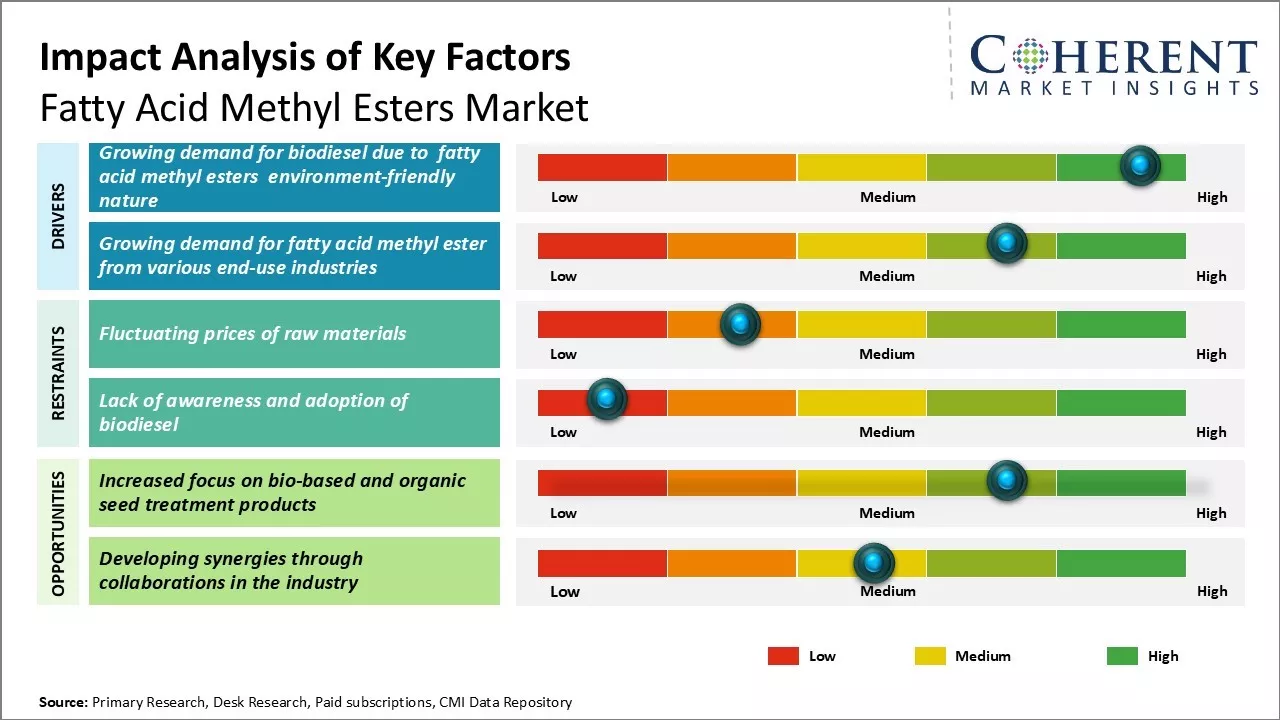
Fatty acid methyl esters find wide applications as biodiesel and are increasingly being used as an alternative to petroleum-based diesel. Growing environmental concerns about carbon emissions and focus on developing bio-based and renewable fuels are expected to drive the demand for fatty acid methyl esters in the coming years.
Insights by Type
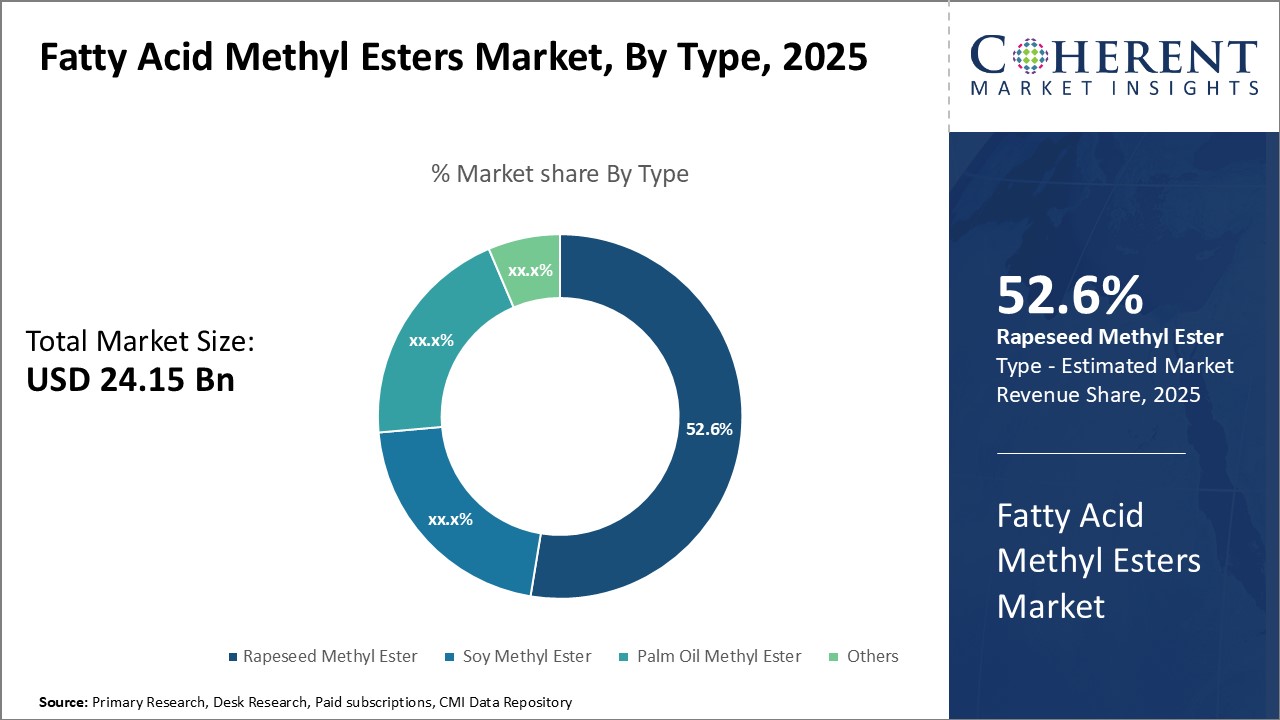
Insights by Type: Rapeseed Methyl Ester Dominates Due to Versatility and Cost Benefits
In terms of type, the rapeseed methyl ester segment is estimated to contribute the highest market share of 53.6% in 2026 due to its versatility and relatively low production costs compared to other vegetable oil sources. Rapeseed, also known as canola, is widely cultivated across Europe and Canada where cool climates are suitable for the crop. Its oil content ranges from 38-48% by weight, yielding more oil per acre than competing crops like soybean or palm.
Insights by Application
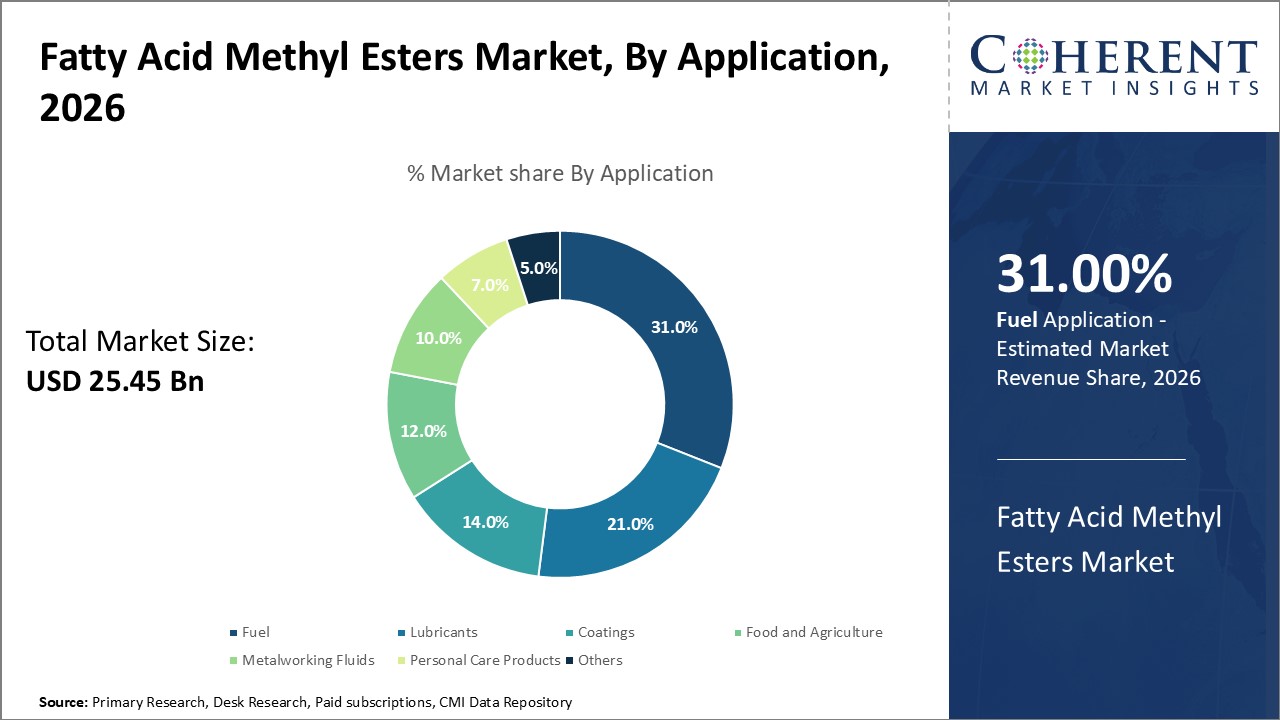
Insights by Application: Fuel Dominates on Mandates and Infrastructure Support
The fuel segment is estimated to contribute the highest market share of 31% in 2026 of the fatty acid methyl esters market due to legislation and infrastructure driving biodiesel consumption. In the transportation sector, many governments have implemented renewable fuel standards that require blending biofuels like fatty acid methyl ester into diesel and gasoline. Mandates guarantee market demand and incentivize fuel producers and retailers to supply biodiesel.
Regional Insights
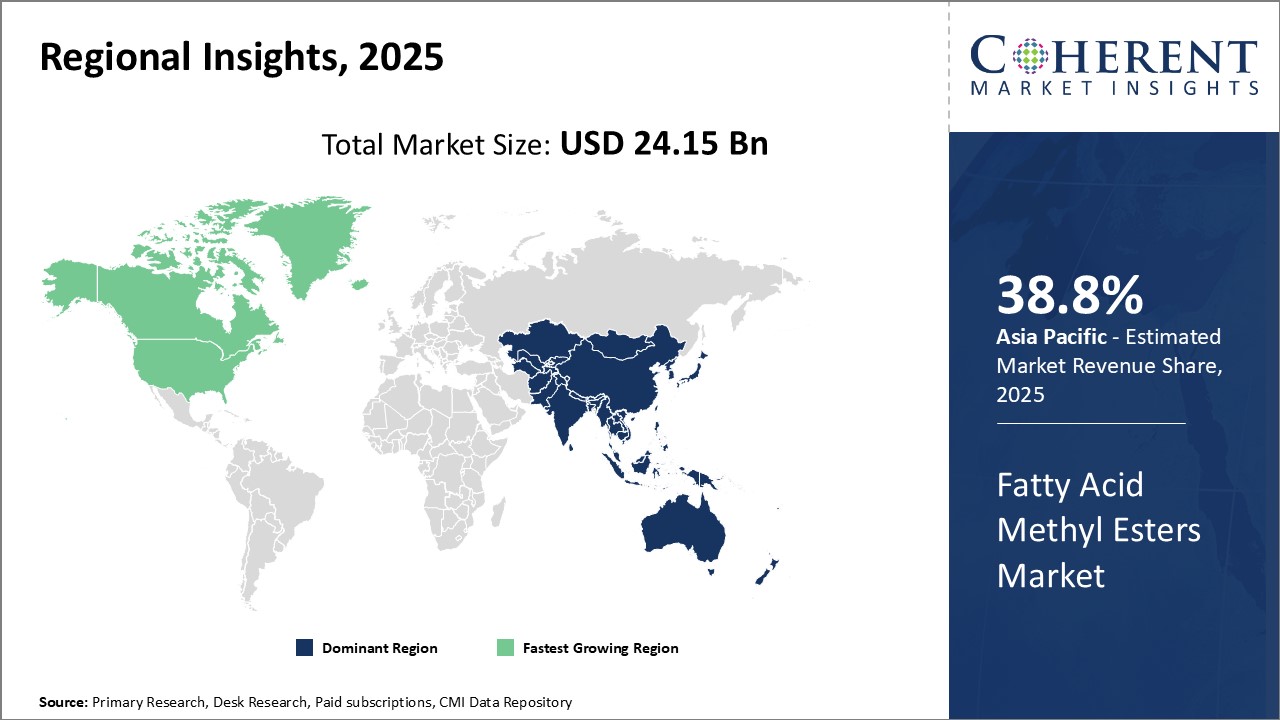
Regional Analysis: Fatty Acid Methyl Esters Market
Dominating Region: Asia Pacific
Asia Pacific accounted for the greatest revenue share, with 38.8% in 2026. In Asia Pacific, the dominance in the fatty acid methyl esters market can be attributed to strong biodiesel policies and incentives in countries such as Indonesia, Malaysia, and Thailand. These countries have ensured robust local production and consumption.
Fastest-Growing Region: North America
The fatty acid methyl esters market in North America exhibits the fastest growth on the back of growing deployment of biodiesel blending mandates in countries like the U.S. and Canada. The region's agriculture industry is a major provider of feedstock, offering a competitive advantage.
Fatty Acid Methyl Esters Market Outlook for Key Countries
Brazil
Brazil market benefits from the country's global leadership in sugarcane cultivation and strong policy push for higher biodiesel mandates and use of renewable fuels.
Argentina
Argentina market is driven by supportive regulations and availability of raw materials such as soybean oil. International investors have ramped up investments in biodiesel production facilities.
U.S.
The U.S. continues to lead in North America, supported by the renewable fuel standard program and advanced biofuels incentives. Regional players are shifting focus to renewable diesel and sustainable aviation fuel.
Germany
Germany market benefits from the country's transition to a greener fuels landscape and emphasis on decarbonization of the transportation sector.
Market Players, Key Development, and Competitive Intelligence
Top Strategies Followed by Fatty Acid Methyl Esters Market Players
- Established Players: R&D Investment - Leading companies such as cargill in the fatty acid methyl esters market are focusing extensively on research and development to innovate high-performance products. They are investing significantly in developing low-carbon and renewable fuel solutions to meet sustainability goals. Strategic Partnerships - Companies are forming strategic alliances with major automobile manufacturers and airlines to solidify their presence in the transportation sector. Such partnerships help improve production capabilities and strengthen distribution networks globally.
- Mid-Level Players: Cost-Effective Solutions - Medium size players in the market are focused on delivering affordable yet quality fatty acid methyl ester products targeting the price sensitive segment. Their strategy lies in optimized production processes that help reduce manufacturing costs. Collaborations - These companies leverage partnerships to augment their technology and production infrastructure. Collaborating with regional startups helps boost local market access and presence.
- Small-Scale Players: Niche Specialization - Small players tend to focus on niche application areas like marine diesel and tap specialized feedstock sources. Their innovation lies in unique product formulations addressing requirements unmet by larger offerings. Technology Adoption - Adopting advanced technologies enables smaller companies to operate efficiently on tighter budgets. Use of smart automation improves productivity and quality. Local Alliances - Forging local supply chain bonds aids market entry. Partnerships with farmers or industrial units aid the procurement of quality raw materials.
Emerging Startups in the Fatty Acid Methyl Esters Market
Innovative Technologies: Examples - Startups are coming up with cutting-edge technologies like enzymatic conversion process, algal oil extraction, and hydrogenated veggie oils production. Market/Impact - Adoption of such innovative technologies could disrupt the industry dynamics and shift trends towards biological routes.
Sustainable Solutions: Examples - Some startups offer carbon recycling technology and waste-derived feedstock. Environmental Impact - Alternative waste management solutions from these startups can significantly reduce industry's carbon footprint over the long-run.
Market Contribution: Niche Markets - Startups address narrow application segments like jet fuels and marine lubricants untapped. Collaborations - Partnering with research bodies helps startups fast-track product development and commercialization.
- Current Industry Events of 2026
- Market Size Estimation
- Regional Breakdown
- Competitive Landscape
- Customer Intelligence
- Segmental Analysis
- Pricing Analysis
- Key Market Drivers, Challenges & Future Trends
- Customized Insights Section
Market Report Scope
Fatty Acid Methyl Esters Market Report Coverage
| Report Coverage | Details | ||
|---|---|---|---|
| Base Year: | 2025 | Market Size in 2026: | USD 25.45 Bn |
| Historical Data for: | 2020 To 2024 | Forecast Period: | 2026 To 2033 |
| Forecast Period 2026 to 2033 CAGR: | 5.4% | 2033 Value Projection: | USD 36.78 Bn |
| Geographies covered: |
| ||
| Segments covered: |
| ||
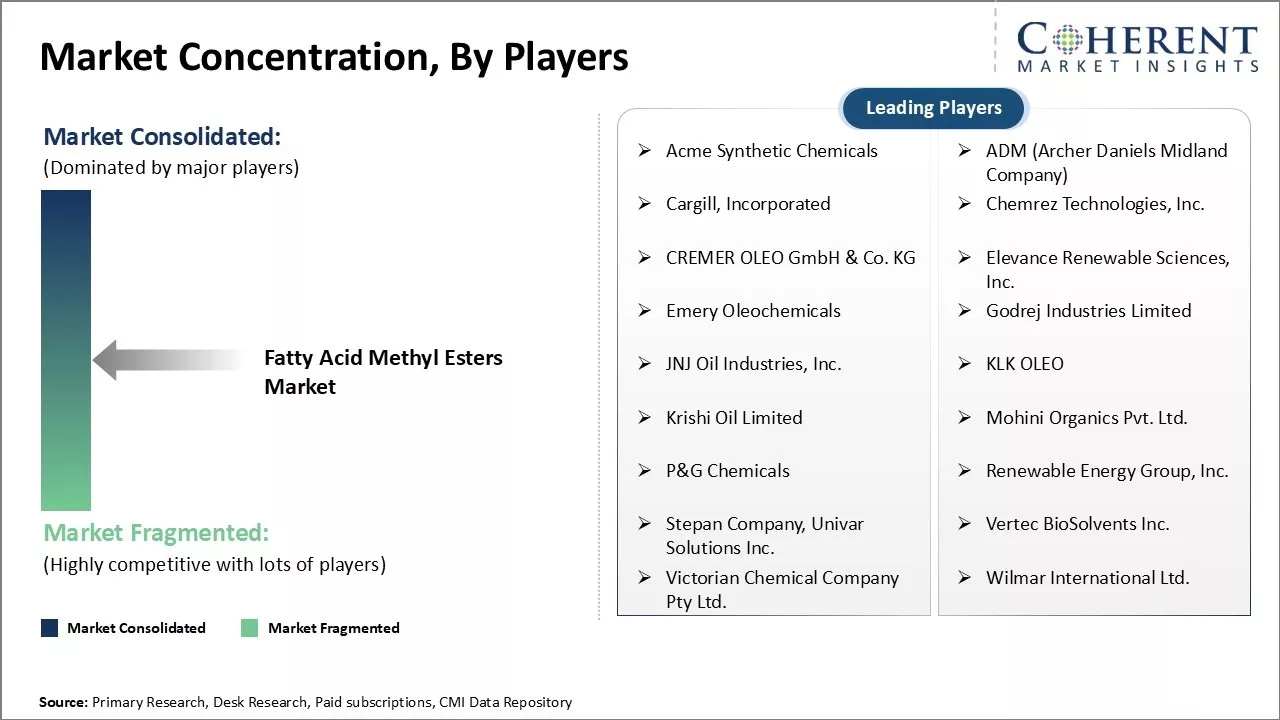
| Companies covered: | Acme Synthetic Chemicals, ADM (Archer Daniels Midland Company), Cargill, Incorporated, Chemrez Technologies, Inc., CREMER OLEO GmbH & Co. KG, Elevance Renewable Sciences, Inc., Emery Oleochemicals, Godrej Industries Limited, JNJ Oil Industries, Inc., KLK OLEO, Krishi Oil Limited, Mohini Organics Pvt. Ltd., P&G Chemicals, Renewable Energy Group, Inc., Stepan Company, Univar Solutions Inc., Vertec BioSolvents Inc., Victorian Chemical Company Pty Ltd., and Wilmar International Ltd. | ||
| Growth Drivers: |
| ||
| Restraints & Challenges: |
| ||
Market Dynamics
Market Driver - Growing demand for biodiesel due to fatty acid methyl esters environment-friendly nature
Demand for biodiesel has been continuously rising across the globe driven by supportive government policies promoting the usage of cleaner fuels. Similarly, many states and municipalities in North America and Brazil have adopted biodiesel blending mandates to lower emissions from transportation and farming equipment. According to data published in May 2023 by The Palm Oil Plantation Fund Management Agency (BPDPKS), the agency provided US$1.85 billion in incentives for the production of 8.42 Bn liters of biodiesel in 2020; in 2021, it is expecting to provide US$2.97 billion for the production of 9.2 Bn liters. This rising consumption will ensure a continuous expansion in the market over the current decade.
Market Challenge - Fluctuating prices of raw materials
Fluctuating prices of raw materials have always presented a significant challenge for players in this market. Palm oil and soybean oil are the primary raw materials used in the production of fatty acid methyl esters. Vegetable oil prices are highly dependent on global crop production and any disruptions caused by unfavorable weather conditions can cause prices to spike. As per data from the Food and Agriculture Organization (FAO) of the United Nations, the FAO food price index that tracks international prices of major commodities averaged 159.3 points in March 2022, up 12.6% from February and as high as March 2011 levels.
Market Opportunity - Increased focus on bio-based and organic seed treatment products
Increased focus on bio-based and organic seed treatment products presents a massive opportunity for players in this market. With sustainability and environmental protection becoming priorities around the world, the demand for bio-based agricultural inputs is witnessing a significant uptrend. They provide protection against various pests and diseases without contaminating the soil or harming other crops. With growing consumer preference for organic food and an increasing emphasis on sustainability within the agriculture industry, the demand for such natural seed treatments is expected to rise steadily. According to data from the Research and Markets organization, the global organic food market grew by nearly 13% in 2020 alone, demonstrating strong tailwinds.
Analyst Opinion (Expert Opinion)
Key Takeaways from Analyst
The fatty acid methyl esters market is expected to experience growth driven by increasing demand for biodiesel. FAME plays a vital role as it is the primary component used in biodiesel production. Growing environmental concerns regarding carbon emissions from conventional diesel and government policies supporting biodiesel adoption will drive more biodiesel production, which, in turn, will augment the demand for FAME. Advancements in biodiesel production technologies are further supporting growth.
However, volatile feedstock prices remain a key challenge. As FAME is derived from vegetable oils and animal fats, fluctuations in agricultural commodity prices directly impact FAME prices. Availability of low-cost feedstock is important for market’s growth. Subsidy cuts in certain regions can also negatively impact demand.
Speak to the analyst
Want personalized insights?
Take the findings above to one of our principal consultants, or have the report rebuilt around the segments, geographies and competitors you actually track.
Market Segmentation
- Type Insights (Revenue, USD, 2021 - 2033)
- Rapeseed Methyl Ester
- Soy Methyl Ester
- Palm Oil Methyl Ester
- Others
- Application Insights (Revenue, USD, 2021 - 2033)
- Fuel
- Lubricants
- Coatings
- Food and Agriculture
- Metalworking Fluids
- Personal Care Products
- Others
- Regional Insights (Revenue, USD, 2021 - 2033)
- North America
- U.S.
- Canada
- Latin America
- Brazil
- Argentina
- Mexico
- Rest of Latin America
- Europe
- Germany
- U.K.
- Spain
- France
- Italy
- Russia
- Rest of Europe
- Asia Pacific
- China
- India
- Japan
- Australia
- South Korea
- ASEAN
- Rest of Asia Pacific
- Middle East
- GCC Countries
- Israel
- Rest of Middle East
- Africa
- South Africa
- North Africa
- Central Africa
- North America
- Key Players Insights
- Acme Synthetic Chemicals
- ADM (Archer Daniels Midland Company)
- Cargill, Incorporated
- Chemrez Technologies, Inc.
- CREMER OLEO GmbH & Co. KG
- Elevance Renewable Sciences, Inc.
- Emery Oleochemicals
- Godrej Industries Limited
- JNJ Oil Industries, Inc.
- KLK OLEO
- Krishi Oil Limited
- Mohini Organics Pvt. Ltd.
- P&G Chemicals
- Renewable Energy Group, Inc.
- Stepan Company, Univar Solutions Inc.
- Vertec BioSolvents Inc.
- Victorian Chemical Company Pty Ltd.
- Wilmar International Ltd.
Get access to 250+ pages report
Every segment, forecast, competitor profile and data table behind the analysis above — available for instant download.
- ESOMAR Member
- ISO 9001:2015 Certified
- D-U-N-S Registered
- GDPR & CCPA Compliant
Missing comfort of reading report in your local language? Find your preferred language:
Transform your Strategy with Exclusive Trending Reports
Frequently Asked Questions
The Fatty Acid Methyl Esters Market is estimated to be valued at USD 25.45 Bn in 2026, and is expected to reach USD 36.78 Bn by 2033.
The CAGR of the Fatty Acid Methyl Esters Market is projected to be 5.4% from 2026 to 2033.
Growing demand for biodiesel due to fatty acid methyl esters environment-friendly nature and growing demand for fatty acid methyl ester from various end-use industries are the major factors driving market growth.
Fluctuating prices of raw materials and lack of awareness and adoption of biodiesel are the major factors hampering the market growth.
In terms of type, the rapeseed methyl ester segment is estimated to dominate the market revenue share in 2026.
Acme Synthetic Chemicals, ADM (Archer Daniels Midland Company), Cargill, Incorporated, Chemrez Technologies, Inc., CREMER OLEO GmbH & Co. KG, Elevance Renewable Sciences, Inc., Emery Oleochemicals, Godrej Industries Limited, JNJ Oil Industries, Inc., KLK OLEO, Krishi Oil Limited, Mohini Organics Pvt. Ltd., P&G Chemicals, Renewable Energy Group, Inc., Stepan Company, Univar Solutions Inc., Vertec BioSolvents Inc., Victorian Chemical Company Pty Ltd., and Wilmar International Ltd. are the major players.
Asia Pacific is expected to lead the global fatty acid methyl esters market in 2026.