

Global 1,3 Propanediol Market Analysis & Forecast: 2026-2033
The Global 1,3 propanediol market size is valued at USD 467.4 Mn in 2026 and is expected to reach USD 905.1 Mn by 2033, growing at a compound annual growth rate (CAGR) of 9.9% from 2026 to 2033.
Key Takeaways
- By Product Type, the Conventional 1,3-Propanediol segment is projected to dominate the global market with a 54.2% share in 2026.
- By Region, North America is expected to lead the global 1,3-Propanediol market, accounting for approximately 45.0% of the market share in 2026.
- By Region, Asia Pacific is projected to be the second-largest market, capturing an estimated 35.0% share in 2026.
- By Region, Europe is anticipated to hold a 10.0% share of the global 1,3-Propanediol market in 2026.
Market Overview
Global 1,3-propanediol market is booming, fueled mainly by a push for greener, bio-based ingredients in cosmetics, personal care, and plastics. Makers now turn to plant-derived PDO because it is less toxic, breaks down more easily, and mixes well in formulas gentle on skin. Top beauty labels, for example, use it as a natural solvent and humectant in lotions and creams. At the same time, PTT- a polymer made with PDO- finds its way into apparel and car components, pulling even more of the chemical through the supply chain. Strong government incentives for bio processes, along with shoppers who choose earth-friendly products, keep the momentum going.
Current Events and Its Impacts
Event | Description and Impact |
Increasing Demand for Eco-Friendly Products |
|
Advancements in Biotechnology |
|
Expansion of End-Use Applications |
|
Segmental Insights
- Current Industry Events of 2026
- Market Size Estimation
- Regional Breakdown
- Competitive Landscape
- Customer Intelligence
- Segmental Analysis
- Pricing Analysis
- Key Market Drivers, Challenges & Future Trends
- Customized Insights Section
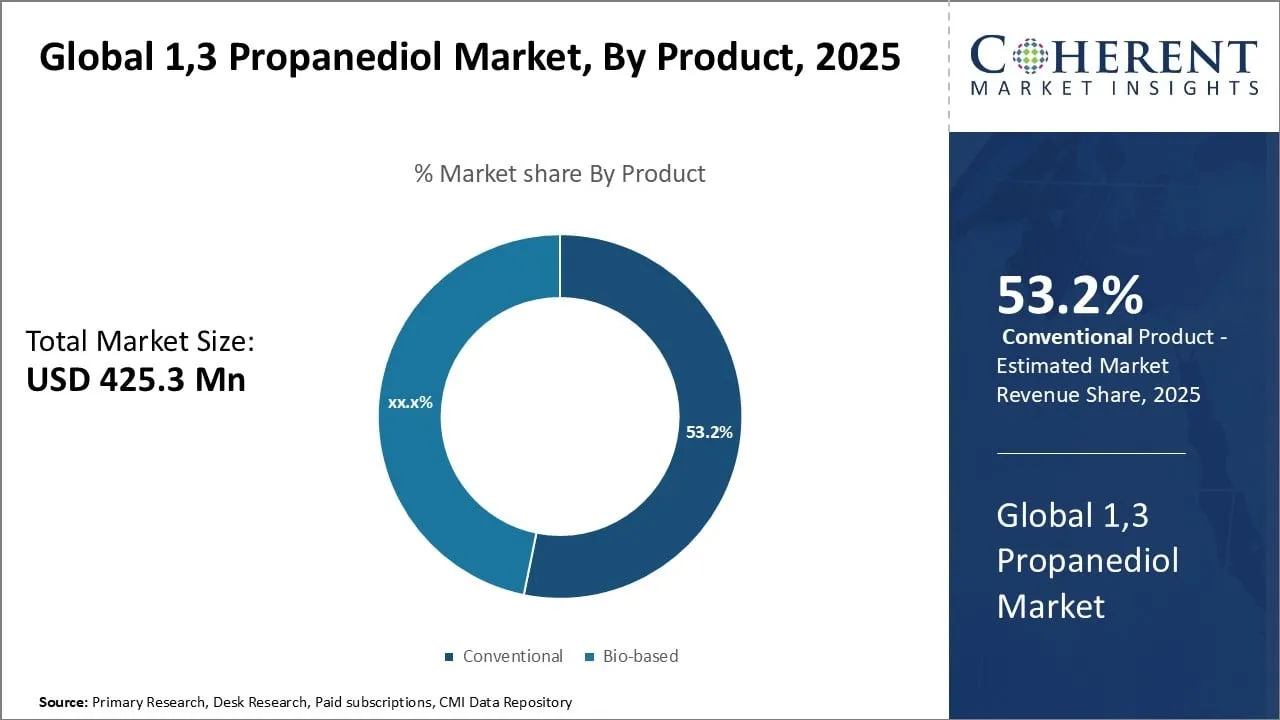
Global 1,3-Propanediol Market Insights, By Product
In terms of product type, conventional 1,3-propanediol is projected to account for 54.2% of the total propanediol market share in 2026, driven by its established supply chains, lower production costs, and widespread industrial usage. Conventional PDO, derived from petrochemical sources, continues to dominate applications such as polytrimethylene terephthalate (PTT) production, coatings, and antifreeze formulations due to its proven performance and availability at scale.
Despite the growing push toward bio-based alternatives, many manufacturers still prefer conventional PDO for large-volume applications where cost-effectiveness is a priority. Its high thermal stability and solvent properties make it suitable for high-temperature processes in textiles and automotive sectors.
Regional Insights
North America 1,3-Propanediol Market Analysis and Trends
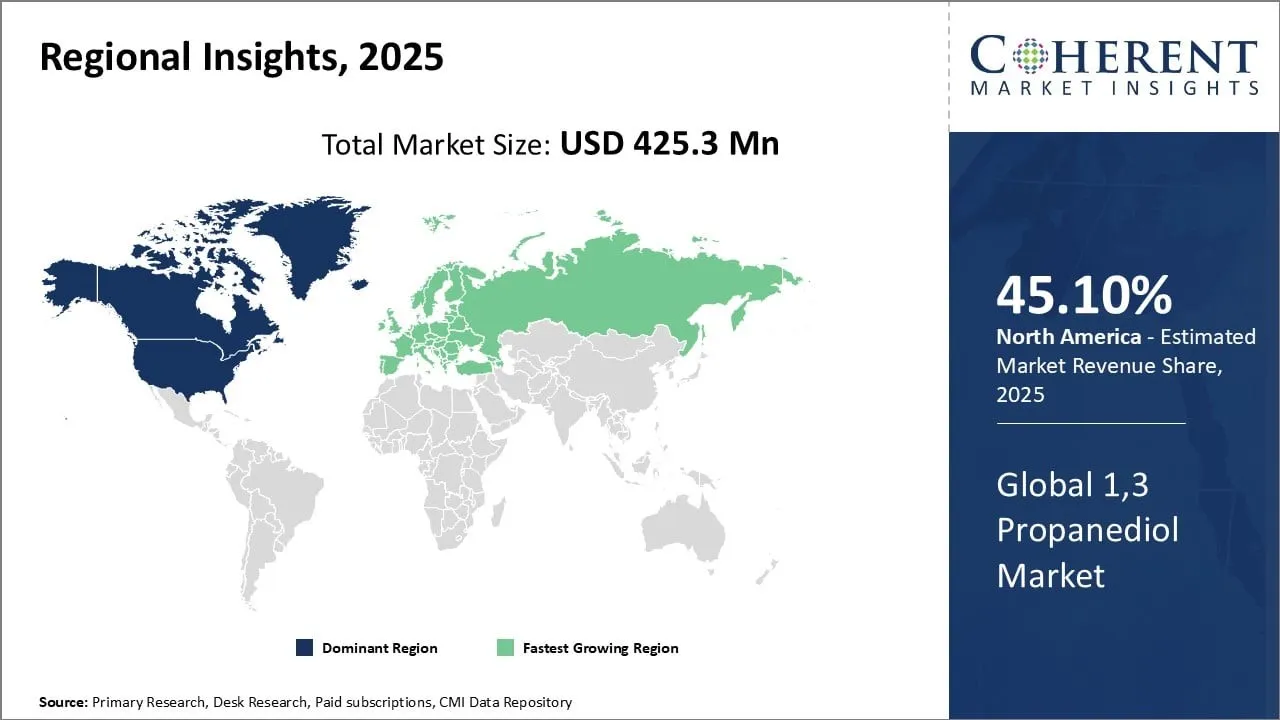
North America is projected to lead the global 1,3-propanediol market in 2026, accounting for approximately 45.1% of the market share. This dominance is driven by strong demand from the cosmetics and personal care sector, where 1,3-propanediol is widely used as a natural, skin-friendly solvent and humectant. The presence of major manufacturers and R&D-focused chemical companies across the U.S. and Canada is accelerating the commercialization of both conventional and bio-based PDO formulations.
Favorable regulatory frameworks encouraging green chemistry and increasing consumer demand for eco-labeled skincare products are further bolstering the region’s market leadership.
Asia Pacific 1,3-Propanediol Market Analysis and Trends
Asia Pacific is expected to be the second-largest market, capturing an estimated 35% market share in 2026. The region’s growth is fueled by the rapid expansion of the cosmetics and personal care industry, particularly in countries like China, India, Japan, and South Korea. Rising disposable income, urbanization, and increasing awareness of sustainable beauty products are driving demand for bio-based PDO as a safe and environmentally friendly alternative to synthetic glycols.
Additionally, Asia Pacific's cost-effective manufacturing capabilities and government support for green chemical production are positioning it as a strategic hub for PDO suppliers targeting global markets.
Europe 1,3-Propanediol Market Analysis and Trends
Europe is projected to hold 10% of the global 1,3-propanediol market in 2026, supported by its strong base of specialty chemical producers and growing emphasis on sustainable ingredients. Regulatory pressure to reduce dependence on petrochemical-based ingredients and a shift toward natural and bio-based solutions in personal care and industrial applications are driving gradual PDO adoption across the region. The presence of leading chemical firms and collaborative efforts to scale up bio-based production technologies are contributing to the region’s steady growth trajectory in this niche but evolving market.
Global 1,3 Propanediol Market Drivers
- Increasing use in polytrimethylene terephthalate (PTT) production
The use of 1,3 propanediol is rapidly expanding as it is the key raw material that is used in the production of polytrimethylene terephthalate which is commonly known as PTT. PTT is a synthetic polyester which exhibits properties similar to nylon such as high strength, elasticity, and resistance to degradation by microorganisms. These properties have made PTT popular for manufacturing textiles, carpeting, upholstery and medical fabrics. Unlike nylon, PTT is moisture-wicking which makes it suitable for outdoor and sportswear.
Leading brands are increasingly incorporating PTT fabric in their athletic and casual wear due to its soft texture and moisture management abilities. The demand for PTT has been growing at an impressive rate over the past few years as consumers are looking for high-performance fabrics for outdoor and athletic activities. The moisture transportation and quick-drying features of PTT fabric meet the evolving needs of active consumers.
Several apparel manufacturers have expanded their PTT capacity which in turn is augmenting the consumption of 1,3 propanediol that acts as building block for producing PTT polymer. The favorable properties coupled with improving production technologies which are supporting the widening scope of PTT applications beyond textiles into areas such as filaments and films.
This widespread utilization of PTT resin across diverse industries is driving significant volume growth for 1,3 propanediol in the near future. For example, Brazil is one of the leading producers of sugarcane-derived 1,3 propanediol. The Brazil country accounted for over 30% of global bio-1,3 propanediol production in 2021 according to the National Confederation of Agriculture.
- Expanding use in polyurethanes synthesis
1,3 propanediol is finding increasing usage as an important intermediate in manufacturing polyurethanes on an industrial scale. Polyurethanes have diverse applications ranging from foam insulation to adhesives & sealants to coatings & artificial leathers. When 1,3 propanediol is used to synthesize polyurethanes, it offers producers the flexibility to cater to varied performance characteristics depending on the specific end use.
For instance, polyurethane flexible foams when manufactured by using 1,3 propanediol as a raw material exhibit superior structural integrity, longevity, and compression set resistance. These high-quality flexible foams find wide applicability in bedding, furniture, automotive interiors and more. Besides flexible foams, 1,3 propanediol derived polyurethanes are also suitable for producing rigid foams, thermoplastic elastomers, adhesives, and synthetic leather.
Their versatile properties and competitive production economics as compared to petrochemical-based routes are spurring the replacement of conventional polyol sources with bio-based 1,3 propanediol. The eco-friendly credentials and compliance with stringent regulatory standards make 1,3 propanediol an attractive proposition for the constantly evolving polyurethane industry.
As polyurethane consumption continues to grow across major regional markets, the incorporation of bio-1,3 propanediol ensures simultaneous growth of the target market in the near future. For instance, according to data provided by the International Energy Agency's report, in 2020, the global plastic demand is projected to double by 2050 with polyurethanes accounting for over 20% of total plastic production.
Global 1,3 Propanediol Market Opportunities
- Growth of Polyethylene Terephthalate (PET) substitutes demand
The demand for PET substitutes has been growing steadily in recent years due to rising environmental concerns and sustainability efforts of manufacturers. PET plastic is non-biodegradable in nature and takes hundreds of years to decompose. This has raised questions on its long-term impact. 1,3 propanediol is a building block used to produce polytrimethylene terephthalate (PTT), which is a viable biodegradable alternative to PET in production of textiles, containers and bottles.
PTT breaks down quicker in municipal waste streams as compared to conventional plastics. For instances, according to statistics by United Nations Environment Program, around 11 Mn metric tonnes of plastic ends up in oceans annually, wreaking havoc on marine life and ecosystem. This has prompted governments worldwide to impose restrictions on single-use plastic items.
- Investments in research and development (R&D) activities
Investing in research and development is key for companies in the 1,3 propanediol market to gain a competitive advantage and drive future growth. 1,3 propanediol is primarily used to manufacture polytrimethylene terephthalate (PTT), which is a lightweight synthetic fibre that is stronger and softer than conventional polyester.
As demand for sustainable and eco-friendly fibres grows, significant R&D efforts are being made to improve the production process for 1,3 propanediol to make it less resource-intensive and have a lower environmental impact. Companies that successfully develop more sustainable production technologies through R&D will be well-positioned to capitalize on the increasing preferences of textile brands and consumers for greener materials.
For instance, research is ongoing to evaluate 1,3 Propanediol's potential as a platform chemical in producing biodegradable plastics, solvents, and cosmetic ingredients. As evidenced by the European Commission, global R&D expenditure on green chemicals is projected to grow over 6% annually between 2020-2023.
- Capacity expansion activities by key players
The 1,3 propanediol market has been witnessing significant capacity expansion activities by major players over the past few years (2020). Several leading manufacturers have announced plans to set up new production facilities or expand existing units across major markets to cater to the growing demand for 1,3 Propanediol. The capacity enhancements by key manufacturers are aimed at capitalizing on the rising requirements for 1,3 PDO especially from polytrimethylene terephthalate (PTT) producers and other application industries.
The demand for PTT fiber and resins has grown multi-fold in recent times on the back of increased textile and packaging needs. For instance, SK Innovation, a prominent South Korea based petrochemical company, started commercial operations of its new 180,000 tonne/year 1,3 PDO plant in Ulsan in 2021. This has significantly boosted SK Innovation's total PDO production capacity.
- Focus on bio-based 1,3-propanediol
The demand for bio-based 1,3-propanediol is rising significantly which is influencing the overall 1,3 propanediol market positively. There is an increasing consumer demand for more sustainable and eco-friendly products which is driving many brands and manufacturers to switch to bio-based alternatives. 1,3-propanediol is mainly used in polyester manufacturing for fabrics, films, and fibers. It is also used in cosmetics, personal care products, and pharmaceuticals.
The rise in focus on sustainability and eco-friendliness in all of these industries is contributing to the growing demand for bio-based 1,3-propanediol. Major brands such as Patagonia, Nike and Adidas have committed to increasing the use of bio-based and recycled materials in their products. For instances, in 2021, Adidas announced their goal of using only recycled polyester in all of their products by 2024.
Market Report Scope
1,3 Propanediol Market Report Coverage
| Report Coverage | Details | ||
|---|---|---|---|
| Base Year: | 2025 | Market Size in 2026: | USD 467.4 Mn |
| Historical Data for: | 2020 To 2024 | Forecast Period: | 2026 To 2033 |
| Forecast Period 2026 to 2033 CAGR: | 9.9% | 2033 Value Projection: | USD 905.1 Mn |
| Geographies covered: |
| ||
| Segments covered: |
| ||
| Companies covered: | Tokyo Chemical Industry Co., Ltd., Shenghong Group Holdings, Primient, Haihang Industry, DuPont, Metabolic Explorer, Zhangjiagang Glory Biomaterial Co., Ltd., Zouping Mingxing Chemical Co., Ltd., Shell Chemicals LP, and Merck KGaA. | ||
| Growth Drivers: |
| ||
| Restraints & Challenges: |
| ||
Global 1,3 Propanediol Market Analyst Viewpoint
- Global 1,3 propanediol market is expected to witness significant growth over the next decade (2032-2040). One of the main drivers boosting this market is the increasing demand for bio-based polymers and fibers. 1,3 propanediol is increasingly being used as a key raw material in producing polylactic acid (PLA) and polytrimethylene terephthalate (PTT), which are becoming more popular sustainable alternatives to traditional plastics.
- Another driver is the rising application of 1,3 propanediol in cosmetics and personal care products. Skin and hair care brands are using it as a moisturizer and emollient in creams, lotions, and other products. Its non-irritating nature makes it appealing for these applications.
- However, high production costs pose a challenge to widespread adoption. 1,3 propanediol is produced through fermentation processes which require significant capital investment and operating expenses. This restrains its price competitiveness against conventional plastics. Volatility in raw material prices also adds economic risks.
- The Asia Pacific region, led by China, is expected to continue dominating the global 1,3 propanediol market over the forecast period. This is due to sizable manufacturing bases for downstream end use industries like polymers and fibers.
Recent Development
- In February 2023, Huntsman International LLC made launched three innovative products at the European Coatings Show. The highlight of these releases includes JEFFAMINE M-3085, a unique mono-polyether amine, and POLYRESYST IC6005, an advanced polyurethane system that is designed specifically for intumescent coatings.
- In September 2022, Covation Biomaterials teamed up with Primient, a company known for its 100% plant-based 1,3-propanediol production. This collaboration marked their entry into Primient's sustainable agriculture program. The initiative is a boon for corn farmers in the American Midwest, aiding them in implementing sustainable and regenerative farming practices.
Market Segmentation
- Global 1,3 Propanediol Market, By Product (Revenue, USD Mn, 2021 - 2033)
- Conventional
- Bio-based
- Global 1,3 Propanediol Market, By Application (Revenue, USD Mn, 2021 - 2033)
- Polytrimethylene Terephthalate
- Polyurethane
- Personal Care & Detergents
- Others
- Global 1,3 Propanediol Market, By Region (Revenue, USD Mn, 2021 - 2033)
- North America
- U.S.
- Canada
- Latin America
- Brazil
- Argentina
- Mexico
- Rest of Latin America
- Europe
- Germany
- U.K.
- Spain
- France
- Italy
- Russia
- Rest of Europe
- Asia Pacific
- China
- India
- Japan
- Australia
- South Korea
- ASEAN
- Rest of Asia Pacific
- Middle East
- GCC Countries
- Israel
- Rest of Middle East
- Africa
- South Africa
- North Africa
- Central Africa
- Top Companies in the Global 1,3 Propanediol Market
- Tokyo Chemical Industry Co., Ltd.
- Shenghong Group Holdings
- Primient
- Haihang Industry
- DuPont, Metabolic Explorer
- Zhangjiagang Glory Biomaterial Co., Ltd.
- Zouping Mingxing Chemical Co., Ltd.
- Shell Chemicals LP
- Merck KGaA.
Sources
Primary Research Interviews
- DuPont Tate & Lyle Bio Products (Key manufacturer)
- Shell Chemicals (Major player)
- Haihang Industry Co., Ltd. (Industry participant)
- METabolic EXplorer (Innovative producer)
- Others
Databases
- Chemical Abstracts Service (CAS)
- SpecialChem Industrial Database
- Others
Magazines
- Chemical & Engineering News
- Chemical Week
- ICIS Chemical Business
- BioFuels Digest
- Others
Journals
- Journal of Applied Polymer Science
- Industrial & Engineering Chemistry Research
- Green Chemistry
- Others
Newspapers
- Chemical Industry News
- Financial Times (Chemical Industry Section)
- Wall Street Journal (Materials & Manufacturing)
- Chemical Daily
- Others
Associations
- American Chemical Society
- European Chemical Industry Council (CEFIC)
- Bio-based Industries Consortium
- Society of Chemical Manufacturers & Affiliates
- Others
Public Domain Sources
- U.S. Department of Energy Reports
- European Commission Chemical Industry Reports
- International Energy Agency Publications
- World Health Organization Chemical Safety Documents
- Others
Proprietary Elements
- CMI Data Analytics Tool
- Proprietary CMI Existing Repository of information for last 8 years
Get access to 250+ pages report
Every segment, forecast, competitor profile and data table behind the analysis above — available for instant download.
- ESOMAR Member
- ISO 9001:2015 Certified
- D-U-N-S Registered
- GDPR & CCPA Compliant
Missing comfort of reading report in your local language? Find your preferred language:
Transform your Strategy with Exclusive Trending Reports
Frequently Asked Questions
The Global 1,3 Propanediol Market size is estimated to be valued at USD 467.4 Mn in 2026, and is expected to reach USD 905.1 Mn by 2033.
Increasing use in polytrimethylene terephthalate (PTT) production and expanding use in polyurethanes synthesis are the major factors driving the global 1,3 propanediol industry.
The polytrimethylene terephthalate is the leading application in the global 1,3 propanediol industry.
The major players operating in the global market are Tokyo Chemical Industry Co., Ltd., Shenghong Group Holdings, Primient, Haihang Industry, DuPont, Metabolic Explorer, Zhangjiagang Glory Biomaterial Co., Ltd., Zouping Mingxing Chemical Co., Ltd., Shell Chemicals LP, and Merck KGaA.
North America leads the global market.
The CAGR of the Global Market is projected to be 9.9% from 2026 to 2033.