

Bromobenzene Market Size and Forecast: 2026-2033
The Bromobenzene Market is estimated to be valued at USD 55.3 Bn in 2026 and is expected to reach USD 68.9 Bn by 2033, exhibiting a compound annual growth rate (CAGR) of 7.2% from 2026 to 2033.
Key Takeaways
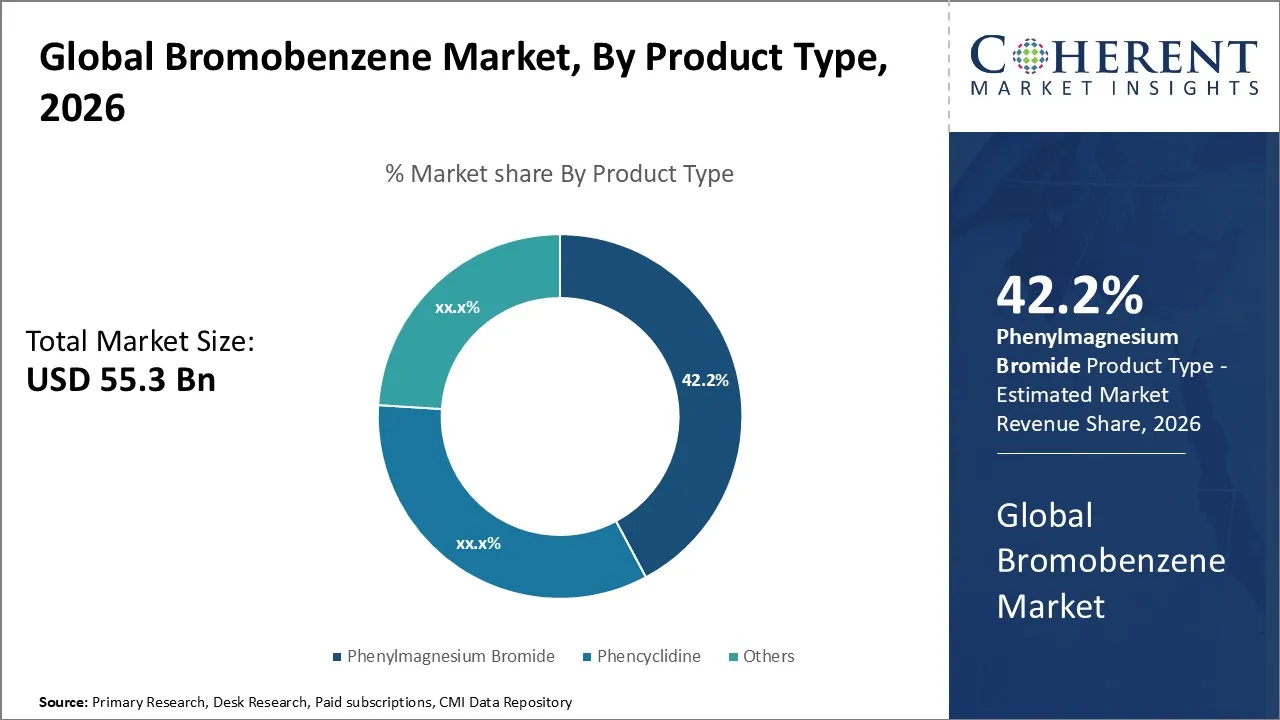
- By Product Type, Phenylmagnesium Bromide hold the largest market share of 42.2% in 2026 owing to the growing pharmaceutical industry.
- By Application, Pharmaceutical Intermediate expected to hold largest market share of 38.8% in 2026 owing to its expansion of global pharmaceutical production.
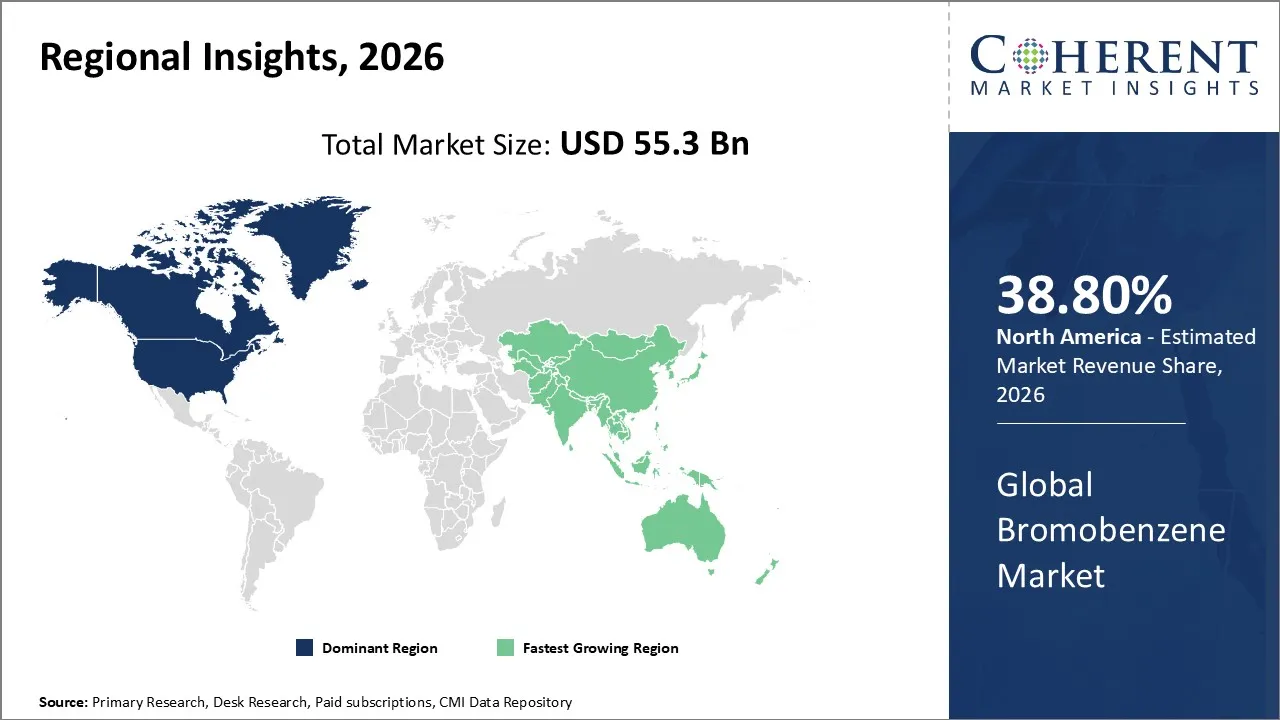
- By Region, North America dominates the overall market with an estimated share of 38.80% in 2026 owing to the strong pharmaceutical industry.
Market Overview
Manufacturers drive the bromobenzene market by using it widely as an intermediate in pharmaceutical, agrochemical, and specialty chemical production. They utilize bromobenzene to produce Grignard reagents and other aromatic compounds for organic synthesis. Increasing demand for pharmaceutical intermediates and fine chemicals continues to expand the market. Researchers and chemical companies also increase demand through growing activities in chemical research and advanced material production. Furthermore, companies strengthen the global bromobenzene market by expanding chemical and pharmaceutical manufacturing operations across major industrial regions.
Current Events and their Impact on the Bromobenzene Market
Current Events | Description and its impact |
Geopolitical Tensions in Key Producing Regions |
|
Economic and Regulatory Developments |
|
Supply Chain and Raw Material Factors |
|
Segmental Insights
- Current Industry Events of 2026
- Market Size Estimation
- Regional Breakdown
- Competitive Landscape
- Customer Intelligence
- Segmental Analysis
- Pricing Analysis
- Key Market Drivers, Challenges & Future Trends
- Customized Insights Section
Bromobenzene Market Insights, By Product Type - Phenylmagnesium Bromide contribute the highest share of the market owing to its expansion of agrochemical industry
Phenylmagnesium Bromide hold the largest market share of 42.2% in 2026. Chemical manufacturers increase the demand for bromobenzene by using it to produce phenylmagnesium bromide, an important Grignard reagent in organic synthesis. They apply this compound to form carbon–carbon bonds during the development of complex molecules for pharmaceuticals, specialty chemicals, and research purposes. Scientists and researchers further drive its use through growing activities in medicinal chemistry and laboratory synthesis. Additionally, the expanding fine chemical industry and the development of new synthetic methods promote greater consumption of phenylmagnesium bromide, which in turn strengthens the bromobenzene market.
Bromobenzene Market Insights, By Application - Pharmaceutical Intermediate contribute the highest share of the market owing to its rising drug discovery and R&D activities
Pharmaceutical Intermediate expected to hold largest market share of 38.8% in 2026. The pharmaceutical intermediate segment drives the bromobenzene market as drug manufacturers use bromobenzene to synthesize aromatic compounds for active pharmaceutical ingredients. Chemists incorporate bromobenzene derivatives into reaction pathways to construct complex molecular structures required for modern medicines. The ongoing development of new therapeutics and generic drugs increases the demand for reliable chemical intermediates. Furthermore, pharmaceutical companies boost bromobenzene consumption by expanding manufacturing capacity and investing more in medicinal chemistry research, which strengthens its role in pharmaceutical supply chains.
Regional Insights
North America Bromobenzene Market Trends
North America dominates the overall market with an estimated share of 38.80% in 2026. Manufacturers in North America drive the bromobenzene market by increasing production of pharmaceuticals and specialty chemicals. They use bromobenzene to produce intermediates for drug synthesis, fine chemicals, and Grignard reagents. Researchers in medicinal chemistry and organic synthesis laboratories further boost its consumption. Companies advance market adoption through technological innovations, sustainable production methods, and modern chemical manufacturing practices. Additionally, the growth of agrochemical production and specialty materials encourages wider use of bromobenzene, reinforcing its role as a versatile intermediate across multiple industries in the region.
Asia Pacific Bromobenzene Market Trends
Manufacturers in the Asia Pacific region expand bromobenzene production to meet growing regional demand. They use bromobenzene extensively to produce pharmaceutical intermediates, fine chemicals, and Grignard reagents for organic synthesis. Rapid industrialization, rising research activities, and the development of specialty chemicals further boost its consumption. Companies also implement advanced production technologies and optimize supply chain practices to increase efficiency. Additionally, the region’s expanding agrochemical and material sciences industries drive broader use of bromobenzene, reinforcing its role as a key intermediate across multiple applications.
United States Bromobenzene Market Trends
Manufacturers in the United States drive bromobenzene demand by producing pharmaceutical intermediates, fine chemicals, and specialty compounds. They use bromobenzene to synthesize Grignard reagents and other aromatic derivatives essential for organic reactions. Researchers further increase its utilization through expanding work in medicinal chemistry and laboratory-scale chemical development. Companies also enhance production by adopting advanced manufacturing technologies and efficient processes. Additionally, the growth of agrochemical and specialty material industries encourages broader use of bromobenzene, reinforcing its role as a versatile intermediate across diverse industrial applications nationwide.
China Bromobenzene Market Trends
Manufacturers in China expand bromobenzene production to meet rising demand from pharmaceutical, agrochemical, and specialty chemical industries. They utilize bromobenzene to produce pharmaceutical intermediates, fine chemicals, and Grignard reagents essential for organic synthesis. Rapid industrial growth, increasing chemical research, and the development of specialty products further drive its consumption. Companies also enhance efficiency by adopting advanced manufacturing techniques and optimizing supply chains. Additionally, the growth of agrochemical and material science sectors encourages broader use of bromobenzene, solidifying its role as a key intermediate across diverse industrial applications in China.
Bromobenzene Market Trend
Rising Demand in Pharmaceutical Synthesis
Bromobenzene continues to gain traction as a key intermediate in pharmaceutical manufacturing. Companies increasingly use it to produce active pharmaceutical ingredients and fine chemicals, particularly through Grignard reactions. Growing research in drug discovery and development drives consistent consumption, as chemists rely on bromobenzene to form complex molecular structures. Pharmaceutical manufacturers also prioritize high-purity grades to ensure reaction efficiency and product quality, making the compound indispensable in medicinal chemistry and laboratory-scale synthesis across various therapeutic segments.
Expansion in Agrochemical Applications
The bromobenzene market benefits from growing agrochemical production, as manufacturers use it to synthesize herbicides, pesticides, and fungicides. Rising global food demand and modern farming practices encourage the development of efficient and targeted crop protection chemicals. End-users rely on bromobenzene intermediates for producing high-quality agrochemicals with stable chemical properties. Continuous innovation in agrochemical formulations further increases consumption, positioning bromobenzene as a critical component in ensuring crop yields and sustainable agricultural practices.
Market Report Scope
Bromobenzene Market Report Coverage
| Report Coverage | Details | ||
|---|---|---|---|
| Base Year: | 2025 | Market Size in 2026: | USD 55.3 Bn |
| Historical Data for: | 2020 To 2024 | Forecast Period: | 2026 To 2033 |
| Forecast Period 2026 to 2033 CAGR: | 7.2% | 2033 Value Projection: | USD 68.9 Bn |
| Geographies covered: |
| ||
| Segments covered: |
| ||
| Companies covered: | CM Fine Chemicals GmbH, Hawks Chemical Company, Hebei Yingong New Material Technology Co., Ltd., Heranba Industries Ltd., Jiangsu Dacheng Pharmaceutical and Chemical Co., Ltd., Luyunjia Chemistry Xiamen Limited, Merck KGaA, Mody Chemi-Pharma Limited, RX MARINE INTERNATIONAL, and Yancheng Longsheng Chemical Co., Ltd. | ||
| Growth Drivers: |
| ||
| Restraints & Challenges: |
| ||
Bromobenzene Market News
In May 2025, LANXESS showcased its portfolio of aroma chemicals and multiple grades of benzyl benzoate for various applications at SIMPPAR 2025. As bromobenzene serves as a precursor for aroma chemicals and is used in the Grignard synthesis of benzyl benzoate, this presentation strengthened the company’s presence in the bromobenzene market.
Analyst Opinion (Expert Opinion)
- The bromobenzene market’s current trajectory underscores a clear structural shift toward high‑purity intermediates and specialty applications, particularly within pharmaceutical synthesis. Pharmaceutical‑grade bromobenzene consistently accounts for around 42–44% of total demand, reflecting its critical role as a precursor for complex active pharmaceutical ingredient (API) pathways and Grignard reagents used in advanced organic synthesis. High‑purity (≥99.5%) variants increasingly dominate orders from regulated R&D and fine‑chemical manufacturers, indicating elevated quality expectations and stringent compliance requirements in mature markets such as the United States and Europe.
- However, this demand concentration also exposes the market to regulatory and cost pressures. Environmental and safety regulations in developed economies impose significant compliance costs and can delay new capacity deployment, particularly where emissions and hazardous waste are tightly controlled. The volatility of benzene and bromine feedstock prices further compresses margins, occasionally prompting formulators to weigh alternative aromatic intermediates against bromobenzene’s superior reaction selectivity.
- Regionally, Asia‑Pacific’s integrated bromine value chains and competitive production costs have positioned it as the largest consumption hub, while North American and European demand increasingly centers on high‑end solvent grades and technical intermediates. This geographic divergence illustrates an ongoing bifurcation between volume‑driven, cost‑efficient supply bases and innovation‑driven, quality‑intensive end users.
Speak to the analyst
Want personalized insights?
Take the findings above to one of our principal consultants, or have the report rebuilt around the segments, geographies and competitors you actually track.
Market Segmentation
- By Product Type
- Phenylmagnesium Bromide
- Phencyclidine
- Others
- By Application
- Grignard Reagent
- Solvents
- Organic Chemical Synthesis
- Additives
- Pharmaceutical Intermediate
- Others
- By Regional Insights
- North America
- U.S.
- Canada
- Latin America
- Brazil
- Argentina
- Mexico
- Rest of Latin America
- Europe
- Germany
- U.K.
- Spain
- France
- Italy
- Russia
- Rest of Europe
- Asia Pacific
- China
- India
- Japan
- Australia
- South Korea
- ASEAN
- Rest of Asia Pacific
- Middle East
- GCC Countries
- Israel
- Rest of Middle East
- Africa
- South Africa
- North Africa
- Central Africa
- North America
- Key Players Insights
- CM Fine Chemicals GmbH
- Hawks Chemical Company
- Hebei Yingong New Material Technology Co., Ltd.
- Heranba Industries Ltd.
- Jiangsu Dacheng Pharmaceutical and Chemical Co., Ltd.
- Luyunjia Chemistry Xiamen Limited
- Merck KGaA
- Mody Chemi-Pharma Limited
- RX MARINE INTERNATIONAL
- Yancheng Longsheng Chemical Co., Ltd.
Sources
Primary Research interviews
- Industry experts and chemical engineers in aromatic compounds manufacturing
- Plant managers at bromobenzene production facilities
- Procurement and supply chain managers in chemical distribution
- R&D heads in specialty chemicals companies
Databases
- PubChem
- ChemSpider
- Reaxys
- Scopus
Magazines
- Chemical & Engineering News
- ICIS Chemical Business
- The Chemist Magazine
Journals
- Journal of Organic Chemistry
- Tetrahedron Letters
- Chemical Reviews
- Journal of Applied Chemistry
Newspapers
- The Chemical Engineer (online edition)
- The New York Times – Science & Technology Section
- The Guardian – Environment & Industry Section
Associations
- American Chemical Society
- European Chemical Industry Council (CEFIC)
- Society of Chemical Industry
Public Domain sources
- United States Environmental Protection Agency (EPA) chemical reports
- European Chemicals Agency (ECHA) databases
- World Health Organization (WHO) chemical safety publications
- United Nations Commodity Trade Statistics Database (UN Comtrade)
Proprietary Elements
- CMI Data Analytics Tool
- Proprietary CMI Existing Repository of information for last 8 years
Get access to 250+ pages report
Every segment, forecast, competitor profile and data table behind the analysis above — available for instant download.
- ESOMAR Member
- ISO 9001:2015 Certified
- D-U-N-S Registered
- GDPR & CCPA Compliant
Missing comfort of reading report in your local language? Find your preferred language:
Transform your Strategy with Exclusive Trending Reports
Frequently Asked Questions
The Bromobenzene Market is estimated to be valued at USD 55.3 Bn in 2026 and is expected to reach USD 68.9 Bn by 2033.
The Bromobenzene Market is estimated to be valued at USD 55.3 Bn in 2026 and is expected to reach USD 68.9 Bn by 2033, exhibiting a compound annual growth rate (CAGR) of 7.2%.
Increasing demand for organic chemicals across the globe, increasing global population, and surging urbanization are expected to drive the bromobenzene market growth.
Increasing demand Diethyl ether or THF (Tetrahydrofuran) is another commercially available form of phenylmagnesium bromide is one of the growing trends in the market.
Overexposure to bromobenzene may cause eye and skin irritation, nose and throat irritation, headache, dizziness, light-headedness, and passing out. Bromobenzene may also damage the human liver and the kidneys. These key factors are hampering the market growth.
Major players operating in the market include CM Fine Chemicals GmbH, Hawks Chemical Company, Hebei Yingong New Material Technology Co., Ltd., Heranba Industries Ltd., Jiangsu Dacheng Pharmaceutical and Chemical Co., Ltd., Luyunjia Chemistry Xiamen Limited, Merck KGaA, Mody Chemi-Pharma Limited, RX MARINE INTERNATIONAL, and Yancheng Longsheng Chemical Co., Ltd.