

Sack Kraft Paper Market Size and Share Analysis- Growth Trends and Forecasts (2026-2033)
The Sack Kraft Paper Market size is anticipated to grow at a CAGR of 4.2% with USD 13.47 Bn in 2026 and is expected to reach USD 17.99 Bn in 2033. The primary drivers are largely defined by rising demand for sustainable, recyclable, and high-strength packaging across cement, building materials, chemicals, agrochemicals, food, and animal feed. Some other factors include increasing replacement of plastic sacks, growth in infrastructure activity, and preference for moisture-resistant valve and open-mouth sacks. The EU regulation requires all packaging to be recyclable by 2030. This supports the use of recyclable sack kraft paper instead of multilayer sacks with high plastic content.
Key Takeaways
- The brown segment is likely to dominate the market with 63.2% in 2026. The segment’s growth is owing to its high strength, lower bleaching cost, natural appearance, and wider use in cement, chemicals, agrochemicals, and animal feed packaging. CEPI Eurokraft notes that sack kraft paper uses long brown or white virgin fibres refined to maximize paper strength.
- The valve sack segment is set to lead with 56.2% in 2026. The segment’s growth is owing to its faster filling, reduced dust leakage, better stacking stability, and suitability for powdered products such as cement, dry mortar, chemicals, and food ingredients. Mondi states that industrial paper bags are optimized for high-speed filling lines and food-contact applications.
- The cement & building materials segment is set to lead with 44.5% in 2026. The segment’s growth is owing to the bulk movement of cement, plaster, adhesives, and dry construction mixes that require tear-resistant and breathable sacks. USGS reported in 2025 that U.S. cement shipments reached around 110 million tons in 2024.
- Asia Pacific is expected to acquire the prominent share of 37.5% in 2026. The region’s growth is owing to the large cement production bases, infrastructure expansion, and strong demand from agrochemicals, animal feed, and food ingredient packaging. India’s PIB reported in April 2024 that cement production increased 10.6% year-on-year in March 2024, while its cumulative index grew 9.1% during FY 2023–24, supporting demand for industrial sack packaging.
Growth in Animal Feed, Pet Food, Food Ingredients, and Agrochemical Packaging is Transforming the Sack Kraft Paper Market in the US
Growth in animal feed, pet food, food ingredients, and agrochemical packaging is transforming the U.S. sack kraft paper market. These applications require durable, printable, recyclable, and moisture-resistant sacks for powders, pellets, seeds, fertilizers, and granular inputs.
In July 2025, USDA NASS reported that U.S. farm production expenditures reached USD 477.6 billion in 2024, with feed, farm services, labor, and livestock/poultry together accounting for 48% of total spending. The same USDA release reported average feed spending of USD 38,883 per farm operation, which supports steady demand for multiwall paper sacks used across feed and pet-food supply chains.
In food ingredients, FDA’s food-contact framework also supports compliant paper-based packaging for materials used in packing and holding food. A relevant development is American Kraft Paper’s expansion of natural kraft multiwall, bag and sack, wet-strength, and porous grades for feed, seed, food ingredients, chemicals, and adhesives.
High-barrier Recyclable Paper Sacks: A Major Breakthrough in the Sack Kraft Paper Market
High-barrier recyclable paper sacks are becoming a major breakthrough in the sack kraft paper market because they combine the strength of kraft paper with improved protection against moisture, humidity, and powder leakage. This directly supports wider use in cement, chemicals, agrochemicals, animal feed, seeds, and dry food packaging, where conventional paper sacks often require plastic liners.
According to Eurostat, published in October 2025, the European Union generated 79.7 million tonnes of packaging waste in 2023, with paper and cardboard accounting for 32.3 million tonnes. Eurostat also states that the EU has set an 85% recycling target for paper and cardboard packaging by 2030.
In June 2025, Mondi launched re/cycle PaperPlus Bag Advanced, a high-barrier paper bag for humidity-sensitive powders. The product uses a 20-micron barrier film, reduces plastic use by up to 60%, and supports recyclable sack packaging adoption.
- Current Industry Events of 2026
- Market Size Estimation
- Regional Breakdown
- Competitive Landscape
- Customer Intelligence
- Segmental Analysis
- Pricing Analysis
- Key Market Drivers, Challenges & Future Trends
- Customized Insights Section
Current Events and Their Impact on the Sack Kraft Paper Market
Current Event | Description and its Impact |
EU Packaging and Packaging Waste Regulation Begins Applying from August 2026 |
|
EU Deforestation Regulation Tightens Wood-Based Packaging Supply Chains |
|
Segmental Insights
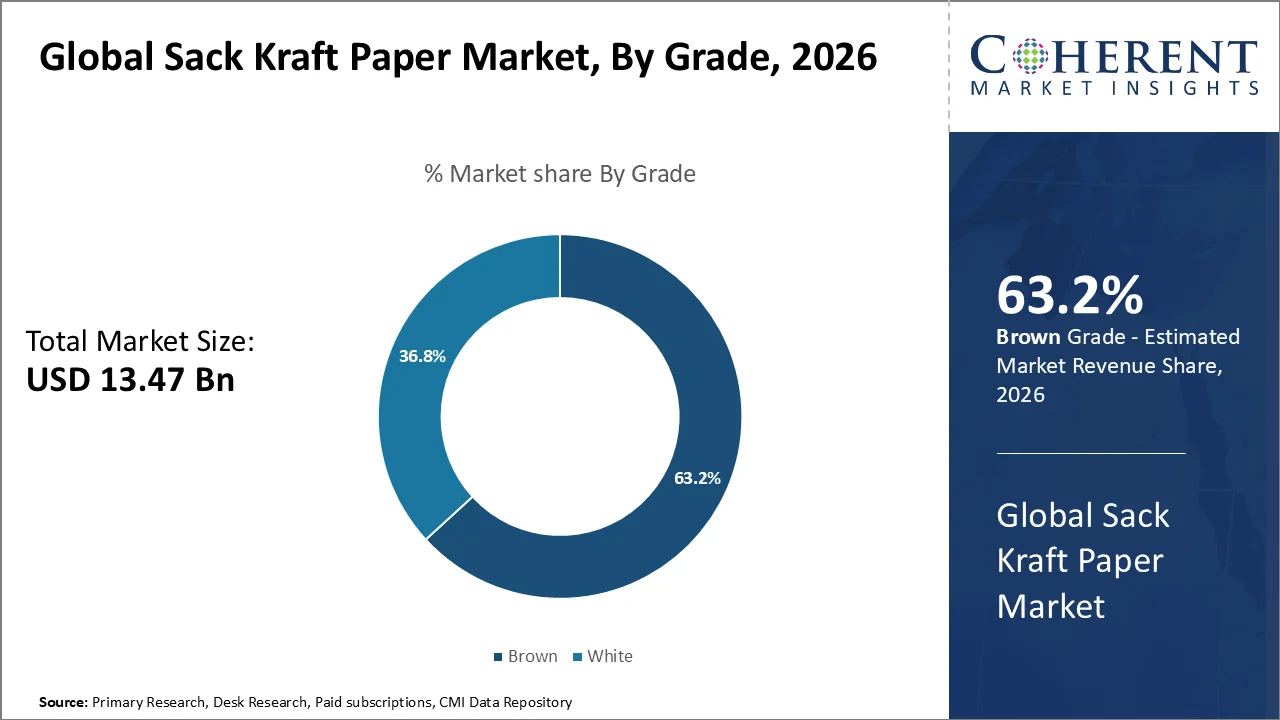
Why is Brown Acquiring the Largest Share?
The brown segment is projected to account for the largest Sack Kraft Paper Market share of 63.2% in 2026. The segment’s growth is owing to its strong fit with industrial bulk packaging, where unbleached fibre strength, lower processing cost, and high sack performance are more important than premium print whiteness.
The demand is supported by cement and construction-material packaging, as USGS estimated global cement production at 4.2 billion metric tons in 2024, indicating a large base of heavy-powder applications requiring durable paper sacks. Brown sack kraft also benefits from recyclability preferences, as the U.S. EPA estimated 41.9 million tons of paper and paperboard containers and packaging were generated, with an 80.9% recycling rate.
In August 2025, Mondi launched Ad/Vantage Smooth Brown Semi Extensible, a recyclable kraft paper designed for industrial packaging, building materials, dry food, and heavy-item applications.
Valve Sack hold the Largest Market Share
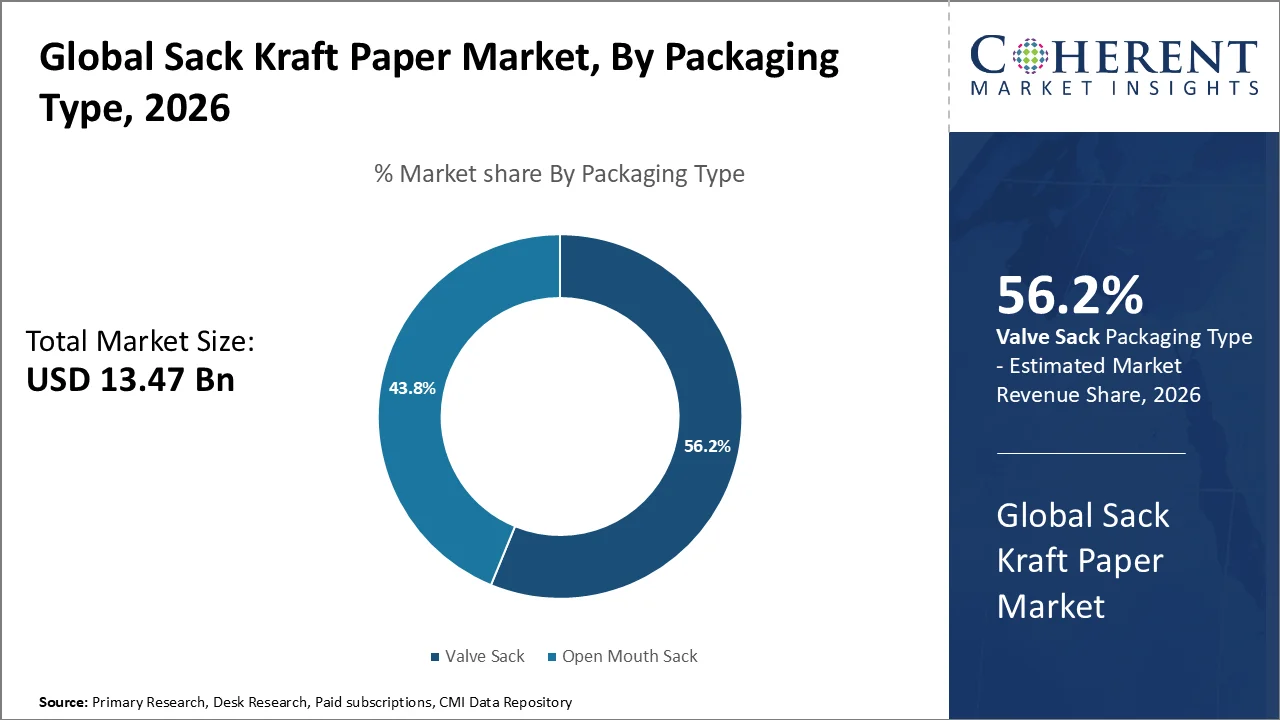
On the basis of packaging type, the valve sack segment lead with a major 56.2% share in 2026. The segment’s growth is owing to its suitability for fast, enclosed, and dust-controlled filling of powdered and granular materials. Valve sacks are widely used by cement, construction chemical, mineral, fertilizer, agrochemical, animal feed, and food ingredient producers, as these industries require packaging that can be filled automatically, sealed securely, stacked efficiently, and transported with minimal product loss.
Cement remains a major application area, as the U.S. Geological Survey reported that total shipments of Portland and blended cement in the U.S. and Puerto Rico reached 9.93 million metric tons in August 2024. Fertilizer and agrochemical packaging is also strengthening this demand. The FAO reported that the global inorganic fertilizer production reached 208 million tons in 2023, with nitrogen fertilizers accounting for 120 million tons.
In April 2025, Mondi teamed up with Evonik and launched a recyclable paper valve bag for specialty chemical powders, thus reducing packaging weight by 30%.
Sack Kraft Paper Market Trends
- The rising shift from plastic sacks to recyclable paper-based industrial packaging is strengthening the demand for sack kraft paper, especially as regulations push brands and industrial packagers toward recyclable and renewable packaging formats.
- The cement, mortar, chemicals, minerals, and building materials industries are increasing the use of sack kraft paper. This is because it delivers high tear strength, good porosity, faster filling, and better product protection during handling and transport.
- The growth of animal feed, pet food, seeds, flour, sugar, rice, powdered milk, and food supplement packaging is expanding the use of sack kraft paper in both open-mouth as well as valve sack formats.
- High-strength and lightweight sack kraft paper grades are gaining traction as converters focus on reducing paper grammage, lowering the number of plies, cutting transport costs, and minimizing product loss during filling and distribution.
- Recent capacity expansion is improving supply reliability in the market. In April 2026, Mondi formed a joint venture with Indocement in Indonesia, which is expected to add over 200 million paper bags to Mondi’s global production footprint by the end of 2026.
Regional Insights
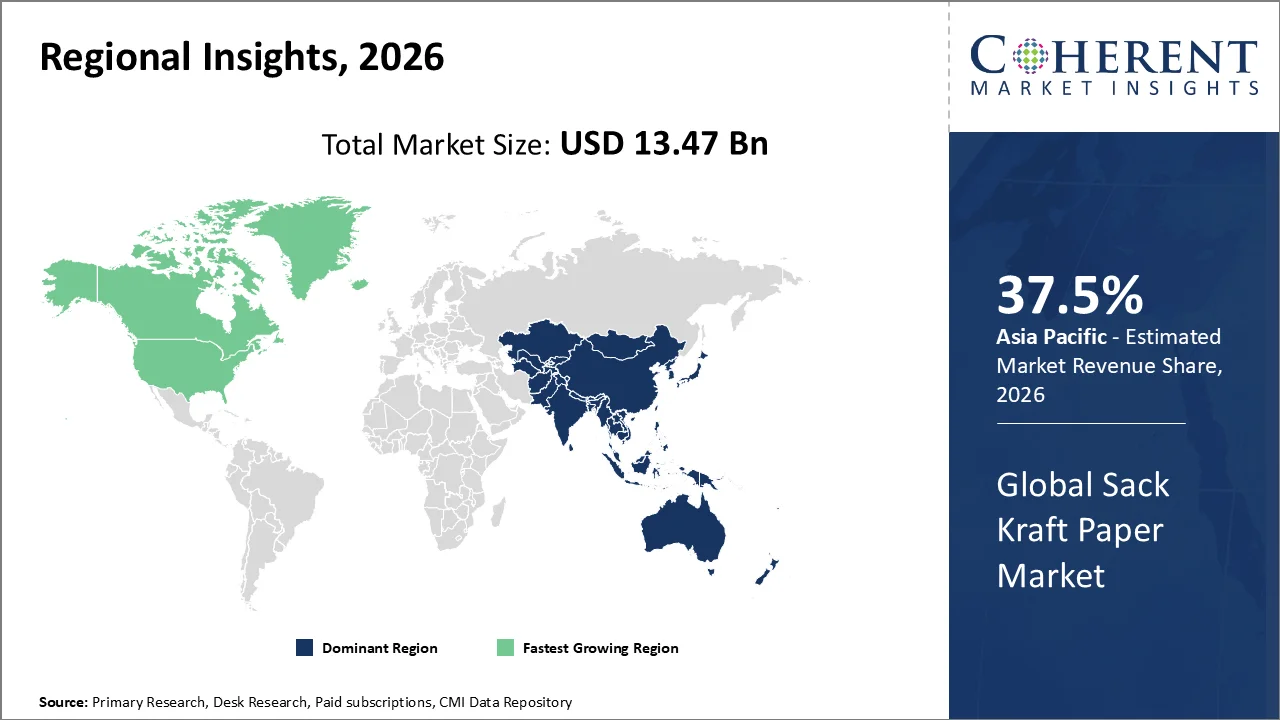
Asia Pacific Dominates Owing to the Strong Demand from Cement, Building Materials, and Industrial Packaging Sectors
The Asia Pacific region accounts for 37.5% of the market share in 2026. The region’s growth is owing to the large-scale demand from cement, building materials, chemicals, agrochemicals, animal feed, and food ingredient packaging. Sack kraft paper is widely preferred in these applications because it offers high tensile strength, tear resistance, printability, and reliable performance in valve and multiwall sacks used for bulk handling.
China continues to promote the regional demand. The National Bureau of Statistics reported 144.16 million tons of cement output in December 2025, thus creating steady consumption of heavy-duty paper sacks. India further strengthens the regional outlook, as the Economic Survey 2025–26 states that India is the second-largest cement producer globally, with domestic cement consumption at nearly 290 kg per capita.
North America Sack Kraft Paper Market Trends
North America is expected to witness strong growth in Sack Kraft Paper Market over the forecast period. The region’s growth is owing to the rising demand for strong, recyclable, and cost-efficient sacks used in cement, dry building mixes, food ingredients, animal feed, pet food, and industrial powders.
The construction sector remains a major demand base, as U.S. construction spending reached a seasonally adjusted annual rate of USD 2,185.5 billion in March 2026, supporting the use of valve sacks for cement, mortar, gypsum, and related materials. Canada’s food processing industry also adds demand, with food manufacturing sales reaching CAD 13.41 billion in March 2026, thereby reflecting steady consumption of paper-based bulk ingredient packaging.
The firm, Canadian Kraft Paper, provides SPX-Velocity and SPX-Vector sack kraft grades for faster filling, lower dust generation, and single-ply valve sack applications, thus strengthening the region’s move toward efficient and recyclable packaging.
Large Cement and Industrial Packaging Demand is Accelerating the Sack Kraft Paper Market in China
China’s sack kraft paper market is expanding steadily as cement, chemicals, minerals, and food ingredient producers require durable, recyclable multiwall sacks for bulk transport and automated filling.
The construction-material packaging base remains large, as China’s National Bureau of Statistics reported 2025 cement output of 1,693.14 million tons, although it declined 6.9% year-on-year. This keeps demand meaningful for valve sacks used in cement and dry building materials.
In September 2025, Valmet announced that it would supply Guangxi Jianhui Paper with a high-end sack and kraft paper machine, with PM 8n start-up scheduled for end-2026, strengthening local production capacity.
United States Sack Kraft Paper Market Trends
The U.S. Sack Kraft Paper Market is growing steadily because food, feed, building material, and chemical producers require durable paper sacks for dry bulk packaging.
The demand is also supported by the country’s strong paper recycling base. The U.S. EPA reported that 67.4 million tons of paper and paperboard were generated in municipal solid waste, of which 46 million tons were recycled, representing a 68.2% recycling rate. This supports the shift toward recyclable paper-based sacks over plastic-heavy packaging.
In April 2026, Mondi opened a new paper bags plant in Pittsburgh, Pennsylvania, to serve food, feed, building materials, and chemicals.
Who are the Major Companies in Sack Kraft Paper Industry
Some of the major key players in Sack Kraft Paper Market are BillerudKorsnas AB, Segezha Group, Nordic Paper, Mondi plc, Natron-Hayat d.o.o., Gascogne Group, Tolko Industries Ltd., Canfor Corporation, KapStone Paper and Packaging Corporation, and Horizon Pulp & Paper Ltd.
Key News
- In May 2026, Svetlogorsk Pulp and Cardboard Mill plan to launch a new kraft sack paper production workshop in December 2026. The company is continuing to advance its sustainable development strategy while expanding its production capacity.
- In July 2025, Parkside partnered with organic vegetable box company Riverford to launch new kerbside-recyclable potato bags made from vertical form-fill-seal paper-based material with advanced water-based coatings.
- In June 2023, Mondi, a global packaging and paper company, partnered with building materials supplier Baumit to introduce SolmixBag, a water-soluble paper bag designed to help reduce construction industry waste.
Market Report Scope
Sack Kraft Paper Market Report Coverage
| Report Coverage | Details | ||
|---|---|---|---|
| Base Year: | 2025 | Market Size in 2026: | USD 13.47 Bn |
| Historical Data for: | 2020 To 2024 | Forecast Period: | 2026 To 2033 |
| Forecast Period 2026 to 2033 CAGR: | 4.2% | 2033 Value Projection: | USD 17.99 Bn |
| Geographies covered: |
| ||
| Segments covered: |
| ||
| Companies covered: | BillerudKorsnas AB, Segezha Group, Nordic Paper, Mondi plc, Natron-Hayat d.o.o., Gascogne Group, Tolko Industries Ltd., Canfor Corporation, KapStone Paper and Packaging Corporation, and Horizon Pulp & Paper Ltd. | ||
| Growth Drivers: |
| ||
| Restraints & Challenges: |
| ||
Analyst Opinion
- Sack kraft paper demand is structurally tied to heavy-duty industrial packaging rather than a short-term packaging trend. Cement remains the anchor application, with USGS estimating global cement production at 3.8 billion tons in 2025, while India alone produced 470 million tons. This strengthens the recurring demand for high-strength valve sacks as well as open-mouth sacks.
- Sustainability is becoming a major purchase driver of growth in the market. The EU packaging rules require packaging waste per capita to fall by 5% by 2030, 10% by 2035, and 15% by 2040, while Europe’s paper recycling rate reached 75.1% in 2024. This strengthens the shift toward recyclable fibre-based sack packaging.
- Product innovation is moving toward lighter, stronger, and lower-carbon sacks. The CEPI Eurokraft and EUROSAC reported in April 2026 that the fossil carbon impact of European paper sacks fell 9%, from 106.7 g CO₂e in 2021 to 97.3 g CO₂e in 2024. This shows that tensile strength, porosity, moisture protection, and lower emissions will shape supplier differentiation in the sack kraft paper market.
Speak to the analyst
Want personalized insights?
Take the findings above to one of our principal consultants, or have the report rebuilt around the segments, geographies and competitors you actually track.
Market Segmentation
- By Grade (Revenue, USD Bn, 2021-2033)
- White
- Brown
- By Packaging Type (Revenue, USD Bn, 2021-2033)
- Open Mouth Sack
- Valve Sack
- By End-use Industries (Revenue, USD Bn, 2021-2033)
- Cement & Building Materials
- Chemicals
- Agrochemicals
- Animal feed & Pet Food
- Food
- Others
- By Region (Revenue, USD Bn, 2021-2033)
- North America
- U.S.
- Canada
- Latin America
- Brazil
- Mexico
- Argentina
- Rest of Latin America
- Europe
- Germany
- U.K.
- France
- Italy
- Spain
- Russia
- Rest of Europe
- Asia Pacific
- China
- India
- Japan
- Australia
- South Korea
- ASEAN
- Rest of Asia Pacific
- Middle East
- GCC
- Israel
- Rest of Middle East
- Africa
- South Africa
- Central Africa
- North Africa
- North America
Sources
Primary Research Interviews
- Sack Kraft Paper Manufacturers
- Kraft Pulp Producers
- Paper Sack Converters
- Flexible Packaging Manufacturers
- Cement, Chemicals, Food & Agriculture Packaging Buyers
- Packaging Procurement Managers
- Paper & Packaging Distributors
- Sustainability and Recyclable Packaging Consultants
- Others
Databases
- Bloomberg Terminal
- FisherSolve
- UN Comtrade Database
- ITC Trade Map
- FAOSTAT Forestry Database
- Others
Magazines
- Paper360° Magazine
- Pulp & Paper Canada
- Packaging Europe
- Packaging World
- Pulp & Paper Technology
- EUWID Pulp and Paper
- The Pulp and Paper Times
- Others
Journals
- TAPPI Journal
- Nordic Pulp & Paper Research Journal
- Packaging Technology and Science
- BioResources Journal
- Cellulose Journal
- Journal of Cleaner Production
- Resources, Conservation & Recycling
- Others
Newspapers
- Financial Times
- The Wall Street Journal
- Reuters
- Bloomberg News
- Nikkei Asia
- The Economic Times
- Others
Associations
- CEPI Eurokraft
- EUROSAC – European Federation of Multiwall Paper Sack Manufacturers
- Confederation of European Paper Industries (CEPI)
- Technical Association of the Pulp and Paper Industry (TAPPI)
- American Forest & Paper Association (AF&PA)
- Indian Paper Manufacturers Association (IPMA)
- World Packaging Organisation (WPO)
- Others
Public Domain Sources
- Food and Agriculture Organization (FAO) – Pulp and Paper Capacity Statistics
- UN Comtrade Database
- World Bank Open Data
- Eurostat Packaging Waste Statistics
- European Commission – Packaging and Packaging Waste Regulation Updates
- U.S. Environmental Protection Agency (EPA) – Packaging and Paper Waste Data
- U.S. Census Bureau – Paper Manufacturing and Trade Data
- Forest Stewardship Council (FSC)
- Programme for the Endorsement of Forest Certification (PEFC)
- Others
Proprietary Elements
- CMI Data Analytics Tool
- Proprietary CMI Existing Repository of Information for the Last 10 Years
Get access to 250+ pages report
Every segment, forecast, competitor profile and data table behind the analysis above — available for instant download.
- ESOMAR Member
- ISO 9001:2015 Certified
- D-U-N-S Registered
- GDPR & CCPA Compliant
Missing comfort of reading report in your local language? Find your preferred language:
Transform your Strategy with Exclusive Trending Reports
Frequently Asked Questions
The Sack Kraft Paper Market is expected to reach USD 17.99 Bn in 2033.
Major players operating in the global Sack Kraft Paper Market include BillerudKorsnas AB, Segezha Group, Nordic Paper, Mondi plc, Natron-Hayat d.o.o., Gascogne Group, Tolko Industries Ltd., Canfor Corporation, KapStone Paper and Packaging Corporation, and Horizon Pulp & Paper Ltd.
The raw material price volatility, high energy and production costs, environmental regulations, and fierce competition from synthetic alternatives are the key factors hampering growth of the market.
The escalating demand for eco-friendly packaging, stringent regulations against single-use plastics, and the continuous expansion of the global construction sector is boosting the demand for Sack Kraft Paper.
The Sack Kraft Paper Market is anticipated to grow at a CAGR of 4.2% between 2026 and 2033.
Among regions, Asia Pacific is expected to account for a largest market share in the global Sack Kraft Paper Market over the forecast period.
Major innovations include high-barrier recyclable paper sacks, water-soluble paper bags, lightweight multiwall sacks, improved wet-strength grades, and paper sacks with advanced coatings.