

Citric Acid Ester Market Size and Forecast — 2026-2033
The global citric acid ester market is estimated to be valued at USD 358.2 Mn in 2026 and is expected to reach USD 582.7 Mn by 2033, exhibiting a compound annual growth rate (CAGR) of 7.2% from 2026 to 2033.
Citric acid esters find wide applications in the food and beverage industry as emulsifiers, flavor enhancers, and stabilizing agents. They are also used as solvents and plasticizers in personal care products and pharmaceutical formulations. The market is expected to witness steady growth on account of increasing demand for all-natural ingredients in food products. Rising health-consciousness is further driving the sales of low-calorie and low-fat food items incorporating citric acid esters. Strong focus on the R&D of multifunctional citric acid esters can open new opportunities in the coming years.
Insights By Grade
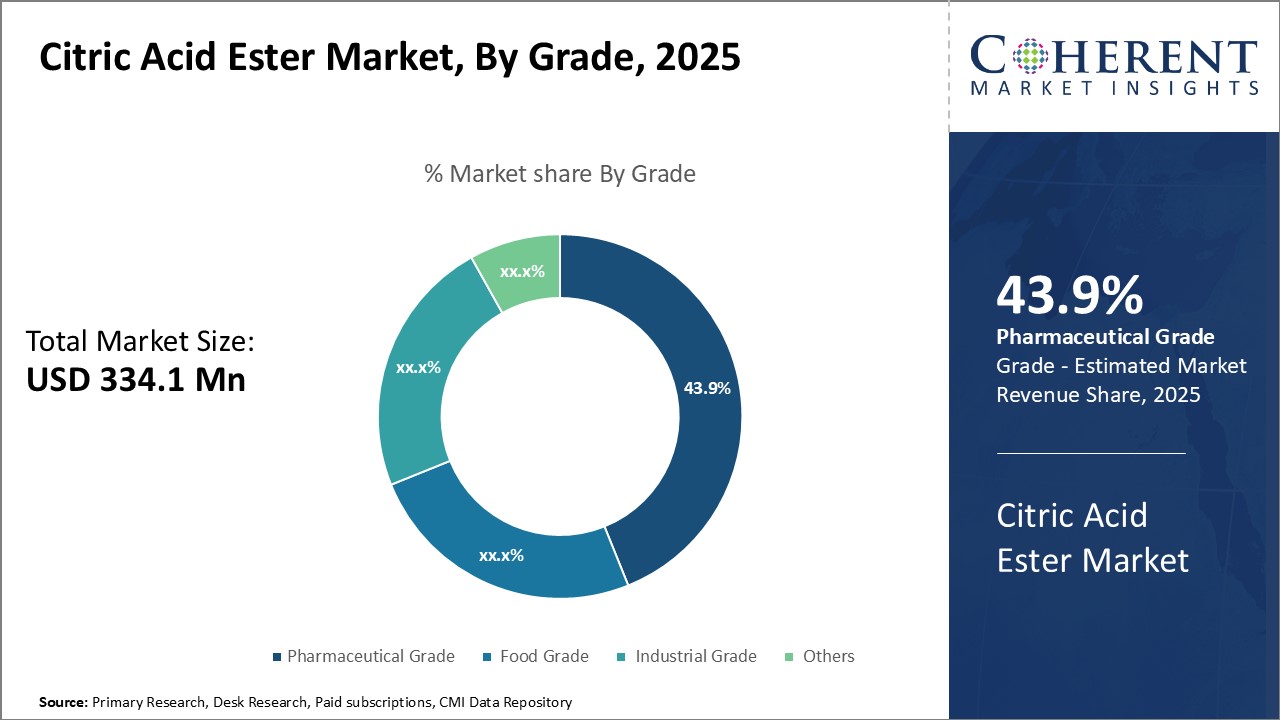
Insights By Grade - Pharmaceutical Grade Segment Dominates the Market owing to Wide Usage in Medicinal Formulations
In terms of grade, the pharmaceutical grade segment is expected to hold 44.9% share of the global citric acid ester market in 2026, driven by strict regulatory standards. The pharmaceutical sector dominates the market by grade, as citric acid esters are widely used as excipients in medicinal formulations. Various types of citric acid esters, including triethyl citrate, acetyl triethyl citrate, and tributyl citrate, serve as plasticizers in the production of films, blister packs, capsules, and tablets.
Insights By Application
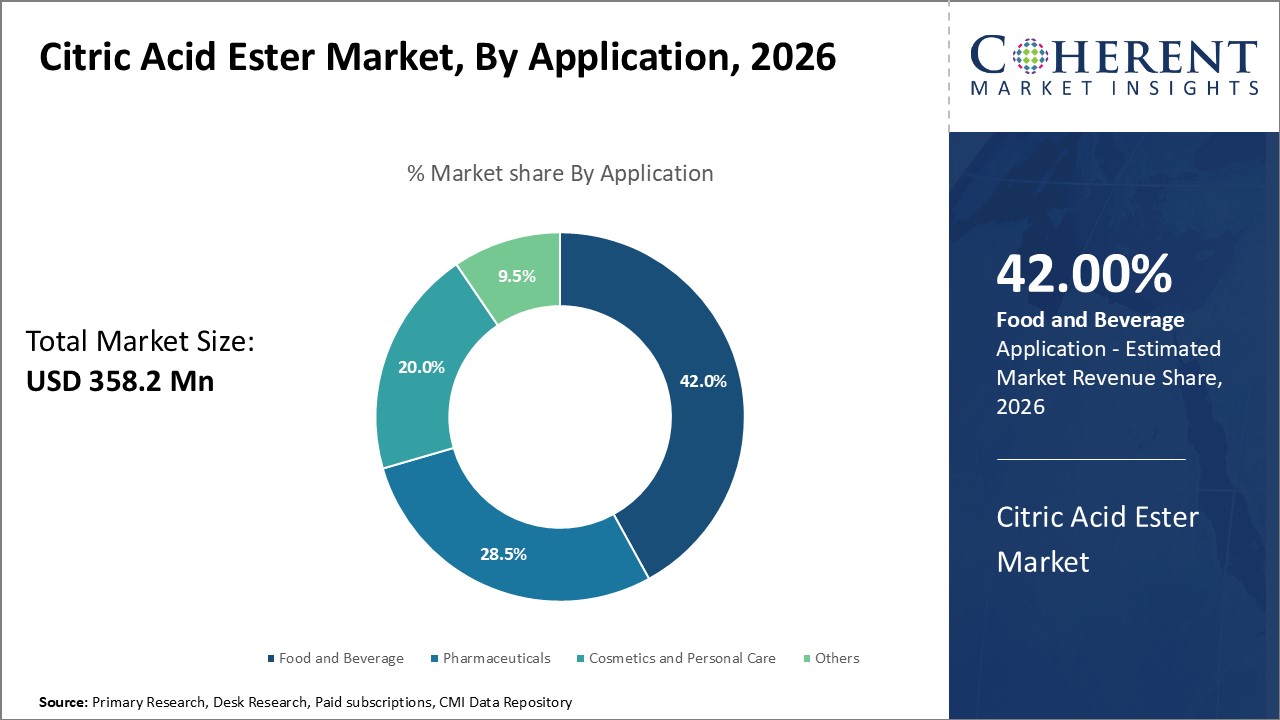
Insights By Application - High Demand for Citric Acid Esters in the Food and Beverage Industry
In terms of application, the food and beverage segment is expected to contribute 42% share of the market in 2026, due to widespread usage in processed foods. The global citric acid ester market witnesses the highest demand from the food and beverage industry in terms of applications. Citric acid esters are commonly used as food additives and flavoring agents in various packaged and processed food products. Triethyl citrate is widely employed as a flavor encapsulant for citrus-flavored foods and beverages.
Regional Insights
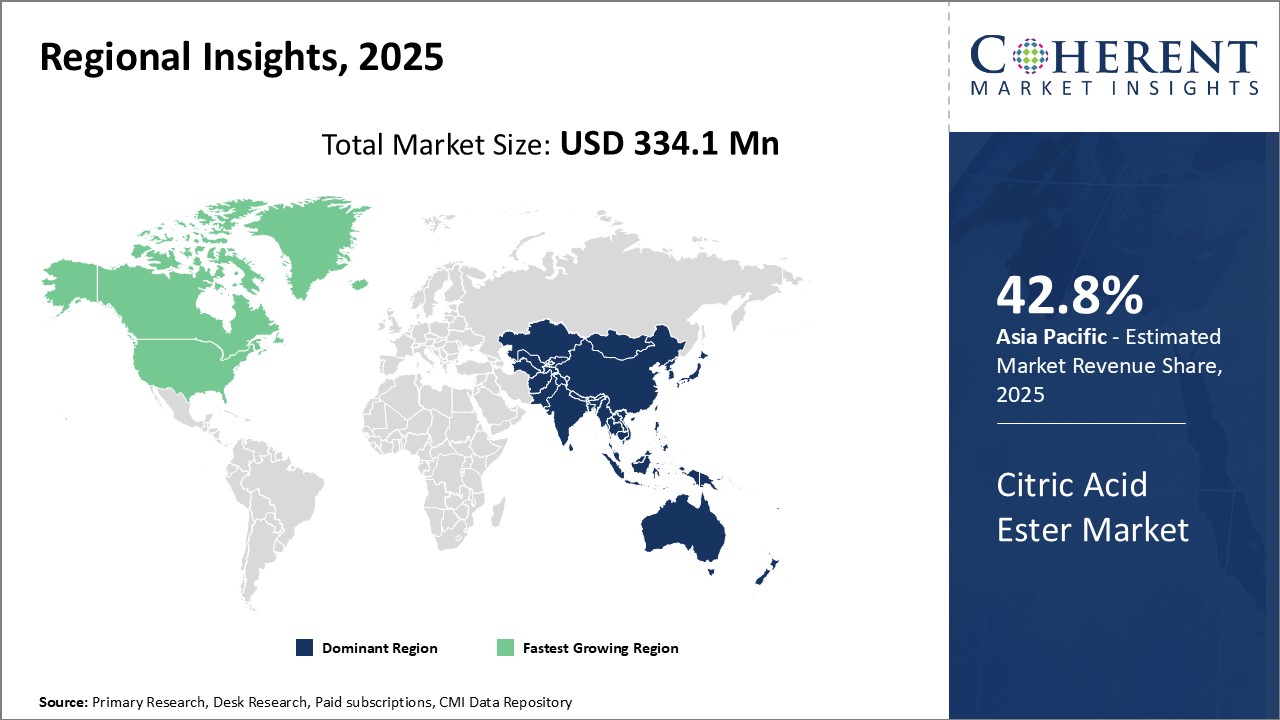
Regional Analysis:
Dominating Region: Asia Pacific
The Asia Pacific region is anticipated to dominate the global citric acid ester market, accounting for an estimated 42.8% share in 2026. This leadership is primarily driven by the region's robust manufacturing sector and extensive consumer base. Nations such as China, India, and Japan have established themselves as key global manufacturing centers, heavily utilizing citric acid esters as solvents and lubricants in various industrial processes. Furthermore, the Asia-Pacific region plays a pivotal role in shaping global trade trends for citric acid esters.
Fastest-Growing Region: North America
North America exhibits the fastest growth riding on the growing consumer awareness about sustainability. There is an increasing preference for bio-based citric acid esters, especially in the food and beverages industry. These products are considered eco-friendly alternatives to traditional chemicals.
Citric Acid Ester Market Outlook for Key Countries
Regulatory Landscape in the U.S.
The U.S. is a major market for citric acid esters, owing to its vast food and beverage industry, where citric acid esters are widely used in products like soft drinks, processed foods, and confectioneries. The growing demand for personal care and cosmetics products also boosts market growth. The U.S. Food and Drug Administration (FDA) ensures that citric acid esters used in food products meet safety standards. The market is also impacted by consumer preference for clean-label products, pushing manufacturers to seek alternatives that align with these trends.
China’s Leading Role in Citric Acid Ester Production and Consumption
China is one of the largest producers and consumers of citric acid esters. The market is driven by its thriving food and beverage sector, which uses citric acid esters as emulsifiers, stabilizers, and flavor enhancers. Additionally, the country’s expanding cosmetic, pharmaceutical, and personal care industries also contribute to market growth.
Japan Citric Acid Ester Market: Demand, Regulations, and Safety Standards
Japan is also witnessing steady demand for citric acid esters, especially in food and beverage products, cosmetics, and pharmaceuticals. The country's preference for high-quality, well-regulated products aligns with the demand for citric acid esters in various sectors. Japan’s food safety regulations, particularly regarding food additives, are indeed stringent, and they ensure that citric acid esters, along with other additives, meet high safety standards. These regulations are enforced by Japan’s Food Sanitation Act and are overseen by the Ministry of Health, Labour and Welfare (MHLW).
Trends, Consumer Demand, and Regulatory Standards in Canada
The citric acid ester market in Canada is driven by the food and beverage industry, as well as the cosmetics and personal care sectors. The demand for clean-label, natural, and organic products is increasing, making citric acid esters a preferred choice due to their versatility and natural derivation. Canada has strict regulations concerning food safety and ingredient labeling. The use of citric acid esters in food products must meet stringent safety standards set by regulatory bodies like Health Canada.
India’s Strong Regulatory Focus on Food Safety
The India citric acid ester market is experiencing growth due to increasing demand from the food, beverage, and pharmaceutical sectors. India’s large population, coupled with the rising middle class, is boosting the demand for packaged and processed foods, where citric acid esters play a key role. While the Indian government has food safety standards under the Food Safety and Standards Authority of India (FSSAI), there is growing emphasis on regulating food additives to ensure product safety, which directly influences the demand for citric acid esters.
Market Players, Key Development, and Competitive Intelligence
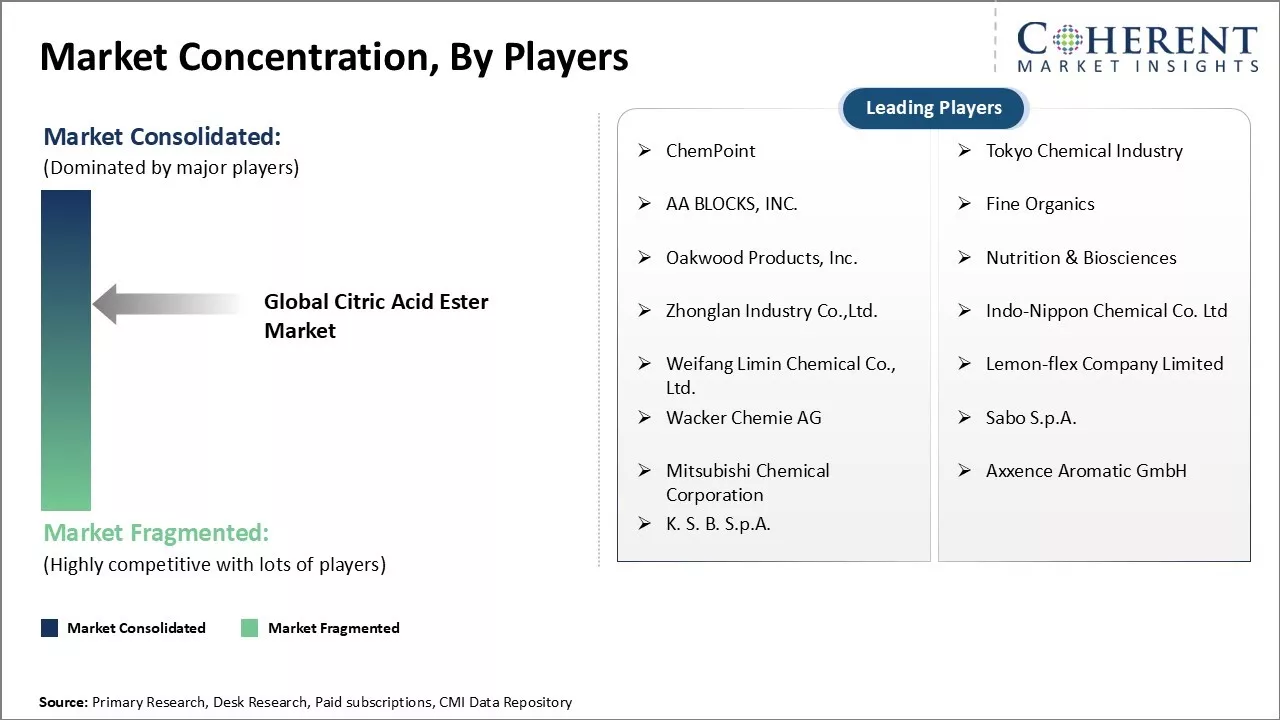
Top Strategies Followed by the Global Citric Acid Ester Market Players
- Established Players: Leading players focus on continuous innovation in citric acid ester products to meet diverse industrial applications such as food and beverages, personal care, pharmaceuticals, and plastics. They invest heavily in R&D to create more efficient and eco-friendly alternatives, especially considering the increasing demand for sustainability.
- Mid-Level Players: Mid-sized companies often compete on price by optimizing manufacturing processes and leveraging economies of scale. By streamlining production and cutting unnecessary costs, they offer competitive pricing without compromising on quality.
- Small-Scale Players: Small-scale companies tend to focus on very specific market segments, such as regional demand for food-grade citric acid esters or eco-friendly formulations. By serving niche sectors or localized demands, they can gain a stronghold in limited geographical areas. They often rely on strong local supplier networks and aim to foster direct relationships with customers, providing a personalized experience.
Emerging Startups in the Global Citric Acid Ester Market
Innovative Technologies: Startups like Bio-on and Anthropic develop bio-based polyesters and artificial intelligence tools respectively with the potential to transform the industry. Their novel technologies could enable more sustainable production processes and intelligent product design in the future.
Sustainable Solutions: Startups like Ioniqa and TIPa focus on sustainability with renewable feedstock for ester synthesis and enzymatic routes creating biodegradable grades. Their eco-friendly materials production aids environmental protection goals.
Market Contribution: Small ventures often fill specialized needs through collaborations. U.S.-based, Licy, creates acquired natural flavors partnering firms. India's Green EcoLab works with farmers promoting green chemistry techniques. Such partnerships spur innovation addressing varied market segments.
- Current Industry Events of 2026
- Market Size Estimation
- Regional Breakdown
- Competitive Landscape
- Customer Intelligence
- Segmental Analysis
- Pricing Analysis
- Key Market Drivers, Challenges & Future Trends
- Customized Insights Section
Market Report Scope
Citric Acid Ester Market Report Coverage
| Report Coverage | Details | ||
|---|---|---|---|
| Base Year: | 2025 | Market Size in 2026: | USD 358.2 Mn |
| Historical Data for: | 2020 To 2024 | Forecast Period: | 2026 To 2033 |
| Forecast Period 2026 to 2033 CAGR: | 7.2% | 2033 Value Projection: | USD 582.7 Mn |
| Geographies covered: |
| ||
| Segments covered: |
| ||
| Companies covered: | ChemPoint, Tokyo Chemical Industry, AA BLOCKS, INC., Fine Organics, Oakwood Products, Inc., Nutrition & Biosciences, Zhonglan Industry Co.,Ltd., Indo-Nippon Chemical Co. Ltd, Weifang Limin Chemical Co., Ltd., Lemon-flex Company Limited, Wacker Chemie AG, Sabo S.p.A., Mitsubishi Chemical Corporation, Axxence Aromatic GmbH, and K. S. B. S.p.A. | ||
| Growth Drivers: |
| ||
| Restraints & Challenges: |
| ||
Market Dynamics
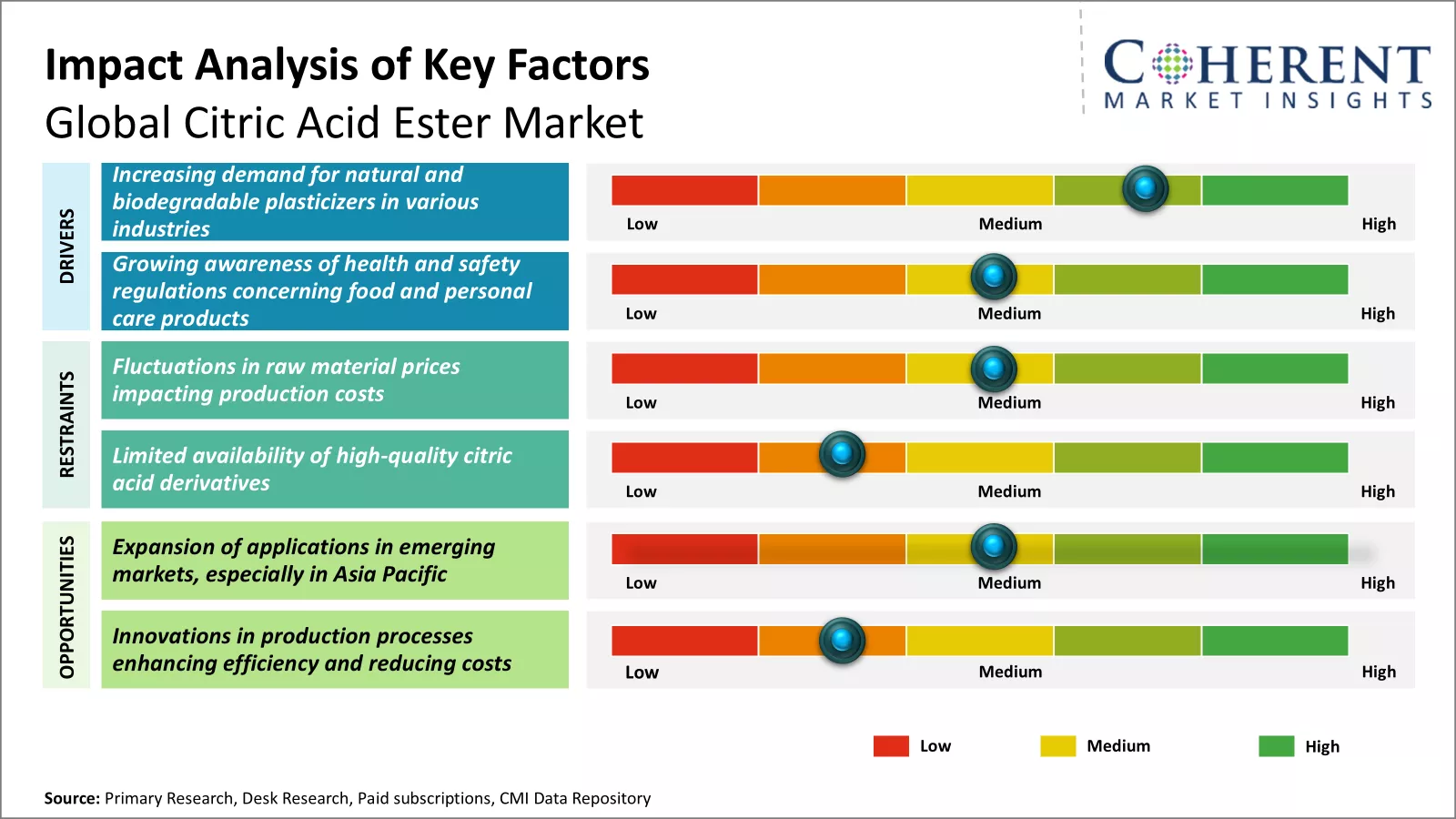
Market Driver - Increasing demand for natural and biodegradable plasticizers in various industries
Citric acid esters are emerging as viable and sustainable alternatives to conventional petroleum-based plasticizers owing to their non-toxicity and biodegradability properties. The global campaign for reducing carbon footprint and use of eco-friendly materials has prompted various industries to seek greener substitutes. Citric acid esters being naturally sourced and readily degradable plasticizers are gaining widespread acceptance across industries such as food packaging, healthcare products, children's toys, and construction where environmental safety standards are increasingly getting priority.
Market Challenge - Fluctuations in raw material prices impacting production costs
This market is facing challenges due to fluctuations in raw material prices impacting production costs for manufacturers. Citric acid esters are manufactured using citric acid as the primary raw material. However, citric acid prices have witnessed strong volatility in recent years due to various factors such as uncertain weather conditions impacting lemon production and global supply demand dynamics. As citric acid accounts for a major portion of the overall production costs for citric acid ester manufacturers, frequent price swings in citric acid are directly impacting the costs and profit margins for these players.
Marke Opportunity - Expansion of applications in emerging markets, especially in Asia Pacific
This market is poised to benefit from the expansion of applications in emerging markets, especially in Asia Pacific over the coming years. Countries in the region such as India, China, Indonesia are witnessing strong economic growth and development of end-use industries where citric acid esters are used. For example, rapid infrastructure development and construction activities are driving demand for paints, coatings and adhesives where citric acid mono- and di-esters are used as plasticizers and lubricants. Moreover, rising health-consciousness and disposable incomes are propelling the personal care and cosmetics industry in Asia, providing opportunities for citric acid esters as emollients, fragrance enhancers and preservatives.
Analyst Opinion (Expert Opinion)
Key Takeaways from Analyst
The market is expected to witness sustained growth over the forecast period driven by the rising demand for natural emulsifiers and flavoring agents across diverse end-use industries. Citric acid esters find wide usage as emulsifiers in food processing, cosmetics, and personal care products due to their ability to stabilize oil-water mixtures. The growing health-conscious consumer trend is propelling the demand for natural and clean-label ingredients which is expected to boost the citric acid ester uptake. Asia Pacific is expected to dominate the market in 2024 led by the thriving fast moving consumer goods (FMCG) sector in India and China. however, North America is likely to emerge as the fastest growing regional market owing to increased R&D focus on natural alternatives.
Nevertheless, availability of inexpensive synthetic substitutes can hamper market growth to some extent. Stringent regulations governing the use of chemical emulsifiers is another challenge for the players. Fluctuations in the raw material prices may also impact the production cost of citric acid esters. Expanding food processing industry and shifting preferences towards safer ingredients are expected to unlock new opportunities for citric acid ester manufacturers over the coming years.
Speak to the analyst
Want personalized insights?
Take the findings above to one of our principal consultants, or have the report rebuilt around the segments, geographies and competitors you actually track.
Market Segmentation
- Grade Insights (Revenue, USD Mn, 2021 - 2033)
- Pharmaceutical Grade
- Food Grade
- Industrial Grade
- Others
- Application Insights (Revenue, USD Mn, 2021 - 2033)
- Food and Beverage
- Cosmetics and Personal Care
- Pharmaceuticals
- Others
- Regional Insights (Revenue, USD Mn, 2021 - 2033)
- North America
- U.S.
- Canada
- Latin America
- Brazil
- Argentina
- Mexico
- Rest of Latin America
- Europe
- Germany
- U.K.
- Spain
- France
- Italy
- Russia
- Rest of Europe
- Asia Pacific
- China
- India
- Japan
- Australia
- South Korea
- ASEAN
- Rest of Asia Pacific
- Middle East
- GCC Countries
- Israel
- Rest of Middle East
- Africa
- South Africa
- North Africa
- Central Africa
- North America
- Key Players Insights
- ChemPoint
- Tokyo Chemical Industry
- AA BLOCKS, INC.
- Fine Organics
- Oakwood Products, Inc.
- Nutrition & Biosciences
- Zhonglan Industry Co.,Ltd.
- Indo-Nippon Chemical Co. Ltd
- Weifang Limin Chemical Co., Ltd.
- Lemon-flex Company Limited
- Wacker Chemie AG
- Sabo S.p.A.
- Mitsubishi Chemical Corporation
- Axxence Aromatic GmbH
- K.S. B. S.p.A.
Get access to 250+ pages report
Every segment, forecast, competitor profile and data table behind the analysis above — available for instant download.
- ESOMAR Member
- ISO 9001:2015 Certified
- D-U-N-S Registered
- GDPR & CCPA Compliant
Missing comfort of reading report in your local language? Find your preferred language:
Transform your Strategy with Exclusive Trending Reports
Frequently Asked Questions
The Citric Acid Ester Market is estimated to be valued at USD 358.2 Mn in 2026, and is expected to reach USD 582.7 Mn by 2033.
The CAGR of the Citric Acid Ester Market is projected to be 7.2% from 2026 to 2033.
Increasing demand for natural and biodegradable plasticizers in various industries and growing awareness of health and safety regulations concerning food and personal care products are the major factors driving the market growth of citric acid ester.
Fluctuations in raw material prices impacting production costs and limited availability of high-quality citric acid derivatives are the major factors hampering the growth of the global citric acid ester market.
In terms of grade, pharmaceutical grade is estimated to dominate the market revenue share in 2026.
ChemPoint, Tokyo Chemical Industry, AA BLOCKS, INC., Fine Organics, Oakwood Products, Inc., Nutrition & Biosciences, Zhonglan Industry Co.,Ltd., Indo-Nippon Chemical Co. Ltd, Weifang Limin Chemical Co., Ltd., Lemon-flex Company Limited, Wacker Chemie AG, Sabo S.p.A., Mitsubishi Chemical Corporation, Axxence Aromatic GmbH, and K. S. B. S.p.A. are the major players.
Asia Pacific is expected to lead the global citric acid ester market in 2026.