

Citric Acid Market Size and Trends Forecast: 2026 - 2033
The citric acid market is estimated to be valued at USD 4.21 Bn in 2026 and is expected to reach USD 5.54 Bn by 2033, exhibiting a compound annual growth rate (CAGR) of 4.0% from 2026 to 2033.
Key Takeaways of the Citric Acid Market
- Based on grade, the food grade segment is expected to contribute the highest share of the market with 61% in 2026.
- Europe is expected to dominate the citric acid market with 45% share in 2026.
- Asia Pacific is expected to account for 25% of the market share in 2026.
Market Overview
The citric acid market is experiencing robust, mid-single-digit growth, driven by its central role in Food & Beverage (F&B) preservation, flavor, and functionality, alongside rising demand in pharma, personal care, and industrial applications. Powdered form remains dominant, liquid is gaining traction, and geographic leadership lies with Europe, supported by clean-label trends and biotech innovation.
However, price fluctuations of raw materials could restrain the market growth. This affects the citric acid manufacturing cost.
Current Events and Their Impact on the Citric Acid Market
Current Events | Description and its impact |
Supply Chain Disruptions and Logistical Challenges |
|
Geopolitical Trade Policy Shifts |
|
Growing Demand from the Food and Beverage Industry
The expanding demand for citric acid within the food and beverage industry is significantly fueling the growth of the overall citric acid market. Citric acid is widely recognized for its multifunctional role as a natural preservative, flavor enhancer, and acidulant, making it indispensable in various food processing applications. Its natural origin and safety profile have made it a preferred additive in an era of growing consumer preference for clean-label products and natural ingredients.
For instance, according to the ScienceDirect Journal, about 70% of total citric acid production is used as an acidulent, flavor enhancer, and preservative in food and carbonated beverages, about 15% as detergent builder co-builder or cleaner in liquid household detergents, detergent powders, hard-surface cleaners, and fabric softeners.
- Current Industry Events of 2026
- Market Size Estimation
- Regional Breakdown
- Competitive Landscape
- Customer Intelligence
- Segmental Analysis
- Pricing Analysis
- Key Market Drivers, Challenges & Future Trends
- Customized Insights Section
Side-Effects Associated with the Excessive Consumption of Citric Acid
Excessive consumption of citric acid can lead to certain health issues which is affecting the growth of the global citric acid market. Citric acid being a weak acid in high quantities can cause side effects like irritation and inflammation in the digestive system. Continuous consumption of foods containing a large amount of added citric acid may cause damage to the inner lining of the stomach and intestines over time. This can lead to complaints like acid reflux, nausea, abdominal pain, and diarrhea.
Segmental Insights
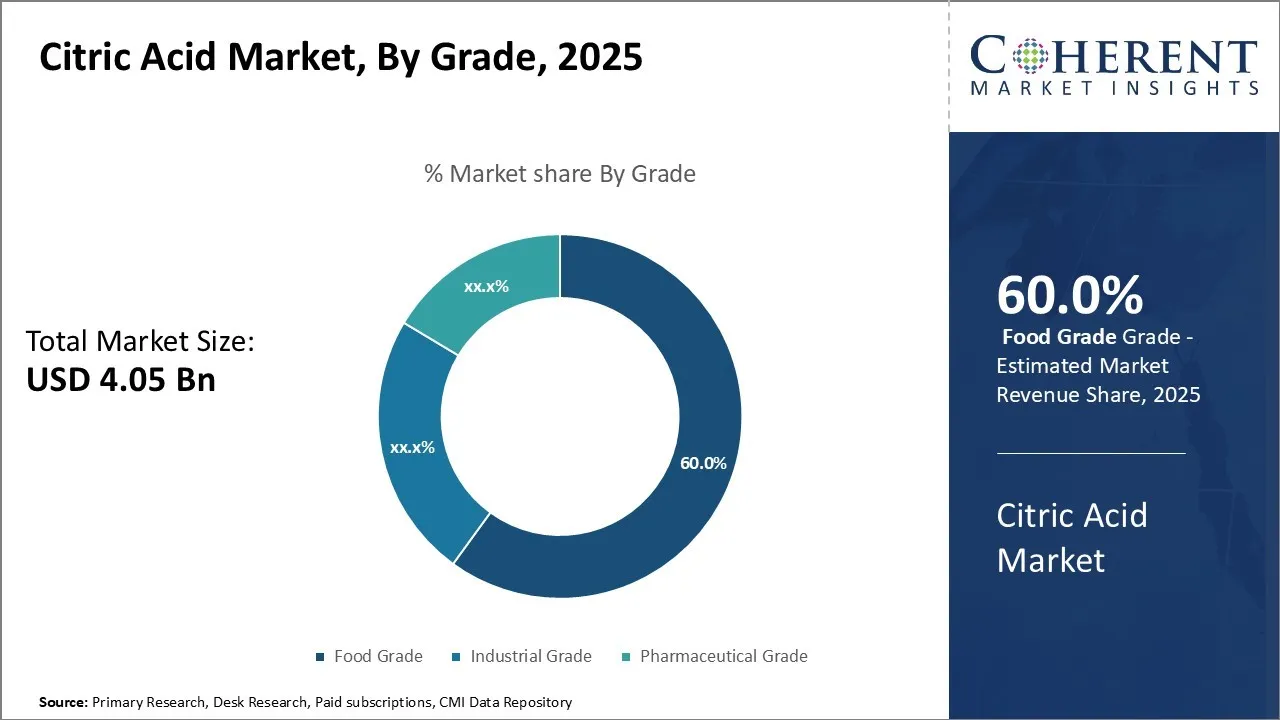
Citric Acid Market Insights By Grade: Multifunctionality Property Drives Food Grade’s Dominance
Based on grade, food grade segment is expected to contribute the highest share of the market with 61% in 2026. Primarily produced by fermenting sugar-based substrates (e.g., molasses) using Aspergillus niger, it is the most consumed grade.
Its multifunctionality including acidulant, preservative, chelating agent, and flavor enhancer makes it indispensable in beverages, jams, confectionery, dairy, and processed foods. Moreover, its “clean-label” appeal being natural, biodegradable, and Generally Recognized As Safe (GRAS)-approved drives its adoption amid growing demand for natural and transparent food ingredients.
Emerging Innovations in the Citric Acid Market
- Shift Toward Biotechnological and Fermentation-Based Production Methods
- Traditionally, citric acid was derived from citrus fruits through extraction processes. However, this method posed limitations in terms of scalability, costs, and supply chain volatility tied to agricultural yields. Modern advancements have made microbial fermentation – particularly using strains of Aspergillus niger – the predominant production technique globally. This biotechnology approach allows for controlled, large-scale manufacturing in bioreactors, which markedly improves efficiency and product consistency.
- Development of High-Value Derivative Products
- Innovation is not limited to production methods alone; the citric acid market has also seen the development of high-value derivative products enabled by novel chemical and enzymatic processes. For example, citric acid esters and salts, which offer enhanced multifunctionality, have gained prominence in applications like cosmetics, detergents, and pharmaceuticals. These derivatives provide benefits such as improved solubility, stability, and environmental friendliness compared to traditional counterparts.
Impacts of Artificial Intelligence (AI) on the Citric Acid Market
The citric acid market, a critical segment within the food, beverage, and pharmaceutical industries, is experiencing transformative shifts driven by the integration of artificial intelligence (AI).
- Givaudan, a leading flavor and fragrance manufacturer that also operates in the citric acid derivative space, has harnessed AI to develop new natural flavor compounds. Through AI-driven molecular modeling and simulation, Givaudan accelerates the design of novel citric acid-based flavor enhancers that meet consumer demand for natural and health-conscious products. This AI-powered approach shortens product development cycles and improves the success rate of new launches.
- The Chinese chemical company, Cofco Biochemical, employs AI-enhanced monitoring tools in its citric acid manufacturing plants. Using AI-powered predictive maintenance algorithms, Cofco can anticipate equipment failures before they occur. This proactive approach reduces downtime, lowers maintenance costs, and ensures consistent product quality, providing a competitive edge in a market where supply reliability is paramount.
- Artificial intelligence is significantly impacting the citric acid market by enhancing production efficiency, improving product quality, and driving innovation. Companies like DSM and Cofco Biochemical exemplify AI integration in core operations and maintenance, while Givaudan showcases AI’s role in product development.
Regional Insights
Europe Citric Acid Market Analysis and Trends
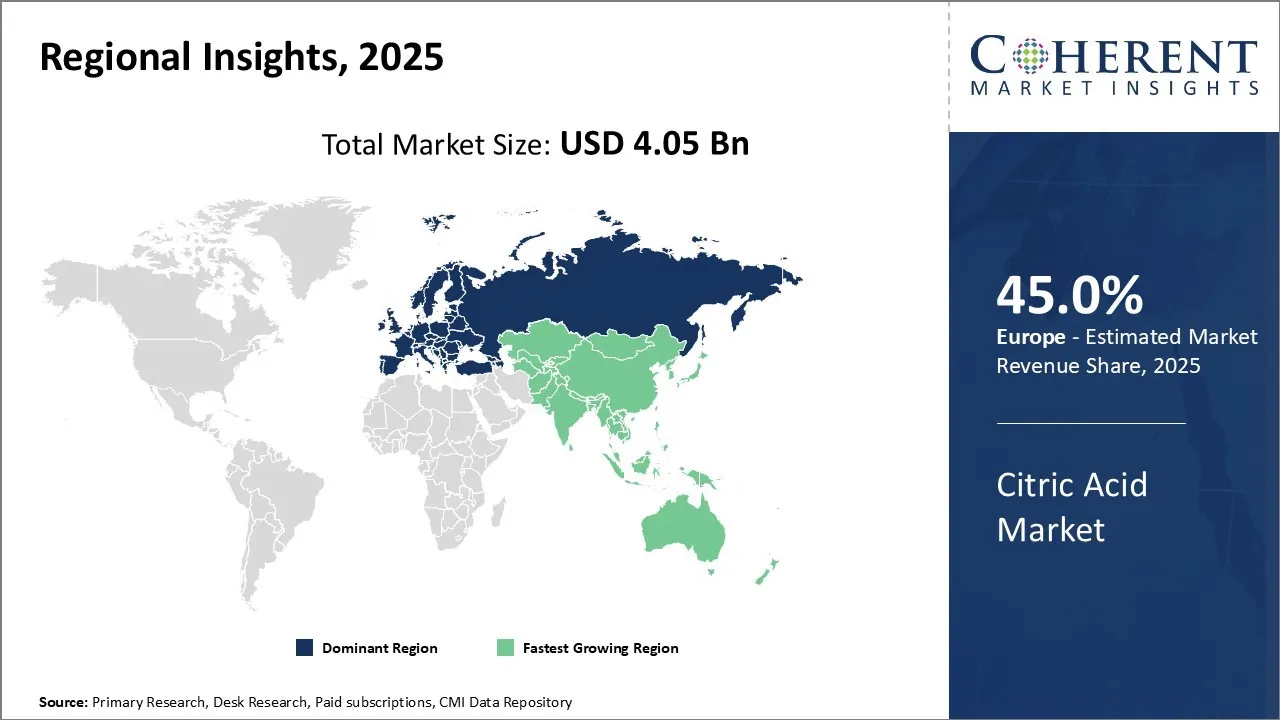
Europe is expected to be the largest market for citric acid, accounting for 45.0% of the market share in 2026. The growth of the citric acid market in Europe can be attributed to the increasing demand for citric acid in countries such as France, Germany, the Netherlands, and Russia.
For instance, according to a report by the Observatory of Economy Complexity, in 2023, Germany exported USD 77.4M of Citric acid, making it the 6th largest exporter of citric acid (out of 126) in the world. During the same year, citric acid was the 1,858th most exported product (out of 4,569) in Germany.
Asia Pacific Citric Acid Market Analysis and Trends
Asia Pacific is expected to account for 25% of the market share in 2026. The citric acid market growth in Asia Pacific is driven by the increasing demand for citric acid in countries such as India and China.
According to a report by the World Bank, in 2023, top exporters of citric acid were China (USD982,522.84K, 1,173,290,000 Kg), Thailand (USD204,934.58K, 110,957,000 Kg), Belgium (USD100,323.83K, 52,858,600 Kg), European Union (USD93,255.34K, 29,700,300 Kg), and Germany (USD77,826.11K, 35,331,200 Kg).
Italy Citric Acid Market Analysis and Trends
In Italy, demand for citric acid is propelled by the country’s renowned food processing sector, especially in fruit juice production, confectionery, tomato-based sauces, and artisanal foods. This growth is underpinned by Italy's cultural emphasis on quality, flavor, and natural ingredients, which aligns perfectly with clean-label trends and premium product positioning—dairy, baked goods, beverages, and sauces increasingly rely on citric acid for pH control, preservation, and taste enhancement.
China Citric Acid Market Analysis and Trends
The market growth is driven by strong domestic demand and rapid growth in processed foods and beverages, where citric acid acts as a natural preservative and flavor enhancer. However, producers face rising costs and regulatory pressures to reduce environmental impacts, pushing innovation in automated, and eco-friendly manufacturing processes.
India Citric Acid Market Analysis and Trends
The trend toward clean-label and natural ingredients, propelled by evolving consumer preferences and stricter food safety regulations, enhances citric acid usage in beverages and convenience foods. Additionally, upticks in pharmaceutical manufacturing are fueling demand for citric acid as a safe excipient and stabilizer.
Brazil Citric Acid Market Analysis and Trends
Brazil is expanding its citric acid usage beyond the food & beverage industry into industrial and home-cleaning applications. Partnerships—such as those between Univar and Dow—have introduced citrate ingredients into household cleaners and detergents, showcasing the shift to eco-safe alternatives. This diversification is supported by growing consumer awareness of sustainability, sparking increased adoption in the cleaning and personal care sectors alongside traditional food applications.
Pricing Analysis of the Citric Acid Market
- Food Grade Citric Acid:
- Average Price Range: USD 1.00 - 1.50 per kg (bulk wholesale)
- Packaged in bulk bags (25 kg to 1 ton) for food manufacturers.
- Price affected by quality certifications (ISO, HACCP, FSSC 22000).
- Premium brands such as Cargill (Tate & Lyle) and ADM often command higher prices due to stringent quality controls and safety standards.
- In retail consumer packaging (powdered citric acid sold for home use), prices can range from USD 2.00 to 4.00 per 100 grams depending on brand and packaging.
- Pharmaceutical Grade Citric Acid:
- Average Price Range: USD 2.00 - 3.50 per kg
- Pharmaceutical grades command higher prices due to ultra-purity standards, compliance with pharmacopoeias (USP, EP, JP), and sterilization requirements.
- Often packaged in smaller, tightly controlled lots (10-25 kg) ensuring pharmaceutical quality.
- Special documentation (certificate of analysis, GMP compliance) adds to cost.
- Industrial Grade Citric Acid:
- Average Price Range: USD 0.85 - 1.20 per kg
- Used primarily by detergent manufacturers, water treatment, textile dyeing industries.
- Bulk packaging offered in 25-50 kg bags or 1-ton bulk.
- Less stringent standards, allowing lower price points.
- Prices vary significantly by region due to logistic costs.
- Specialty Grades (Buffered Citric Acid and Derivatives):
- Average Price Range: USD 3.50 - 5.00 per kg
- Buffered citric acid and tri-sodium citrate (derivatives) used for specific pharmaceutical, food, and biochemical applications.
- Prices higher due to chemical modification and additional processing.
Market Report Scope
Citric Acid Market Report Coverage
| Report Coverage | Details | ||
|---|---|---|---|
| Base Year: | 2025 | Market Size in 2026: | USD 4.21 Bn |
| Historical Data for: | 2020 To 2024 | Forecast Period: | 2026 To 2033 |
| Forecast Period 2026 to 2033 CAGR: | 4.0% | 2033 Value Projection: | USD 5.54 Bn |
| Geographies covered: |
| ||
| Segments covered: |
| ||
| Companies covered: | Archer Daniels Midland Company, Jungbunzlauer Suisse AG, Basel, Pfizer Inc., Shandong Juxian Hongde Citric Acid Co. Ltd., Delek Group, Cargill, Incorporated, Weifang Ensign Industry Co., Ltd., Tate & Lyle plc., COFCO Biochemical (AnHui) Co. Ltd., and RZBC GROUP | ||
| Growth Drivers: |
| ||
| Restraints & Challenges: |
| ||
Citric Acid Industry News
- In January 2025, Brenntag Pharma announced that it was expanding the collaboration with Citribel for the distribution of citric acids and citrates. In addition to the longtime cooperation on the Pharma markets of France, Spain, Germany and Benelux, Citribel is now offered to Brenntag Pharma customers in Israel, Turkey and South Africa (RSA).
- In January 2025, CloroxPro announced the expansion of the EcoClean product portfolio with the launch of CloroxPro Clorox EcoClean Disinfecting Wipes. These ready-to-use wipes are made with a 100% plant-based substrate and naturally-derived, citric acid active ingredient that kills 99.9% of germs without bleach, ammonia or alcohol.
- In March 2024, at Food Ingredients China 2024 (March 20–22, Shanghai), Shandong Ensign Industry Co., Ltd. awarded UTS a “Top 3 Citric Acid Sales in Russia” distinction, underscoring UTS’s strong, long-standing presence in the Russian citric acid import market.
- In November 2024, Jungbunzlauer has partnered with TU Wien to support innovative research at the newly opened Christian Doppler Lab, aiming to optimize citric acid production by refining fungal strains.
Analyst View
- The citric acid market is witnessing robust momentum driven by increasing demand across food and beverage, pharmaceuticals, and cosmetic industries. As a versatile organic acid, citric acid serves as a natural preservative, flavor enhancer, and pH adjuster, which fuels its widespread adoption. A key driver is the rising consumer preference for clean-label and naturally derived ingredients, boosting demand in processed foods and beverages.
- Additionally, the pharmaceutical sector relies heavily on citric acid for effervescent tablets and buffering agents, further expanding its application scope.
- However, the market faces certain challenges, primarily linked to raw material price fluctuations and environmental concerns associated with traditional production methods. Manufacturers are under pressure to adopt sustainable and cost-effective fermentation processes, which presents both a restraint and an opportunity. Technological advancements aimed at improving yield and reducing waste are likely to reshape the competitive landscape positively.
- Regionally, Europe stands out as the dominant growth engine, driven by expanding production capacities and robust demand from food processing and export-oriented manufacturing. Strategic investments in sustainable production technologies and regional infrastructure enhancements present key avenues for market stakeholders to navigate raw material constraints while capturing value in high-growth verticals
Market Segmentation
- By Form (Revenue, USD Bn, 2021 - 2033)
- Powder
- Anhydrous
- Monohydrous
- Liquid
- By Grade (Revenue, USD Bn, 2021 - 2033)
- Food Grade
- Industrial Grade
- Pharmaceutical Grade
- By Application (Revenue, USD Bn, 2021 - 2033)
- Acidulant
- Cleaning Agent
- Binding Agent
- Preservative
- Others
- By End-use Industry (Revenue, USD Bn, 2021 - 2033)
- Food & Beverages
- Bakery & Confectionery
- Dairy
- Convenience Food
- Beverages
- Jams & Preserve
- Other
- Pharmaceutical/Personal Care
- Animal Feed
- Metal Finishing & Cleaning
- Others
- Food & Beverages
- By Region (Revenue, USD Bn, 2021 - 2033)
- North America
- U.S.
- Canada
- Latin America
- Brazil
- Argentina
- Mexico
- Rest of Latin America
- Europe
- Germany
- U.K.
- Spain
- France
- Italy
- Russia
- Rest of Europe
- Asia Pacific
- China
- India
- Japan
- Australia
- South Korea
- ASEAN
- Rest of Asia Pacific
- Middle East
- GCC Countries
- Israel
- Rest of Middle East
- Africa
- South Africa
- North Africa
- Central Africa
- North America
- Key Players Insights
- Archer Daniels Midland Company
- Jungbunzlauer Suisse AG, Basel
- Pfizer Inc.
- Shandong Juxian Hongde Citric Acid Co. Ltd.
- Delek Group
- Cargill, Incorporated
- Weifang Ensign Industry Co., Ltd.
- Tate & Lyle plc.
- COFCO Biochemical (AnHui) Co. Ltd.
- RZBC GROUP
Sources
Primary Research Interviews
- Senior R&D Manager, Global Citric Acid Manufacturer
- Procurement Head, Food & Beverage Industry
- Product Development Lead, Pharmaceutical Company
- Regulatory Affairs Specialist, Chemical Industry
- Others
Magazines
- ChemicalWeek
- Food processing
- Beverage Industry Magazine
- Others
Journals
- Journal of Food Science and Technology
- Industrial & Engineering Chemistry Research
- Journal of Cleaner Production
- Others
Newspapers
- The Financial Times
- The Economic Times
- Reuters
- Others
Associations
- Citric Acid Manufacturers Association (CAMA)
- International Food Additives Council (IFAC)
- American Chemical Society (ACS)
- Others
Public Domain Sources
- WHO (World Health Organization)
- FAO (Food and Agriculture Organization)
- US FDA (Food and Drug Administration)
- Others
Proprietary Elements
- CMI Data Analytics Tool – Citric Acid Market
- CMI Existing Repository of Information for the Last 8 Years
*Definition The citric acid is an organic compound with the chemical formula HOC (CO2H) (CH2CO2H)2. It is a colorless weak organic acid. It occurs naturally in citrus fruits. In biochemistry, it is an intermediate in the citric acid cycle, which occurs in the metabolism of all aerobic organisms.
Get access to 250+ pages report
Every segment, forecast, competitor profile and data table behind the analysis above — available for instant download.
- ESOMAR Member
- ISO 9001:2015 Certified
- D-U-N-S Registered
- GDPR & CCPA Compliant
Missing comfort of reading report in your local language? Find your preferred language:
Transform your Strategy with Exclusive Trending Reports
Frequently Asked Questions
The citric acid market is estimated to be valued at USD 4.21 Bn in 2026 and is expected to reach USD 5.54 Bn by 2033.
The CAGR of the citric acid market is projected to be 4.0% from 2026 to 2033.
Rising demand for convenience food & beverage products and rising demand from personal care and pharmaceutical industries are the major factors driving the global citric acid market growth.
Stringent regulations pertaining to usage of citric acid and side-effects associated with the excessive consumption of citric acid are the key factors hampering the growth of the citric acid market.
Food grade is the leading grade segment in the global citric acid market.
The major players operating in the global citric acid market include Archer Daniels Midland Company, Jungbunzlauer Suisse AG, Basel, Pfizer Inc., Shandong Juxian Hongde Citric Acid Co. Ltd., Delek Group, Cargill, Incorporated, Weifang Ensign Industry Co., Ltd., Tate & Lyle plc. COFCO Biochemical (AnHui) Co. Ltd., and RZBC GROUP.
Europe is expected to lead the citric acid market in 2026.