

Ferro Manganese Market Size and Forecast – 2026 to 2033
The Ferro Manganese Market is anticipated to grow at a CAGR of 11.7% with USD 14.7 Bn in 2026 and is expected to reach USD 22.4 Bn in 2033. Rising global steel production, Infrastructure development & urbanization and Automotive industry demand. India’s steel production rose to 15,300 thousand tonnes in March 2026, up from 13,600 thousand tonnes in February 2026.
Key Takeaways
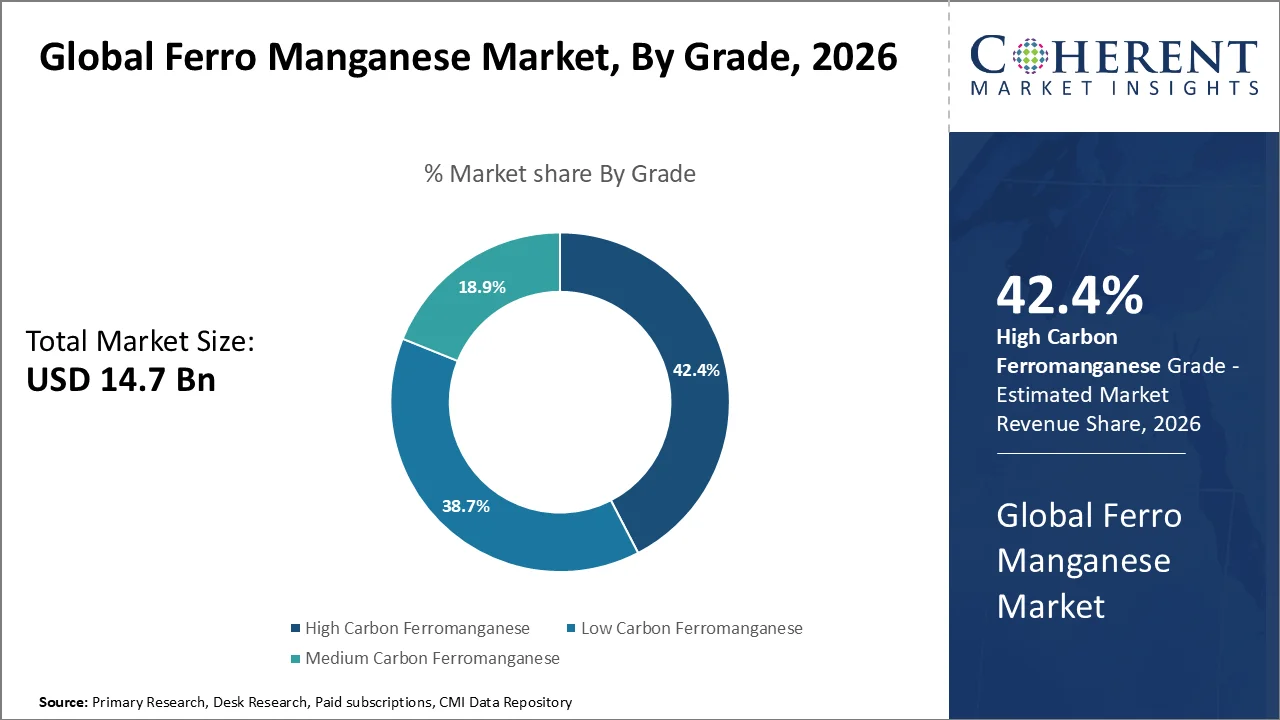
- By Grade, High Carbon Ferromanganese hold the largest market share of 42.4% in 2026 owing to its strong demand from steel production.
- By Application, Alloy Steel expected to hold largest market share of 34.8% in 2026 owing to the growing demand for high-strength materials. High-strength steel usage has increased by 25% in automotive manufacturing, boosting manganese alloy consumption.
- By Production Method, Metallurgy acquired the prominent market share of 45.4% in 2026 owing to the widespread use in steelmaking. Metallurgical processes contribute to over 90% of ferromanganese production, as they are essential for large-scale steel refining.
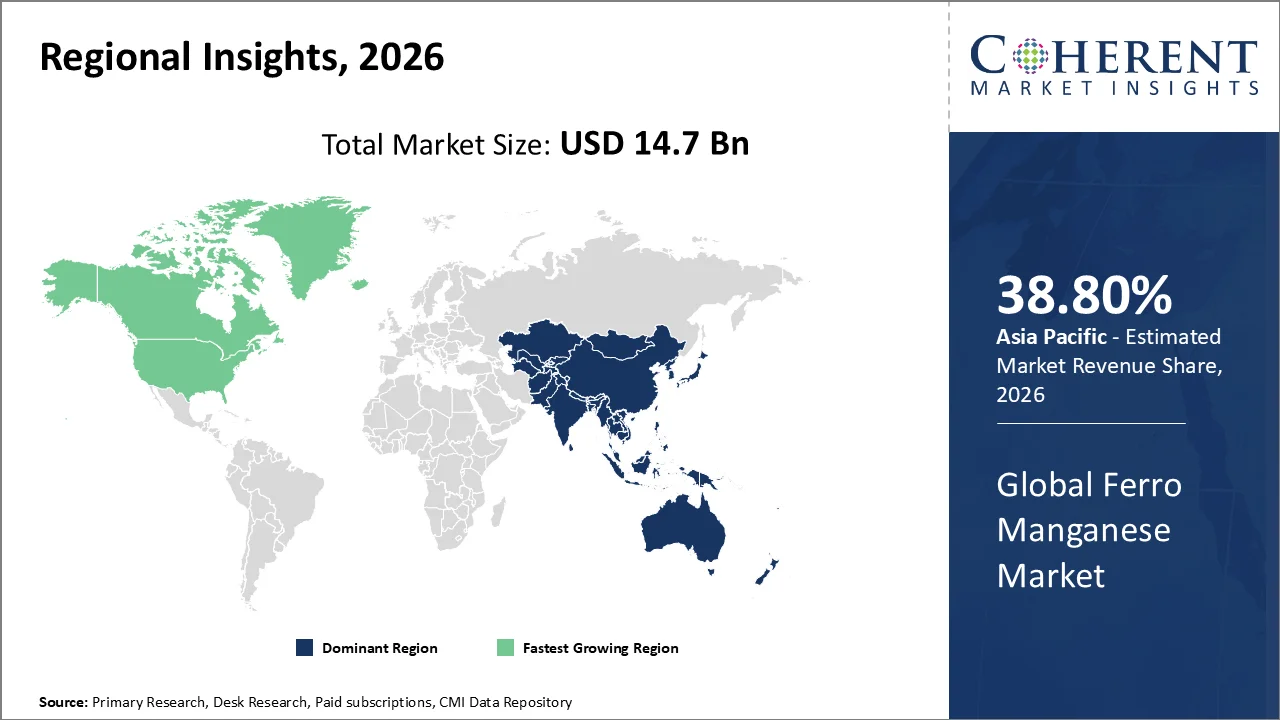
- By Region, Asia Pacific is expected to acquire the dominant share of 38.8% in 2026 owing to its dominance of steel metal production. The region accounts for nearly 70% of global steel output, led by China and India. China alone produces over 50% of the world’s steel, while India’s demand is growing at 6%–7% annually, strengthening regional market growth.
Segmental Insights
Why is High Carbon Ferromanganese Acquiring the Largest Market Share?
High Carbon Ferromanganese hold the largest market share of 42.4% in 2026. High Carbon Ferro Manganese grows in the ferro manganese market mainly due to its extensive use in steel production, where it serves as a key deoxidizing and alloying agent that improves strength and durability. Construction, automotive, and infrastructure sectors drive its demand as they heavily depend on carbon and alloy steels. Urbanization and industrialization continue to expand its use, while the cost-effectiveness of high carbon grades further encourages their adoption in large-scale steel manufacturing worldwide. For instance, President Jacob Zuma launched a manganese sinter plant near Hotazel in the Northern Cape as part of a black women-led integrated mining and beneficiation project, designed to produce 32,000 tons per year of high-carbon ferromanganese.
- Current Industry Events of 2026
- Market Size Estimation
- Regional Breakdown
- Competitive Landscape
- Customer Intelligence
- Segmental Analysis
- Pricing Analysis
- Key Market Drivers, Challenges & Future Trends
- Customized Insights Section
Alloy Steel expected to hold largest market share
Based on Application, Alloy Steel expected to hold largest market share of 34.8% in 2026 owing to the Expansion of automotive and transportation industries. Alloy steel grows in the ferro manganese market because industries increasingly use it in high-strength applications across automotive, construction, and heavy engineering sectors. Manufacturers depend on manganese to enhance hardness, toughness, and wear resistance, which makes ferro manganese a vital input in alloy steel production. Demand for durable industrial machinery, ongoing infrastructure development, and advanced manufacturing practices further drive its use. Expanding transportation networks and the shift toward high-performance materials also reinforce alloy steel’s importance in the ferro manganese market. For instance, in September 2025, Beekay Steel Industries Ltd started commercial production at its Cuttack, Odisha facility, boosting its steel and ferro alloy output capacity and strengthening its presence in eastern India.
Which Production Method segment dominates the market?
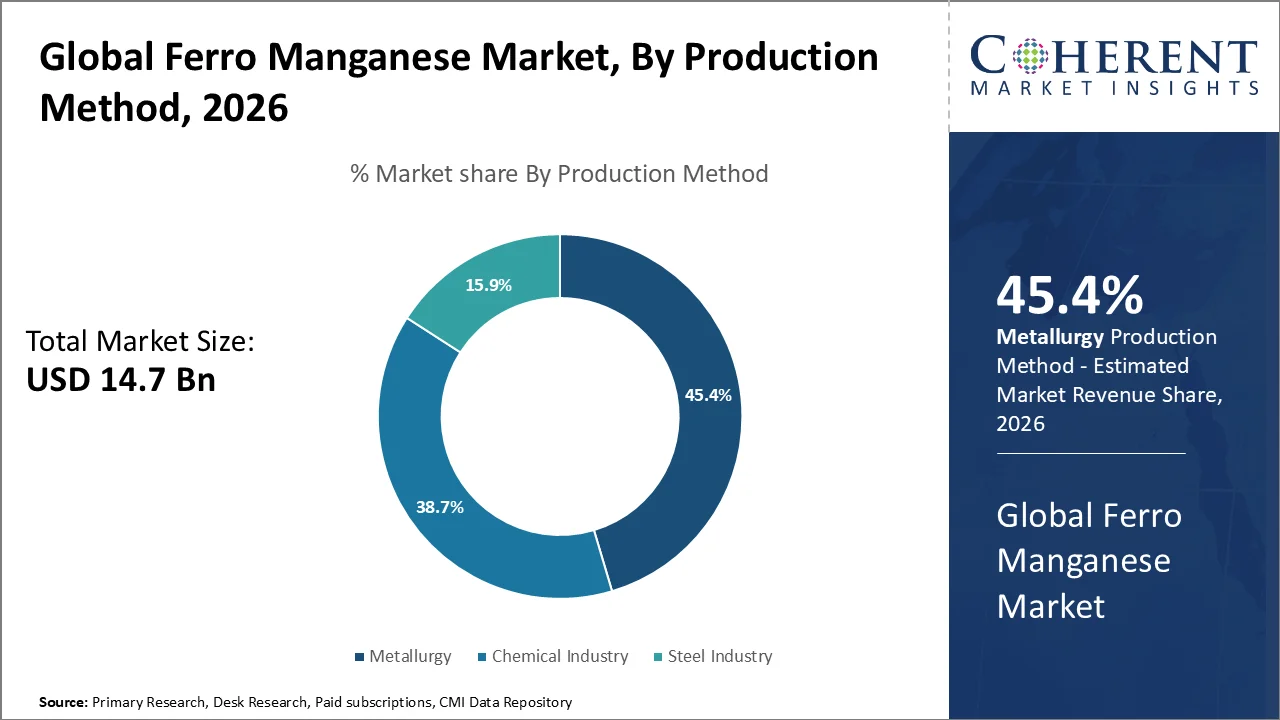
Metallurgy acquired the prominent market share of 45.4% in 2026. Producers actively use ferro manganese as a deoxidizing and desulfurizing agent to enhance steel quality and remove impurities, with nearly 90%–95% of global manganese alloys consumed in steel production. Rising steel production across construction, automotive, and industrial sectors increases its use in metallurgical applications, as the construction industry alone accounts for over 40% of total steel consumption.
Ferro Manganese Market Trends
- Rising steel production across construction, automotive, and infrastructure sectors strengthens demand for ferro manganese as a key deoxidizing and alloying agent in metallurgical processes, improving steel strength and durability. Global crude steel production exceeds 1.9–2.0 billion tonnes annually, with nearly 90%–95% of manganese alloys consumed in steelmaking. The construction sector alone accounts for over 40% of total steel demand, reinforcing consistent alloy usage.
- Expanding adoption of high-strength and lightweight alloy steels in automotive and heavy engineering applications increases manganese consumption, as it enhances hardness, wear resistance, and performance characteristics. The automotive sector contributes around 20%–25% of global steel consumption, with high-strength steel usage rising by 25%+ in the past decade. Alloy and specialty steels make up approximately 25%–30% of total steel production, supporting higher manganese intake.
Current Events and Their Impact
Current Event | Description and its Impact |
Geopolitical and Trade Dynamics |
|
Global Economic and Demand-Side Trends |
|
Regional Insights
Asia Pacific dominates owing to Expanding construction and real estate sector
Asia Pacific is expected to acquire the dominant share of 38.8% in 2026. The Asia Pacific region drives the ferro manganese market through its strong dominance in steel production and rapid industrial expansion. The region accounts for nearly 70% of global steel production, with China alone contributing over 50% of total output, while India ranks among the top producers with production exceeding 150 million tonnes annually. This large-scale steel manufacturing significantly increases ferro manganese demand in metallurgical applications, as 90%–95% of manganese alloys are consumed in steelmaking.
North America expected to hold largest market share
North America drives the ferro manganese market through steady steel production and strong demand from automotive, construction, and industrial sectors. The region produces over 100–110 million tonnes of crude steel annually, with the United States accounting for nearly 70%–75% of regional output. Manufacturers use ferro manganese to improve steel strength, durability, and corrosion resistance in various applications, with nearly 90% of manganese alloys consumed in steelmaking processes.
Infrastructure renovation activities in the United States and Canada further increase consumption, supported by over $1 trillion in infrastructure investment plans focused on roads, bridges, and utilities. The growing use of advanced alloy steels in aerospace and heavy machinery also boosts demand, as aerospace-grade steel accounts for around 15%–20% of specialty steel usage in the region.
Japan Ferro Manganese Market Trends
Japan drives the ferro manganese market through its advanced steelmaking industry and strong focus on producing high-quality specialty steels. The country produces around 80–90 million tonnes of crude steel annually, with a strong emphasis on value-added and specialty steel grades. Japan extensively uses ferro manganese in automotive, shipbuilding, and precision engineering sectors to improve strength, durability, and performance, with the automotive industry alone accounting for nearly 30% of domestic steel demand.
United States Ferro Manganese Market Trends
The United States drives the ferro manganese market through strong steel production and high demand from automotive, construction, and industrial sectors. Manufacturers actively use ferro manganese to enhance steel strength, hardness, and resistance across various applications. Infrastructure modernization, including roads, bridges, and commercial projects, further boosts consumption. The aerospace and defense industries also drive demand for advanced alloy steels. Additionally, technological advancements in steelmaking and a strong focus on producing high-quality, durable materials support market growth across the country. For instance, in May 2025, General Motors and LG Energy Solution developed prismatic lithium-manganese-rich battery cells for electric pickups and SUVs, and Ultium Cells plans to begin U.S. production with pre-series output.
Who are the Major Companies in Ferro Manganese Industry
Some of the major key players in Ferro Manganese are Monnet Group, Maithan Alloys Limited, Tata Steel, Gulf Manganese Corporation Limited, Ferroglobe, OM Holdings Ltd., Nippon Denko, Sinai Manganese, ERAMET, and Gulf Ferro Alloys.
Key News
- In November 2025, the European Commission proposed a three-year safeguard measure to cut EU imports of four silicon- and manganese-based alloying elements by 25% compared to the average levels of the past three years.
Market Report Scope
Ferro Manganese Market Report Coverage
| Report Coverage | Details | ||
|---|---|---|---|
| Base Year: | 2025 | Market Size in 2026: | USD 14.7 Bn |
| Historical Data for: | 2020 To 2024 | Forecast Period: | 2026 To 2033 |
| Forecast Period 2026 to 2033 CAGR: | 11.7% | 2033 Value Projection: | USD 22.4 Bn |
| Geographies covered: |
| ||
| Segments covered: |
| ||
| Companies covered: | Monnet Group, Maithan Alloys Limited, Tata Steel, Gulf Manganese Corporation Limited, Ferroglobe, OM Holdings Ltd., Nippon Denko, Sinai Manganese, ERAMET, and Gulf Ferro Alloys. | ||
Analyst Opinion
- The ferro manganese market is fundamentally demand-locked to global steel production, and this makes it structurally non-cyclical in the long term. With global crude steel output consistently exceeding 1.8 billion tonnes annually (World Steel Association), ferro manganese remains indispensable because nearly every tonne of carbon and alloy steel requires manganese as a deoxidizer and strengthening agent. This is not optional chemistry—it is embedded in steelmaking itself.
- High carbon ferro manganese continues to dominate consumption because of its cost efficiency in bulk steel production. In basic oxygen furnace operations, manganese recovery rates typically range between 85–95%, making it one of the most efficient alloying additions in steel metallurgy. For example, integrated steel plants in China and India still rely heavily on HC FeMn to balance cost and performance in large-volume structural steel output.
- Alloy steel production is intensifying structural demand for ferro manganese, especially in high-stress engineering applications. In automotive manufacturing, manganese-alloyed steels are widely used in crankshafts, gears, and safety structures because they improve fatigue resistance and impact strength. The shift toward electric vehicles is further increasing the need for high-strength, lightweight alloy steels, reinforcing manganese intensity per unit of steel.
- From a metallurgical standpoint, ferro manganese remains non-substitutable in conventional steel refining. Alternative deoxidizers such as silicon or aluminum cannot replicate manganese’s dual role in both impurity removal and mechanical property enhancement. This is why even advanced EAF-based recycling systems still reinject manganese to restore alloy balance in scrap-based steel, ensuring persistent baseline demand regardless of steel cycle fluctuations.
Speak to the analyst
Want personalized insights?
Take the findings above to one of our principal consultants, or have the report rebuilt around the segments, geographies and competitors you actually track.
Market Segmentation
- By Grade
- High Carbon Ferromanganese
- Low Carbon Ferromanganese
- Medium Carbon Ferromanganese
- By Application
- Carbon Steel
- Stainless Steel
- Alloy Steel
- Cast Iron
- By Production Method
- Metallurgy
- Chemical Industry
- Steel Industry
- By Region
- North America
- U.S.
- Canada
- Latin America
- Brazil
- Mexico
- Argentina
- Rest of Latin America
- Europe
- Germany
- U.K.
- France
- Italy
- Spain
- Russia
- Rest of Europe
- Asia Pacific
- China
- India
- Japan
- Australia
- South Korea
- ASEAN
- Rest of Asia Pacific
- Middle East
- GCC
- Israel
- Rest of Middle East
- Africa
- South Africa
- Central Africa
- North Africa
- North America
- Key Players Insights
- Monnet Group
- Maithan Alloys Limited
- Tata Steel
- Gulf Manganese Corporation Limited
- Ferroglobe
- OM Holdings Ltd.
- Nippon Denko
- Sinai Manganese
- ERAMET
- Gulf Ferro Alloys.
Sources
Primary Research Interviews
- Ferro manganese manufacturers and alloy producers
- Steel plant procurement and operations managers
- Raw material suppliers (manganese ore traders, coke suppliers)
- Industry experts from metallurgical engineering departments
- Logistics and supply chain executives in the ferro alloys sector
Databases
- International trade statistics databases (import/export shipment data)
- Government mining and mineral statistics portals
- Customs and tariff data repositories
- Commodity price tracking databases
- Industrial production and capacity utilization datasets
Magazines
- Metallurgy and steel industry trade magazines
- Industrial materials and alloys-focused publications
- Mining and mineral resources magazines
- Global commodity and metals newsletters
Journals
- Metallurgical engineering research journals
- Materials science and alloy development journals
- Iron and steel production research publications
- Mineral processing and extraction technology journals
Newspapers
- Business and financial newspapers covering commodities
- National newspapers with industrial and manufacturing sections
- Regional economic publications covering mining hubs
- Trade and export-focused news sections
Associations
- Steel and ferro alloy industry associations
- Mining and mineral development organizations
- Metallurgical engineering professional bodies
- International trade and commodity councils
- Industrial manufacturing federations
Public Domain Sources
- Government ministry reports on mining and metals
- National and international trade statistics portals
- Central and state geological survey publications
- Policy documents related to steel and alloy industries
- Port authority export-import data releases
Proprietary Elements
- CMI Data Analytics Tool, and Proprietary CMI Existing Repository of information for last 8 years
Get access to 250+ pages report
Every segment, forecast, competitor profile and data table behind the analysis above — available for instant download.
- ESOMAR Member
- ISO 9001:2015 Certified
- D-U-N-S Registered
- GDPR & CCPA Compliant
Missing comfort of reading report in your local language? Find your preferred language:
Transform your Strategy with Exclusive Trending Reports
Frequently Asked Questions
The Ferro Manganese Market is anticipated to grow at a CAGR of 11.7% with USD 14.7 Billion in 2026 and is expected to reach USD 22.4 Billion in 2033.
Ferro manganese is primarily used in steelmaking as a deoxidizing and desulfurizing agent.
It removes oxygen and sulfur impurities during steel refining, which improves steel quality and structural integrity.
Key demand comes from construction, automotive, infrastructure, heavy engineering, shipbuilding, and industrial machinery sectors, all of which rely heavily on steel containing manganese.
High carbon ferro manganese is mainly used in bulk steel production due to its cost efficiency, while low carbon grades are used in specialty steels where lower carbon content is required for precision applications.
Asia Pacific dominates the market due to large-scale steel production in countries like China and India, along with rapid infrastructure development and industrial expansion.