

Global Rhenium Powder Market Size and Forecast – 2026 To 2033
The Global Rhenium Powder Market is estimated to be valued at USD 103.6 Mn in 2026 and is expected to reach USD 164.2 Mn by 2033, growing at a compound annual growth rate (CAGR) of 6.80% from 2026 to 2033. The steady growth is driven by demand from aerospace, power generation, specialized automotive and electronics applications. Rhenium’s high melting point, thermal stability and creep resistance make it a valuable engineering material. The commercial prospects for rhenium powder suppliers are improving due to the increasing capabilities in superalloy manufacturing and the development of high-performance turbine components.
In August 2026, SeAH Superalloy Technologies announced the introduction of cast ingots at its upcoming manufacturing facility in Temple, Texas. Its alloys portfolio includes René N5, a nickel-base superalloy with rhenium for high-pressure turbine blades and advanced aircraft engines.
Key Takeaways of the Global Rhenium Powder Market
- 99.9% to Below 99.99% purity level is projected to register a CAGR of 6.6% during 2026–2033, accounting for 43.8% of the global rhenium powder market in 2026. Its commercial advantage lies in balancing material purity with procurement costs for specialty alloy manufacturing. In November 2026, FUJIFILM Wako Pure Chemical Corporation listed rhenium powder with a minimum metallic purity of 99.9% in its technical specifications.
- Irregular & Agglomerated Powder is forecast to expand at a CAGR of 6.1% during 2026–2033, securing 71.5% of the global rhenium powder market in 2026. The dominance reflects its established production methods and minimal processing requirements, obviating the necessity of spherical particles. In October 2025, researchers at Carnegie Mellon University reported the use of irregular rhenium powder obtained from Rhenium Alloys as a feedstock for plasma spheroidization.
- 10–45 µm particle size is anticipated to achieve a CAGR of 7.1% during 2026–2033, representing 45.6% of global rhenium powder market revenue in 2026. This range of particle size has practical advantages in alloy processing, powder handling and blending. BGRIMM Technology Group completed the research in June 2026, confirming that it successfully produced rhenium powders with median particle sizes of 13.2 µm and 28.2 µm.
- Primary-Refined Rhenium is estimated to grow at a CAGR of 6.2% during 2026–2033, contributing 78.3% of the global rhenium powder market in 2026. The current processing infrastructure gives commercial availability of copper and molybdenum and makes less reliance on scrap collection. U.S. Geological Survey, February 2026, U.S. primary rhenium production in 2025 estimated at 9,800 kg—5% percent annual increase.
- North America is expected to record a CAGR of 6.7% during 2026–2033 while maintaining its dominant share of 37.2% of the global rhenium powder market in 2026. The region possesses significant commercial engine manufacturing capabilities and existing aerospace supply chains. In March 2026, GE Aerospace announced a USD 1 billion U.S. manufacturing investment, including a high-pressure turbine durability kit capacity expansion.
- Europe is positioned to register the fastest CAGR of 7.8% during 2026–2033, holding 30.8% of the global rhenium powder market in 2026. The investment in advanced turbine blade manufacturing creates more opportunities for suppliers of refractory metals in the region. In March 2026, Rolls-Royce announced it would invest USD 251.54 Mn in its Rotherham Advanced Blade Casting Facility, to support its ambition to double production output by 2030.
Segmental Insights
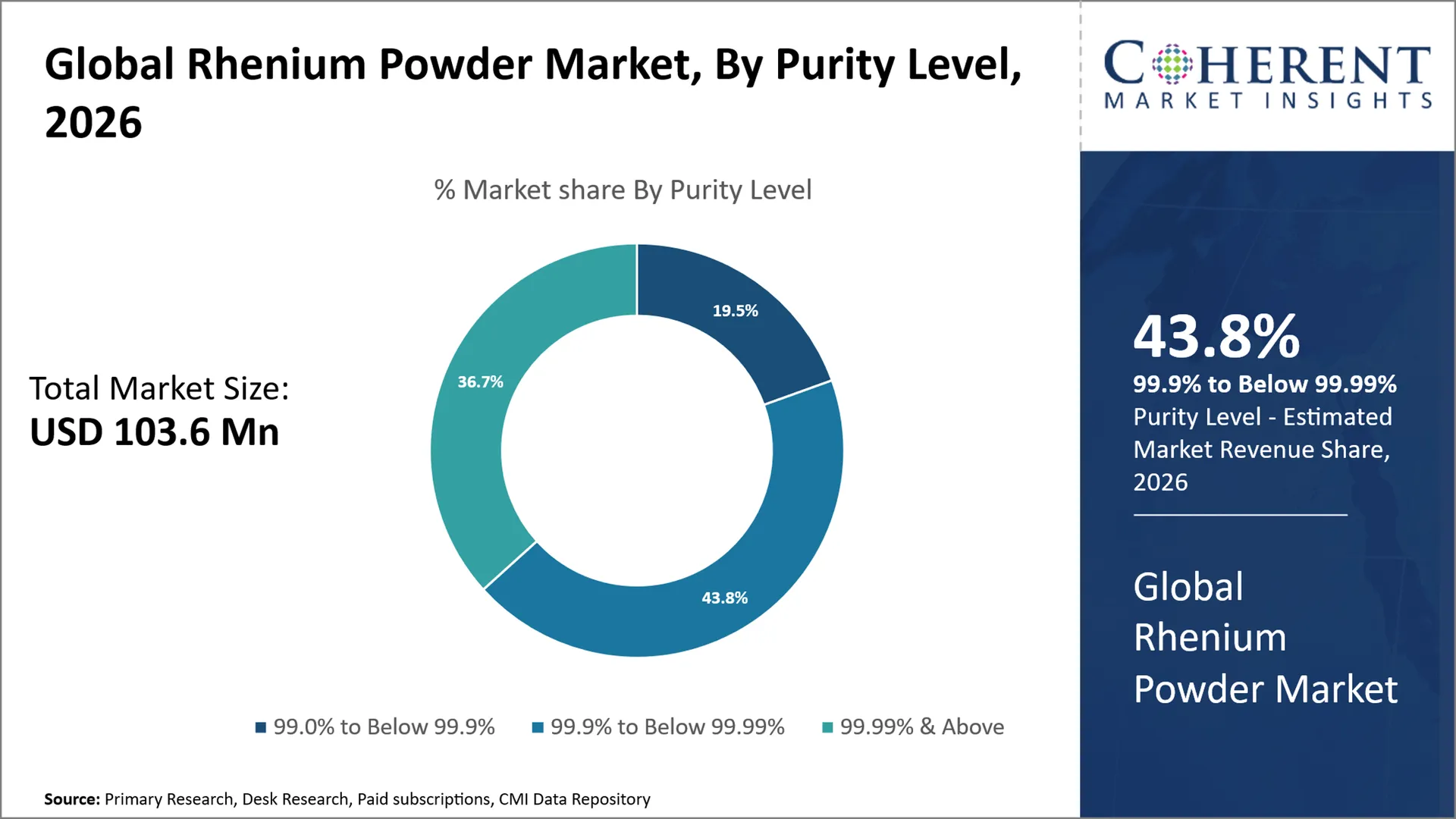
Why Does the 99.9% to Below 99.99% Purity Level Dominate the Global Rhenium Powder Market?
The 99.9% to Below 99.99% purity level segment is expected to account for 43.8% of the global rhenium powder market in 2026. Its metallurgical requirements reinforce the leadership of industrial alloy manufacturers, since the control of unwanted elements is essential to the attainment of predictable mechanical properties. This range of purities is a practical compromise between the costs of purification and the performance of the material. The demand is particularly high in the nickel-based superalloy and refractory alloy manufacturing sectors, where the reliability of the components is dependent on the precise chemical compositions. For example, MetalsTek Engineering sells rhenium powder in the standard particle size of 200 mesh and 99.95% purity with the option to customize particle size specifications. These commercial offerings are for specialized engineering applications and high-temperature alloy manufacturing and enhance the industrial relevance of the purity segment from 99.9% to Below 99.99%.
- Current Industry Events of 2026
- Market Size Estimation
- Regional Breakdown
- Competitive Landscape
- Customer Intelligence
- Segmental Analysis
- Pricing Analysis
- Key Market Drivers, Challenges & Future Trends
- Customized Insights Section
Why Does Irregular & Agglomerated Powder Represent the Largest Powder Morphology Segment in the Global Rhenium Powder Market?
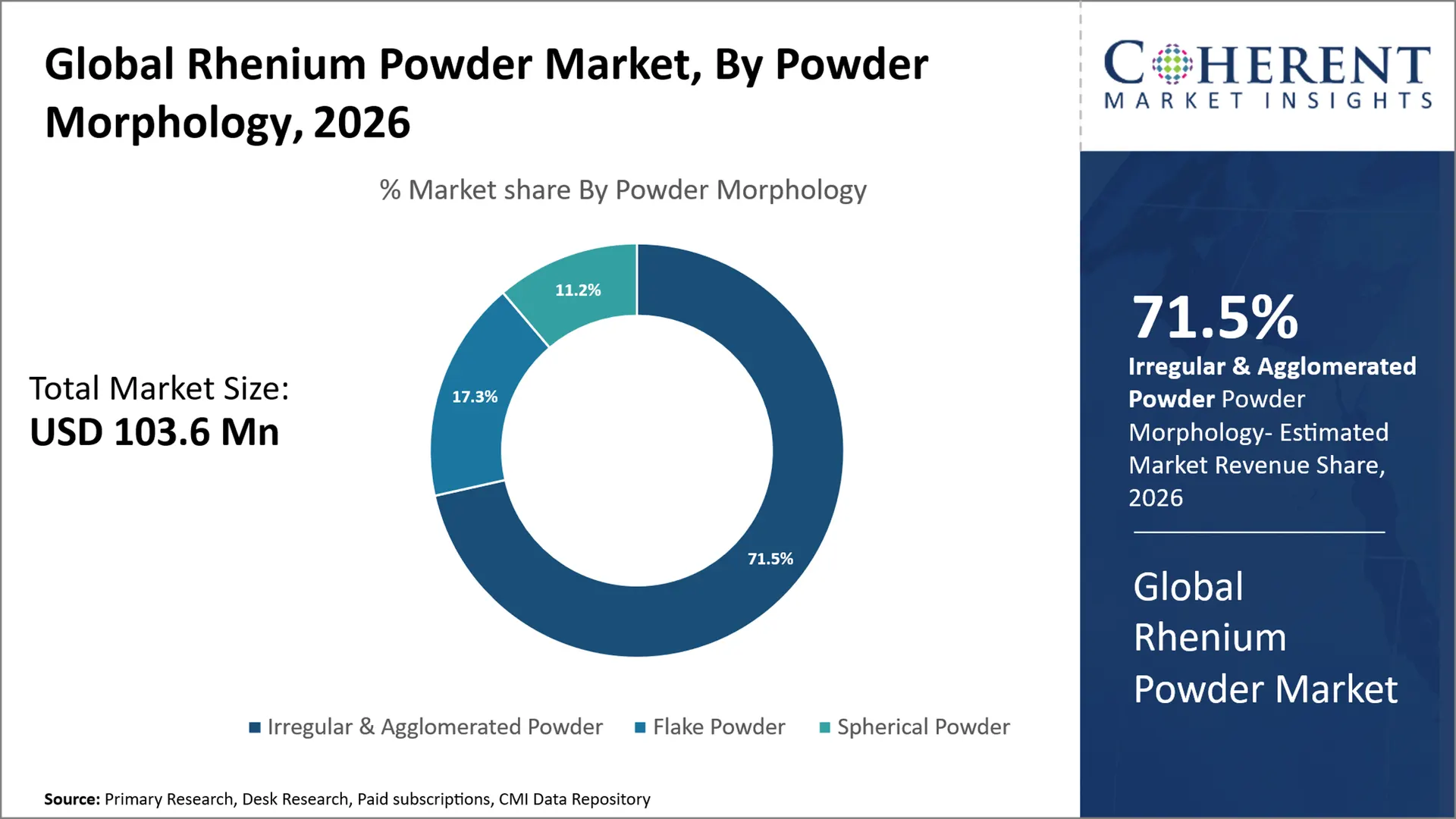
Irregular & Agglomerated Powder is anticipated to capture 71.5% of the global rhenium powder market in 2026. Its market position indicates its compatibility with existing powder metallurgy and downstream alloy conversion processes. Industrial manufacturers can incorporate agglomerated particles into powder blending, compaction and sintering operations without the need for additional spheroidization steps. This morphology is particularly suitable for the manufacture of semi-finished alloy products in which a change of the original particle geometry occurs in the consolidation. For example, Hoganas AB produces rhenium metal powder that consists of agglomerated single crystals and is particularly suitable for the production of specialty alloys and medical anode plates. The company retains the particle size distribution, tap density and specific surface area to facilitate the blending and sintering of homogeneous powders. These properties emphasize the commercial importance of agglomerated rhenium powders in standard metallurgical manufacturing processes.
Why Does the 10–45 µm Particle Size Segment Dominate the Global Rhenium Powder Market?
The 10–45 µm particle size segment is projected to represent 45.6% of the global rhenium powder market in 2026. Its commercial importance is due to processing requirements of specialized component fabrication, additive manufacturing and powder metallurgy. Intermediate sized particles provide a convenient balance between the performance of consolidation, surface activity and powder handling. Controlled size distribution of the materials allows for consistent feeding and processing of materials under appropriate manufacturing conditions. For example, Heeger Materials Inc. provides spherical rhenium powder with a particle size in the range of 15–45 µm, especially designed for high-temperature alloy applications, thermal spraying, and additive manufacturing. The company also provides customized particle size specifications for a variety of industrial processing requirements. The commercial availability of specified powder grades emphasizes the significance of intermediate particle sizes for advanced manufacturing and provides opportunities for suppliers of classified metallic powders.
Current Events and their Impact
Current Event | Description and Its Impact |
November 2025 – Inclusion of Rhenium in the U.S. Critical Minerals List |
|
February 2025 – India's Customs Duty Exemption on Rhenium Scrap |
|
Global Rhenium Powder Market Dynamics
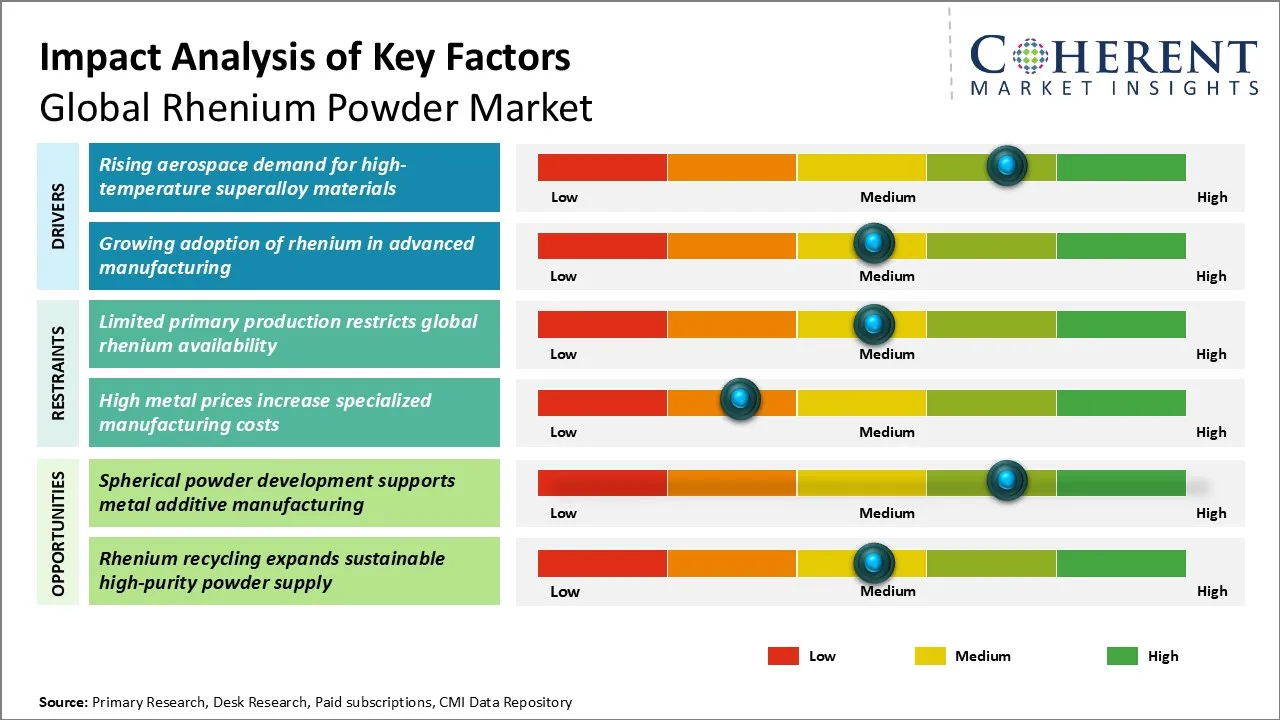
Key Market Drivers
- Rising aerospace demand for high-temperature superalloy materials: Aircraft engine manufacturers are increasingly focusing on nickel-based superalloys that can maintain structural integrity for extended periods of thermal and mechanical stress. In some superalloy formulations, rhenium helps to improve creep resistance, allowing turbine components to retain their properties at higher operating temperatures. Engine order books, whether for original equipment manufacturing or aftermarket component replacement, produce recurring material requirements. This is particularly beneficial for specialty alloy manufacturers and accredited rhenium powder suppliers that have built relationships with aerospace customers. In July 2026, Pratt & Whitney since the start of the year has received more than 800 GTF engine orders and commitments, increasing its engine backlog to more than 8,000 units
- Growing adoption of rhenium in advanced manufacturing: Advanced manufacturing processes are extending the commercial potential of rhenium beyond conventional alloy production. Manufacturers can use powder-based fabrication to create complex components and custom material compositions that are difficult to achieve by conventional machining. This leads to special procurement opportunities for suppliers who can provide metallic powders for specific applications. In February 2025, scientists at the Wroclaw University of Science and Technology published a study on the mechanical and fatigue properties of rhenium-modified Inconel 718 produced through laser powder bed fusion. This research bolsters future materials qualification pathways for industrial 3D printing companies and specialty powder manufacturers.
Emerging Market Trends
- Expansion of closed-loop rhenium recovery models: Increasingly industrial customers are considering the recovery of rhenium from retired components, manufacturing residues and rhenium-bearing industrial scrap. It's a slow integration of both recovered materials and new refined metal into the evolving procurement models.
Impact: Structured collection agreements may provide more predictable volumes of feedstock to specialized metal recovery companies. Traditional suppliers lacking recycling abilities may be forced to broaden their service offering.
Relevance to the market: The closed-loop material arrangements are expected to improve the availability of secondary-recovered rhenium powder during the forecast period. These arrangements will also promote closer collaboration between the industrial consumers and powder processors.
- Transition toward application-specific powder qualification: Industrial buyers are shifting away from nominal purity specifications to a more in-depth look at powder chemistry, surface contamination and manufacturing compatibility. The later processing of the material will influence the customers more and more in their buying decisions.
Impact: Suppliers that offer detailed characterization and reproducible manufacturing batches could experience an increase in customer retention. Traders who cannot show a consistent performance with powder might have trouble trying to secure higher-value contracts.
Relevance to the market: This transition is expected to drive more investment in analytical testing capabilities, customer-specific qualification programs and differentiated powder grades at specialty metal manufacturing facilities.
Key Restraining Factors
- Limited flexibility in rhenium feedstock production: Rhenium is predominantly recovered during the processing of other metals. Consequently, producers cannot independently increase output in direct response to rhenium demand. This restricts supply responsiveness and creates procurement uncertainty during periods of accelerated consumption
- High material costs and working capital requirements: The elevated value of rhenium increases inventory financing requirements for powder manufacturers and industrial buyers. Smaller processors may struggle to maintain adequate safety stocks without exposing themselves to significant price-related losses.
Regional Insights
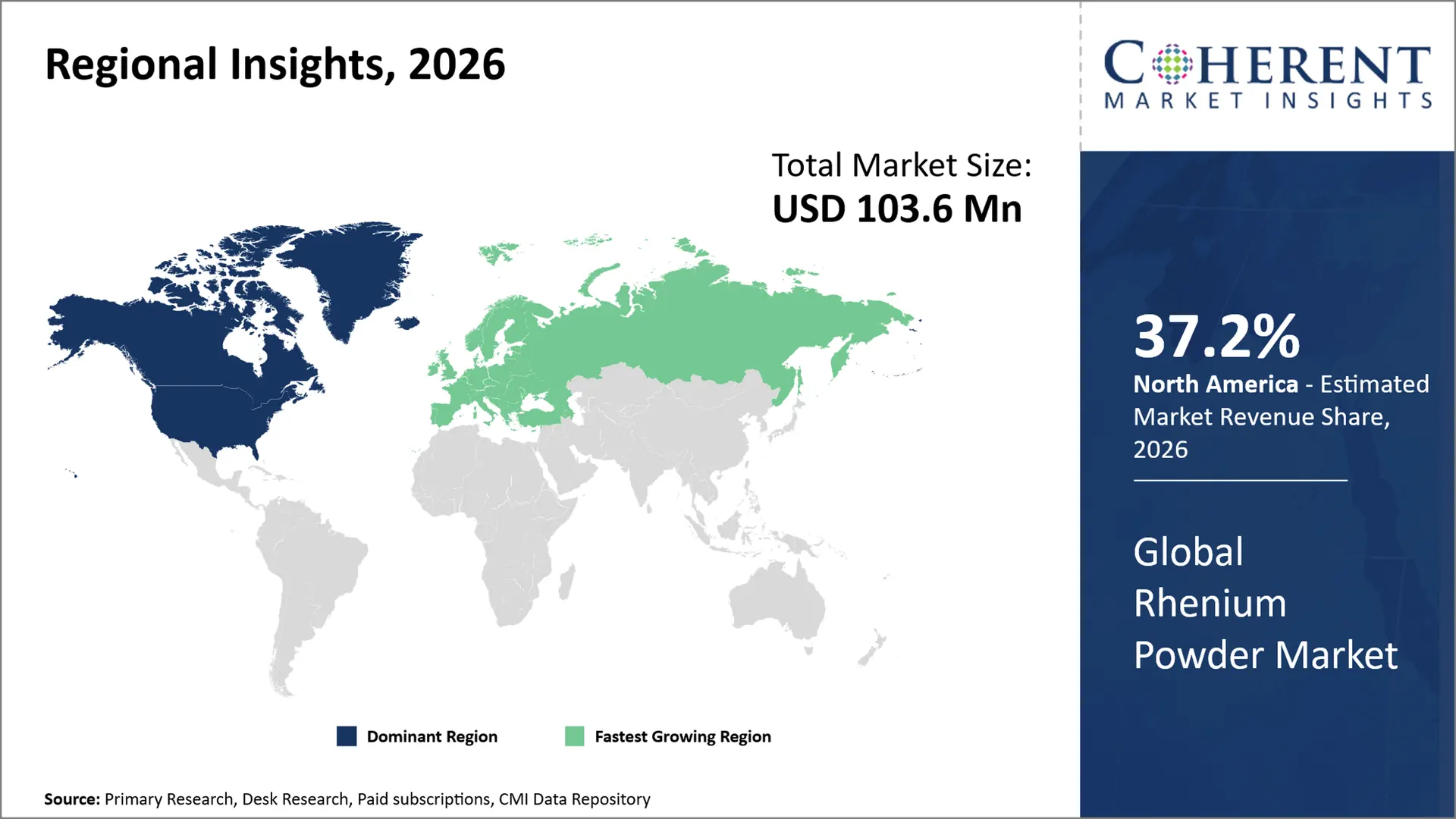
Why Does North America Dominate the Global Rhenium Powder Market?
North America is expected to account for 37.2% of the global rhenium powder market in 2026. The regional demand is also found outside of aircraft manufacturing, in industrial gas turbines for power generation and large scale industrial operations. The development of power generation facilities creates opportunities for manufacturers of rhenium-containing superalloys for some high temperature turbine components. Established metallurgical plants and industrial service chains also allow to procure the materials for component substitution repeatedly. In October 2026, Mitsubishi Power Americas announced a $490 million investment to expand its Savanna Machinery Works facility in Georgia that produces and services advanced-class gas turbines. These investments could strengthen downstream demand for temperature resistant alloy materials, providing further commercial opportunities for regional rhenium powder suppliers.
Why Is Europe Emerging as the Fastest-Growing Region in the Global Rhenium Powder Market?
Europe is anticipated to capture 30.8% of the global rhenium powder market in 2026 and register the fastest growth during 2026–2033. Regional manufacturers are investing in integrated production infrastructure to reduce their reliance on external suppliers of critical aircraft engine components. This industrial shift creates opportunities for specialty metal processors who provide qualified alloying materials to European manufacturing facilities. In April 2026, Safran Aircraft Engines announced a USD 163.48 million investment to upgrade its forging capabilities in Gennevilliers, France, with operations expected to commence in 2029. While the investment is not directly linked to the production of rhenium powder, the wider expansion of engine manufacturing will enhance the long-term prospects for suppliers servicing European high-performance alloy supply chains.
Global Rhenium Powder Market Outlook for Key Countries
Why Is the U.S. a Key Market for the Global Rhenium Powder Market?
The U.S. is estimated to hold a market share of about 34.0% of the global rhenium powder market by 2026. The country’s competitive position is supported by advanced infrastructure in powder metallurgy, specialized material engineering capabilities and commercial investment in processing of refractory metals. Industrial customers have local sourcing requirements that support the development of locally manufactured metallic powders. In its October 2026 filing with the U.S. Securities and Exchange Commission, Amaero Inc. disclosed that its specialty powder portfolio included rhenium for high-temperature engineering applications. The company has facilities in Tennessee for making refractory metal powders. These capabilities increase the availability of domestic material and provide an opportunity to reduce reliance on imported specialty powders while serving customers with demanding technical specifications.
Why Does China Support Growth in the Global Rhenium Powder Market?
China is estimated to contribute close to 14.0% of the global rhenium powder market in 2026. It has commercial value due to its integrated rare-metal processing capabilities and the presence of domestic manufacturers producing rhenium-based materials for specialized engineering applications. Local processing infrastructure allows manufacturers to carry out several stages of production in-house, reducing the need to import finished materials. Zhuji Hongde New Material has a base line for rhenium metal, with an annual output of 30 tons. In 2024 the company was certified for quality, environment, occupational safety and military standards systems. These capabilities strengthen China’s position in technically demanding material supply chains and support domestic commercialization of high-purity rhenium products and specialized refractory alloys.
Why Is Germany a Strategic Country in the Global Rhenium Powder Market?
Germany is expected to hold an almost 10.0% share of the global rhenium powder market in 2026. This specialized expertise in the refining of metal and sophisticated services in the management of industrial materials also highlight the country’s strategic importance. German suppliers can stand out by providing chemical purification, analytical characterization, and custom procurement arrangements for high-value metals. Heraeus Precious Metals provides high purity rhenium powders and pellets for superalloy production as well as rhenium recovery and analytical testing, financing and metal leasing. This integrated offering addresses the financial and operational challenges of purchasing scarce metallic materials. Germany's established industrial service capabilities are expected to strengthen customer relationships and create commercially attractive opportunities for specialist suppliers serving aerospace, precision engineering, and medical technology manufacturers.
Innovation, Production & Manufacturing Landscape in the Global Rhenium Powder Market
Production Technology | Technology Description | Adoption Status | Commercial Significance |
Selective ion exchange | Uses selective resins to separate perrhenate ions from metal bearing processing solutions. | Established | Improves rhenium extraction from complex solutions, reducing the need for downstream purification. |
Ammonium perrhenate crystallization | Provides purified crystalline intermediates for further processing to metallic rhenium. | Established | Enables a uniform precursor quality and supports an efficient powder production. |
Hydrogen reduction | Converts ammonium perrhenate into metallic rhenium powder through controlled thermal reduction. | Widely established | Remains a principal industrial production route for metallic rhenium powder. |
Radio-frequency plasma spheroidization | Reshapes irregular metallic particles into more spherical forms through high-temperature plasma processing. | Specialized commercial adoption | Enables premium powder grades suitable for applications requiring improved flowability. |
Electrochemical rhenium recovery | Uses electrochemical processes to recover metallic rhenium from suitable electrolyte solutions. | Emerging and specialized | Offers an alternative recovery pathway, subject to improvements in efficiency and production economics. |
Combined carbon and hydrogen reduction | Uses combined reducing agents to investigate the synthesis of ultrafine rhenium powders. | Research and development stage | Could enable differentiated fine-powder grades for specialized powder metallurgy applications. |
How Are High-Temperature Measurement and Medical Engineering Applications Creating New Growth Opportunities in the Global Rhenium Powder Market?
Specialized electronics and medical engineering are an underdeveloped commercial opportunity for rhenium powder producers looking to diversify away from aerospace-related consumption. Opportunities exist with tungsten-rhenium thermocouple materials, molybdenum-rhenium alloys and selected medical engineering components where the material performance can justify higher procurement costs.
Suppliers can capitalize on this opportunity by creating powders specifically designed for the manufacturing needs of high temperature sensors, precision instruments and specialty medical components. Working together with component manufacturers to develop materials could lead to recurring purchase contracts and less reliance on ad-hoc metal sales.
It requires precise impurity control, small batch production, specialized metallurgical knowledge and application-specific documentation to participate. Medical applications may also require significant validation and regulatory qualification at the finished device level. Established refractory metal experts are especially well placed to meet these needs. Smaller manufacturers can build commercially defensible positions by focusing on narrowly defined applications for which technical expertise is more important in making a purchase decision than production scale.
Market Players, Key Developments, and Competitive Intelligence
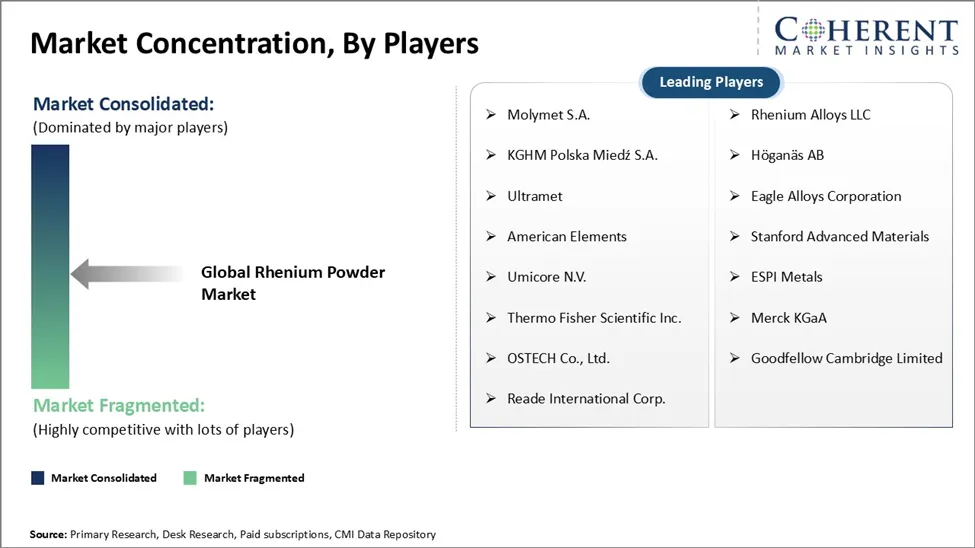
Key Developments
- In November 2026, Uzbekistan Technological Metals Complex (TMK) announced that its R&D Park had obtained international management system certifications covering activities including high-purity rhenium production. This is important for the global rhenium powder market because standardized manufacturing systems can strengthen supplier credibility among technically demanding international customers.
- In January 2026, Molymet announced a memorandum of understanding with Maritime House Metals to evaluate a joint venture for recovering rhenium-bearing scrap and supplying finished rhenium products, including powders. This is important for the global rhenium powder market because the proposed arrangement could expand secondary material availability.
- In April 2025, Almalyk Mining and Metallurgical Complex (AMMC) announced the launch of rhenium production, supported by a specialized processing facility and planned annual output of up to three metric tons. This is important for the global rhenium powder market because additional metallic rhenium production could diversify upstream sourcing options.
Competitive Landscape
The global rhenium powder market is moderately consolidated and comprises integrated metal refiners, refractory powder manufacturers, specialized recovery companies, and regional distributors. Existing producers have structural advantages through access to upstream resources, whereas specialist manufacturers compete on efficient conversion of powder and flexible order fulfillment. The ability to serve technically demanding industrial customers, production economics, contractual purchasing arrangements and metallurgical expertise are becoming more and more important in determining competitive positioning.
Key Focus Areas Include
- Control over feedstock purchase and refining costs.
- Improvement of metallurgical recovery and conversion yields.
- Flexible production capacity for individual order quantities.
- Competitive metal pricing and contractual adjustment mechanisms.
- Protection of proprietary powder manufacturing processes.
- Reduction of material losses during production.
- Development of regional inventory and logistics capabilities.
- Technical assistance for industrial material selection.
Market Report Scope
Global Rhenium Powder Market Report Coverage | |||
Report Coverage | Details | ||
Base Year | 2025 | Market Size in 2026: | USD 103.6 Mn |
Historical Data For: | 2020 to 2024 | Forecast Period: | 2026 to 2033 |
Forecast Period 2026 To 2033 CAGR: | 6.80% | 2033 Value Projection: | USD 164.2 Mn |
Geographies covered: |
| ||
Segments covered: |
| ||
Companies covered: | Molymet S.A., Rhenium Alloys LLC, KGHM Polska Miedź S.A., Höganäs AB, Ultramet, Eagle Alloys Corporation, American Elements, Stanford Advanced Materials, Umicore N.V., ESPI Metals, Thermo Fisher Scientific Inc., Merck KGaA, OSTECH Co., Ltd., Goodfellow Cambridge Limited, Reade International Corp. | ||
Growth Drivers: |
| ||
Restraints & Challenges: |
| ||
Analyst Opinion (Expert Opinion)
- Future Market Direction: The global rhenium powder market is expected to transition toward reservation-based procurement models, where industrial customers contract processing capacity before placing individual material orders. Suppliers capable of coordinating production schedules with customer consumption patterns could establish more predictable revenue streams and reduce exposure to irregular purchasing cycles.
- Transformative Trend or Disruption: Computational alloy design could fundamentally reshape the relationship between industrial output and rhenium consumption. Manufacturers may increasingly optimize alloy compositions around component-level performance rather than established material recipes. Powder suppliers relying exclusively on conventional formulations could face commercial pressure as alternative compositions progress through industrial qualification.
- Strategic Priorities and Recommendations: Market participants should prioritize modular processing investments, disciplined inventory management, and customer-backed capacity expansion. Developing flexible production infrastructure would allow suppliers to respond to changes in material specifications without excessive capital commitments. Manufacturers should avoid speculative inventory accumulation and large-scale capacity investments unsupported by credible industrial purchasing agreements.
Speak to the analyst
Want personalized insights?
Take the findings above to one of our principal consultants, or have the report rebuilt around the segments, geographies and competitors you actually track.
Market Segmentation
- Purity Level Insights (Revenue, USD Mn, 2021 - 2033)
- 99.0% to Below 99.9%
- 99.9% to Below 99.99%
- 99.99% & Above
- Powder Morphology Insights (Revenue, USD Mn, 2021 - 2033)
- Irregular & Agglomerated Powder
- Flake Powder
- Spherical Powder
- Particle Size Insights (Revenue, USD Mn, 2021 - 2033)
- Below 10 µm
- 10–45 µm
- Above 45 µm
- Feedstock Source Insights (Revenue, USD Mn, 2021 - 2033)
- Primary-Refined Rhenium
- Secondary-Recovered Rhenium
- Application Insights (Revenue, USD Mn, 2021 - 2033)
- Nickel-Based Superalloy Manufacturing
- Tungsten-Rhenium & Molybdenum-Rhenium Alloys
- Powder Metallurgy & Sintered Components
- Additive Manufacturing
- Electronics & Medical Applications
- Other Specialty Applications
- Sales Channel Insights (Revenue, USD Mn, 2021 - 2033)
- Direct Manufacturer Sales
- Specialty Metal Distributors
- Regional Insights (Revenue, USD Mn, 2021 - 2033)
- North America
- U.S.
- Canada
- Latin America
- Brazil
- Argentina
- Mexico
- Rest of Latin America
- Europe
- Germany
- U.K.
- Spain
- France
- Italy
- Russia
- Rest of Europe
- Asia Pacific
- China
- India
- Japan
- Australia
- South Korea
- ASEAN
- Rest of Asia Pacific
- Middle East
- GCC Countries
- Israel
- Rest of Middle East
- Africa
- South Africa
- North Africa
- Central Africa
- North America
- Key Players Insights
- Molymet S.A.
- Rhenium Alloys LLC
- KGHM Polska Miedź S.A.
- Hoganas AB
- Ultramet
- Eagle Alloys Corporation
- American Elements
- Stanford Advanced Materials
- Umicore N.V.
- ESPI Metals
- Thermo Fisher Scientific Inc.
- Merck KGaA
- OSTECH Co., Ltd.
- Goodfellow Cambridge Limited
- Reade International Corp.
Sources
Primary Research Interviews
- Rhenium powder manufacturers and metal refiners
- Aerospace superalloy manufacturers and turbine component suppliers
- Refractory metal and powder metallurgy specialists
- Rhenium recovery and recycling companies
- Specialty metal distributors and material procurement professionals
Stakeholders
- Primary and secondary rhenium producers
- Metallic powder manufacturers and processors
- Nickel-based superalloy manufacturers
- Tungsten-rhenium and molybdenum-rhenium alloy manufacturers
- Aerospace OEMs and additive manufacturing companies
- Specialty metal distributors and industrial importers
End-use Sectors
- Aerospace & Defense: Aircraft engine and turbine components
- Energy & Power Generation: High-temperature gas turbine components
- Electronics: Electrical contacts and thermocouples
- Medical Devices: Specialized refractory alloy components
- Industrial Manufacturing: Powder metallurgy and precision engineering
Product Applications
- Nickel-based superalloy manufacturing
- Tungsten-rhenium and molybdenum-rhenium alloy production
- Powder metallurgy and sintered components
- Additive manufacturing and metal powder processing
- Electronics and specialized medical applications
- High-temperature sensors and specialty engineering components
Regulatory and Industry Bodies
- U.S. Geological Survey (USGS)
- U.S. Department of the Interior (DOI)
- U.S. Environmental Protection Agency (EPA)
- European Chemicals Agency (ECHA)
- European Commission
- ASTM International
- International Organization for Standardization (ISO)
Databases
- USGS – Rhenium Mineral Commodity Summaries
- UN Comtrade and ITC Trade Map – Rhenium Trade Statistics
- USITC DataWeb – Rhenium Import and Export Data
- British Geological Survey – World Mineral Statistics
- Eurostat – Specialty Metal Trade Statistics
- Company Annual Reports and Investor Presentations
Magazines and Journals
- Powder Technology
- Powder Metallurgy
- Journal of Alloys and Compounds
- International Journal of Refractory Metals and Hard Materials
- Metallurgical and Materials Transactions
- Metal Powder Report
- Additive Manufacturing
Associations
- Metal Powder Industries Federation (MPIF)
- European Powder Metallurgy Association (EPMA)
- International Molybdenum Association (IMOA)
- Minor Metals Trade Association (MMTA)
- The Minerals, Metals & Materials Society (TMS)
- Aerospace Industries Association (AIA)
Public Domain Sources
- Rhenium powder product catalogs and technical specifications
- Mineral production, reserves, and trade statistics
- Rhenium extraction, refining, and recovery technology disclosures
- Superalloy manufacturing and aerospace production data
- Powder metallurgy and material performance studies
- Manufacturing expansions, patents, and product launches
- Company financial reports and metal pricing data
Key Standards and Regulations
- EU REACH Regulation (EC) No. 1907/2006 – Chemical Registration and Restrictions
- EU CLP Regulation (EC) No. 1272/2008 – Chemical Classification and Labeling
- U.S. Toxic Substances Control Act (TSCA) – Chemical Substance Requirements
- U.S. 2025 Critical Minerals List – Rhenium Designation
- ASTM B822 – Metal Powder Particle Size Distribution
- ASTM B214 – Sieve Analysis of Metal Powders
- ASTM B213 – Metal Powder Flow Rate Testing
- ISO 4497:2020 – Metallic Powder Particle Size Determination
- ISO 13320:2020 – Laser Diffraction Particle Size Analysis
Proprietary Elements
- CMI Data Analytics Tool
- Proprietary research repository, supported by primary interviews, rhenium powder purity benchmarking, powder morphology and particle size analysis, primary and secondary feedstock assessment, refining and recovery technology evaluation, application-specific demand assessment, aerospace and superalloy consumption analysis, sales-channel assessment, country-level market sizing, metal pricing evaluation, regulatory assessment, manufacturer profiling, and competitive intelligence.
Get access to 250+ pages report
Every segment, forecast, competitor profile and data table behind the analysis above — available for instant download.
- ESOMAR Member
- ISO 9001:2015 Certified
- D-U-N-S Registered
- GDPR & CCPA Compliant
Frequently Asked Questions
The CAGR of the global rhenium powder market is projected to be 6.80% from 2026 to 2033.
The global rhenium powder market is estimated to be valued at USD 103.6 Mn in 2026 and is expected to reach USD 164.2 Mn by 2033.
Rhenium powder is more flexible in terms of processing for the production of alloys, blending of materials and powder metallurgy, compared to rhenium pellets, sheets and ingots.
The price of rhenium powder is dependent on raw material availability, purity, powder characteristics, refining costs and contractual arrangements for purchasing.
Yes, rhenium can be reclaimed from spent catalysts, superalloy scrap and industrial residues by specialized extraction, purification and powder conversion processes.
Buyers should evaluate chemical purity, impurity levels, particle size distribution, powder morphology, oxygen content, batch consistency, and supplier quality certifications.
The global rhenium powder market is primarily driven by rising aerospace demand for high-temperature superalloys and the growing use of rhenium in advanced manufacturing processes.