

Global Rice Bran Oil Market Size and Forecast – 2026 To 2033
The Global Rice Bran Oil Market is estimated to be valued at USD 9.85 Bn in 2026 and is expected to reach USD 18.24 Bn by 2033, growing at a compound annual growth rate (CAGR) of 9.20% from 2026 to 2033. This growth reflects increasing consumer preference for healthier edible oils, supported by rising interest in oils with nutritional attributes such as naturally occurring antioxidants, oryzanol, and improved cooking performance.
Demand is also supported by the expansion of branded edible oil categories, food processing applications, and regulatory focus on edible oil quality and safety standards. In 2025, the Food Safety and Standards Authority of India (FSSAI) continued strengthening edible oil quality regulations and standards, including requirements related to food product standards, labeling, and safety compliance, supporting greater transparency and consumer confidence in edible oil products.
Key Takeaways of the Global Rice Bran Oil Market
- Refined Rice Bran Oil is expected to record an estimated 9.4% CAGR and hold 72.0% share in the global rice bran oil market, supported by strong household adoption, premium edible oil positioning, and established refining infrastructure. In August 2025, SPGCL announced expansion of its refined rice bran oil business through direct-to-consumer branding, highlighting continued commercialization of refined products.
- Solvent Extraction is expected to achieve an estimated 8.8% CAGR and account for 54.6% share in the global rice bran oil market, as it remains widely used for efficient oil recovery from rice bran at industrial scale. In April 2025, Acuité’s assessment of Rungta Industries highlighted its solvent extraction operations for rice bran oil manufacturing, reflecting the method’s continued industrial relevance.
- Food and Cooking Oil is projected to grow at an estimated 9.1% CAGR and represent 68.4% share in 2026, driven by rice bran oil’s role as a mainstream edible oil with nutritional positioning. In June 2021, India’s Ministry of Consumer Affairs introduced NAFED Fortified Rice Bran Oil to strengthen availability of fortified edible oils for consumers.
- Asia Pacific is expected to expand at an estimated 9.6% CAGR and contribute 62.8% share in the global rice bran oil market, supported by rice production ecosystems, domestic edible oil consumption, and established processing capabilities. In December 2025, Reliance Consumer Products acquired Tamil Nadu’s heritage nutrition brand Udhaiyam, indicating continued consolidation within India’s consumer food and edible oil landscape.
- Europe is anticipated to register an estimated 10.1% CAGR and account for 14.7% share in the global rice bran oil market, supported by increasing interest in specialty edible oils and health-oriented food choices. In April 2025, Om Gold highlighted expanded rice bran oil product formats, including packaged consumer options, reflecting broader retail diversification opportunities relevant to European-style premium oil consumption patterns.
Segmental Insights
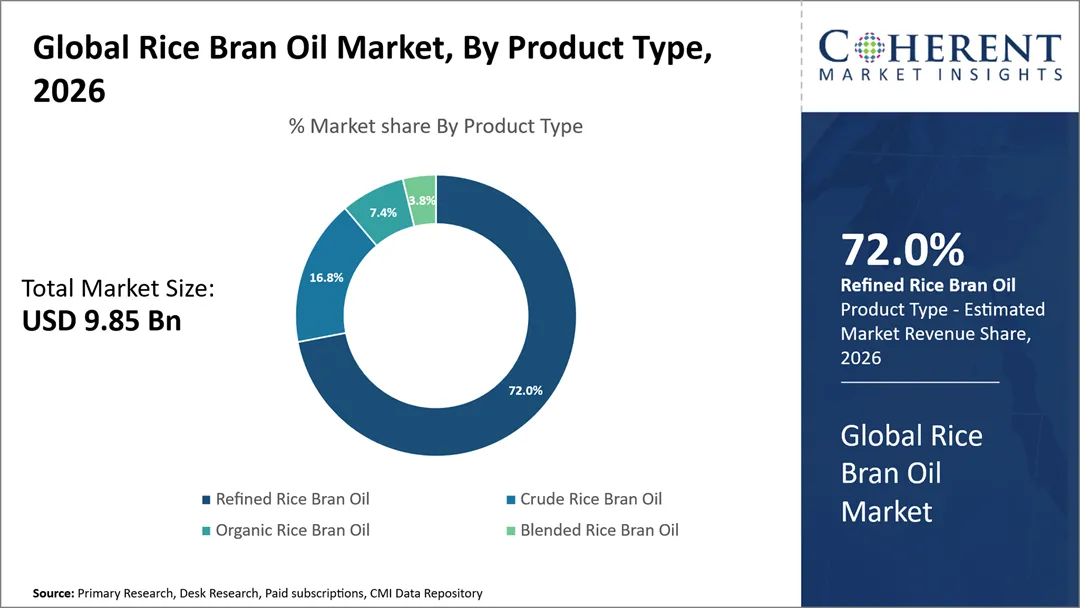
Why Does Refined Rice Bran Oil Dominate the Global Rice Bran Oil Market?
Refined Rice Bran Oil is expected to account for 72.0% of the global rice bran oil market in 2026, supported by its suitability for large-scale household consumption, branded retail sales, and foodservice applications. The segment leads because refining improves stability, removes impurities, and delivers consistent quality required by consumers and commercial buyers. Retail brands benefit from easier product standardization, longer shelf life, and stronger consumer trust compared with less processed alternatives. Manufacturers with integrated refining capabilities can capture higher margins through premium packaging, fortified variants, and export-grade products. In August 2025, SPGCL announced plans to expand its domestic agri-oil business by selling refined rice bran oil under its own consumer brand, utilizing its refining infrastructure and rice-bran sourcing advantage.
- Current Industry Events of 2026
- Market Size Estimation
- Regional Breakdown
- Competitive Landscape
- Customer Intelligence
- Segmental Analysis
- Pricing Analysis
- Key Market Drivers, Challenges & Future Trends
- Customized Insights Section
Why Does Solvent Extraction Represent the Largest Extraction Method Category in the Global Rice Bran Oil Market?
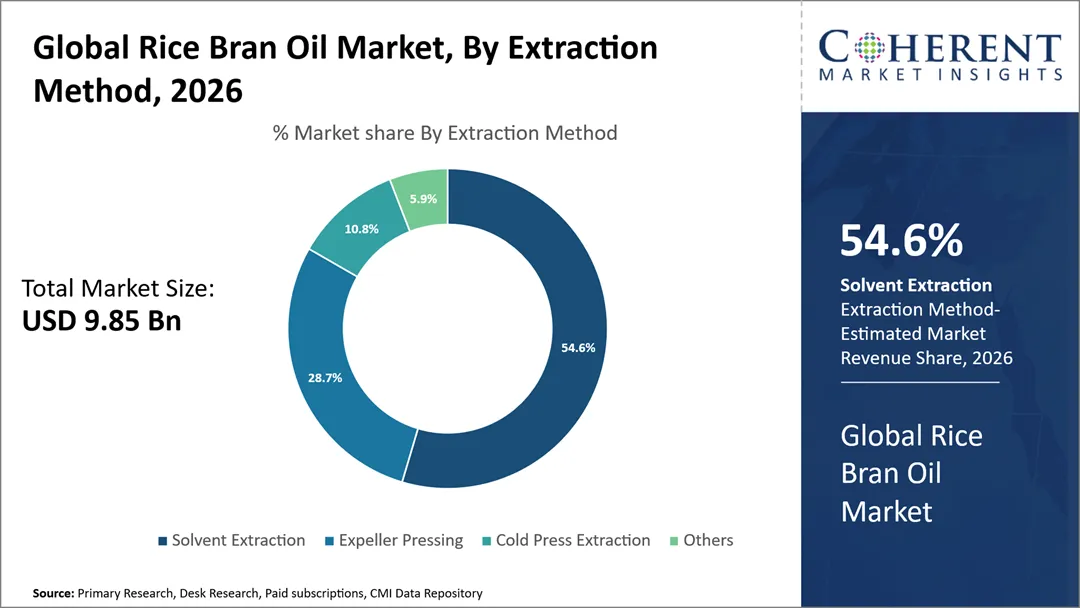
Solvent Extraction is expected to hold 54.6% share of the global rice bran oil market in 2026, supported by its ability to efficiently recover oil from rice bran at industrial scale while improving overall processing economics. Since rice bran contains relatively lower oil content compared with many oilseeds, commercial processors rely on high-efficiency extraction systems to maximize output and maintain profitability. The method also enables integrated utilization of rice bran through crude rice bran oil production and de-oiled rice bran generation for animal feed applications. In October 2024, BCL Bio Energy Private Limited started production of crude rice bran oil from its 300 TPD solvent extraction facility in West Bengal, demonstrating continued investment in large-scale rice bran processing infrastructure.
Why Do Food and Cooking Oil Dominate the Application Category of the Global Rice Bran Oil Market?
Food and Cooking Oil is expected to represent 68.4% share of the global rice bran oil market in 2026, driven by its established role in household cooking, retail consumption, and foodservice applications across rice-producing and emerging economies. The segment benefits from strong consumer familiarity, wide availability through supermarkets and distributors, and growing preference for edible oils positioned around nutritional benefits and cooking performance. Rice bran oil manufacturers continue strengthening branded offerings by improving packaging, quality positioning, and consumer accessibility. In March 2026, Kaleesuwari Refinery Private Limited expanded its Gold Winner edible oil portfolio with Rice Bran Oil, adding another cooking oil category under its established consumer brand. The expansion strengthens the company’s presence in the branded edible oil segment by leveraging its existing retail distribution network and consumer relationships.
Current Events and their Impact
Current Event | Description and Its Impact |
February 2025 – DGFT Amendment on De-Oiled Rice Bran Export Policy |
|
November 2025 – Implementation of Vegetable Oil Products Production and Availability Regulation Order (VOPPA 2025) |
|
May 2025 – India Edible Oil Import Duty Adjustment |
|
Global Rice Bran Oil Market Dynamics
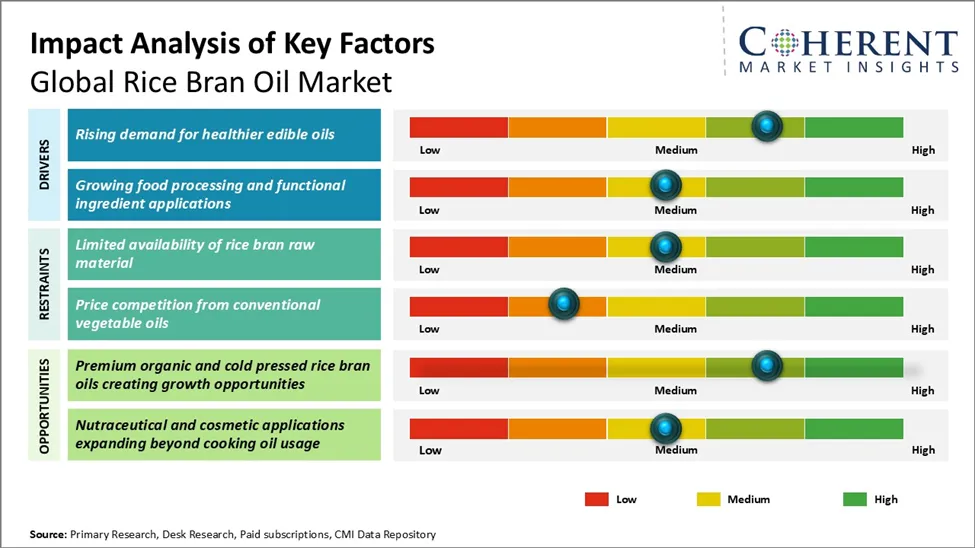
Key Market Drivers
- Rising demand for healthier edible oils: Rising demand for healthier edible oils is strengthening the commercial position of rice bran oil as consumers and food manufacturers increasingly evaluate oils based on nutritional composition, oxidative stability, and functional benefits. Rice bran oil producers, refiners, and branded edible oil companies benefit from its positioning as a premium cooking oil containing naturally occurring compounds such as oryzanol and tocopherols. This trend is encouraging companies to expand branded offerings, improve consumer awareness, and introduce differentiated edible oil portfolios. In January 2025, the Food Safety and Standards Authority of India (FSSAI) continued implementation of mandatory fortification standards for edible oils, supporting greater focus on quality, nutritional value, and consumer health considerations within India’s edible oil sector.
- Growing food processing and functional ingredient applications: Growing food processing and functional ingredient applications are expanding rice bran oil consumption beyond household cooking by increasing its relevance in processed foods, frying operations, nutraceutical formulations, and specialty food applications. Food manufacturers select rice bran oil due to its neutral taste, high smoke point, and suitability for applications requiring consistent performance. This creates opportunities for extractors, refiners, and ingredient suppliers to develop specialized solutions for industrial customers. In June 2025, Thailand’s Ministry of Agriculture and Cooperatives announced initiatives to promote value-added agricultural processing, encouraging greater utilization of rice-based resources and supporting downstream opportunities for rice-derived ingredients and food products.
Emerging Market Trends
- Premiumization of specialty and clean-label rice bran oil products: The global rice bran oil market is gradually shifting from commodity-oriented edible oil sales toward differentiated products focused on purity, processing methods, organic positioning, and consumer wellness expectations. Manufacturers are increasingly exploring specialty variants that communicate transparency, traceability, and enhanced nutritional value. This trend is encouraging brands to improve packaging, storytelling, and quality certifications while creating opportunities for smaller premium-focused suppliers. Over the forecast period, companies with stronger capabilities in product differentiation, consumer education, and direct retail engagement are likely to gain competitive advantages over conventional volume-focused producers.
- Integration of advanced extraction and refining technologies: Rice bran oil production is evolving through improvements in extraction efficiency, refining precision, and quality preservation methods. Processors are increasingly focusing on technologies that maximize oil recovery, maintain nutritional characteristics, reduce processing losses, and improve operational efficiency. Advanced filtration, improved stabilization techniques, and optimized refining systems are becoming important differentiators for manufacturers competing in domestic and export markets. This trend may reshape supplier competitiveness by favoring companies that combine processing expertise with consistent quality management, while older facilities with limited technological capabilities may face pressure to modernize operations.
Regional Insights
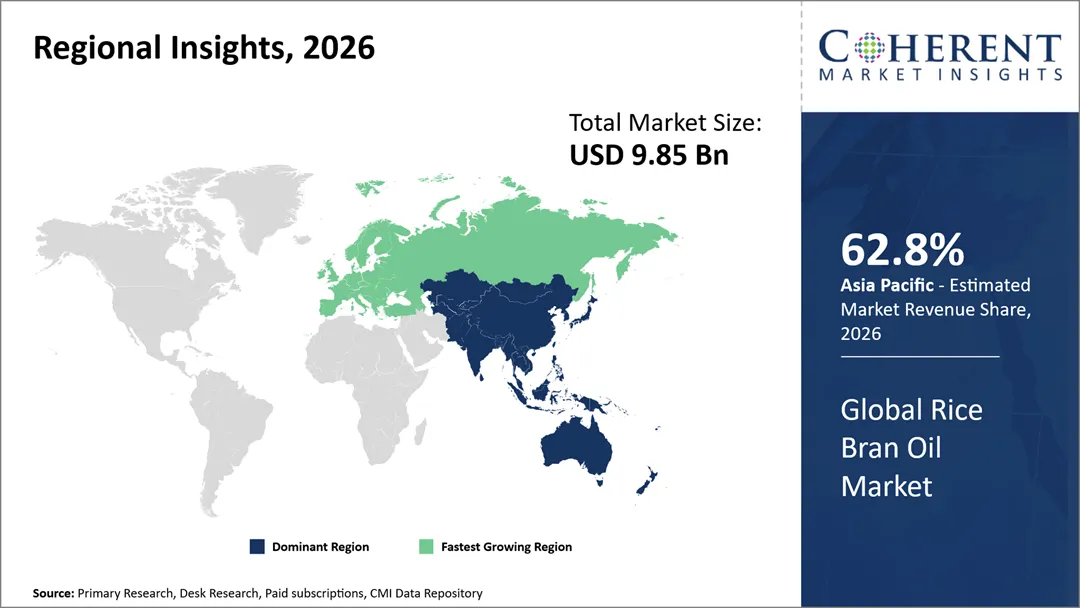
Why Does Asia Pacific Dominate the Global Rice Bran Oil Market?
Asia Pacific is expected to account for 62.8% share of the global rice bran oil market in 2026, supported by its strong rice cultivation base, extensive rice milling ecosystem, and established edible oil consumption patterns. Countries including India, China, Thailand, and Japan benefit from the availability of rice bran as a processing by-product, enabling integrated supply chains from rice mills to oil extraction and refining facilities. The region’s large consumer base, preference for cooking oils with perceived health benefits, and expanding packaged edible oil distribution networks further strengthen market penetration. Rice bran oil manufacturers in Asia Pacific also benefit from cost-efficient processing infrastructure and domestic demand stability. In October 2025, India’s Directorate General of Foreign Trade (DGFT) amended the export policy of de-oiled rice bran, changing policy conditions for the commodity. The policy update is relevant to the Global Rice Bran Oil Market because rice bran processing economics depend on efficient utilization of rice bran derivatives. Such regulatory changes influence integrated rice milling operations, extraction businesses, and by-product value chains across Asia Pacific, reinforcing the region’s advantage in rice-based oil production.
Why Is Europe Emerging as the Fastest-Growing Region in the Global Rice Bran Oil Market?
Europe is emerging as the fastest-growing region in the global rice bran oil market with an expected 14.7% share in 2026, supported by increasing consumer interest in healthier cooking oils, premium edible oil categories, and clean-label food products. Unlike rice-producing regions, European growth is largely influenced by import availability, specialty food positioning, and demand from health-focused consumers seeking alternatives to conventional oils. Retailers and food manufacturers are increasingly emphasizing traceability, nutritional attributes, and sustainable sourcing when selecting edible oils. Rice bran oil suppliers with strong certification capabilities and premium product positioning are better positioned to expand across European markets. In March 2025, the European Commission continued implementation of updated food information and sustainability-related requirements influencing food manufacturers’ sourcing and labeling strategies across Europe.
Global Rice Bran Oil Market Outlook for Key Countries
Why Is the U.S. a Key Market for the Global Rice Bran Oil Market?
The U.S. represents an important market for the global rice bran oil market due to rising interest in specialty edible oils, health-oriented cooking ingredients, and premium food products. Demand is concentrated among consumers seeking alternatives with favorable nutritional profiles, while food manufacturers value rice bran oil for frying stability and neutral flavor characteristics. The country’s advanced retail infrastructure, specialty food channels, and growing acceptance of Asian-origin ingredients support market expansion. Importers and distributors play an important role because domestic rice bran oil production remains limited compared with demand potential. In February 2025, the U.S. Food and Drug Administration continued strengthening oversight of food ingredient safety and labeling compliance, reinforcing the importance of regulatory alignment for edible oil suppliers entering the U.S. market.
Why Is India Important in the Global Rice Bran Oil Market?
India is one of the most important countries in the global rice bran oil market due to its extensive rice production base, large rice milling industry, and established edible oil consumption ecosystem. The country benefits from strong availability of rice bran feedstock, supporting solvent extraction, refining, and branded consumer oil production. Domestic manufacturers leverage integrated supply chains connecting rice mills, extraction facilities, refiners, and retail distributors. Rice bran oil also holds strategic importance in India’s edible oil diversification efforts as the country seeks greater domestic production capability. April 2025, India’s Agricultural and Processed Food Products Export Development Authority (APEDA) continued promoting processed food and agricultural product exports, supporting broader opportunities for value-added agricultural products including specialty edible oils.
Why Does China Support Growth in the Global Rice Bran Oil Market?
China supports growth in the global rice bran oil market through its large rice production base, developed agricultural processing sector, and significant domestic edible oil consumption. The country’s extensive rice milling operations create consistent availability of rice bran, enabling extraction and refining activities at commercial scale. Chinese consumers’ growing interest in diversified edible oils and healthier cooking alternatives provides additional demand opportunities. Local processors benefit from established industrial infrastructure and distribution networks covering both urban retail and food manufacturing customers. May 2025, China’s Ministry of Agriculture and Rural Affairs continued initiatives focused on improving agricultural processing efficiency and strengthening value-added utilization of agricultural resources, supporting the broader development of food processing industries.
Why Is Thailand a Strategic Country in the Global Rice Bran Oil Market?
Thailand plays a strategic role in the global rice bran oil market due to its strong rice export industry, advanced milling infrastructure, and established position as a major agricultural processing country. The availability of rice bran from large-scale rice milling operations supports domestic extraction activities and provides opportunities for refined rice bran oil production. Thai producers benefit from export-oriented food manufacturing capabilities and growing demand for premium edible oils in regional markets. The country’s food processing sector also creates opportunities for rice bran oil applications beyond household consumption, including industrial food preparation. August 2025, Thailand’s Ministry of Commerce continued supporting agricultural export competitiveness through trade promotion activities, strengthening opportunities for value-added agricultural products.
Why Is Brazil an Important Growth Market for the Global Rice Bran Oil Market?
Brazil represents an important growth market for the global rice bran oil market due to its agricultural production capabilities, expanding processed food sector, and increasing consumer interest in diversified edible oil options. Although soybean oil remains dominant in Brazil, rice-producing regions create opportunities for utilizing rice bran as a value-added raw material. Food manufacturers and specialty oil suppliers can capture opportunities by positioning rice bran oil around nutritional characteristics and premium culinary applications. The country’s strong agricultural infrastructure and established food distribution channels provide a foundation for future category development. September 2025, Brazil’s Ministry of Agriculture and Livestock continued initiatives supporting agricultural value addition and food industry competitiveness, encouraging greater utilization of agricultural resources.
Product Innovation and Consumption Evolution Landscape
Innovation Area | Current Adoption Level | Commercial Application | Strategic Impact |
Solvent extraction optimization | High | Industrial rice bran oil recovery | Improves extraction yield and supports large-scale production economics |
Advanced refining systems | High | Removal of impurities and quality enhancement | Enables consistent food-grade oil quality and export compliance |
Cold press extraction | Moderate | Premium and specialty rice bran oil products | Supports clean-label positioning and premium pricing strategies |
Nutrient preservation technologies | Emerging | Retention of antioxidants and bioactive compounds | Helps differentiate health-focused products |
Digital quality monitoring systems | Emerging | Production traceability and process control | Improves compliance, consistency, and operational efficiency |
Sustainable processing technologies | Developing | Energy-efficient extraction and waste reduction | Supports environmental positioning and long-term cost optimization |
How Are Specialty Nutrition and Value-Added Applications Creating New Growth Opportunities in the Global Rice Bran Oil Market?
Specialty nutrition applications represent an important opportunity for rice bran oil manufacturers seeking higher-value market positioning beyond conventional cooking oil sales. Companies can expand into nutraceutical ingredients, wellness-focused formulations, premium culinary oils, and functional food applications by emphasizing rice bran oil’s naturally occurring bioactive components. This opportunity requires investment in extraction quality, scientific validation, product development capabilities, and regulatory compliance across target markets. Established refiners with strong supply networks may benefit from scaling differentiated products, while specialized ingredient companies can capture niche applications through innovation and customization. The opportunity also encourages stronger collaboration between processors, food manufacturers, and retail brands to develop consumer-focused solutions that combine nutritional positioning with convenience and premium branding.
Market Players, Key Development, and Competitive Intelligence

Key Developments
- In May 2026, LPP Group expanded its rice bran oil business in Thailand through the launch of LPP Rice Bran Oil Co., Ltd. The initiative leverages Thailand’s rice processing ecosystem to develop branded and OEM rice bran oil solutions, supporting vertical integration from agricultural sourcing to finished edible oil distribution.
- In March 2026, Cargill expanded its Port Klang, Malaysia edible oils facility by adding specialty fats production capabilities and a lipid research facility. This development is important for the global rice bran oil market because advanced lipid processing capabilities can support broader innovation in specialty edible oil applications and strengthen regional ingredient supply capabilities.
- In July 2025, KRBL Limited entered the edible oil segment with its India Gate Uplife range featuring rice bran oil-based products. The move enables KRBL to utilize its established rice value chain, consumer brand presence, and distribution network to strengthen participation in the branded rice bran oil category.
Competitive Landscape
The global rice bran oil market is moderately fragmented, with competition involving integrated rice millers, solvent extraction companies, edible oil refiners, specialty oil producers, and branded consumer oil companies. Competition is influenced by raw material availability, extraction efficiency, refining capabilities, product quality, pricing, distribution strength, and regulatory compliance. Regional producers maintain advantages through local rice supply chains, while international brands compete through premium positioning and consumer trust.
Key focus areas include
- Raw material sourcing capability and rice bran supply network strength
- Extraction efficiency and production yield optimization
- Product quality, purity standards, and food safety compliance
- Retail branding and consumer trust development
- Manufacturing scale and supply reliability
- Premium, organic, and specialty product differentiation
- Distribution reach across retail, foodservice, and industrial channels
- Export capability and compliance with international standards
Market Report Scope
Global Rice Bran Oil Market Report Coverage | |||
Report Coverage | Details | ||
Base Year | 2025 | Market Size in 2026: | USD 9.85 Bn |
Historical Data For: | 2020 To 2024 | Forecast Period: | 2026 To 2033 |
Forecast Period 2026 To 2033 CAGR: | 9.20% | 2033 Value Projection: | USD 18.24 Bn |
Geographies covered: |
| ||
Segments covered: |
| ||
Companies covered: | Cargill, Wilmar International, Bunge, Ricela Health Foods, Marico Limited, Adani Wilmar, Oryza Oil & Fat Chemical, Tsuno Food Industrial, RiceBran Technologies, King Rice Oil Group, K.S. Oils, A.P. Refinery, Sethia Oils, 3F Industries, Vaighai Agro Products | ||
Growth Drivers: |
| ||
Restraints & Challenges: |
| ||
Analyst Opinion (Expert Opinion)
- The global rice bran oil market is likely to shift from volume-led competition toward value creation through product differentiation, stronger branding, and application-specific offerings. Companies combining efficient sourcing, refining capabilities, quality assurance, and consumer-focused positioning are expected to build stronger long-term competitiveness.
- Rice bran oil is gradually moving beyond traditional cooking applications into functional food, wellness, and specialty ingredient uses. Producers that support product benefits with scientific evidence and develop targeted formulations can create higher-value opportunities, while commodity-focused suppliers may face increasing pressure.
- Market participants should focus on supply-chain integration, processing efficiency, consistent quality, and premium portfolio development. Greater control over raw material sourcing and distribution can reduce margin pressure, while certifications, sustainability practices, and stronger customer relationships will become more important for maintaining market relevance.
Speak to the analyst
Want personalized insights?
Take the findings above to one of our principal consultants, or have the report rebuilt around the segments, geographies and competitors you actually track.
Market Segmentation
- Product Type Insights (Revenue, USD Bn, 2021 - 2033)
- Refined Rice Bran Oil
- Crude Rice Bran Oil
- Organic Rice Bran Oil
- Blended Rice Bran Oil
- Extraction Method Insights (Revenue, USD Bn, 2021 - 2033)
- Solvent Extraction
- Expeller Pressing
- Cold Press Extraction
- Others
- Application Insights (Revenue, USD Bn, 2021 - 2033)
- Food and Cooking Oil
- Food Processing
- Nutraceuticals and Supplements
- Cosmetics and Personal Care
- Others
- Packaging Type Insights (Revenue, USD Bn, 2021 - 2033)
- Bottles
- Pouches
- Bulk Containers
- Others
- Distribution Channel Insights (Revenue, USD Bn, 2021 - 2033)
- Supermarkets and Hypermarkets
- Online Retail
- Specialty Stores
- Foodservice Channels
- Others
- Regional Insights (Revenue, USD Bn, 2021 - 2033)
- North America
- U.S.
- Canada
- Latin America
- Brazil
- Argentina
- Mexico
- Rest of Latin America
- Europe
- Germany
- U.K.
- Spain
- France
- Italy
- Russia
- Rest of Europe
- Asia Pacific
- China
- India
- Japan
- Australia
- South Korea
- ASEAN
- Rest of Asia Pacific
- Middle East
- GCC Countries
- Israel
- Rest of Middle East
- Africa
- South Africa
- North Africa
- Central Africa
- North America
Sources
Primary Research Interviews
- Rice bran oil manufacturers, edible oil refiners, rice millers, extraction companies, distributors, retailers, food manufacturers, and ingredient suppliers
- Procurement managers, food industry executives, edible oil specialists, agricultural processors, nutrition experts, and trade professionals
Stakeholders
- Rice bran oil producers, solvent extraction companies, refining companies, branded edible oil companies, and private-label manufacturers
- Rice mills, agricultural processors, packaging suppliers, distributors, supermarkets, foodservice operators, and online retail platforms
- Food manufacturers, nutraceutical companies, restaurants, and institutional buyers
End-use Sectors
- Household cooking and edible oil consumption
- Food processing and frying applications
- Foodservice and commercial cooking operations
- Nutraceutical, wellness, and specialty ingredient applications
Regulatory and Industry Bodies
- Food Safety and Standards Authority of India (FSSAI)
- U.S. Food and Drug Administration (FDA)
- European Food Safety Authority (EFSA)
- Codex Alimentarius Commission
- National edible oil, food processing, and agricultural authorities
Databases
- Company annual reports, investor presentations, and corporate filings
- Agricultural production and trade databases
- Edible oil import-export statistics and customs datasets
- Food industry databases and retail intelligence platforms
- Product portfolio and competitive intelligence databases
Magazines and Journals
- Edible oil and food processing publications
- Food science and nutrition journals
- Agricultural processing and commodity trade publications
- Consumer food and retail industry publications
Associations
- American Oil Chemists’ Society (AOCS)
- International Food Information Council (IFIC)
- Food and Agriculture Organization (FAO)
- National edible oil and food industry associations
- Agricultural and rice processing associations
Public Domain Sources
- Rice production and agricultural processing trends
- Edible oil consumption patterns and dietary preferences
- Food processing and functional ingredient developments
- Retail and e-commerce expansion of edible oil products
- Sustainability initiatives in oilseed and agricultural processing
Key Standards and Regulations
- Food safety and edible oil quality standards
- Labeling and nutritional information requirements
- Chemical residue and contaminant compliance standards
- Sustainable sourcing and environmental regulations
- International trade and import-export requirements for edible oils
Proprietary Elements
- CMI Data Analytics Tool
- Proprietary CMI repository containing 10+ years of food & beverage, agricultural commodities, consumer goods, and edible oil market intelligence.
Get access to 250+ pages report
Every segment, forecast, competitor profile and data table behind the analysis above — available for instant download.
- ESOMAR Member
- ISO 9001:2015 Certified
- D-U-N-S Registered
- GDPR & CCPA Compliant
Missing comfort of reading report in your local language? Find your preferred language:
Frequently Asked Questions
The CAGR of global rice bran oil market is projected to be 9.20% from 2026 to 2033.
The global rice bran oil market is estimated to be valued at USD 9.85 Bn in 2026 and is expected to reach USD 18.24 Bn by 2033.
Rice bran oil is primarily used for household cooking, food processing, frying applications, foodservice operations, and selected nutraceutical and personal care applications.
Rice bran oil is preferred by many consumers due to its nutritional profile, including naturally occurring antioxidants such as oryzanol and tocopherols, along with its balanced cooking performance.
Major end users of rice bran oil include households, food manufacturers, restaurants, foodservice operators, and companies using edible oils in processed food production.
Key trends shaping the market include premiumization of edible oils, growth of branded rice bran oil products, increasing focus on clean-label ingredients, and expansion of value-added food applications.
The growth of the global rice bran oil market is primarily driven by rising demand for healthier edible oils and the expanding use of rice bran oil in food processing and functional ingredient applications. Consumers are increasingly seeking oils with nutritional benefits, while food manufacturers are adopting rice bran oil due to its stability, neutral flavor, and suitability for diverse applications.