

Global Robotic Arm Market Size and Forecast – 2026 To 2033
The global robotic arm market is expected to grow from USD 42 Bn in 2026 to USD 89 Bn by 2033, registering a compound annual growth rate (CAGR) of 11% from 2026 to 2033. The global robotic arm market is driven by the expansion of electronics and semiconductor manufacturing. On January 7, 2025, the semiconductor industry is expected to start 18 new fab construction projects in 2025, according to SEMI's latest quarterly World Fab Forecast report. The new projects include three 200mm and fifteen 300mm facilities, the majority of which are expected to begin operations from 2026 to 2027.
Key Takeaways of the Global Robotic Arm Market
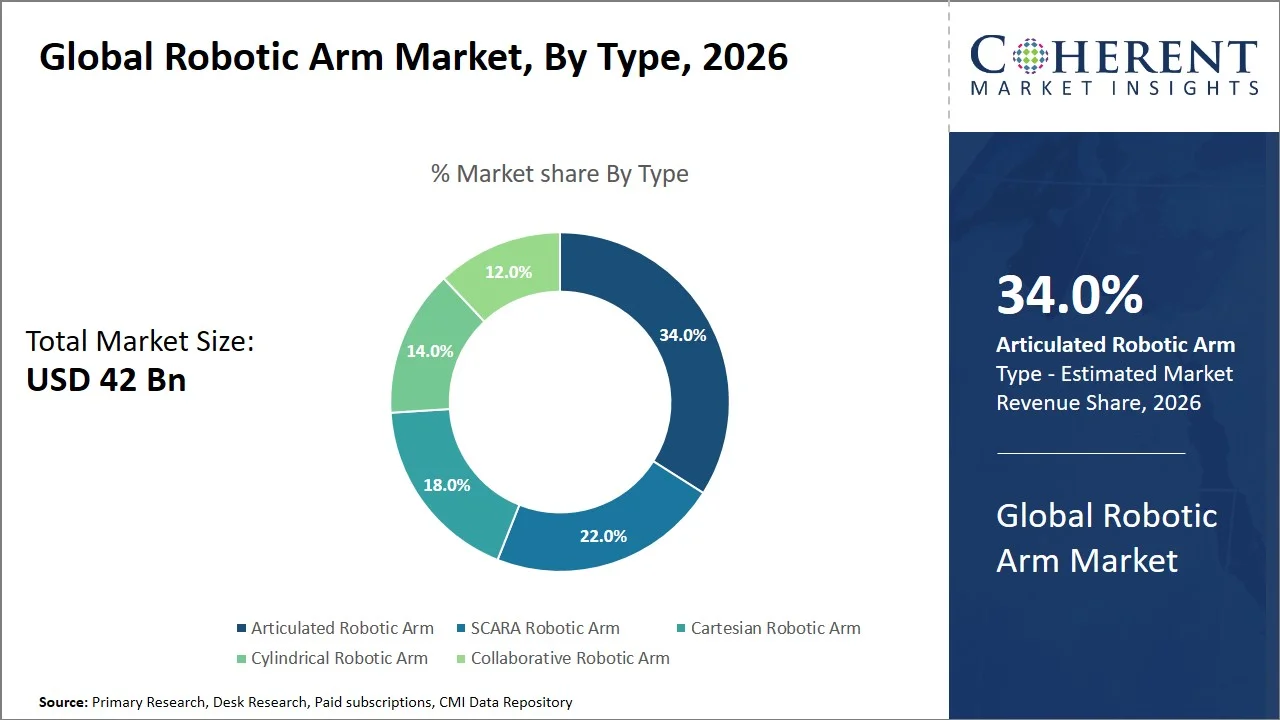
- The articulated robotic arm segment is expected to account for 34.0 % of the global robotic arm market share in 2026. Increasing labor shortages in industrial production is driving the growth of the segment. On January 6, 2026, Hyundai Motor Group unveiled its transformative AI Robotics Strategy at the Consumer Electronics Show 2026 (CES 2026), presenting a bold roadmap for advancing human-robot collaboration under the theme ‘Partnering Human Progress’.
- The up to 10 kg segment is estimated to capture 46.0 % of the market share in 2026. Growth in warehouse and logistics automation is majorly driving the growth of the segment. On July 21, 2026, Ocado Group announced an agreement to build a large Customer Fulfilment Centre for a fast-growing European national retailer.
- The material handling segment is estimated to capture 29.0 % of the market share in 2026. Higher demand for precision in handling activities is driving the growth of the segment. On August 28, 2025, FANUC announced it is releasing its high-specification LR Mate/10-11A Food/Clean, a compact yet powerful industrial robot with features that add value in these challenging tasks.
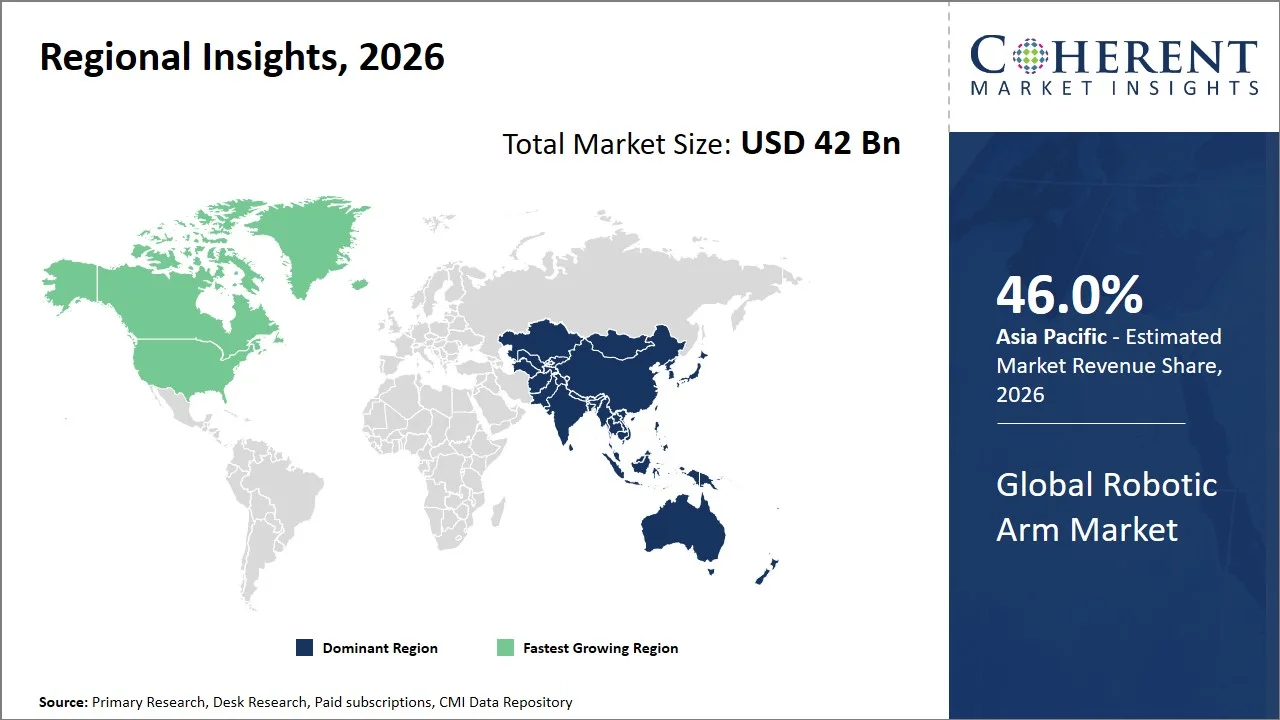
- Asia Pacific is expected to dominate the robotic arm market in 2026 with a market share of 46.0 %. Growth of robotic automation in e-commerce fulfillment centers in Asia Pacific is driving the growth of the regional market. On December 19, 2025, Grab Holdings Ltd. announced the acquisition of Infermove, a Chinese AI robotics company, marking a significant strategic move by the Southeast Asian ride-hailing and delivery giant in the artificial intelligence robotics sector.
- North America is expected to account for 24.0 % of the market share in 2026 and is projected to record the fastest growth over the forecast period. Emerging demand from aerospace and battery manufacturing in North America is driving the growth of the regional market. On July 20, 2026, Redwire Corporation, together with the State of Alabama and the City of Huntsville, announced a major expansion of Redwire’s Huntsville campus, reinforcing Alabama’s position as a national leader in aerospace, defense, and advanced, U.S.-based manufacturing.
- Rapid Adoption of AI Powered Vision and Autonomous Motion Planning: Manufacturers are integrating more AI vision systems, machine learning algorithms and real-time motion planning in robotic arms for autonomous object recognition, adaptive path optimization and higher accuracy for complex assembly, inspection and material handling applications.
- Expansion of Collaborative Robotic Arms across Small and Medium Enterprises: Small and medium-sized manufacturers are increasingly adopting collaborative robot arms, which offer force sensing, easier programming and enhanced safety. These arms provide adaptable automation solutions without requiring extensive changes to production lines or safety fencing.
Segmental Insights
Why Does Articulated Robotic Arm Dominate the Global Robotic Arm Market?
The articulated robotic arm segment is expected to account for 34.0% of the global robotic arm market share in 2026. Articulate robotic arms are popular because they have a series of rotary joints that enable great dexterity in performing sophisticated multi-axis movements in tight production locations. With this versatility, a single robotic system can perform many different types of tasks such as welding, assembly, material handling, machine tending and painting with high precision, which makes articulated robotic arms the most common form of robotic deployment in automotive, electronics, metal fabrication, and general industrial production facilities. On March 9, 2026, ABB Robotics announced is integrating NVIDIA Omniverse libraries into ABB Robotics’ RobotStudio to help manufacturers deploy physical AI in real world robotics applications. The collaboration focuses on combining ABB Robotics’ software programming, design and simulation suite, RobotStudio, with the physically accurate simulation power of NVIDIA.
- Current Industry Events of 2026
- Market Size Estimation
- Regional Breakdown
- Competitive Landscape
- Customer Intelligence
- Segmental Analysis
- Pricing Analysis
- Key Market Drivers, Challenges & Future Trends
- Customized Insights Section
Why is Up to 10 kg the Most Preferred Payload?
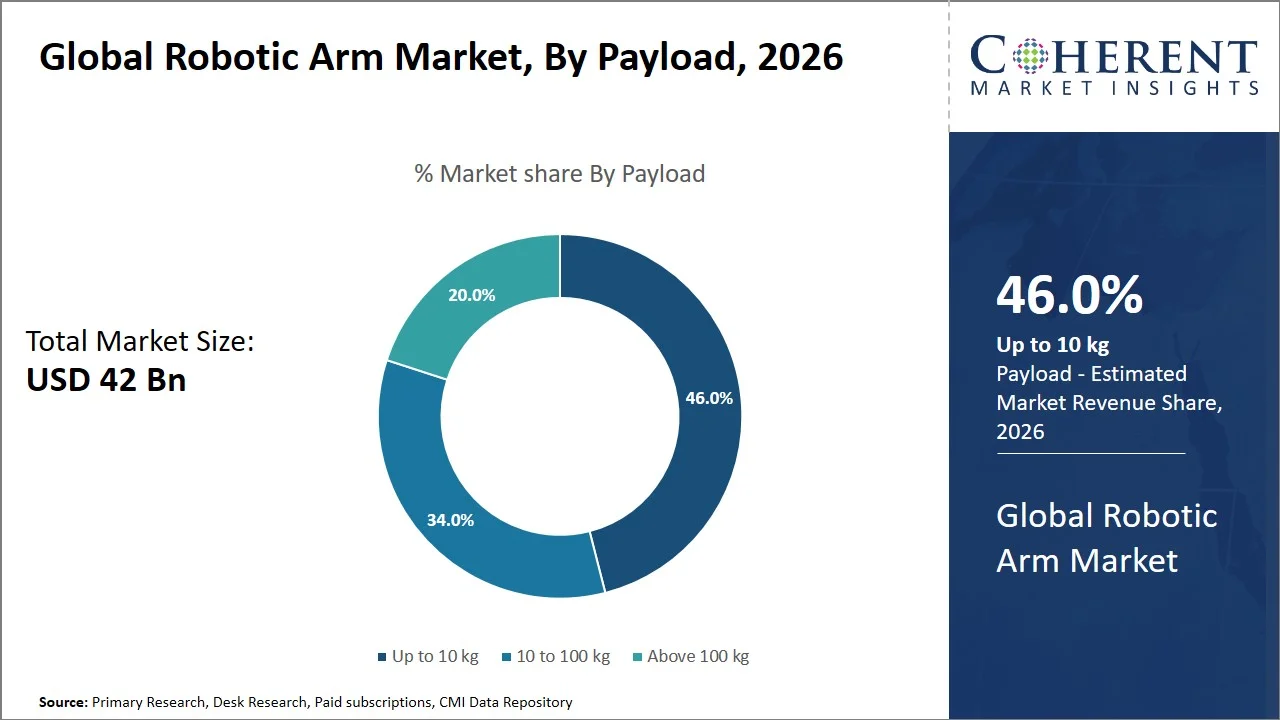
The up to 10 kg segment is expected to account for 46.0% of the global robotic arm market share in 2026. Robotic arms with payloads up to 10 kg are very popular. They are ideal for high-volume, precision-driven manufacturing operations such as electronics assembly, semiconductor handling, medical device production, packaging and small component inspection. Their small size, increased speed, lower power consumption and easier integration into automated manufacturing lines allow manufacturers to achieve better throughput while preserving accuracy and operational efficiency. On April 22, 2026, ABB Robotics announced it is combining the flexibility of cobots with higher payloads and performance, with the launch of its new PoWa cobot family into the rapidly expanding global collaborative robot market, which ABB Robotics estimates will grow by 20 percent annually through to 2028.
Material Handling Dominates the Global Robotic Arm Market
The material handling segment is expected to account for 29.0% of the global robotic arm market share in 2026. The most common application is material handling, which is required at almost all stages of manufacturing and warehouse processes – from loading raw materials and transporting workpieces to palletizing finished products. Robotic arms are a significant step forward in operational efficiency, performing repetitive tasks at a constant rate, with accuracy and reliability, and reducing the need for manual labor and the risk of injury in the workplace in automotive, electronics, logistics, food processing and consumer goods manufacturing industries. On May 12, 2025, Universal Robots announced the launch of the UR15 collaborative robot for material handling, palletizing and packing. It combines higher operating speeds and precise motion control for higher throughput in manufacturing and logistics environments.
Current Events and their Impact
Current Events | Description and its Impact |
European Union - Artificial Intelligence Act (AI Act) |
|
European Union - Machinery Regulation (EU) 2023/1230 |
|
Global Robotic Arm Market Dynamics
Market Drivers
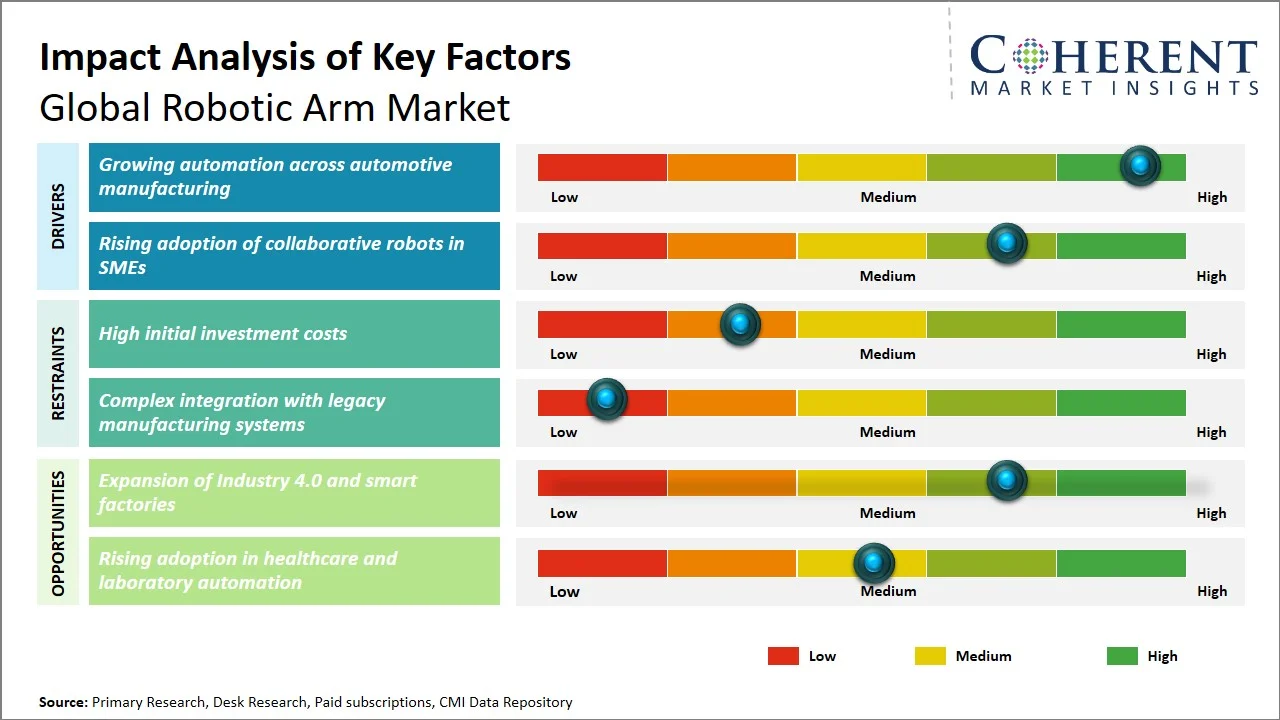
- Growing automation across automotive manufacturing: Automotive manufacturers are adopting robotic arms for body welding, painting, assembly, machine tending, adhesive dispensing, and battery pack production to improve production efficiency, ensure product quality, and achieve high-volume manufacturing. The fast growth in the production of electric vehicles has also sped up investment in robotic automation, as manufacturers need extremely precise and repeatable systems that can handle complicated components while also decreasing production cycle times and labor dependence. On July 9, 2026, Mitsubishi Motors Corporation and Highlanders, Inc. announced that they have signed a Memorandum of Understanding (MOU) to collaborate in establishing a new industrial foundation where humans and robots work together. Under this MOU, the two companies will explore the joint development of humanoid robots for use at Mitsubishi Motors’ manufacturing facilities as well as mass production of Highlanders products at Mitsubishi Motors’ Kyoto Plant.
- Rising adoption of collaborative robots in SMEs: Small and medium-sized enterprises are increasingly adopting collaborative robotic arms, as they are cost-effective automation solutions with easy programming, compact footprints and safe operation alongside humans without the need for extensive safety barriers. Automation of repetitive processes such as assembly, packaging, inspection and machine tending helps SMEs boost productivity, handle labor shortages and generate faster returns on investment, while keeping the flexibility needed for low- and medium-volume manufacturing. On November 18, 2025, Viam, the modern software engineering platform for robotics, announced a new partnership with Universal Robots, the leading collaborative robot company. Universal Robots’ UR Series collaborative robots (cobots) will be a flagship hardware partner as Viam expands its industrial robotic solutions.
Emerging Trends
- Growing Deployment in Battery, Semiconductor, and Electronics Manufacturing: The rapid expansion of electric vehicle battery production, semiconductor fabs and high-tech electronic manufacturing is driving the demand for high-precision robotic arms with micron-level positioning accuracy, contamination-free handling and continuous high-speed operations.
- Integration of Digital Twins, Industrial IoT, and Predictive Maintenance: Industrial facilities are increasingly adopting robotic arms that are connected to Industrial IoT platforms and digital twin environments that allow for real-time performance monitoring, predictive maintenance, remote diagnostics and production optimization, thus increasing equipment availability and reducing unplanned downtime.
Regional Insights
Why is Asia Pacific a Strong Market for Robotic Arms?
Asia Pacific is expected to account for a market share of 46.0% in 2026. Asia Pacific is the hub for global robotic arm manufacturing and deployment with heavy investments in automotive, electronics, semiconductor, battery and precision engineering industries. Japan is home to major robot manufacturers such as FANUC, Yaskawa Electric, Kawasaki Heavy Industries, Denso, Epson Robots and Nachi-Fujikoshi. China continues to promote intelligent industrial development with “Made in China 2025” and large-scale factory automation.
South Korea has one of the greatest industrial robot densities in the world, with companies such as Samsung Electronics, SK hynix, LG Electronics, Hyundai Motor Group, Kia, LG Energy Solution, Samsung SDI and SK On heavily using robotic arms in semiconductor fabs, battery facilities and car assembly lines. In advanced chip manufacturing, Taiwan's TSMC uses highly automated robotic wafer handling systems, and in certain production sites, Foxconn employs robotic arms to assemble devices. Singapore continues integrating robotic automation in biomedical manufacturing, precision engineering, and semiconductor production, making the region the global hub for industrial robotic arm adoption.
Why Does the North America Robotic Arm Market Exhibit High Growth?
North America is projected to account for 24.0% of the global robotic arm market and expected to register the fastest growth. North America continues to be one of the most developed robotic arm markets in the world, driven by electric vehicles, aerospace, semiconductor manufacturing, logistics and medical device manufacturing demand. Tesla employs robotic arms at its Gigafactories for giga casting, battery cell production, structural battery pack assembly and final vehicle production while General Motors, Ford, Rivian and Lucid Motors are still ramping up automated welding and assembly operations.
Boeing utilizes robotic drilling, composite layup and automated fastening equipment in the manufacture of commercial aircrafts. RTX, Lockheed Martin and Northrop Grumman use robotic systems for precision manufacturing in military. In contamination-controlled environments, robotic arms are employed by Intel, Micron Technology, Texas Instruments, GlobalFoundries and Analog Devices to fabricate semiconductors. Amazon Robotics continues to deploy robotic picking, palletizing and package handling systems across its fulfillment centers, while healthcare firms such as Medtronic, Stryker and Boston Scientific are deploying robotic automation for precision medical device manufacturing.
Global Robotic Arm Market Outlook for Key Countries
Why is China Emerging as a Major Hub in the Robotic Arm Market?
China has become the largest industrial robotic arm deployment base with ongoing industry modernization and domestic robotics growth. Car makers including BYD, SAIC Motor, Geely, Changan Automobile, Great Wall Motor, GAC Group, Chery Automobile, NIO, XPeng and Xiaomi Auto all rely heavily on robotic arms to weld bodies, paint them, assemble battery packs and build finished cars. CATL, CALB, Gotion High-Tech, EVE Energy and Sunwoda use robotic automation in battery manufacturing plants. Foxconn, Luxshare Precision, BOE Technology and Goertek have robotics systems that they use to assemble and test electronics. Estun Automation, Siasun Robot and Automation, Efort Intelligent Equipment, Inovance Technology and STEP Electric are among the domestic manufacturers of industrial robotic arms, who are still growing local production. The government supports domestic manufacturing technology.
Is the U.S. the Next Growth Engine for the Robotic Arm Market?
The U.S. is at the forefront of innovation for high-performance robotic arm applications spanning automotive, aerospace, semiconductor, warehouse automation, and healthcare industrial industries. At its production facilities, Tesla employs robotic arms for its giga casting, battery production, paint shops and final assembly lines. Boeing employs robotic drilling systems to create ultra-precise holes on commercial aircraft fuselages. Lockheed Martin and Northrop Grumman use robotic automation in aircraft structures, missile components and composite manufacturing. Intel, Micron Technology, Texas Instruments, GlobalFoundries and TSMC Arizona are investing in semiconductors boosting demand for robotic wafer handling and cleanroom automation. Amazon Robotics continues to grow its robotic fulfillment business, utilizing robotic arms for sorting, palletizing and moving packages. Companies like Medtronic, Stryker, Boston Scientific and Abbott Laboratories are integrating robotic arms into their medical device manufacture and inspection processes.
Germany Robotic Arm Market Analysis and Trends
Germany is the largest European market for robotic arms, driven by its highly mechanized automotive and industrial engineering industries. Volkswagen, BMW, Mercedes-Benz Group, Audi, Porsche, Opel and Bosch operate plants that use robotic arms for body welding, painting, adhesive dispensing, powertrain assembly and automated quality inspection. KUKA, headquartered in Augsburg, continues to develop advanced articulated, heavy-payload and collaborative robotic arms supplied to manufacturers worldwide. Siemens combines robotic automation with digital twin software, industrial edge computing and factory automation systems to improve production efficiency. Robotic arms are being used more and more in battery manufacturing projects led by PowerCo and other European cell makers, for handling electrodes, assembling modules and producing battery packs. Germany’s machine tool industry is pairing robotic arms with flexible CNC machining cells for lights-out manufacturing.
Japan Robotic Arm Market Analysis and Trends
Japan is one of the world’s most developed markets for robotic arms, due to decades of leadership in industrial automation and precision manufacturing. FANUC, Yaskawa Electric, Kawasaki Heavy Industries, Denso, Epson Robots, Nachi-Fujikoshi, Mitsubishi Electric and Seiko Epson supply robotic arms to industries across the globe, continually innovating motion control, servo technology and intelligent automation. Toyota Motor, Honda, Nissan, Subaru, Mazda and Suzuki widely use robotic arms for welding, assembling, painting and powertrain manufacture. Electronics manufacturers such as Sony, Panasonic, Canon, Keyence and Murata Manufacturing employ robotic systems in the production of semiconductor equipment, optical devices, sensors and electronic components. Japanese firms are also leading the way in using collaborative robotic arms and AI-assisted automation for precision assembly and high-mix industrial situations.
South Korea Robotic Arm Market Analysis and Trends
South Korea operates one of the world's most highly automated manufacturing industries, where robotic arms are fundamental to semiconductor, battery, automotive, and consumer electronics production. Samsung Electronics and SK hynix employ highly automated robotic wafer transport systems throughout semiconductor fabrication plants producing advanced memory and logic chips. In the stamping, welding, painting, battery assembly and final vehicle processes, Hyundai Motor Group and Kia have robotic arms built in. Hyundai Robotics provides industrial automation solutions to domestic manufacturers. LG Electronics uses robotic automation in its home appliance and consumer electronics production, while battery manufacturers such as LG Energy Solution, Samsung SDI and SK On are using robotic arms for electrode coating, cell assembly, module production and battery pack manufacturing. The country is also raising its investment in smart factory development and further quickening robotic arm deployment in precision manufacturing industries.
Global Robotic Arm Market - Average Robot Utilization Rate By Industry
Industry | Average Robot Utilization Rate |
Automotive Manufacturing | 89% |
Semiconductor Manufacturing | 92% |
Electronics & Electrical | 90% |
Metal Fabrication | 84% |
Aerospace & Defense | 80% |
Food & Beverage Processing | 76% |
Pharmaceuticals & Medical Devices | 81% |
Logistics & Warehousing | 78% |
Plastics & Rubber | 82% |
Consumer Goods Manufacturing | 74% |
How is the Expansion of Industry 4.0 and Smart Factories Creating New Growth Opportunities in the Global Robotic Arm Market?
Industry 4.0 and smart factories are offering new business prospects by transforming robotic arms into linked, data-driven production assets that can make their own decisions and optimize processes in real time. Automotive maker BMW and industrial giants, Siemens, Bosch, Schneider Electric, Foxconn, Tesla and TSMC are integrating robotic arms with industrial IoT platforms, digital twins, AI-enabled machine vision, manufacturing execution systems and edge computing to synchronize production lines, automatically tune operating parameters and detect quality deviations without human intervention.
Modern robotic arms increasingly share operational data with automated guided vehicles, CNC machines, warehouse management systems and cloud-based analytics platforms via industrial communication protocols like OPC UA, Profinet and EtherCAT, enabling predictive maintenance, dynamic production scheduling and end-to-end traceability. The change is fueling the demand for software-defined robotic systems, AI-enabled controllers, intelligent end-of-arm tooling and cybersecure industrial automation solutions, providing tremendous growth opportunities for robotics manufacturers, system integrators, industrial software vendors and sensor technology firms.
On October 24, 2025, Siemens and rhobot.ai announced the next step in their collaboration with the commercial availability of their advanced AI solution for manufacturing. Following a highly successful deployment at CarbonAMS in Ireland, this specialized, edge-native AI is now accessible through the Siemens Xcelerator digital marketplace, marking a significant step forward in industrial optimization and control.
Market Players, Key Development, and Competitive Landscape
Key Developments
- On June 18, 2025, Fizyr and Yaskawa announced a new automated hygienic handling solution for the food and life sciences industries. The solution comes on the heels of Fizyr and Yaskawa announcing an expanded partnership, including a non-exclusive go-to-market strategy for Europe. The hygienic handling solution utilizes Yaskawa’s new HD-series robots, Fizyr PANOPTICTM vision AI, a binpick food cell from Van Wees Waalwijk, and programming support from Alpha Robotica.
- On October 21, 2024, Universal Robots, a Danish collaborative robot (cobot) company, presented for the first time the UR AI Accelerator, a ready-to-use hardware and software toolkit created to further enable the development of AI-powered cobot applications.
Competitive Landscape
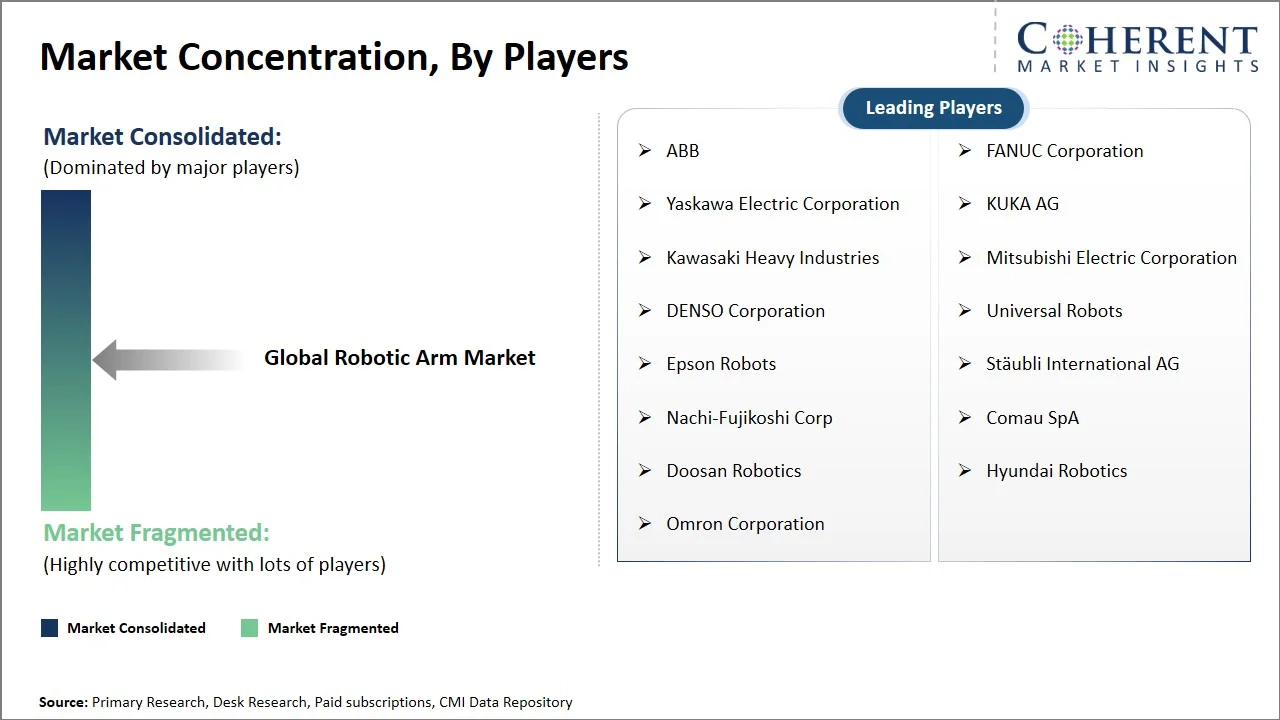
The global robotic arm market is led by ABB, FANUC Corporation, Yaskawa Electric Corporation, KUKA AG, Kawasaki Heavy Industries, Mitsubishi Electric, Denso Corporation, Universal Robots, Epson Robots, and Stäubli International, with competition centered on motion accuracy, AI-enabled automation, software ecosystems, and application-specific robotic solutions rather than hardware alone. ABB continues to enhance its OmniCore controller platform and AI-powered robotic software, while enhancing its digital manufacturing capabilities with RobotStudio. FANUC is dedicated to high-speed industrial robots and zero-downtime manufacturing with FIELD system connectivity for smart factories. Yaskawa is adding robotic solutions for EV battery production, semiconductor manufacturing and logistics automation.
KUKA is still focusing on the integration of robotic arms with digital twin technologies and autonomous mobile robots in flexible production cells and Universal Robots is working on collaborative robotic arms that make deployment easier for small and medium-sized manufacturers. Stäubli and Epson Robots continue to build on their positions in cleanroom robotics for semiconductor and pharmaceutical production, while Denso grows small robotic systems for electronics and automotive component assembly. Competition is increasingly shifting toward AI-based machine vision, software-defined automation, predictive maintenance, and complete turnkey automation solutions delivered through partnerships with system integrators.
Market Report Scope
Robotic Arm Market Report Coverage
| Report Coverage | Details | ||
|---|---|---|---|
| Base Year: | 2025 | Market Size in 2026: | USD 42 Bn |
| Historical Data for: | 2020 To 2024 | Forecast Period: | 2026 To 2033 |
| Forecast Period 2026 to 2033 CAGR: | 11% | 2033 Value Projection: | USD 89 Bn |
| Geographies covered: |
| ||
| Segments covered: |
| ||
| Companies covered: | ABB, FANUC Corporation, Yaskawa Electric Corporation, KUKA AG, Kawasaki Heavy Industries, Mitsubishi Electric Corporation, DENSO Corporation, Universal Robots, Epson Robots, Stäubli International AG, Nachi-Fujikoshi Corp, Comau SpA, Doosan Robotics, Hyundai Robotics, and Omron Corporation | ||
| Growth Drivers: |
| ||
| Restraints & Challenges: |
| ||
Analyst Opinion (Expert Opinion)
- The strongest long-term growth is expected to come from robotic arms equipped with artificial intelligence, machine vision, and digital connectivity rather than conventional standalone automation systems. Demand is likely to accelerate as semiconductor fabrication, electric vehicle battery manufacturing, precision electronics production, and advanced logistics facilities require autonomous robotic operations with real-time quality control and predictive maintenance capabilities.
- The best opportunity is expected in articulated robotic arms for material handling and precision assembly applications within China, Japan, South Korea, and the U.S. Semiconductor fabrication facilities, lithium-ion battery gigafactories and electronics manufacturing plants are likely to continue to be the leading investment destinations, as these industries demand continuous, contamination-controlled and high-precision robotic automation.
- AI-enabled vision systems, digital twin integration, industrial IoT connectivity and intelligent end-of-arm tooling are likely to provide market participants with a competitive advantage by boosting software capabilities alongside robotic hardware. Manufacturers that build strong relationships with semiconductor manufacturers, battery manufacturers, automotive OEMs, and industrial automation integrators, and deliver lifecycle services, predictive maintenance, and application-specific robotic solutions are likely to improve their competitive positioning.
Speak to the analyst
Want personalized insights?
Take the findings above to one of our principal consultants, or have the report rebuilt around the segments, geographies and competitors you actually track.
Market Segmentation
- Type Insights (Revenue, USD Billion, 2021 - 2033)
- Articulated Robotic Arm
- SCARA Robotic Arm
- Cartesian Robotic Arm
- Cylindrical Robotic Arm
- Collaborative Robotic Arm
- Payload Insights (Revenue, USD Billion, 2021 - 2033)
- Up to 10 kg
- 10 to 100 kg
- Above 100 kg
- Application Insights (Revenue, USD Billion, 2021 - 2033)
- Material Handling
- Welding
- Assembly
- Painting
- Packaging and Palletizing
- Machine Tending
- Inspection and Quality Control
- Regional Insights (Revenue, USD Billion, 2021 - 2033)
- North America
- U.S.
- Canada
- Latin America
- Brazil
- Argentina
- Mexico
- Rest of Latin America
- Europe
- Germany
- U.K.
- Spain
- France
- Italy
- Russia
- Rest of Europe
- Asia Pacific
- China
- India
- Japan
- Australia
- South Korea
- ASEAN
- Rest of Asia Pacific
- Middle East
- GCC Countries
- Israel
- Rest of Middle East
- Africa
- South Africa
- North Africa
- Central Africa
- North America
- Key Players Insights
- ABB
- FANUC Corporation
- Yaskawa Electric Corporation
- KUKA AG
- Kawasaki Heavy Industries
- Mitsubishi Electric Corporation
- DENSO Corporation
- Universal Robots
- Epson Robots
- Stäubli International AG
- Nachi-Fujikoshi Corp
- Comau SpA
- Doosan Robotics
- Hyundai Robotics
- Omron Corporation
Sources
Primary Research Interviews
- Robotic Arm Manufacturers & OEMs
- Industrial Automation System Integrators
- End-User Industry Representatives (Automotive, Electronics, Healthcare)
- Robotics Technology Consultants & Analysts
Magazines
- Robotics Business Review Magazine
- Automation World Magazine
- Manufacturing Engineering Magazine
- Industrial Automation Magazine
Journals
- Journal of Field Robotics
- IEEE Transactions on Robotics
- Robotics and Autonomous Systems (Elsevier)
Associations
- International Federation of Robotics (IFR)
- Robotic Industries Association (RIA) / A3 Association
- International Society of Automation (ISA)
- European Robotics Association (euRobotics)
Public Domain Sources
- U.S. Bureau of Labor Statistics (BLS) – Automation & Manufacturing Data
- European Commission – Industrial Digitalization Reports
- World Economic Forum (WEF) – Future of Manufacturing Reports
- U.S. International Trade Administration (ITA) – Robotics Trade Data
Proprietary Elements
- CMI Data Analytics Tool
- Proprietary CMI Existing Repository of Information for the Last 10 Years
Get access to 250+ pages report
Every segment, forecast, competitor profile and data table behind the analysis above — available for instant download.
- ESOMAR Member
- ISO 9001:2015 Certified
- D-U-N-S Registered
- GDPR & CCPA Compliant
Missing comfort of reading report in your local language? Find your preferred language:
Transform your Strategy with Exclusive Trending Reports
Frequently Asked Questions
The global robotic arm market is expected to stand at USD 42 Bn in 2026 and is expected to reach USD 89 Bn by 2033.
The CAGR of the global robotic arm market is projected to be 11% from 2026 to 2033.
Growing automation across automotive manufacturing and rising adoption of collaborative robots in SMEs are the major factors driving the growth of the global robotic arm market.
High initial investment costs and complex integration with legacy manufacturing systems are the major factors hampering the growth of the global robotic arm market.
In terms of type, the articulated robotic arm segment is estimated to dominate the market revenue share in 2026.
They improve welding accuracy, battery assembly precision, and production efficiency while supporting high-volume vehicle manufacturing.
A collaborative robotic arm is designed to operate safely alongside human workers without extensive physical safety barriers.