

Global Robotic Microsurgery Market Size and Forecast – 2026 To 2033
The global robotic microsurgery market is expected to grow from USD 1,060.0 Mn in 2026 to USD 2,701.7 Mn by 2033, registering a compound annual growth rate (CAGR) of 14.3% from 2026 to 2033. The market for global robotic microsurgery is poised for significant expansion, fueled by the rising demand for high-precision surgical procedures.
According to U.S. National Institutes of Health (NIH), more than 50 million Americans undergo surgery annually, with approximately 40% aged over 65, highlighting the need for precise surgical techniques for complex procedures in older patients. This growing surgical demand creates opportunities for robotic systems that enhance instrument stability and control.
Key Takeaways of the Global Robotic Microsurgery Market
- Robotic microsurgery systems are projected to hold 78.4% of the global robotic microsurgery market share in 2026, making it dominant product segment, across Asia Pacific particularly China supported by growing investment in precision surgical technologies. For instance, in July 2025, China’s National Medical Products Administration (NMPA) announced measures to strengthen the full-lifecycle regulation of high-end medical devices, explicitly identifying medical robots as a priority and supporting the development of technical standards and classification guidance for surgical robots.
- Ophthalmology is projected to hold 24.6% of the global robotic microsurgery market share in 2026, making it dominant application segment, across North America particularly U.S, where public research initiatives support innovation in precision eye surgery. For instance, the U.S. National Eye Institute supports research into advanced ophthalmic technologies through its research funding programs, including projects focused on improving the diagnosis and treatment of retinal diseases. These initiatives contribute to the broader innovation ecosystem for precision-based ophthalmic interventions.
- Hospitals and surgical centers are projected to hold 76.5% of the global robotic microsurgery market share in 2026, making it dominant end user segment, across Asia Pacific specifically Japan, where government initiatives promote the adoption of advanced medical technologies and digital healthcare. For instance, Japan’s Ministry of Health, Labour and Welfare supports the development and implementation of innovative medical technologies through its healthcare policy and medical-device development programs, creating a supportive environment for advanced surgical equipment in hospital settings.
- North America market maintains dominance with an expected share of 39.4% in 2026, bolstered by established academic medical centers, advanced surgical infrastructure, and federal investment in biomedical engineering research. For instance, the U.S. National Institutes of Health (NIH) supports biomedical engineering research through its Focused Technology Research and Development funding program, which funds the development of innovative technologies and research tools for biomedical applications. This federal research infrastructure supports the broader innovation environment for precision surgical robotics.
- Asia Pacific is expected to exhibit the fastest growth in the global robotic microsurgery market, registering an estimated CAGR of 16.9% during 2026–2033, driven by expanding healthcare infrastructure, rising demand for specialized surgery, and government initiatives supporting medical robotics. For instance, in May 2026, Japan’s Ministry of Economy, Trade and Industry updated its national AI robotics strategy to accelerate real-world implementation of robotics, strengthening the broader technology ecosystem for future medical robotics applications.
Segmental Insights
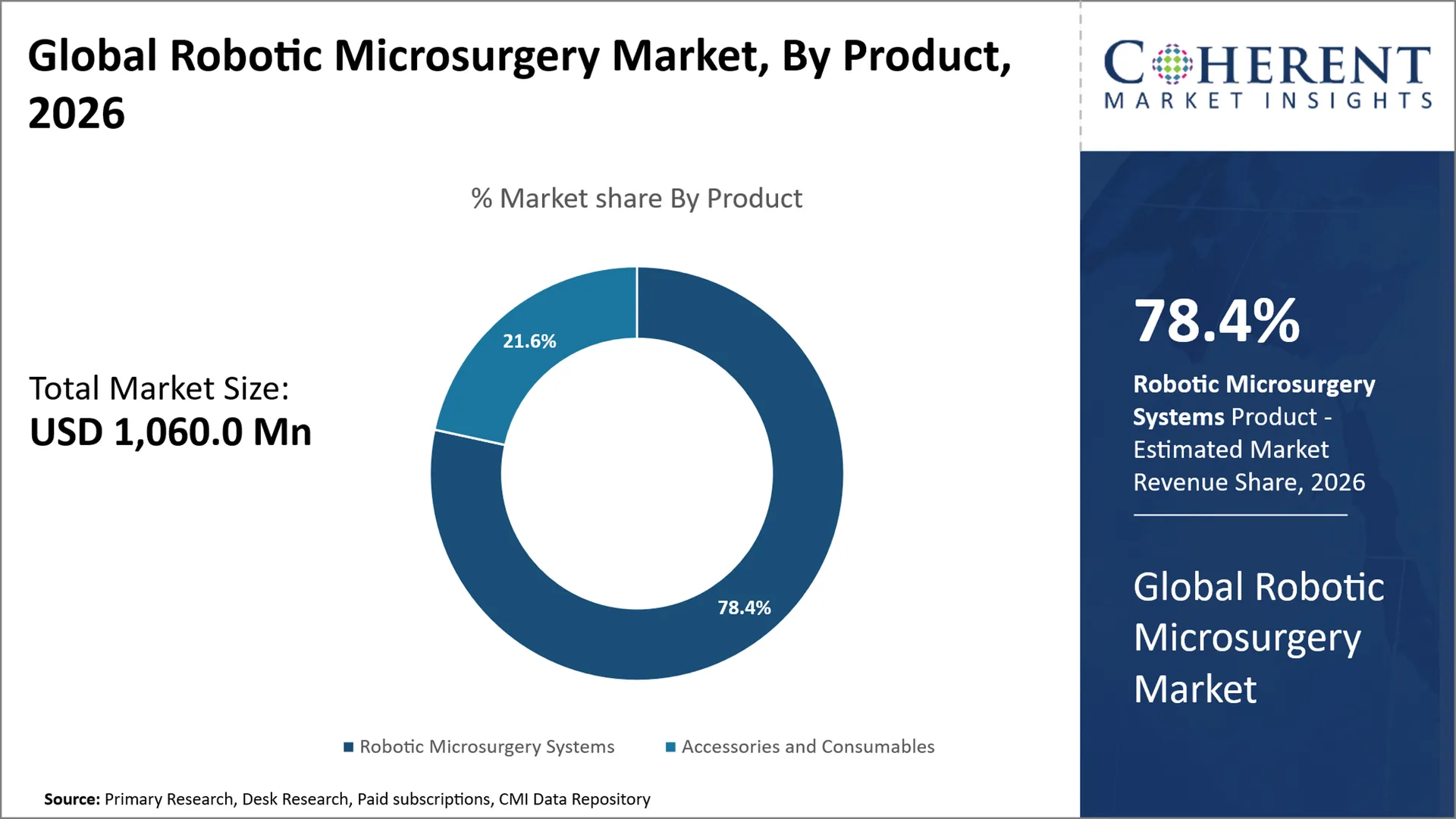
Why Do Robotic Microsurgery Systems Dominate the Global Robotic Microsurgery Market?
Robotic microsurgery systems are projected to hold the market share of 78.4% in 2026, due to the presence of a robotic arm, instruments and technologies with accuracy control, which offer stability and dexterity for difficult surgeries. They are the best option for complex surgeries related to tiny blood vessels, lymphatic vessels, and nerves, which makes them highly suitable for reconstructive and super microsurgery. For instance, in May 2026 Microsure announced CE mark approval of its robotic microsurgery system, MUSA-3, a major milestone for the clinical use of its robotic platform in open microsurgical procedures. It represents a major breakthrough in the domain of specialized robotic systems, intended to improve the accuracy and control in surgical procedures.
- Current Industry Events of 2026
- Market Size Estimation
- Regional Breakdown
- Competitive Landscape
- Customer Intelligence
- Segmental Analysis
- Pricing Analysis
- Key Market Drivers, Challenges & Future Trends
- Customized Insights Section
Why Do Ophthalmology Represent the Largest Application Segment in the Robotic Microsurgery Market?
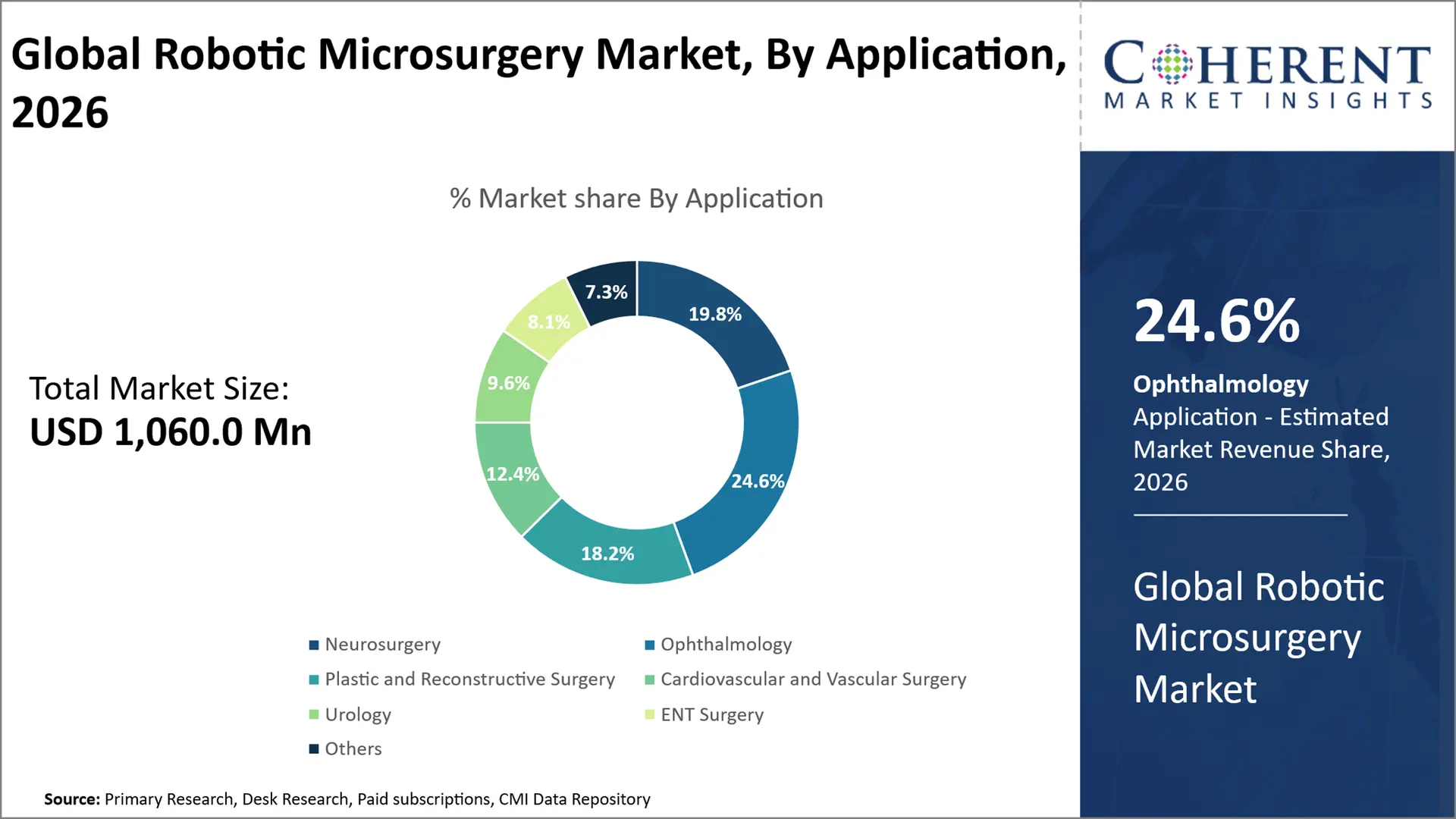
Ophthalmology is projected to hold a market share of 24.6% in 2026, owing to the requirement of high precision in procedures such as cataract removal and retinal surgery. Robotic assistance can enhance instrument placement, correct for hand tremors and facilitate controlled movements around delicate ocular tissues. For instance, in December 2025, researchers at the University of California, Los Angeles (UCLA) reported the first human clinical trial of robotic-assisted cataract surgery, in which 10 patients underwent the procedure without adverse events, highlighting the potential of robotics in ophthalmic surgery.
Hospitals and Surgical Centers Segment Dominates the Global Robotic Microsurgery Market
The hospitals and surgical centers segment are projected to hold a market share of 76.5% in 2026, driven by their ability to directly deploy state-of-the-art operating room setups, highly trained surgical teams, and high-cost surgical robotics. Multidisciplinary capabilities of hospitals/surgical centers may further drive adoption of robotic systems. For instance, in November 2024, the U.S. Centers for Medicare & Medicaid Services (CMS) updated the payment policies for hospital outpatient and ambulatory surgical centers recognizing the continued role of these outpatient centers in providing focused surgical care.
Current Events and their Impact
Current Events | Description and its Impact |
U.S. FDA Issues Draft Guidance for Robotically Assisted Surgical Devices (September 2026) |
|
ARPA-H Announces Funding for Autonomous Robotic Interventions (August 2026) |
|
NIH Continues Funding for Robotic Intraocular Surgery Research (January 2026) |
|
Robotic Microsurgery Market Dynamics
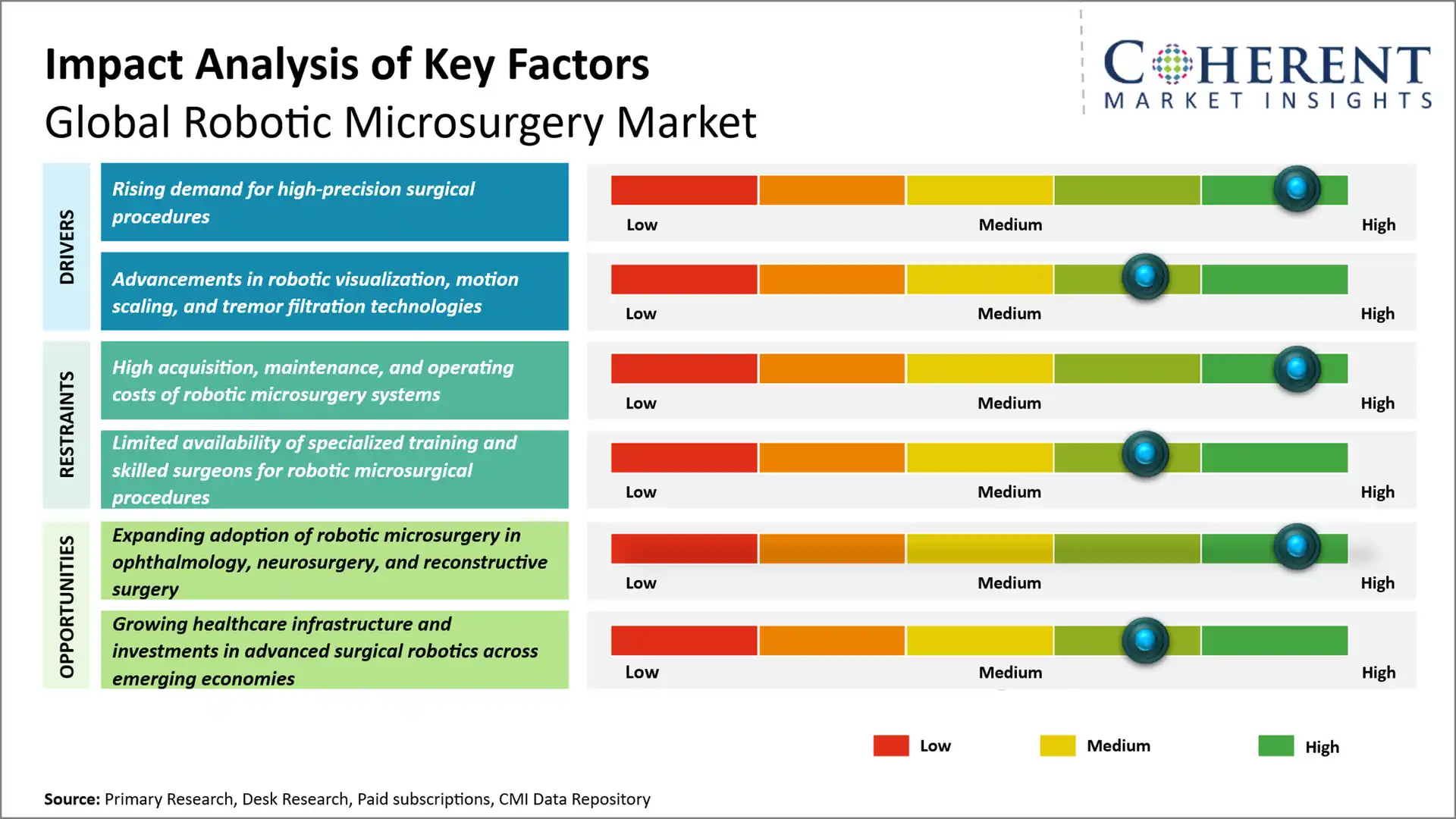
Market Drivers
- Rising demand for high-precision surgical procedures: The need for accurate microvascular reconstruction is driving interest in robotic microsurgery systems that improve instrument stability and control when connecting tiny blood vessels. For instance, in July 2026, a multicenter post-market clinical study published by the National Library of Medicine, evaluated the Symani Surgical System in 412 patients across 10 sites, reporting a 94.1% technical success rate across 539 robotic anastomoses performed in reconstructive, nerve-repair, and lymphovenous procedures.
- Advancements in robotic visualization, motion scaling, and tremor filtration technologies: Advancements in robotic control and visualization are improving instrument positioning and precision during delicate microsurgical procedures. For instance, in September 2025, a study published in Microsystems & Nanoengineering demonstrated that a robotic system for retinal surgery reduced surgical trajectory deviation from 143.06 μm during manual operation to 26.39 μm with robotic assistance, highlighting the potential of precision-control technologies to improve surgical accuracy.
- Growing adoption of minimally invasive surgical techniques: The increasing preference for procedures that minimize tissue damage and support faster recovery is encouraging healthcare providers to explore robotic microsurgery solutions. For instance, in February 2024, the U.S. FDA approved the MMI Symani Surgical System for use in open microsurgery, including lymphatic reconstruction and plastic and reconstructive surgery, expanding access to robotic assistance for complex microsurgical procedures.
Emerging Trends
- Integration of artificial intelligence and image-guided robotics: Robotic microsurgery systems are increasingly incorporating AI-assisted planning, advanced imaging, and real-time instrument tracking to support precise surgical movements. These technologies may improve targeting accuracy and assist surgeons during complex procedures involving delicate anatomical structures.
- Expansion of robotic super microsurgery: Advances in miniaturized instruments, motion scaling, and tremor filtration are expanding the potential use of robotic systems in super microsurgical procedures, including lymphatic reconstruction and small-vessel anastomosis. This trend is creating opportunities for applications requiring manipulation of extremely small blood vessels and lymphatic channels.
- Development of application-specific robotic platforms: Manufacturers are developing specialized robotic platforms tailored to disciplines such as ophthalmology, neurosurgery, and reconstructive surgery. This approach enables system designs to address procedure-specific requirements for precision, instrument maneuverability, and surgical workflow integration.
Regional Insights
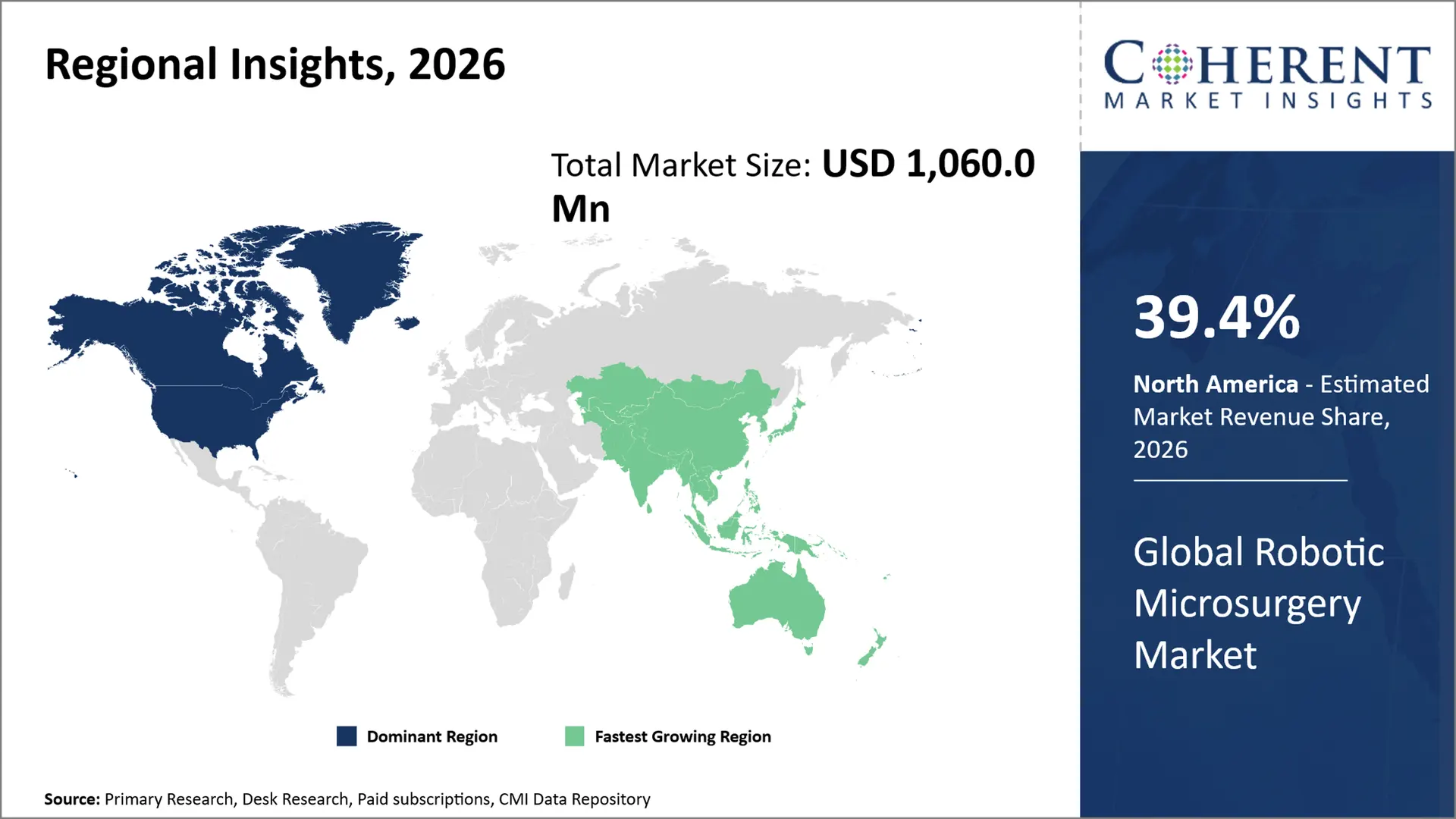
Why is North America a Strong Market for Robotic Microsurgery?
North America leads the global robotic microsurgery market, accounting for an estimated 39.4% share in 2026, primarily attributed to the presence of well-established healthcare infrastructure, high adoption of medical equipment, and access to high investments in healthcare research & development. Moreover, the region is expected to continue its domination, owing to the growing number of partnerships among research organizations, universities, and hospitals, which will strengthen the surgical robots.
In addition, increasing government funding, healthcare reforms, and reimbursement policies will further boost the market growth. For instance, in May 2025, the American Medical Association’s CPT Editorial Panel agenda included proposed Category III codes X476T–X478T for robotic lymphovenous bypass and microsurgical lymph node transfer, providing a coding pathway for reporting these specialized procedures.
Why Does Asia Pacific Robotic Microsurgery Market Exhibit High Growth?
Asia Pacific is expected to exhibit the fastest growth in the global robotic microsurgery market, registering an estimated CAGR of 16.9% during 2026–2033. The region is projected to account for 24.1% of the global market in 2026, owing to improvement in the regional healthcare infrastructure, rise in the geriatric population, and the growing adoption for sophisticated surgical procedures. The regional market is further expected to benefit from government initiatives to expand access to healthcare and innovations, with specific focus on promoting advanced technologies such as surgical endoscopic devices and robotic microsurgery, especially in China, Japan, and South Korea.
For instance, In October 2025, China’s National Medical Products Administration (NMPA) announced measures to optimize the full life-cycle regulation of high-end medical devices, including developing classification guidelines for surgical robots and improving technical standards and regulatory support for innovative devices. The initiative is designed to promote medical technology innovation and enhance the development of advanced surgical robotics in China. Furthermore, increasing funding for innovative medical technologies, rising presence of specialized surgeons, and increasing medical tourism may also boost the growth of the regional market.
Global Robotic Microsurgery Market Outlook for Key Countries
Why is the U.S. Leading Innovation and Adoption in the Robotic Microsurgery Market?
The U.S is expected to be the dominant market in terms of innovation and commercialization due to presence of strong biomedical engineering research domain, centered surgical markets, and advancement in medical devices. Additionally, progress due to effective collaboration between the academia, clinicians, and robotics companies is assumed to facilitate faster clinical translation of experimental devices. Moreover, increasing interest in surgical precision in ophthalmology, neurosurgery, and reconstructive surgery may favor market growth.
Is Japan a Favorable Market for Robotic Microsurgery Market?
Japan offers significant commercial potential for robotic microsurgery driven by its aging population, combined with the need to perform fine microsurgical procedures to treat degenerative diseases, makes it an attractive market. Additionally, the existence of strong in-house medical-device manufacturing, coupled with the cooperation of engineering researchers and surgeons promote the use of cutting-edge microsurgery.
Is China Emerging as a Key Growth Hub for the Robotic Microsurgery Market?
With its increasing availability of sophisticated surgical options, combined with high government and private sector investment in home-grown medical devices, China is set to emerge as a major growth driver of the robotic microsurgery market. Large patient pools and the rising trends of seeking treatment for specialized surgeries are likely to drive demand for ophthalmic, neurosurgical, and reconstructive robotic applications. In addition, developments in hospital infrastructure and medical devices in China are likely to boost growth.
Why Does Germany Top the European Robotic Microsurgery Market?
Germany is expected to dominate the European robotic microsurgery market, owing to the rapidly growing base of medical-device engineering as well as the superior hospital infrastructure and interaction between hospitals and technology developers. Germany's expertise in high-value medical equipment and precision engineering is a significant factor in defining the demand for complex surgical robots. The country's experience with clinical research adds to its potential as a market.
Is Robotic Microsurgery Market Developing in UK?
The clinical research, centres of expertise and fusion of academia and medical technology companies, are probable enablers of the UK robotic microsurgery market. The established biomedical research environment in the UK seems conducive for the uptake of robotic technologies for complex procedures (key areas include ophthalmology, reconstructive and neurosurgery). Larger adoption of such systems will require extensive clinical validation, cost-effectiveness and integration within routine practice.
Microsurgery Applications by Surgical Specialty
Surgical Application | Robotic Instrument Precision | Microscale Tissue / Vessel Repair | Image-Guided Navigation | Minimally Invasive Access |
Ophthalmology | ✓ | ✓ | ✓ | ✓ |
Neurosurgery | ✓ | ✓ | ✓ | ✓ |
Plastic and Reconstructive Surgery | ✓ | ✓ | ✓ | ✓ |
Cardiovascular and Vascular Surgery | ✓ | ✓ | ✓ | ✓ |
ENT Surgery | ✓ | ✓ | ✓ | ✓ |
Urology | ✓ | ✓ | ✓ | ✓ |
How is the expanding adoption of robotic microsurgery in ophthalmology, neurosurgery, and reconstructive surgery creating new growth opportunities in the robotic microsurgery market?
The global robotic microsurgery market is expected to create significant opportunities as robotic platforms advance into smaller, more niche procedures requiring highly precise, dexterous and steady state control of instruments. Experience from related fields of ophthalmic surgery, neurosurgery, and reconstructive surgery show increased need for technologies and instruments capable of handling finer tissues and performing more complex microsurgical procedures. In addition, improvements in robotic visualization, smaller instruments, and image-guided navigation may further expand possible clinical use. For instance, in February 2025, the U.S. National Eye Institute released a report about early studies of a robotic device that was developed by the University of Utah for use in retinal surgery. The results demonstrate possibilities for improved subretinal injections, paving the way for future robotic microsurgery.
Market Players, Key Development, and Competitive Intelligence

Key Developments
- On October 12, 2026, Stryker and CMR Surgical announced a strategic alliance involving an approximately USD 400 million preferred equity investment by Stryker in CMR Surgical. The partnership aims to accelerate innovation and global commercialization of CMR Surgical’s Versius robotic surgery portfolio, with Stryker becoming its exclusive U.S. sales agent. The agreement also grants Stryker an option to acquire CMR Surgical in the future, strengthening commercialization prospects for robotic-assisted surgical technologies.
- On October 8, 2026, Medical Microinstruments (MMI) announced that it raised USD 125 million in Series D financing to accelerate the global commercialization of its Symani Surgical System. The funding will support broader adoption in the U.S. and international markets, alongside clinical research, including the REMIND trial investigating robotic microsurgery for Alzheimer’s disease. This investment is expected to support market expansion and further clinical evidence generation.
- In September 2026, Cornerstone Robotics and Medtronic announced a strategic partnership involving an approximately USD 700 million investment to expand global access to robotic-assisted surgery. The agreement grants Medtronic distribution rights for Cornerstone Robotics’ Sentire Surgical System in selected markets outside the U.S., complementing its Hugo robotic-assisted surgery platform. The partnership highlights growing investment in surgical robotics and efforts to accelerate international commercialization.
- In May 2026, AiM Medical Robotics announced a collaboration with Siemens Healthineers to integrate its MRI-compatible robotic neurosurgery platform with Siemens Healthineers’ MAGNETOM MRI scanners. The interface is designed to support image-guided procedures, including neurostimulator lead placement, biopsies, and tumor ablation. This collaboration advances the integration of real-time imaging and robotic precision in neurosurgical interventions.
Competitive Landscape
The global robotic microsurgery market is evolving through advancements in robotic precision, high-resolution imaging, motion stabilization, and minimally invasive surgical technologies. Market participants are increasingly focusing on enhancing surgical accuracy, improving instrument dexterity, and expanding clinical applications across neurosurgery, ophthalmology, and reconstructive surgery.
Key focus areas include
- Development of advanced robotic platforms for precision microsurgical procedures
- Integration of high-resolution imaging and real-time surgical guidance technologies
- Enhancement of motion scaling, tremor filtration, and instrument maneuverability
- Expansion of robotic microsurgery applications across specialized surgical disciplines
- Development of AI-enabled surgical assistance and improved surgeon training solutions
Market Report Scope
Global Robotic Microsurgery Market Report Coverage | |||
Report Coverage | Details | ||
Base Year | 2025 | Market Size in 2026: | USD 1,060.0 Mn |
Historical Data For: | 2020 To 2024 | Forecast Period: | 2026 To 2033 |
Forecast Period 2026 To 2033 CAGR: | 14.3% | 2033 Value Projection: | USD 2,701.7 Mn |
Geographies covered: |
| ||
Segments covered: |
| ||
Companies covered: | Medical Microinstruments S.p.A., MicroSure B.V., Carl Zeiss Meditec AG, ForSight Robotics Ltd., Ophthorobotics AG, AcuSurgical, Brainlab AG, Intuitive Surgical, Inc., Medtronic plc, Zimmer Biomet Holdings, Inc. | ||
Growth Drivers: |
| ||
Restraints & Challenges: |
| ||
Analyst Opinion (Expert Opinion)
- In the coming years, global robotic microsurgery market will be shaped by the development of highly precise, compact, and intelligent robotic systems capable of performing complex procedures with greater consistency and control. Increasing integration of advanced imaging, motion scaling, tremor filtration, and AI-assisted surgical guidance is expected to expand the clinical applications of robotic microsurgery. Over the long term, market growth will depend on demonstrating meaningful clinical benefits, improving system affordability, and enabling wider adoption beyond leading specialist hospitals.
- The maximum opportunities are foreseen within ophthalmology in the U.S. and neurosurgery in China. Ophthalmology offers potential for robotic assistance in delicate procedures requiring exceptional precision, while neurosurgery presents opportunities for technologies that support accurate instrument positioning and navigation within sensitive anatomical structures. China could offer additional growth potential through healthcare infrastructure expansion and investment in advanced medical technologies. However, commercial success in these applications will depend on clinical validation, regulatory approvals, and integration into existing surgical workflows.
- In order to gain a competitive advantage market players should prioritize application-specific robotic platforms, demonstrate measurable improvements in surgical precision and patient outcomes, and strengthen partnerships with specialist hospitals and academic research institutions. Companies should also invest in surgeon training, intuitive system design, and cost-effective deployment models to reduce adoption barriers. Building robust clinical evidence, securing regulatory clearances across target markets, and developing scalable service and support networks will be essential for establishing long-term competitive positioning.
Speak to the analyst
Want personalized insights?
Take the findings above to one of our principal consultants, or have the report rebuilt around the segments, geographies and competitors you actually track.
Market Segmentation
- Product Insights (Revenue, USD Mn, 2021 - 2033)
- Robotic Microsurgery Systems
- Accessories and Consumables
- Application Insights (Revenue, USD Mn, 2021 - 2033)
- Neurosurgery
- Ophthalmology
- Plastic and Reconstructive Surgery
- Cardiovascular and Vascular Surgery
- Urology
- ENT Surgery
- Others
- End User Insights (Revenue, USD Mn, 2021 - 2033)
- Hospitals and Surgical Centers
- Specialty Clinics
- Research Institutes
- Others
- Regional Insights (Revenue, USD Mn, 2021 - 2033)
- North America
- U.S.
- Canada
- Latin America
- Brazil
- Argentina
- Mexico
- Rest of Latin America
- Europe
- Germany
- U.K.
- Spain
- France
- Italy
- Russia
- Rest of Europe
- Asia Pacific
- China
- India
- Japan
- Australia
- South Korea
- ASEAN
- Rest of Asia Pacific
- Middle East
- GCC Countries
- Israel
- Rest of Middle East
- Africa
- South Africa
- North Africa
- Central Africa
- North America
Sources
Primary Research Interviews
- Robotic microsurgery system manufacturers and platform developers
- Microsurgical instrument and robotic manipulation technology specialists
- Medical imaging, surgical visualization, and navigation technology experts
- Neurosurgeons, ophthalmic surgeons, and plastic and reconstructive surgeons experienced in microsurgical procedures
- Clinical researchers specializing in robotic-assisted microsurgery and super microsurgery
- Hospital procurement managers and operating-room technology specialists
- Biomedical engineers and AI specialists developing surgical robotics and image-guidance technologies
Stakeholders
- Robotic microsurgery system developers and manufacturers
- Microsurgical instrument, robotic arm, and accessories suppliers
- Surgical imaging, visualization, and navigation technology providers
- Hospitals, specialist surgical centers, and academic medical institutions
- Clinical research organizations and medical-device testing laboratories
- Healthcare AI, software integration, and surgical simulation providers
- Medical device distributors and healthcare technology service providers
- End-use Sectors
- Hospitals and Surgical Centers
- Specialty Clinics
- Research and Academic Institutions
- Other End-use Sectors
- Regulatory & Health Bodies
- U.S. Food and Drug Administration (FDA) — robotic surgical device classifications, regulatory clearances, and device safety information.
- European Commission — Medical Devices — European medical-device regulatory frameworks.
- Medicines and Healthcare products Regulatory Agency (MHRA), UK — UK medical-device regulation.
- Pharmaceuticals and Medical Devices Agency (PMDA), Japan — medical-device review and regulatory information.
- National Medical Products Administration (NMPA), China — medical-device registration and oversight.
- Central Drugs Standard Control Organisation (CDSCO), India — Indian medical-device regulation.
- World Health Organization (WHO) — medical-device policy and health technology guidance.
Databases
- ClinicalTrials.gov — clinical trials involving robotic microsurgery, reconstructive surgery, and surgical robotics.
- WHO International Clinical Trials Registry Platform (ICTRP) — international clinical-trial records.
- FDA Medical Device Databases — device classifications, premarket submissions, and regulatory records.
- NIH / National Center for Advancing Translational Sciences (NCATS) — translational medical technology research and development.
Associations
- American Society for Reconstructive Microsurgery (ASRM)
- American Society of Plastic Surgeons (ASPS)
- American Academy of Ophthalmology (AAO)
- American Association of Neurological Surgeons (AANS)
- Society of American Gastrointestinal and Endoscopic Surgeons (SAGES)
Public Domain Sources
- U.S. Food and Drug Administration (FDA) — robotic surgical device classifications, clearances, and safety information.
- National Institutes of Health (NIH) — biomedical research and surgical technology studies.
- National Center for Biotechnology Information (NCBI) — scientific literature on robotic microsurgery, surgical precision, and clinical applications.
- ClinicalTrials.gov — registered studies evaluating robotic surgical platforms and microsurgical procedures.
- World Health Organization (WHO) — medical-device guidance and health technology information.
- European Commission — Medical Devices — medical-device regulatory requirements and policy information.
Proprietary Elements
- CMI Data Analytics Tool
- Proprietary CMI Existing Repository of information for last 10 years.
Get access to 250+ pages report
Every segment, forecast, competitor profile and data table behind the analysis above — available for instant download.
- ESOMAR Member
- ISO 9001:2015 Certified
- D-U-N-S Registered
- GDPR & CCPA Compliant
Frequently Asked Questions
The global robotic microsurgery market is estimated to be valued at USD 1,060.0 Mn in 2026 and is expected to reach USD 2,701.7 Mn by 2033.
Robotic microsurgery systems dominate due to their central role in enabling high-precision surgical procedures, enhanced instrument control, and tremor reduction.
Robotic microsurgery uses specialized robotic systems to assist surgeons in performing delicate procedures with enhanced precision, stability, and control.
The CAGR of global robotic microsurgery market is projected to be 14.3% from 2026 to 2033.
Rising demand for high-precision surgical procedures, and advancements in robotic visualization, motion scaling, and tremor filtration technologies are the major factors driving the growth of the global robotic microsurgery market.
High acquisition, maintenance, and operating costs of robotic microsurgery systems, and limited availability of specialized training and skilled surgeons for robotic microsurgical procedures are the major factors hampering the growth of the global robotic microsurgery market.
In terms of application, ophthalmology is estimated to dominate the market revenue share in 2026.