

Robotic Vial Washing and Filling Machines Market Size and Forecast — 2026-2033
The Global Robotic Vial Washing and Filling Machines Market is estimated to be valued at USD 594.9 Mn in 2026 and is expected to reach USD 770.2 Mn by 2033, exhibiting a compound annual growth rate (CAGR) of 4.4% from 2026 to 2033.
Key Takeaways of the Global Robotic Vial Washing and Filling Machines Market:
- In terms of machine type, the robotic vial washers segment is expected to contribute the highest share of the market with 53.1% in 2026 owing to their advanced functionality for enhancing production workflows.
- In terms of type, the standalone washing machines segment is expected to contribute the highest share of the market with 44.1% in 2026 owing to their modular configurations
- In terms of end user, the pharmaceutical & biopharmaceuticals companies segment is expected to contribute the highest share of the market with 33.3% in 2026 owing to their stringent manufacturing compliance standards.
- North America is projected to lead the market with a 36.5% share in 2026, driven by advanced healthcare infrastructure and strong digital adoption. Asia Pacific is expected to follow, accounting for a 26.5% share, supported by increasing digitization and government initiatives in countries such as China and India.
Market Overview:
The robotic vial washing and filling machines market is expected to witness strong growth during the forecast period due to increasing focus on enhancing pharmaceutical production efficiency. Adoption of robotic machines helps reduce costs and improve quality by minimizing human errors. Moreover, these machines offer increased throughput and flexibility compared to traditional washing and filling methods. Key players are investing in developing advanced solutions with improved washing, disinfecting and filling capabilities to further automate pharmaceutical manufacturing processes. One key player making such investments is Syntegon Technology GmbH. The company is actively developing advanced robotic solutions for pharmaceutical washing and filling, aiming to enhance automation, precision, and compliance in drug manufacturing processes.
Currents Events and Their Impact
Current Events | Description and its impact |
Surge in Demand for Injectable Drugs |
|
Technological Advancements in Automation |
|
Insights, By Machine Type
Global Robotic Vial Washing and Filling Machines Market Insights, By Machine Type - Efficiency and Precision Boosting Capabilities Drive Demand for Robotic Vial Washers
The robotic vial washers segment is projected to hold the largest market share at 53.1% in 2026, driven by their advanced capabilities in optimizing production workflows. Robotic vial washers utilize automated arms, clamps, and other mechanisms to efficiently pick up and transfer vials at a rapid pace with precise movements. This allows for a significant increase in washing capacity compared to traditional methods. The robotic systems can wash hundreds of vials per hour in a highly consistent manner while minimizing human errors.
Their reproducible washing cycles and protocols ensure stringent cleaning of vials according to the current Good Manufacturing Practice (cGMP) requirements of pharmaceutical manufacturers. For instance, in November 2024, Sidel, a leading provider of equipment and services, introduced the Hydra Ultrasonic, an innovative bottle washer that combines chemical and ultrasonic technologies to improve cleaning efficiency while minimizing energy, water, and chemical consumption.
Insights, By Type
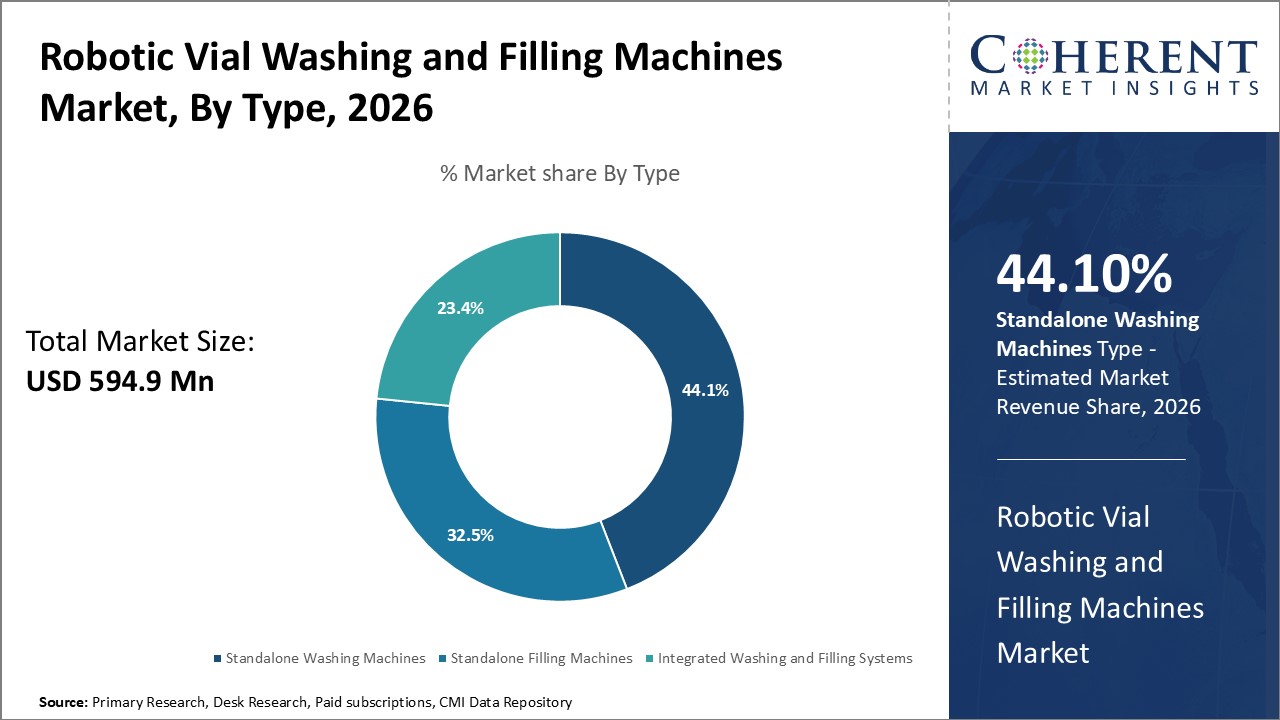
Global Robotic Vial Washing and Filling Machines Market Insights, By Type Insights - Versatility and Modularity Drive Adoption of Standalone Washing Machines
The standalone washing machines segment is anticipated to account for the largest market share at 44.1% in 2026, attributed to their modular design and flexible configurations. Standalone machines offer pharmaceutical manufacturers the flexibility to customize washing functions according to their specific production needs. Manufacturers can select modules for different vial treatment steps like rinsing, sterilization or drying and integrate them in a singular machine. This modular approach allows companies to configure washing systems that perfectly match the vial formats, output requirements as well as cleaning validation protocols for different drug products. The modular machines also adapt easily to future expansions or changes in manufacturing operations. Their simple scalability makes standalone washing systems a cost-effective yet versatile option for small volume parenteral production units. Further, maintenance and upgrades of individual modules pose minimal disruption to production schedules.
Insights, By End User
Global Robotic Vial Washing and Filling Machines Market Insights, By End User Insights - Infrastructure and Compliance Needs Drive Demand from Pharmaceutical Companies
The pharmaceutical and biopharmaceutical companies segment is projected to hold the largest market share at 33.3% in 2026, driven by strict manufacturing compliance requirements. Pharmaceutical manufacturers operate in a highly regulated environment with strict legislative mandates around vial and container cleaning validation. Automated systems like robotic vial washing and filling machines help companies comply seamlessly with ICH, USFDA and cGMP regulations through their standardized, documented processes. The robotic solutions also allow configuring digital workflows integrated with LIMS and MES for traceability. Their use minimizes human intervention risks during critical cleaning stages. Additionally, many pharmaceutical firms are shifting operations to large centralized facilities for drugs as well as biologics.
Role of Artificial Intelligence (AI)
AI is transforming the robotic vial washing and filling machines indutsry by enhancing efficiency, reducing costs, and automating processes. With predictive analytics, manufacturers can anticipate equipment failures and optimize maintenance schedules, minimizing downtime. AI improves process automation, ensuring precise vial handling, which is crucial in pharmaceuticals. Companies like KUKA AG are integrating AI into their robotic systems to enhance efficiency and accuracy. Emerging opportunities include innovative business models like data-as-a-service, offering analytics based on production data. However, challenges such as high initial investments and the need for skilled personnel must be addressed.
Regional Insights
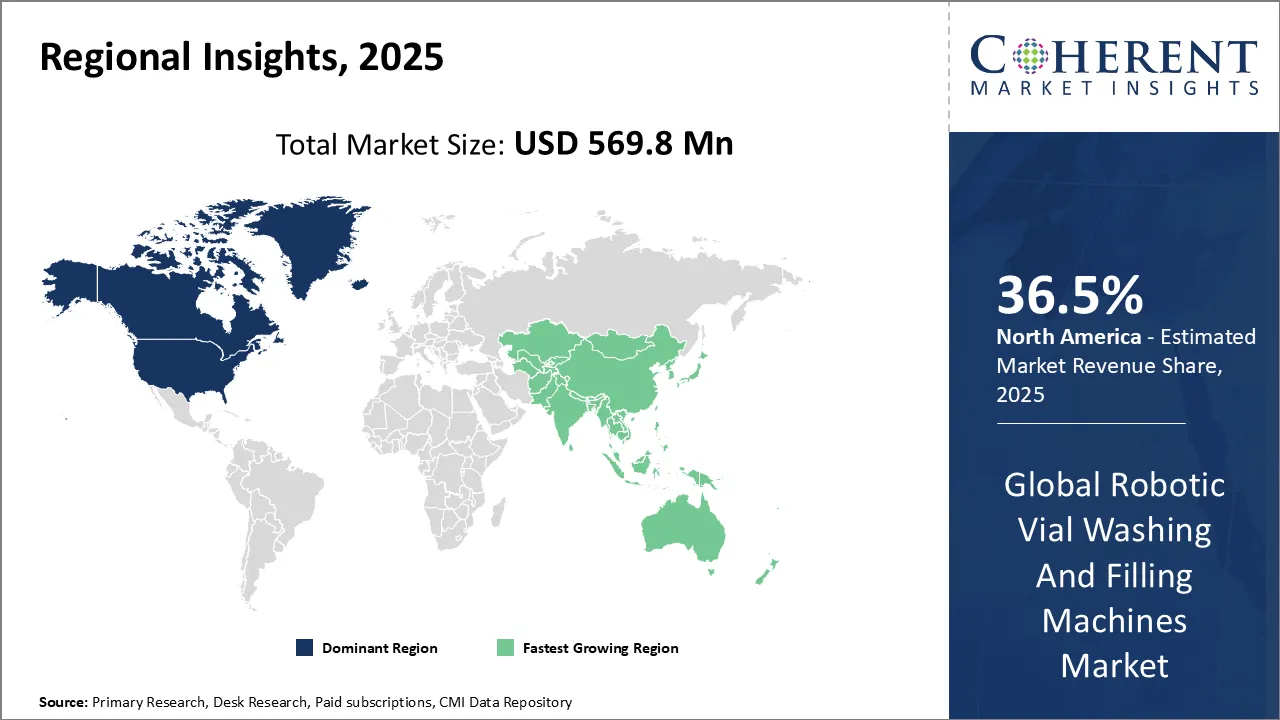
North America Robotic Vial Washing and Filling Machines Market Analysis and Trends
In North America, the dominance in the robotic vial washing and filling machines industry with an estimated market share of 36.5% in 2026 can be attributed to the robust presence of major life sciences companies and supportive government policies promoting biotech innovation. The U.S., in particular, is home to most leading pharmaceutical manufacturers globally which are continually seeking automation solutions to boost efficiency. For example, startups like XYZ Robotics Inc. are developing advanced technologies, including AI-driven robotic systems for precise vial handling. Its 3D-AI Vision Processor utilizes deep learning algorithms to enhance operational efficiency, which could significantly influence market dynamics by reducing labor costs and increasing throughput.
Asia Pacific Robotic Vial Washing and Filling Machines Market Analysis and Trends
Meanwhile, the Asia Pacific region is expected to exhibit the fastest growth with share of 26.5% in 2026 and is emerging as a key market for robotic vial washing and filling machines. Countries such as China, India, and Japan are witnessing expansion of their domestic pharmaceutical sectors and growing investments by multinational brands to tap the widening customer base. This is fueling the uptake of productivity-enhancing technologies in the drug manufacturing landscape.
Market Outlook for Key Countries
U.S. Robotic Vial Washing and Filling Machines Market Analysis and Trends
The U.S. market for robotic vial washing and filling machines is expanding due to the increasing demand for injectable drugs and the adoption of automation in pharmaceutical manufacturing. Companies like Syntegon, a global company specializing in processing and packaging technology, have installed over 1,500 vial filling machines globally, processing vaccines and biopharmaceuticals.
Japan Robotic Vial Washing and Filling Machines Market Analysis and Trends
The Japan robotic vial washing and filling machines market is expanding due to technological advancements and automation in pharmaceutical manufacturing. For example, SHIBUYA CORPORATION, a packaging machinery manufacturing company in Japan, offers comprehensive solutions for aseptic vial processing, encompassing washing, sterilization, filling, and sealing. Its systems feature ultrasonic washing for uniform cleaning, Class 100 sterilization tunnels, precise filling with rubber stoppering, and seaming machines for consistent cap sealing.
Germany Robotic Vial Washing and Filling Machines Market Analysis and Trends
Germany plays a pivotal role in the global robotic vial washing and filling machines market. For example, companies like Groninger, one of the international manufacturers of filling and closing machines, are at the forefront of innovation. For instance, Groninger’s flagship technology, the robocell, exemplifies the country's commitment to advanced pharmaceutical manufacturing solutions. The robocell is a gloveless, fully automated robotic system designed for filling and closing Ready-to-Use (RTU) syringes, vials, and cartridges. Developed in collaboration with SKAN, this system eliminates human intervention in aseptic processes, thereby enhancing sterility assurance and aligning with the latest EU GMP Annex 1 regulations.
Canada Robotic Vial Washing and Filling Machines Market Analysis And Trends
Canada’s growing biopharmaceutical sector and focus on automation are driving the robotic vial washing and filling machines market growth. For instance, in February 2021, Cytiva, global life science company, acquired Vanrx Pharmasystems, a Canada-based innovator in robotic aseptic filling machines for vials, syringes, and cartridges. The acquisition enhanced Cytiva’s bioprocessing workflow, addressing the global shift toward smaller batch manufacturing and personalized therapies in the US$ 300 billion biologics market.
Market Players, Key Development, and Competitive Intelligence
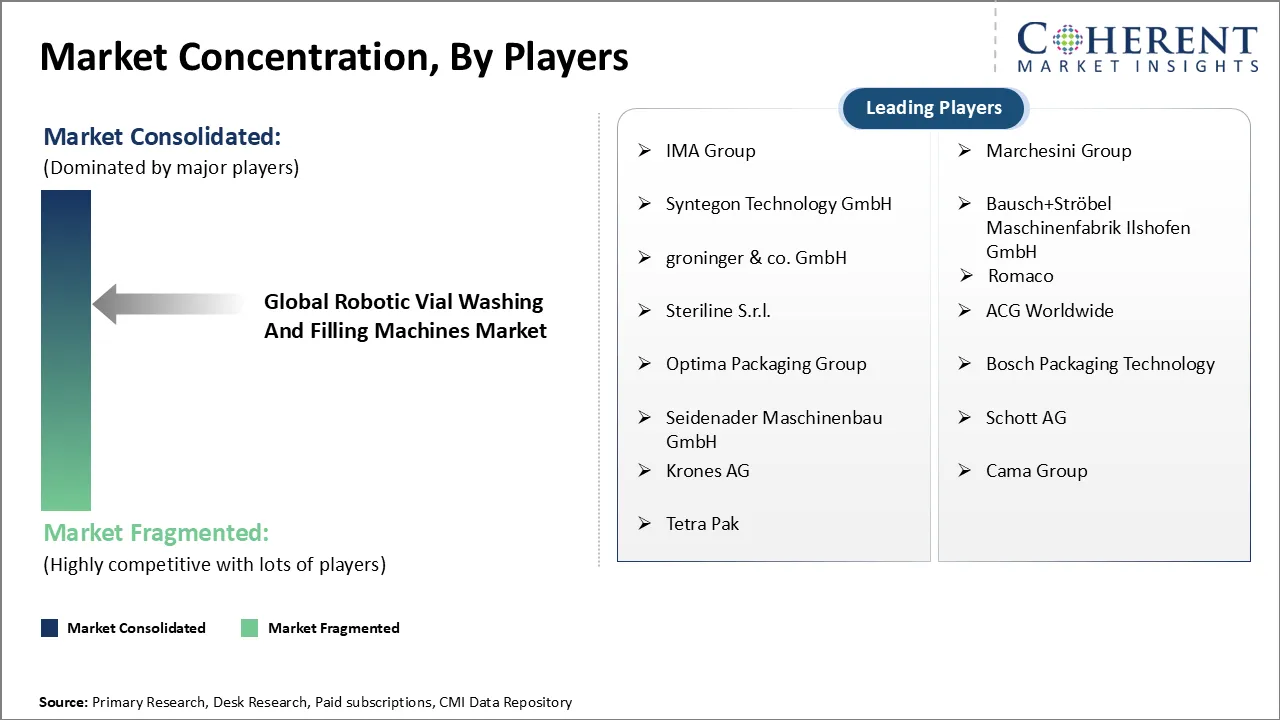
Key Developments:
- In September 2024, Steriline, a leading European manufacturer of robotic filling machines and aseptic filling/finishing lines, unveiled its Robotic Vial Filling & Capping Machine (RVFCM11-S) at CPHI Milan (October 8–10 2024). Displayed at Stand A42, Hall 18, this state-of-the-art machine is designed to improve production efficiency and meet stringent pharmaceutical industry standards.
- In March 2024, at Interphex Booth 2537, Steriline introduced a Robotic Vial Filling Machine equipped with Planar Motor Technology, a magnetically levitated transport system inspired by Maglev Bullet Trains. This advanced platform enables frictionless, precise 6-degree motion, enhancing operational efficiency and precision in aseptic filling processes.
- In June 2024, Syntegon, a machine industry company, acquired Azbil Telstar, a manufacturer and supplier of global life and health science equipment, to enhance its liquid pharmaceutical processing and packaging portfolio. The acquisition strengthens Syntegon’s vial filling and isolator solutions, offering single-source, seamless processing solutions to global pharmaceutical manufacturers and CMOs.
Top Strategies Followed By Global Robotic Vial Washing And Filling Machines Market Players
- Established Players: Leading companies prioritize extensive research and development to innovate high-performance products.
- For instance, Optima plays a key role in robotic vial washing and filling machines by offering customized, platform-based turnkey solutions that integrate filling lines, isolators, and freeze-dryers. Using their CSPE approach, Optima ensures faster time-to-market, minimal product loss, and high system efficiency through smart innovations and digital technologies.
- Mid-Level Players: Mid-tier companies focus on delivering quality, budget-friendly products targeting price-sensitive consumers.
- For instance, AIPAK provides robotic vial washing and filling machines that balance affordability with performance, appealing to a broad range of pharmaceutical manufacturers.
- Small-Scale Players: Small players often target niche markets with unique features or innovative products. MGA Technologies specializes in customized robotic solutions for vial processing, catering to specific client requirements and carving out a distinct market segment.
- Embracing cutting-edge technologies, Steriline S.r.l. integrates advanced automation and robotics into its vial washing and filling machines, ensuring competitiveness in a technology-driven market.
- Current Industry Events of 2026
- Market Size Estimation
- Regional Breakdown
- Competitive Landscape
- Customer Intelligence
- Segmental Analysis
- Pricing Analysis
- Key Market Drivers, Challenges & Future Trends
- Customized Insights Section
Market Report Scope
Robotic Vial Washing and Filling Machines Market Report Coverage
| Report Coverage | Details | ||
|---|---|---|---|
| Base Year: | 2025 | Market Size in 2026: | USD 594.9 Mn |
| Historical Data for: | 2020 To 2024 | Forecast Period: | 2026 To 2033 |
| Forecast Period 2026 to 2033 CAGR: | 4.4% | 2033 Value Projection: | USD 770.2 Mn |
| Geographies covered: |
| ||
| Segments covered: |
| ||
| Companies covered: | IMA Group, Marchesini Group, Syntegon Technology GmbH, Bausch+Ströbel Maschinenfabrik Ilshofen GmbH, groninger & co. GmbH, Romaco, Steriline S.r.l., ACG Worldwide, Optima Packaging Group, Bosch Packaging Technology, Seidenader Maschinenbau GmbH, Schott AG, Krones AG, Cama Group, and Tetra Pak | ||
| Growth Drivers: |
| ||
| Restraints & Challenges: |
| ||
Market Dynamics
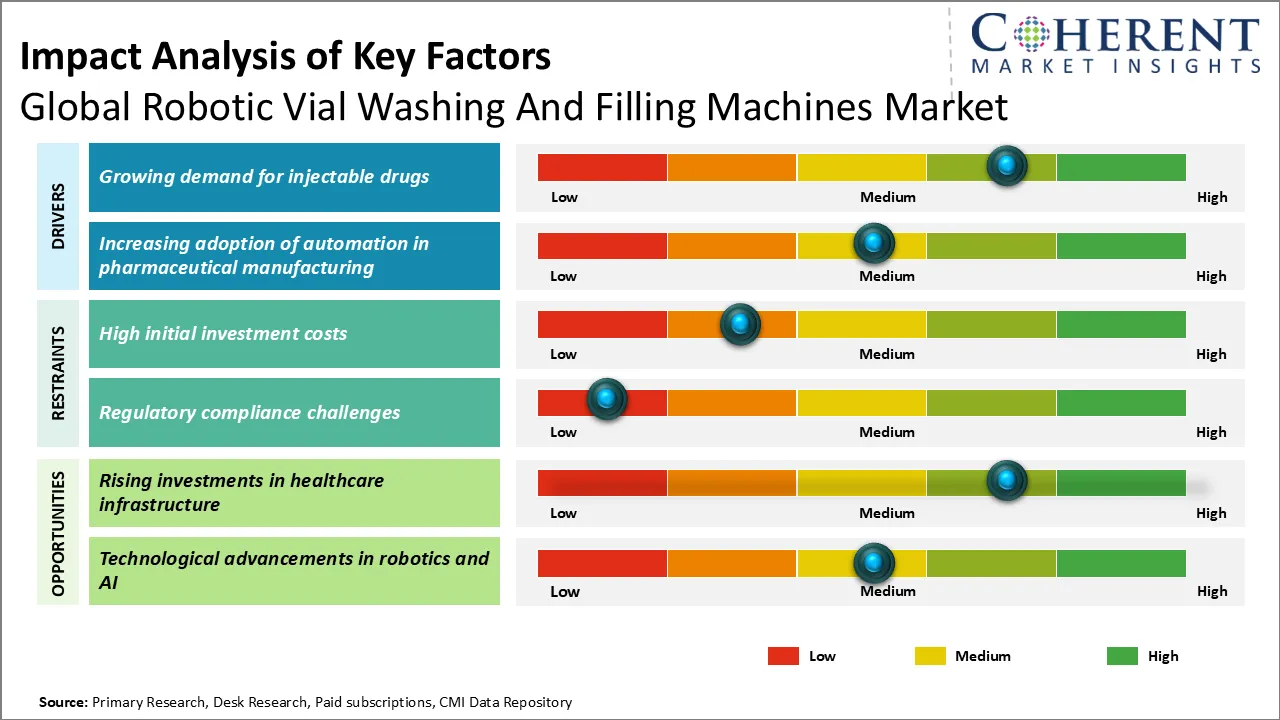
Robotic Vial Washing and Filling Machines Market Driver - Growing demand for injectable drugs
The growth of the pharmaceutical industry, especially in developing countries like India and China has led to a surge in demand for injectable drugs. Injectable medications allow for fast absorption of drugs into the bloodstream and bypass the gastrointestinal tract, making them very effective for a variety of diseases. They are commonly used for vaccination, cancer treatment, chronic conditions like diabetes and autoimmune disorders. This rising preference for injectables is fueling the need for high-speed vial washing and filling systems. Traditional manual methods cannot cope with the expanding production volumes and stringent quality standards of pharmaceutical manufacturing. Robotic vial washing and filling machines offer automated handling of vials along with precision filling capabilities. They ensure product quality is maintained consistently while drastically improving productivity compared to manual labor. For instance, in October 2024, Medicines for Malaria Venture (MMV) and Quotient Sciences, Pharmaceutical Contract Development and Manufacturing Organization & Contract Research Organization launched the first clinical trial for MMV371, a long-acting injectable malaria prevention drug. Conducted in Nottingham, U.K., the trial explores a single injection providing up to 3 months of protection.
Robotic Vial Washing and Filling Machines Market Opportunity - Rising investments in healthcare infrastructure
Governments across major markets are increasingly focusing on improving healthcare infrastructure and boosting local pharmaceutical production. There is a growing emphasis on modernization of manufacturing facilities and adoption of advanced robotic technologies. This creates a positive environment for robotic vial washing and filling machines as governments support local players through subsidies and favorable policies. For instance, several developing Asian, Latin American and Middle Eastern countries have announced large strategic healthcare projects worth billions of dollars. A part of the allocated budget is aimed at setting up local pharmaceutical manufacturing plants with automated production lines. Rising public investments in healthcare infrastructure present a major opportunity for robotic vial washing and filling machine manufacturers to increase their geographical footprint and tap into high growth markets. It also encourages global players to engage in joint ventures or technology transfers with local partners.
For instance, in March 2024, Wipro GE Healthcare, a leading global medical technology, announced an investment of over (approximately USD 958 million) over the next five years to expand manufacturing and R&D in India. As part of its ‘Make in India for the World’ initiative, the company will export products such as the Positron Emission Tomography – Computed Tomography (PET CT) Discovery to 15 countries and manufacture devices like the Revolution Aspire CT, Revolution ACT, and MR breast coils for global distribution.
Analyst Opinion (Expert Opinion)
- The growing need for automation in pharmaceutical bottle processing is a major driver for the adoption of robotic vial washing and filling machines worldwide. These machines help reduce turnaround times and improve process efficiencies via automation. North America will continue to dominate the market over the next five years owing to strong pharmaceutical research activities and stringent regulatory compliance in these regions.
- The global robotic vial washing and filling machines market is expanding rapidly, fueled by rising demand for injectable drugs and growing adoption of automation in pharmaceutical manufacturing. These machines enhance sterility, reduce human error, and boost production efficiency by automating washing, sterilizing, and filling processes. The prevalence of chronic diseases and the surge in biologics and biosimilars are increasing the need for precise, contamination-free drug delivery. Regulatory compliance, especially with GMP standards, is a key driver pushing companies toward robotic solutions.
- Emerging markets like India and China are heavily investing in pharmaceutical infrastructure, further propelling demand. Companies like Steriline are innovating with technologies such as AI integration and magnetically levitated transport systems. This shift to smart, high-performance systems is transforming pharmaceutical production, making robotic vial washing and filling machines essential for future-ready drug manufacturing.
Speak to the analyst
Want personalized insights?
Take the findings above to one of our principal consultants, or have the report rebuilt around the segments, geographies and competitors you actually track.
Market Segmentation
- Machine Type Insights (Revenue, USD Mn, 2021 - 2033)
- Robotic Vial Washers
- Rotary Washing Machines
- Linear Washing Machine
- External Washing Machines
- Robotic Vial Filling Machines
- Powder Filling Machines
- Modular Machines Filling Machines
- Robotic Vial Washers
- Type Insights (Revenue, USD Mn, 2021 - 2033)
- Standalone Washing Machines
- Standalone Filling Machines
- Integrated Washing and Filling Systems
- End User Insights (Revenue, USD Mn, 2021 - 2033)
- Pharmaceutical & Biopharmaceuticals Companies
- Biotechnology Companies
- CMOs & CDMOs
- Research Laboratories
- Others (CROs etc.)
- Application Type Insights (Revenue, USD Mn, 2021 - 2033)
- Vaccines
- Biologics
- Small Molecule Drugs
- Specialty Pharmaceuticals
- Regional Insights (Revenue, USD Mn, 2021 - 2033)
- North America
- U.S.
- Canada
- Latin America
- Brazil
- Argentina
- Mexico
- Rest of Latin America
- Europe
- Germany
- U.K.
- Spain
- France
- Italy
- Russia
- Rest of Europe
- Asia Pacific
- China
- India
- Japan
- Australia
- South Korea
- ASEAN
- Rest of Asia Pacific
- Middle East
- GCC Countries
- Israel
- Rest of Middle East
- Africa
- South Africa
- North Africa
- Central Africa
- North America
- Key Players Insights
- IMA Group
- Marchesini Group
- Syntegon Technology GmbH
- Bausch+Ströbel Maschinenfabrik Ilshofen GmbH
- groninger & co. GmbH
- Romaco
- Steriline S.r.l.
- ACG Worldwide
- Optima Packaging Group
- Bosch Packaging Technology
- Seidenader Maschinenbau GmbH
- Schott AG
- Krones AG
- Cama Group
- Tetra Pak
Sources
Primary Research Interviews:
- Industry Stakeholders: Interviews conducted with pharmaceutical equipment manufacturers, automation specialists, robotics engineers, and technology providers involved in the design and integration of aseptic vial washing and filling systems.
- End Users: Insights gathered from pharmaceutical companies, contract manufacturing organizations (CMOs), and biologics producers implementing robotic fill-finish solutions in their sterile manufacturing environments.
Magazines:
- Pharmaceutical Manufacturing Magazine
- Medical Device & Diagnostics Industry (MD+DI)
- European Pharmaceutical Review
Journals:
- Journal of Pharmaceutical Innovation
- International Journal of Pharmaceutics
- Journal of Pharmaceutical Engineering and Processing
Newspapers:
- The Wall Street Journal
- Financial Times
- The Economic Times (India)
Associations:
- International Society for Pharmaceutical Engineering (ISPE)
- Parenteral Drug Association (PDA)
- European Medicines Agency (EMA)
Public Domain Sources:
- World Health Organization (WHO)
- U.S. Food and Drug Administration (FDA)
- Eurostat
- United Nations COMTRADE
- National Pharmaceutical Regulatory Authorities
Proprietary Elements:
- CMI Data Analytics Tool: Proprietary analytics tool to analyze real-time market trends, consumer behavior, and technology adoption in dark factories.
- Proprietary CMI Existing Repository of Information for Last 8 Years
Get access to 250+ pages report
Every segment, forecast, competitor profile and data table behind the analysis above — available for instant download.
- ESOMAR Member
- ISO 9001:2015 Certified
- D-U-N-S Registered
- GDPR & CCPA Compliant
Missing comfort of reading report in your local language? Find your preferred language:
Transform your Strategy with Exclusive Trending Reports
Frequently Asked Questions
The global robotic vial washing and filling machines market is estimated to be valued at USD 594.9 Mn in 2026 and is expected to reach USD 770.2 Mn by 2033.
The CAGR of the global robotic vial washing and filling machines market is projected to be 4.4% from 2026 to 2033.
Growing demand for injectable drugs and increasing adoption of automation in pharmaceutical manufacturing are the major factors driving the growth of the global robotic vial washing and filling machines market.
High initial investment costs and regulatory compliance challenges are the major factors hampering the growth of the global robotic vial washing and filling machines market.
In terms of machine type, the robotic vial washers segment is estimated to dominate the market revenue share in 2026.
IMA Group, Marchesini Group, Syntegon Technology GmbH, Bausch+Ströbel Maschinenfabrik Ilshofen GmbH, groninger & co. GmbH, Romaco, Steriline S.r.l., ACG Worldwide, Optima Packaging Group, Bosch Packaging Technology, Seidenader Maschinenbau GmbH, Schott AG, Krones AG, Cama Group, and Tetra Pak are the major players.
North America is expected to lead the global robotic vial washing and filling machines market in 2026.