

Global Rosehip Oil Market Size and Forecast – 2026 To 2033
The Global Rosehip Oil Market is estimated to be valued at USD 250.6 Mn in 2026 and is expected to reach USD 432.3 Mn by 2033, growing at a compound annual growth rate (CAGR) of 8.1% from 2026 to 2033. This growth is supported by increasing consumer preference for natural and organic skincare products, along with wider acceptance of rosehip oil in cosmetic, therapeutic, and wellness applications.
The market is further strengthened by the expansion of premium botanical skincare offerings, where brands are emphasizing ingredient purity, traceability, and multifunctional skin benefits. In 2025, The Ordinary continued offering its 100% Organic Cold-Pressed Rose Hip Seed Oil, positioned around hydration, skin elasticity support, and natural skincare benefits, reflecting continued commercial adoption of rosehip oil-based formulations in the global beauty industry.
Key Takeaways of the Global Rosehip Oil Market
- Cold Pressed Rosehip Oil, with an estimated CAGR of 8.6% from 2026–2033, is expected to hold 48.6% of the global rosehip oil market in 2026. Its gentle processing preserves bioactive compounds, supporting premium skincare positioning and ingredient transparency. In April 2025, Trilogy highlighted its cold-pressed Certified Organic Rosehip Oil as a core skin barrier product offering.
- Cold Press Extraction, with an estimated CAGR of 8.0% from 2026–2033, is expected to account for 46.8% of the global rosehip oil market in 2026. The method leads due to its ability to preserve natural compounds and maintain oil quality, making it preferred for premium skincare and clean-label cosmetic formulations. In May 2025, Alteya Organics continued promoting its botanical oil-based skincare portfolio, highlighting the commercial relevance of naturally extracted oils in premium beauty applications.
- Skincare and Cosmetics, with an estimated CAGR of 8.9% from 2026–2033, is expected to account for 56.8% of the global rosehip oil market in 2026. The application benefits from rosehip oil’s positioning in facial care formulations focused on hydration, skin repair, and botanical ingredients. In June 2025, Kosmea continued promoting certified organic rosehip oil within its dedicated natural skincare portfolio.
- Europe, with an estimated CAGR of 7.8% from 2026–2033, is projected to represent 34.8% of the global rosehip oil market in 2026. The region’s strong cosmetics compliance framework supports demand for traceable botanical ingredients and responsible formulations. In May 2025, the European Commission maintained updates to cosmetic product requirements under Regulation (EC) No 1223/2009, influencing ingredient transparency practices.
- North America, with an estimated CAGR of 9.2% from 2026–2033, is expected to represent 28.6% of the global rosehip oil market in 2026. Growth potential is supported by consumer preference for natural facial oils, premium personal care routines, and direct-to-consumer botanical brands. In September 2025, Kosmea continued expanding its rosehip oil focused skincare offerings across North American channels.
Segmental Insights
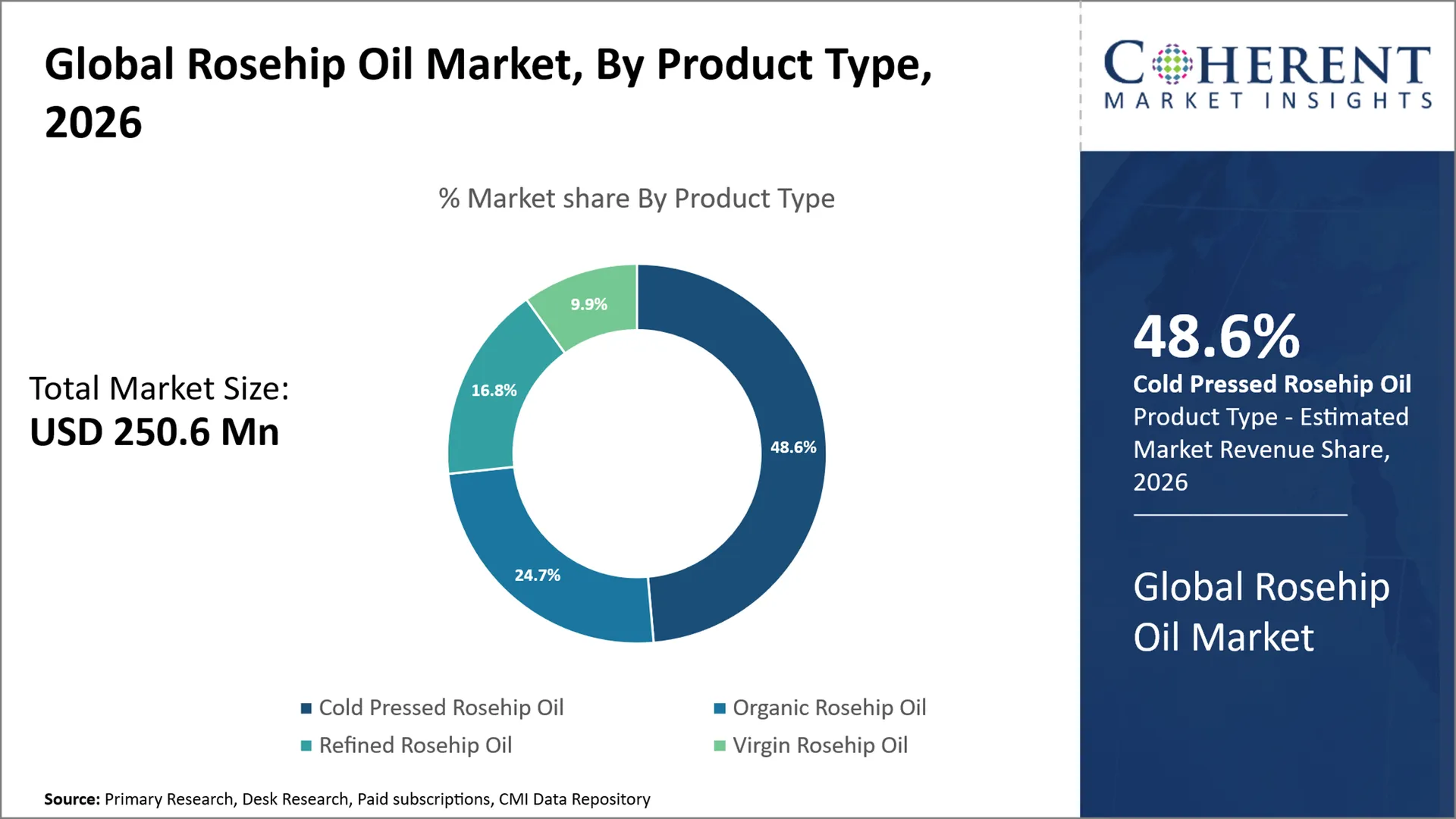
Why Does Cold Pressed Rosehip Oil Dominate the Product Type Segment in the Global Rosehip Oil Market?
Cold Pressed Rosehip Oil is expected to account for 48.6% of the global rosehip oil market in 2026 due to its strong positioning as a premium ingredient where preservation of natural characteristics directly influences purchasing decisions. Unlike heavily processed alternatives, cold pressing maintains the oil’s natural profile, making it suitable for facial oils, serums, and clean beauty formulations. Producers benefit from higher-value product positioning, while cosmetic brands use this format to support premium pricing and ingredient differentiation. Demand is particularly strong among skincare formulators seeking minimally processed botanical oils with consistent quality specifications. In April 2025, Pai Skincare continued promoting its Rosehip Bioregenerate Face Oil, highlighting its use of organic rosehip oil extracted through supercritical CO₂ technology. This supports the premium positioning of rosehip oil in skincare by demonstrating how advanced extraction methods are being applied to preserve botanical compounds and differentiate high-value facial care formulations.
- Current Industry Events of 2026
- Market Size Estimation
- Regional Breakdown
- Competitive Landscape
- Customer Intelligence
- Segmental Analysis
- Pricing Analysis
- Key Market Drivers, Challenges & Future Trends
- Customized Insights Section
Why Does Cold Press Extraction Represent the Largest Extraction Method Category in the Global Rosehip Oil Market?
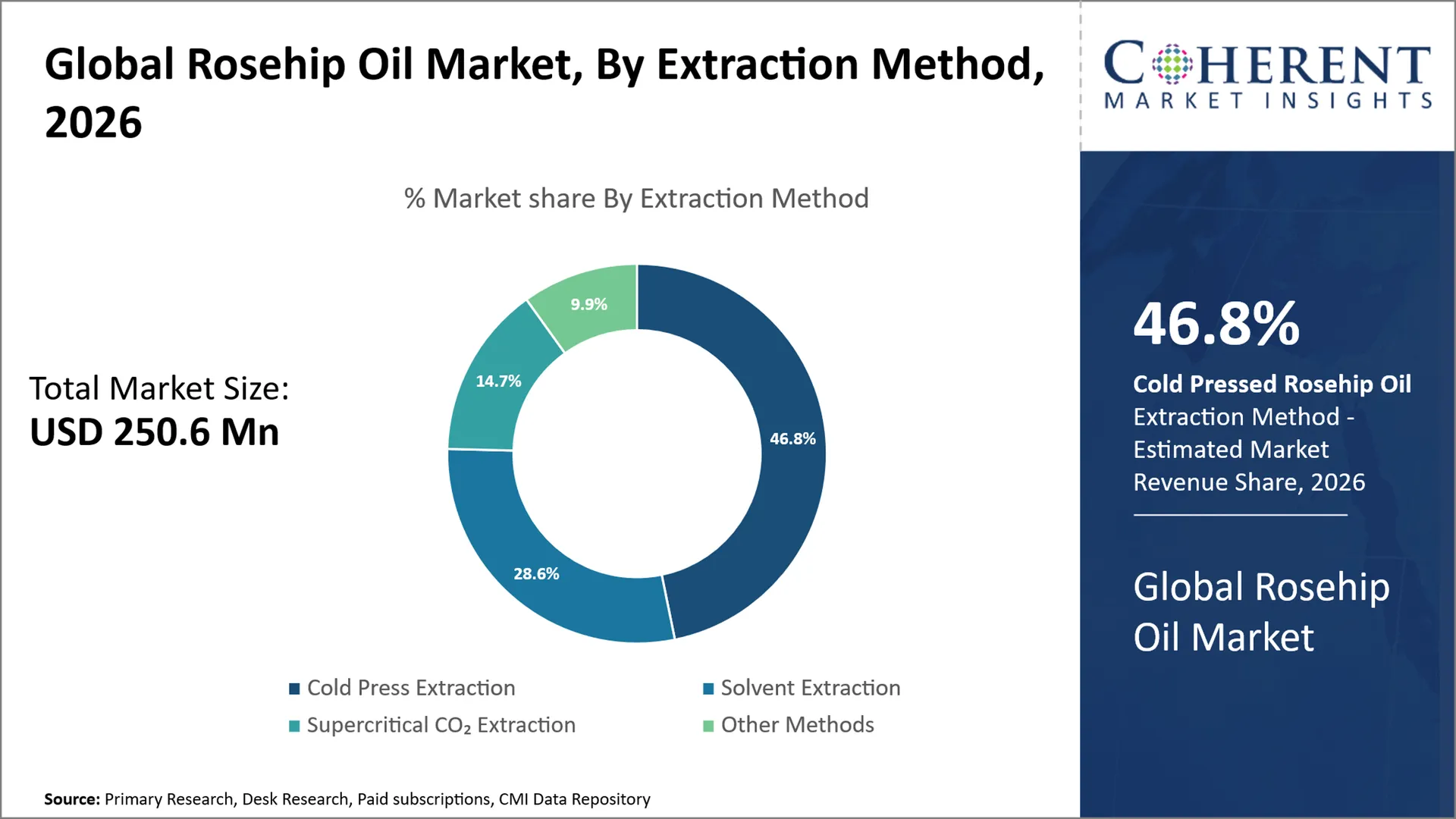
Cold Press Extraction is projected to hold 46.8% of the global rosehip oil market in 2026 as manufacturers prioritize extraction methods that deliver high-quality oils for sensitive skincare and premium cosmetic applications. The process supports suppliers in maintaining product integrity while meeting demand for naturally processed ingredients from beauty brands and specialty formulators. From a supply perspective, advancements in small-scale and industrial pressing equipment have improved production consistency, enabling processors to serve both niche organic brands and larger personal care manufacturers. The method also aligns with traceability requirements because producers can better communicate processing conditions and raw material handling practices. In February 2025, The Body Shop highlighted its continued use of naturally derived oils within its skincare portfolio, supporting broader commercial acceptance of plant-based oil ingredients.
Why Does Skincare and Cosmetics Dominate the Application Segment of the Global Rosehip Oil Market?
Skincare and Cosmetics is expected to represent 56.8% of the global rosehip oil market in 2026 because rosehip oil has established relevance in facial care products where consumers value botanical ingredients, multifunctional benefits, and premium self-care positioning. Cosmetic formulators integrate rosehip oil into facial treatments, moisturizers, and restorative products to enhance product differentiation and appeal to customers seeking naturally positioned skincare solutions. The segment benefits from established beauty distribution networks, including specialty retailers, online channels, and professional skincare providers. Manufacturers can capture higher margins by developing application-specific formulations rather than selling only raw oil. In January 2025, Weleda continued promoting plant-based skincare formulations featuring natural oils, reflecting ongoing commercial integration of botanical ingredients within the personal care industry.
Current Events and their Impact
Current Event | Description and Its Impact |
Cosmetics Regulation Compliance Requirements – European Union (2025) |
|
Cosmetics Rules 2020 Implementation Framework – India (2025) |
|
Ingredient Naming and Label Transparency Requirements – United States (2025) |
|
Global Rosehip Oil Market Dynamics
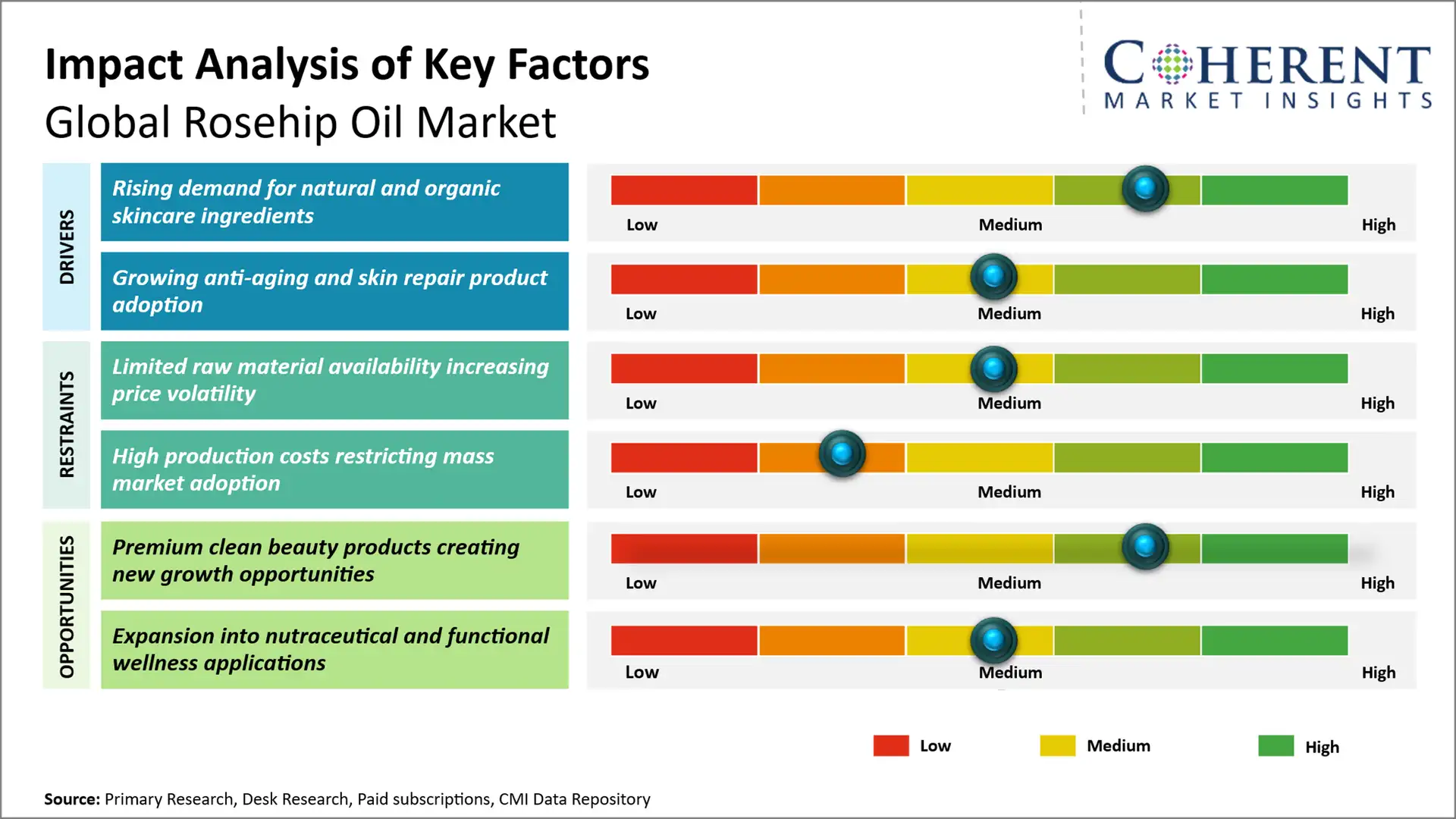
Key Market Drivers
- Rising demand for natural and organic skincare ingredients: The rising preference for naturally derived skincare ingredients is strengthening adoption of rosehip oil as brands seek botanical alternatives with traceable sourcing and clean-label positioning. Organic farms, specialty oil processors, and personal care formulators benefit as consumers increasingly evaluate ingredient origin, extraction quality, and sustainability attributes before purchase. The shift is encouraging suppliers to invest in certified cultivation, cold-press processing, and premium-grade formulations. In October 2025, the U.S. Food and Drug Administration continued emphasizing ingredient transparency and safety responsibilities for cosmetic manufacturers, reinforcing the importance of compliant ingredient selection.
- Growing anti-aging and skin repair product adoption: The increasing integration of botanical oils into anti-aging and skin recovery formulations is expanding commercial opportunities for rosehip oil suppliers. Cosmetic brands are incorporating oils rich in fatty acids and naturally occurring compounds into facial oils, serums, and treatment products targeting hydration, elasticity, and skin appearance. Premium skincare manufacturers and ingredient suppliers benefit from higher-value positioning compared with conventional carrier oils. In March 2025, Weleda expanded its natural skincare portfolio with continued promotion of plant-based facial care formulations, reinforcing the broader shift toward botanical ingredients in premium skin wellness products.
Emerging Market Trends
- Shift toward multifunctional botanical skincare formulations: the global rosehip oil market is increasingly positioned within multifunctional beauty products that combine hydration, nourishment, and appearance-enhancing benefits rather than being marketed only as a standalone facial oil. This trend is encouraging formulators to develop blended solutions combining botanical oils with active ingredients, creating differentiated premium offerings. Ingredient suppliers capable of providing standardized quality, consistent performance, and formulation support are likely to gain stronger relationships with cosmetic brands. Over the forecast period, competition is expected to move toward formulation expertise and application-specific solutions rather than only raw material availability.
- Expansion of transparent and traceable ingredient supply chains: The rosehip oil market is gradually moving toward greater supply-chain visibility as cosmetic brands demand clearer information regarding cultivation practices, extraction methods, certifications, and sustainability credentials. Suppliers with integrated sourcing networks and documentation capabilities are better positioned to support premium personal care brands. This transformation may increase compliance requirements for smaller producers while creating opportunities for specialized processors offering certified organic, ethically sourced, and customized oil grades. Transparency is expected to become a stronger purchasing criterion across both B2B ingredient procurement and consumer-facing product positioning.
Regional Insights
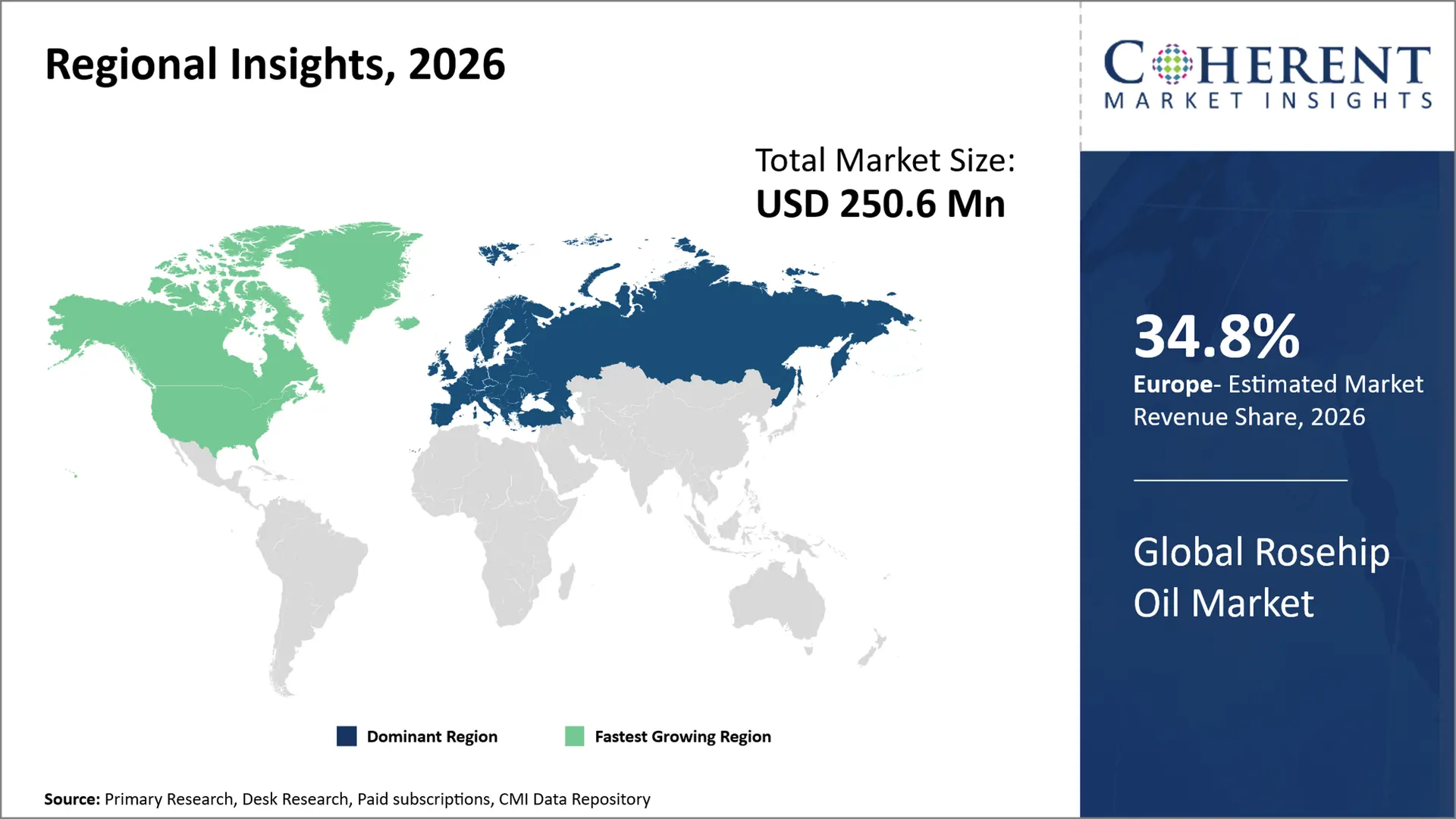
Why Does Europe Dominate the Global Rosehip Oil Market?
Europe is projected to represent 34.8% of the global rosehip oil market in 2026, supported by strong demand for sustainable cosmetics, certified organic ingredients, and premium botanical formulations. European consumers increasingly evaluate skincare products based on ingredient traceability, environmental impact, and responsible sourcing practices, encouraging brands to strengthen their natural ingredient portfolios. The region’s established cosmetics manufacturing base, particularly in Germany, France, and the United Kingdom, supports innovation in facial care, anti-aging products, and specialty skincare solutions. Regulatory emphasis on ingredient safety and product transparency further supports the adoption of high-quality rosehip oil. In January 2025, the European Chemicals Agency continued updates related to chemical safety information requirements, reinforcing compliance expectations for cosmetic ingredient suppliers operating in European markets.
Why Is North America Emerging as the Fastest-Growing Region in the Global Rosehip Oil Market?
North America is expected to account for 28.6% of the global rosehip oil market in 2026, supported by strong demand for premium skincare products, clean beauty formulations, and botanical-based personal care ingredients. The region’s developed beauty retail ecosystem, high penetration of online skincare platforms, and strong consumer preference for ingredient transparency provide a favorable environment for rosehip oil brands. Cosmetic formulators in the U.S. and Canada increasingly incorporate plant-based oils into facial serums, moisturizers, and restorative skincare products, creating opportunities for specialty ingredient suppliers. The region also benefits from advanced regulatory frameworks that encourage product quality, safety documentation, and consumer trust. In February 2025, the U.S. Food and Drug Administration continued providing updated guidance on cosmetic product safety responsibilities, influencing ingredient compliance practices among skincare manufacturers.
Global Rosehip Oil Market Outlook for Key Countries
Why Is the U.S. a Key Market for the Global Rosehip Oil Market?
The U.S. is a key market for rosehip oil due to its large premium skincare consumer base, strong e-commerce ecosystem, and high acceptance of natural cosmetic ingredients. American consumers increasingly seek multifunctional skincare products combining botanical ingredients with wellness-oriented positioning, creating opportunities for brands offering rosehip oil-based serums, facial oils, and treatment products. The country’s established beauty brands, specialty retailers, and direct-to-consumer companies provide multiple channels for ingredient suppliers and finished product manufacturers. Domestic demand is further supported by advanced cosmetic formulation capabilities and strong innovation activity within personal care companies. In March 2025, the U.S. FDA continued strengthening cosmetic oversight through implementation activities related to the Modernization of Cosmetics Regulation Act, increasing focus on safety reporting and manufacturer responsibility.
Why Is India Important in the Global Rosehip Oil Market?
India represents an important growth market for rosehip oil due to expanding premium beauty consumption, increasing interest in natural personal care products, and growth of online beauty platforms. The country’s large consumer base is encouraging domestic skincare brands to introduce botanical formulations targeting hydration, skin nourishment, and anti-aging requirements. India also provides manufacturing advantages through established cosmetic formulation capabilities, lower production costs, and access to regional distribution networks. Importers and local brands are increasingly using specialty oils to differentiate products in competitive skincare categories. In March 2025, India’s Ministry of Health and Family Welfare continued implementation of the Cosmetics Rules framework through the Central Drugs Standard Control Organization, supporting structured compliance requirements for cosmetic products entering the Indian market.
Why Does China Support Growth in the Global Rosehip Oil Market?
China supports growth in the rosehip oil market through its expanding beauty and personal care industry, advanced cosmetic manufacturing ecosystem, and growing consumer interest in premium skincare solutions. The country has become a major hub for cosmetic formulation, private-label manufacturing, and digital beauty commerce, enabling rosehip oil suppliers to access both domestic brands and export-oriented manufacturers. Demand is supported by younger consumers seeking functional skincare products featuring natural and plant-derived ingredients. China’s extensive e-commerce infrastructure also allows niche botanical products to reach targeted consumer segments rapidly. In November 2024, China’s National Medical Products Administration continued strengthening cosmetic supervision requirements, including ingredient and product compliance processes that influence domestic and imported skincare products.
Why Is Germany a Strategic Country in the Global Rosehip Oil Market?
Germany holds strategic importance in the global rosehip oil market due to its strong position in natural cosmetics, advanced formulation expertise, and preference for certified sustainable ingredients. The country hosts several established personal care manufacturers and organic beauty brands that prioritize ingredient quality, environmental responsibility, and transparent sourcing. German consumers demonstrate strong acceptance of certified botanical products, supporting demand for premium rosehip oil applications in facial care and wellness categories. The country’s export-oriented cosmetics industry also provides access to broader European markets through established manufacturing and distribution networks. In April 2025, Germany’s Federal Office of Consumer Protection and Food Safety continued supporting cosmetic product safety oversight through European regulatory implementation activities, reinforcing compliance expectations for manufacturers.
Why Is Brazil an Important Growth Market for the Global Rosehip Oil Market?
Brazil is an important growth market for rosehip oil due to its strong beauty and personal care industry, high consumer engagement with natural ingredients, and established position as a major cosmetics market in Latin America. The country’s biodiversity-focused consumer preferences and expanding premium skincare segment create opportunities for botanical oils used in facial care and wellness formulations. Local cosmetic manufacturers benefit from established distribution networks, including specialty stores, pharmacies, and digital commerce channels. Brazil’s cosmetic sector also provides opportunities for international rosehip oil suppliers seeking regional expansion through partnerships with local brands and formulators. In June 2025, Brazil’s health regulatory authority ANVISA continued updating cosmetic product regulations and compliance requirements, supporting structured market access for cosmetic ingredients and finished products.
Innovation, Production and Manufacturing Landscape
Technology / Process | Application in Rosehip Oil Market | Commercial Impact | Adoption Level |
Cold Press Extraction Technology | Production of premium unrefined rosehip oil while preserving natural compounds | Supports premium pricing and clean beauty positioning | High |
Supercritical CO₂ Extraction | Production of high-purity specialty oils with controlled extraction parameters | Enables differentiated specialty grades | Medium |
Organic Cultivation Practices | Certified sourcing of rosehip fruits for organic oil production | Improves brand value and traceability | High |
Advanced Filtration and Refining Systems | Removal of impurities while maintaining desired oil characteristics | Enhances consistency for cosmetic formulations | Medium |
Analytical Quality Testing Technologies | Verification of fatty acid profile purity and stability | Supports regulatory compliance and customer confidence | High |
Sustainable Processing Technologies | Reduction of waste and improvement of resource efficiency | Supports environmentally focused product strategies | Emerging |
How Are Advanced Botanical Extraction and Customized Formulations Creating New Growth Opportunities in the Global Rosehip Oil Market?
Advanced extraction methods and customized formulation capabilities are creating opportunities beyond conventional rosehip oil applications by enabling suppliers to serve specialized skincare categories. Manufacturers can capture value by developing application-specific grades designed for facial serums, professional skincare, wellness products, and premium cosmetic formulations. The opportunity is particularly relevant for companies that combine raw material sourcing with technical formulation support, allowing them to move from commodity oil supply toward solution-oriented partnerships. Smaller specialists may compete effectively through certified organic sourcing, unique extraction expertise, and customized specifications, while established suppliers can leverage distribution networks and manufacturing scale. Companies entering this opportunity will need capabilities in quality control, regulatory documentation, sustainable sourcing, and customer collaboration to address evolving expectations from cosmetic brands.
Market Players, Key Development, and Competitive Landscape
Key Developments
- In August 2025, The Ordinary continued promoting its 100% Organic Cold-Pressed Rose Hip Seed Oil, highlighting the commercial strength of organic and minimally processed rosehip oil formulations within the beauty industry. This development supports market expansion by reinforcing consumer acceptance of botanical oils used for hydration, skin texture improvement, and premium skincare routines.
- In February 2024, Maiwe launched its Rosehip Rescue Balm, expanding its rosehip-based skincare portfolio with a targeted repair-focused formulation. This development is important for the global rosehip oil market because it demonstrates continued innovation in value-added skincare products where rosehip oil is positioned beyond standalone facial oils and incorporated into multifunctional skin recovery solutions.
Competitive Landscape
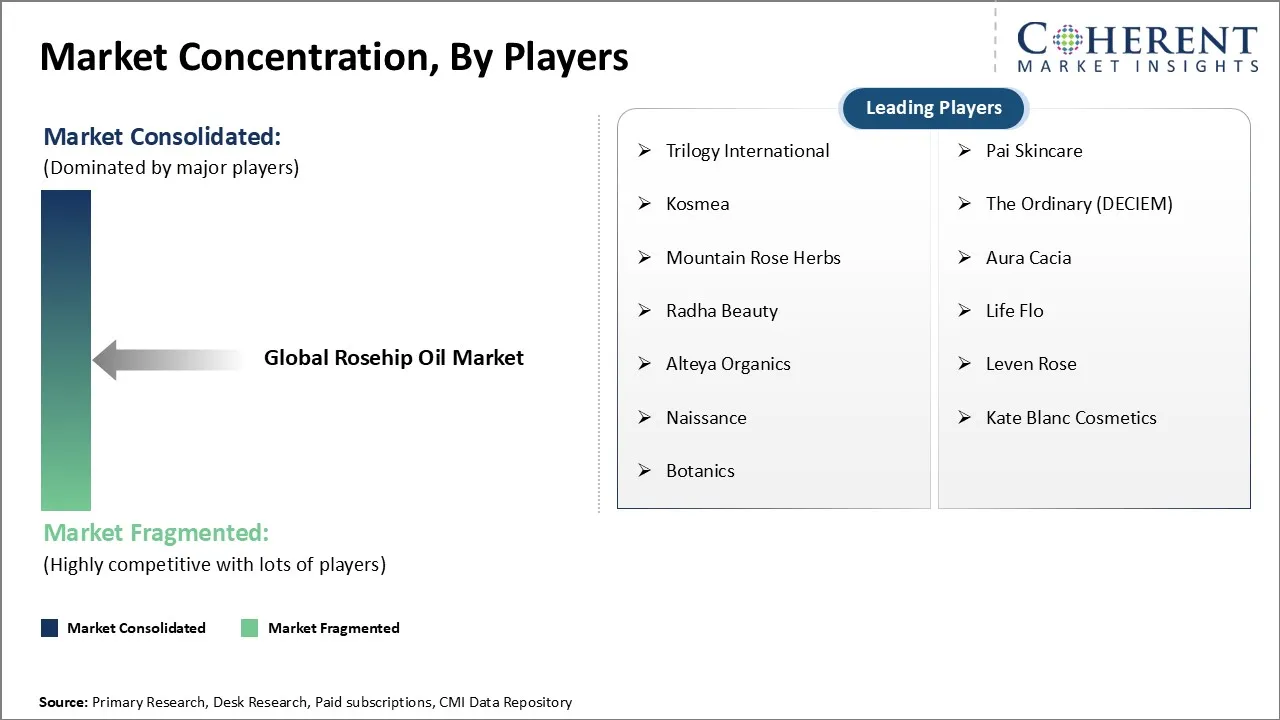
The global rosehip oil market is moderately fragmented, with competition among botanical oil producers, specialty ingredient suppliers, organic skincare brands, and private-label manufacturers. Competitive differentiation depends on extraction quality, sourcing transparency, certifications, formulation support, pricing, and distribution capability. Regional suppliers with access to rosehip cultivation areas compete alongside international personal care companies offering branded formulations. Key Focus Areas Include:
- Cold-pressed and specialty extraction capability
- Organic certification and sustainable sourcing practices
- Product purity and quality consistency
- Traceability of agricultural supply chains
- Custom formulation and private-label capabilities
- Regulatory documentation and compliance support
- Premium positioning through clean-label claims
- Distribution strength across beauty retail and e-commerce channels
Market Report Scope
Rosehip Oil Market Report Coverage | |||
Report Coverage | Details | ||
Base Year | 2025 | Market Size in 2026: | USD 250.6 Mn |
Historical Data For: | 2020 To 2024 | Forecast Period: | 2026 To 2033 |
Forecast Period 2026 To 2033 CAGR: | 8.1% | 2033 Value Projection: | USD 432.3 Mn |
Geographies covered: |
| ||
Segments covered: |
| ||
Companies covered: | Trilogy International, Pai Skincare, Kosmea, The Ordinary (DECIEM), Mountain Rose Herbs, Aura Cacia, Radha Beauty, Life Flo, Alteya Organics, Leven Rose, Naissance, Kate Blanc Cosmetics, Botanics | ||
Growth Drivers: |
| ||
Restraints & Challenges: |
| ||
Analyst Opinion (Expert Opinion)
The global rosehip oil market is likely to transition from ingredient-driven competition toward value-added solution partnerships. Suppliers that provide formulation expertise, documentation support, and application-specific grades may gain stronger commercial positions compared with companies competing only on raw oil availability.
The most significant transformation will come from the integration of sustainability, traceability, and personalization into botanical skincare supply chains. Companies unable to demonstrate sourcing transparency or consistent quality may face pressure as premium beauty brands increasingly prioritize responsible ingredient ecosystems.
Market participants should prioritize supply-chain control, quality standardization, and specialized product development. Companies should avoid competing solely through price because premium botanical oil categories depend heavily on trust, certification, and formulation performance. Strategic partnerships with cosmetic formulators and regional distributors will remain important for long-term market positioning.
Speak to the analyst
Want personalized insights?
Take the findings above to one of our principal consultants, or have the report rebuilt around the segments, geographies and competitors you actually track.
Market Segmentation
- Product Type Insights (Revenue, USD Mn, 2021 - 2033)
- Cold Pressed Rosehip Oil
- Organic Rosehip Oil
- Refined Rosehip Oil
- Virgin Rosehip Oil
- Extraction Method Insights (Revenue, USD Mn, 2021 - 2033)
- Cold Press Extraction
- Solvent Extraction
- Supercritical CO Extraction
- Other Methods
- Application Insights (Revenue, USD Mn, 2021 - 2033)
- Skincare and Cosmetics
- Haircare Products
- Nutraceuticals and Supplements
- Pharmaceuticals
- Aromatherapy and Others
- End User Insights (Revenue, USD Mn, 2021 - 2033)
- Personal Care and Cosmetics
- Wellness and Nutraceuticals
- Pharmaceutical
- Others
- Distribution Channel Insights (Revenue, USD Mn, 2021 - 2033)
- Online Retail
- Specialty Beauty Stores
- Direct Sales
- Pharmacies and Health Stores
- Others
- Regional Insights (Revenue, USD Mn, 2021 - 2033)
- North America
- U.S.
- Canada
- Latin America
- Brazil
- Argentina
- Mexico
- Rest of Latin America
- Europe
- Germany
- U.K.
- Spain
- France
- Italy
- Russia
- Rest of Europe
- Asia Pacific
- China
- India
- Japan
- Australia
- South Korea
- ASEAN
- Rest of Asia Pacific
- Middle East
- GCC Countries
- Israel
- Rest of Middle East
- Africa
- South Africa
- North Africa
- Central Africa
- North America
- Key Players Insights
- Trilogy International
- Pai Skincare
- Kosmea
- The Ordinary (DECIEM)
- Mountain Rose Herbs
- Aura Cacia
- Radha Beauty
- Life Flo
- Alteya Organics
- Leven Rose
- Naissance
- Kate Blanc Cosmetics
- Botanics
Sources
Primary Research Interviews
- Rosehip oil producers, botanical oil manufacturers, skincare ingredient suppliers, cosmetic formulators, private-label skincare brands, and personal care companies
- Cosmetic product developers, sourcing managers, formulation specialists, beauty industry executives, distributors, retailers, and e-commerce sellers
Stakeholders
- Rosehip oil manufacturers, organic ingredient suppliers, natural cosmetics brands, skincare companies, and specialty botanical oil producers
- Raw material suppliers, agricultural growers, extraction technology providers, packaging suppliers, distributors, and retail channel partners
- Cosmetic brands, beauty retailers, wellness companies, and end consumers
End-use Sectors
- Skincare and cosmetic formulations including facial oils, serums, moisturizers, and anti-aging products
- Haircare and personal care applications
- Wellness and nutraceutical applications
- Pharmaceutical and therapeutic skincare applications
Regulatory and Industry Bodies
- Cosmetic safety and regulatory authorities
- Organic certification organizations
- Natural and organic beauty industry associations
- Sustainability and ethical sourcing organizations
- Personal care and cosmetic trade associations
Databases
- Company annual reports, investor presentations, corporate filings, and product portfolios
- Cosmetic ingredient databases and beauty industry intelligence platforms
- E-commerce product listings, pricing databases, and consumer review platforms
- Trade statistics, import-export datasets, and botanical ingredient databases
- Competitive intelligence and supplier databases
Magazines and Journals
- Cosmetic and personal care industry publications
- Dermatology and skincare research journals
- Botanical ingredient and natural product research publications
- Beauty, wellness, and consumer lifestyle publications
- Sustainability and clean beauty journals
Associations
- Personal Care Products Council (PCPC)
- International Federation of Societies of Cosmetic Chemists (IFSCC)
- Cosmetic ingredient and natural products associations
- Organic certification and sustainability organizations
- Regional cosmetics and beauty industry associations
Public Domain Sources
- Natural and organic beauty trends
- Clean-label skincare product developments
- Botanical ingredient innovations and extraction advancements
- Beauty retail and e-commerce channel expansion
- Sustainable sourcing and ethical supply chain developments
Key Standards and Regulations
- Cosmetic ingredient safety and product compliance requirements
- Organic certification and natural ingredient standards
- Cosmetic labeling and ingredient disclosure requirements
- Sustainable sourcing and environmental compliance standards
- International trade and import regulations for botanical oils
Proprietary Elements
- CMI Data Analytics Tool, Proprietary CMI repository containing 10+ years of personal care, cosmetics, consumer goods, and natural ingredient market intelligence.
Get access to 250+ pages report
Every segment, forecast, competitor profile and data table behind the analysis above — available for instant download.
- ESOMAR Member
- ISO 9001:2015 Certified
- D-U-N-S Registered
- GDPR & CCPA Compliant
Missing comfort of reading report in your local language? Find your preferred language:
Frequently Asked Questions
The global rosehip oil market is estimated to be valued at USD 250.6 million in 2026 and is expected to reach USD 432.3 million by 2033
The CAGR of global rosehip oil market is projected to be 8.1% from 2026 to 2033.
Rosehip oil is mainly used in skincare and personal care formulations, including facial oils, serums, moisturizers, anti-aging products, and skin recovery solutions.
The market is influenced by growing preference for clean beauty products, organic ingredients, sustainable sourcing, and premium botanical skincare formulations.
Major consumers include cosmetic manufacturers, skincare brands, personal care companies, wellness product companies, and individual customers seeking natural beauty solutions.
Companies should evaluate sourcing quality, extraction methods, certification requirements, supplier reliability, product differentiation, distribution channels, and consumer preferences before entering the global rosehip oil market.
The growth of the global rosehip oil market is primarily supported by rising consumer preference for natural and organic skincare ingredients, along with increasing adoption of anti-aging and skin repair products.