

Global Satellite Backhaul Market Size and Forecast – 2026 To 2033
The global satellite backhaul market is expected to grow from USD 4.05 Bn in 2026 to USD 9.20 Bn by 2033, registering a compound annual growth rate (CAGR) of 12.5% from 2026 to 2033. The global satellite backhaul market is driven by rising maritime and aviation connectivity requirements. On December 15, 2025, SES and Abra Group launched fast and reliable multi-orbit inflight connectivity service on the first 10 of more than 100 aircraft, solidifying SES’ position as a leading provider of satellite-powered broadband inflight service in the Americas.
Key Takeaways of the Global Satellite Backhaul Market
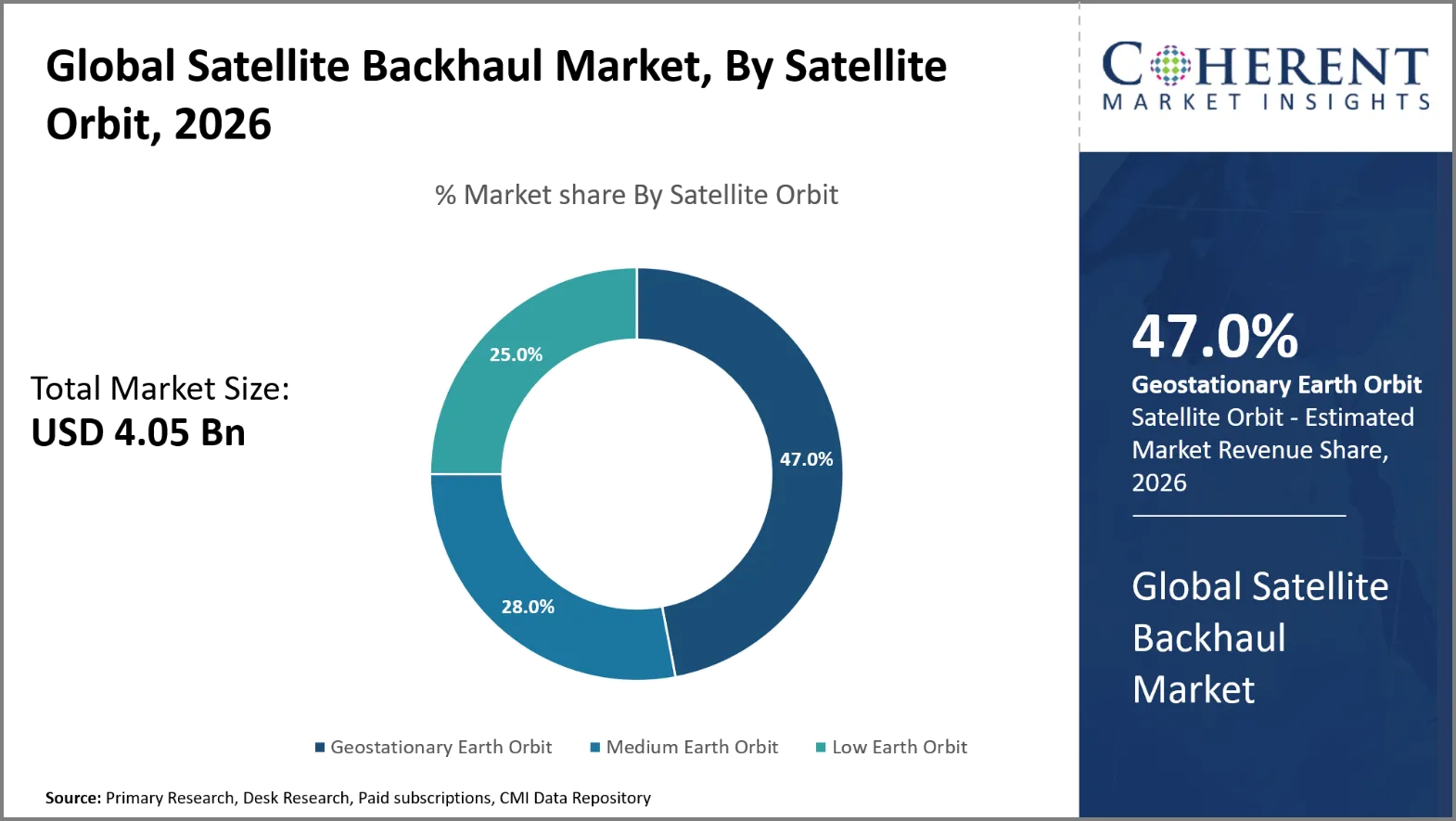
- The Geostationary Earth Orbit segment is expected to account for 47.0% of the global satellite backhaul market share in 2026. Increasing deployment of orbit satellite constellations is driving the growth of the segment. For instance, Telesat advanced its Lightspeed constellation throughout 2025 after completing critical design reviews. The company worked with MDA Space toward production and deployment.
- The Antennas segment is estimated to capture 43.0% of the market share in 2026. Growing disaster recovery communication requirements is majorly driving the growth of the segment. On November 14, 2025, Eutelsat Group in partnership with regional satellite solutions provider Neptune Communications, announced the donation and deployment of emergency satellite communications services to support the Government of Jamaica following the impact of Hurricane Melissa.
- The Mobile Backhaul segment is estimated to capture 34.0% of the market share in 2026. Expansion of satellite-supported enterprise networks is driving the growth of the segment. On September 23, 2026, Viasat Inc. secured a U.S. Marine Corps enterprise services task order. The initial order totals USD 42 million under a seven-year contract with a USD 307 million ceiling.
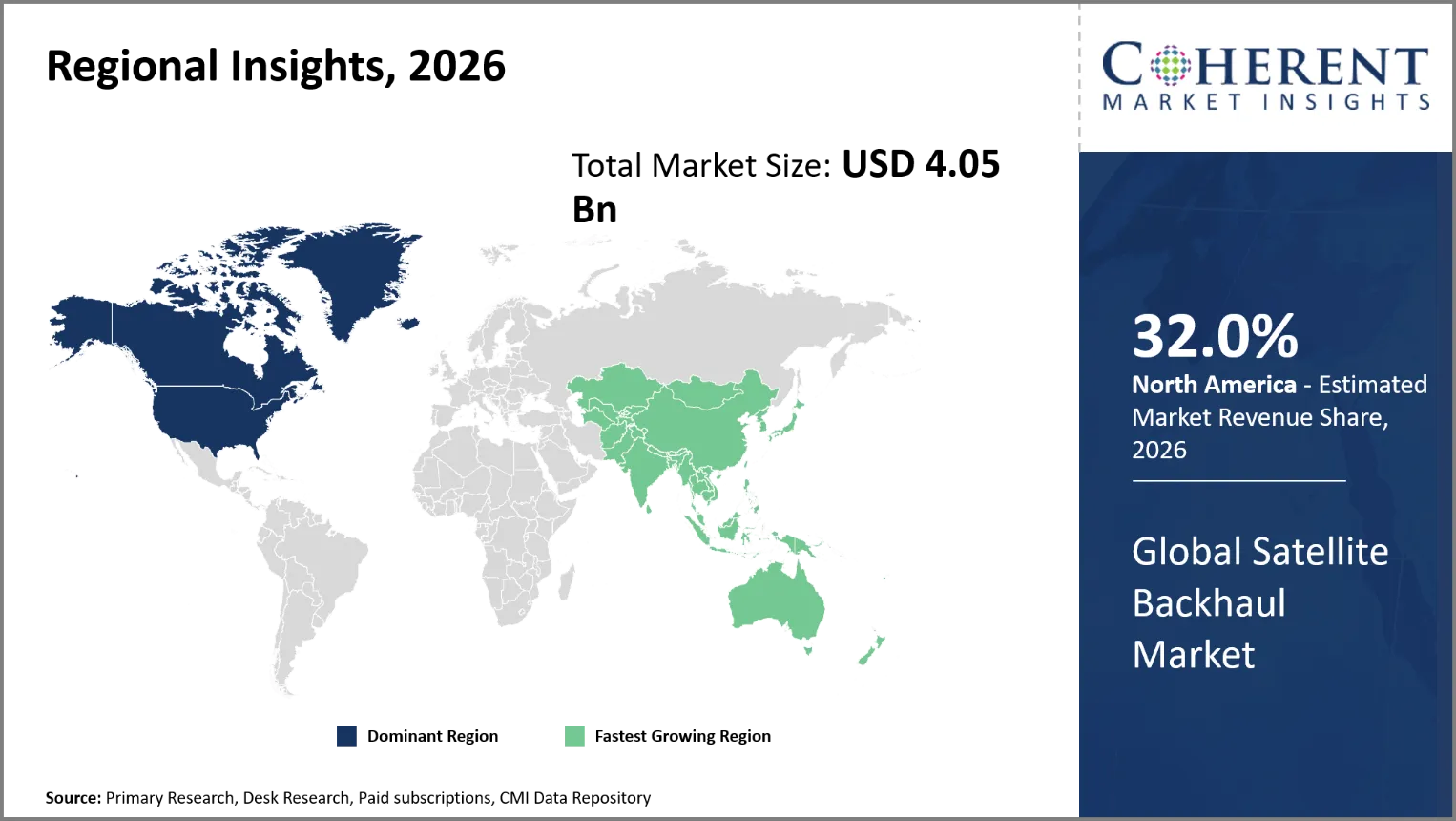
- North America is expected to dominate the satellite backhaul market in 2026 with a market share of 32.0%. Growing satellite support for emergency communication networks in North America is driving the growth of the regional market. On May 6, 2026, Verizon introduced a multi-orbit disaster-response vehicle for the hurricane season. The vehicle switches between Geostationary Earth Orbit and Low Earth Orbit satellites.
- Asia Pacific is expected to account for 28.0% share in 2026. Expansion across remote industrial locations in Asia Pacific is driving the growth of the regional market. On May 25, 2026, Vocus launched a private satellite-to-cloud network for Australian critical infrastructure. The solution connects remote pumping stations, substations, and mine-site control rooms directly to Australian cloud infrastructure.
Segmental Insights
Why Does Geostationary Earth Orbit Dominate the Global Satellite Backhaul Market?
The geostationary earth orbit segment is expected to account for 47.0% of the global satellite backhaul market share in 2026. Geostationary earth orbit is common as satellites maintain fixed positions relatively to the Earth. This location allows for the continuous coverage over wide geographical areas. Existing satellite infrastructure can be used by operators to service several remote locations. Geostationary satellites also enable reliable network planning for telecommunications carriers. Mature ground infrastructure of existing backhaul networks has eased deployment complexity. Broadband, cellular and enterprise communication requirements are supported by high-capacity transponders.
On April 8, 2025, Eutelsat Group and Panasonic Avionics Corporation (PAC) announced a renewal of their capacity agreement on the EUTELSAT 10B satellite serving the inflight connectivity market, covering the period and volume of the previous agreement.
- Current Industry Events of 2026
- Market Size Estimation
- Regional Breakdown
- Competitive Landscape
- Customer Intelligence
- Segmental Analysis
- Pricing Analysis
- Key Market Drivers, Challenges & Future Trends
- Customized Insights Section
Why is Antennas the Most Deployed Component?
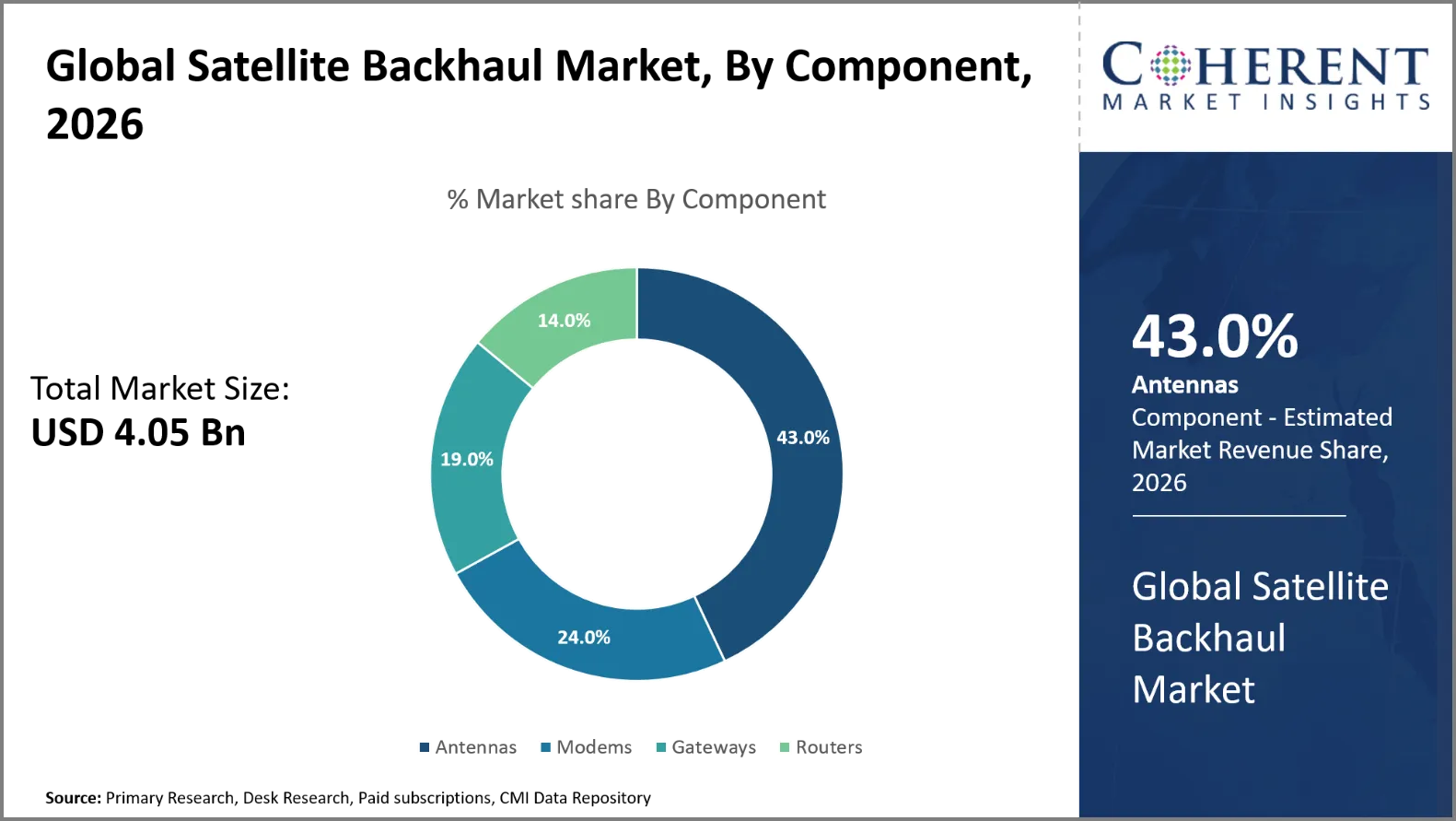
The antennas segment is expected to account for 43.0% of the global satellite backhaul market share in 2026. The most deployed component in satellite backhaul is the antenna, as all satellite backhaul terminals require radio-frequency transmission equipment. Ground antennas are the vital connection between satellite networks and the infrastructure on the ground. The latest antennas are designed to operate with multiple frequency bands and network types. Electronically steered antennas increasingly support flexible satellite connectivity requirements. Compact antenna designs also simplify deployment at remote cellular sites. The performance of the antenna directly affects the link availability, throughput and network reliability. Therefore, antennas are prioritized by operators in the expansion of satellite-enabled backhaul capacity.
On May 12, 2025, Gilat Satellite Networks Ltd. announced the successful completion of a series of test flights featuring its ESR-2030Ku electronically steered antenna (ESA). Conducted in collaboration with Gogo, which will be the exclusive distributor of the antenna for the business aviation and defense markets, the tests demonstrated outstanding performance of the ESA on the OneWeb Low Earth Orbit (LEO) network.
Mobile Backhaul Dominates the Global Satellite Backhaul Market
The mobile backhaul segment is expected to account for 34.0% of the global satellite backhaul market share in 2026. Mobile backhaul dominates because cellular networks require reliable connections between remote base stations and core networks. Satellite systems extend mobile coverage where fiber and microwave infrastructure remain unavailable. This is especially significant in rural, mountainous, island and sparsely populated areas. Satellite backhaul can speed up network deployment without a lot of terrestrial infrastructure build-out. Operators can add new cellular sites and reduce reliance on tough physical infrastructure. The growth of 4G and 5G networks significantly raises the backhaul capacity requirements.
On May 5, 2026, Gilat Satellite Networks Ltd. announced that it received a order from Nelco, a leading Satcom service provider in India. Deliveries are expected over the next 12 months. Under the agreement, Nelco has chosen Gilat’s SkyEdge IV hub platform to deploy the most advanced Ka-band service network in India using GSAT-N2 Ka-band HTS satellite.
Current Events and their Impact
Current Events | Description and its Impact |
India Telecommunications Act |
|
U.S. Supplemental Coverage from Space Framework |
|
Satellite Backhaul Market Dynamics
Market Drivers
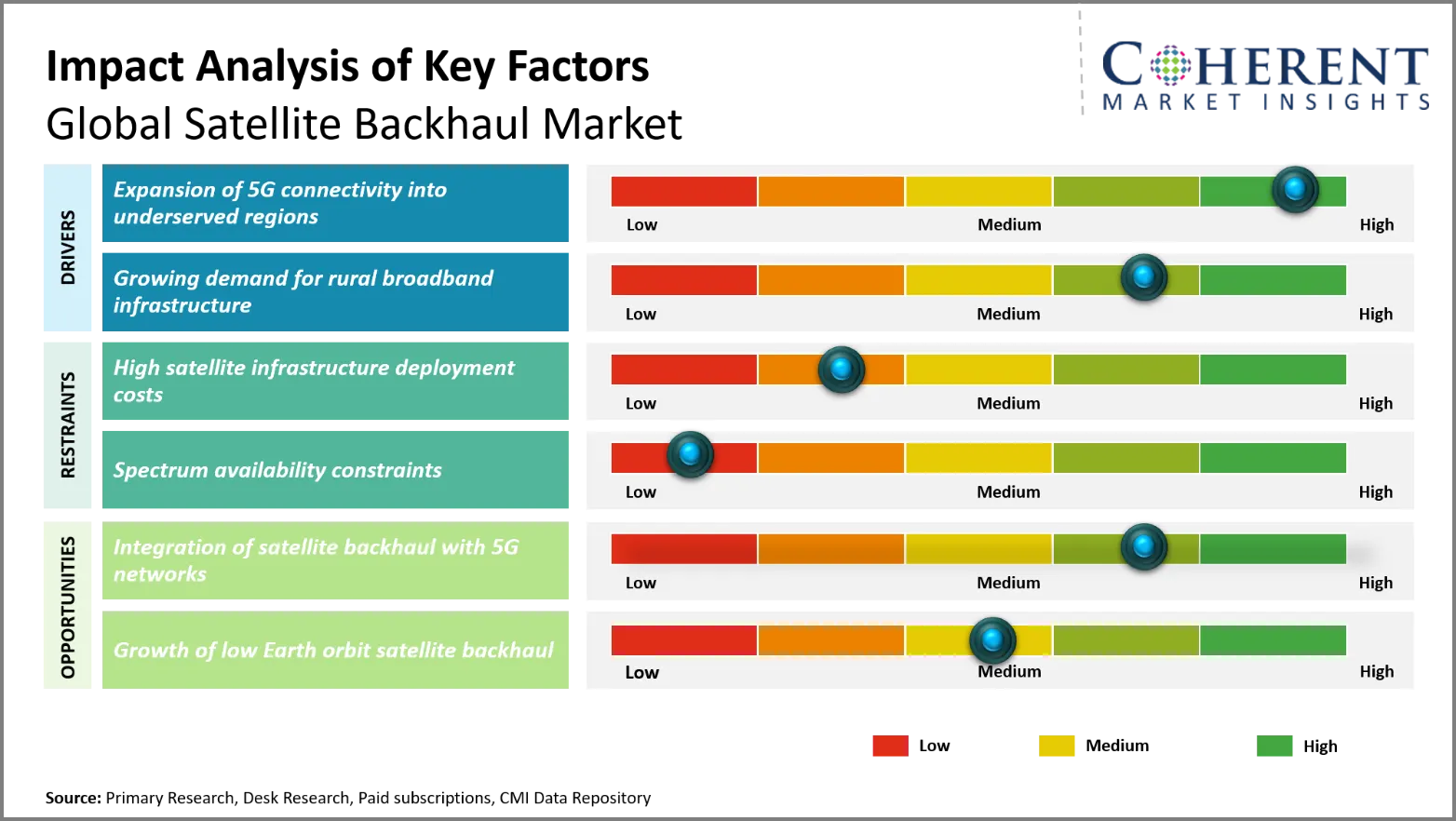
Expansion of 5G connectivity into underserved regions
The extension of 5G networks into underserved regions is creating demand for satellite backhaul. Satellite links connect remote base stations where fiber infrastructure is still limited. Operators can provide 5G services without waiting for the massive deployment of terrestrial networks. Satellite backhaul also provides interim connectivity while infrastructure is being built. Satellites in low earth orbit can provide lower latency for developing 5G applications. Geostationary systems still provide wide regional coverage and mature network designs. These capabilities make satellite backhaul increasingly important for geographically challenging markets.
On February 24, 2025, Eutelsat Group, MediaTek Inc. and Airbus Defense and Space conducted the world’s first successful trial of 5G Non-Terrestrial Network (NTN) technology over the Eutelsat OneWeb low Earth orbit (LEO) satellites. The tests pave the way for deployment of the 5G NTN standard, which will result in future satellite and terrestrial interoperability within a large ecosystem, lowering the cost of access and enabling the use of satellite broadband for 5G devices around the world.
Growing demand for rural broadband infrastructure
Rural broadband expansion is creating sustained demand for satellite-enabled connectivity infrastructure. Many rural communities remain difficult to serve with fiber or terrestrial microwave networks. Satellite backhaul can connect broadband access points across dispersed populations and remote locations. Governments are increasingly prioritizing digital inclusion and universal internet access. Telecom companies can use satellite networks to extend coverage beyond the profitable terrestrial deployment zones. Hybrid satellite-terrestrial systems can further improve network resilience and geographic reach. These developments are strengthening satellite backhaul opportunities across underserved rural markets.
On August 5, 2025, NBN Co. and Amazon announced an agreement to deliver high-speed, wholesale fixed broadband to customers in parts of regional, rural and remote Australia via Project Kuiper’s low Earth orbit (LEO) satellite technology. The agreement will enable NBN Co to transition from its existing geostationary Sky Muster satellite service over the coming years and will complement NBN Co’s investments in fiber and fixed wireless upgrades for regional Australia.
Emerging Trends
- Integration with Low Earth Orbit Constellations: Low Earth orbit constellations are transforming satellite backhaul through lower latency and flexible coverage. Operators increasingly combine these satellites with terrestrial networks. This design supports remote cellular sites, enterprise connectivity and broadband services demanding enhanced responsiveness.
- Rise of Multi-Orbit Network Architectures: Operators are increasingly combining geostationary, medium Earth orbit and low Earth orbit satellites, thus increasing the value of multi-orbit systems. Network managers can choose optimal connectivity based on the latency, coverage, capacity and application needs. It enhances network flexibility and resiliency.
- Software-Defined Satellite Networking: Satellite backhaul infrastructure becomes more versatile with software-defined networking. Operators can dynamically allot bandwidth, optimize traffic routing and adapt network resources. These characteristics enhance capacity utilization and allow for shifting requirements in cellular, corporate, maritime, and emergency connection applications.
- Integration With Fifth-Generation and Future Networks: Satellite backhaul is rapidly being integrated with fifth generation and emerging sixth generation network systems. Standardized interfaces allow for tighter integration between terrestrial and satellite systems. The integration provides ubiquitous connectivity, durable communications and extended coverage in geographically difficult areas.
Regional Insights
Why is North America a Strong Market for Satellite Backhaul?
North America is expected to account for a market share of 32.0% in 2026. Demand exists for satellite backhaul in North America including Alaska, northern Canada and remote island communities. By 2026, the Federal Communications Commission anticipates satellite backhaul will enable the deployment of 5G-NR in isolated Alaskan settlements. Satellite operators are also adding capacity while middle-mile infrastructure is still costly in remote locations. Terrestrial-satellite integration under the Federal Communications Commission’s Supplemental Coverage from Space framework is also helping the region. This allows satellite operators to add specific terrestrial spectrum to mobile networks. These developments particularly strengthen satellite connectivity for emergency communications, Tribal communities, and geographically isolated cellular sites.
Why Does Asia Pacific Satellite Backhaul Market Exhibit High Growth?
Asia Pacific is expected to register the fastest growth with a CAGR of 13.4% over the forecast period. Asia Pacific is projected to account for 28.0% of the global satellite backhaul market in 2026. Asia Pacific is experiencing strong satellite backhaul adoption because archipelagic geography and mountainous terrain complicate terrestrial network expansion. Satellite communication is increasingly helping cellular networks in distant islands and rural villages. Japan, India, China, Indonesia and the Philippines are developing various satellite-terrestrial communication systems. LEO constellations are adding new capacity alongside the established GEO systems. Regional operators are trialing satellite links for fifth-generation networks and remote enterprise connectivity. The region’s dispersed populace, growing mobile networks and challenging topography present unique requirements for satellite-supported backhaul infrastructure.
Global Satellite Backhaul Market Outlook for Key Countries
Why is U.S. Emerging as a Major Hub in the Satellite Backhaul Market?
Connectivity needs across Alaska and other frontier markets are a major driver of the U.S. satellite backhaul business. The Federal Communications Commission specifically addresses satellite backhaul in its mobile support structure. Its 2024 order stated satellite backhaul might allow supported providers to offer 5/1 Mbps connectivity to isolated Alaskan towns by 2026. The organization also cited further growth in satellite capacity. The Supplemental Coverage from Space framework is a satellite-terrestrial cooperation that expands mobile coverage. These policies unlock prospects for satellite backhaul supporting rural mobile sites, emergency communications, and challenging middle-mile connections.
Is China the Next Growth Engine for the Satellite Backhaul Market?
China is expanding satellite backhaul capabilities through a more integrated space infrastructure and terrestrial telecommunications networks. It is building its own low earth orbit satellite capabilities and rolling out fifth generation coverage in rural and western areas. Satellite communication is particularly significant for hilly and border regions, and for areas where terrestrial infrastructure encounters deployment difficulties. China’s wider satellite communication expansion also underpins maritime connectivity and emergency communications. Government-backed space infrastructure activities are building the nation’s capability for domestic satellite services. The growth of the domestic satellite, together with the expanded mobile coverage, opens up potential for satellite supported backhaul.
Australia Satellite Backhaul Market Analysis and Trends
The large geographic region and sparsely populated distant population means Australia has an extremely high satellite connectivity demand. In 2025 NBN Co selected Amazon’s Project Kuiper to supply low earth orbit broadband to more than 300,000 premises throughout its satellite footprint. The proposed service will sit separately to existing Sky Muster infrastructure and regional network enhancements. In 2026 NBN Co revealed anticipated wholesale speeds of up to 100/20 Mbps for qualifying LEO customers. Satellite connectivity also supports emergency services and evacuation centres. The Australian Government plans to expand community satellite Wi-Fi services to as many as 500 additional sites.
Japan Satellite Backhaul Market Analysis and Trends
Japan’s satellite backhaul development is more and more on durable fifth-generation networks and catastrophe response. In 2025 Japan Radio Company and SKY Perfect Japan Corporation, University of Tokyo and the National Institute of Information and Communications Technology showed an integrated satellite-terrestrial network. Their trial combined geostationary, low Earth orbit, and local fifth-generation links. The system demonstrated dynamic backhaul switching and application-based quality-of-service control. Researchers have also modeled catastrophic scenarios, and assessed the durability of the network. Adaptive satellite backhaul is particularly useful in preserving communications when terrestrial networks are disrupted, especially given Japan's frequent earthquakes and islands that are spread widely geographically.
India Satellite Backhaul Market Analysis and Trends
India has widespread satellite backhaul opportunities as large rural areas remain difficult to economically connect with traditional infrastructure. The country’s telecommunications regime now has specialized authorization procedures for satellite communications services. Satellite communication is especially relevant for distant people in the Himalayas, island territories, border areas and sparsely inhabited rural areas. The Department of Telecommunications has laid down the procedures for the grant of authorization of the Global Mobile Personal Communication by Satellite. These provisions are the backbone of satellite-based connection services in India’s growing telecommunications architecture. The developing 5G network in India also necessitates reliable backhaul in areas where laying terrestrial fiber is still hard.
Global Satellite Backhaul Market - Mobile Base Stations Using Satellite Backhaul by Region (2025)
Region | Estimated Mobile Base Stations Using Satellite Backhaul | Regional Share |
Africa | 6,800 | 36% |
Asia Pacific | 5,200 | 28% |
North America | 2,900 | 15% |
Latin America | 1,900 | 10% |
Middle East | 1,200 | 6% |
Europe | 950 | 5% |
Global Total | 18,950 | 100% |
How is Integration of Satellite Backhaul with 5G Networks Creating New Growth Opportunities in the Satellite Backhaul Market?
By integrating satellite backhaul with 5G networks, we are unlocking new potential to deliver high capacity mobile connection to places not within fiber reach. The Federal Communications Commission’s Supplemental Coverage from Space framework allows satellite providers to supplement terrestrial mobile networks. Japan conducted an experiment in 2025 for multi-orbit integration of geostationary, low Earth orbit and fifth-generation networks. The trial supported dynamic switching between satellite and terrestrial backhaul according to network conditions. The International Telecommunication Union also published Recommendation ITU-T Y.3208 for satellite backhaul supporting International Mobile Telecommunications-2020 networks. These advances make it possible to support remote fifth-generation installations, disaster recovery and interim network capacity via satellite connections.
On December 16, 2025, ST Engineering iDirect announced that it is collaborating with Capgemini to create a 5G Non-Terrestrial Network (NTN) satellite base station. The cloud-native foundation of the system will enable smooth integration of satellite and terrestrial networks to accelerate the implementation of standards-based, software-defined 5G NTN technology.
Market Players, Key Development, and Competitive Landscape
Key Developments
- On September 10, 2026, Eutelsat announced plans to procure 229 additional OneWeb Low Earth Orbit (LEO) satellites from Airbus Defense and Space. Eutelsat has signed an Authorisation to Proceed (ATP) with Airbus Defence and Space covering initial industrial activities for the 229 satellites. They are planned in addition to the 440 satellites already procured from Airbus, bringing the total of new OneWeb satellites with Airbus to 669.
- On August 31, 2026, Viasat, Inc. announced that its ViaSat-3 F3 satellite has entered service, with capacity now available for customers operating across fast-growing markets in the Asia-Pacific region. The milestone marks the beginning of revenue-generating operations for one of the most advanced high throughput communications satellites ever deployed.
- On March 24, 2026, SES, a space solutions company, announced it will deploy meoSphere, a next-generation medium Earth orbit (MEO) satellite network targeted for operation by 2030 and designed to significantly boost the company’s MEO network capacity. The program launches with a close collaboration designed for efficient satellite production.
Competitive Landscape
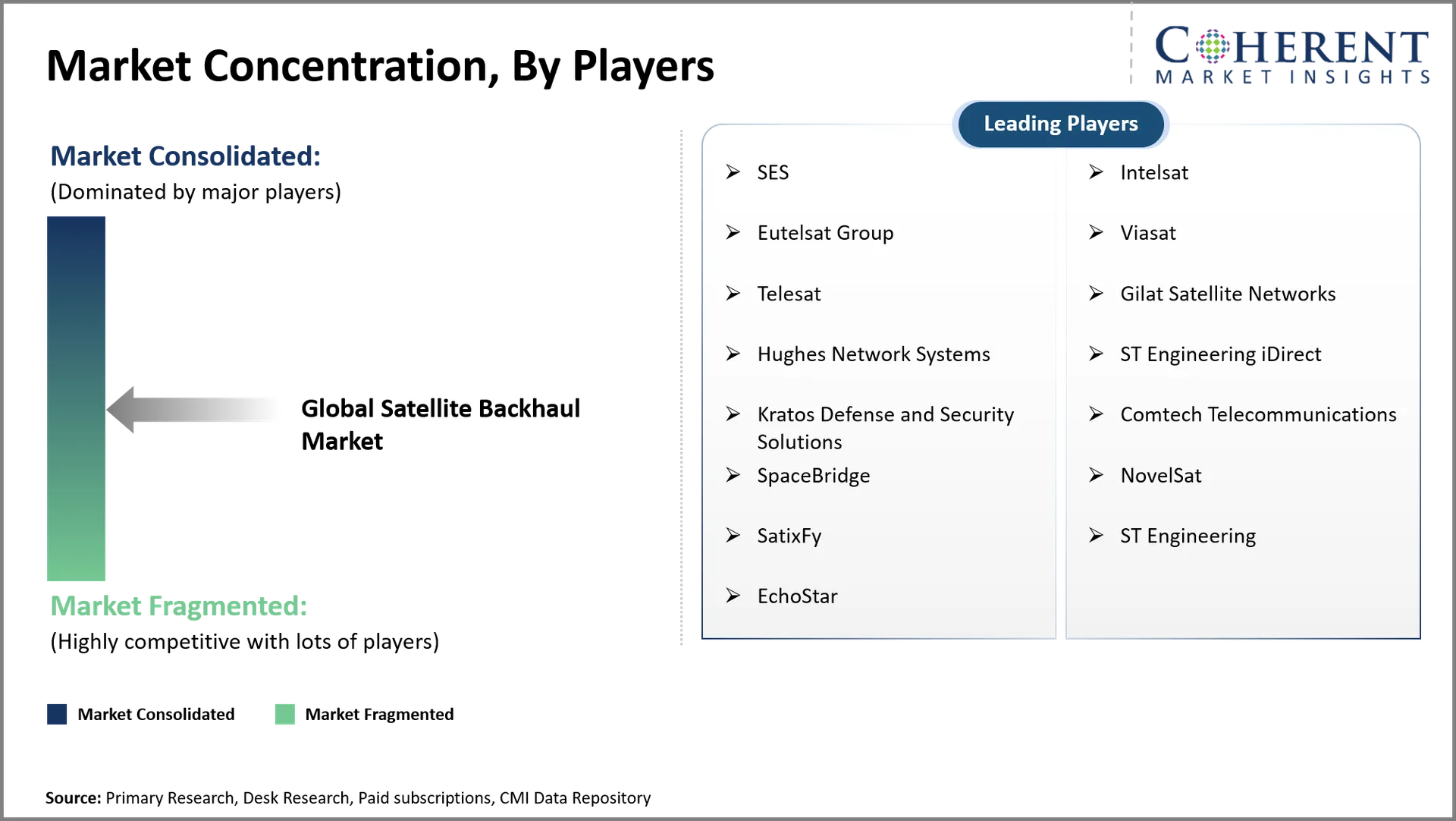
The competitive landscape is shifting toward multi-orbit platforms, integrated ground systems, and mobile network partnerships. SES solidified its position by the acquisition of Intelsat in July 2025. SES is building a next-generation MEO architecture that combines GEO, MEO and other connectivity assets. Its O3b mPOWER platform will target mobile backhaul with predictable latency and dynamically customizable capacity. Gilat Satellite Networks is aggressively investing in 5G Non-Terrestrial Network integration. In February 2026, Gilat showcased standardized 5G Non-Terrestrial Network connectivity over GEO infrastructure. Viasat is pursuing shared satellite-ground infrastructure through its planned Equatys venture with Space42. The model targets 5G integration and lower infrastructure duplication.
Top Manufacturers and Notable Products in the Satellite Backhaul Market
Manufacturer | Notable Product | Key features |
Gilat Satellite Networks | SkyEdge IV | Multi-orbit architecture, 5G NTN evolution, cellular backhaul, high-throughput satellite support, cloud and edge integration |
ST Engineering iDirect | Dialog Platform | 3G to 5G support, dynamic bandwidth allocation, DVB-S2X, traffic optimization, network management |
Hughes Network Systems | JUPITER System | 4G and 5G backhaul, 200 Mbps-plus terminal throughput, bandwidth optimization, IEEE 1588v2 timing, rapid deployment |
SES | O3b mPOWER | Low-latency MEO connectivity, multi-gigabit throughput, dynamic bandwidth allocation, 5G-ready mobile backhaul, multi-orbit integration |
Viasat | ViaSat-3 Network | High-capacity GEO connectivity, flexible capacity allocation, wide geographic coverage, enterprise connectivity, mobile applications |
Market Report Scope
Report Coverage | Details | ||
Base Year | 2025 | Market Size in 2026: | USD 4.05 Bn |
Historical Data For: | 2020 To 2024 | Forecast Period: | 2026 To 2033 |
Forecast Period 2026 To 2033 CAGR: | 12.5% | 2033 Value Projection: | USD 9.20 Bn |
Geographies covered: |
| ||
Segments covered: |
| ||
Companies covered: | SES, Intelsat, Eutelsat Group, Viasat, Telesat, Gilat Satellite Networks, Hughes Network Systems, ST Engineering iDirect, Kratos Defense and Security Solutions, Comtech Telecommunications, SpaceBridge, NovelSat, SatixFy, ST Engineering, EchoStar | ||
Growth Drivers: |
| ||
Restraints & Challenges: |
| ||
Analyst Opinion (Expert Opinion)
- The industry's future will center on hybrid networks rather than satellite-only backhaul. GEO will retain importance for broad coverage and established infrastructure. MEO and LEO systems will increasingly handle applications requiring lower latency and flexible capacity. Japan's 2025 demonstration already combined GEO, LEO, and local 5G networks. Dynamic routing allowed traffic to shift between available connectivity paths.
- The strongest opportunities should emerge in mobile backhaul, rural fifth-generation coverage, and network resilience. MEO appears particularly attractive for applications requiring predictable latency across large regions. LEO will gain importance where latency-sensitive connectivity justifies more complex constellation management. India, Australia, Japan, and remote North American regions offer strong deployment opportunities. These markets combine difficult geography with expanding requirements for dependable mobile connectivity.
- Players seeking an edge should prioritize interoperable multi-orbit architectures and intelligent traffic management. They should integrate satellite terminals directly with existing mobile network infrastructure. Gilat's standardized 5G Non-Terrestrial Network approach demonstrates the value of compatibility with established mobile standards. Operators should also develop automated path selection, bandwidth optimization, and service-level management. Partnerships with mobile network operators can accelerate deployment and reduce customer integration barriers.
Speak to the analyst
Want personalized insights?
Take the findings above to one of our principal consultants, or have the report rebuilt around the segments, geographies and competitors you actually track.
Market Segmentation
- Satellite Orbit Insights (Revenue, USD Billion, 2021 - 2033)
- Geostationary Earth Orbit
- Medium Earth Orbit
- Low Earth Orbit
- Component Insights (Revenue, USD Billion, 2021 - 2033)
- Antennas
- Modems
- Gateways
- Routers
- Application Insights (Revenue, USD Billion, 2021 - 2033)
- Mobile Backhaul
- Enterprise Connectivity
- Maritime Connectivity
- Aviation Connectivity
- Rural Broadband
- Government Communications
- End User Insights (Revenue, USD Billion, 2021 - 2033)
- Telecommunications
- Government
- Maritime
- Aviation
- Energy And Utilities
- Mining
- Defense
- Others
- Regional Insights (Revenue, USD Billion, 2021 - 2033)
- North America
- U.S.
- Canada
- Latin America
- Brazil
- Argentina
- Mexico
- Rest of Latin America
- Europe
- Germany
- U.K.
- Spain
- France
- Italy
- Russia
- Rest of Europe
- Asia Pacific
- China
- India
- Japan
- Australia
- South Korea
- ASEAN
- Rest of Asia Pacific
- Middle East
- GCC Countries
- Israel
- Rest of Middle East
- Africa
- South Africa
- North Africa
- Central Africa
- North America
- Key Players Insights
- SES
- Intelsat
- Eutelsat Group
- Viasat
- Telesat
- Gilat Satellite Networks
- Hughes Network Systems
- ST Engineering iDirect
- Kratos Defense and Security Solutions
- Comtech Telecommunications
- SpaceBridge
- NovelSat
- SatixFy
- ST Engineering
- EchoStar
Sources
Primary Research Interviews
- Satellite Network Operators & Service Providers
- Telecom Infrastructure Companies
- Ground Station Equipment Manufacturers
- Mobile Network Operators (MNOs)
Magazines
- Via Satellite Magazine
- Satellite Today
- Mobile Communications International
- Telecom Asia
Journals
- IEEE Transactions on Aerospace and Electronic Systems
- International Journal of Satellite Communications and Networking
- Journal of Communications and Networks
Associations
- Satellite Industry Association (SIA)
- Global VSAT Forum (GVF)
- European Satellite Operators Association (ESOA)
- GSM Association (GSMA)
Public Domain Sources
- U.S. Federal Communications Commission (FCC) Reports
- European Space Agency (ESA) Publications
- International Telecommunication Union (ITU) Reports
- NASA Technical Reports Server
Proprietary Elements
- CMI Data Analytics Tool
- Proprietary CMI Existing Repository of Information for the Last 10 Years
Get access to 250+ pages report
Every segment, forecast, competitor profile and data table behind the analysis above — available for instant download.
- ESOMAR Member
- ISO 9001:2015 Certified
- D-U-N-S Registered
- GDPR & CCPA Compliant
Frequently Asked Questions
The global satellite backhaul market is expected to stand at USD 4.05 Bn in 2026 and is expected to reach USD 9.20 Bn by 2033.
The CAGR of the global satellite backhaul market is projected to be 12.5% from 2026 to 2033.
Expansion of 5G connectivity into underserved regions and Growing demand for rural broadband infrastructure are the major factors driving the growth of the global satellite backhaul market.
High satellite infrastructure deployment costs and Spectrum availability constraints are the major factors hampering the growth of the global satellite backhaul market.
In terms of satellite orbit, geostationary earth orbit segment is estimated to dominate the market revenue share in 2026.
Satellite backhaul connects remote access networks with core telecommunications infrastructure using satellite links.
Satellite backhaul connects remote fifth-generation base stations with core networks when terrestrial connections remain difficult.