

Global Satellite Broadband Market Size and Forecast – 2026 To 2033
The global satellite broadband market is expected to grow from USD 14.00 Bn in 2026 to USD 36.00 Bn by 2033, registering a compound annual growth rate (CAGR) of 9.8% from 2026 to 2033. The global satellite broadband market is driven by growing maritime and aviation connectivity demand. On February 6, 2025, A.P. Moller - Maersk and Inmarsat Maritime signed an agreement to upgrade Inmarsat satellite communications services across Maersk’s global fleet of approximately 340 container ships.
Key Takeaways of the Global Satellite Broadband Market
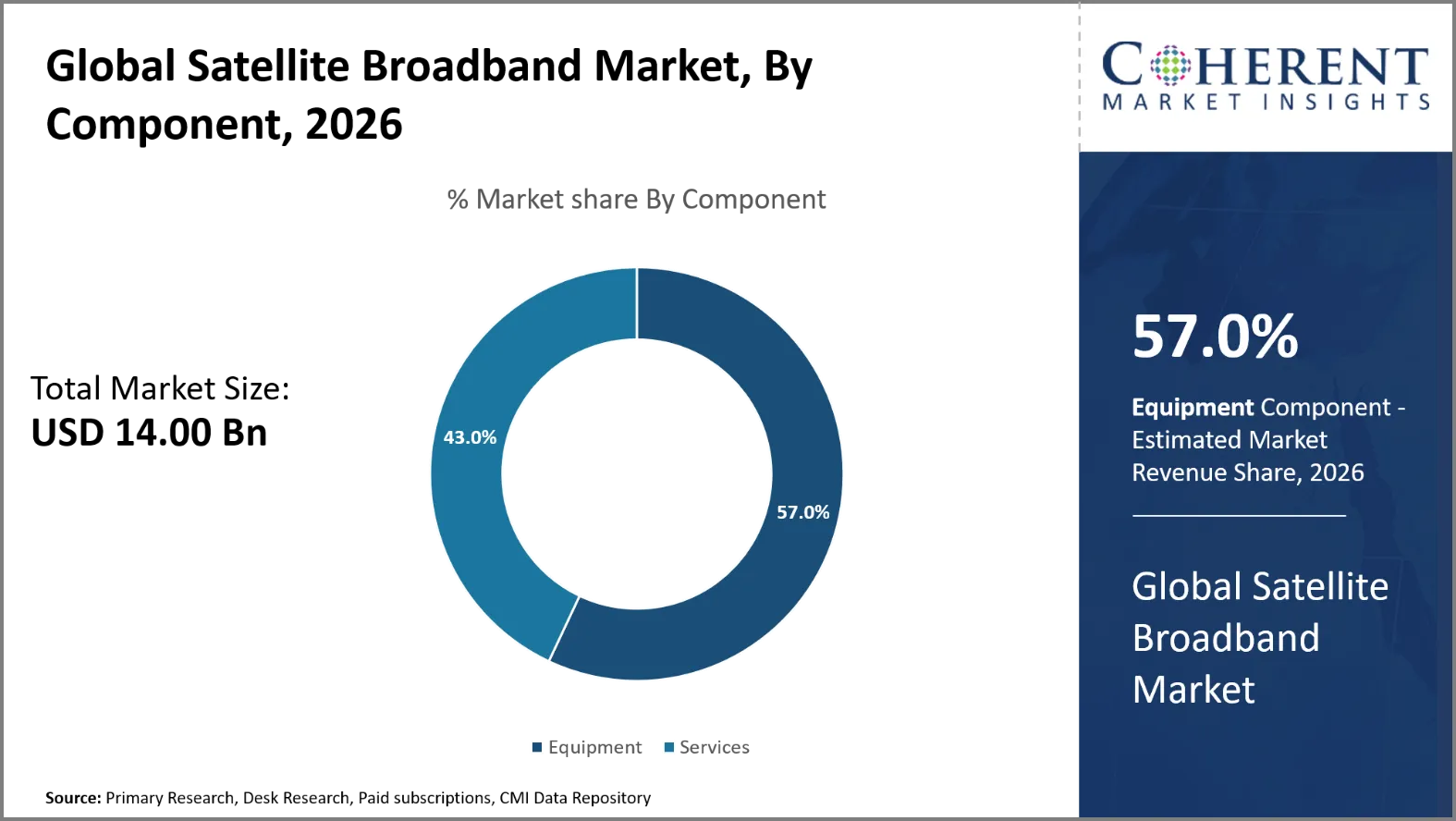
- The Equipment segment is expected to account for 57.0% of the global satellite broadband market share in 2026. Growing enterprise demand for resilient communications is driving the growth of the segment. On July 21, 2025, Eutelsat partnered with NSSLGlobal and Foreign, Commonwealth and Development Office Services to provide OneWeb satellite connectivity worldwide.
- The Low Earth Orbit segment is estimated to capture 51.0% of the market share in 2026. Increasing government investment in rural broadband is majorly driving the growth of the segment. On March 25, 2025, the Australian Government announced additional support for telecommunications resilience in disaster-prone communities.
- The L Band segment is estimated to capture 34.0% of the market share in 2026. Increasing integration with 5G mobile networks is driving the growth of the segment. On March 11, 2025, Viasat and Space42 signed an agreement to explore a joint worldwide 5G Non-Terrestrial Network infrastructure. The initiative targets direct-to-device satellite communications, narrowband Internet of Things services, and next-generation mobile satellite services.
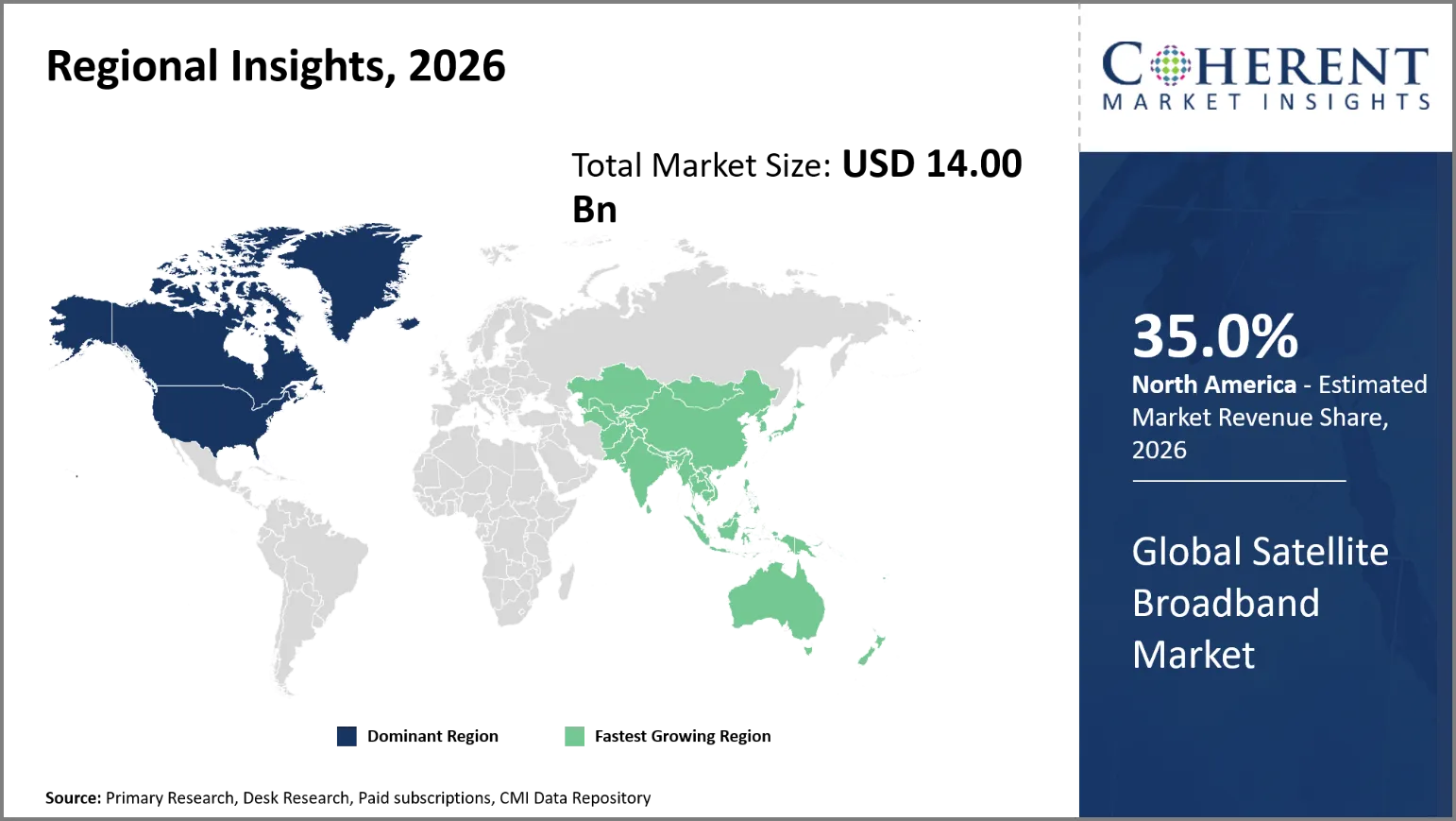
- North America is expected to dominate the satellite broadband market in 2026 with a market share of 35.0%. Growing adoption of in-flight and maritime internet services in North America is driving the growth of the regional market. On April 15, 2025, American Airlines and AT&T announced that members of its AAdvantage loyalty program will have free high-speed, satellite-based Wi-Fi starting in January 2026.
- Asia Pacific is expected to account for 26.0% share in 2026. Growing emphasis on disaster recovery communications in Asia Pacific is driving the growth of the regional market. On June 10, 2026, Globe announced satellite-to-mobile services for South Cotabato, Sultan Kudarat and Sarangani in the Philippines following a magnitude 7.8 earthquake.
Segmental Insights
Why Does Equipment Dominate the Global Satellite Broadband Market?
The equipment segment is expected to account for 57.0% of the global satellite broadband market share in 2026. Equipment leads as satellite communication requires specialized hardware to transmit and receive signals and to administer networks. User terminals, antennae, modems, transceivers and gateway stations allow satellites to communicate reliably with terrestrial networks. More and more deployments of Low Earth Orbit constellations drive the demand for compact terminals and electronically guided antennas. Upgraded equipment also allows for increased data throughput, better tracking of satellite signals and compatibility with new satellite architectures. Maritime, aviation, defense and distant enterprise applications further drive demand for robust communication hardware.
On April 10, 2025, Hughes Network Systems announced global commercial availability of its HL1100W single-panel electronically steerable antenna. The terminal received approval for Eutelsat OneWeb’s low Earth orbit network. Its small form provides high speed, low latency communication and reduces equipment size.
- Current Industry Events of 2026
- Market Size Estimation
- Regional Breakdown
- Competitive Landscape
- Customer Intelligence
- Segmental Analysis
- Pricing Analysis
- Key Market Drivers, Challenges & Future Trends
- Customized Insights Section
Why is Low Earth Orbit the Most Preferred Satellite Orbit?
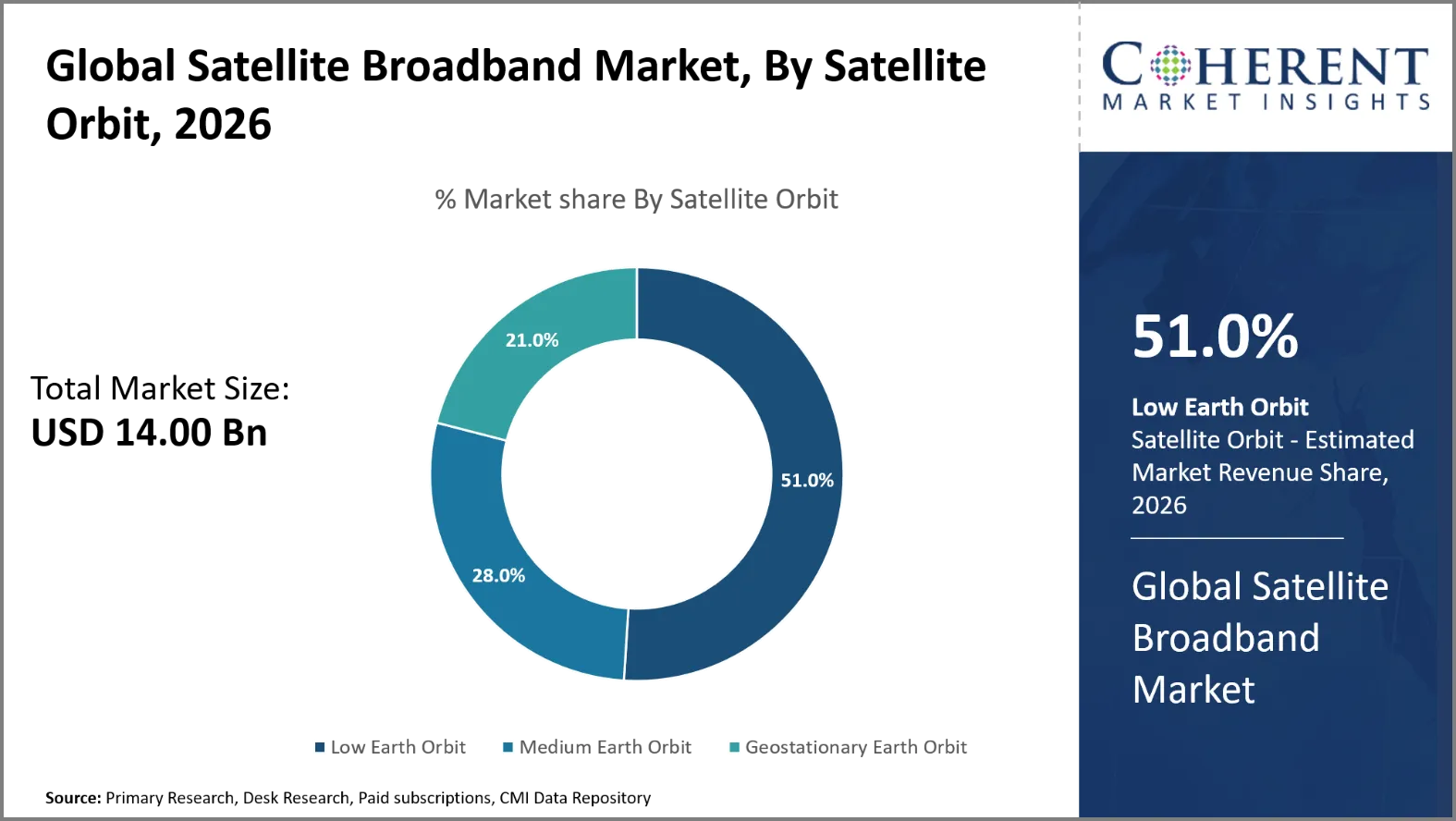
The low earth orbit segment is expected to account for 51.0% of the global satellite broadband market share in 2026. Satellite broadband is increasingly moving to Low Earth Orbit where the signal has less distance to travel than higher orbit systems. This advantage leads to more responsive internet access, video conferencing, cloud apps and other latency-sensitive services. Large satellite constellations can provide coverage to isolated settlements, sea routes and underdeveloped regions. The satellites are moving often thus they need to execute coordinated handovers and have large constellations deployed to keep the connection at all times. Advances in satellite manufacture, launch capabilities and ground infrastructure are enabling the growth of Low Earth Orbit broadband networks.
On December 23, 2025, AST SpaceMobile launched BlueBird 6 from India’s Satish Dhawan Space Centre. The satellite features an approximately 2,400-square-foot phased-array antenna designed to provide broadband connectivity directly to standard mobile phones.
L Band Dominates the Global Satellite Broadband Market
The L Band segment is expected to account for 34.0% of the global satellite broadband market share in 2026. L band supports satellite connectivity because its lower radio frequencies generally provide reliable signal propagation under challenging weather conditions. This feature makes the band useful for mobile satellite communications including maritime operations, aviation, emergency response and remote industrial applications. L band terminals can offer connectivity where terrestrial networks are absent or unreliable. But L band is not dominant across the board for satellite broadband, especially for high-capacity residential internet services. The L band is crucial for mobile connection and robust communications, whereas Ku band and Ka band are typically used for higher-throughput broadband applications.
On February 26, 2025, Globalstar, Inc., a provider of next generation telecommunications infrastructure and technology, announced the introduction of a two-way satellite IoT solution using its LEO constellation. This novel networking solution provides a unique low power satellite communication platform.
Current Events and their Impact
Current Events | Description and its Impact |
India - Telecommunications Act No. 44 of 2023 |
|
India - Telecom Regulatory Authority of India Spectrum Assignment Recommendations, 2025 |
|
Satellite Broadband Market Dynamics
Market Drivers
Increasing rural broadband demand
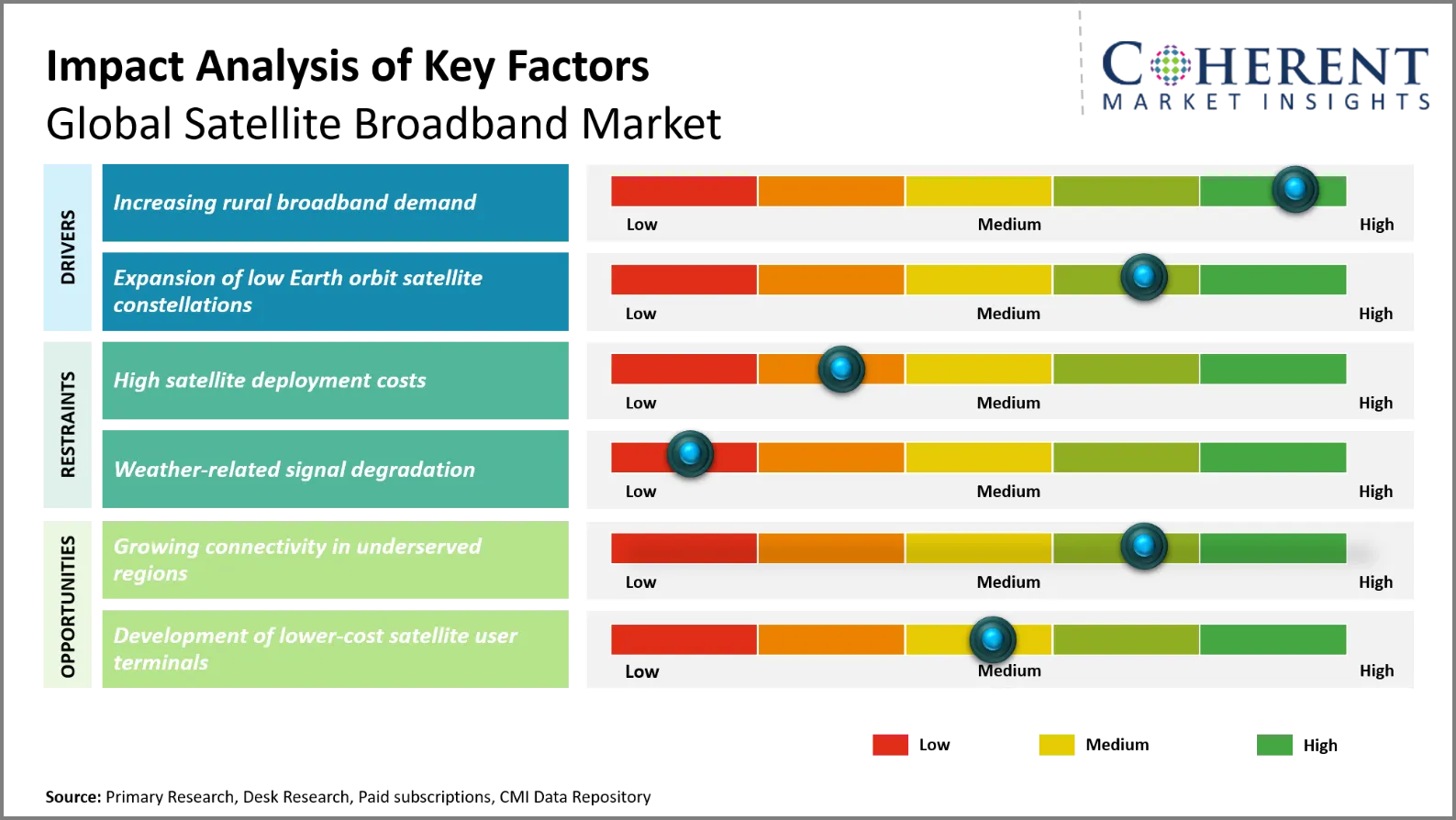
The global satellite broadband market is propelled by increasing demand for rural broadband since remote populations frequently lack reliable terrestrial access. Because of geographic constraints, low populations and the cost of deploying fiber, satellite internet is a feasible option for connectivity. Governments are accelerating digital inclusion programs to bolster access to online education, telemedicine, digital banking, and public services. Agricultural and rural businesses also need reliable internet for precision farming and cloud-based operations. These applications are forcing satellite operators to expand their coverage and to offer affordable service packages to the marginalized.
On February 26, 2026, Amazon announced a partnership with Vanu, Inc., a provider of mobile network equipment and services, to assist offer high-quality internet to rural communities across Africa. The analysis finds that the partnership could assist meet an important demand in the Southern African Development Community (SADC), where connectivity falls well short of global norms.
Expansion of low Earth orbit satellite constellations
Growth of Low Earth Orbit satellite constellations is creating growth opportunities for the Global Satellite Broadband Market owing to its improved connectivity speed, coverage and responsiveness. These satellites are closer to the Earth than geostationary satellites, therefore lowering the latency of the signal for interactive internet applications. Companies are building out larger constellations to serve residential consumers, corporations, aircraft, ships and remote industrial sites. Reusable launch vehicles and improvements in the fabrication of satellites are helping to lower deployment costs and speed up network growth.
On October 14, 2026, Arianespace announced it will launch 36 Amazon Leo satellites aboard Ariane 6 in its Ariane 64 configuration from Europe's Spaceport in French Guiana. The launch is planned no earlier than November 23, 2026, and a final launch window will be set closer to the mission.
Emerging Trends
- Direct-to-Device Satellite Connectivity: Satellite operators are creating networks that link compatible smartphones directly to satellites, without the need for dedicated broadband terminals. This technique has the potential to bring connectivity to rural communities, emergency responders and visitors outside of terrestrial service. Satellite company agreements with mobile network carriers are growing and extending opportunities for service.
- Electronically Steered Flat-Panel Antennas: Advancements in electronically steered antennas allow tiny satellite terminals to monitor moving satellites without mechanical repositioning. These systems provide connectivity for ships, aircraft, cars and residential users. Advances in antenna design and manufacture are also helping to ease the complexity of installation and cost of equipment.
- Satellite-Terrestrial Network Integration: Satellite operators and telco players are converging satellite networks with the terrestrial mobile infrastructure to increase coverage continuity. New standards for non-terrestrial networks permit communication between cellular and satellite systems. This combination allows service providers to expand coverage for connected devices, industrial applications and emergency communications.
- High-Throughput Satellite Capacity Expansion: Satellite broadband providers are boosting network capacity through the utilization of next-generation payloads, frequency reuse and multi-orbit architectures. These technologies enable the rising need for cloud applications, video streaming and workplace connection. Better coordination of satellites and ground networks also helps improve bandwidth usage and service dependability.
Regional Insights
Why is North America a Strong Market for Satellite Broadband?
North America is expected to account for a market share of 35.0% in 2026. The North American satellite broadband market is expected to be driven by demand from sparsely populated territories, Indigenous settlements, maritime routes, and disaster-prone locations. The Canadian Radio-television and Telecommunications Commission has given 25 towns in Nunavut more satellite capacity to reach around 11,400 households. There is also significant demand in the U.S. across Alaska, tribal territory and rural regions where terrestrial infrastructure is still challenging to deploy. Satellite operators can serve residential customers, remote industrial facilities, and public institutions. Growing integration between satellite networks and mobile telecommunications providers creates further opportunities for emergency communications and coverage extension.
Why Does Asia Pacific Satellite Broadband Market Exhibit High Growth?
Asia Pacific is expected to register the fastest growth with a CAGR of 10.3% over the forecast period. It is projected to account for 26.0% of the global satellite broadband market in 2026. Asia Pacific satellite broadband potential is varied, with its markets including inaccessible islands, hilly terrain, rising digital infrastructure, and growing space projects. Indonesia’s fragmented archipelago makes for need for satellite communication between islands where extending underwater cables and terrestrial networks is expensive. Japan and South Korea have prospects in maritime communications, disaster resilience, and backup connection for key infrastructure. China is constructing indigenous satellite constellations while India is improving licensing and spectrum regimes for commercial satellite communications. Regional demand spans household broadband, enterprise networks, transport connectivity, and government communications, rather than relying on one shared growth driver.
Global Satellite Broadband Market Outlook for Key Countries
Why is U.S. Emerging as a Major Hub in the Satellite Broadband Market?
The emergence of commercial constellations, need for rural connectivity and demand from mobile sectors are all positives for the U.S. satellite broadband market. SpaceX’s Starlink offers internet services to homes and businesses while Amazon Leo is working on a rival Low Earth Orbit broadband network. Demand is particularly great in Alaska, where the distant towns face considerable infrastructure and maintenance issues. Satellite connectivity is also used for disaster recovery, mobile operations and communications for energy installations in remote locations outside of urban networks. Constellation deployment and service availability are subject to the Federal Communications Commission’s spectrum licensing regime. More competition among satellite carriers is driving investment in user terminals, network capacity and service delivery.
Is China the Next Growth Engine for the Satellite Broadband Market?
China’s satellite broadband market is characterized by the rise of domestic constellations, critical communications infrastructure, and the need to boost indigenous space capabilities. The Guowang and Qianfan projects are important efforts for building large-scale Low Earth Orbit satellite networks. These programs generate demand for satellite manufacture, launch services, gateway infrastructure and ground terminals. Satellite broadband can also bring connectivity to isolated western regions, rural populations, maritime activities and emergency communications. The domestic aerospace industry is well positioned to leverage the range of opportunities that exist from satellite production to network deployment. China’s priority on establishing its own space technology and communications infrastructure means its market is different from that of countries that rely mostly on foreign, commercially run constellations.
Canada Satellite Broadband Market Analysis and Trends
Satellite broadband market in Canada is driven by connectivity needs in northern territories, Indigenous communities, distant settlements and sparsely inhabited areas. Consider Nunavut, where topographical and logistical constraints severely impede the rollout of terrestrial infrastructure. The Canadian Radio-television and Telecommunications Commission granted extra satellite capacity for all 25 Nunavut settlements, servicing about 11,400 households. In February 2025, the federal government released a framework for additional satellite mobile coverage. This regulation will help boost connection in underserved areas and allow for more reliable emergency communications in the future. Satellite operators can deliver household internet access, community services, remote transit corridors and industrial connectivity in places where traditional infrastructure is still too expensive.
Australia Satellite Broadband Market Analysis and Trends
The satellite broadband industry in Australia is driven by the issue of linking geographically dispersed households, farms, mining activities and remote companies. NBN’s Sky Muster service benefits communities outside practical fixed line coverage and the next generation Low Earth Orbit effort seeks to boost connection. In August 2025, the National Broadband Network selected Amazon’s Project Kuiper (rebranded as Amazon Leo) for future wholesale satellite broadband services. The proposed service is available to over 300,000 eligible premises in the current satellite area. The program, ‘Australia’s Strengthening Telecommunications Against Natural Disasters’, also leverages satellite links to emergency facilities, driving the need for resilient communications infrastructure.
India Satellite Broadband Market Analysis and Trends
The need for connectivity in Himalayan communities, northeastern regions, isolated villages, islands and industrial locations with difficult geography is driving the Indian satellite broadband industry. The Department of Telecommunications has granted Global Mobile Personal Communications by Satellite licenses to OneWeb India Communications and Jio Satellite Communications. OneWeb plans to use its Low Earth Orbit constellation, while Jio's proposed services draw on the medium Earth orbit O3b mPOWER network. In May 2025, the Telecom Regulatory Authority of India recommended satellite spectrum allocations in view of commercial deployment conditions. Satellite broadband can augment BharatNet and mobile networks where fiber rollout is still difficult. Main uses include enterprise connectivity, catastrophe response and remote infrastructure.
Global Satellite Broadband Market - Direct-to-Device Satellite Connectivity by Region:
Region | Key Countries | Leading Companies | Connectivity Status in 2025-2026 | Key Services | Data Point |
North America | United States, Canada | SpaceX, T-Mobile, Rogers, AST SpaceMobile | Commercial satellite messaging available, broader services under development | Text messaging, emergency alerts, limited applications | More than 650 Starlink Direct to Cell satellites reported by mid-2025 |
Europe | France, Germany, Romania, Switzerland | Orange, Skylo, Vodafone, AST SpaceMobile, Satellite Connect Europe | Satellite messaging launched in France, further partnerships and demonstrations announced | Satellite SMS, location sharing, planned voice and data | Orange public service availability announced for 11 December 2025 |
Asia Pacific | Australia, Japan, New Zealand, Philippines | SpaceX, KDDI, SoftBank, NTT docomo, Telstra, Globe | Commercial services expanded across several markets during 2025-2026 | Satellite messaging, limited application data, emergency communications | Six Starlink-based commercial services across four markets by July 2026 |
How is Growing Connectivity in Underserved Regions Creating New Growth Opportunities in the Satellite Broadband Market?
The global satellite broadband market is growing with the increasing need for connection in underserved areas by connecting communities that are out of the practical reach of terrestrial networks. Satellite broadband can be used to support telemedicine, digital education and government services in the Himalayan communities and the northeastern regions of India where the topography makes deployment of fiber problematic. Reliable connectivity is crucial for remote mining operations in Australia to support worker communications, equipment monitoring, and the transfer of operational data. Satellite systems enable residential internet and critical public services in Canada’s northern towns. These needs are forcing operators to provide low-cost user terminals, community connection solutions and flexible service packages. Partnerships with telecom companies and government agencies enhance deployment prospects in remote geographic areas.
On August 5, 2025, NBN Co and Amazon announced an agreement to supply high-speed, wholesale fixed broadband to clients in portions of regional, rural and remote Australia using Project Kuiper’s low Earth orbit (LEO) satellite technology. Project Kuiper Amazon’s satellite broadband company to provide fast, dependable internet to consumers around the world.
Market Players, Key Development, and Competitive Landscape
Key Developments
- On September 10, 2026, Eutelsat announced at the International Space Summit in Paris an important step in assuring and enhancing service continuity of its OneWeb constellation, with plans to procure 229 additional OneWeb Low Earth Orbit (LEO) satellites from Airbus Defense and Space.
- On April 29, 2026, Viasat, Inc. announced the successful launch and initial signal acquisition of the ViaSat-3 Flight 3 satellite. The satellite successfully separated from the launch vehicle’s upper stage just under five hours after liftoff, with initial signals acquired minutes later, confirming the satellite is healthy in orbit and ready for the next phase of operations.
- On April 14, 2026, Hughes Network Systems, LLC announced that Air India has selected the Hughes In-Flight connectivity solution to deliver a consistent Wi-Fi experience using a common connectivity platform across its mixed widebody fleet. Hughes will leverage Airbus HBCplus for A350-1000 aircraft and the RAVE Aerospace solution for Boeing 787-8 and Boeing 777-300ER aircraft.
Competitive Landscape
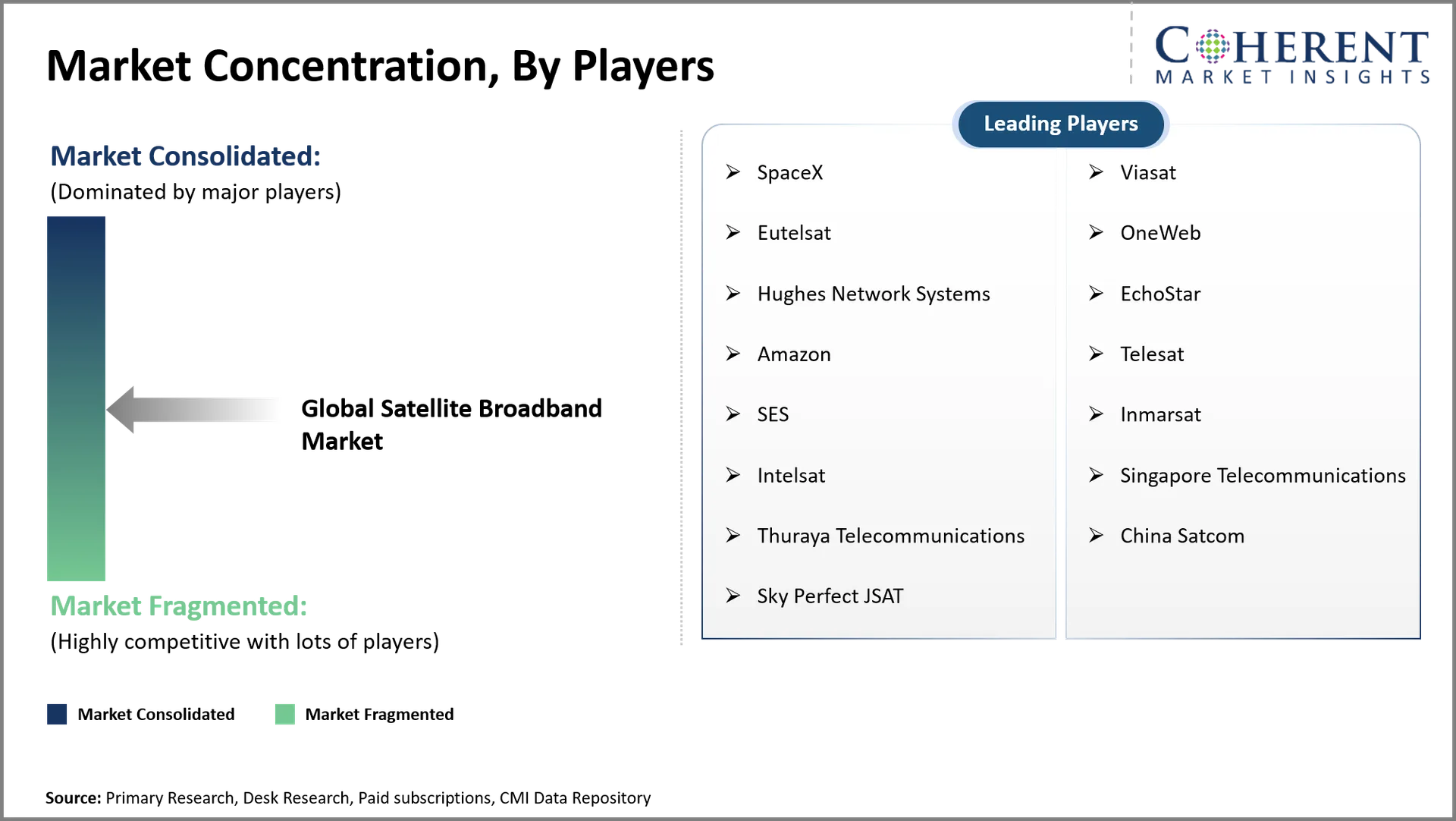
The global satellite broadband market features SpaceX, Amazon, Eutelsat, Viasat, and EchoStar Corporation, competing through constellation scale, network capacity, and specialized services. SpaceX’s Starlink targets residential users, companies, aviation and maritime connectivity, and underserved communities, with more than nine million consumers reported in its 2025 progress report. Amazon Leo is building a Low Earth Orbit network with small customer terminals and interaction with Amazon Web Services. Eutelsat offers a hybrid of OneWeb’s Low Earth Orbit constellation and geostationary satellite capabilities, targeting governments, telecommunications carriers and airlines. Viasat concentrates on aviation, maritime and government and enterprise connections, while EchoStar’s Hughes delivers consumer broadband, ground-network equipment and managed services.
Top Manufacturers and Notable Products in the Satellite Broadband Market
Manufacturer | Notable Product | Key features |
SpaceX | Starlink Direct to Cell | Connects compatible LTE phones without specialized satellite hardware, supports messaging and selected data applications, with voice and expanded broadband planned |
AST SpaceMobile | BlueBird Satellite Network | Designed for direct-to-smartphone 4G and 5G broadband, supports voice and video calls, uses large phased-array antennas |
Globalstar | Apple Emergency SOS Satellite Connectivity | Enables emergency messaging on compatible Apple devices, supports location sharing and emergency assistance beyond cellular coverage |
Skylo Technologies | Skylo Non-Terrestrial Network Service | Enables satellite connectivity on supported smartphones and Internet of Things devices, supports messaging and emergency communications through partner networks |
Iridium Communications | Iridium Certus and Satellite Internet of Things Services | Provides low Earth orbit connectivity for compatible devices, supports messaging and tracking, serves remote and emergency communication applications |
Market Report Scope
Report Coverage | Details | ||
Base Year | 2025 | Market Size in 2026: | USD 14.00 Bn |
Historical Data For: | 2020 To 2024 | Forecast Period: | 2026 To 2033 |
Forecast Period 2026 To 2033 CAGR: | 9.8% | 2033 Value Projection: | USD 36.00 Bn |
Geographies covered: |
| ||
Segments covered: |
| ||
Companies covered: | SpaceX, Viasat, Eutelsat, OneWeb, Hughes Network Systems, EchoStar, Amazon, Telesat, SES, Inmarsat, Intelsat, Singapore Telecommunications, Thuraya Telecommunications, China Satcom, Sky Perfect JSAT | ||
Growth Drivers: |
| ||
Restraints & Challenges: |
| ||
Analyst Opinion (Expert Opinion)
- The future of the global satellite broadband market will depend on affordable Low Earth Orbit services, multi-orbit networks, and integration with terrestrial telecommunications. Operators will increasingly compete on latency, installation simplicity, service reliability, and coverage consistency. Direct-to-device connectivity will create an additional growth pathway by connecting compatible mobile devices beyond cellular coverage. This makes Amazon’s planned integration of Globalstar capabilities in Amazon Leo a perfect example. Providers should build flexible network architectures that connect residential broadband with mobile, enterprise and emergency communications services.
- The strongest potential is anticipated to be in enterprise connectivity, aviation, maritime communications and underserved regions. There is promise in Himalayan villages, isolated industrial plants and rural India, yet commercial deployment would depend on regulatory approvals and spectrum access. Opportunities exist in remote mining enterprises and rural households in Australia, but Canada needs strong links across northern regions. In the United States, rural broadband and aviation connection continue to be major applications. Providers should focus on customer segments whose terrestrial infrastructure is expensive, unreliable or operationally impracticable.
- Satellite broadband providers will need to decrease their terminal prices, upgrade indoor connectivity and provide transparent service plans to remain competitive. Equipment manufacturers should create electronically guided antennas that work with numerous satellite networks and are easy to install. Operators should collaborate with mobile carriers, cloud providers, equipment vendors and local telcos. In India, corporations have to get security clearances, spectrum allocation and service permission before commercial launches. Providers also need to develop regional gateways, beef up cybersecurity and plan capacity around real consumer need. Such techniques can increase affordability of services, their operational efficiency and long-term customer retention.
Speak to the analyst
Want personalized insights?
Take the findings above to one of our principal consultants, or have the report rebuilt around the segments, geographies and competitors you actually track.
Market Segmentation
- Component Insights (Revenue, USD Billion, 2021 - 2033)
- Equipment
- Services
- Satellite Orbit Insights (Revenue, USD Billion, 2021 - 2033)
- Low Earth Orbit
- Medium Earth Orbit
- Geostationary Earth Orbit
- Frequency Band Insights (Revenue, USD Billion, 2021 - 2033)
- L Band
- S Band
- C Band
- X Band
- Ku Band
- Ka Band
- Connectivity Type Insights (Revenue, USD Billion, 2021 - 2033)
- Fixed Satellite Broadband
- Mobile Satellite Broadband
- Direct to Device Satellite Connectivity
- Application Insights (Revenue, USD Billion, 2021 - 2033)
- Residential Broadband
- Enterprise Connectivity
- Government and Public Sector
- Maritime Connectivity
- Aviation Connectivity
- Energy and Utilities
- Transportation and Logistics
- Military and Defense
- Media and Broadcasting
- End User Insights (Revenue, USD Billion, 2021 - 2033)
- Individual Consumers
- Small and Medium Enterprises
- Large Enterprises
- Government Organizations
- Regional Insights (Revenue, USD Billion, 2021 - 2033)
- North America
- U.S.
- Canada
- Latin America
- Brazil
- Argentina
- Mexico
- Rest of Latin America
- Europe
- Germany
- U.K.
- Spain
- France
- Italy
- Russia
- Rest of Europe
- Asia Pacific
- China
- India
- Japan
- Australia
- South Korea
- ASEAN
- Rest of Asia Pacific
- Middle East
- GCC Countries
- Israel
- Rest of Middle East
- Africa
- South Africa
- North Africa
- Central Africa
- North America
- Key Players Insights
- SpaceX
- Viasat
- Eutelsat
- OneWeb
- Hughes Network Systems
- EchoStar
- Amazon
- Telesat
- SES
- Inmarsat
- Intelsat
- Singapore Telecommunications
- Thuraya Telecommunications
- China Satcom
- Sky Perfect JSAT
Sources
Primary Research Interviews
- Satellite Broadband Service Providers
- Telecom & Network Infrastructure Manufacturers
- Satellite Operators & Launch Service Providers
- Government & Defense Communication Agencies
Magazines
- Via Satellite Magazine
- Satellite Evolution Global
- Space News Magazine
- Aviation Week & Space Technology
Journals
- International Journal of Satellite Communications and Networking
- IEEE Transactions on Aerospace and Electronic Systems
- Journal of Spacecraft and Rockets
Associations
- Satellite Industry Association (SIA)
- Global VSAT Forum (GVF)
- European Satellite Operators Association (ESOA)
- International Astronautical Federation (IAF)
Public Domain Sources
- U.S. Federal Communications Commission (FCC) Reports
- European Space Agency (ESA) Publications
- ITU Global Connectivity Reports
- NASA Technical Reports Server
Proprietary Elements
- CMI Data Analytics Tool
- Proprietary CMI Existing Repository of Information for the Last 10 Years
Get access to 250+ pages report
Every segment, forecast, competitor profile and data table behind the analysis above — available for instant download.
- ESOMAR Member
- ISO 9001:2015 Certified
- D-U-N-S Registered
- GDPR & CCPA Compliant
Frequently Asked Questions
The global satellite broadband market is expected to stand at USD 14.00 Bn in 2026 and is expected to reach USD 36.00 Bn by 2033.
The CAGR of the global satellite broadband market is projected to be 9.8% from 2026 to 2033.
Increasing rural broadband demand and Expansion of low Earth orbit satellite constellations are the major factors driving the growth of the global satellite broadband market.
High satellite deployment costs and Weather-related signal degradation are the major factors hampering the growth of the global satellite broadband market.
In terms of component, equipment segment is estimated to dominate the market revenue share in 2026.
The global satellite broadband market covers satellite-based internet connectivity equipment, infrastructure, and services for residential, commercial, government, and industrial users.
Satellite broadband transmits internet data between user terminals, orbiting satellites, and ground gateways connected to terrestrial networks.