

Global Satellite Manufacturing, Integration, and Testing Market Size and Forecast – 2026 To 2033
The global satellite manufacturing, integration, and testing market is expected to grow from USD 11.85 Bn in 2026 to USD 19.80 Bn by 2033, registering a compound annual growth rate (CAGR) of 7.6% from 2026 to 2033. The global satellite manufacturing, integration, and testing market is driven by Growing demand for advanced Earth observation satellites. On January 15, 2025, Space42 announced the successful deployment of the second phase of its Foresight satellite constellation. In partnership with ICEYE, the companies launched the next-generation SAR spacecraft into orbit
Key Takeaways of the Global Satellite Manufacturing, Integration, and Testing Market
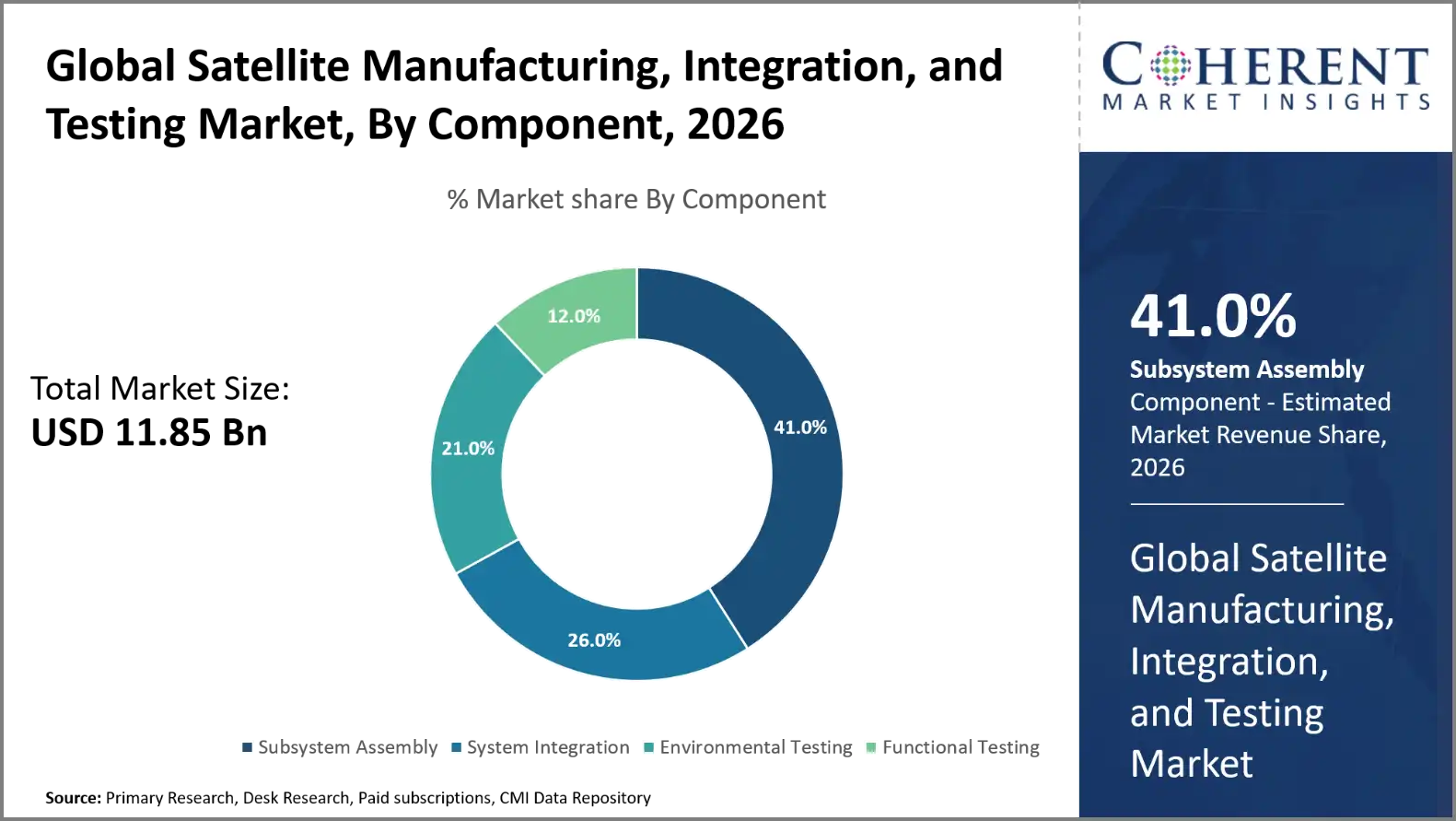
- The Subsystem Assembly segment is expected to account for 41.0% of the global satellite manufacturing, integration, and testing market share in 2026. Increasing military requirements for secure satellite infrastructure is driving the growth of the segment. On May 26, 2026, The U.S. Space Force awarded SpaceX a USD 2.29 billion contract for its Space Data Network Backbone. The program will develop secure, high-speed satellite communications infrastructure for military sensors and weapons platforms.
- The Assembly Services segment is estimated to capture 48.0% of the market share in 2026. Rising adoption of small satellite manufacturing technologies is majorly driving the growth of the segment. On October 30, 2025, EnduroSat announced a USD 104 million funding round to accelerate small and medium satellite production. The investment accompanied the opening of its new Space Center in Sofia, Bulgaria.
- The Commercial segment is estimated to capture 38.0% of the market share in 2026. Growing demand for comprehensive spacecraft environmental testing is driving the growth of the segment. On June 16, 2026, Sidus Space announced successful vibration testing of its upcoming LizzieSat spacecraft. Element U.S. Space and Defense conducted the qualification testing at its Orlando facility.
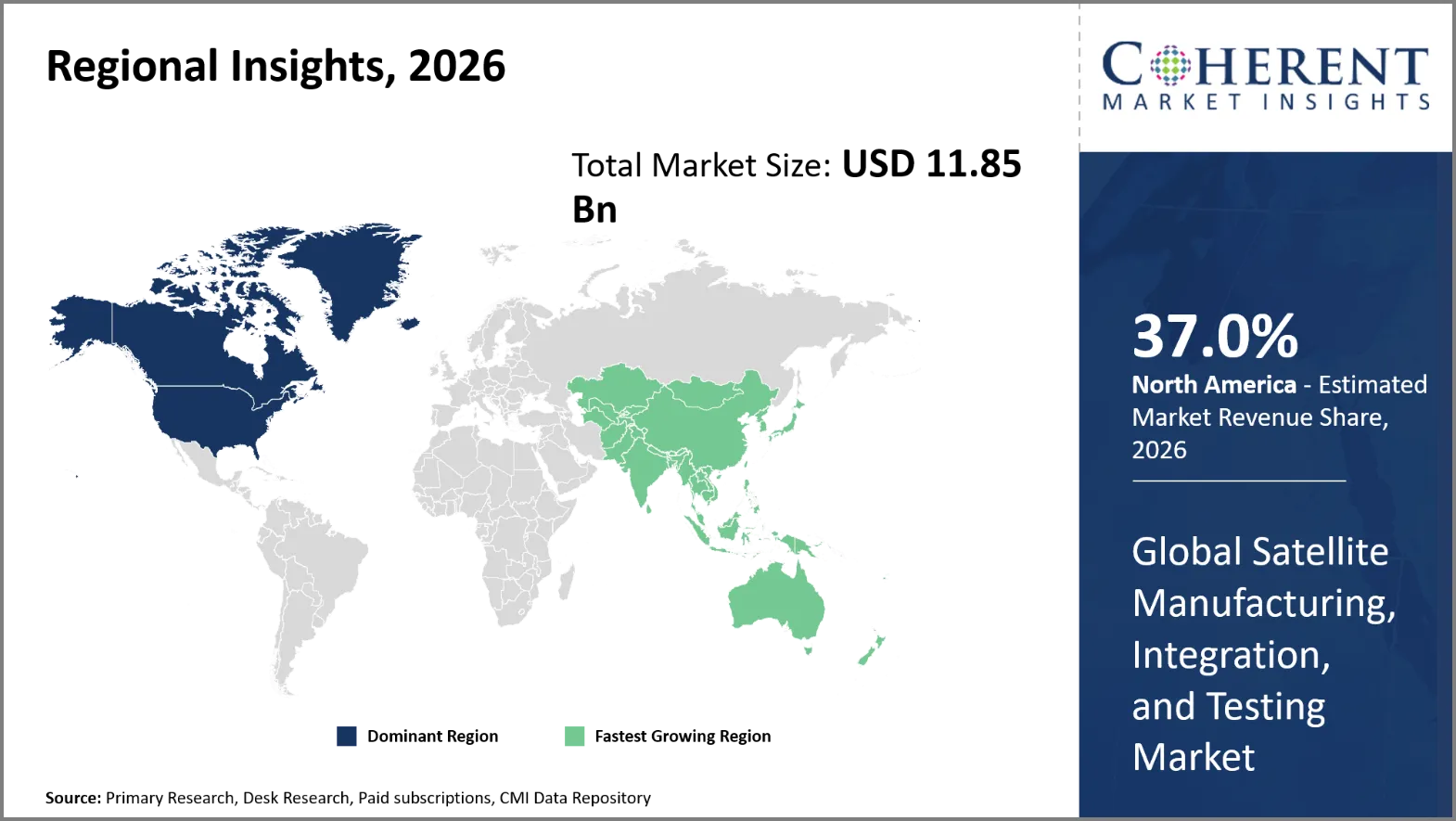
- North America is expected to dominate the satellite manufacturing, integration, and testing market in 2026 with a market share of 37.0%. Increasing demand for small satellite testing services in North America is driving the growth of the regional market. On January 20, 2026, Utah State University’s Space Dynamics Laboratory conducted thermal vacuum, electromagnetic compatibility, and vibration testing. The campaign covered six small satellites designed to operate together as a distributed radio telescope.
- Asia Pacific is expected to account for 21.0% share in 2026. Expansion of domestic satellite manufacturing capabilities in Asia Pacific is driving the growth of the regional market. On December 2, 2025, Hanwha Systems inaugurated its satellite manufacturing facility at Hawon Techno Campus in Seogwipo, South Korea. Its infrastructure includes satellite assembly areas, cleanrooms, functional testing facilities, and environmental testing equipment.
Segmental Insights
Why Does Subsystem Assembly Dominate the Global Satellite Manufacturing, Integration, and Testing Market?
The subsystem assembly segment is expected to account for 41.0% of the global satellite manufacturing, integration, and testing market share in 2026. Subsystem assembly is the dominant segment since satellites require several coupled hardware systems to function reliably. These are propulsion, power, communication, temperature control, attitude determination. The manufacturer must incorporate these subsystems meeting rigorous weight, performance and reliability constraints. As satellites get more complicated, the necessity for specialist assembly capabilities increases. Modular architectures for spacecraft also promote the standardized integration of subsystems across satellite platforms. These criteria make subsystem assembly a key step in the satellite manufacturing process.
On April 14, 2026, Rocket Lab Corporation, a global leader in launch services and space systems, announced a new electric satellite thruster for high-volume production to address the growing demand for reliable satellite propulsion across commercial and national security constellations. The Gauss thruster should provide higher specific impulse than conventional chemical thrusters. This means that it can produce more thrust with the same amount of fuel and would be more efficient for long term missions.
- Current Industry Events of 2026
- Market Size Estimation
- Regional Breakdown
- Competitive Landscape
- Customer Intelligence
- Segmental Analysis
- Pricing Analysis
- Key Market Drivers, Challenges & Future Trends
- Customized Insights Section
Why is Assembly Services the Most Crucial Service Type?
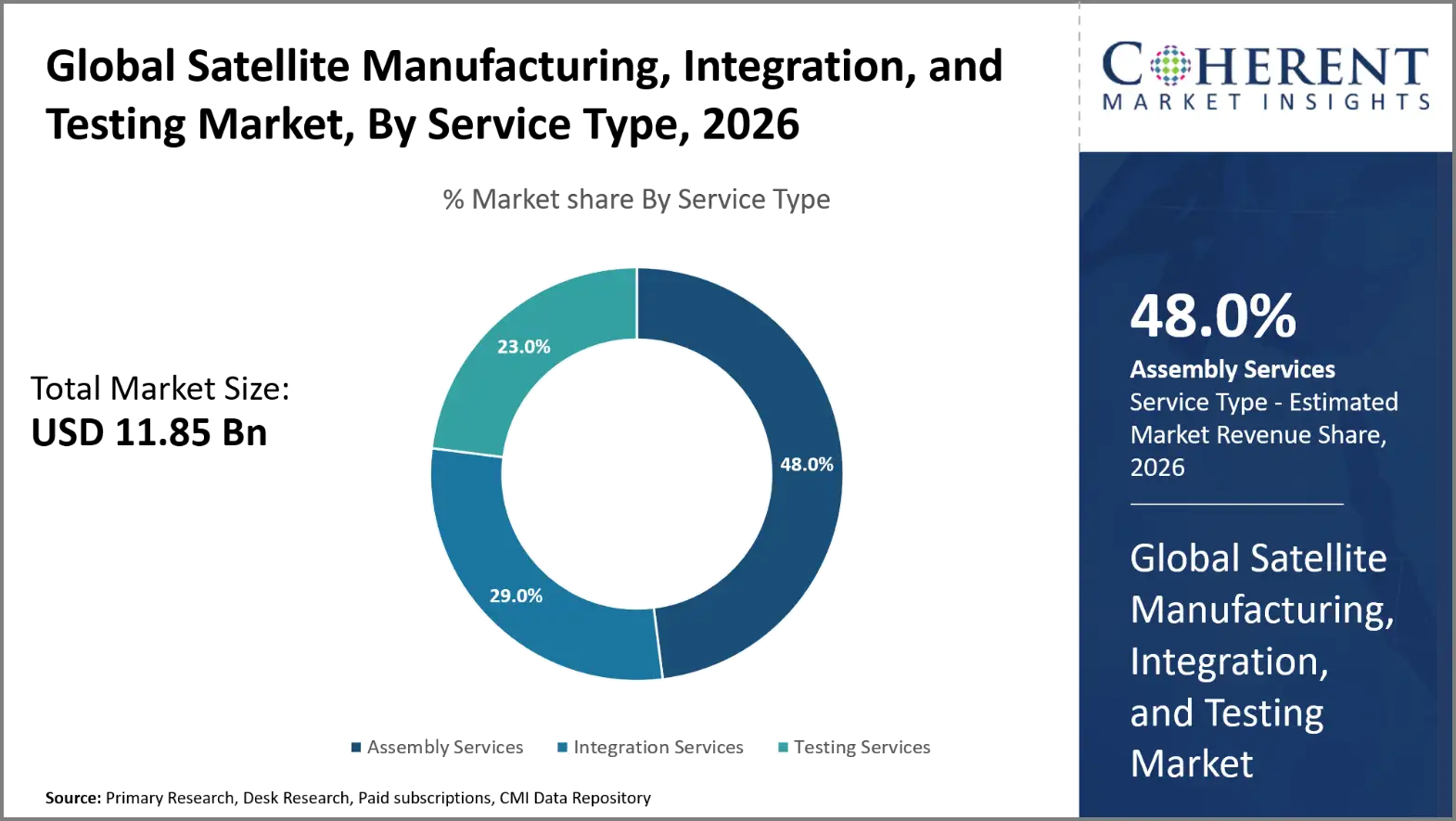
The assembly services segment is expected to account for 48.0% of the global satellite manufacturing, integration, and testing market share in 2026. Assembly services are still needed to convert individual satellite pieces into a working spacecraft. This covers mechanical installation, electrical connections, subsystem integration and configuration verification. The accurate assembly guarantees that the systems on board are compatible before the environmental testing begins. More satellites mean there has to be repeatable ways to assemble them. Also, manufacturers need specialized facilities for handling sensitive electronic and mechanical parts. These issues emphasize the necessity of assembly services to commercial and government satellite operations.
On December 22, 2025, XDLINX Space Labs announced the extension of its operations by a partnership with the GMR Group to create a state-of-the-art satellite research and development facility in GMR Aerospace Park, Hyderabad, India. This development marks a significant milestone in the company’s ambition to develop niche technologies, qualify advanced systems, and serve global satellite customers over the long term, while contributing to the growth of India’s space economy.
Commercial Dominates the Global Satellite Manufacturing, Integration, and Testing Market
The commercial segment is expected to account for 38.0% of the global satellite manufacturing, integration, and testing market share in 2026. The commercial segment dominates because satellite demand increasingly comes from telecommunications, broadband, navigation, and Earth observation applications. Private operators continue expanding satellite constellations to improve global connectivity and data coverage. Commercial satellite deployment is progressing with companies such as Space Exploration Technologies Corporation, OneWeb and Amazon. The rising demand for high-speed internet is also spurring investment in low Earth orbit satellite networks. Commercial operators are increasingly focusing on scalable manufacturing and standardized testing processes. These advances add to the commercial demand for satellite manufacturing, integration and test services.
On January 29, 2025, Planet Labs announced a multiyear arrangement with an established Asia-Pacific business partner. The contract is for a new constellation of Pelican high-resolution Earth monitoring satellites. Planet will build and transport the satellites and will also provide the operating services. The deal will increase commercial and government client imaging capacity.
Current Events and their Impact
Current Events | Description and its Impact |
India’s Foreign Direct Investment Policy for the Space Sector, 2024 |
|
European Union Space Act, 2025 |
|
Satellite Manufacturing, Integration, and Testing Market Dynamics
Market Drivers
Increasing deployment of commercial satellite constellations
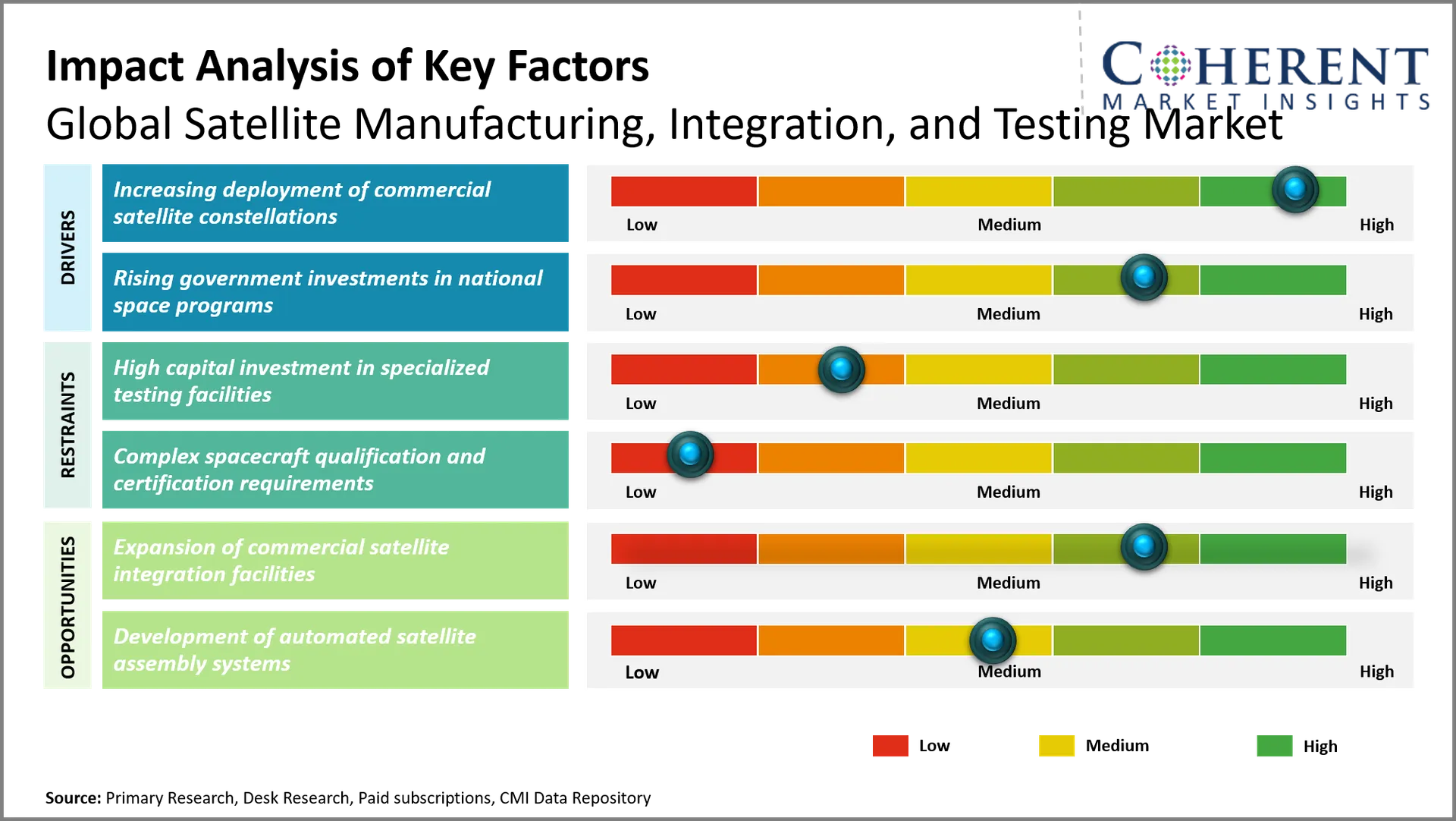
Increasing deployment of commercial satellite constellations is boosting demand for satellite manufacturing, integration and testing services. Companies are building low Earth orbit networks to provide broadband internet, telephony and earth observation services. Eutelsat OneWeb has global broadband coverage, while Space Exploration Technologies Corporation continues to build out Starlink. Amazon also has their Project Kuiper satellite network in development. These large-scale initiatives require consistent spacecraft fabrication, subsystem assembly, payload integration and comprehensive environmental testing. Increasing constellation replacement needs also drive need for recurrent satellite manufacturing and validation services.
On March 18, 2025, Kinéis completed the deployment of their 25-satellite Internet of Things constellation. Rocket Lab’s Electron rocket has successfully launched the High Five mission. This fifth and final launch from Mahia, New Zealand, completes the deployment of the Kinéis constellation.
Rising government investments in national space programs
Rising government investments in national space programs are driving demand for domestic satellite manufacturing and integration skills. Countries are looking at space infrastructure for communication security, earth observation, navigation, scientific research and defense. India’s space agency is also building indigenous spacecraft and enhancing national satellite capabilities. The European Space Agency supports joint development of satellites and advanced space technology activities. The National Aeronautics and Space Administration also finances science spacecraft and exploration missions. These investments will fuel the growth of domestic supply chains, innovative component production, and specialized testing facilities. Government procurement initiatives also offer long-term potential for satellite makers and integration service providers.
On February 6, 2026, Japan's Ministry of Defense selected Mitsubishi Electric Corporation to develop and manufacture its next-generation geostationary communications satellite. The program will replace the existing Kirameki-2 defense communications satellite. It also includes development of the supporting ground communication system. The spacecraft will feature a digital communications payload with adaptable beam coverage.
Emerging Trends
- Adoption of Modular Satellite Manufacturing Architectures: Satellite manufacturers are increasingly using modular spacecraft architectures, standardized interfaces, and configurable subsystems. These technologies make manufacture more efficient, accelerate integration, and allow for tailored satellite systems for commercial and government missions.
- Impact: Modular manufacturing simplifies assembly, enhances production repeatability, and decreases spacecraft development time. It also allows manufacturers to adjust to evolving payload needs without redesigning complete satellite platforms.
- Relevance to the market: Airbus Defense and Space and Thales Alenia Space illustrate the relevance of standardized spacecraft systems. Their manufacturing capabilities enable scalable satellite production and integrated subsystem development.
- Increasing Adoption of Advanced Automated Satellite Testing Technologies: Satellite makers are increasingly turning to automated inspection, digital twins, and advanced testing systems. These technologies enhance manufacturing accuracy, detect integration flaws and reinforce spacecraft qualification processes.
- Impact: Test automation increases inspection uniformity, lowers manual intervention and speeds up defect discovery. Digital simulations also enable engineers to evaluate spacecraft performance before embarking on expensive physical qualification efforts.
- Relevance to the market: Northrop Grumman Corporation and Lockheed Martin Corporation build sophisticated spacecraft that require substantial qualification. Their programs demonstrate the requirement for advanced integration facilities and automated environmental testing capabilities.
Regional Insights
Why is North America a Strong Market for Satellite Manufacturing, Integration, and Testing?
North America is expected to account for a market share of 37.0% in 2026. The region benefits from increased production of commercial spacecraft, manufacturing of defense payloads and specialized satellite testing facilities. Canada is bolstering its position with the expansion of the MDA Space factory in Montréal. The facility is 185,000 square feet, double the size of the company’s existing manufacturing floor space. It allows the simultaneous manufacture, integration and testing of several MDA AURORA spacecraft. High-level automation & augmented reality boost production efficiency. In October 2026, Spire Global launched its first three satellites from its Boulder production facility in the U.S. These advancements support regional large volume spacecraft manufacturing, domestic supply chains and mission specific satellite manufacture.
Why Does Asia Pacific Satellite Manufacturing, Integration, and Testing Market Exhibit High Growth?
Asia Pacific is expected to register the fastest growth with a CAGR of 7.9% over the forecast period. It is projected to account for 21.0% of the global satellite manufacturing, integration, and testing market in 2026. Asia Pacific is building up its satellite manufacturing ecosystem with privately operated testing facilities and sovereign spacecraft production projects. South Korea’s Asia Pacific Satellite finished its private satellite Assembly, Integration and Test facility in Bucheon in May 2026. The five-story center will assemble and test satellites for spacecraft weighing up to 750 kilograms. Its infrastructure comprises clean rooms for avionics fabrication, printed circuit board production and mission control facilities. Australia is also growing its industrial spaceship production with Space Machines Company’s Optimus Factory at the University of Technology Sydney. The facility supports assembly and testing of spacecraft weighing up to 300 kilograms.
Global Satellite Manufacturing, Integration, and Testing Market Outlook for Key Countries
Why is U.S. Emerging as a Major Hub in the Satellite Manufacturing, Integration, and Testing Market?
The U.S. market gains from the acquisition of defense satellites, missile warning infrastructure, and the manufacture of specialist infrared payloads. In December 2025, L3Harris Technologies expanded its Satellite Integration and Test facility in Florida. The USD 100 million facility covers 94,000 square feet and supports parallel spacecraft production. The company is manufacturing 34 satellites for Space Development Agency programs. Its work includes Tranche 1 and Tranche 2 Tracking Layer satellites. These spacecrafts are outfitted with infrared sensors and sophisticated threat-tracking algorithms. The need for resilient missile detection capabilities is increasing the demand for specialized payload assembly, secure manufacturing facilities, and expedited satellite qualification procedures.
Is China the Next Growth Engine for the Satellite Manufacturing, Integration, and Testing Market?
China is pushing forward with smart production lines, flexible spacecraft platforms and integrated environmental test infrastructure for satellite manufacture. Guoyu Starry Sky Technology has a satellite manufacturing base in Wuxi, Jiangsu. The plant can create more than 150 satellites a year, with masses ranging from 200 to 500 kilograms. Its automated production solutions include robotic assembly, artificial intelligence and digital twin technology. It is estimated that individual mass-produced satellites can be built in 20-25 days. The center also does thermal vacuum, vibration and electromagnetic testing. China’s increasing commercial manufacturing capacity is demonstrated by the manufacture of six Huantian Constellation spacecraft in June 2026.
Japan Satellite Manufacturing, Integration, and Testing Market Analysis and Trends
Local production of synthetic aperture radar and niche Earth observation expertise is gaining traction in Japan’s market. In October 2026, IHI Corporation started assembling and testing satellites at its Tokyo Pilot Lab. The facility has the capacity to handle two satellites at the same time, and enables coordination with Finland’s ICEYE. Five Japanese engineers were given specialized training at ICEYE’s facilities in Finland. The first project involves two satellites, to be launched in the first quarter of 2027. IHI is looking to build a sovereign constellation of up to 24 satellites. The planned design is multi-sensor including radar, optical, infrared and hyperspectral sensors.
France Satellite Manufacturing, Integration, and Testing Market Analysis and Trends
France benefits from specialized spacecraft electronics manufacturing, precision navigation components, and radiation-resistant subsystem development. Rakon has ordered an ISO 8 cleanroom in Pont-Sainte-Marie for March 2026. The facility is on the order of 100 square meters in area and manufactures space grade navigation receivers and Master Reference Oscillators. These components provide satellite location, timing precision and synchronization requirements. The production process involves incoming material inspection, subsystem assembly and radiation testing. The facility will add to the current infrastructure for making quartz and ultra stable oscillators. The increasing requirement for reliable navigation electronics is driving France's contribution to the manufacture and qualification of certain satellite subsystems.
India Satellite Manufacturing, Integration, and Testing Market Analysis and Trends
India’s market is moving forward with private-sector participation in the domestic development of Earth observation satellites. The Indian National Space Promotion and Authorization Center has set up a public-private cooperation model for commercial earth observation constellations. The concept was announced in August 2026 and includes 12 proposed satellites using optical, multispectral, hyperspectral and synthetic aperture radar technologies. The planned hyperspectral spacecraft incorporate 250 spectral bands. Private companies can undertake satellite design, fabrication, integration, testing, and operations. This initiative creates opportunities for domestic payload manufacturing, specialized electronics production, environmental qualification, and commercial spacecraft integration.
Global Satellite Manufacturing, Integration, and Testing Market - Satellite Manufacturing Facility Comparison
Company | Country | Facility | Facility Size | Production Capacity |
MDA Space | Canada | Montréal Satellite Manufacturing Facility | 185,000 sq ft expansion | Up to 400 satellites annually |
Apex | U.S. | Factory One Los Angeles | 130,000 sq ft | More than 200 satellites annually |
Muon Space | U.S. | San Jose Production Facility | 130,000 sq ft | More than 500 satellites annually across company facilities |
EnduroSat | Bulgaria | Sofia Space Center | 188,340 sq ft | Up to 2 satellites daily weighing 200-500 kg |
Thales Alenia Space | Italy | Space Smart Factory Rome | 1,200 m² cleanroom | More than 100 satellites annually |
How is Expansion of Commercial Satellite Integration Facilities Creating New Growth Opportunities in the Satellite Manufacturing, Integration, and Testing Market?
Expansion of commercial satellite integration facilities is creating opportunities for independent spacecraft manufacturers, payload suppliers, and specialized testing providers. Companies can build customer-owned satellite platforms with new facilities that do not include the costs of cleanrooms and environmental testing equipment. In 2026, South Korea's Asia Pacific Satellite opened a private assembly, integration and testing center in Bucheon. The facility also has avionics production capability and can host spacecraft up to 750 kg in weight. This infrastructure offers smaller satellite developers specific production capabilities. Such infrastructure enables smaller satellite developers to access specialized manufacturing resources. It also creates demand for outsourced subsystem installation, electrical verification, thermal vacuum testing, vibration testing, and electromagnetic compatibility assessments.
On March 19, 2026, SWISSto12, one of the world’s fastest-growing aerospace companies and a leading manufacturer of advanced satellite systems, announced the inauguration of its largest ever cleanroom, a 1,000 m² purpose-built assembly facility for the industrial-scale production of its HummingSat satellite.
Market Players, Key Development, and Competitive Landscape
Key Developments
- On May 19, 2026, Firefly Aerospace, a market leading space and defense technology company, announced the company moved into a new headquarters, expanded its cleanroom space, and added an innovation lab to support Firefly’s growing workforce, accelerate spacecraft production, and enable breakthrough space technologies.
- On March 25, 2026, Momentus Inc., a U.S. commercial space company specializing in satellite technology, space transportation, and orbital services, announced that the Company has completed its relocation to a new facility at 1762 Automation Parkway in San Jose, California, marking a significant milestone in the company’s growth and operational expansion.
- On June 27, 2025, Space Forge confirmed the successful launch and in-orbit communication with ForgeStar-1, the UK’s first in-space manufacturing satellite, developed entirely in Wales. The launch marks a major breakthrough for British-built space hardware and the next chapter in in-space industrial capability.
Competitive Landscape
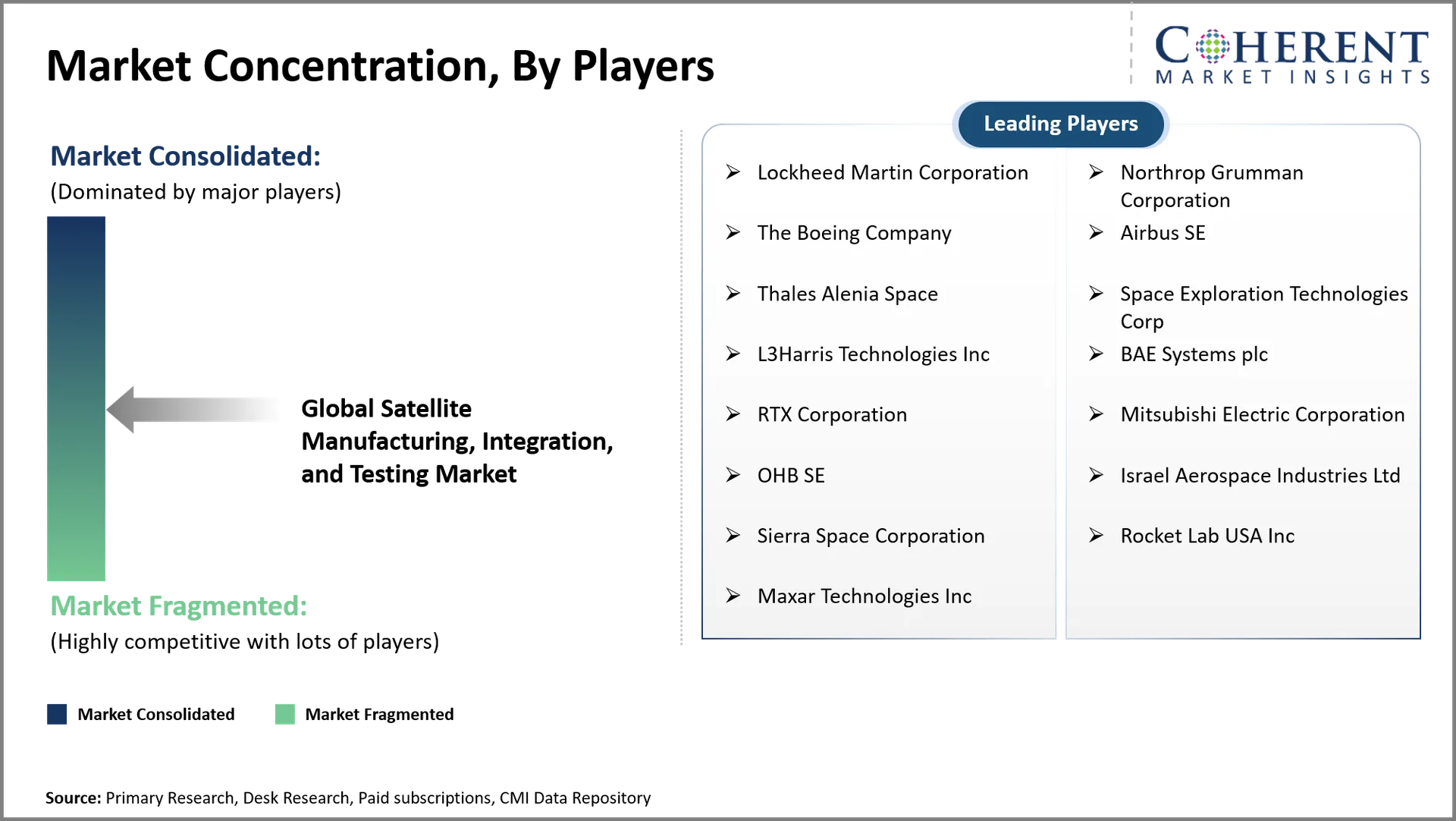
The global satellite manufacturing, integration, and testing market features established aerospace contractors and vertically integrated commercial manufacturers. Airbus Defense and Space is developing adaptable OneSat platforms and European constellation programs, such as Infrastructure for Resilience, Interconnectivity and Security by Satellite. Lockheed Martin Corporation emphasizes defense spacecraft, modular platforms, and software-defined satellite capabilities. Northrop Grumman Corporation targets missile-warning satellites, proliferated defense architectures, and spacecraft servicing technologies. Thales Alenia Space concentrates on telecommunications, navigation, and institutional satellite programs. MDA Space is expanding automated satellite production and digital beamforming technologies through its AURORA platform. Space Exploration Technologies Corporation prioritizes vertically integrated Starlink manufacturing and production scalability.
Top Manufacturers and Notable Products in the Satellite Manufacturing, Integration, and Testing Market
Manufacturer | Notable Product | Key features |
Airbus Defence and Space | OneSat | Fully reconfigurable geostationary satellite, software-defined payload, dynamic beam coverage, all-electric propulsion, modular manufacturing architecture |
Lockheed Martin Corporation | LM 400 | Multi-orbit satellite platform, payload capacity up to 1100 kg, modular architecture, onboard processing, mission-specific configurations |
Northrop Grumman Corporation | ESPAStar | Modular spacecraft platform, six standardised payload ports, hosted payload integration, multiple launch vehicle compatibility, adaptable orbital missions |
Thales Alenia Space | Space INSPIRE | Fully digital satellite architecture, in-orbit reconfiguration, flexible connectivity, high-throughput communications, software-defined payload |
MDA Space Ltd. | MDA AURORA | Software-defined satellite platform, digital beamforming, electronically steerable antennas, onboard packet routing, dynamic bandwidth allocation |
Satellite Manufacturing, Integration, and Testing Market | |||
Report Coverage | Details | ||
Base Year | 2025 | Market Size in 2026: | USD 11.85 Bn |
Historical Data For: | 2020 To 2024 | Forecast Period: | 2026 To 2033 |
Forecast Period 2026 To 2033 CAGR: | 7.6% | 2033 Value Projection: | USD 19.80 Bn |
Geographies covered: |
| ||
Segments covered: |
| ||
Companies covered: | Lockheed Martin Corporation, Northrop Grumman Corporation, The Boeing Company, Airbus SE, Thales Alenia Space, Space Exploration Technologies Corp, L3Harris Technologies Inc, BAE Systems plc, RTX Corporation, Mitsubishi Electric Corporation, OHB SE, Israel Aerospace Industries Ltd, Sierra Space Corporation, Rocket Lab USA Inc, Maxar Technologies Inc | ||
Growth Drivers: |
| ||
Restraints & Challenges: |
| ||
Analyst Opinion (Expert Opinion)
- The industry will increasingly transition toward standardized spacecraft platforms, automated assembly lines, and software-defined satellite architectures. Commercial constellation operators will prioritize shorter replacement cycles and predictable manufacturing schedules. Defense customers will demand resilient spacecraft with secure communications and advanced sensing payloads. Satellite manufacturers will increasingly integrate onboard processing, electronic propulsion, and autonomous fault-management capabilities. In-space servicing will also create opportunities for spacecraft designed with replaceable modules and robotic interfaces. Manufacturers combining repeatable production with mission-specific customization will gain stronger competitive positions.
- The strongest opportunities will emerge in small satellite manufacturing, commercial constellation integration, and advanced Earth observation payloads. Low Earth orbit communication satellites will require scalable assembly and repeated qualification services. Opportunities for integration of specialized payloads will arise with synthetic aperture radar and hyperspectral satellites. India presents prospects through private industrial partnerships and development of homegrown constellations. France has prospects in modern telecommunications systems, particularly in European institutional programs. The U.S. remains attractive for defense spacecraft, missile-warning systems, and secure satellite communications. Manufacturers should prioritize subsystem assembly and automated environmental testing capabilities.
- Market participants should invest in automated cleanrooms, digital manufacturing systems, and integrated environmental testing infrastructure. Developing standardized satellite buses can reduce engineering complexity and improve production consistency. Companies should establish strategic partnerships with semiconductor manufacturers, propulsion suppliers, and specialized payload developers. Securing domestic supply chains for radiation-resistant electronics can improve procurement reliability. Manufacturers should also develop in-house thermal vacuum, vibration, electromagnetic compatibility, and acoustic testing capabilities. Establishing regional integration facilities near major aerospace customers can improve delivery coordination and customer access.
Speak to the analyst
Want personalized insights?
Take the findings above to one of our principal consultants, or have the report rebuilt around the segments, geographies and competitors you actually track.
Market Segmentation
- Component Insights (Revenue, USD Billion, 2021 - 2033)
- Subsystem Assembly
- System Integration
- Environmental Testing
- Functional Testing
- Service Type Insights (Revenue, USD Billion, 2021 - 2033)
- Assembly Services
- Integration Services
- Testing Services
- Application Insights (Revenue, USD Billion, 2021 - 2033)
- Commercial
- Military
- Scientific
- Civilian And Government
- End User Insights (Revenue, USD Billion, 2021 - 2033)
- Satellite Manufacturers
- Space Agencies
- Defense Organizations
- Commercial Space Companies
- Research Institutions
- Regional Insights (Revenue, USD Billion, 2021 - 2033)
- North America
- U.S.
- Canada
- Latin America
- Brazil
- Argentina
- Mexico
- Rest of Latin America
- Europe
- Germany
- U.K.
- Spain
- France
- Italy
- Russia
- Rest of Europe
- Asia Pacific
- China
- India
- Japan
- Australia
- South Korea
- ASEAN
- Rest of Asia Pacific
- Middle East
- GCC Countries
- Israel
- Rest of Middle East
- Africa
- South Africa
- North Africa
- Central Africa
- North America
- Key Players Insights
- Lockheed Martin Corporation
- Northrop Grumman Corporation
- The Boeing Company
- Airbus SE
- Thales Alenia Space
- Space Exploration Technologies Corp
- L3Harris Technologies Inc
- BAE Systems plc
- RTX Corporation
- Mitsubishi Electric Corporation
- OHB SE
- Israel Aerospace Industries Ltd
- Sierra Space Corporation
- Rocket Lab USA Inc
- Maxar Technologies Inc
Sources
Primary Research Interviews
- Satellite Manufacturers & OEMs
- Satellite Integration & Testing Engineers
- Space Agency Representatives
- Defense & Government Procurement Officials
Magazines
- Aviation Week & Space Technology
- Satellite Today
- Via Satellite Magazine
- Space News Magazine
Journals
- Journal of Spacecraft and Rockets (AIAA)
- Acta Astronautica (Elsevier)
- IEEE Transactions on Aerospace and Electronic Systems
Associations
- Satellite Industry Association (SIA)
- American Institute of Aeronautics and Astronautics (AIAA)
- Global VSAT Forum (GVF)
- Space Foundation
Public Domain Sources
- NASA Official Website (nasa.gov)
- European Space Agency Official Website (esa.int)
- Federal Aviation Administration (FAA) – Office of Commercial Space Transportation
- U.S. Government Accountability Office (GAO) Space Reports
Proprietary Elements
- CMI Data Analytics Tool
- Proprietary CMI Existing Repository of Information for Last 10 Years
Get access to 250+ pages report
Every segment, forecast, competitor profile and data table behind the analysis above — available for instant download.
- ESOMAR Member
- ISO 9001:2015 Certified
- D-U-N-S Registered
- GDPR & CCPA Compliant
Frequently Asked Questions
The global satellite manufacturing, integration, and testing market is expected to stand at USD 11.85 Bn in 2026 and is expected to reach USD 19.80 Bn by 2033.
The CAGR of the global satellite manufacturing, integration, and testing market is projected to be 7.6% from 2026 to 2033.
Increasing deployment of commercial satellite constellations and Rising government investments in national space programs are the major factors driving the growth of the global satellite manufacturing, integration, and testing market.
High capital investment in specialized testing facilities and Complex spacecraft qualification and certification requirements are the major factors hampering the growth of the global satellite manufacturing, integration, and testing market.
In terms of component, subsystem assembly segment is estimated to dominate the market revenue share in 2026.
It covers spacecraft production, subsystem assembly, payload integration, system verification, and environmental qualification.
Integration ensures that mechanical, electrical, software, and communication systems operate together reliably.