

Global Seaweed Fertilizer Market Size and Forecast – 2026 To 2033
The Global Seaweed Fertilizer Market is estimated to be valued at USD 1.42 Bn in 2026 and is expected to reach USD 2.84 Bn by 2033, growing at a compound annual growth rate (CAGR) of 10.4% from 2026 to 2033. Market expansion is supported by the shift toward sustainable crop nutrition, greater adoption of organic farming practices, and growing use of seaweed-derived inputs to improve nutrient uptake, soil health, and crop resilience.
Government support for seaweed cultivation is also strengthening the upstream supply base. In July 2024, the Government of India reported approval of seaweed cultivation projects valued at USD 2.02 Bn under the Pradhan Mantri Matsya Sampada Yojana and confirmed seaweed as a regulated biostimulant category under the Fertilizer Control Order. This supports greater availability and commercialization of seaweed-based agricultural inputs.
Key Takeaways of the Global Seaweed Fertilizer Market
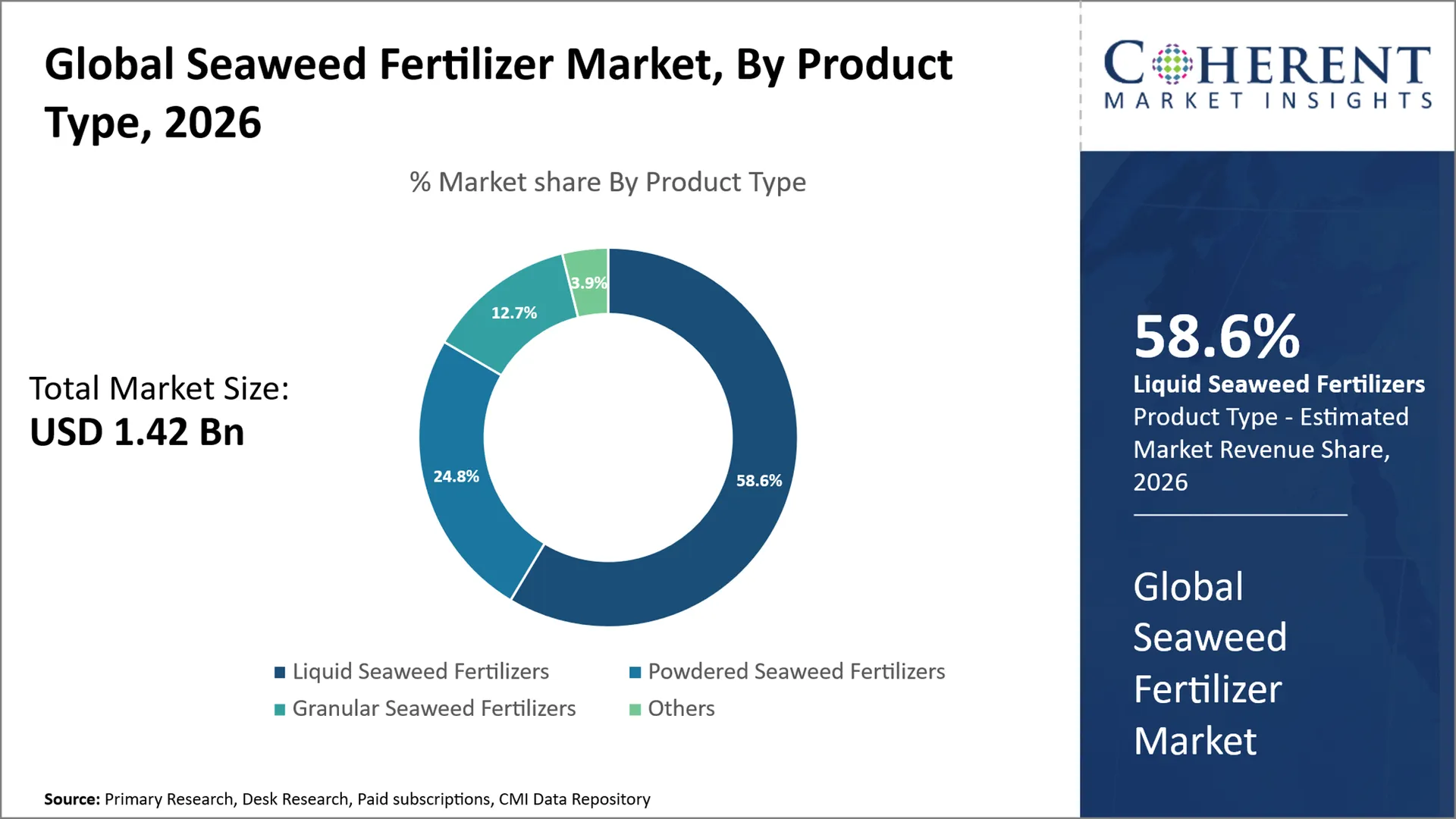
- Liquid Seaweed Fertilizers are projected to expand at an estimated CAGR of 10.8% during 2026–2033 and are expected to hold 58.6% of the global seaweed fertilizer market in 2026. Their lead reflects easy dilution, compatibility with foliar and fertigation equipment, and flexible dosing across crop stages. In February 2025, ACO Certification listed Seasol liquid seaweed processing and packaging under permitted crop fertilizers and soil amendments.
- Brown Seaweed should advance at an estimated CAGR of 10.6% during 2026–2033 while representing 64.8% of the global seaweed fertilizer market in 2026. Its position is reinforced by established use of Ascophyllum nodosum as a concentrated source of bioactive compounds for crop resilience. In July 2025, Syngenta highlighted continued processing of sustainably harvested Ascophyllum nodosum through its ALGEA operations in Norway for agricultural biologicals.
- Foliar Application is forecast to post an estimated CAGR of 11.0% during 2026–2033 and capture 42.8% of the global seaweed fertilizer market in 2026. This method enables targeted treatment at sensitive crop stages and fits existing spray programs. In September 2025, a Frontiers in Plant Science study reported that foliar Ascophyllum nodosum extract applications during flowering significantly increased total fruit yield in pepper and eggplant.
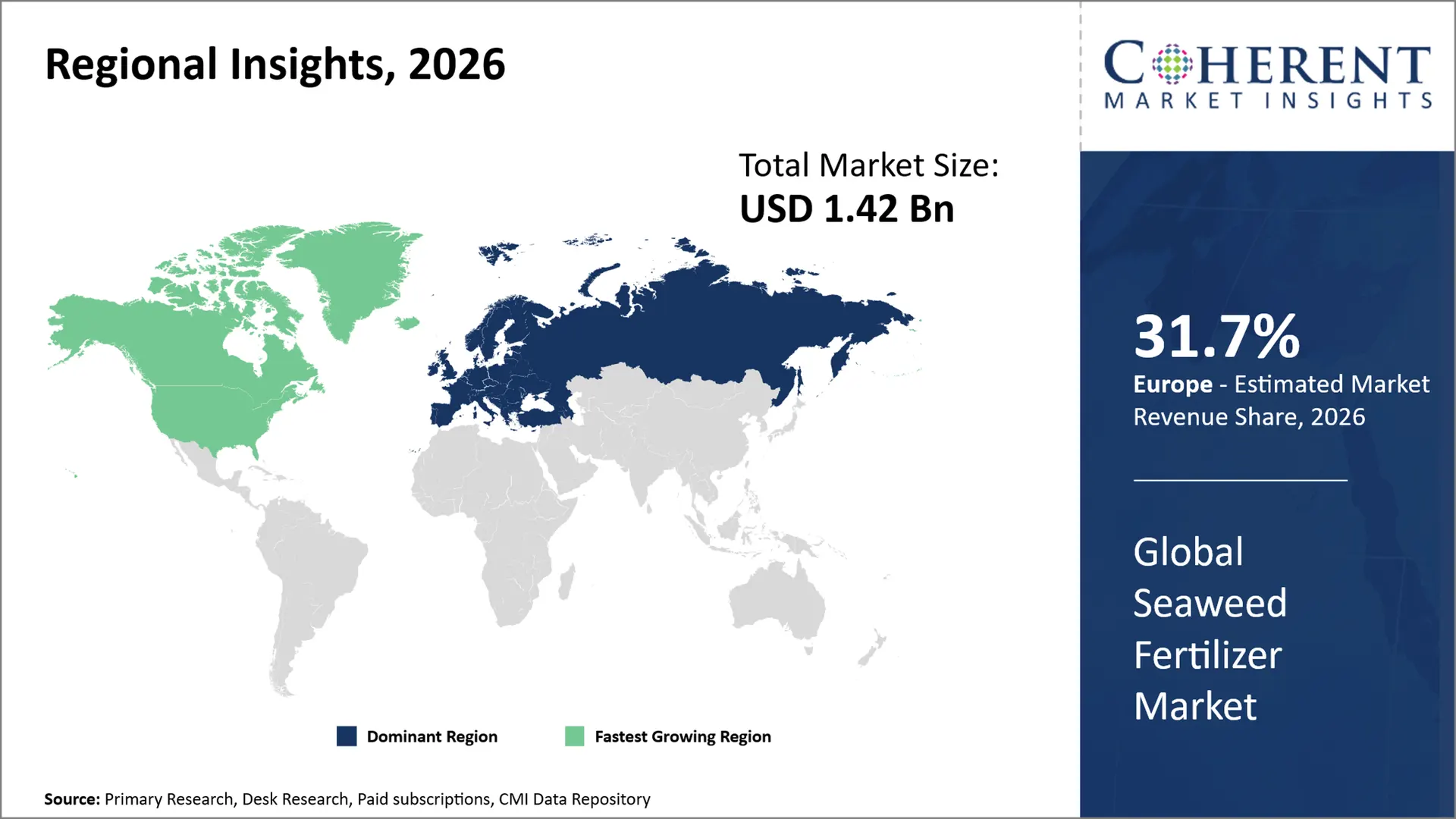
- Europe is anticipated to grow at an estimated CAGR of 9.8% during 2026–2033 while accounting for 31.7% of the global seaweed fertilizer market in 2026. Its leadership is supported by mature biological-input channels, an established plant-biostimulant framework, and active algae value chains. In June 2026, the European Commission’s EU4Algae platform highlighted increasing adoption of seaweed-derived biostimulants and biofertilisers across Europe through the I3-4-Seaweed initiative.
- North America is expected to register an estimated CAGR of 11.7% during 2026–2033 and hold 26.8% of the global seaweed fertilizer market in 2026. Growth is supported by biological-input adoption and efforts to strengthen domestic seaweed supply chains. In September 2025, USDA ARS began a project to improve U.S. seaweed farming for biostimulants, soil amendments, and other commercial products.
Current Events and their Impact
Current Event | Description and Its Impact |
India Ends Provisional Biostimulant Registrations – June 2025 |
|
Canada Adds Seaweed Meal to Registration-Exempt Materials – March 2026 |
|
EU Introduces Digital Labelling Framework for Fertilising Products – September 2024 |
|
Segmental Insights
- Current Industry Events of 2026
- Market Size Estimation
- Regional Breakdown
- Competitive Landscape
- Customer Intelligence
- Segmental Analysis
- Pricing Analysis
- Key Market Drivers, Challenges & Future Trends
- Customized Insights Section
Why Do Liquid Seaweed Fertilizers Dominate the Product Type Segment of the Global Seaweed Fertilizer Market?
Liquid Seaweed Fertilizers are expected to account for 58.6% of the global seaweed fertilizer market by product type in 2026. Their dominance is supported by strong compatibility with modern farming practices, including foliar spraying, drip irrigation, and fertigation systems, enabling growers to apply bioactive compounds efficiently across different crop stages. Liquid formulations also provide advantages such as easier mixing, faster field application, improved handling, and suitability for customized crop-specific solutions. Manufacturers benefit from lower application barriers and broader distribution opportunities across commercial farms, horticulture operations, and organic farming channels. The format is particularly attractive where growers require frequent applications for stress management, root development, and crop-quality improvement. In March 2025, Valagro expanded its biostimulant portfolio with liquid formulations designed for sustainable crop nutrition, strengthening the commercial availability of liquid biological inputs for professional agriculture.
Why Does Brown Seaweed Growing the Global Seaweed Fertilizer Market?
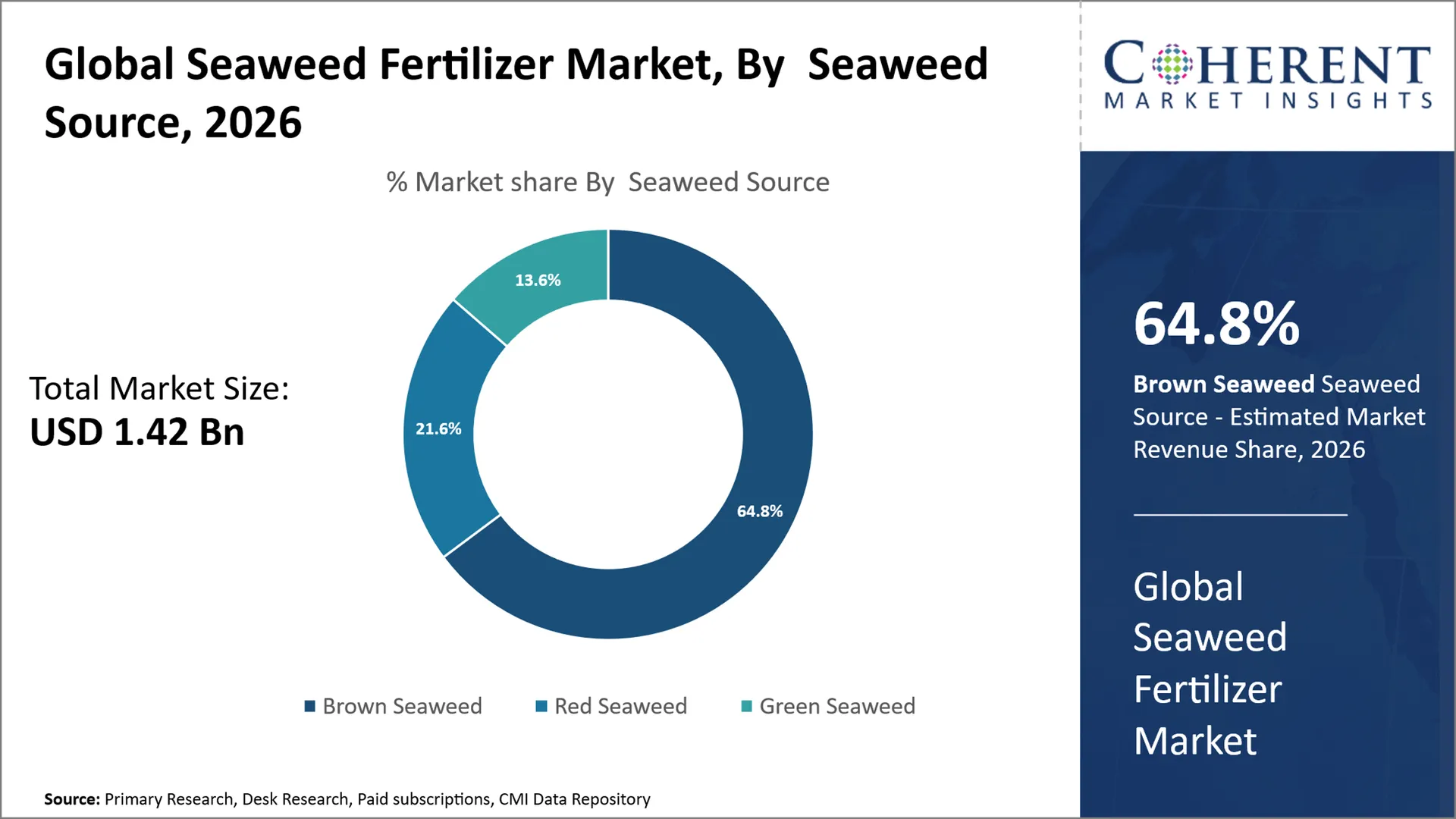
Brown Seaweed is expected to account for 64.8% of the global seaweed fertilizer market by seaweed source in 2026. Its leadership reflects the commercial maturity of brown macroalgae such as Ascophyllum nodosum and Sargassum, whose polysaccharides, alginates, mannitol, and other bioactive fractions are well suited to concentrated agricultural extracts. Established harvesting and extraction know-how also gives formulators greater control over product consistency, solubility, and compatibility with liquid, powder, and blended fertilizer systems. For manufacturers, this creates scope for differentiated biostimulant formulations rather than competition based only on nutrient content. Commercial demand is strongest where growers require stress-management and nutrient-efficiency support within existing fertility programs. In February 2026, CSIR-CSMCRI transferred a liquid seaweed plant biostimulant technology produced from brown Sargassum algae to Jagrit Chemicals & Fertilizers for commercialization in India.
Why Does Foliar Application Represent the Largest Application Method in the Global Seaweed Fertilizer Market?
Foliar Application is projected to hold 42.8% of the global seaweed fertilizer market by application method in 2026. Its lead comes from operational fit: growers can place seaweed-based inputs directly into established spray schedules and target flowering, fruit set, or stress periods without modifying irrigation infrastructure. Leaf-directed delivery also supports relatively low application volumes and allows commercial farms to coordinate biostimulants with other crop-management passes, improving labor and equipment efficiency. For suppliers, this favors highly soluble, low-residue formulations with reliable tank-mix behavior and precise crop-stage recommendations. Adoption is particularly relevant where timely physiological intervention matters. In August 2025, India’s Fertiliser Control Order amendment added an Ascophyllum nodosum seaweed-extract specification with formal foliar-use directions, including applications on groundnut, providing regulatory recognition of foliar seaweed-biostimulant deployment within commercial crop programs.
Global Seaweed Fertilizer Market Dynamics
Key Market Drivers
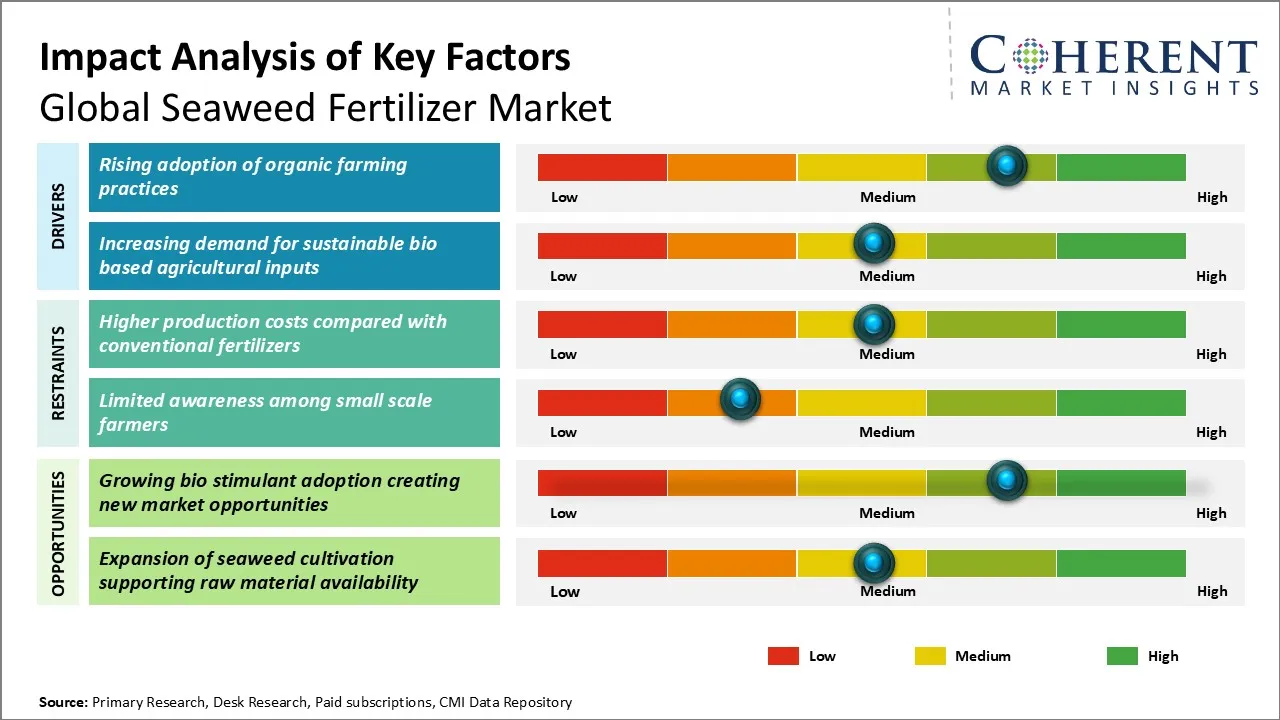
- Rising Adoption of Organic Farming Practices: Organic production systems restrict many conventional input choices, creating a larger addressable base for naturally derived crop-support products such as seaweed fertilizers and biostimulants. As certified acreage and organic food demand remain substantial, growers need inputs that can support nutrient-use efficiency, root activity, and stress management while fitting organic-compliant programs. These benefits certified seaweed extract suppliers, organic fertilizer formulators, distributors, and specialty-crop advisers. In February 2026, FiBL and IFOAM reported that global organic farmland remained near 99 million hectares in 2024 and organic retail sales rose to USD 166.23billion, reinforcing the commercial scale of the addressable farming base.
- Increasing Demand for Sustainable Bio Based Agricultural Inputs: Pressure to reduce dependence on resource-intensive crop inputs is expanding the role of seaweed-derived products beyond traditional organic niches and into broader nutrient-management programs. Seaweed fertilizers can be positioned as complementary biological inputs where growers seek better nutrient uptake, stress tolerance, and soil function without simply increasing conventional fertilizer rates. This creates opportunities for extract processors, formulation specialists, agricultural distributors, and seaweed cultivators. In July 2026, the World Bank, The Nature Conservancy, and Hatch Blue published a dedicated seaweed-biostimulant report emphasizing their potential to support plant and soil health while reducing dependence on synthetic fertilizers.
Emerging Market Trends
- Shift from Generic Seaweed Extracts to Function-Specific Crop Solutions: Seaweed fertilizer development is moving from broad plant-tonic positioning toward formulations designed around specific physiological outcomes such as nutrient-use efficiency, heat tolerance, salinity response, rooting, or reproductive-stage support. This shift encourages suppliers to differentiate by extraction profile, bioactive characterization, crop timing, and validated mode of action rather than by seaweed concentration alone. Formulators and agronomic specialists stand to gain, while undifferentiated extract suppliers may face pricing pressure. During the forecast period, product portfolios are likely to become more crop-specific and problem-specific, supporting stronger value-based selling.
- Traceability and Agronomic Evidence Becoming Procurement Filters: Buyer evaluation is becoming more evidence-led, with greater attention to raw-seaweed origin, harvesting method, extraction consistency, contaminant control, shelf stability, and repeatable field response. This changes procurement from a simple comparison of liquid or powder products toward scrutiny of traceability and formulation reproducibility. Suppliers with standardized biomass sourcing, documented quality systems, and multi-location agronomic validation should gain credibility with distributors and commercial growers. The trend is likely to raise development and compliance costs, but it can also support premium positioning and reduce the advantage of low-cost products built mainly on broad biological claims.
Regional Insights
Why Does Europe Dominate the Global Seaweed Fertilizer Market?
Europe is expected to account for 31.7% of the global seaweed fertilizer market in 2026, supported by an established plant-biostimulant ecosystem, harmonized EU fertilising-product rules, high adoption of biological crop inputs, and strong demand from horticulture, vineyards, fruit production, and other high-value crops. The region also benefits from active marine-biomass innovation, experienced biological-input distributors, and grower interest in improving nutrient-use efficiency and abiotic-stress management without materially increasing conventional fertilizer intensity. Market leadership is reinforced by easier cross-border commercialization of compliant biostimulants within the EU market. This regulatory-commercial combination supports higher-value seaweed formulations rather than commodity positioning. In December 2025, Rovensa Next launched Myndra across Europe, an Ascophyllum nodosum-based biostimulant recognized under the EU Fertilising Products Regulation for EU-wide commercialization.
Why Is North America Emerging as the Fastest-Growing Region in the Global Seaweed Fertilizer Market?
North America is expected to hold 26.8% of the global seaweed fertilizer market in 2026 and emerge as the fastest-growing region as biological crop inputs move into broader commercial agriculture. Growth is supported by expanding seaweed cultivation and processing capability, strong specialty-crop and row-crop input channels, and greater interest in tools that improve crop resilience under drought, salinity, heat, and nutrient-efficiency pressure. Unlike Europe, where regulatory harmonization is a major structural advantage, North America’s growth case is increasingly linked to domestic feedstock development and commercialization of locally produced marine biomass. This can shorten supply chains and improve formulation economics for regional suppliers. In June 2025, Canada’s National Research Council supported a Newfoundland project designed to develop and validate a commercially viable seaweed-based biostimulant through cultivation, processing, efficacy testing, and commercialization.
Global Seaweed Fertilizer Market Outlook for Key Countries
Why Is the U.S. a Key Market for the Global Seaweed Fertilizer Market?
The U.S. is a key global seaweed fertilizer market because it combines a large commercial farming base with advanced biological-input distribution, strong agricultural research capacity, and increasing interest in reducing nutrient losses while maintaining crop productivity. The opportunity extends beyond high-value horticulture into row crops if suppliers can demonstrate consistent field performance, compatibility with existing fertilizer programs, and cost-effective application at scale. Domestic seaweed production is also strategically relevant because imported biomass and extracts can expose formulators to supply and freight variability. Federal innovation programs are beginning to connect offshore seaweed cultivation directly with agricultural applications. In January 2025, the U.S. Department of Energy’s ARPA-E launched the HAEJO program, explicitly identifying agricultural biostimulants as a target market for scaled domestic seaweed biomass and research aimed at reducing reliance on synthetic fertilizers.
Why Does China Support Growth in the Global Seaweed Fertilizer Market?
China supports growth in the global seaweed fertilizer market through its extensive crop-production base, coastal seaweed resources, established algae-processing capability, and significant need for technologies suited to saline and alkaline agricultural soils. These conditions create commercial space for seaweed fertilizers in cereals, vegetables, protected cultivation, and soil-management programs where nutrient uptake and stress resilience are important purchasing considerations. China also possesses the processing and formulation infrastructure required to move marine biomass into standardized agricultural products at industrial scale. Domestic research is strengthening the technical rationale for these applications. In July 2025, researchers from Qingdao Agricultural University published results showing that seaweed fertilizer, alone and alongside biochar, could improve chemical and microbial soil properties and support maize growth in coastal saline-alkali soils, demonstrating a highly relevant domestic application pathway.
Why Is Japan Important in the Global Seaweed Fertilizer Market?
Japan is important in the global seaweed fertilizer market because its agriculture is concentrated in high-value crops where input efficiency, crop quality, stress management, and precise application can justify premium biological products. The country also has deep familiarity with marine resources and a sophisticated agricultural-input market that places strong emphasis on product evidence, clear claims, safety, and agronomic reliability. These characteristics favor standardized seaweed-based biostimulants with defined functions rather than broadly positioned organic crop tonics. Regulatory clarity is particularly important because it can strengthen farmer confidence while requiring suppliers to substantiate efficacy claims. In May 2025, Japan’s Ministry of Agriculture, Forestry and Fisheries issued national guidelines covering biostimulant definitions, efficacy evidence, usage claims, labeling, and safety considerations, creating a clearer commercialization framework for seaweed-derived and other biological agricultural inputs.
Why Is Chile an Important Growth Market for the Global Seaweed Fertilizer Market?
Chile is an important growth market in the global seaweed fertilizer market because it combines commercially important fruit and horticultural production with abundant marine biomass and growing exposure to water scarcity, heat, salinity, and other abiotic stresses. This creates a distinctive local value proposition: converting coastal algae into higher-value agricultural inputs for orchards, vineyards, vegetables, and arid-zone production. Chile also offers favorable conditions for circular-economy models in which locally available macroalgae or marine residues become biostimulants and soil-conditioning products, reducing dependence on imported specialty inputs. Public agricultural research is actively exploring this pathway. In December 2025, Chile’s INIA reported that its Intihuasi center was advancing a Coquimbo project to convert stranded macroalgal residues, particularly Sarcodiotheca gaudichaudii, into an agricultural biostimulant for crop development in arid zones, with hydroponic validation underway.
Technology Adoption Landscape for Seaweed Extraction and Formulation Innovation
Technology | Adoption Landscape | Role in Seaweed Fertilizer Production | Commercial Implication |
Low-Temperature Physical Extraction | Increasingly important in premium seaweed extracts | Limits excessive thermal degradation while releasing soluble marine bioactives from harvested biomass | Supports differentiation based on retained biological functionality and formulation quality |
Enzyme-Assisted Extraction | Emerging in higher-value biostimulant processing | Uses selected enzymes to release polysaccharides and other functional fractions under relatively mild conditions | Can improve extraction selectivity and create more specialized crop-response formulations |
Fermentation-Based Biotransformation | Developing among biotechnology-led suppliers | Alters or releases bioactive fractions through controlled microbial or enzymatic processes | Enables differentiated products and can support greater consistency than minimally processed biomass |
Membrane Filtration and Controlled Concentration | Growing in industrial-scale liquid formulations | Separates unwanted fractions and concentrates desirable soluble compounds while controlling viscosity and solids | Improves transport economics formulation stability and suitability for concentrated commercial products |
Microencapsulation and Controlled-Release Systems | Early-stage but commercially relevant for advanced formats | Protects sensitive actives and enables more controlled delivery through seed soil or granular applications | Opens opportunities beyond conventional liquid foliar products and improves compatibility with existing input systems |
Multi-Component Biological Formulation Platforms | Expanding within specialty crop nutrition | Combines seaweed-derived compounds with minerals amino acids beneficial microorganisms or complementary biological components | Shifts competition toward formulation know-how compatibility testing and integrated crop-performance solutions |
How Are Seed-Applied and Fertilizer-Coated Seaweed Actives Creating New Growth Opportunities in the Global Seaweed Fertilizer Market?
Applying concentrated seaweed bioactive through seed treatments, in-furrow systems, or coatings on granular fertilizers creates an underdeveloped route into broad-acre crops where standalone foliar programs can be operationally difficult. The opportunity is strategically important because it embeds the biological input into an existing farmer operation, potentially improving convenience, dosing discipline, and distributor acceptance. Cereals, grains, oilseeds, and large commercial farms are priority customer groups, while fertilizer blenders and seed-treatment channels can become important routes to market. Companies can capture the opportunity through highly concentrated, storage-stable formulations that remain compatible with coating polymers, micronutrients, microbes, and conventional crop inputs. Participation requires formulation science, seed-safety testing, shelf-life validation, application-equipment knowledge, and crop-specific efficacy data. The model is likely to favor specialist formulators and established input suppliers that can partner with seed companies, fertilizer manufacturers, and agronomy networks.
Market Players, Key Development, and Competitive Landscape
Key Developments
- In February 2025, Koppert launched Stingray 25 in France, an Ascophyllum nodosum-derived seaweed biostimulant designed to support root development, nutrient uptake, and stress tolerance. The launch expands grower access through an established biological-input channel and strengthens seaweed-based products’ positioning within integrated crop-management programs.
- In October 2025, Ficosterra reported that Terramare obtained European Union FPC 6(A) biostimulant registration, enabling CE-marked commercialization across EU member states. The seaweed-and-microorganism formulation illustrates how regulatory validation can support cross-border distribution, technical differentiation, and greater buyer confidence in complex biological crop-input products.
- In August 2025, Acadian Plant Health reported that Acadian Seaplants (parent company) had added a fifth CE-marked biostimulant under the EU Fertilising Products Regulation. Expanding the compliant portfolio reduces country-by-country global seaweed fertilizer market-access friction and strengthens the commercial value of regulatory-ready seaweed formulations for European distributors and growers.
Competitive Landscape
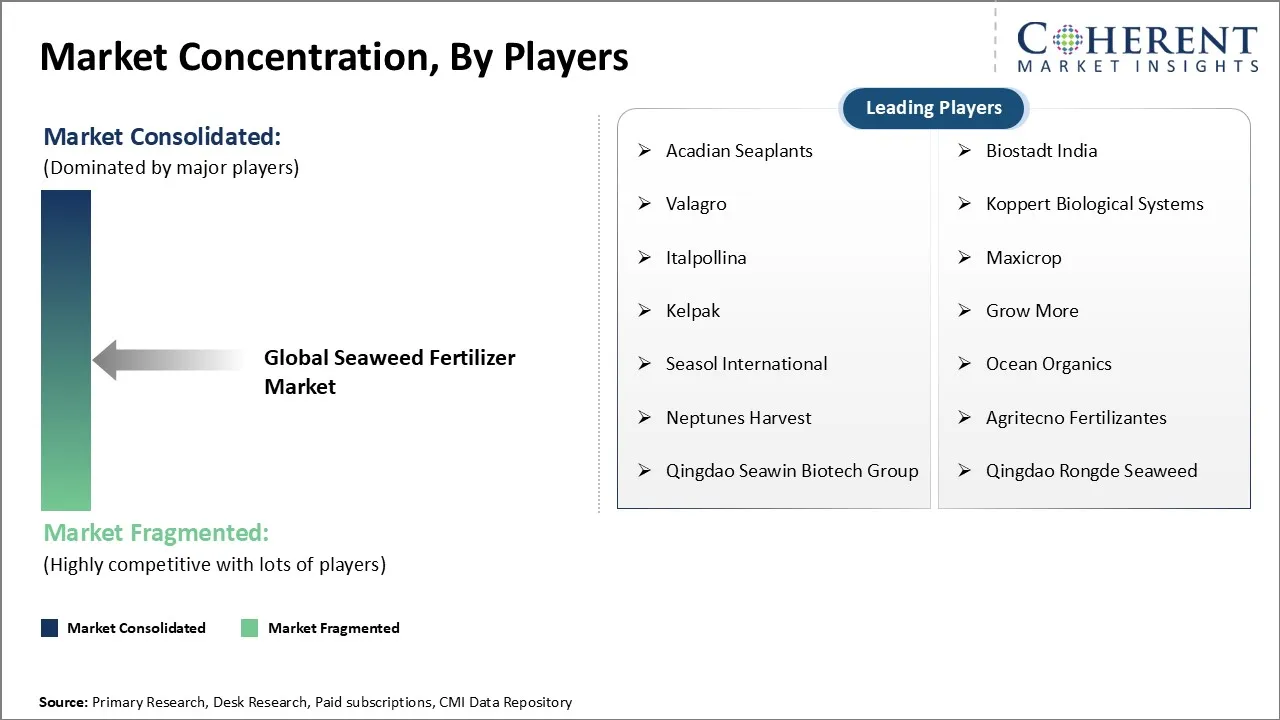
The global seaweed fertilizer market is moderately fragmented, combining specialist marine-biotechnology companies, diversified biological-input suppliers, organic fertilizer producers, and regional formulators. Competition increasingly depends on extract consistency, agronomic validation, regulatory readiness, raw-seaweed security, formulation compatibility, and distributor access rather than price alone. Regional suppliers remain important where local crop knowledge, registration capability, and technical support influence repeat purchasing.
Key focus areas include
- Agronomic performance differentiation: Suppliers increasingly need reproducible crop-response evidence rather than relying solely on seaweed concentration or nutrient content.
- Extraction and formulation capability: Process control influences bioactive consistency solubility stability and suitability for foliar soil fertigation or seed applications.
- Raw-material security: Reliable access to appropriate seaweed species and controlled harvesting conditions reduces batch variability and supply disruption.
- Regulatory readiness: Technical dossiers labeling quality assurance and efficacy substantiation increasingly determine access to higher-value agricultural markets.
- Distribution reach: Agricultural dealers agronomists fertilizer blenders and specialist distributors remain important for grower education and repeat adoption.
- Application compatibility: Tank-mix stability fertigation suitability and integration with existing fertilizer programs can materially influence commercial acceptance.
- Technical customer support: Crop-specific recommendations field demonstrations and troubleshooting are becoming important tools for retaining professional growers.
Market Report Scope
Seaweed Fertilizer Market Report Coverage | |||
Report Coverage | Details | ||
Base Year | 2025 | Market Size in 2026: | USD 1.42 Bn |
Historical Data For: | 2020 To 2024 | Forecast Period: | 2026 To 2033 |
Forecast Period 2026 To 2033 CAGR: | 10.4% | 2033 Value Projection: | USD 2.84 Bn |
Geographies covered: |
| ||
Segments covered: |
| ||
Companies covered: | Acadian Seaplants, Biostadt India, Valagro, Koppert Biological Systems, Italpollina, Maxicrop, Kelpak, Grow More, Seasol International, Ocean Organics, Neptunes Harvest, Agritecno Fertilizantes, Qingdao Seawin Biotech Group, Qingdao Rongde Seaweed | ||
Growth Drivers: |
| ||
Restraints & Challenges: |
| ||
Analyst Opinion (Expert Opinion)
- The global seaweed fertilizer market competition is likely to migrate from extract-centric portfolios toward agronomic outcome platforms that combine formulations with application protocols compatibility guidance and field support. As commercial growers demand greater repeatability the strongest market positions should increasingly belong to suppliers that can translate marine bioactive chemistry into crop-specific recommendations rather than simply sell concentrated seaweed material.
- Cultivated seaweed supply and multi-output biorefinery models could materially change feedstock economics. Greater reliance on controlled cultivation may give processors stronger influence over species chemistry harvest timing and raw-material consistency while allowing additional marine fractions to be commercialized. This transition could pressure commodity extract traders and favor vertically coordinated businesses capable of linking cultivation processing formulation and multiple end markets.
- Market participants should prioritize crop-specific efficacy dossiers extraction reproducibility application compatibility and distributor technical training. Margin pressure will be greatest where products compete mainly on concentration or price. Suppliers should diversify seaweed sourcing develop local regulatory expertise and build partnerships with fertilizer blenders seed-treatment providers and agronomy networks while avoiding excessive investment in undifferentiated capacity before repeatable field performance and route-to-market economics are proven.
Speak to the analyst
Want personalized insights?
Take the findings above to one of our principal consultants, or have the report rebuilt around the segments, geographies and competitors you actually track.
Market Segmentation
- Product Type Insights (Revenue, USD Bn, 2021 - 2033)
- Liquid Seaweed Fertilizers
- Powdered Seaweed Fertilizers
- Granular Seaweed Fertilizers
- Others
- Seaweed Source Insights (Revenue, USD Bn, 2021 - 2033)
- Brown Seaweed
- Red Seaweed
- Green Seaweed
- Application Method Insights (Revenue, USD Bn, 2021 - 2033)
- Foliar Application
- Soil Application
- Seed Treatment
- Fertigation
- Crop Type Insights (Revenue, USD Bn, 2021 - 2033)
- Fruits and Vegetables
- Cereals and Grains
- Horticulture Crops
- Turf and Ornamentals
- Others
- End User Insights (Revenue, USD Bn, 2021 - 2033)
- Commercial Farmers
- Horticulture Growers
- Organic Farming Operators
- Home Gardening
- Distribution Channel Insights (Revenue, USD Bn, 2021 - 2033)
- Agricultural Retail Stores
- Agricultural Retail Stores
- Online Retail
- Others
- Regional Insights (Revenue, USD Bn, 2021 - 2033)
- North America
- U.S.
- Canada
- Latin America
- Brazil
- Argentina
- Mexico
- Rest of Latin America
- Europe
- Germany
- U.K.
- Spain
- France
- Italy
- Russia
- Rest of Europe
- Asia Pacific
- China
- India
- Japan
- Australia
- South Korea
- ASEAN
- Rest of Asia Pacific
- Middle East
- GCC Countries
- Israel
- Rest of Middle East
- Africa
- South Africa
- North Africa
- Central Africa
- North America
- Key Players Insights
- Acadian Seaplants
- Biostadt India
- Valagro
- Koppert Biological Systems
- Italpollina
- Maxicrop
- Kelpak
- Grow More
- Seasol International
- Ocean Organics
- Neptunes Harvest
- Agritecno Fertilizantes
- Qingdao Seawin Biotech Group
- Qingdao Rongde Seaweed
Sources
Primary Research Interviews
- Seaweed fertilizer manufacturers, biostimulant producers, organic fertilizer companies, distributors, agricultural input suppliers, and commercial farmers
- Agronomists, crop consultants, horticulture specialists, soil scientists, marine biotechnology experts, and sustainable agriculture professionals
Stakeholders
- Seaweed fertilizer manufacturers, marine biomass processors, biostimulant companies, organic input suppliers, and agricultural biotechnology firms
- Seaweed harvesters, extraction technology providers, fertilizer blenders, distributors, retailers, and e-commerce agricultural platforms
- Commercial farmers, horticulture growers, organic farming operators, greenhouse operators, and agricultural cooperatives
End-use Sectors
- Commercial agriculture and crop nutrition applications
- Fruits and vegetables cultivation
- Cereals and grains production
- Organic farming and sustainable agriculture systems
- Horticulture, turf, and specialty crop applications
Regulatory and Industry Bodies
- Agricultural ministries and fertilizer regulatory authorities
- Organic farming certification organizations
- Plant biostimulant regulatory bodies
- Sustainable agriculture and marine resource management organizations
- Fertilizer and crop nutrition industry associations
Databases
- Company annual reports, investor presentations, and corporate filings
- Agricultural input and biostimulant product databases
- Fertilizer trade statistics and import-export datasets
- Crop production, organic farming, and agricultural consumption databases
- Seaweed cultivation and marine biomass production databases
- Product portfolio and competitive intelligence databases
Magazines and Journals
- Agricultural science and crop nutrition publications
- Plant biostimulant and soil health journals
- Marine biotechnology and seaweed research publications
- Organic farming and sustainable agriculture journals
- Fertilizer industry and agribusiness publications
Associations
- International Federation of Organic Agriculture Movements (IFOAM Organics International)
- International Fertilizer Association (IFA)
- European Biostimulants Industry Council (EBIC)
- Seaweed industry associations
- National agricultural and horticulture associations
Public Domain Sources
- Organic farming adoption trends and sustainable agriculture developments
- Seaweed cultivation and marine biomass utilization initiatives
- Crop nutrition innovation and biological input advancements
- Agricultural sustainability programs and government initiatives
- Fertilizer regulation and biostimulant approval developments
Key Standards and Regulations
- Fertilizer registration and biostimulant approval requirements
- Organic input certification standards
- Agricultural product labeling and application guidelines
- Sustainable seaweed harvesting and marine resource regulations
- International trade and import regulations for agricultural inputs
Proprietary Elements
- CMI Data Analytics Tool, Proprietary CMI repository containing 10+ years of agriculture, fertilizer, crop nutrition, sustainability, and industrial biotechnology market intelligence.
Get access to 250+ pages report
Every segment, forecast, competitor profile and data table behind the analysis above — available for instant download.
- ESOMAR Member
- ISO 9001:2015 Certified
- D-U-N-S Registered
- GDPR & CCPA Compliant
Missing comfort of reading report in your local language? Find your preferred language:
Frequently Asked Questions
The CAGR of global seaweed fertilizer market is projected to be 10.4% from 2026 to 2033.
The global seaweed fertilizer market is estimated to be valued at USD 1.42 billion in 2026 and is expected to reach USD 2.84 billion by 2033.
Seaweed fertilizers are available in liquid, powdered, and granular forms, offering different application options based on crop requirements, farming practices, and delivery methods.
Seaweed fertilizers are primarily used for crop nutrition, soil improvement, stress management, plant growth enhancement, and improving overall crop quality across agricultural applications.
Seaweed fertilizers are widely used in fruits and vegetables, cereals and grains, horticulture crops, turf, ornamentals, and other specialty crop applications.
Companies compete through product formulation, extraction technology, raw material sourcing, regulatory approvals, distribution networks, sustainability positioning, and development of crop-specific biological solutions.
The increasing adoption of organic farming practices and growing demand for sustainable bio-based agricultural inputs are the major factors driving the growth of the global seaweed fertilizer market.