

Global Security Automation Market Size and Forecast – 2026 To 2033
The global security automation market is expected to grow from USD 13.50 Bn in 2026 to USD 34.00 Bn by 2033, registering a compound annual growth rate (CAGR) of 12.0% from 2026 to 2033. The global Security Automation market is driven by rising adoption of security orchestration platforms. On September 9, 2025, Cisco introduced Splunk Enterprise Security Essentials Edition and Splunk Enterprise Security Premier Edition, providing customers two agentic AI-powered SecOps options that unify security workflows across threat detection, investigation, and response (TDIR).
Key Takeaways of the Global Security Automation Market
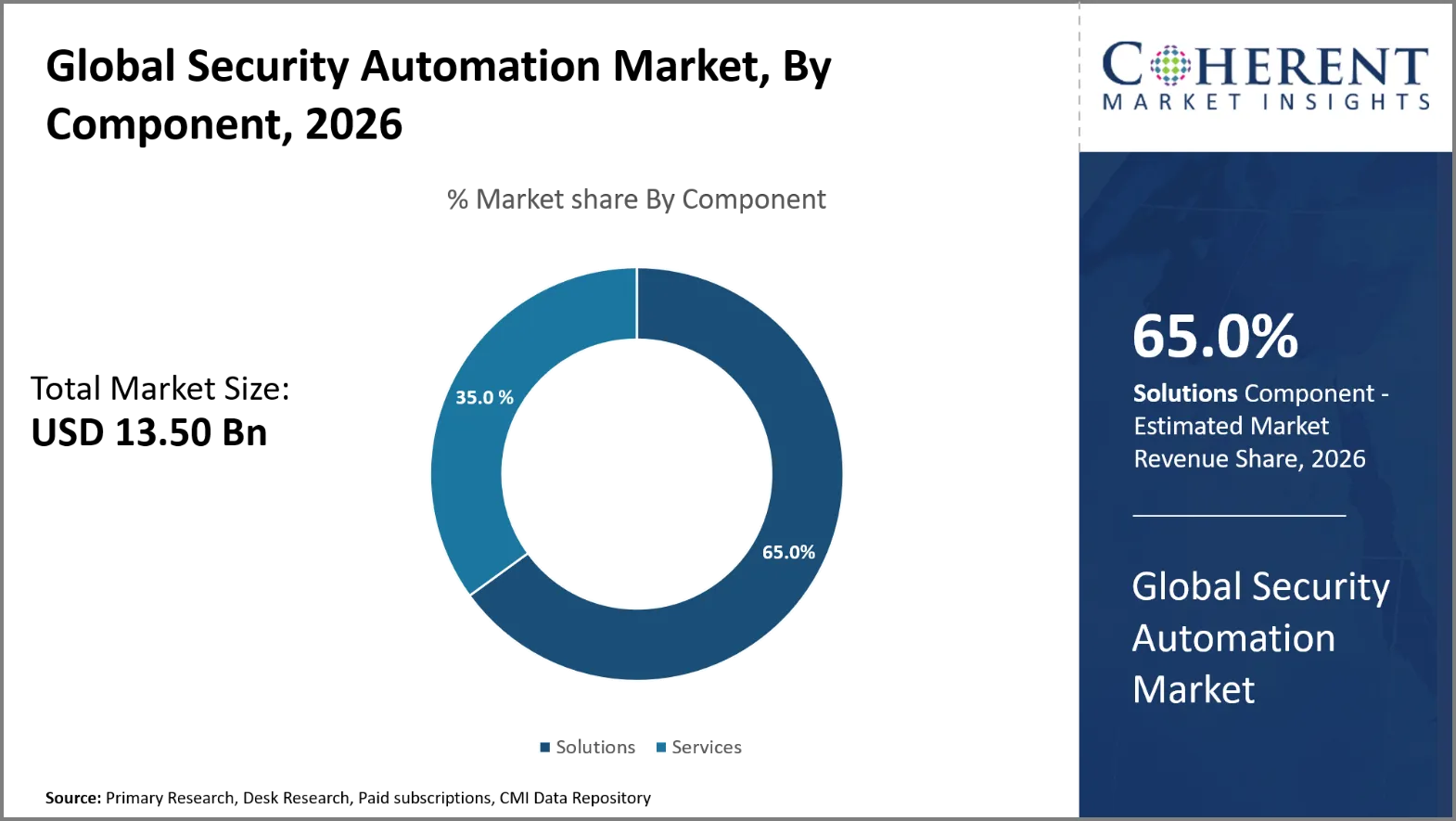
- The Solutions segment is expected to account for 65.0% of the global security automation market share in 2026. Increasing cybersecurity workforce shortages is driving the growth of the segment. On May 7, 2026, ServiceNow launched agents designed to improve security investigations, vulnerability response, and risk management workflows.
- The Cloud-Based segment is estimated to capture 52.0% of the market share in 2026. Growing demand for faster incident response is majorly driving the growth of the segment. On October 8, 2025, PagerDuty introduced agents for incident diagnosis, remediation recommendations, runbook generation, incident summaries, and on-call scheduling.
- The Robotic Process Automation segment is estimated to capture 36.0% of the market share in 2026. Expanding cloud security requirements is driving the growth of the segment. On February 13, 2025, Palo Alto Networks introduced Cortex Cloud by combining cloud detection and response with cloud-native application protection capabilities.
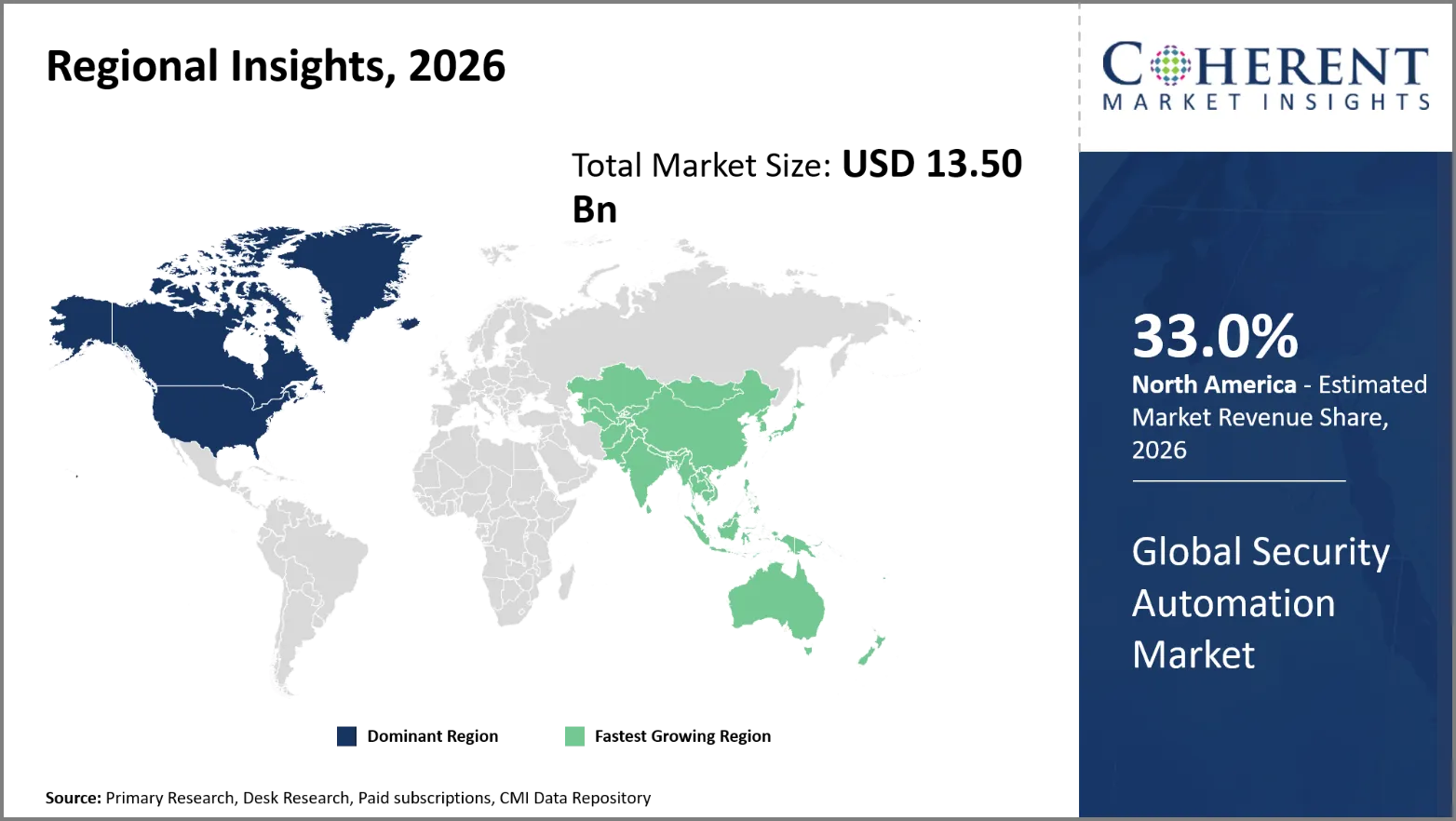
- North America is expected to dominate the security automation market in 2026 with a market share of 33.0%. Increasing adoption of AI in cybersecurity in North America is driving the growth of the regional market. On May 12, 2026, Microsoft announced its multi-model agentic security system, known as MDASH, for automated vulnerability discovery and validation. The system coordinates more than 100 specialized artificial intelligence agents to identify, investigate, and validate software vulnerabilities.
- Asia Pacific is expected to account for 25.0% share in 2026. Rising regulatory compliance requirements in Asia Pacific is driving the growth of the regional market. On January 15, 2026, Cloudflare announced that it had been registered under Japan’s Information System Security Management and Assessment Program. This registration enables Japanese government agencies and regulated organizations to consider its eligible services under applicable government procurement requirements.
Segmental Insights
Why Does Solutions Dominate the Global Security Automation Market?
The solutions segment is expected to account for 65.0% of the global security automation market share in 2026. Organizations want integrated systems that offer automated security monitoring, threat detection, incident response, and compliance management. These systems feature security information and event management, security orchestration, automation and response, and identity management capabilities. Centralized solutions allow security teams to correlate warnings, prioritize risks and reduce manual investigation loads. Organizations can gain from standardized security standards, faster incident containment and more visibility across complex information technology infrastructures. Growing cyber dangers, cloud usage and scattered workforces are also driving need for scalable security solutions.
On April 9, 2025, Google Cloud launched Google Unified Security at its Google Cloud Next event. The platform combines Mandiant capabilities across threat intelligence, security operations, cloud security and secure enterprise browsing.
- Current Industry Events of 2026
- Market Size Estimation
- Regional Breakdown
- Competitive Landscape
- Customer Intelligence
- Segmental Analysis
- Pricing Analysis
- Key Market Drivers, Challenges & Future Trends
- Customized Insights Section
Why is Cloud-Based the Most Preferred Deployment Type?
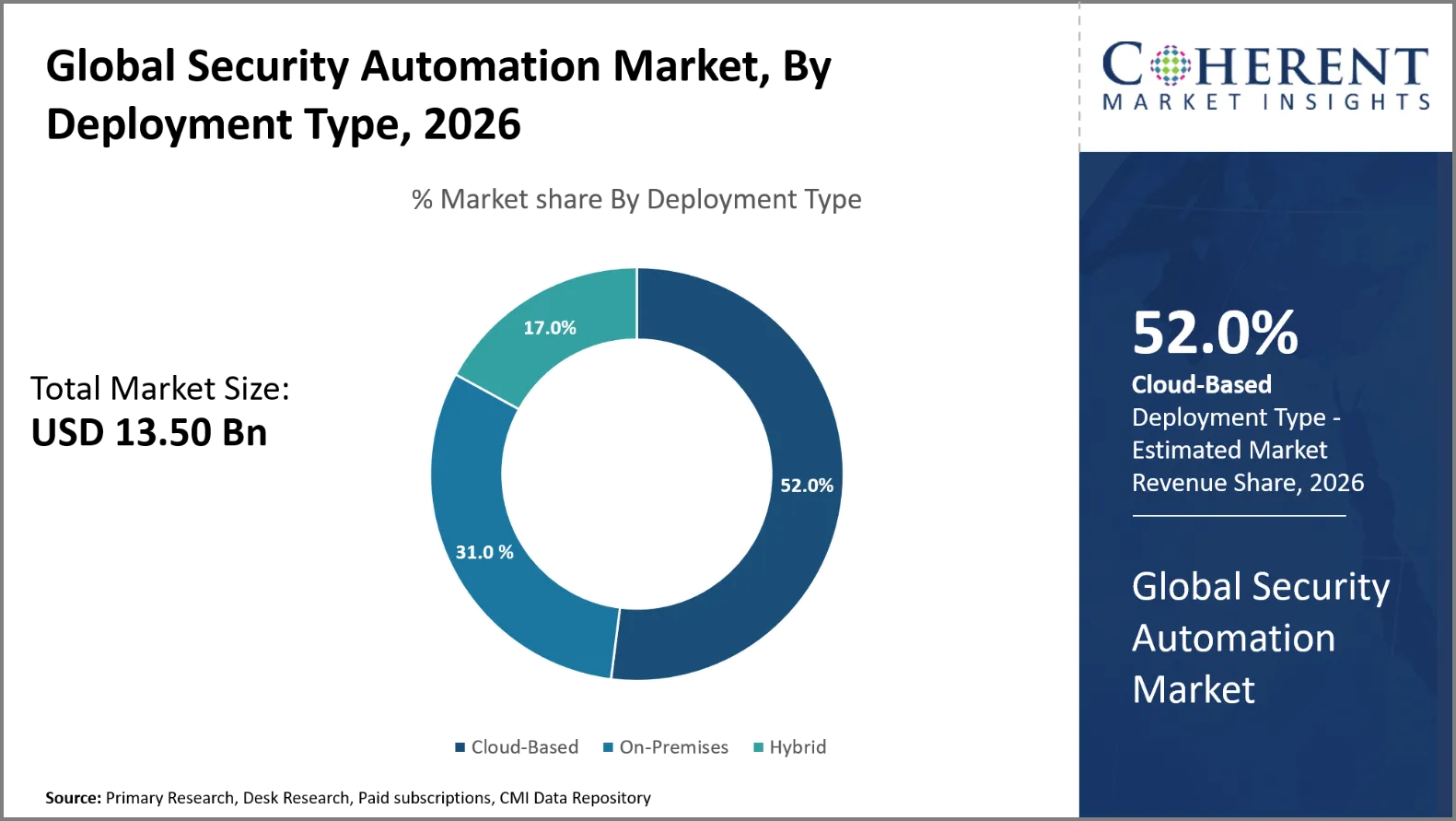
The cloud-based segment is expected to account for 52.0% of the global security automation market share in 2026. Cloud deployment is recommended for its scalability, faster deployments, and flexible access to security capabilities. This enables organizations to automate threat detection and incident response without needing a large on-premises infrastructure. With the cloud platforms, the remote offices, cloud workloads, endpoints and scattered teams across geographies may be centrally monitored. The subscription model also allows firms to manage upfront technology expenses and scale capacity as security needs evolve. Continuous software updates improve access to emerging threat intelligence and automation features.
On April 2, 2025, Wiz announced the general availability of Wiz Defend, the industry’s first threat detection and response solution truly reimagined for the cloud. The platform combines cloud telemetry, runtime signals, threat intelligence, and code-to-cloud context to identify suspicious activity. Automated threat enrichment, investigation graphs, containment playbooks and remediation workflows enable security teams respond faster.
Robotic Process Automation Dominates the Global Security Automation Market
The robotic process automation segment is expected to account for 36.0% of the global security automation market share in 2026. Robotic process automation is a leading technology because it automates repetitive, rule-based security and administrative tasks. Security teams employ software bots to handle user provisioning, execute access requests, reconcile security records and provide compliance reporting. Automation decreases the amount of manual effort, increases the uniformity of processing and allows analysts to focus on complicated investigations. Robotic Process Automation can also incorporate existing applications without requiring large-scale changes to legacy systems. Its relative simplicity of deployment makes it attractive to enterprises looking for measurable operational benefits.
On March 18, 2026, UiPath revealed a security automation feature built with Microsoft. The connection combines UiPath automation with Microsoft Defender for Cloud, Microsoft Sentinel and Microsoft threat intelligence. It automates threat detection, alert enrichment and response procedures across corporate processes.
Current Events and their Impact
Current Events | Description and its Impact |
European Union Network and Information Security Directive 2 (EU) 2022/2555 |
|
European Union Cyber Solidarity Act Regulation (EU) 2025/38 |
|
Security Automation Market Dynamics
Market Drivers
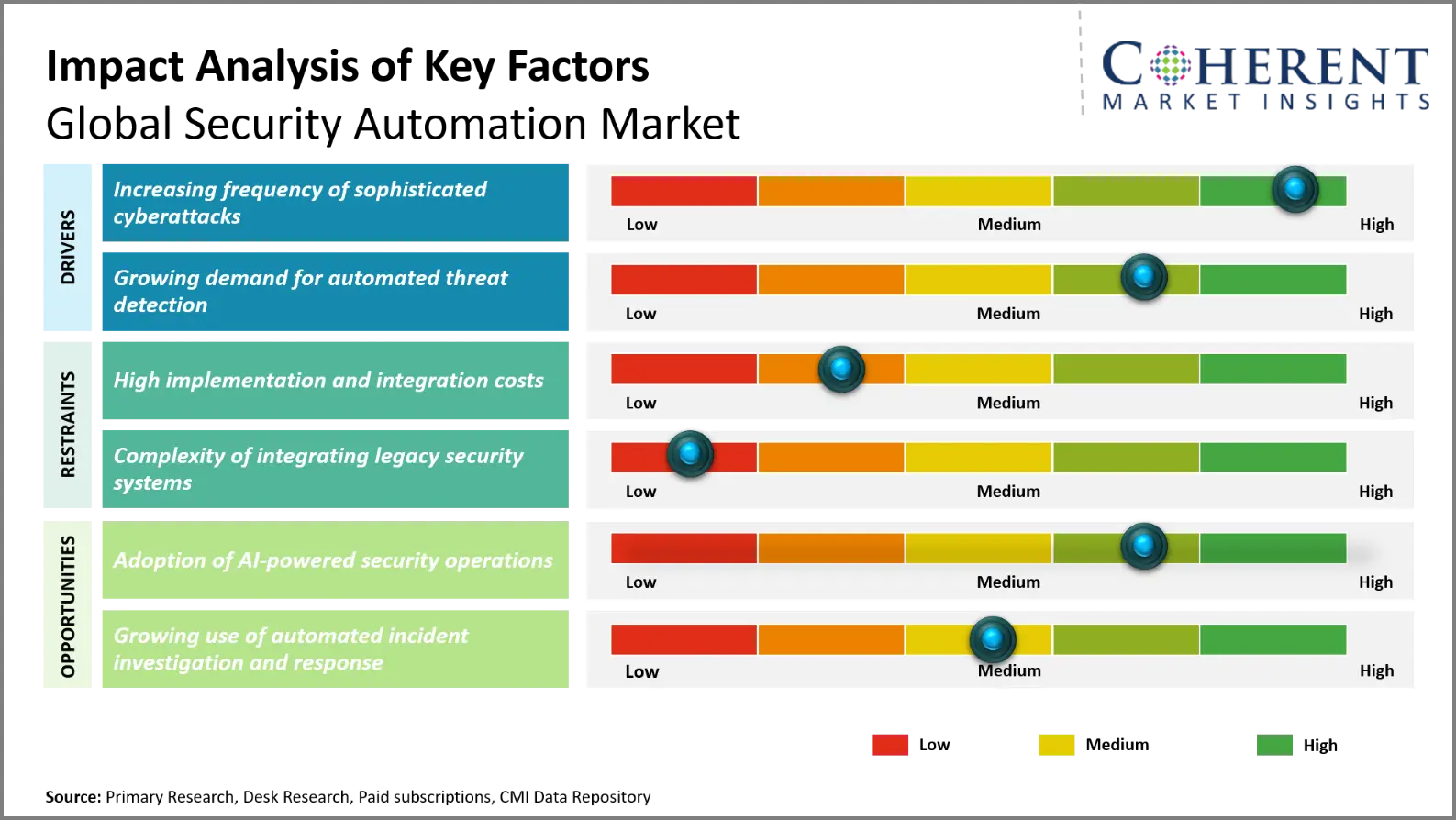
- Increasing frequency of sophisticated cyberattacks: The rising incidence of sophisticated cyberattacks is driving the growth of the global security automation market. Cybercriminals are increasingly targeting enterprise networks with ransomware, phishing, credential theft and AI-powered attacks. Such threats put huge burden on security personnel, and the risk of data breaches and operational disruption is significant. Security automation allows organizations to correlate threat intelligence, prioritize alerts, evaluate suspicious activities and manage incident control. Automated security workflows assist reduce reaction delays while providing more standardization across different IT systems. Attackers are becoming more adaptive, and organizations are boosting their spending in security automation to improve cyber resilience and safeguard critical digital resources.
- On February 24, 2026, CrowdStrike released its 2026 Global Threat Report, revealing that AI is accelerating the adversary and expanding the enterprise attack surface. Average cybercrime breakout time fell to 29 minutes, while the fastest observed breakout took just 27 seconds. AI-powered adversaries have increased their activities 89% YoY, weaponizing AI from reconnaissance to credential theft to evasion.
- Growing demand for automated threat detection: The growing need for automated threat detection is fueling the growth of the global security automation market. Organizations generate vast amounts of security data from endpoints, cloud apps, networks and identity management systems. Manual monitoring is too slow to pick up these signals and to detect complex attack patterns. Automated detection tools parse security event data, connect suspicious actions and prioritize alerts by risk. Integration with security orchestration platforms enables faster investigations and coordinated responses. And as cloud use, remote jobs and digital infrastructure develop, so too grows the need to monitor. Therefore, firms are investing in automated threat detection to improve visibility, reduce analyst effort and improve the ability to detect emerging threats.
- On May 27, 2026, Google Cloud introduced Google AI Threat Defense, an automated cybersecurity tool meant to detect and respond to threats in enterprise environments. The platform examines systems continuously, prioritizing exploitable vulnerabilities, expediting cleanup, and offering ongoing support with threat monitoring.
Emerging Trends
- AI-Driven Security Operations: Behavioral analytics, anomaly detection, threat intelligence correlation, and automated investigation workflows are driving the use of artificial intelligence to help automate security functions. These skills enable security staff to spot elaborate assaults and put high-risk situations first.
- Impact: AI reduces alert fatigue, speeds up threat investigations and increases reaction consistency. But false positives and aggressive manipulation demand continual validation and supervision by humans.
- Relevance to the market: The trend is driving the demand for intelligent security orchestration platforms, automated incident response solutions and AI-enabled security operations centers in enterprise environments.
- Cloud-Native Security Automation: Companies are turning to cloud-native security automation to protect hybrid infrastructure, distributed applications and distant endpoints. Centralized platforms include monitoring, identity controls, vulnerability management, and response protocols.
- Impact: Cloud-native automation delivers increased scalability, consolidated visibility and removes the need for human administration. This enables organizations to respond more uniformly across a range of circumstances and reduces the complexity of security operations management.
- Relevance to the market: This trend is driving demand for cloud-based security automation subscriptions, integrated security platforms, and scalable managed security services for enterprises scaling digital infrastructure.
Regional Insights
Why is North America a Strong Market for Security Automation?
North America is expected to account for a market share of 33.0% in 2026. North America has advanced security operations centers, strong cloud infrastructure and growing investment in automated cyber protection. U.S. firms are turning to security orchestration, automation and response solutions to coordinate incident investigations across endpoints, identities and cloud workloads. In Canada, financial institutions and telecom providers also need automated monitoring and incident management to protect sensitive information. The area has a concentration of cyber security enterprises and enables threat intelligence integration, endpoint detection and automated remediation. Federal cybersecurity directives and critical infrastructure protection requirements also further enable structured security monitoring. Organizations are increasingly focused on decreasing alert fatigue, speeding up investigations, and orchestrating actions across complex enterprise systems.
Why Does Asia Pacific Security Automation Market Exhibit High Growth?
Asia Pacific is expected to register the fastest growth with a CAGR of 12.4% over the forecast period. It is projected to account for 25.0% of the global security automation market in 2026. Digital government activities, burgeoning financial technology ecosystems and national cybersecurity strategies fuel demand for security automation in Asia Pacific. Singapore’s Cybersecurity Strategy 2026 stresses on safeguarding vital infrastructure, AI-driven cyber defense and consolidated threat detection capabilities. Australia’s 2025 Commonwealth Cyber Security Posture report indicated that 82% of surveyed government institutions had cybersecurity strategy. They promote automated monitoring, vulnerability prioritization and incident co-ordination across public services. India’s digital public infrastructure is growing, but that means more demands for identity protection and ongoing surveillance for security. Regional providers can help meet these objectives with managed detection services, automated compliance workflows and cloud-based security systems.
Global Security Automation Market Outlook for Key Countries
Why is U.S. Emerging as a Major Hub in the Security Automation Market?
The market for security automation is driven by U.S. federal zero trust goals and the requirement to protect operational IT infrastructures. In April 2026, the Cybersecurity and Infrastructure Security Agency and federal partners issued guidance on how to apply zero-trust concepts to operational technology. The guidance centers on asset visibility, safe supply chains and effective identification controls. These requirements result in a need for automated device detection, access verification and threat monitoring across industrial networks. Automation can help federal agencies and critical infrastructure operators correlate security events and orchestrate actions without depending solely on human inquiry. Vendors that blend information technology and operational technology security will find possibilities to meet these particular needs.
Is China the Next Growth Engine for the Security Automation Market?
China’s security automation market is driven by the need to regulate network data, protect vital information infrastructure, and its own cybersecurity compliance regulations. The Network Data Security Management Regulations issued by the State Council with Order No. 790 came into force on January 1, 2025. These rules include processing of network data, protection of personal information and management of vital data. Thus, organizations that deal with sensitive information need more insight into data access, processing operations and security issues. Automated data classification, access monitoring and compliance evidence gathering can assist in meeting these operational requirements. Such relevant users include financial institutions, telecommunications operators, internet platforms, industrial firms, etc. Providers also need to consider China's unique regulatory framework and related indigenous technological needs.
Germany Security Automation Market Analysis and Trends
Germany's security automation industry is shaped by industrial cybersecurity, production continuity, and increasing ransomware exposure. The German government’s 2025 cybercrime report reveals nearly 334,000 cases of cybercrime, with ransomware assaults increasing by 10% year over year. There was also a 25% increase in distributed denial-of-service attacks. These shifts signal security challenges for industries, government institutions and logistical companies. Automated endpoint monitoring, operational technology threat detection and ransomware containment can help organizations limit disruption. In German industry there is a special need for security tools that protect production systems without causing unnecessary interruptions to operations. These criteria can be met with industrial asset visibility and orchestrated incident response from suppliers.
U.K. Security Automation Market Analysis and Trends
The U.K. government’s cybersecurity monitoring for critical services and organized security assessment processes drives the growth of the security automation market. The National Cyber Security Centre’s Cyber Assessment Framework version 4.0 looks at governance, risk management, asset management, supply-chain security, security monitoring and threat hunting. The assessment objectives motivate the operator to build measurable controls and to spot suspicious activity that affects critical functions. Electricity providers, healthcare organizations, transport operators and public services may benefit from automated asset inventories, ongoing surveillance, and threat-hunting workflows to help execute these policies. Integration with incident management systems also helps with investigative uniformity. Security suppliers that provide assessment-ready reporting and monitoring capabilities can address enterprises that require demonstrable operational resilience.
Japan Security Automation Market Analysis and Trends
Japan’s security automation industry is driven by supply-chain risk, sophisticated manufacturing and the need to increase cybersecurity among smaller suppliers. On October 26, 2026, Japan’s Prime Minister’s Office stated it will speed up evaluations of vulnerabilities with the help of artificial intelligence, and will set up surveillance of cyberattacks on supply chains. The announcement also referred to cooperation among companies, local governments and related support groups. These activities drive demand for automated vulnerability detection, supplier risk management, and coordinated incident alerts. Manufacturers need visibility that extends beyond their own internal networks. Weaknesses in suppliers can impact production and the exchange of information. Security vendors can give major manufacturers and the smaller linked enterprises scalability assessments and centralized monitoring.
Global Security Automation Market - Security Automation Adoption Rate by Country (2025)
Country | Adoption Rate |
U.S. | 74% |
Singapore | 71% |
Germany | 67% |
U.K. | 62% |
Italy | 55% |
France | 52% |
Australia | 100% |
India | 43% |
Japan | 74% |
Sweden | 68% |
How is Adoption of AI-Powered Security Operations Creating New Growth Opportunities in the Security Automation Market?
Growth opportunities are being generated by the adoption of artificial intelligence-powered security operations in the Global Security Automation Market. It permits security teams to automate complex investigations and respond to changing threats. Security operations centers are increasingly using artificial intelligence to correlate endpoint telemetry, identity logs, cloud activities and threat information into unified incident investigations. For example, Microsoft Security Copilot facilitates analyst investigations and response workflows throughout Microsoft’s security ecosystem; Google Security Operations uses generative artificial intelligence for security investigations and threat hunting. These capabilities necessitate automated alarm triage, investigation summaries, action recommendations, and coordinated remediation. Vendors can set their solutions apart through explainable judgments, trustworthy integrations, and measurable savings in analyst burden.
For instance, Google’s Security Operations Threat Hunt Agent leverages Gemini to assist with proactive threat hunting. Microsoft’s Security Copilot agents automate alert triage and investigation chores. These improvements open potential for vendors who provide configurable automation, integration with existing security systems, and human-approved repair. Enterprise should focus on technologies that enable auditable actions, transparent rationale and demonstrable operational benefits.
Market Players, Key Development, and Competitive Intelligence
Key Developments
- On September 9, 2026, Zscaler, Inc. introduced Zscaler Agentic SOC, a new approach to security operations built to proactively reduce exposures, scale human expertise and stop AI-driven attacks at machine speed. Zscaler is delivering a new solution to the security operations center (SOC), purpose-built from the ground up with an AI-first approach to detect, investigate, and stop threats at machine speed.
- On April 15, 2026, IBM introduced IBM Autonomous Security, a multi-agent‑powered service designed to deliver coordinated decision making, response and intelligence at machine speed. IBM Autonomous Security brings together interoperable, vendor-agnostic digital workers that operate across an organization's full security stack, enabling security programs to act as a system rather than a collection of disconnected tools.
- On January 21, 2026, Check Point Software Technologies Ltd. introduced Check Point Exposure Management, a new approach designed to help organizations defend against AI-era attacks by turning fragmented exposure data into prioritized, actionable, and safe remediation.
Competitive Landscape
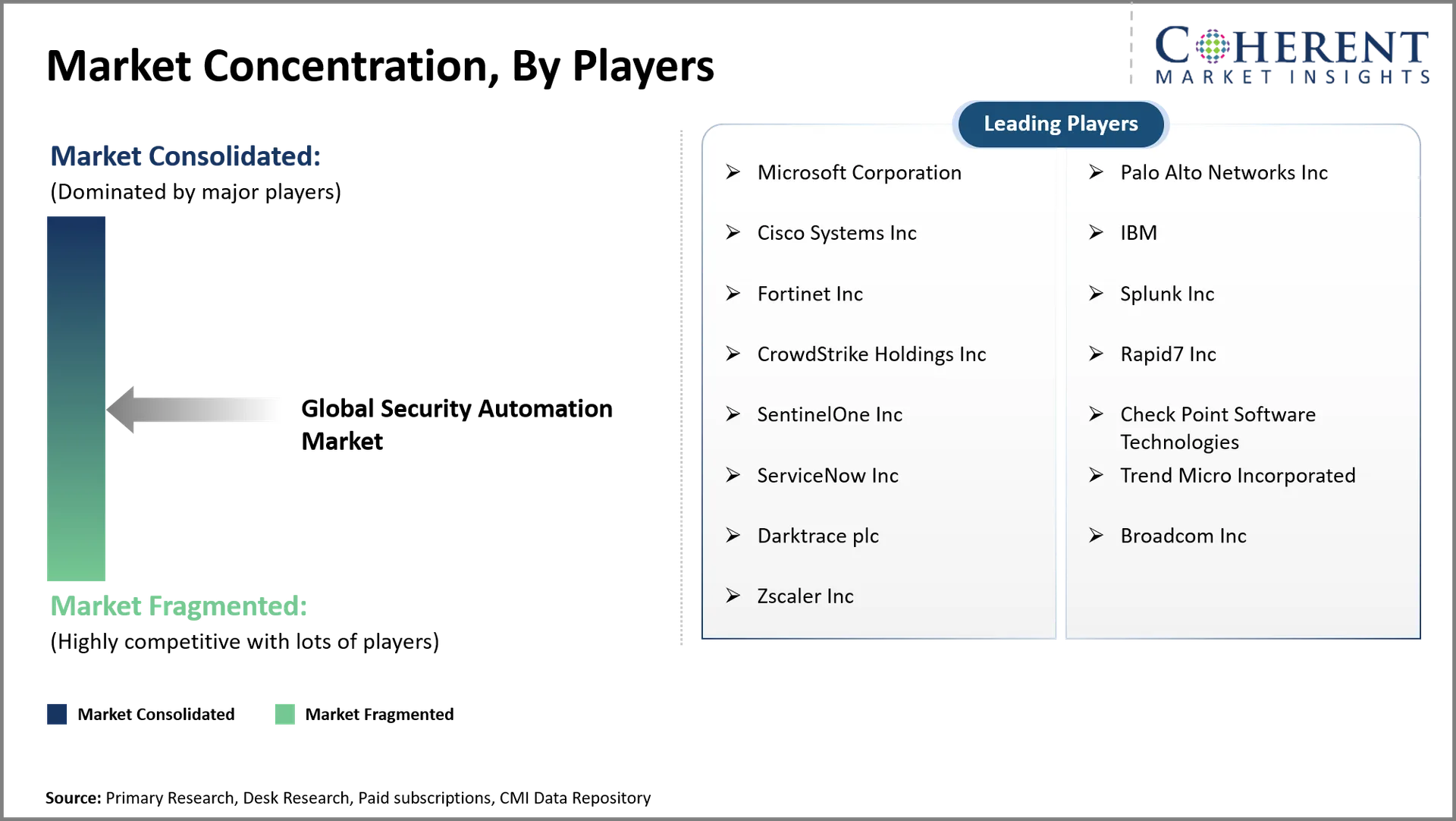
The global security automation industry is crowded with established cybersecurity companies fighting on platform integration, artificial intelligence and automated incident response. Microsoft is bringing Microsoft Sentinel, Defender XDR, and Security Copilot together to help with security monitoring, investigation and response across enterprise environments. Palo Alto Networks is focused on Cortex XSIAM and Cortex AgentiX, bringing together security analytics, automation and artificial intelligence agents for security operations. CrowdStrike bolsters Falcon platform with Charlotte AI and customized agent workflows for investigations and threat prioritization. Google Cloud adds Gemini to Google Security Operations to help with threat hunting, investigations and response. Cisco combines network security expertise with Splunk security analytics and automation. Competitive differentiation increasingly depends on integration flexibility, accurate detection, automated remediation, and measurable reductions in analyst workload.
Top Manufacturers and Notable Products/Solutions in the Security Automation Market
Company/Manufacturer | Notable Product/Solution | Key features |
Microsoft | Microsoft Sentinel | Cloud-native security information and event management, automated incident response, threat intelligence, artificial intelligence-powered analytics, multi-cloud monitoring |
Palo Alto Networks | Cortex XSIAM | Artificial intelligence-driven threat detection, unified security data, automated investigation, security orchestration, incident response, machine learning analytics |
CrowdStrike | Falcon Next-Gen SIEM | Real-time threat detection, endpoint telemetry integration, security data analytics, automated threat hunting, artificial intelligence-assisted investigation |
Cisco | Splunk Enterprise Security | Security event correlation, risk-based alerting, threat intelligence integration, detection engineering, security analytics, incident investigation |
SentinelOne | Singularity Platform | Autonomous threat detection, endpoint protection, behavioral analysis, automated incident response, threat hunting, cross-domain security visibility |
Market Report Scope
Global Security Automation Market Report Coverage | |||
Report Coverage | Details | ||
Base Year | 2025 | Market Size in 2026: | USD 13.50 Bn |
Historical Data For: | 2020 To 2024 | Forecast Period: | 2026 To 2033 |
Forecast Period 2026 To 2033 CAGR: | 12.00% | 2033 Value Projection: | USD 34.00 Bn |
Geographies covered: |
| ||
Segments covered: |
| ||
Companies covered: | Microsoft Corporation, Palo Alto Networks Inc, Cisco Systems Inc, IBM, Fortinet Inc, Splunk Inc, CrowdStrike Holdings Inc, Rapid7 Inc, SentinelOne Inc, Check Point Software Technologies, ServiceNow Inc, Trend Micro Incorporated, Darktrace plc, Broadcom Inc, Zscaler Inc | ||
Growth Drivers: |
| ||
Restraints & Challenges: |
| ||
Analyst Opinion (Expert Opinion)
- The future of the global security automation market will increasingly center on autonomous security operations rather than isolated alert-management tools. Artificial intelligence agents will coordinate threat investigation, evidence collection, vulnerability prioritization, and approved remediation across interconnected security systems. However, organizations will still need to have human supervision for high-impact decisions involving privileged access, production infrastructure and sensitive information. Vendors able to provide dependable automation with clear decision trails and reversible reaction actions would be better positioned to meet business security requirements.
- The biggest opportunity will be in cloud security orchestration, AI-powered security operations and automated identity threat response. The U.S. provides enormous prospects among large corporations, cloud providers, financial institutions, and critical infrastructure operators. Germany and the U.K discuss outlook on technologies enabling industrial cybersecurity, essential services and compliance. Managed security services and scalable automation create opportunities for businesses with small security teams in India. Suppliers should focus on applications that combine endpoint detection, cloud monitoring, identity security, and incident response within the enterprise’s existing infrastructures.
- Market participants should differentiate based on proven operational achievements, rather than by introducing artificial intelligence characteristics that have no apparent economic benefit. Vendors should demonstrate improvement in alarm prioritization, investigation accuracy, containment time, and analyst effort as measured against customer-specific standards. Open application programming interfaces and integrations with existing security information and event management platforms could help reduce deployment friction. Companies also should have authorization controls, audit records, model validation and human approval on sensitive cures. Distribution can be pushed down to smaller enterprises by using managed security service providers. Pricing that is flexible according to the covered assets and the use of automation can make the service more accessible and help retain clients over the long run.
Speak to the analyst
Want personalized insights?
Take the findings above to one of our principal consultants, or have the report rebuilt around the segments, geographies and competitors you actually track.
Market Segmentation
- Component Insights (Revenue, USD Billion, 2021 - 2033)
- Solutions
- Services
- Deployment Type Insights (Revenue, USD Billion, 2021 - 2033)
- Cloud-Based
- On-Premises
- Hybrid
- Technology Type Insights (Revenue, USD Billion, 2021 - 2033)
- Robotic Process Automation
- AI and Machine Learning
- Security Orchestration
- Behavioral Analytics
- Automated Threat Detection
- Automated Incident Response
- Application Insights (Revenue, USD Billion, 2021 - 2033)
- Threat Detection
- Incident Response
- Vulnerability Management
- Security Operations
- Identity and Access Management
- Network Security
- Endpoint Security
- Compliance Management
- Fraud Detection
- End User Insights (Revenue, USD Billion, 2021 - 2033)
- BFSI
- IT and Telecommunications
- Healthcare
- Government
- Retail and E-Commerce
- Manufacturing
- Energy and Utilities
- Education
- Others
- Regional Insights (Revenue, USD Billion, 2021 - 2033)
- North America
- U.S.
- Canada
- Latin America
- Brazil
- Argentina
- Mexico
- Rest of Latin America
- Europe
- Germany
- U.K.
- Spain
- France
- Italy
- Russia
- Rest of Europe
- Asia Pacific
- China
- India
- Japan
- Australia
- South Korea
- ASEAN
- Rest of Asia Pacific
- Middle East
- GCC Countries
- Israel
- Rest of Middle East
- Africa
- South Africa
- North Africa
- Central Africa
- North America
- Key Players Insights
- Microsoft Corporation
- Palo Alto Networks Inc
- Cisco Systems Inc
- IBM
- Fortinet Inc
- Splunk Inc
- CrowdStrike Holdings Inc
- Rapid7 Inc
- SentinelOne Inc
- Check Point Software Technologies
- ServiceNow Inc
- Trend Micro Incorporated
- Darktrace plc
- Broadcom Inc
- Zscaler Inc
Sources
Primary Research Interviews
- Chief Information Security Officers (CISOs)
- Security Operations Center (SOC) Managers
- IT Infrastructure & Network Security Specialists
- Security Automation Solution Providers & Vendors
Magazines
- SC Magazine (Cybersecurity)
- Dark Reading – Information Security Magazine
- Infosecurity Magazine
- Security Week Magazine
Journals
- Journal of Cybersecurity (Oxford Academic)
- IEEE Transactions on Information Forensics and Security
- International Journal of Information Security (Springer)
Associations
- International Information System Security Certification Consortium (ISC)²
- Information Systems Security Association (ISSA)
- Cloud Security Alliance (CSA)
- ISACA (Information Systems Audit and Control Association)
Public Domain Sources
- U.S. National Institute of Standards and Technology (NIST) - Cybersecurity Framework
- European Union Agency for Cybersecurity (ENISA) - Reports & Publications
- Cybersecurity and Infrastructure Security Agency (CISA) - U.S. Government Reports
- U.S. Department of Homeland Security (DHS) - Security Automation Guidelines
Proprietary Elements
- CMI Data Analytics Tool
- Proprietary CMI Existing Repository of Information for the last 10 years
Sources
Primary Research Interviews
- Chief Information Security Officers (CISOs)
- Security Operations Center (SOC) Managers
- IT Infrastructure & Network Security Specialists
- Security Automation Solution Providers & Vendors
Magazines
- SC Magazine (Cybersecurity)
- Dark Reading – Information Security Magazine
- Infosecurity Magazine
- Security Week Magazine
Journals
- Journal of Cybersecurity (Oxford Academic)
- IEEE Transactions on Information Forensics and Security
- International Journal of Information Security (Springer)
Associations
- International Information System Security Certification Consortium (ISC)²
- Information Systems Security Association (ISSA)
- Cloud Security Alliance (CSA)
- ISACA (Information Systems Audit and Control Association)
Public Domain Sources
- U.S. National Institute of Standards and Technology (NIST) - Cybersecurity Framework
- European Union Agency for Cybersecurity (ENISA) - Reports & Publications
- Cybersecurity and Infrastructure Security Agency (CISA) - U.S. Government Reports
- U.S. Department of Homeland Security (DHS) - Security Automation Guidelines
Proprietary Elements
- CMI Data Analytics Tool
- Proprietary CMI Existing Repository of Information for the last 10 years
Get access to 250+ pages report
Every segment, forecast, competitor profile and data table behind the analysis above — available for instant download.
- ESOMAR Member
- ISO 9001:2015 Certified
- D-U-N-S Registered
- GDPR & CCPA Compliant
Frequently Asked Questions
The global security automation market is expected to stand at USD 13.50 Bn in 2026 and is expected to reach USD 34.00 Bn by 2033.
The CAGR of the global security automation market is projected to be 12.0% from 2026 to 2033.
Increasing frequency of sophisticated cyberattacks and Growing demand for automated threat detection are the major factors driving the growth of the global security automation market.
High implementation and integration costs and Complexity of integrating legacy security systems are the major factors hampering the growth of the global security automation market.
In terms of component, solutions segment is estimated to dominate the market revenue share in 2026.
The global security automation market covers technologies that automate cybersecurity monitoring, threat detection, incident investigation, response, and compliance activities.
Artificial intelligence identifies suspicious patterns, correlates security events, prioritizes alerts, and assists analysts with investigations and response decisions.