

Serverless Computing Market and Forecast – 2026 to 2033
The global serverless computing market is estimated to be valued at USD 28.30 Bn in 2026 and is expected to reach USD 67.41 Bn by 2033, exhibiting a compound annual growth rate (CAGR) of 13.2% from 2026 to 2033.
Key Takeaways of the Serverless Computing Market
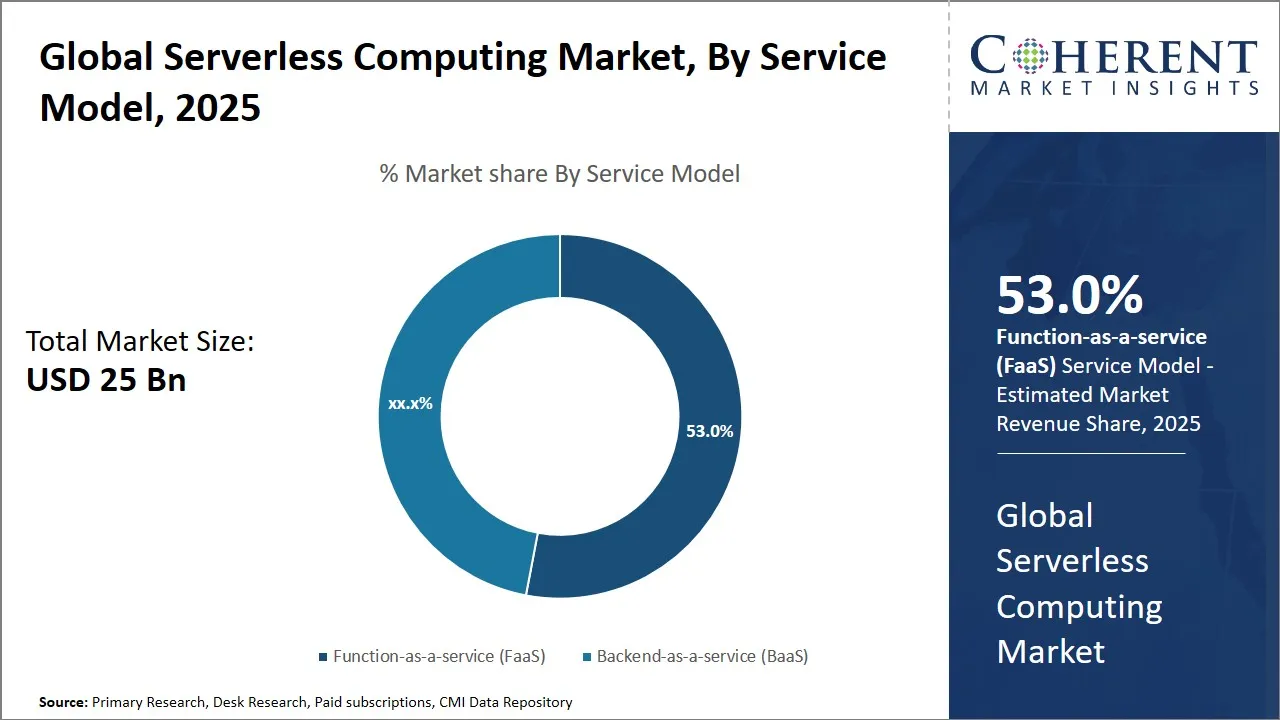
- The Function-as-a-service (FaaS) segment is expected to account for 54% of the serverless computing market share in 2026.
- The public cloud segment is projected to capture 48% of the market share in 2026.
- The BFSI segment is expected to command 34% share in 2026.
- North America will dominate the serverless computing market in 2026 with an estimated 36%
- Asia Pacific will hold 27% share in 2026 and record the fastest growth.
Currents Events and Its Impacts
Current Events | Description and its Impact |
AWS at ReInvent 2025 |
|
Segmental Insights
- Current Industry Events of 2026
- Market Size Estimation
- Regional Breakdown
- Competitive Landscape
- Customer Intelligence
- Segmental Analysis
- Pricing Analysis
- Key Market Drivers, Challenges & Future Trends
- Customized Insights Section
Why Does the Function-as-a-service (FaaS) Segment Dominate the Global Serverless Computing Market in 2026?
The Function-as-a-service (FaaS) segment is expected to hold 54.0% of the global serverless computing market share in 2026. The growth isn't just based on how well it works, but also on how well it fits into different development workflows. As infrastructure fades into the background, what happens behind the scenes stays hidden. This keeps the focus on what matters, small pieces of logic doing one thing at a time.
For instance, on December 1, 2026, Akamai Technologies, Inc. announced the acquisition of Fermyon, the serverless WebAssembly company. As artificial intelligence (AI) inference shifts to the edge, combining Fermyon’s cloud-native WebAssembly (Wasm) function-as-a-service (FaaS) with Akamai’s globally distributed platform enables enterprises to build edge-native applications that offer improved performance and lower costs compared to traditional cloud-native apps.
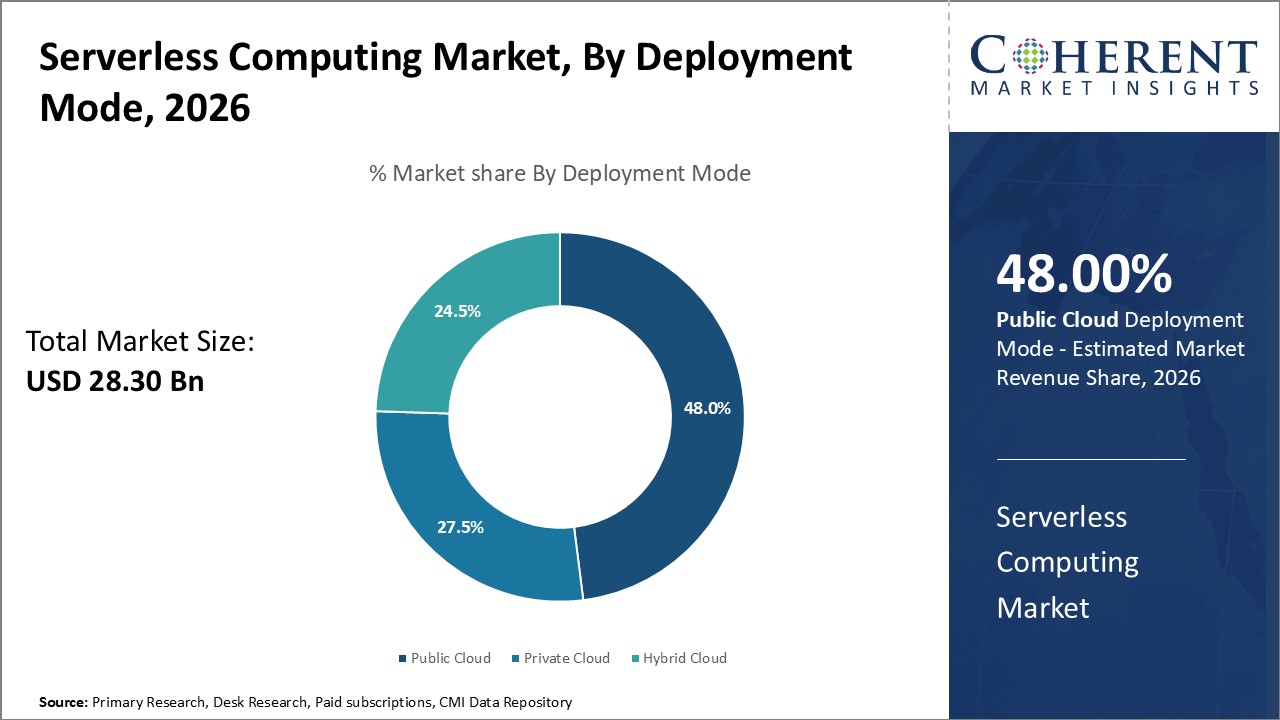
Public Cloud Segment Dominates the Global Serverless Computing Market
The public cloud segment is expected to hold 48.0% of the market share in 2026. Startups start out lean, avoiding extra gear that just sits around. When rules change suddenly or people are on different continents, quick answers are very important. This is because servers are connected to each other through global networks. Momentum keeps going, not because of big events but because of small, steady improvements in security and performance that often go unnoticed. In these kinds of situations, code-running services grow, not because they're popular, but because the infrastructure has quietly become strong enough.
Why is BFSI the Most Dominant End User in the Serverless Computing Market?
The BFSI segment is expected to hold 34.0% of the serverless computing market share in 2026. Security concerns and data privacy remain central, yet firms in banking and finance must also push innovation forward, refine interactions with customers. Not only does serverless speed things up for banks and other financial services, but it also helps them with timing. When idle resources shut down, costs go down automatically, stopping waste. Fraud detection systems can change because they have room to grow. Their power comes from more than just algorithms.
For instance, on April 2026, NxtGen Cloud Technologies launched India's first Financial Services Cloud (FSC), a sovereign cloud platform built specifically for the Banking, Financial Services, and Insurance (BFSI) sector to meet strict data residency and security rules. This platform ensures 100% data localization in India, protecting against foreign jurisdictions.
Serverless Security Exposure Mapping
Security Exposure Area | Typical Serverless Component Affected | Estimated % of Serverless Deployments Impacted | Risk Severity (1–5) |
Excessive IAM Permissions | FaaS (Lambda, Cloud Functions) | 58% | 5 |
Insecure API Endpoints | API Gateway/HTTP Triggers | 46% | 4 |
Event Injection Attacks | Event queues, streams, triggers | 32% | 4 |
Third-Party Dependency Vulnerabilities | Function runtime packages | 41% | 4 |
Inadequate Logging & Monitoring | Serverless workflows | 37% | 3 |
Regional Insights
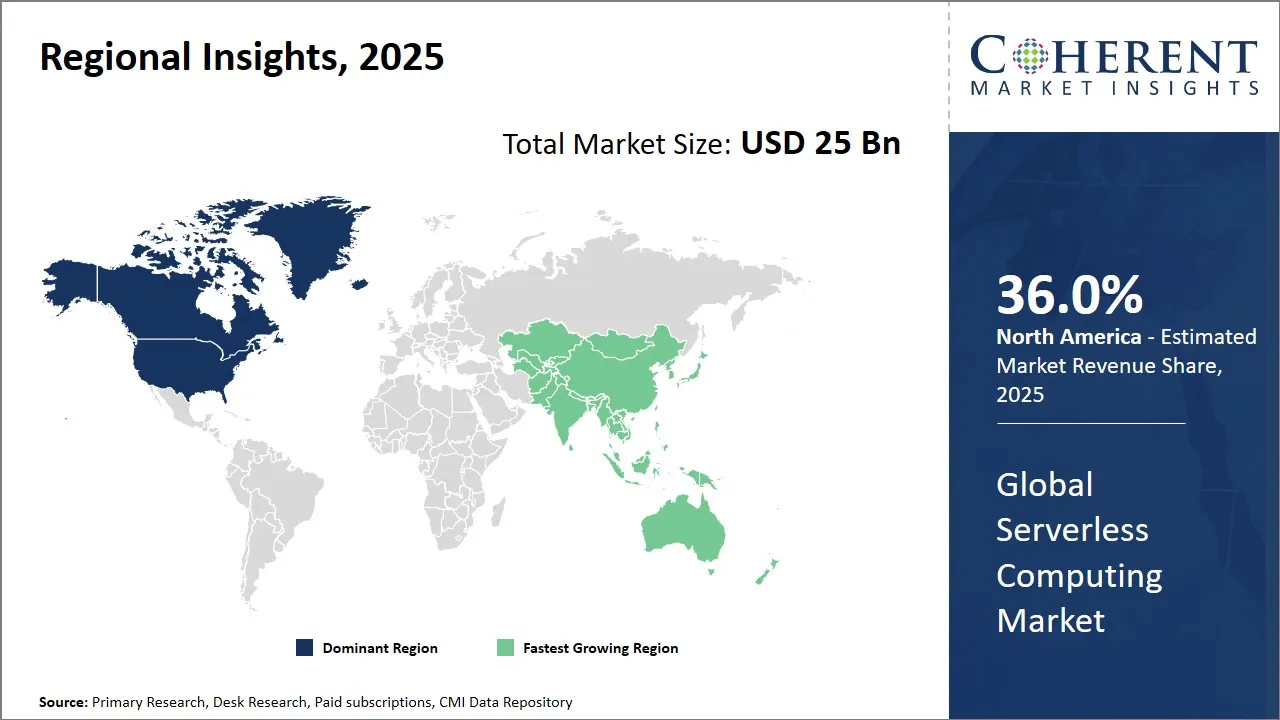
North America Serverless Computing Market Analysis and Trends
The North America region is projected to lead the market with a 36% share in 2026. A surge in momentum comes not just from advanced technological networks, but through deep roots in cloud infrastructure, fueled quietly by policy that leans into digital change. Dominant players like AWS, Microsoft Azure, and Google Cloud shape much of what happens here, refining serverless tools as business demands shift. Startups thrive amid this setup, feeding off expansive systems already in place while enterprises move steadily toward cloud integration.
On the sidelines, innovation in data safeguards gains traction alongside regulatory nudges favoring adoption. Tech hubs dot the landscape, backed by a talent pool both wide and experienced, lending weight to continued influence without fanfare.
Asia Pacific Serverless Computing Market Analysis and Trends
Asia Pacific is expected to exhibit the fastest growth in the market contributing 27% share in 2026. The growth stems from swift moves toward digital systems, broader web access, and deeper spending on cloud platforms, especially within developing markets like India, China, and nations across Southeast Asia. Fueled by policy shifts, authorities in these areas back cloud-based frameworks, nudging public institutions to shift online, quietly paving the way for serverless models to take root.
Small tech ventures, alongside growing middle-sized firms, lean into budget-friendly serverless setups, flexible enough to stretch when demand spikes. Not slowing down, industry names such as Alibaba Cloud, Tencent Cloud, and Huawei Cloud push further, reshaping tools for regional needs while trying out fresh angles. Backed by skilled crews priced accessibly, evolving cloud trends, plus mounting interest from global investors, steady movement builds momentum in real spaces.
Serverless Computing Market Outlook for Key Countries
Why is the U.S. Emerging as a Major Hub in the Serverless Computing Market?
The U.S. is one of the major hubs in serverless computing, fueled by clusters of tech hubs and homegrown cloud giants. What began as an experiment soon became standard as AWS redefined the landscape by backing ideas such as Lambda before they were obvious. Close on its heels, Microsoft built ground with Azure Functions, shaping adoption in its own image.
Google responded differently, framing similar tools beneath the name Cloud Functions. Government shifts toward updated digital backbones have, without fanfare, encouraged broader reliance on these models. In offices and small teams alike, serverless setups see use - not due to fashion - but because speed in reaction has grown non-negotiable.
Is China the Next Growth Engine for the Serverless Computing Market?
A ripple moves across China’s technological scene, driven by steady government support for cloud infrastructure and wider digital transformation. Backed by national initiatives, companies like Alibaba Cloud and Huawei Cloud build serverless solutions tailored to local laws and business habits - different from Western blueprints. Across areas such as banking and city management, shifts happen gradually, one step at a time, as organizations shift toward cloud-based setups due to subtle but ongoing regulatory pushes.
A quiet change is taking root, driven by serverless designs settling into unexpected corners. Not because they were pushed, yet because they kept showing up raw scale lending weight to grassroots visions. Enabled by cloud tools, approaches move forward without fanfare, altering the rhythm of local innovation. Expansion doesn’t come with warnings; it arrives already present.
India Serverless Computing Market Analysis and Trends
India steps into sharper view across global serverless computing market, not from leaps, yet through gradual strength in digital architecture. Firms including Microsoft Azure and AWS aren’t holding back; they’re anchoring new data facilities while aligning with domestic players to gain ground. Talent flows freely here: thousands of capable coders, often nested in agile startups, experiment continuously with event-driven models to trim costs without sacrificing reach. Focus into intelligent urban networks and next-gen financial tools add weight to this shift as the country is quietly turning gears behind scalable, code-light platforms.
Germany Serverless Computing Market Analysis and Trends
Serverless computing finds solid ground in Germany, where high-tech manufacturing meets a dense network of small and medium enterprises embracing smart industry shifts. Firms including SAP and Deutsche Telekom’s cloud arm, alongside international names such as AWS and Azure - are shaping offerings that align tightly with EU rules on data protection. Support rolls out from Berlin, steering public works and auto makers into digital shifts, subtle pushes, and persistent outcomes. Known for tight engineering and forward-thinking rules, Germany keeps attracting eyes to adaptive, event-driven setups. Need remains firm, shaped by daily demands instead of passing fads.
Brazil Serverless Computing Market Analysis and Trends
The market in Brazil is growing as cloud use is rising across retail, finance, and telecom. Notable infrastructure moves come from global providers: Google Cloud, AWS, Microsoft Azure, all positioning within Latin America’s biggest economy. Their interest ties closely to surging digital projects, alongside deeper mobile connectivity.
Policy direction out of Brasília adds momentum; support for tech advancement nudges companies toward serverless setups. It makes sense for a lot of people because it saves money and makes things run more smoothly. A healthy startup scene and a lot of user demand keep the market moving. Growth doesn't have to happen. It follows patterns that are already in place.
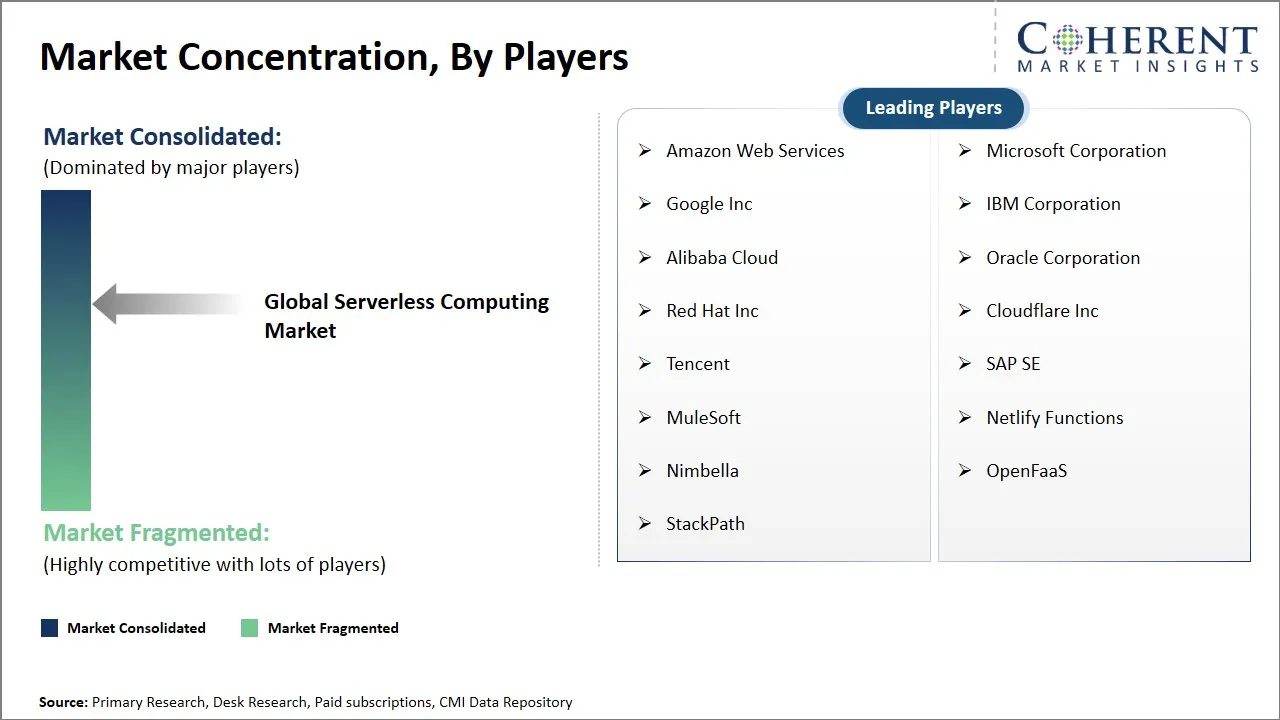
Market Players, Key Development, and Competitive Intelligence
Key Developments
- On September 9, 2025, AWS expanded the usability of AWS Lambda by introducing seamless console-to-Visual Studio Code (VS Code) integration. This feature streamlines the transition between cloud and local development environments, preserving code and configurations with a single click. The enhancement addresses long-standing challenges developers faced in manually configuring local IDEs, reducing workflow disruptions, and improving productivity.
- On May 29, 2025, Amazon Web Services (AWS) announced the open-source AWS Serverless Model Context Protocol (MCP) Server. This tool integrates AI-driven assistance with serverless expertise to guide developers on architectural, implementation, and deployment decisions, further strengthening modern application development.
Top Strategies Followed by Global Serverless Computing Market Players
Player Type | Strategic Focus | Example |
Established Market Leaders | Microsoft Industry Recognition | On June 23, 2025, Microsoft Azure was named a Leader in The Forrester Wave: Serverless Development Platforms, Q2 2025, showcasing its strength with services like Azure Functions and Azure Container Apps for empowering developers, scaling applications, and driving innovation, especially with AI integration. |
Mid-Level Players | Business Collaboration | On April 9, 2024, MongoDB, Inc. at Google Cloud Next ‘24 announced an expanded collaboration with Google Cloud to make it even easier and more cost-effective to build, scale, and deploy generative AI applications using MongoDB Atlas Vector Search and Vertex AI from Google Cloud, along with additional support for data processing with BigQuery. |
Small-Scale Players | Feature Launch | On November 25, 2024, Kinesis Network, a global compute optimization platform, announced a new serverless feature enabling enterprises to run workloads across a dynamic, multi-cloud environment. |
Market Report Scope
Serverless Computing Market Report Coverage
| Report Coverage | Details | ||
|---|---|---|---|
| Base Year: | 2025 | Market Size in 2026: | USD 28.30 Bn |
| Historical Data for: | 2020 To 2024 | Forecast Period: | 2026 To 2033 |
| Forecast Period 2026 to 2033 CAGR: | 13.2% | 2033 Value Projection: | USD 67.41 Bn |
| Geographies covered: |
| ||
| Segments covered: |
| ||
| Companies covered: | Amazon Web Services, Microsoft Corporation, Google Inc, IBM Corporation, Alibaba Cloud, Oracle Corporation, Red Hat Inc, Cloudflare Inc, Tencent, SAP SE, MuleSoft, Netlify Functions, Nimbella, OpenFaaS, and StackPath | ||
| Growth Drivers: |
| ||
| Restraints & Challenges: |
| ||
Global Serverless Computing Market Dynamics
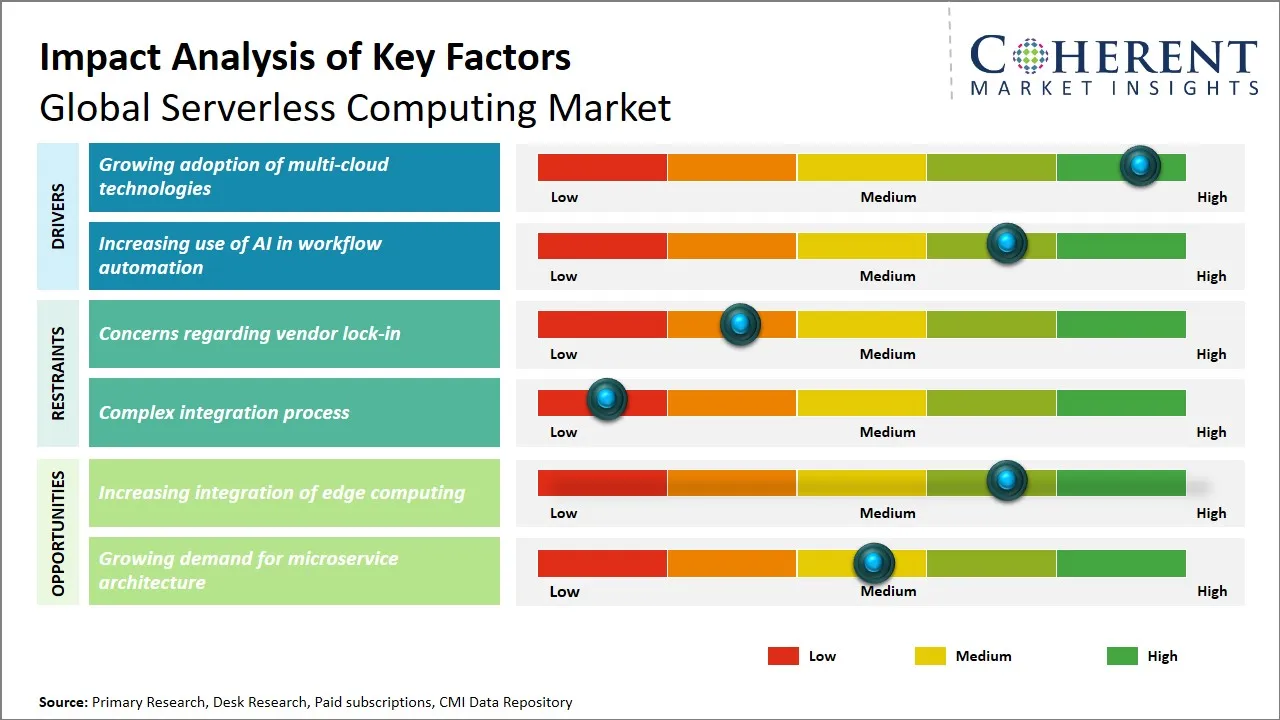
Global Serverless Computing Market Driver - Growing Adoption of Multi-cloud Technologies
More companies now rely on several cloud services at once, this shift quietly fuels interest in serverless setups. Code goes live without having to maintain the server, and lean execution layers turn on and off for a short time, only charging while they are on. These setups fit in well with hybrid cloud patterns that value steady behavior over hardware oversight. The location of the software is less important; moving between zones feels natural. Performance stays the same no matter what the name of the place on the map is.
A change happens quietly as code moves faster now that engineers are less focused on calibrating machines and more on guiding logical structures. Things that used to need constant tweaking fade into the background, making room for quick changes and shorter cycles. As more companies design around instant triggers, it feels less like climbing a wall to expand capacity when serverless platforms move smoothly across vendor boundaries. This quiet synchronization that connects decentralized architectures with responsive computing is what drives the growth of software today, and it needs fewer people along the way.
Global Serverless Computing Market Opportunity - Increasing Integration of Edge Computing
What used to be dominated by centralized cloud facilities is gradually giving way to decentralized processing, where computation moves closer to the source. With apps needing instant responses, companies now push edge computing closer to where it happens. Proximity matters more than ever, especially when a fraction of a second can change outcomes in self-driving cars or live medical monitoring. Instead of sticking to rigid setups, tasks run in fleeting modules, sparking to life only when called upon.
For instance, on February 1, 2024, Gcore announced the launch of FastEdge, a cutting-edge serverless product revolutionizing application deployment and performance. Designed for cloud-native development, FastEdge is a low-latency, high-performance solution for creating responsive and personalized applications without the complexities of server management.
Analyst Opinion (Expert Opinion)
- Now shaping up into steady expansion, the serverless computing market responds to corporate needs like speed, leaner costs, and quicker digital progress. Not confined anymore to simple Function-as-a-Service tasks, companies increasingly adopt serverless frameworks for data systems, event-based designs, even workflows built around artificial intelligence from the start. Major providers including AWS, Microsoft Azure, and Google Cloud extend their reach, embedding serverless capabilities into computation, storage, analysis, and edge processing setups. What once felt peripheral now threads through cloud-native planning as a central piece, not an outlier choice.
- What comes next for market development hinges on tailored uptake across sectors, especially banking, shopping platforms, and medical services - alongside deeper links to artificial intelligence workflows. Edge-based serverless setups are gaining ground, shifting how compute resources are deployed. Even though dependency on single providers, monitoring challenges, and data protection issues persist, steady upgrades in infrastructure and compliance-aware designs ease the path forward. Gradually, experts see this approach becoming standard practice for building current-gen software, fueling steady growth well into the 2030s.
Speak to the analyst
Want personalized insights?
Take the findings above to one of our principal consultants, or have the report rebuilt around the segments, geographies and competitors you actually track.
Market Segmentation
- Service Model Insights (Revenue, USD Bn, 2021 - 2033)
- Function-as-a-service (FaaS)
- Backend-as-a-service (BaaS)
- Deployment Mode Insights (Revenue, USD Bn, 2021 - 2033)
- Public Cloud
- Private Cloud
- Hybrid Cloud
- End User Insights (Revenue, USD Bn, 2021 - 2033)
- BFSI
- IT and Telecom
- Healthcare and Life Sciences
- Retail and Consumer Goods
- Government and Defense
- Transportation and Logistics
- Manufacturing
- Others
- Regional Insights (Revenue, USD Bn, 2021 - 2033)
- North America
- U.S.
- Canada
- Latin America
- Brazil
- Argentina
- Mexico
- Rest of Latin America
- Europe
- Germany
- U.K.
- Spain
- France
- Italy
- Russia
- Rest of Europe
- Asia Pacific
- China
- India
- Japan
- Australia
- South Korea
- ASEAN
- Rest of Asia Pacific
- Middle East
- GCC Countries
- Israel
- Rest of Middle East
- Africa
- South Africa
- North Africa
- Central Africa
- North America
- Key Players Insights
- Amazon Web Services
- Microsoft Corporation
- Google Inc
- IBM Corporation
- Alibaba Cloud
- Oracle Corporation
- Red Hat Inc
- Cloudflare Inc
- Tencent
- SAP SE
- MuleSoft
- Netlify Functions
- Nimbella
- OpenFaaS
- StackPath
Sources
Primary Research Interviews
- Cloud Service Providers (AWS, Microsoft Azure, Google Cloud)
- Enterprise IT Decision Makers and CTOs
- Serverless Platform Vendors and Solution Providers
- DevOps Engineers and Software Developers
Databases
- IDC Worldwide Cloud Services Database
Magazines
- Cloud Computing Magazine
- InfoWorld
- TechCrunch
- ServerWatch
Journals
- IEEE Computer Society Digital Library
- ACM Digital Library
- Journal of Cloud Computing
Newspapers
- The Wall Street Journal (Technology Section)
- Financial Times (Digital Business)
- Reuters Technology News
- Bloomberg Technology
Associations
- Cloud Security Alliance (CSA)
- Cloud Native Computing Foundation (CNCF)
- International Association of Cloud & Mobile Computing (IACMC)
- Open Cloud Computing Interface (OCCI)
Public Domain Sources
- U.S. Securities and Exchange Commission (SEC) Filings
- Company Annual Reports and Investor Relations
- Government Technology Procurement Reports
Proprietary Elements
- CMI Data Analytics Tool
- Proprietary CMI Existing Repository of information for last 8 years
Get access to 250+ pages report
Every segment, forecast, competitor profile and data table behind the analysis above — available for instant download.
- ESOMAR Member
- ISO 9001:2015 Certified
- D-U-N-S Registered
- GDPR & CCPA Compliant
Missing comfort of reading report in your local language? Find your preferred language:
Transform your Strategy with Exclusive Trending Reports
Frequently Asked Questions
The global serverless computing market is estimated to be valued at USD 28.30 Bn in 2026 and is expected to reach USD 67.41 Bn by 2033.
The CAGR of global serverless computing market is projected to be 13.2% from 2026 to 2033.
Growing adoption of multi-cloud technologies and increasing use of AI in workflow automation are the major factors driving the growth of the global serverless computing market.
Concerns regarding vendor lock-in and complex integration process are the major factors hampering the growth of the global serverless computing market.
In terms of service model, Function-as-a-service (FaaS) is estimated to dominate the market revenue share in 2026.
North America is expected to lead the global serverless computing market in 2026.
Amazon Web Services, Microsoft Corporation, Google Inc, IBM Corporation, Alibaba Cloud, Oracle Corporation, Red Hat Inc, Cloudflare Inc, Tencent, SAP SE, MuleSoft, Netlify Functions, Nimbella, OpenFaaS, and StackPath are the major players.