

Global Shopping Cart Market Size and Forecast – 2026 To 2033
The Global Shopping Cart Market is estimated to be valued at USD 2.45 Bn in 2026 and is expected to reach USD 3.56 Bn by 2033, growing at a compound annual growth rate (CAGR) of 5.50% from 2026 to 2033. This steady expansion is supported by the modernization of grocery retail infrastructure, increasing adoption of organized retail formats, and growing demand for convenient and efficient in-store shopping experiences.
Retailers are increasingly upgrading store environments with digital solutions, improved customer mobility systems, and omnichannel capabilities to enhance engagement across physical and online channels. In April 2025, Wegmans introduced an upgraded website and mobile application integrating online shopping features with in-store navigation capabilities, highlighting the broader shift toward connected retail experiences that influence future shopping cart innovation and store equipment requirements.
Key Takeaways of the Global Shopping Cart Market
- Standard Shopping Carts are estimated to record a CAGR of 4.9% and hold 52.8% of the global shopping cart market in 2026, supported by their broad suitability across supermarkets, hypermarkets, and large-format retailers requiring durable high-capacity solutions. In July 2025, Instacart expanded Caper Cart deployment at Wegmans, highlighting continued innovation around traditional cart platforms.
- Metal or Wire Carts are projected to achieve a CAGR of 5.1% and account for 54.6% of the market in 2026, reflecting strong retailer preference for durability, load-bearing capacity, repairability, and long operating life in high-frequency shopping environments. In September 2025, Morrisons announced plans to introduce AI-powered shopping trolleys in the UK, demonstrating continued modernization of cart infrastructure.
- Four Wheel Carts are expected to register a CAGR of 5.0% and capture 78.6% of the global shopping cart market in 2026 due to superior stability, maneuverability, and suitability for large basket sizes across retail formats. In February 2025, Coles Supermarkets introduced Caper Carts in Australia, combining conventional trolley formats with digital capabilities for improved in-store convenience.
- North America is forecast to achieve a CAGR of 5.4% and represent 34.8% of the global market in 2026, supported by mature grocery retail networks, large-format stores, and early adoption of connected shopping technologies. In June 2026, Weis Markets and Instacart launched AI-powered Caper Carts at selected stores, reinforcing regional investment in digitally enhanced shopping experiences.
- Europe is anticipated to post a CAGR of 5.8% and contribute 28.7% of the global shopping cart market in 2026, driven by retail modernization, sustainability-focused procurement, and adoption of advanced store technologies. In October 2025, European consumer organizations assessed supermarket sustainability practices, highlighting increasing attention toward responsible retail operations and purchasing environments.
Segmental Insights
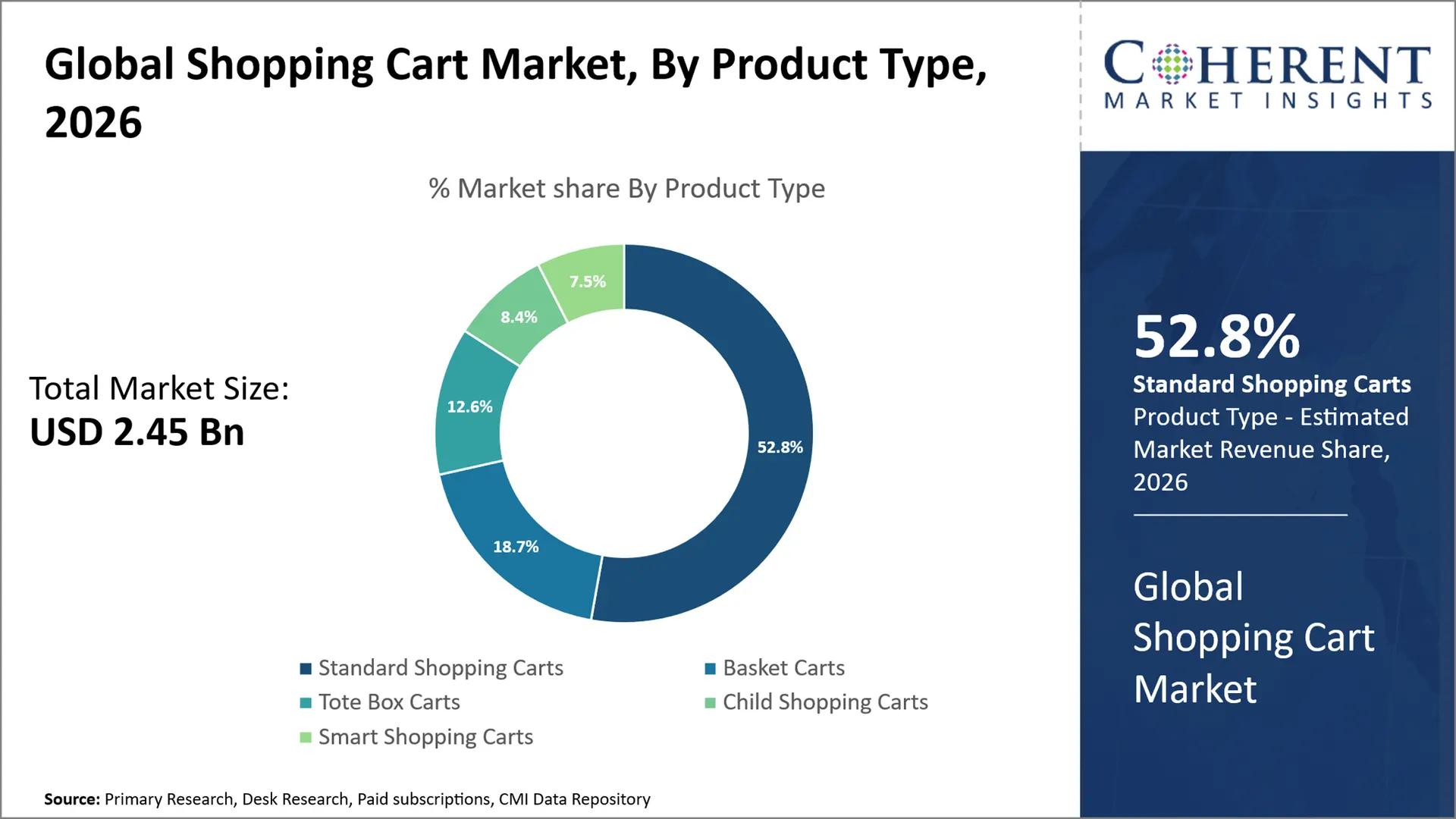
Why Do Standard Shopping Carts Dominate the Global Shopping Cart Market?
Standard Shopping Carts are expected to account for 52.8% of the global shopping cart market in 2026, supported by their widespread acceptance across supermarkets, hypermarkets, and warehouse retail formats. Their dominance is linked to proven durability, high carrying capacity, simple maintenance requirements, and compatibility with established store layouts. Retailers continue preferring standard carts because they provide reliable customer handling efficiency without requiring significant technology investment or infrastructure changes. Manufacturers benefit from consistent replacement demand, customization opportunities, and large-volume procurement from organized retail chains. These carts remain essential for weekly grocery shopping formats where customers typically purchase multiple products in a single visit. In August 2025, The Peggs Company introduced its Matrix Series of all-plastic shopping carts in the U.S., reflecting continued product innovation within conventional shopping cart categories through improved durability and retailer customization options.
- Current Industry Events of 2026
- Market Size Estimation
- Regional Breakdown
- Competitive Landscape
- Customer Intelligence
- Segmental Analysis
- Pricing Analysis
- Key Market Drivers, Challenges & Future Trends
- Customized Insights Section
Why Do Metal or Wire Carts Represent the Largest Material Category in the Global Shopping Cart Market?
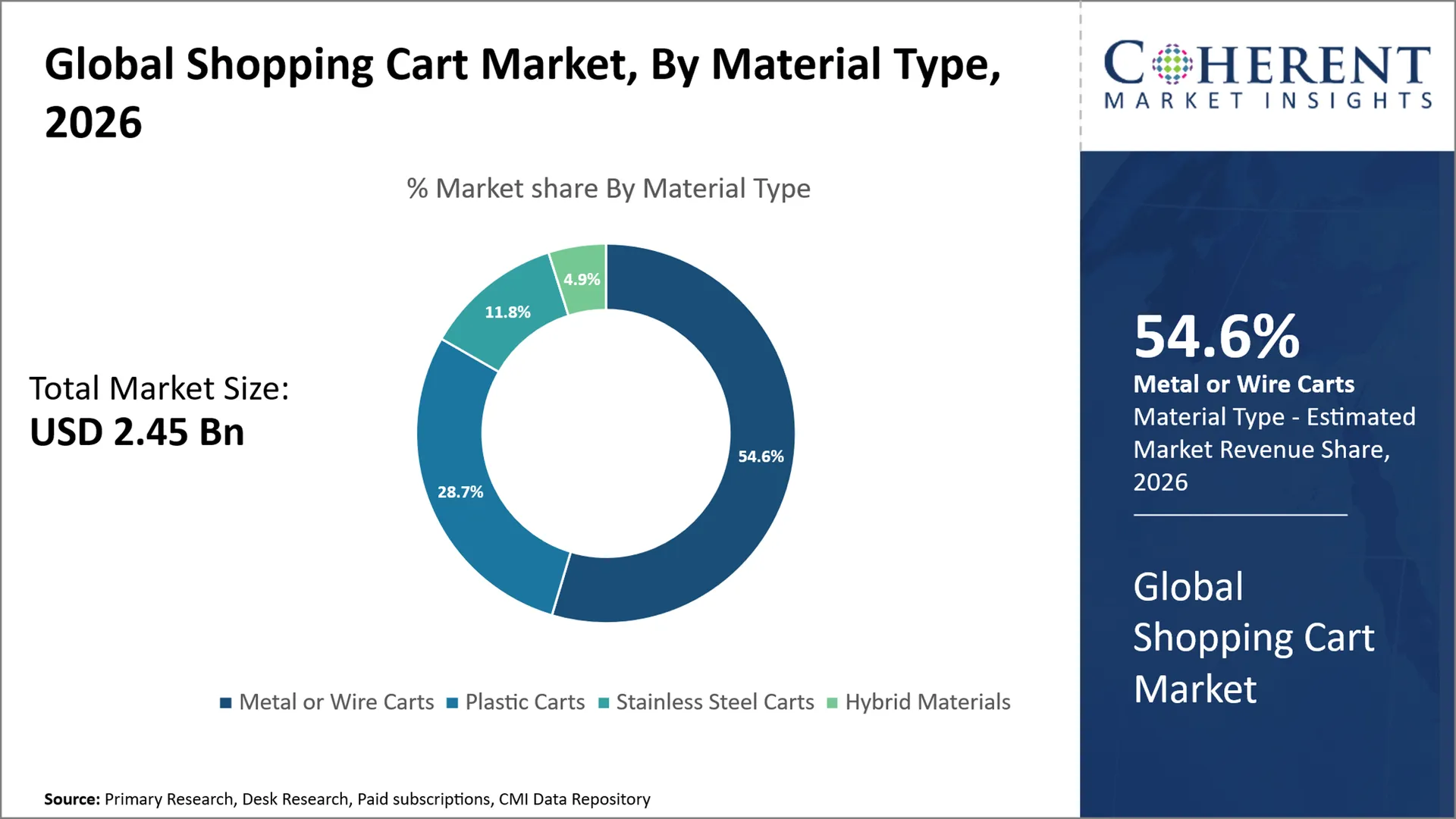
Metal or Wire Carts are projected to hold 54.6% of the global shopping cart market in 2026, leading the material category due to their strength, load-bearing capability, repair flexibility, and suitability for intensive retail environments. Grocery chains and large-format stores continue selecting metal carts because they withstand frequent usage, outdoor exposure, and repeated handling better than many lightweight alternatives. The established manufacturing ecosystem for steel fabrication, coating technologies, and component replacement supports efficient supply availability globally. These carts are particularly relevant in supermarkets, hypermarkets, and wholesale clubs where operational reliability is prioritized over premium aesthetics. Suppliers benefit from recurring fleet replacement, refurbishment services, and long-term retailer relationships. In December 2025, Unarco highlighted its large-scale shopping cart manufacturing and remanufacturing capabilities, emphasizing lifecycle extension and fleet management solutions for retail operators.
Why Do Four Wheel Carts Dominate the Wheel Type Segment of the Global Shopping Cart Market?
Four Wheel Carts are expected to represent 78.6% of the global shopping cart market in 2026, making them the leading wheel configuration due to their superior stability, maneuverability, and suitability for diverse retail environments. The four-wheel design provides balanced movement, easier navigation through wider store aisles, and improved handling when carts carry heavier loads. Retailers favor this configuration because it supports both customer convenience and operational efficiency across supermarkets, hypermarkets, and warehouse-style stores. Manufacturers continue improving wheel systems, ergonomic designs, and cart mobility features to enhance durability and reduce maintenance requirements. The widespread installed base of four-wheel carts also creates replacement and aftermarket opportunities for suppliers. In January 2026, Amazon highlighted enhancements to its Dash Cart design, including improved mobility and increased carrying capacity, demonstrating continued focus on optimizing shopping cart usability and customer handling experience.
Current Events and their Impact
Current Event | Description and Its Impact |
European Circular Economy Action Plan Implementation – March 2025 |
|
U.S. Accessibility Standards and Retail Infrastructure Compliance Updates – 2024–2026 |
|
China Domestic Consumption Expansion Policies – 2025 |
|
Global Shopping Cart Market Dynamics
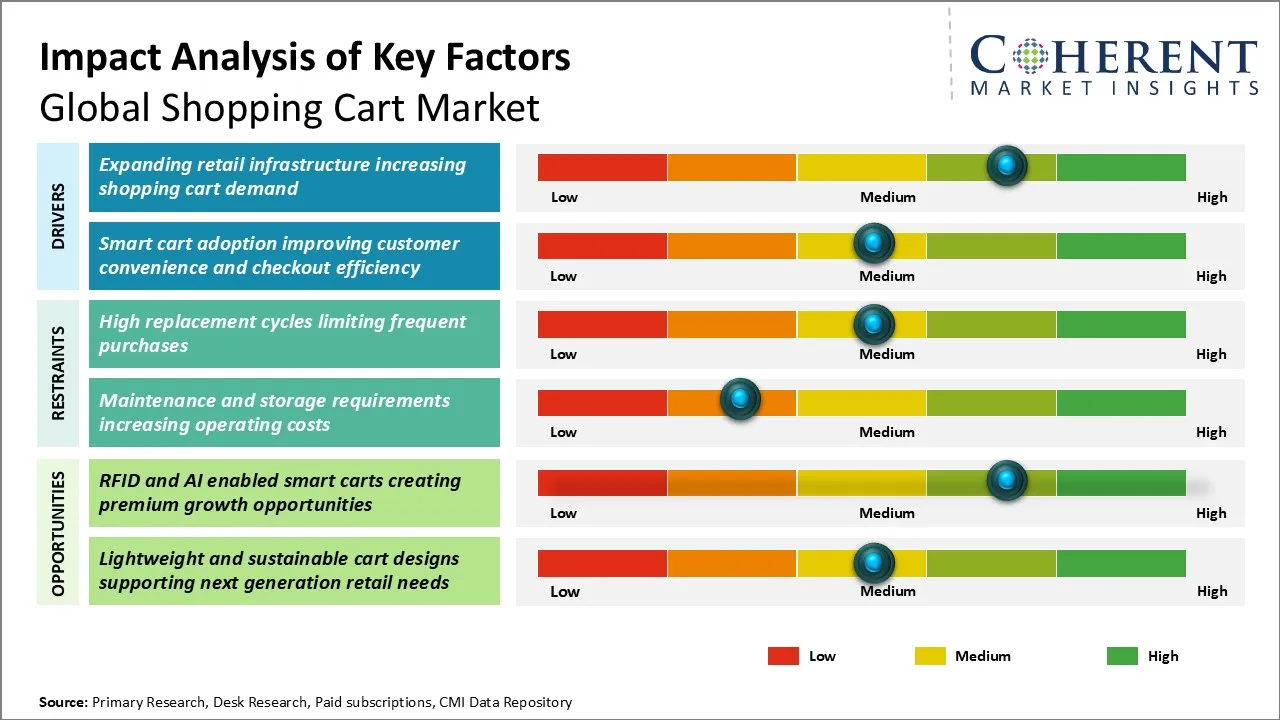
Key Market Drivers
- Expanding Retail Infrastructure Increasing Shopping Cart Demand: Expansion of supermarkets, hypermarkets, warehouse clubs, and organized grocery formats continues to strengthen demand for shopping carts by increasing the requirement for durable customer mobility solutions. Retailers benefit from reliable cart availability as it directly influences customer convenience, store navigation, and operational efficiency. Manufacturers and suppliers gain opportunities through replacement cycles, customization requirements, and large-scale procurement contracts from retail chains. The shift toward modern retail environments in emerging economies is also widening adoption beyond traditional markets. In July 2025, Instacart and Wegmans launched Caper Carts at Wegmans Dewitt in New York, demonstrating how retailers are upgrading in-store shopping infrastructure through advanced cart solutions.
- Smart Cart Adoption Improving Customer Convenience and Checkout Efficiency: Integration of artificial intelligence, computer vision, sensors, digital displays, and self-checkout capabilities is transforming shopping carts from basic transportation equipment into interactive retail platforms. Smart carts enable retailers to improve customer engagement, provide personalized promotions, reduce checkout friction, and collect valuable shopping behavior insights. Technology providers, retailers, and cart manufacturers benefit from growing demand for connected store ecosystems. These solutions are becoming strategically important as grocery operators seek to combine physical stores with digital retail experiences. In September 2025, Instacart introduced enhanced Caper Cart capabilities including digital coupons, loyalty integration, and personalized savings features to improve omnichannel grocery experiences.
Emerging Market Trends
- Transition Toward Connected and Data-Enabled Shopping Cart Ecosystems: The shopping cart market is shifting from equipment-focused purchasing toward connected retail infrastructure where carts function as digital touchpoints inside stores. Retailers are increasingly evaluating carts based on their ability to support navigation, personalized recommendations, loyalty engagement, inventory insights, and checkout optimization. This trend benefits technology-enabled cart suppliers while creating pressure on traditional manufacturers to incorporate digital capabilities. Over the forecast period, partnerships between hardware providers, retail technology companies, and grocery operators are expected to shape competitive positioning by making connected capabilities a differentiating factor rather than an optional feature.
- Sustainability and Lifecycle Optimization Influencing Cart Design: Sustainability considerations are increasingly affecting shopping cart procurement decisions as retailers evaluate product lifespan, material efficiency, maintenance requirements, and replacement frequency. Manufacturers are expected to focus on recyclable materials, lightweight structures, corrosion resistance, and improved durability to reduce long-term operating costs. Retailers with large store networks are likely to prioritize suppliers capable of delivering reliable products with lower lifecycle impact. This trend may create opportunities for manufacturers specializing in advanced materials and environmentally responsible production methods while increasing competition among traditional cart suppliers.
Regional Insights
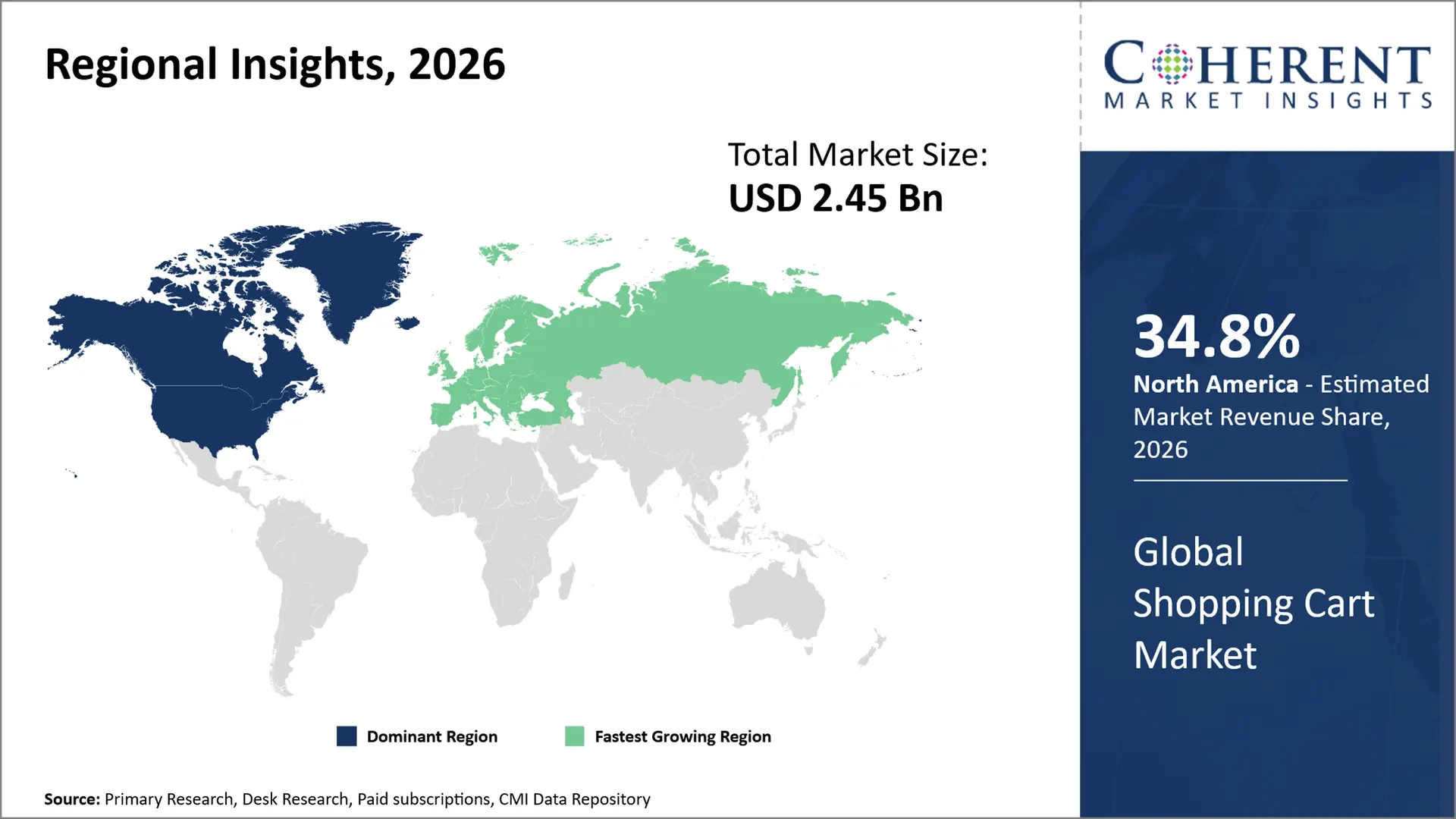
Why Does North America Dominate the Global Shopping Cart Market?
North America is expected to dominate the global shopping cart market with a 34.8% share in 2026, supported by its highly developed grocery retail infrastructure, strong presence of supermarkets and hypermarkets, and widespread adoption of large-capacity shopping carts across organized retail formats. The region benefits from a mature retail ecosystem where cart durability, operational efficiency, customer convenience, and store productivity remain important purchasing considerations. High penetration of warehouse clubs, grocery chains, and omnichannel retailers also support continuous replacement and modernization demand. Retailers in the U.S. and Canada are increasingly investing in connected cart solutions, self-checkout integration, and improved in-store experiences to enhance customer engagement. In May 2025, Walmart expanded its artificial intelligence and digital retail initiatives across stores, reinforcing investments in technology-enabled shopping experiences that influence future cart innovation.
Why Is Europe Emerging as the Fastest-Growing Region in the Global Shopping Cart Market?
Europe is projected to emerge as the fastest-growing region in the global shopping cart market, accounting for a 28.7% share in 2026, driven by retail modernization, sustainability-focused procurement, and increasing adoption of efficient store equipment. European retailers are actively upgrading shopping infrastructure to improve customer mobility, reduce operational costs, and support environmentally responsible retail practices. The region’s emphasis on circular economy principles is encouraging manufacturers to develop longer-lasting carts using recyclable materials and improved designs. Growing investments by supermarkets, discount retailers, and convenience chains are also supporting replacement demand across mature markets such as Germany, France, and the U.K. In March 2025, the European Commission continued implementation efforts under the Circular Economy Action Plan, strengthening the focus on sustainable product design and resource efficiency across industries.
Global Shopping Cart Market Outlook for Key Countries
Why Is the U.S. a Key Market for the Global Shopping Cart Market?
The U.S. represents a significant market for the global shopping cart market due to its extensive supermarket network, large-format retail presence, and high concentration of grocery chains requiring continuous cart procurement and replacement. The country’s retail landscape includes major supermarkets, warehouse clubs, and hypermarkets that depend on durable carts for high-volume customer movement. Increasing adoption of smart retail technologies, self-checkout systems, and customer experience solutions is also encouraging retailers to explore advanced shopping cart formats. Strong domestic manufacturing capabilities and established suppliers further support market availability and customization. The expansion of digitally integrated retail models is creating opportunities for smart carts equipped with navigation, product discovery, and checkout assistance features. In January 2025, Target announced continued investment in store technology and digital capabilities to enhance customer shopping experiences across its retail network.
Why Is India Important in the Global Shopping Cart Market?
India is becoming increasingly important in the global shopping cart market as organized retail expansion, supermarket growth, and modern trade penetration increase demand for efficient shopping infrastructure. The country’s growing urban population, rising disposable income, and increasing preference for organized grocery formats are encouraging retailers to adopt professional store equipment, including shopping carts and baskets. Expansion of supermarkets, hypermarkets, and premium retail outlets is creating opportunities for domestic and international cart manufacturers. Additionally, India’s rapidly developing e-commerce and omnichannel retail ecosystem is influencing physical store transformation and customer convenience initiatives. Retailers are increasingly focusing on improving in-store experience to compete with digital channels. In February 2025, Reliance Retail continued expanding its retail footprint through new store launches and format development, supporting long-term demand for organized retail equipment.
Why Does China Support Growth in the Global Shopping Cart Market?
China plays a crucial role in the global shopping cart market due to its extensive manufacturing ecosystem, strong metal processing capabilities, and large domestic retail sector. The country provides significant production capacity for shopping carts, components, and customized retail equipment due to established supply chains for steel, plastics, and industrial fabrication. Rising supermarket penetration, convenience retail expansion, and modernization of shopping environments continue to support domestic consumption. China’s advanced manufacturing infrastructure also enables cost-efficient production and export competitiveness across global markets. Growing adoption of smart retail technologies, automated stores, and digital customer engagement solutions is further influencing next-generation cart development. In April 2025, China’s Ministry of Commerce highlighted continued efforts to expand domestic consumption and improve retail circulation systems, supporting modernization across the consumer sector.
Why Is Germany a Strategic Country in the Global Shopping Cart Market?
Germany holds strategic importance in the global shopping cart market due to its advanced retail sector, strong supermarket and discount store presence, and emphasis on efficient store operations. The country’s retail environment is characterized by large grocery chains, sustainability-focused procurement practices, and demand for high-quality, durable shopping equipment. German retailers increasingly prioritize products that provide operational reliability, longer lifecycle value, and reduced environmental impact. The presence of leading discount retailers and supermarkets creates consistent demand for standardized and customized cart solutions. Germany’s strong engineering capabilities also support innovation in lightweight materials, ergonomic designs, and digitally enabled retail equipment. In June 2025, Aldi Süd continued expanding modernization initiatives across its store network, reflecting ongoing investments in efficient retail formats and customer experience improvements.
Why Is Brazil an Important Growth Market for the Global Shopping Cart Market?
Brazil represents an important growth opportunity in the global shopping cart market due to its expanding organized retail sector, large consumer base, and increasing concentration of supermarkets and wholesale clubs. The country’s retail industry continues shifting from traditional stores toward more structured shopping environments requiring professional equipment, including durable carts and baskets. Growth of cash-and-carry formats, grocery chains, and urban retail centers is increasing demand for efficient customer movement solutions. Brazil’s regional importance within Latin America also supports demand through distribution networks serving multiple urban markets. Retailers are increasingly improving store layouts and customer experiences to remain competitive. In August 2025, Carrefour Brazil continued investments in store modernization and operational improvements, supporting the evolution of organized retail infrastructure in the country.
Shopping Cart Design, Innovation & Product Evolution Landscape
Innovation Area | Description | Market Impact | Key Beneficiaries |
Smart Cart Integration | AI-enabled carts with digital displays, navigation, loyalty connectivity, and checkout assistance are transforming traditional carts into interactive retail solutions. | Improves customer engagement, reduces checkout friction, and enables data-driven retail operations. | Retailers, smart cart providers, technology companies |
Lightweight & Hybrid Cart Designs | Use of advanced plastics, composites, and hybrid structures improves cart handling, durability, and corrosion resistance. | Supports easier maneuverability, lower maintenance, and premium retail applications. | Cart manufacturers, supermarkets, premium retailers |
Ergonomic Product Design | Improved handles, wheel systems, child seating, and accessibility-focused features enhance customer comfort and usability. | Strengthens in-store experience and supports broader customer adoption. | Retail chains, equipment suppliers |
Modular & Customized Cart Platforms | Configurable designs allow retailers to customize cart size, accessories, branding, and functionality based on store requirements. | Reduces fleet complexity and improves operational flexibility for large retailers. | OEM suppliers, supermarkets, hypermarkets |
Sustainable Cart Development | Recyclable materials, repairable components, and refurbishment programs are improving cart lifecycle performance. | Supports sustainability goals and reduces long-term replacement costs. | Retailers, manufacturers, fleet service providers |
Advanced Mobility Systems | Improved caster technology, wheel materials, and braking systems enhance stability and movement efficiency. | Reduces maintenance needs and improves customer handling experience. | Cart manufacturers, component suppliers, retailers |
How Are Smart Retail Integration and Connected Store Technologies Creating New Growth Opportunities in the Global Shopping Cart Market?
Smart retail integration represents a significant underdeveloped opportunity in the global shopping cart market as retailers increasingly seek solutions that connect physical shopping environments with digital platforms. Connected carts can create additional value beyond transportation by supporting customer guidance, loyalty engagement, personalized promotions, and operational insights. The opportunity extends across supermarkets, hypermarkets, convenience stores, and premium grocery formats seeking differentiated customer experiences. Companies capable of combining cart manufacturing expertise with software, analytics, and retail technology integration are positioned to capture higher-value opportunities. Success will require investments in sensor technology, cloud connectivity, cybersecurity, and retailer-specific customization. Established cart manufacturers may need partnerships with technology providers, while specialized smart retail companies can enter through software-enabled solutions and integrated platforms.
Market Players, Key Development, and Competitive Intelligence
Key Developments
- In June 2026, A2Z Cust2Mate Solutions Corp announced that its smart shopping cart mass-production facilities in China became fully operational, enabling large-scale manufacturing and faster retailer deployments. The production expansion strengthens supply capacity for connected shopping carts and supports wider commercialization by improving manufacturing scalability and delivery capabilities across international retail markets.
- In February 2025, Coles Supermarkets introduced Instacart’s AI-powered Caper Carts at its Richmond Traders supermarket in Melbourne, Australia. The deployment included AI cameras, built-in scales, and smart trolley checkout capabilities, supporting Coles’ focus on improving in-store convenience and digital retail integration. This development expands smart cart adoption beyond North America and strengthens the role of connected carts in global grocery retail transformation.
- In June 2024, Amazon Web Services highlighted Amazon Fresh’s Dash Cart deployment, demonstrating how smart card technology can improve grocery shopping through integrated product recognition, checkout assistance, and personalized customer experiences. The development highlights the growing role of connected cart platforms in reducing checkout friction and enabling retailers to optimize store operations through real-time shopping data.
Competitive Landscape
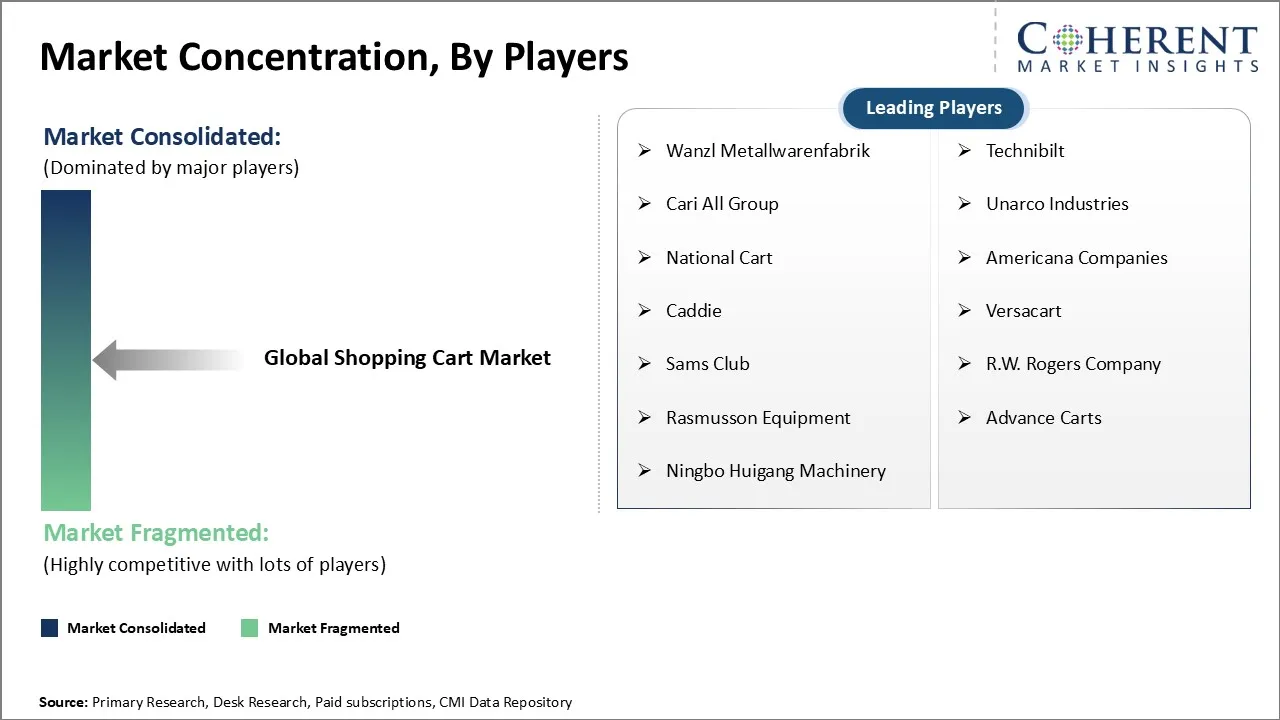
The global shopping cart market is moderately concentrated as the competition among the players include the shopping cart manufacturers, shopping cart equipment suppliers and smart shopping cart technology enabled providers. Although durability, pricing, customization and supply reliability are the current core aspects of traditional competition, new competition is growing increasingly digital, automated and based on retailer ecosystem partnerships. Regional manufacturers will continue to play an important role with localized value chains, while technology providers are transforming value creation with connected solutions.
Key Focus Areas Include
- Product durability, corrosion resistance, and lifecycle performance
- Manufacturing efficiency and large-scale supply capability
- Smart technology integration and digital retail compatibility
- Customization capabilities for different retail formats
- Pricing competitiveness and total ownership cost
- Distribution networks and after-sales support
- Sustainability-focused materials and production practices
- Partnerships with retailers and technology platforms
Market Report Scope
Global Shopping Cart Market Report Covergae | |||
Report Coverage | Details | ||
Base Year | 2025 | Market Size in 2026: | USD 2.45 Bn |
Historical Data For: | 2020 To 2024 | Forecast Period: | 2026 To 2033 |
Forecast Period 2026 To 2033 CAGR: | 5.50% | 2033 Value Projection: | USD 3.56 Bn |
Geographies covered: |
| ||
Segments covered: |
| ||
Companies covered: | Wanzl Metallwarenfabrik, Technibilt, Cari All Group, Unarco Industries, National Cart, Americana Companies, Caddie, Versacart, Sams Club, R.W. Rogers Company, Rasmusson Equipment, Advance Carts, Ningbo Huigang Machinery | ||
Growth Drivers: |
| ||
Restraints & Challenges: |
| ||
Analyst Opinion (Expert Opinion)
- The global shopping cart market may move from a hardware-centric business to a solutions-centric, joint solutions business where shopping cart suppliers leverage on their digital capabilities, service integration and retailer intelligence, against one another. Companies who are able to provide both physical equipment knowledge and software abilities will have better chances to shape buying choices.
- The most significant disruption will come from the convergence of shopping carts, artificial intelligence, and retail analytics. Traditional carts may increasingly become connected store infrastructure, creating pressure on manufacturers that compete only through price and basic product specifications.
- Market participants should prioritize modular product designs, technology partnerships, sustainable materials, and retailer-specific customization. Companies should avoid excessive investment in standalone hardware without digital integration capabilities, as future purchasing decisions are expected to increasingly consider operational value rather than equipment cost alone.
Speak to the analyst
Want personalized insights?
Take the findings above to one of our principal consultants, or have the report rebuilt around the segments, geographies and competitors you actually track.
Market Segmentation
- Product Type Insights (Revenue, USD Bn, 2021 - 2033)
- Standard Shopping Carts
- Basket Carts
- Tote Box Carts
- Child Shopping Carts
- Smart Shopping Carts
- Material Type Insights (Revenue, USD Bn, 2021 - 2033)
- Metal or Wire Carts
- Plastic Carts
- Stainless Steel Carts
- Hybrid Materials
- Wheel Type Insights (Revenue, USD Bn, 2021 - 2033)
- Four wheel Carts
- Three wheel Carts
- Specialty Carts
- Application Insights (Revenue, USD Bn, 2021 - 2033)
- Supermarkets and Hypermarkets
- Shopping Malls
- Convenience Stores
- Wholesale Clubs
- Others
- Distribution Channel Insights (Revenue, USD Bn, 2021 - 2033)
- Direct Sales
- Indirect Sales
- Regional Insights (Revenue, USD Bn, 2021 - 2033)
- North America
- U.S.
- Canada
- Latin America
- Brazil
- Argentina
- Mexico
- Rest of Latin America
- Europe
- Germany
- U.K.
- Spain
- France
- Italy
- Russia
- Rest of Europe
- Asia Pacific
- China
- India
- Japan
- Australia
- South Korea
- ASEAN
- Rest of Asia Pacific
- Middle East
- GCC Countries
- Israel
- Rest of Middle East
- Africa
- South Africa
- North Africa
- Central Africa
- North America
Sources
Primary Research Interviews
- Shopping cart manufacturers, retail equipment suppliers, smart cart technology providers, retailers, supermarkets, hypermarkets, and shopping mall operators
- Procurement managers, retail operations executives, store equipment specialists, supply chain professionals, and industry experts
Stakeholders
- Shopping cart manufacturers, metal fabrication companies, plastic cart producers, component suppliers, and technology solution providers
- Supermarkets, hypermarkets, convenience stores, wholesale clubs, shopping malls, and online-to-offline retail operators
- Retail equipment distributors, maintenance service providers, and fleet management companies
End-use Sectors
- Supermarkets and hypermarkets
- Shopping malls and organized retail stores
- Convenience stores and wholesale clubs
- Smart retail and omnichannel shopping environments
Regulatory and Industry Bodies
- International Organization for Standardization (ISO)
- Consumer Product Safety Commission (CPSC)
- European Committee for Standardization (CEN)
- Retail industry associations and consumer safety organizations
- National retail and product safety authorities
Databases
- Company annual reports, investor presentations, and corporate filings
- Retail infrastructure and store expansion databases
- Trade and import-export databases for retail equipment
- Supplier directories and product catalog databases
- Competitive intelligence and technology adoption databases
Magazines and Journals
- Retail technology publications
- Supermarket and grocery industry magazines
- Manufacturing and industrial equipment journals
- Consumer retail and store innovation publications
Associations
- National Retail Federation (NRF)
- European Retail Institute and retail industry associations
- Retail equipment manufacturers’ associations
- Supply chain and logistics associations
Public Domain Sources
- Retail store expansion and modernization trends
- Shopping cart technology adoption and smart retail developments
- Consumer shopping behavior and in-store experience trends
- Sustainability initiatives in retail equipment manufacturing
- Digital transformation of physical retail environments
Key Standards and Regulations
- Product safety and material quality standards
- Retail equipment design and manufacturing guidelines
- Accessibility and ergonomic requirements
- Environmental and recyclable material regulations
- International trade and import-export compliance requirements
Proprietary Elements
- CMI Data Analytics Tool
- Proprietary CMI repository containing 10+ years of retail infrastructure, consumer goods, industrial equipment, and market intelligence data.
Get access to 250+ pages report
Every segment, forecast, competitor profile and data table behind the analysis above — available for instant download.
- ESOMAR Member
- ISO 9001:2015 Certified
- D-U-N-S Registered
- GDPR & CCPA Compliant
Missing comfort of reading report in your local language? Find your preferred language:
Frequently Asked Questions
The CAGR of global shopping cart market is projected to be 5.50% from 2026 to 2033.
The global shopping cart market is estimated to be valued at USD 2.45 Bn in 2026 and is expected to reach USD 3.56 Bn by 2033.
The global shopping cart market includes various product offerings designed for different retail environments, customer requirements, and store formats, ranging from conventional carts to specialized retail mobility solutions.
Supermarkets, hypermarkets, shopping malls, convenience stores, wholesale clubs, and other organized retail operators are the primary buyers of shopping carts globally.
Retailers typically evaluate factors such as durability, material quality, load capacity, maneuverability, maintenance requirements, customization options, and supplier reliability when purchasing shopping carts.
Technology is influencing the global shopping cart market through the integration of digital features, smart assistance systems, customer engagement tools, and connected retail solutions that enhance in-store shopping experiences.
The growth of the Global Shopping Cart Market is primarily driven by expanding retail infrastructure, which is increasing demand for efficient shopping solutions, along with the adoption of smart carts that enhance customer convenience, improve checkout experiences, and support digital retail transformation.