

Global Silicone-Like Acrylic Sealant Binders Market Size and Forecast – 2026 To 2033
The global silicone-like acrylic sealant binders market is estimated to be valued at USD 72.2 Mn in 2026 and is expected to reach USD 185.1 Mn by 2033, expanding at a CAGR of 14.40% during the forecast period. The growing use of high-elasticity acrylic binders that provide silicone-like flexibility, enhanced substrate adhesion, weather resistance, and paintability is driving market growth. Based on such properties, advanced acrylic formulations are suitable for sealing joints in facades, sealing windows and doors, building housing and special applications in industry.
In January 2025, PPG Industries' Top Gun sealant portfolio was documented under a verified Environmental Product Declaration, covering elastomeric siliconized acrylic sealants such as Top Gun 210X and Top Gun 300Xi. The move reflects the increasing significance of integrating high-performance acrylic sealing with clear environmental disclosure to satisfy the ever-changing needs of the construction sector.
Key Takeaways of the Global Silicone-Like Acrylic Sealant Binders Market
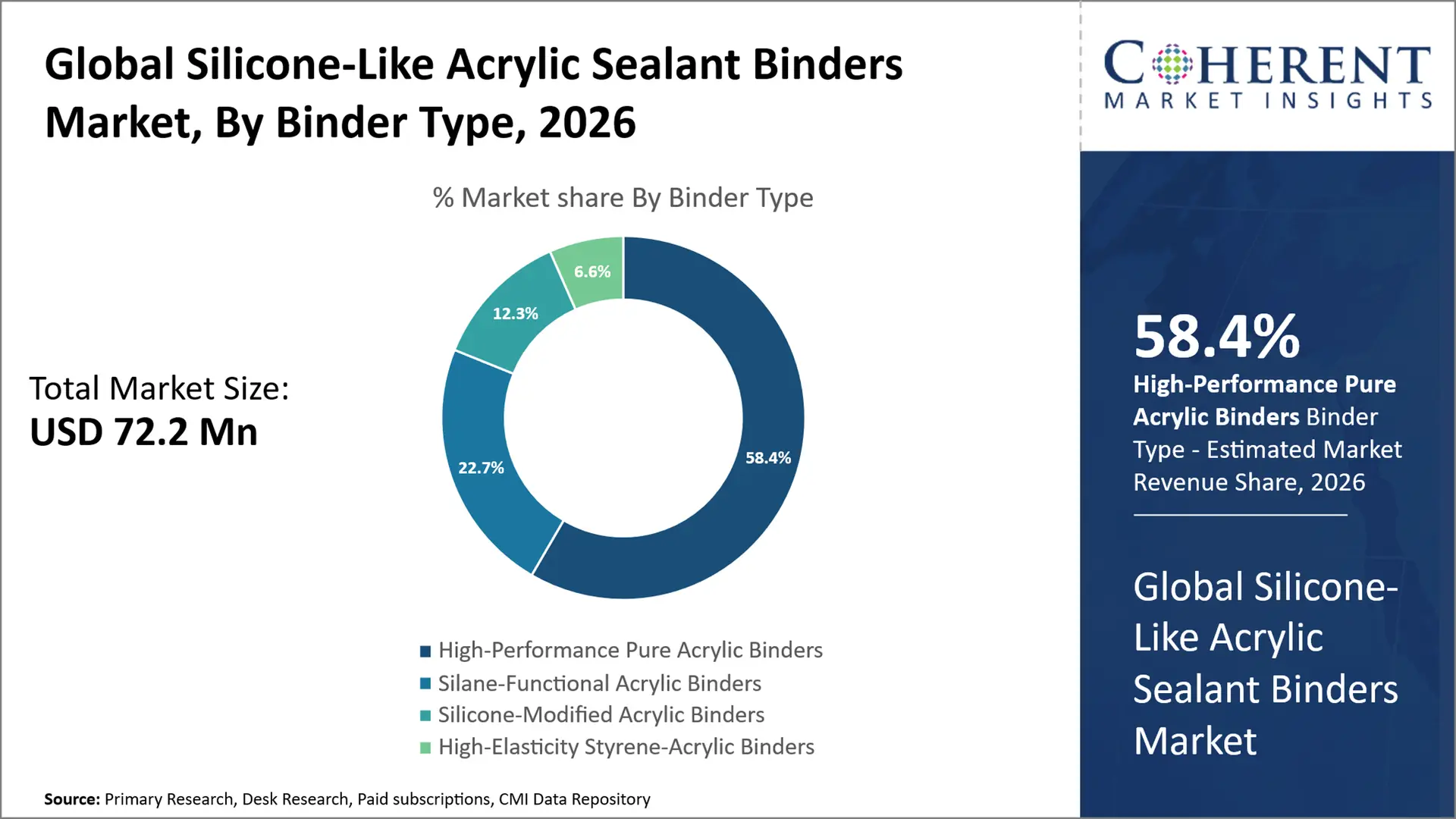
- The High-Performance Pure Acrylic Binders are expected to register an estimated CAGR of 14.8% for the foreseeable future and dominate the silicone-like acrylic sealant binders market with 58.4% share by 2026. They're attractive because they offer waterproofing, but are also flexible like silicone, and formulated at a reasonable price. In September 2026, BASF introduced Acronal BC 5225 X for Class 25LM acrylic sealant formulations.
- High-Movement, Low-Modulus Binders are estimated to grow at a CAGR of 15.6% through 2033 and represent 65.7% share of 2026 demand in the global silicone-like acrylic sealant binders market. These materials absorb repeated joint displacement while limiting stress on concrete, framing, and other substrates, reducing repair exposure for contractors. In July 2025, Sika documented its modified-acrylic SikaSeal-106 Construction with low modulus and ±25% movement capability.
- Facade and Expansion Joint Sealants are expected to see an estimated CAGR of 14.9% and will be 33.8% of the global silicone-like acrylic sealant binders market in 2026. The durability to withstand changing temperatures, moisture, and dissimilar materials in exterior assemblies is the key issue for product selection. Henkel's RUBSON AB Acrylic Building technical specification also included façade movement joints in April 2026.
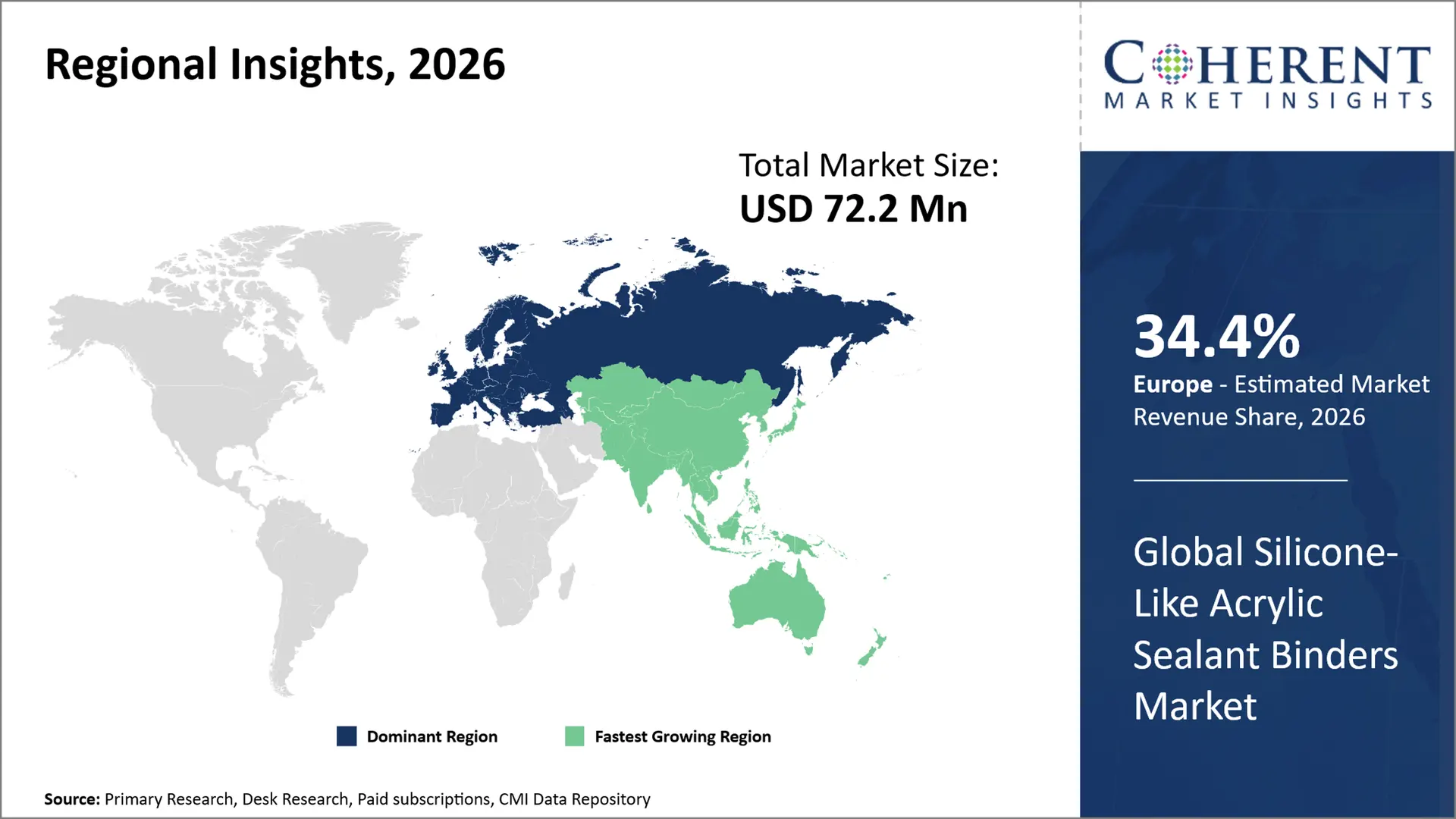
- Europe is estimated to post a CAGR of 12.4% over 2026–2033 while retaining the largest 2026 regional share at 34.4% in the global silicone-like acrylic sealant binders market. When a building envelope is facing issues due to its aging, the specifications favor paintable, durable, window perimeter and façade interface sealants. The European Union (EU) updated the energy performance of buildings directive (EPBD) in May 2024, reinforcing the policy framework for renovation.
- Asia Pacific is expected to account for 33.5% of the market in 2026 and grow at an estimated CAGR of 17.2% through 2033, making it the fastest-growing region. The rise of acrylic and hybrid gap-filling solutions where the price is critical in construction provides an opportunity for upgrading a product by the supplier. Pidilite identified unpenetrated acrylic and hybrid sealant applications in India in the investor presentation in May, 2024.
Segmental Insights
Why Do High-Performance Pure Acrylic Binders Dominate the Global Silicone-Like Acrylic Sealant Binders Market?
High-Performance Pure Acrylic Binders are expected to hold 58.4% of the global silicone-like acrylic sealant binders market in 2026, driven by their economic benefits of changing the composition of acrylic polymer without having to add new resin families. The solids content, film-formation characteristics, and filler compatibility of a waterborne formulation can be modified to produce multiple sealant grades. This simplifies reformulation for manufacturers who produce both professional caulks and sealants for the construction industry. Suppliers of acrylic emulsion products are better served when customers are able to avoid relying on specific chemistries and instead stick with a range of versatile polymers that are technically sound. In September 2026, Trinseo announced that it was seeing continued growth in its acrylic latex product lines for sealants and construction adhesives, noting that performance needed to be proven through customer-scale processing tests. This approach from the supplier helps to ensure repeatable manufacturing and maintain margin due to consistent formulation results.
- Current Industry Events of 2026
- Market Size Estimation
- Regional Breakdown
- Competitive Landscape
- Customer Intelligence
- Segmental Analysis
- Pricing Analysis
- Key Market Drivers, Challenges & Future Trends
- Customized Insights Section
Why Do High-Movement, Low-Modulus Binders Represent the Largest Performance Grade in the Global Silicone-Like Acrylic Sealant Binders Market?
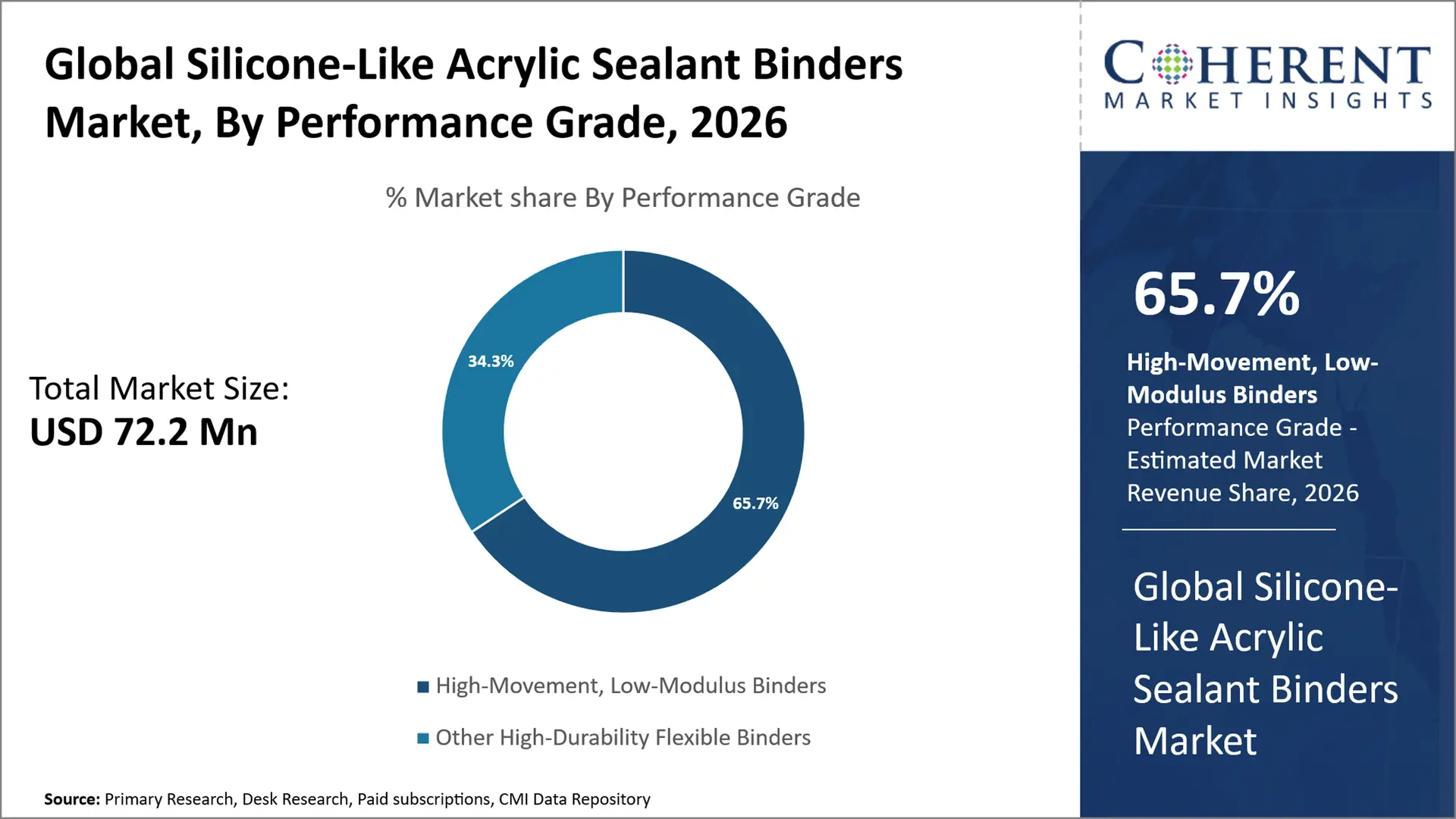
High-Movement, Low-Modulus Binders will make up 65.7% of the global silicone-like acrylic sealant binders market in 2026, because accommodating movement is crucial to ensure joint integrity where materials have varying thermal expansion properties. Low-modulus polymers reduce the stress transferred to adjacent plaster, concrete, and framing materials, helping minimize adhesive failure during repeated joint displacement. The choice of binder formulations by sealant manufacturers is thus determined by a number of factors, including elasticity, joint dimensions and substrate compatibility. This favors suppliers who can supply a consistent level of polymer flexibility and application reliability. In June 2026, Bostik technical documentation was updated to refer to an acrylic-dispersion sealant that complies with EN 15651-1 F-EXT-INT 12.5P (12.5%) movement. The documented performance demonstrates how important technically validated flexible acrylic formulations are in construction sealing applications.
Why Do Facade and Expansion Joint Sealants Dominate the Application Segment of the Global Silicone-Like Acrylic Sealant Binders Market?
Facade and Expansion Joint Sealants are expected to represent 33.8% of global silicone-like acrylic sealant binders market in 2026, underscoring the need to seal interfaces between various prefabricated panels, rendered surfaces and adjacent building components. The choice of products is based not only on initial product price, but on expected joint movement, substrate characteristics, and product proven performance. This opens the door for manufacturers to provide sealant types tailored to specific applications that have specific tolerances and installation instructions. Binder manufacturers can enhance their products by testing substrate adhesion and optimizing the rheology of binders for vertical joint applications. Torggler's product catalogue in April 2025 included a paintable acrylic sealant (A 2.1) that was classified as exterior/interior façade with EN 15651-1 and had a maximum working elongation of 10%. Moderate-movement façade joints are different from high-displacement expansion joints, as demonstrated by its defined movement limit.
Current Events and their Impact
Current Event | Description and Its Impact |
January 2026 – Revised EU Construction Products Regulation Becomes Applicable |
|
California Sealant VOC Restrictions get closer to compliance milestone in January 2026. |
|
September 2026 – Canada Updates VOC Analytical Guidance |
|
Global Silicone-Like Acrylic Sealant Binders Market Dynamics
Key Market Drivers
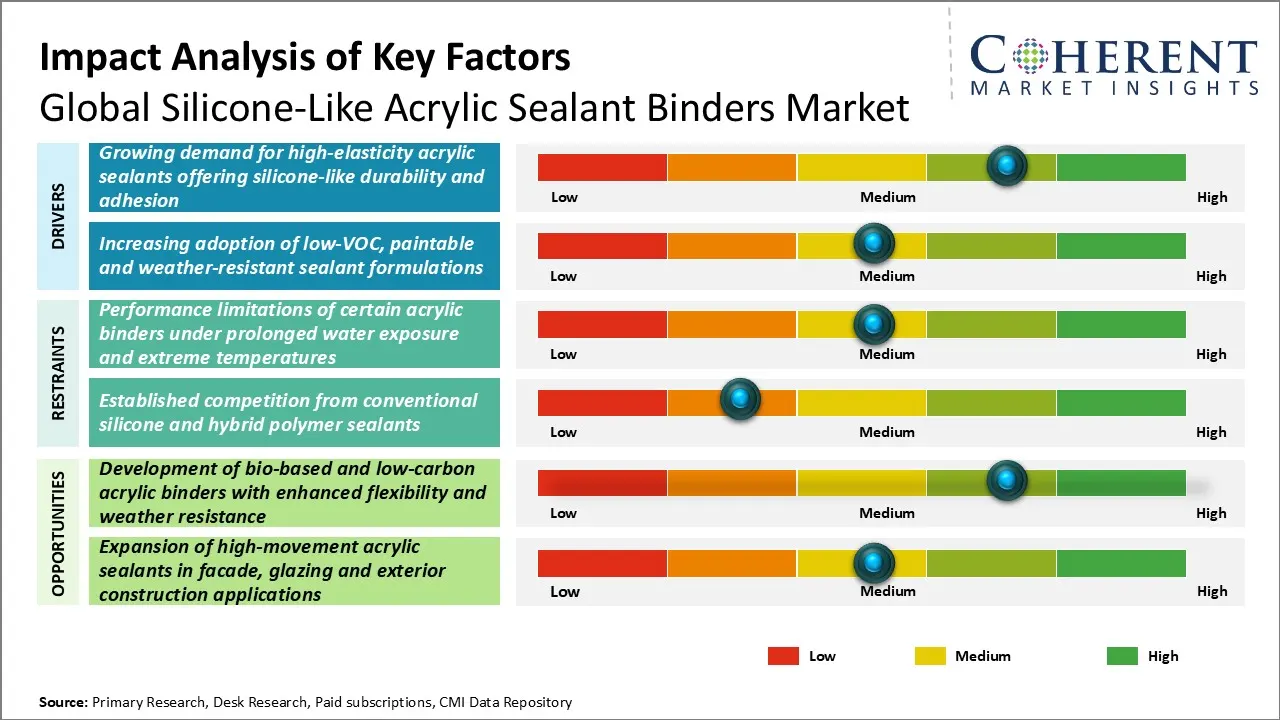
- Growing Demand for High-Elasticity Acrylic Sealants Offering Silicone-Like Durability and Adhesion: Demand for high-elasticity acrylic sealant binders is strengthening as formulators seek improved joint movement, crack resistance, and adhesion to substrates, but without the processing expense of traditional reactive sealants. Flexible acrylic formulations can be used in exterior joints and in homes, where paintability is an issue, due to its flexibility. This is a benefit to differentiated grades of polymers provided to binder manufacturers and used to form construction chemicals. In August 2024, Berger Paints announced the launch of its new HomeShield Acrylic Sealant, which is a flexible sealant and can be painted on and is capable of sealing gaps up to 20 mm in both interior and exterior areas.
- Increasing Adoption of Low-VOC, Paintable and Weather-Resistant Sealant Formulations: Low-VOC acrylic sealants are becoming more attractive to manufacturers seeking improved indoor application conditions, cleaner finishes, and compatibility with conventional architectural paints. Waterborne binder systems aid in the formulation to minimize the use of organic solvents and assist with application and clean-up. These attributes can add to the acceptance of products in the decorating contractor and building maintenance field. In February 2024, illbruck updated the packaging configuration of its solvent-free LD730 Acrylic Sealant, emphasizing paintability, flexibility, and demand-aligned supply for professional interior decorating applications.
Emerging Market Trends
- Greater Emphasis on Quantifiable Binder Sustainability: Acrylic sealant binder procurement is starting to shift towards documented environmental performance, in addition to product positioning for low emissions. Increasingly, formulators are considering the origin, manufacturing energy requirements, and product carbon footprint of polymers, in addition to mechanical properties.
Impact: This shift could create greater differentiation between suppliers offering traceable environmental data and those competing primarily on resin price. Documentation on sustainability could also be more important in the formulation qualification.
Relevance to Market: Suppliers with the ability to deliver validated environmental data and a uniform binder should have a greater advantage in meeting specification-based demands and in developing high quality products during the forecast period.
- Formulation Optimization for Automated Sealant Application: The adoption of controlled dispensing and automated sealing processes could reshape binder specifications for prefabricated building components and industrial assemblies. Formulators will increasingly need to manage viscosity stability, extrusion consistency, recovery after dispensing, and wet-film geometry.
Impact: Materials with predictable rheological behavior can help to enhance production speeds and lower rejected sealant beads. The application-testing capability of binder suppliers may influence more formulation decisions by the customer.
Relevance to Market: This trend would benefit the technically oriented acrylic polymer producers supplying sealant manufacturers serving window, door and modular building applications. Suppliers offering polymers with consistent rheological properties and compatibility with automated dispensing processes may gain a competitive advantage as manufacturers prioritize application consistency, production efficiency, and reduced material wastage.
Key Restraining Factors
- Performance Limitations in Continuous Moisture Exposure: Conventional acrylic waterborne sealant formulations may have limitations in performance when exposed to continuous moisture prior to complete film formation. It is possible to create greater water resistance without sacrificing flexibility, adhesion or paintability, but requires more development and validation. This forms an adoption impediment when exposed to moist joints, exterior applications and other weather conditions.
- Formulation Costs and Qualification Requirements: Premium acrylic binders require careful control of polymer composition, raw material consistency, and additive compatibility. Extended testing for movement ability, weathering and adhesion to various construction substrates may be required for high-performance grades. The requirements drive up development costs and may contribute to a delay in commercial qualification, especially for smaller sealant producers with smaller lab resources. Where there is a technical difference between a standard acrylic sealant and a premium binder, price sensitive customers may not be willing to pay for the difference
Regional Insights
Why Does Europe Dominate the Global Silicone-Like Acrylic Sealant Binders Market?
Europe is expected to account for 34.4% of the global silicone-like acrylic sealant binders market in 2026, owing to its extensive manufacturing base specializing in specialized construction chemicals, and a well-established distribution chain of sealant formulators. Acrylic binders are being assessed more and more for good compatibility with fillers and controlled drying, as well as consistent performance in various construction substrates throughout Europe. Technical distribution networks also exist on a regional level to support formulation changes and product qualification. In June 2026, Archroma and TER Chemicals announced their distribution partnership in Europe for advanced polymer dispersions for construction adhesives and sealants. The arrangement demonstrates the potential impact of increased availability of dedicated water-based binders for formulation and enhanced regional possibilities for water-based sealant manufacturers.
Why Is Asia Pacific Emerging as the Fastest-Growing Region in the Global Silicone-Like Acrylic Sealant Binders Market?
Asia Pacific is expected to account for 33.5 % of the global silicone-like acrylic sealant binders market in 2026 and will deliver the highest growth rate till 2033. The availability of acrylic raw materials, the production of acrylic resin in the region and the technical differentiation of construction sealants that is increasing in the region are providing support for regional expansion. High humidity, tropical temperatures, and price considerations for construction increasingly allow the formulation of products specifically designed for tropical conditions. In February 2025, Arkema announced that its acrylic and polyester resin production facilities in Pasir Gudang, Malaysia, have been certified as ISCC PLUS. The development strengthens access to certified specialty resin supply in the region and highlights opportunities for lower-carbon acrylic material sourcing, although sealant-specific output was not disclosed.
Global Silicone-Like Acrylic Sealant Binders Market Outlook for Key Countries
Why Is the U.S. a Key Market for the Global Silicone-Like Acrylic Sealant Binders Market?
The U.S. is a key global silicone-like acrylic sealant binders market by virtue of its mature construction chemical industry, high level of residential maintenance activity and technically demanding caulk formulations. Manufacturers are looking more and more for acrylic polymers that can give them exterior durability, application consistency and material efficiency. Established specialty chemical suppliers also provide formulation support to construction sealant producers for both professional and consumer applications. Dow’s bio-based PRIMAL and RHOPLEX acrylic emulsions for caulks and sealants, showcased in October 2026, are said to be compatible with existing formulation processes. This development illustrates how U.S.-based polymer innovators can differentiate acrylic binder portfolios through renewable material sourcing while retaining the application characteristics expected by sealant manufacturers.
Why Is India Important in the Global Silicone-Like Acrylic Sealant Binders Market?
India has opportunities for growth in the building of affordable housing, residential finishing, and increased access to formulated construction chemicals. Ease of application and compatibility with paints were factors that influenced the purchase of acrylic sealant for the cost sensitive applications used for wall cracks, door-frame connections and interior joints. The ability to formulate and package domestically can also help to lessen reliance on imported finished specialty sealants. In July 2026, India's Ministry of Housing and Urban Affairs announced the continued implementation of PMAY-U 2.0, a scheme designed to support additional eligible urban housing beneficiaries. The program is not a requirement for the use of acrylic sealant, but provides potential downstream market opportunities for the construction sealant suppliers of housing developers, contractors and building-material distributors.
Why Does China Support Growth in the Global Silicone-Like Acrylic Sealant Binders Market?
China is strategically positioned in the global silicone-like acrylic sealant binders market with its manufacturing capabilities, construction chemical manufacturers, and sealing applications in industry. In addition to the traditional building joints, acrylic formulations also meet special needs in container production and transport. Applications provide opportunities for binder suppliers who can regulate flexibility, adhesion and processing properties for industrial production lines. An example of this multi-faceted demand is found in Guangzhou Jointas Chemical's water-based acrylic sealant JT-323, which is used as a sealant for joints in shipping containers and refrigerated trucks. Its application profile shows prospects for domestic formulator to supply export oriented industrial manufacturer. This opens up new markets for acrylic binder makers, apart from the traditional commercial and decorational sealing applications and the residential construction.
Why Is Germany a Strategic Country in the Global Silicone-Like Acrylic Sealant Binders Market?
Germany plays an important role in the silicone-like acrylic sealant binders market due to its technically specialized sealant industry, construction material testing framework and focus on product performance documentation. German sealant formulation needs binders that ensure steady extrusions and controlled shrinkage, as well as compatibility with architectural finishing materials. The selection of products for indoor construction is also affected by independent emission classifications. In March 2025, the official product documentation from BTI contained the EMICODE EC1 PLUS sealant certification for acrylic sealant. It is indicative of the commercial significance of verified low-emission performance of professional construction sealants. Manufacturers of acrylic adhesives can benefit from the requirements by ensuring a controlled residual monomer content, production consistency and formulation support which enhances the chances of qualification in German construction chemical manufacturers.
Why Is Japan an Important Growth Market for the Global Silicone-Like Acrylic Sealant Binders Market?
Japan presents opportunities for global silicone-like acrylic sealant binders market through residential refurbishment and the technical requirements associated with window replacement. Installers need compatible sealing systems for joints between window frames, interior finishes, and existing wall materials. Binder selection must account for dimensional stability, controlled drying, and adhesion to substrates encountered during renovation. In July 2025, Japan's Green Housing Support Program (GHSP) updated the eligibility criteria for the exterior window and door replacement work, reinforcing the focus on the eligibility of energy-efficient exterior window and door replacement work. These programs provide the potential for acrylic sealants in appropriate perimeter and finishing joint applications downstream. Application-specific formulation information can be more valuable to renovation-focused construction chemical manufacturers, who may have a better understanding of the specific application requirements.
Acrylic Sealant Binder Supply Chain and Commercial Procurement Landscape
Market Parameter | Key Industry Considerations | Market Landscape | Commercial Significance |
Raw Material Availability | The cost of a binder is affected by the availability and the price of the acrylic monomers, emulsifiers and specialty additives. | The supply conditions are related to the regional production of monomers, feedstock costs and supply diversification. | Reliable sourcing is essential for helping manufacturers keep their prices competitive and their manufacturing lines running. |
Manufacturing Cost Structure | Manufacturing economics are influenced by polymer solids, processing efficiency, energy usage and scale of production. | The integrated procurement in larger production and higher production volumes are advantages for large producers, and customized grades are the focus of the specialists. | Cost-efficient production supports competitive pricing and protects supplier margins. |
Quality and certification of products. | Qualification criteria include consistency, solids content, storage stability and the performance of the finished sealant. | Increasingly, sealant manufacturers are asking for documented product specifications and testing for applications. | Quality reliability facilitates supplier approval, long-term contracts, and positioning the product as a premium product. |
Customer Procurement Preferences | Sealant formulators place a high value on having consistent binder specifications, technical support, competitive pricing and reliable delivery. | Customers still need to have direct manufacturer relationships for special formulations and frequent bulk orders. | Strong technical and commercial relationships improve customer retention and recurring sales. |
Distribution and Supply Accessibility | Regional inventory, transportation costs, order quantities, and delivery flexibility influence sourcing decisions. | Direct sales serve major formulators, while specialty chemical distributors support smaller manufacturers and regional customers. | Efficient distribution expands customer access and reduces supply disruptions. |
Pricing and Contract Structures | Factors that affect binder prices include price changes of monomers, volume of purchase, product specifications and contract terms. | A negotiated supply agreement could be preferable to a buyer, depending on the availability of the materials and the buyer's desire for price predictability. | Differentiated product grades and flexible contracts can provide more profits and revenue stability. |
How Are Specialized Fire- and Acoustic-Sealing Applications Creating New Growth Opportunities in the Global Silicone-Like Acrylic Sealant Binders Market?
Acrylic binder manufacturers, who want to break out of the traditional decorative joint arena, will find fire and acoustic-sealing systems as a niche opportunity. Sealing materials can be used with suitable test systems to provide compartment integrity and designed to provide controlled sound transmission at hospitals, educational facilities, commercial buildings and modular construction projects.
These applications can be addressed in advanced acrylic formulations by customizable flexibility, adhesion, filler compatibility and shrinkage. But, besides the fire resistance, acoustic resistance should be demonstrated at the complete assembly or sealing-system level not from the binder characteristics alone.
Suppliers need to work closely with specialist sealant formulators, fire-protection product manufacturers, and construction-system testing organizations to best take advantage of this opportunity. Formulation stability, compatibility with fire-resistant fillers, and documentation to support relevant test requirements are some of the investment priorities.
Specialized polymer producers who are able to provide customized grades of binder are especially appealing. That could enable such companies to attract more lucrative technical connections while minimizing direct commodity acrylic sealant connections.
Market Players, Key Development, and Competitive Intelligence
Key Developments
- In July 2025, Hermann Otto GmbH introduced OTTOSEAL A 220 Turbo, an acrylic sealant designed for immediate overpainting in interior construction and renovation applications. Its emphasis on quicker finishing and reduced cracking illustrates how formulation performance can create differentiation beyond basic joint sealing.
- In April 2025, DAP Global Inc announced its On-The-Go product range, including smaller-format ALEX PLUS acrylic latex caulk and KWIK SEAL acrylic latex adhesive caulk. This development expands access to acrylic sealant solutions for minor household repairs and targeted applications, illustrating the importance of package-size differentiation and convenient retail distribution.
- In February 2025, KUDO introduced acrylic vapor-barrier and vapor-permeable joint sealants under its PROFF range in 3 kg containers. Designed for interior and exterior window-frame installation respectively, these products demonstrate an application-specific approach to moisture management, supporting differentiated acrylic sealant formulations for building-envelope installation systems.
Competitive Landscape
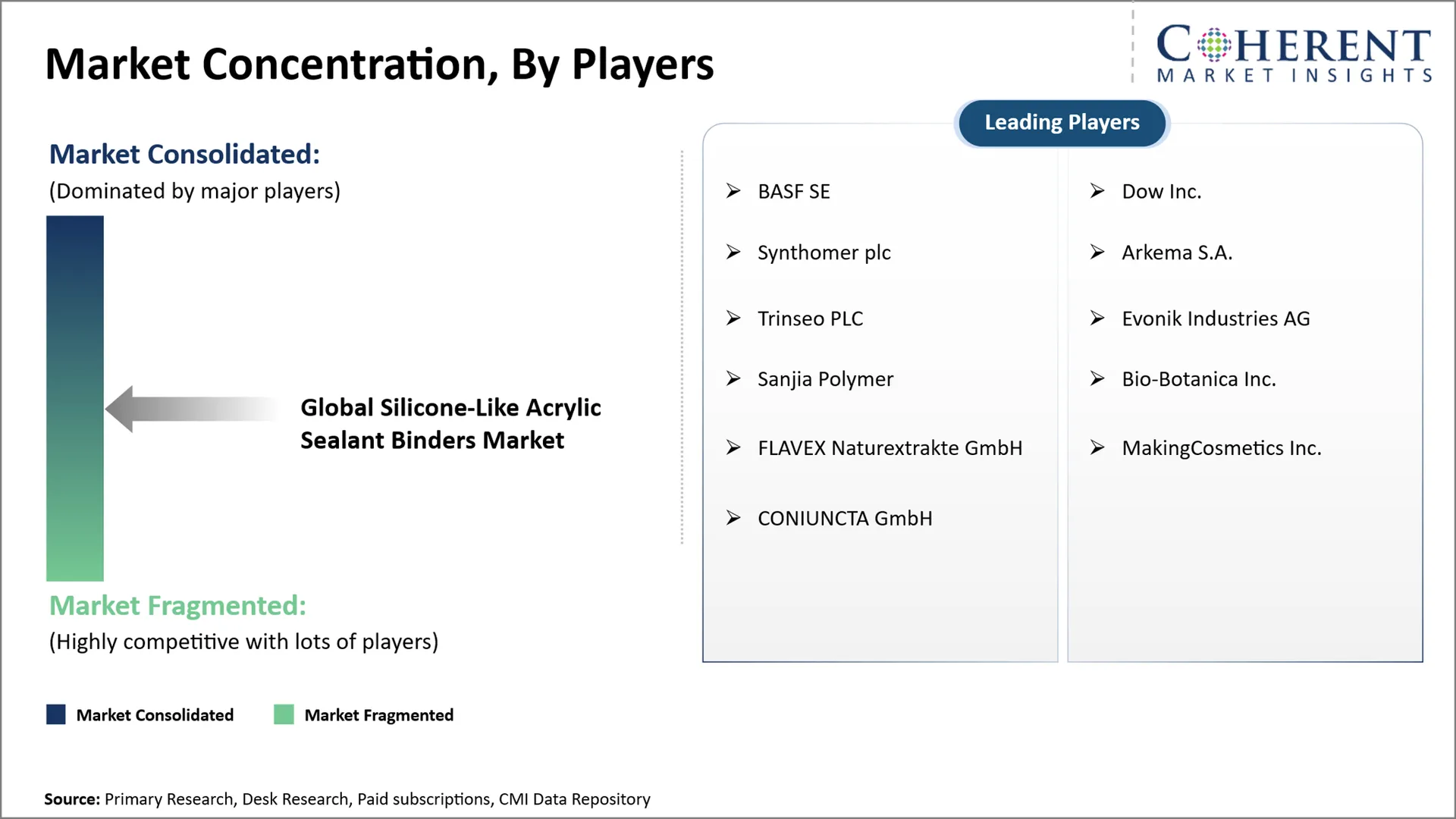
The global silicone-like acrylic sealant binders market is moderately consolidated, with established specialty chemical manufacturers competing alongside regional emulsion polymer producers. The competition is on polymer performance, manufacturing consistency, formulation flexibility, technical support, and supply reliability. Regional specialists can hold their ground with application-specific grades and responsive customer service, while larger suppliers benefit from broader research capabilities and existing multinational customer relationships.
Key competitive considerations include
- Binder Performance: Suppliers compete by controlling elongation, elastic recovery, tensile properties and long-term adhesion.
- Formulation Economics: Total formulation cost, polymer solids and additive compatibility impact buying decisions.
- Manufacturing Consistency: Stable latex particle characteristics and batch-to-batch quality support repeatable finished-sealant performance.
- Product Customization: Application-specific polymer grades enable suppliers to address different substrates, joint conditions, and processing requirements.
- Technical Qualification: Laboratory testing, formulation assistance, and performance documentation can influence supplier approval.
- Supply Reliability: The continuity of supply is determined by the availability of raw materials, inventory and manufacturing capacity in a given region.
- Customer Retention: Joint development programs and established technical relationships can increase the cost and complexity of switching suppliers.
Market Report Scope
Global Silicone-Like Acrylic Sealant Binders Market Report Coverage | |||
Report Coverage | Details | ||
Base Year | 2025 | Market Size in 2026: | USD 72.2 Mn |
Historical Data For: | 2020 To 2024 | Forecast Period: | 2026 To 2033 |
Forecast Period 2026 To 2033 CAGR: | 14.40% | 2033 Value Projection: | USD 185.1 Mn |
Geographies covered: |
| ||
Segments covered: |
| ||
Companies covered: | BASF SE, Dow Inc., Synthomer plc, Arkema S.A., Trinseo PLC, Evonik Industries AG, Sanjia Polymer, Bio-Botanica Inc., FLAVEX Naturextrakte GmbH, MakingCosmetics Inc., CONIUNCTA GmbH | ||
Growth Drivers: |
| ||
Restraints & Challenges: |
| ||
Analyst Opinion (Expert Opinion)
- The global silicone-like acrylic sealant binders market leadership is likely to depend increasingly on the ability to supply application-ready polymer solutions rather than standalone acrylic binder grades. Sealant manufacturers need to better integrate their product development processes with suppliers that can provide tailored resin chemistry, formulation guidance, processing support and customer validation capabilities.
- The move to integrated binder and additive formulation platforms can be a structural change. Instead of buying polymers and optimizing multiple additives themselves, sealant manufacturers can choose to buy validated combinations for their specific application needs. This could heighten the competitive advantage of companies with formulation expertise in-house and put pressure on traditional suppliers of emulsions.
- Manufacturers should focus on the development of advanced polymer synthesis, controlled rheology and application specific testing capabilities. Investments need to be focused on customer needs that are technically challenging and can be differentiated to maintain margins. Companies should also strengthen monomer sourcing arrangements and develop regional technical partnerships while avoiding excessive capacity investment in undifferentiated acrylic binder grades.
Speak to the analyst
Want personalized insights?
Take the findings above to one of our principal consultants, or have the report rebuilt around the segments, geographies and competitors you actually track.
Market Segmentation
- Binder Type Insights (Revenue, USD Mn, 2021 - 2033)
- High-Performance Pure Acrylic Binders
- Silane-Functional Acrylic Binders
- Silicone-Modified Acrylic Binders
- High-Elasticity Styrene-Acrylic Binders
- Performance Grade Insights (Revenue, USD Mn, 2021 - 2033)
- High-Movement, Low-Modulus Binders
- Other High-Durability Flexible Binders
- Application Insights (Revenue, USD Mn, 2021 - 2033)
- Facade and Expansion Joint Sealants
- Window and Door Sealants
- Sanitary and Wet-Area Sealants
- Interior Flexible Joint Sealants
- Industrial and Specialty Sealants
- End User Insights (Revenue, USD Mn, 2021 - 2033)
- Residential Construction
- Commercial and Institutional Construction
- Industrial and Transportation
- Infrastructure Construction
- Sales Channel Insights (Revenue, USD Mn, 2021 - 2033)
- Direct Manufacturer Sales
- Specialty Chemical Distributors
- Regional Insights (Revenue, USD Mn, 2021 - 2033)
- North America
- U.S.
- Canada
- Latin America
- Brazil
- Argentina
- Mexico
- Rest of Latin America
- Europe
- Germany
- U.K.
- Spain
- France
- Italy
- Russia
- Rest of Europe
- Asia Pacific
- China
- India
- Japan
- Australia
- South Korea
- ASEAN
- Rest of Asia Pacific
- Middle East
- GCC Countries
- Israel
- Rest of Middle East
- Africa
- South Africa
- North Africa
- Central Africa
- North America
- Key Players Insights
- BASF SE
- Dow Inc.
- Synthomer plc
- Arkema S.A.
- Trinseo PLC
- Evonik Industries AG
- Sanjia Polymer
- Bio-Botanica Inc.
- FLAVEX Naturextrakte GmbH
- MakingCosmetics Inc.
- CONIUNCTA GmbH
Sources
Primary Research Interviews
- Acrylic binder manufacturers, specialty polymer formulators, and chemical distributors
- Construction sealant manufacturers, façade contractors, window and door manufacturers, and industrial sealant formulators
Stakeholders
- Acrylic monomer suppliers, polymer emulsion manufacturers, and specialty additive suppliers
- Sealant producers, construction chemical companies, industrial buyers, and formulation technology providers
End-use Sectors
- Residential construction, commercial and institutional construction, infrastructure, and industrial applications
- Façade and expansion joints, windows and doors, sanitary areas, interior flexible joints, and specialty sealing applications
Regulatory and Industry Bodies
- U.S. Environmental Protection Agency (EPA)
- European Chemicals Agency (ECHA)
- European Commission
- California Air Resources Board (CARB)
- South Coast Air Quality Management District (SCAQMD)
Databases
- UN Comtrade and International Trade Centre (ITC) Trade Map
- Eurostat PRODCOM and U.S. Census Bureau manufacturing statistics
- U.S. Census Bureau construction spending and building permit statistics
- National construction output, chemical production, and industrial manufacturing datasets
Magazines and Journals
- Progress in Organic Coatings
- Journal of Applied Polymer Science
- International Journal of Adhesion and Adhesives
- Construction and Building Materials
Associations
- European Adhesive & Sealant Industry Association (FEICA)
- The Adhesive and Sealant Council (ASC)
- British Adhesives and Sealants Association (BASA)
- National Association of Home Builders (NAHB)
Public Domain Sources
- Acrylic binder product specifications, technical data sheets, and safety data sheets
- Sealant performance testing, joint movement classifications, adhesion, and weathering data
- Acrylic monomer pricing, polymer production capacity, and specialty chemical manufacturing investments
- Construction renovation statistics, building activity, and sealant product development announcements
Key Standards and Regulations
- EU REACH Regulation (EC) No 1907/2006
- EU CLP Regulation (EC) No 1272/2008
- EU Construction Products Regulation (EU) 2024/3110
- EN 15651-1 – Sealants for façade elements
- ASTM C834 – Standard Specification for Latex Sealants
- ASTM C920 – Standard Specification for Elastomeric Joint Sealants
- South Coast AQMD Rule 1168 – Adhesive and Sealant Applications
Proprietary Elements
- CMI Data Analytics Tool
- Proprietary research repository, supplemented by primary interviews, binder-level demand estimates, acrylic polymer production analysis, pricing assessments, competitive intelligence, and application-specific market forecasting.
Get access to 250+ pages report
Every segment, forecast, competitor profile and data table behind the analysis above — available for instant download.
- ESOMAR Member
- ISO 9001:2015 Certified
- D-U-N-S Registered
- GDPR & CCPA Compliant
Frequently Asked Questions
The CAGR of global silicone-like acrylic sealant binders market is projected to be 14.40% from 2026 to 2033.
The global silicone-like acrylic sealant binders market is estimated to be valued at USD 72.2 Mn in 2026 and is expected to reach USD 185.1 Mn by 2033.
Silicone-like acrylic sealant binders are used for façade joints, window and door sealing, interior flexible joints, sanitary applications and special formulations for industrial sealants.
Manufacturers have to consider elasticity, adhesion strength, weather resistance, paintability, substrate compatibility, formulation stability and overall production costs.
Custom binder formulations, specialty construction sealants, low-emission products and technical partnerships with established sealant manufacturers are some of the opportunities for new players.
The report offers insights on competitive positioning, supplier capabilities, pricing dynamics, raw material availability, customer procurement preferences, and potential investment opportunities across the sealant binder value chain.
The major factors driving growth in the global silicone-like acrylic sealant binders market include increasing demand for high-elasticity acrylic sealants with silicone-like durability and strong adhesion. The growing preference for low-VOC, paintable, and weather-resistant sealant formulations is also supporting market expansion.