

Global Simultaneous Localization and Mapping Market Size and Forecast – 2026 To 2033
The global simultaneous localization and mapping market is expected to grow from USD 335 Mn in 2026 to USD 2,290 Mn by 2033, registering a compound annual growth rate (CAGR) of 24% from 2026 to 2033. The global simultaneous localization and mapping market is driven by increasing warehouse automation. On June 30, 2025, Amazon rolled out its 1 millionth robot, strengthening its role as the world’s biggest maker and user of mobile robotics. This milestone robot was recently delivered to a fulfillment center in Japan.
Key Takeaways of the Global Simultaneous Localization and Mapping Market
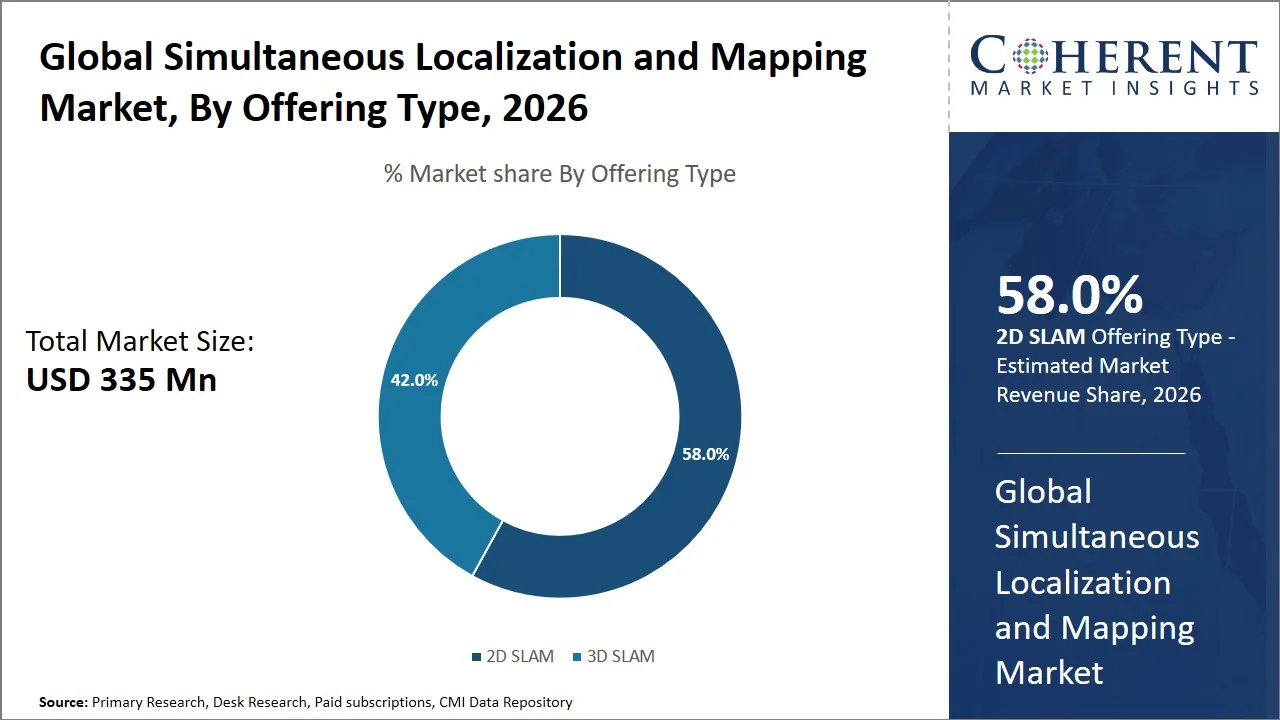
- The 2D SLAM segment is expected to account for 58.0% of the global simultaneous localization and mapping market share in 2026. Expansion of drone-based navigation is driving the growth of the segment. On June 4, 2025, Quantum Systems launched MOSAIC UXS. The platform enables one operator to control unmanned aerial, ground, and maritime systems.
- The Camera Based segment is estimated to capture 63.0% of the market share in 2026. Growing demand for real-time three-dimensional mapping is majorly driving the growth of the segment. On March 18, 2025, Ouster launched its Gemini Cloud Portal for real time 3D situational awareness. The platform provides live and historical 3D visualizations across deployed lidar sites.
- The Visual SLAM segment is estimated to capture 39.0% of the market share in 2026. Rising adoption of augmented reality and virtual reality is driving the growth of the segment. On June 16, 2026, Snap Inc launched Specs, its first consumer focused augmented reality glasses, at Augmented World Expo 2026.
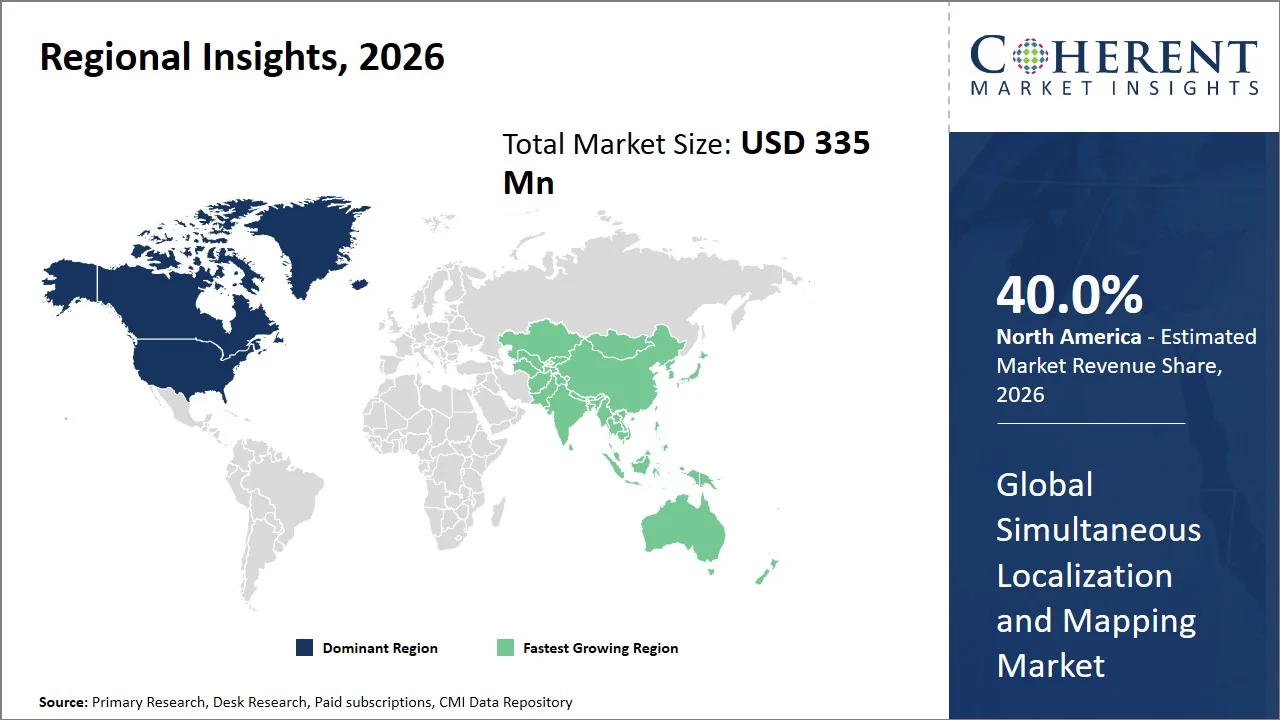
- North America is expected to dominate the simultaneous localization and mapping market in 2026 with a market share of 40.0%. Rising autonomous vehicle development in North America is driving the growth of the regional market. On July 8, 2026, Waymo announced it will soon begin fully autonomous operations in Denver, Las Vegas, San Diego, and Tampa in the U.S.
- Asia Pacific is expected to account for 29.0% share in 2026. Increasing drone deployment for industrial inspection in Asia Pacific is driving the growth of the regional market. In May, 2026, Rakuten supported Swarmer's expansion activities in Japan involving artificial intelligence coordinated drone operations.
Segmental Insights
Why Does 2D SLAM Dominate the Global Simultaneous Localization and Mapping Market?
The 2D SLAM segment is expected to account for 58.0% of the global simultaneous localization and mapping market share in 2026. 2D SLAM is a common approach for efficient navigation in organized interior environments. It is less computationally intense than 3D mapping techniques. This makes it applicable for warehouse robots, autonomous mobility robots and service robots. The simpler sensor requirements can also result in reduced system integration complexity. Continued strong deployment in industrial facilities is driving broad acceptance. On May 18, 2026, Yantrix created an 80 kg payload autonomous mobile robot for an Indian automotive components warehouse. The robot uses a 2D LiDAR SLAM system with Robot Operating System 2 and Nav2. The 20,000 square foot facility demonstrates direct industrial application of 2D SLAM for warehouse navigation.
- Current Industry Events of 2026
- Market Size Estimation
- Regional Breakdown
- Competitive Landscape
- Customer Intelligence
- Segmental Analysis
- Pricing Analysis
- Key Market Drivers, Challenges & Future Trends
- Customized Insights Section
Why is Camera Based the Most Preferred System Type?
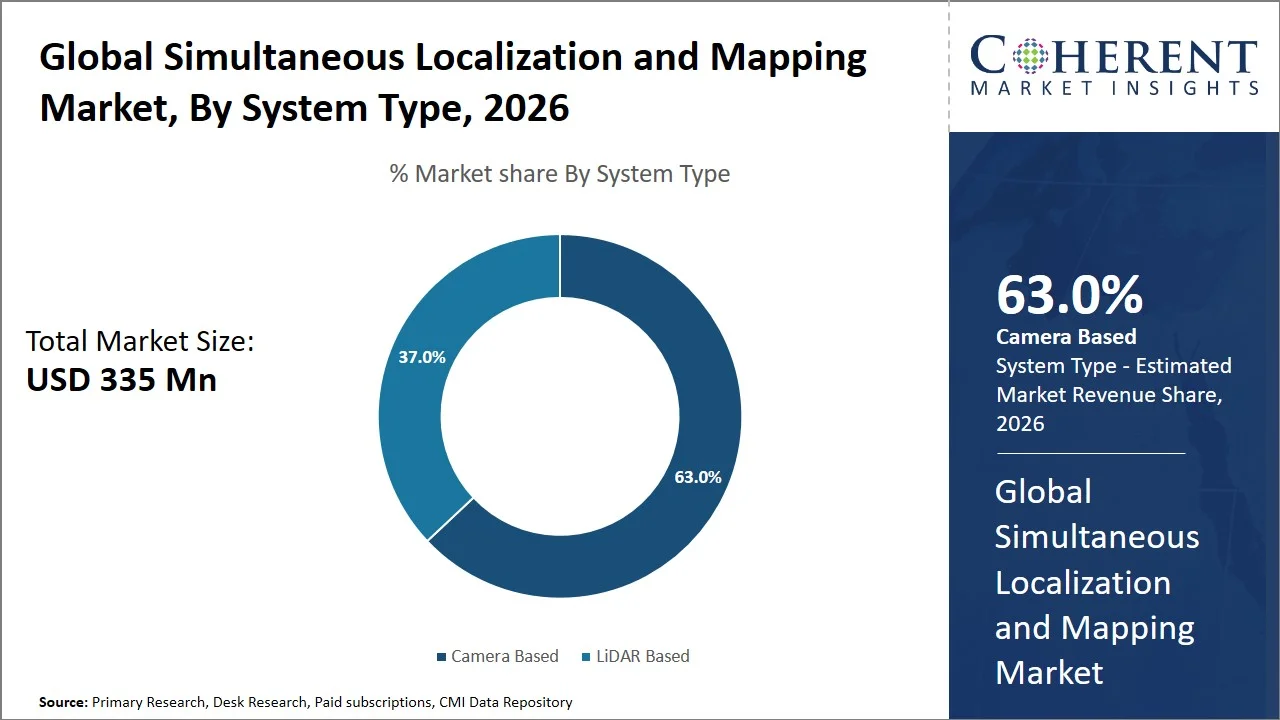
The camera based segment is expected to account for 63.0% of the global simultaneous localization and mapping market share in 2026. Camera based SLAM is preferable as cameras give rich visual information for perception and localization of the environment. They can find textures, edges, objects, and spatial elements in different interior situations. Camera systems can also provide wider scene coverage than more narrowly focused sensor technologies. The integration with existing robotic vision systems enables effective navigation and perception. The features of camera based systems make them well suited for robots working in dynamic situations. On March 16, 2026, RealSense and LimX Dynamics Showcase Autonomous Humanoid Navigation with RealSense Depth Cameras It uses camera-based depth perception and NVIDIA’s cuVSLAM processing. The integration enables dense 3D mapping and localization for humanoid robots.
Visual SLAM Dominates the Global Simultaneous Localization and Mapping Market
The Visual SLAM segment is expected to account for 39.0% of the global simultaneous localization and mapping market share in 2026. The Visual SLAM uses the camera which can collect the detailed details of the surroundings for accurate localization and mapping. It can operate with relatively compact sensing hardware across indoor and outdoor environments. Advances in computer vision and artificial intelligence have improved feature detection and tracking capabilities. Visual SLAM also supports cost sensitive robotic platforms requiring detailed spatial awareness. These advantages have encouraged adoption across robotics, autonomous vehicles, drones, and augmented reality systems. On June 4, 2026, Kudan Inc. announced its collaboration with Zhejiang MRDVS Technology Co., Ltd. The collaboration aims to integrate Kudan Visual SLAM, KdVisual, into MRDVS’s smart sensor modules, aiming to enable robust on-module spatial intelligence for robots and industrial fleets.
Current Events and their Impact
Current Events | Description and its Impact |
European Union Artificial Intelligence Act |
|
United States Executive Order On Artificial Intelligence |
|
Simultaneous Localization and Mapping Market Dynamics
Market Drivers
Rising deployment of autonomous mobile robots
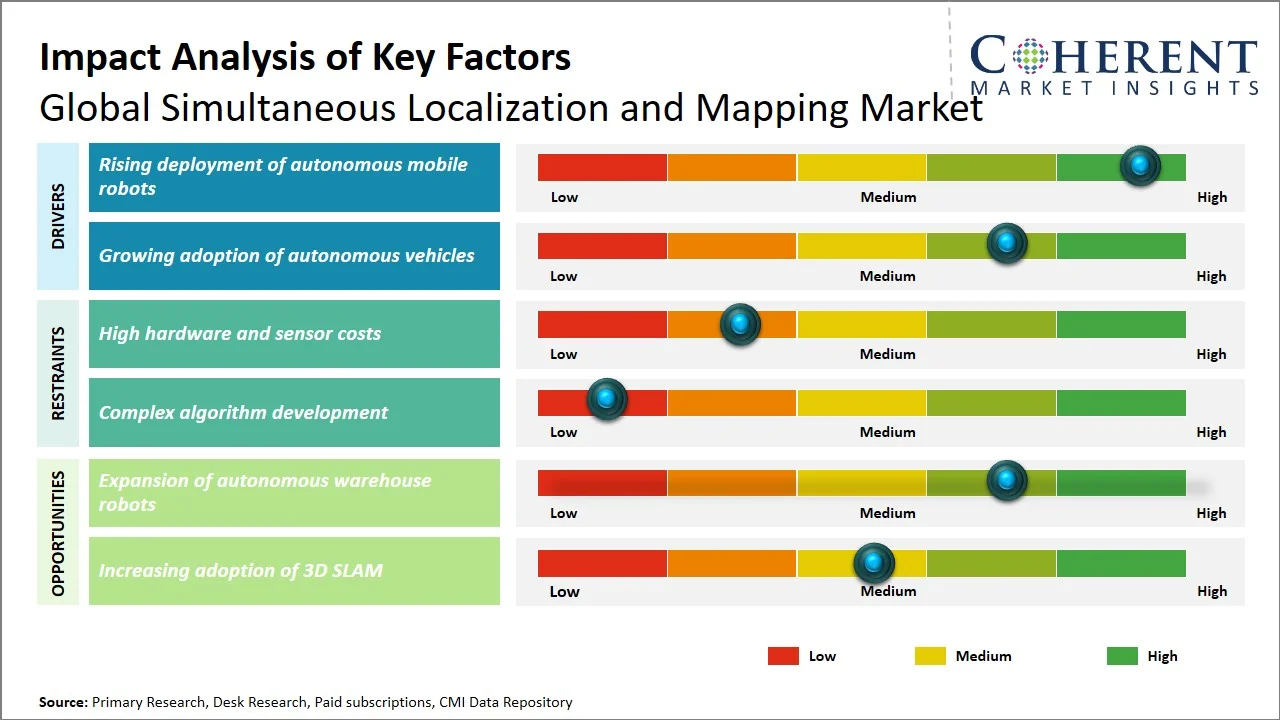
The rising use of autonomous mobile robots is leading to a growing need for accurate indoor localization and mapping capabilities. These robots are increasingly used in warehouses for material moving, inventory handling, picking and order fulfillment. To navigate aisles, avoid obstructions, and maximize their movement in dynamic facility layouts, robots need to be constantly localized. This requirement is encouraging manufacturers to integrate Simultaneous Localization and Mapping capabilities into autonomous mobile robot platforms. Growing warehouse automation therefore supports wider adoption of reliable real time mapping technologies. On June 4, 2026, Amazon revealed an enhanced Proteus mobility robot for fulfillment centers. The warehouse is supported by artificial intelligence and the robot responds to verbal commands from the warehouse.
Growing adoption of autonomous vehicles
Rising adoption of autonomous vehicles is boosting need for sophisticated localization and environmental mapping technology. Autonomous vehicles must continuously localize themselves and understand surrounding roadways, vehicles, people and infrastructure. When conventional location signals are faulty, SLAM devices can aid in localization. Automotive developers are therefore combining cameras, LiDAR, inertial sensors, and advanced computing platforms for improved environmental perception. Expanding autonomous vehicle development is consequently creating additional applications for advanced mapping and localization solutions. On July 30, 2026, Zoox announced that it has received the first-ever commercial exemption for a purpose-built autonomous robotaxi from the National Highway Traffic Safety Administration (NHTSA). With this exemption, Zoox is now granted federal regulatory approval to charge for its robotaxi service.
Emerging Trends
Integration With Artificial Intelligence
Rising adoption of autonomous vehicles is boosting need for sophisticated localization and environmental mapping technology. Autonomous vehicles must continuously localize themselves and understand surrounding roadways, vehicles, people and infrastructure. When conventional location signals are faulty, SLAM devices can aid in localization.
Growth of Visual and LiDAR Fusion
Artificial intelligence is rapidly being integrated with Simultaneous Localization and Mapping techniques. This fusion increases the object detection, scene understanding, dynamic obstacle avoidance and localization accuracy. This helps autonomous systems to get a better understanding of complex settings.
Expansion of Cloud Enabled Mapping
Cloud connected mapping architectures are surfacing for applications demanding continuous updates of maps. Sharing information on space can lead to better operating efficiency for several autonomous devices. This strategy is especially suitable for huge warehouses, industrial plants and distributed robotic fleets.
Increasing Adoption of Edge Computing
Edge computing is increasingly relevant for real time Simultaneous Localization and Mapping applications. Local processing minimizes communication delays and facilitates quicker navigation decisions. This capacity is useful for autonomous robotics, vehicles, drones and other systems that must react to their environments without delay.
Regional Insights
Why is North America a Strong Market for Simultaneous Localization and Mapping?
North America is expected to account for a market share of 40.0% in 2026. Advanced warehouse automation, automobile manufacturing and robotics research infrastructure are benefits North America enjoys. The U.S. accounted for 68% of installations in the Americas in 2024. The U.S. auto industry installed 13,700 industrial robots in 2024, up 10.7%. The National Institute of Standards and Technology is specifically testing mobile robots that use Simultaneous Localization and Mapping. The test includes wheel slip, uneven floors, dynamic barriers, vibrations and forced de-localization. Canada installed 3,800 industrial robots in 2024, and Mexico installed 5,600. In Mexico, the automotive sector accounted for 63% of national installations. These conditions create distinct demand for robust localization across manufacturing and logistics environments.
Why Does Asia Pacific Simultaneous Localization and Mapping Market Exhibit High Growth?
Asia Pacific is expected to register the fastest growth with a CAGR of 26% over the forecast period. Asia Pacific is projected to account for 29.0% of the global simultaneous localization and mapping market in 2026. Concentrated robotics manufacturing, production of electronics and large-scale automation programs are a beneficiary of Asia Pacific. In 2024, the area accounted for 74% of global industrial robot deployments. The key technical ecosystems that assist the development of autonomous navigation are China, Japan and South Korea. India also had 9,100 industrial robot installations in 2024, a 7% increase. Sales of professional service robots in Asia Pacific surpassed 162,284 units in 2023. They are employed in logistics, industrial, healthcare and service applications needing independent movement. Strong semiconductor, sensor, battery, and robotics supply chains further support regional development.
Global Simultaneous Localization and Mapping Market Outlook for Key Countries
Why is U.S. Emerging as a Major Hub in the Simultaneous Localization and Mapping Market?
The U.S. simultaneous localization and mapping market is strongly supported by automotive automation, warehouse robotics, and advanced robotics research. U.S. car manufacturers installed 13,700 industrial robots in 2024, up 10.7% year on year. The National Institute of Standards and Technology is developing testing procedures for mobile robots that use simultaneous localization and mapping. Amazon Robotics also powers large-scale robotic fulfillment operations using autonomous warehouse navigation. Waymo, Zoox and Tesla have also seen significant autonomous vehicle research in the U.S. Such deployments demand continual localization over dynamic road and warehousing settings. The combination of automotive investment and artificial intelligence research strengthens advanced SLAM development.
Is China the Next Growth Engine for the Simultaneous Localization and Mapping Market?
China benefits from exceptionally large industrial automation deployment and rapid embodied artificial intelligence development. In 2024, Chinese factories had more than two million industrial robots in use. Annual installations were estimated at 295,000 units, or 54% of global installations. Chinese manufacturers secured 57% of the local industrial robot market in 2024. China also had more than 150 humanoid robot companies by late 2025. The country released more than 330 humanoid robot products during 2025. These developments increase requirements for visual perception, sensor fusion, spatial understanding, and autonomous navigation.
Germany Simultaneous Localization and Mapping Market Analysis and Trends
Germany benefits from advanced automotive manufacturing and sophisticated industrial automation applications. Germany’s factories put in 26,982 industrial robots in 2024, keeping the country on top of Europe’s robotics industry. The German Aerospace Center designed AIMM, an autonomous mobile manipulator for manufacturing and laboratory purposes. AIMM is a combination of laser scanners, stereo and color cameras. In 2025, ABB also presented the Flexley Mover P604 with 3D visual simultaneous localization and mapping navigation. The system targets automotive manufacturing logistics and production-line supply operations. These applications create demand for reliable 3D localization in partially structured industrial environments.
Japan Simultaneous Localization and Mapping Market Analysis and Trends
Japan benefits from its mature robotics industry, extensive factory automation, and specialized autonomous machines. Japan added 44,500 industrial robots to enterprises in 2024. The stock of operational industrial robots in the country reached over 450,500 units. Japan’s robotics ecosystem is placing more emphasis on open software foundations for a variety of robotic devices. The Ministry of Economy, Trade and Industry has selected seven research subjects of open robotics software development for 2025. Japan also showcased autonomous lunar exploration with the LEV-2 transformable nano-rover. These efforts extend the use of localization technologies from the factory floor to aeronautical exploration. Such applications encourage advances in compact sensing, autonomous navigation, and multi-robot coordination.
South Korea Simultaneous Localization and Mapping Market Analysis and Trends
South Korea benefits from exceptionally high robot density across electronics and automotive manufacturing. The country recorded 1,220 industrial robots per 10,000 manufacturing employees. This represented the world's highest robot density according to the International Federation of Robotics. South Korean factories installed 30,600 industrial robots during 2024. Seoul-based researchers developed real-time SLAM mapping incorporating obstacle information for indoor autonomous robots. Separate Korean research has combined SLAM with Global Navigation Satellite System positioning. The approach enables autonomous robots to switch positioning methods between indoor and outdoor environments. These advancements are directly addressing the localization issues in mixed operating circumstances.
Global Simultaneous Localization and Mapping Market - Multi Sensor SLAM Deployment by Industry (2025)
Industry | Deployment Share |
Manufacturing And Warehousing | 32% |
Automotive And Transportation | 24% |
Drones And Unmanned Aerial Vehicles | 16% |
Healthcare And Life Sciences | 10% |
Defense And Security | 9% |
Construction And Mining | 6% |
Agriculture | 3% |
How is Expansion of Autonomous Warehouse Robots Creating New Growth Opportunities in the Simultaneous Localization and Mapping Market?
With the growing number of autonomous warehouse robots, fulfillment settings are becoming more complex, presenting new potential for SLAM. To fulfill the criteria of precision indoor navigation, Amazon deploys hundreds of thousands of mobile robots in its fulfillment facilities. Symbotic deploys autonomous systems that coordinate storage, retrieval, and pallet movement within high-density warehouses. These environments require robots to localize continuously around shelving, workers, pallets, and other moving machines. Increasing warehouse density is also encouraging multi-robot mapping, dynamic obstacle recognition, and real-time map updating. Consequently, SLAM suppliers can develop specialized solutions for fleet coordination, narrow-aisle navigation, and changing warehouse layouts.
On August 24, 2026, Amazon announced Project Tetromino for highly automated delivery stations. The company planned an initial USD 103 million investment for the pilot. The project targets automated package sorting and vehicle loading operations.
Market Players, Key Development, and Competitive Intelligence
Key Developments
- On July 11, 2025, RealSense announced its successful spinout from Intel Corporation and the close of a USD 50 million Series A funding round. RealSense now operates as an independent company focused on advancing innovation in AI, robotics, biometrics and computer vision.
- On March 28, 2025, RoboSense announced the launch of AC1, the first product in its groundbreaking Active Camera series, along with the AI-Ready ecosystem, providing an all-in-one solution for robotic perception development. As the inaugural product in the Active Camera series, AC1 pioneers the Spatiotemporal fusion of three core sensors: LiDAR, camera, and IMU.
Competitive Landscape
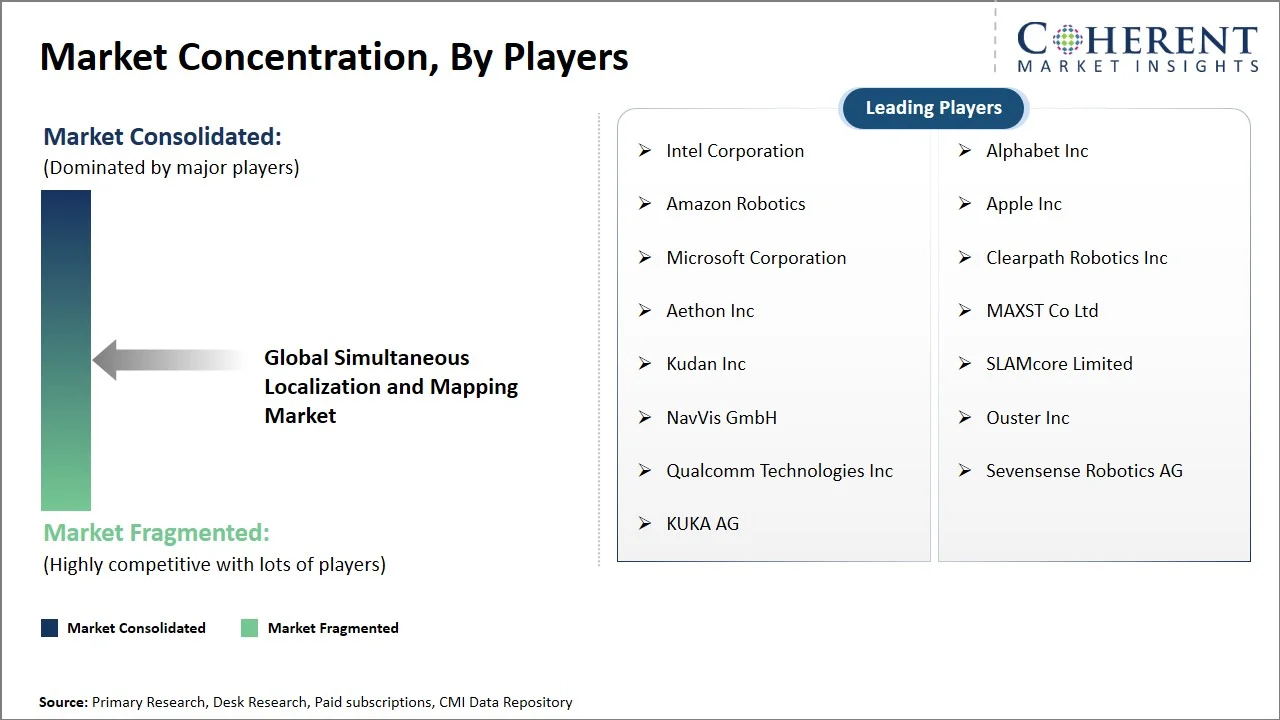
The competitive landscape is shifting toward integrated perception, navigation, and robotics software platforms. ABB is embedding artificial intelligence enabled Visual SLAM into Flexley Mover robots. Its P604 targets automotive production-line supply and intralogistics applications. Kudan is combining Visual SLAM with NVIDIA Isaac Perceptor for dynamic warehouse environments. This strategy targets 3D perception and autonomous mobile robot developers. Slamcore is developing vision-based spatial intelligence for intralogistics and mixed traffic settings. Its technology is aimed at warehouses, factories, manually operated vehicles and autonomous machinery. Ouster is emphasizing high-resolution LiDAR, mapping software, and robotics integrations. Its solutions target autonomous navigation, collision avoidance, mapping, and industrial automation.
Market Report Scope
Simultaneous Localization and Mapping Market Report Coverage
| Report Coverage | Details | ||
|---|---|---|---|
| Base Year: | 2025 | Market Size in 2026: | USD 335 Mn |
| Historical Data for: | 2020 To 2024 | Forecast Period: | 2026 To 2033 |
| Forecast Period 2026 to 2033 CAGR: | 24% | 2033 Value Projection: | USD 2,290 Mn |
| Geographies covered: |
| ||
| Segments covered: |
| ||
| Companies covered: | Intel Corporation, Alphabet Inc, Amazon Robotics, Apple Inc, Microsoft Corporation, Clearpath Robotics Inc, Aethon Inc, MAXST Co Ltd, Kudan Inc, SLAMcore Limited, NavVis GmbH, Ouster Inc, Qualcomm Technologies Inc, Sevensense Robotics AG, KUKA AG | ||
| Growth Drivers: |
| ||
| Restraints & Challenges: |
| ||
Analyst Opinion (Expert Opinion)
- The future of the industry will increasingly center on AI-enabled spatial intelligence rather than standalone localization algorithms. Visual SLAM should gain importance as cameras become capable of richer scene interpretation. Kudan's integration with NVIDIA Isaac Perceptor illustrates this transition toward combined perception and localization. The strongest opportunities should emerge in autonomous mobile robots, warehouse automation, drones, and industrial vehicles. These applications require continuous localization across dynamic environments containing people, machines, and changing layouts.
- The largest opportunity should remain in autonomous warehouse robots requiring 3D perception and dynamic obstacle handling. ABB's Flexley Mover P604 demonstrates how Visual SLAM is being embedded directly into industrial mobile robots. China should remain particularly attractive because of its extensive robotics manufacturing ecosystem. Japan and South Korea have also major potential in the development of modern manufacturing automation and robotics. Edge based processing should be more relevant where robots need fast localization decisions and have limited computing power.
- Players should focus on integrated solutions combining Visual SLAM, LiDAR, inertial sensing and artificial intelligence perception. The Arm partnership of Slamcore underlines the requirement to optimize spatial intelligence for small and power-efficient processors. Companies also need to develop interoperable software that can integrate with existing robotics frameworks and fleet-management platforms. Good performance in dynamic warehouses can be a key competitive advantage. Providers should also concentrate on retrofit solutions, since there are enormous deployment potential for current forklifts and industrial vehicles. Slamcore’s approach to warehouse retrofit is a perfect example of this concept.
Speak to the analyst
Want personalized insights?
Take the findings above to one of our principal consultants, or have the report rebuilt around the segments, geographies and competitors you actually track.
Market Segmentation
- Offering Type Insights (Revenue, USD Million, 2021 - 2033)
- 2D SLAM
- 3D SLAM
- System Type Insights (Revenue, USD Million, 2021 - 2033)
- Camera Based
- LiDAR Based
- Technology Type Insights (Revenue, USD Million, 2021 - 2033)
- Visual SLAM
- LiDAR SLAM
- IMU Based SLAM
- Laser SLAM
- RGB D SLAM
- Application Insights (Revenue, USD Million, 2021 - 2033)
- Robotics
- Unmanned Aerial Vehicles
- Autonomous Vehicles
- Augmented Reality and Virtual Reality
- Real Time Location Systems
- Industrial Automation
- Mapping and Surveying
- Regional Insights (Revenue, USD Million, 2021 - 2033)
- North America
- U.S.
- Canada
- Latin America
- Brazil
- Argentina
- Mexico
- Rest of Latin America
- Europe
- Germany
- U.K.
- Spain
- France
- Italy
- Russia
- Rest of Europe
- Asia Pacific
- China
- India
- Japan
- Australia
- South Korea
- ASEAN
- Rest of Asia Pacific
- Middle East
- GCC Countries
- Israel
- Rest of Middle East
- Africa
- South Africa
- North Africa
- Central Africa
- North America
Sources
Primary Research Interviews
- Robotics Engineers & Autonomous Systems Developers
- SLAM Technology Solution Providers & Vendors
- Autonomous Vehicle Manufacturers & OEMs
- Defense & Aerospace Technology Specialists
Magazines
- IEEE Spectrum
- Robotics Business Review
- Autonomous Vehicle International
- MIT Technology Review
Journals
- International Journal of Robotics Research (IJRR)
- Journal of Field Robotics
- IEEE Transactions on Robotics
Associations
- Association for Unmanned Vehicle Systems International (AUVSI)
- International Federation of Robotics (IFR)
- Consumer Technology Association (CTA)
Public Domain Sources
- U.S. Department of Defense – Defense Advanced Research Projects Agency (DARPA) Publications
- NASA Technical Reports Server (NTRS)
- European Commission – Horizon Europe Research & Innovation Reports
- U.S. Patent and Trademark Office (USPTO) – SLAM Technology Patent Database
Proprietary Elements
- CMI Data Analytics Tool
- Proprietary CMI Existing Repository of Information for the Last 10 Years
Get access to 250+ pages report
Every segment, forecast, competitor profile and data table behind the analysis above — available for instant download.
- ESOMAR Member
- ISO 9001:2015 Certified
- D-U-N-S Registered
- GDPR & CCPA Compliant
Missing comfort of reading report in your local language? Find your preferred language:
Frequently Asked Questions
The global simultaneous localization and mapping market is expected to stand at USD 335 Mn in 2026 and is expected to reach USD 2,290 Mn by 2033.
The CAGR of the global simultaneous localization and mapping market is projected to be 24% from 2026 to 2033.
Rising deployment of autonomous mobile robots and growing adoption of autonomous vehicles are the major factors driving the growth of the global simultaneous localization and mapping market.
High hardware and sensor costs and complex algorithm development are the major factors hampering the growth of the global simultaneous localization and mapping market.
In terms of offering type, 2D SLAM segment is estimated to dominate the market revenue share in 2026.
Simultaneous localization and mapping enables machines to build maps while determining their position within unfamiliar environments.
LiDAR provides accurate depth measurements that support reliable spatial mapping and obstacle detection.