

Global Smart Appliance Market Size and Forecast – 2026 To 2033
The Global Smart Appliance Market is estimated to be valued at USD 39.5 Bn in 2026 and is expected to reach USD 73.14 Bn by 2033, registering a compound annual growth rate (CAGR) of 9.20% from 2026 to 2033. This growth is supported by the integration of artificial intelligence, wireless connectivity, and intelligent energy management into household appliances, enabling consumers to automate routine tasks, remotely monitor appliance performance, and optimize resource consumption.
In September 2025, Vestel showcased its connected washing and drying machines at IFA 2025, featuring AfterWash technology for coordinated appliance operation and the WashWizard application for customized washing programs. The company also presented AI-enabled air conditioners capable of learning user preferences and recommending energy-efficient settings. These developments highlight how manufacturers are combining intelligent automation with practical household functionality to strengthen product differentiation and encourage smart appliance adoption.
Key Takeaways of the Global Smart Appliance Market
- Smart Washing Machines and Washer Dryer Combos are estimated to register a 9.7% CAGR during 2026–2033 and account for 33.8% of the global smart appliance market in 2026. Automated cycle selection, convenient laundry management, and space-efficient designs support household adoption. In August 2025, LG Electronics unveiled its AI-powered HeatPump WasherDryer featuring intelligent fabric care, automated washing functions, and energy-efficient operation.
- Wi-Fi is projected to achieve an estimated 9.5% CAGR during 2026–2033 and capture 81.5% of global smart appliance market revenue in 2026. Compatibility with existing household networks enables smartphone control, software upgrades, and integration with connected home platforms without additional hubs. In August 2025, Samsung Electronics announced extended software support for eligible Wi-Fi-enabled home appliances, strengthening product longevity and connected functionality.
- Connected Appliances with Remote Monitoring and Control are expected to expand at an estimated 8.4% CAGR during 2026–2033 and represent 64.3% of the global smart appliance market in 2026. Accessible pricing and practical features such as status notifications and remote scheduling support broader adoption. In March 2025, Electrolux Group highlighted connected appliance functions enabling consumers to schedule operations around electricity prices and receive personalized usage guidance.
- Asia Pacific is estimated to record an 8.8% CAGR during 2026–2033 and contribute 41.5% of global smart appliance market revenue in 2026. Established manufacturing ecosystems, extensive retail distribution, and household appliance replacement opportunities support its dominant position. In September 2026, China's Ministry of Commerce outlined measures promoting smart home product development, improved interoperability standards, and dedicated retail experience centers to encourage consumer adoption.
- North America is forecast to deliver an estimated 11.0% CAGR during 2026–2033, with a 26.0% global smart appliance market share in 2026. Premium appliance replacement, digital household integration, and consumer interest in intelligent kitchens support its fastest-growing regional outlook. In March 2026, GE Appliances showcased SmartHQ-connected refrigerators and wall ovens with integrated cooking assistance at the Kitchen and Bath Industry Show.
Segmental Insights
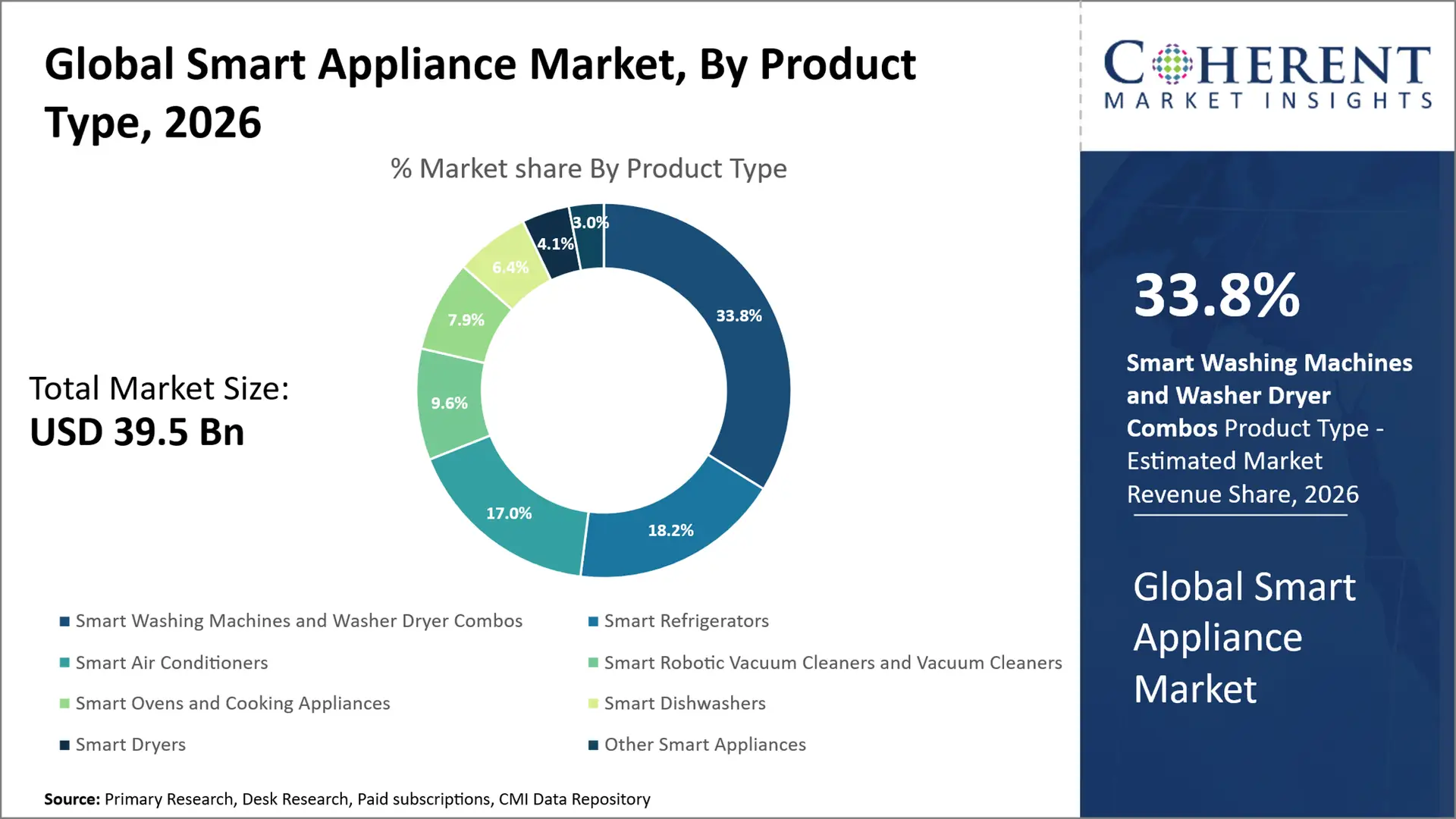
Why Do Smart Washing Machines and Washer Dryer Combos Dominate the Global Smart Appliance Market?
Smart Washing Machines and Washer Dryer Combos are expected to account for 33.8% of the global smart appliance market in 2026, reflecting their importance in frequent household laundry activities. The segment benefits from consumer preferences for improved fabric protection, hygiene, and simplified handling of different garment types. Manufacturers can address these requirements through intelligent detergent dispensing, load balancing, and specialized washing programs. Localized production also helps suppliers adapt appliance capacities and features to regional household requirements while maintaining competitive pricing. In April 2026, Haier introduced its F11 washing machine series in India, featuring Ultra Fresh Air Technology, an AI touchscreen, and automated detergent adjustment. Manufactured locally, the range includes washer and washer-dryer variants. Such product customization strengthens manufacturers' ability to serve diverse laundry requirements and capture higher-value replacement purchases.
- Current Industry Events of 2026
- Market Size Estimation
- Regional Breakdown
- Competitive Landscape
- Customer Intelligence
- Segmental Analysis
- Pricing Analysis
- Key Market Drivers, Challenges & Future Trends
- Customized Insights Section
Why Does Wi-Fi Represent the Largest Connectivity Technology Segment in the Global Smart Appliance Market?
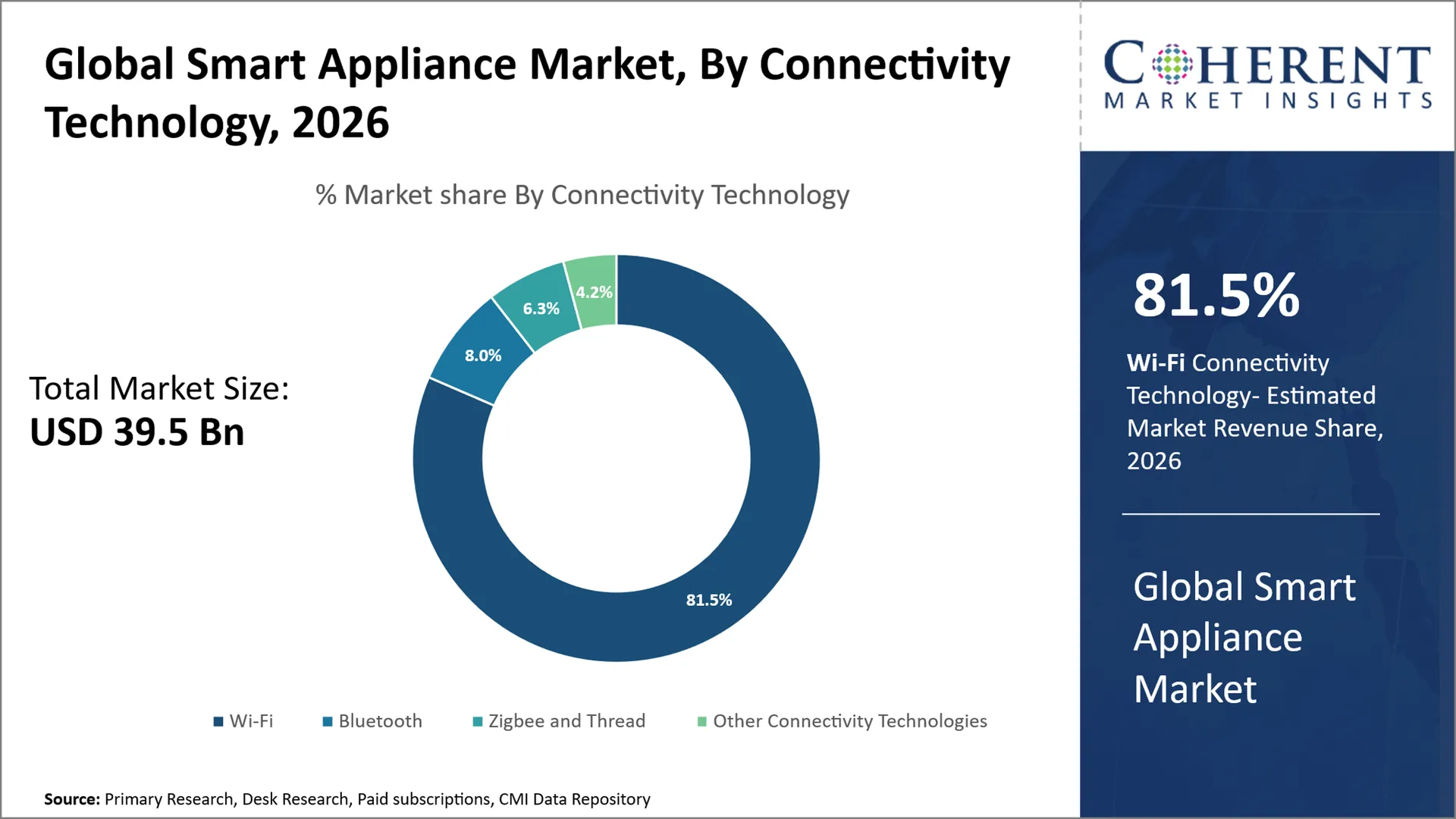
Wi-Fi is projected to account for 81.5% of the global smart appliance market in 2026, supported by its suitability for standardized connectivity across multiple appliance categories. Unlike short-range communication technologies, Wi-Fi allows manufacturers to deploy common connectivity architectures across geographically diverse product portfolios. This simplifies component sourcing, application development, and technical support while reducing dependence on specialized network equipment. For residential air conditioners, reliable connectivity also facilitates equipment diagnostics and user-specific operating adjustments. In March 2025, Panasonic expanded its Matter-enabled residential air conditioner portfolio in India, extending interoperability to additional inverter models through its MirAIe platform. The development illustrates how manufacturers can combine Wi-Fi-enabled products with interoperable smart home standards, strengthening product accessibility and reducing barriers to connected appliance adoption.
Why Do Connected Appliances with Remote Monitoring and Control Dominate the Functional Capability Segment of the Global Smart Appliance Market?
Connected Appliances with Remote Monitoring and Control are expected to represent 64.3% of the global smart appliance market in 2026, as practical connected functions can be introduced without requiring advanced autonomous decision-making systems. This allows manufacturers to extend digital capabilities across different product price categories while managing hardware complexity. Consumers benefit from clearer appliance status information and easier access to troubleshooting assistance. These functions are particularly relevant to refrigerators, dishwashers, and cooking appliances, where dependable operation remains a purchasing priority. In August 2026, Miele highlighted expanded application-based support capabilities, including its Consumption Dashboard and AI Diagnostics functionality for compatible connected appliances. Such service-oriented integration can reduce avoidable technician visits, strengthen customer relationships, and create opportunities for manufacturers to differentiate through post-purchase support.
Current Events and their Impact
Current Event | Description and Its Impact |
April 2024 – United Kingdom Introduces Mandatory Security Requirements for Consumer Connected Products |
|
September 2026 – European Union Cyber Resilience Act Reporting Requirements Become Applicable |
|
July 2026 – European Union Right-to-Repair Rules Begin Applying |
|
Global Smart Appliance Market Dynamics
Key Market Drivers
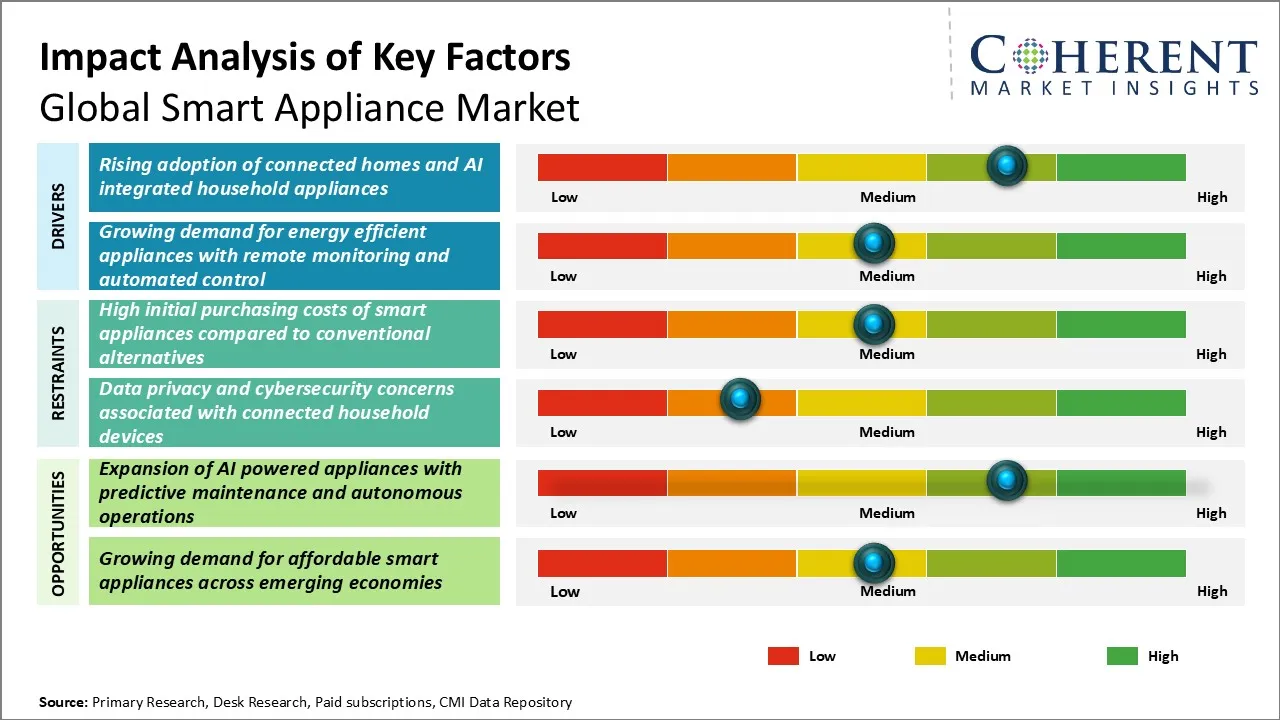
- Rising adoption of connected homes and AI integrated household appliances: Smart appliance adoption is increasingly influenced by consumers seeking coordinated household functions rather than independently operated devices. Integration across refrigeration, cooking, laundry, and climate-control equipment helps simplify routine activities and improves the usefulness of connected home ecosystems. Manufacturers offering reliable cross-device integration can strengthen customer retention and encourage appliance upgrades. In September 2026, Hisense showcased its AI Companion Suite at IFA, demonstrating coordinated food management, cooking, and laundry functions through its connected home platform. This development highlights the commercial importance of integrated appliance experiences.
- Growing demand for energy efficient appliances with remote monitoring and automated control: Household electricity expenses are encouraging consumers to evaluate appliance operating costs alongside purchase prices. Intelligent load sensing, predictive temperature adjustment, and automated operating schedules enable better resource management without compromising essential functions. These capabilities create product differentiation opportunities for manufacturers and strengthen the value proposition of premium connected models. In September 2024, Midea introduced its AI ECOMASTER solution at IFA, combining cloud connectivity, intelligent algorithms, and application-based energy monitoring across several appliance categories. Such functionality supports the commercialization of measurable efficiency improvements.
Emerging Market Trends
- Shift Toward Extended Software Support and Lifecycle-Based Appliance Value: Connected appliances are increasingly being evaluated as long-term digital products rather than hardware with fixed functionality. This shift is changing how manufacturers approach firmware maintenance, software compatibility, warranty commitments, and customer support. Buyers may increasingly consider the expected availability of connected features when comparing appliances with similar physical specifications. Manufacturers capable of maintaining dependable software experiences throughout product ownership could achieve stronger customer retention. Over the forecast period, transparent support commitments are likely to become an important factor influencing purchasing decisions and residual appliance value.
- Growing Preference for Renovation-Compatible and Design-Integrated Appliances: Smart appliance purchasing decisions are becoming more closely associated with kitchen renovation, cabinetry compatibility, and coordinated interior design. Manufacturers are responding through integrated installation formats, concealed controls, configurable exterior finishes, and improved compatibility with existing residential layouts. This trend creates opportunities for appliance suppliers working closely with kitchen designers, builders, and specialist retailers. Companies offering installation flexibility without sacrificing product functionality could strengthen their position in premium residential projects. During the forecast period, physical design compatibility is expected to become an increasingly important competitive differentiator.
Regional Insights
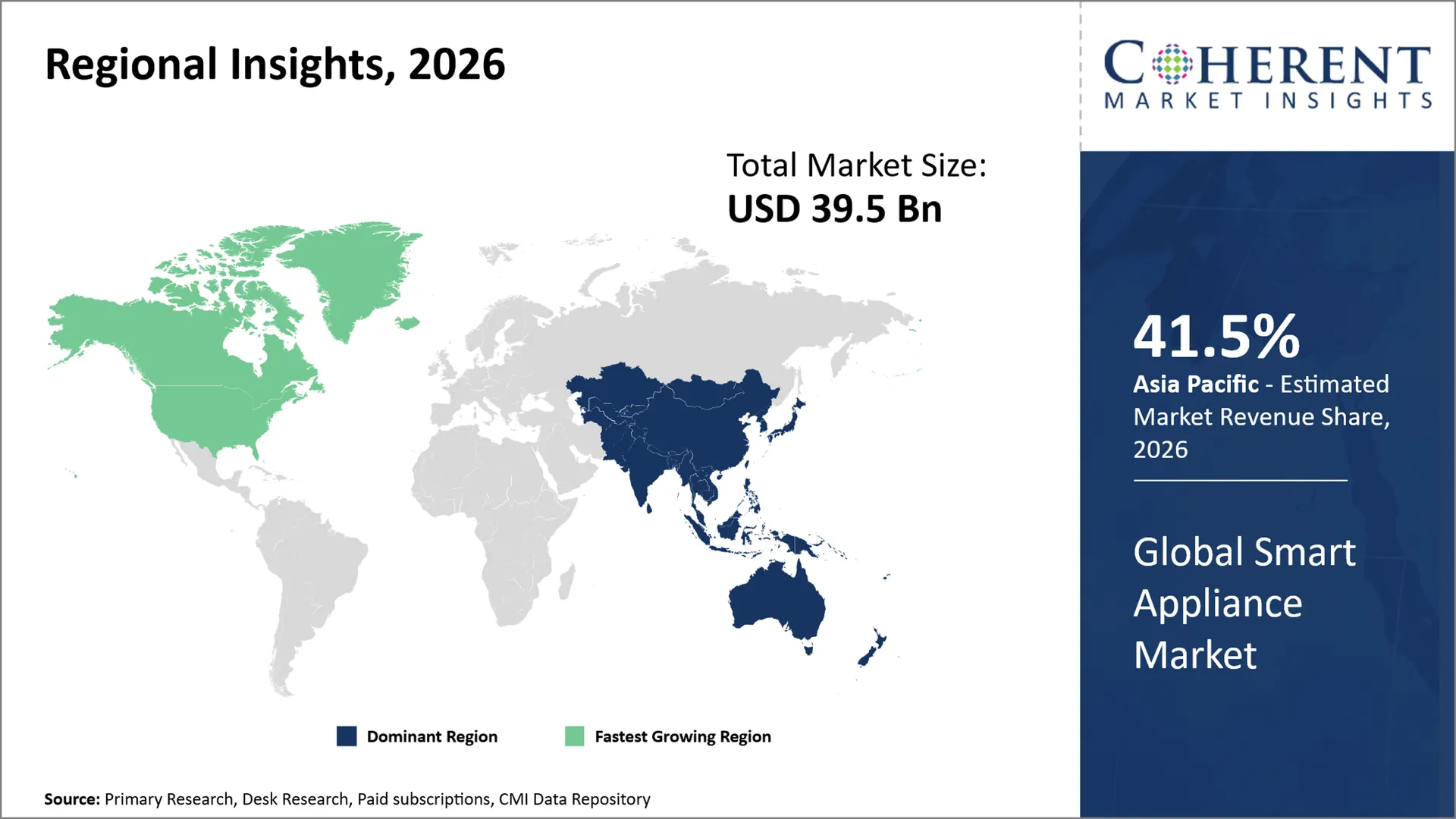
Why Does Asia Pacific Dominate the Global Smart Appliance Market?
Asia Pacific is expected to account for 41.5% of the global smart appliance market in 2026, supported by diverse household requirements across its major economies. Hot climatic conditions encourage intelligent cooling solutions, while space-constrained urban homes create opportunities for compact multifunctional appliances. Manufacturers can address these varying requirements through localized product specifications and flexible equipment platforms. Regional efforts to improve appliance performance standards further influence purchasing decisions and product development. In June 2025, the ASEAN Centre for Energy and UNEP's United for Efficiency organized a regional workshop in the Philippines involving representatives from eight ASEAN countries to advance energy performance standards for room air conditioners. Such initiatives encourage manufacturers to prioritize efficient cooling technologies and strengthen the competitive position of higher-performance connected appliances across regional markets.
Why Is North America Emerging as the Fastest-Growing Region in the Global Smart Appliance Market?
North America is projected to capture 26.0% of the global smart appliance market in 2026, with its fastest-growing outlook supported by financially attractive appliance replacement opportunities. Consumers increasingly evaluate long-term operating expenses, warranty coverage, and equipment performance when purchasing refrigerators, laundry machines, and other household appliances. Financial incentives for energy-efficient replacements can also improve the affordability of connected models that meet eligibility requirements. In November 2025, the Ontario government expanded its Home Renovation Savings Program to provide rebates of up to CAD 200 for eligible energy-efficient refrigerators, freezers, and laundry machines. Although the rebates do not specifically require smart connectivity, they can improve replacement economics for qualifying connected products. Manufacturers offering measurable operating benefits and accessible product pricing are positioned to capture these purchasing opportunities.
Global Smart Appliance Market Outlook for Key Countries
Why Is the U.S. a Key Market for the Global Smart Appliance Market?
The U.S. represents an important region for smart appliance market, particularly robotic vacuum cleaners equipped with intelligent navigation and automated maintenance functions. Households with pets, mixed flooring, and demanding cleaning requirements create opportunities for equipment that reduces manual intervention. Established electronics retailers and digital sales platforms also make advanced cleaning technologies accessible to consumers comparing performance specifications. In March 2026, SharkNinja introduced its PowerDetect UV Reveal robotic vacuum and mop in the U.S., combining ultraviolet stain detection with camera-based recognition and automated cleaning functions. This introduction demonstrates how manufacturers can differentiate products through specialized cleaning performance rather than connectivity alone. Suppliers offering verifiable functionality, reliable replacement components, and comprehensive customer support can strengthen their position in the American premium appliance segment.
Why Does China Support Growth in the Global Smart Appliance Market?
China plays a central role in the global smart appliance market through its capabilities in consumer electronics engineering, robotic automation, and integrated component manufacturing. Domestic manufacturers benefit from access to navigation sensors, electric motors, control electronics, and specialized software expertise required for intelligent household equipment. These capabilities enable rapid product development and support the commercialization of increasingly sophisticated robotic cleaning systems. In January 2025, Chinese manufacturer Roborock introduced its Saros Z70 robotic vacuum featuring a foldable five-axis mechanical arm designed to move small obstacles during cleaning. This development illustrates China's progression from conventional appliance production toward differentiated household robotics. Manufacturers combining proprietary engineering with scalable production capabilities can strengthen export competitiveness and improve their position in higher-value international appliance categories.
Why Is Germany a Strategic Country in the Global Smart Appliance Market?
Germany maintains a strategic position in the global smart appliance market through specialized refrigeration engineering, product durability requirements, and demand for high-performance household equipment. German manufacturers emphasize precise temperature management, food preservation, and dependable mechanical performance when developing premium refrigerators and freezers. Connected functionality provides additional value when integrated with these established engineering capabilities. In September 2025, Liebherr-Hausgeräte presented updates to its SmartDevice platform at IFA Berlin, including an improved application interface and planned capabilities for monitoring refrigeration energy consumption and accessing food storage information. This development demonstrates how established appliance manufacturers can extend product functionality through specialized digital services. Companies combining refrigeration expertise, dependable hardware, and useful connected features can reinforce their position among premium residential customers and international distributors.
Why Is India an Important Growth Market for the Global Smart Appliance Market?
India offers substantial opportunities for smart air conditioners designed around local cooling preferences, household budgets, and installation conditions. Manufacturers increasingly need to provide practical automation features while addressing consumer concerns regarding purchase affordability, maintenance expenses, and equipment reliability. Products that coordinate cooling with existing household equipment can provide an accessible introduction to intelligent appliance functionality. In March 2026, Godrej Enterprises Group unveiled its upgraded smart air conditioner portfolio featuring Smart Sync technology, allowing compatible Wi-Fi-enabled air conditioners to coordinate operation with room fans. The range also incorporates energy monitoring, scheduled operation, and maintenance notifications. This approach demonstrates the importance of developing locally relevant connected features. Manufacturers combining functional innovation with affordable financing and reliable service networks can improve adoption across Indian households.
Why Is South Korea an Important Growth Market for the Global Smart Appliance Market?
South Korea represents an important market for intelligent household equipment through its emphasis on compact residential living, product personalization, and connected home services. Consumers seeking improved indoor air quality and convenient equipment management create opportunities for connected air purifiers and other specialized appliances. The country's advanced electronics capabilities also support development of intelligent sensors and digitally managed household products. In December 2025, Coway announced that eleven products, including connected air purifiers and water purification equipment, received recognition under South Korea's My AI certification program. The assessment considered practical usefulness, convenience, and consumer trust. This development highlights growing attention to measurable intelligent functionality. Manufacturers offering reliable product performance and convenient maintenance services can strengthen customer engagement and recurring revenue opportunities.
Smart Appliance Technology Adoption and Integration Landscape
Technology | Key Applications | Adoption Status | Commercial Implications |
Wi-Fi Connectivity and IoT Integration | Smart refrigerators, washing machines, air conditioners, ovens, and dishwashers | Mainstream | Enables app-based control and connected services across major household appliance categories. |
AI-Based Machine Vision and Intelligent Recognition | Fabric identification, ingredient recognition, cooking assistance, and robotic cleaning | Expanding | Supports automation-focused product differentiation and premium appliance positioning. |
Advanced Sensors and Adaptive Control Systems | Load detection, temperature monitoring, moisture sensing, and soil-level recognition | Established and expanding | Improves operating precision and supports more consistent appliance performance. |
Inverter Technology and Intelligent Motor Control | Smart air conditioners, washing machines, refrigerators, and dryers | Established | Supports efficient equipment operation and provides a foundation for more advanced control functions. |
Matter, Thread, and Zigbee-Based Interoperability | Multi-device smart home integration and compatible appliance control ecosystems | Emerging to selective | Can reduce dependence on proprietary control environments where appliance compatibility is supported. |
Predictive Diagnostics and Connected Maintenance Systems | Fault detection, component monitoring, maintenance alerts, and service diagnostics | Developing | Creates opportunities to reduce avoidable service visits and improve repair planning. |
How Are Centralized Appliance Management Platforms Creating New Growth Opportunities in the Global Smart Appliance Market?
An underdeveloped commercial opportunity exists in supplying connected appliances as managed assets to multifamily housing operators, rental property owners, and student accommodation providers. These customers require centralized equipment monitoring, streamlined installation, maintenance scheduling, and efficient appliance replacement rather than standalone consumer applications.
Manufacturers can capture this opportunity by offering compatible appliance portfolios supported by secure management dashboards, standardized device registration, and remote fault notifications. Such solutions could reduce maintenance coordination expenses while improving equipment visibility across residential properties. Successful participation will require investment in property management software integration, installer training, technical support, and secure access controls. Suppliers must also establish clear data ownership policies and service agreements.
Established manufacturers may benefit from their distribution and maintenance networks, while specialist software providers can participate through integration partnerships. Commercial success will depend on demonstrating measurable operating benefits and delivering dependable support across multiple properties.
Market Players, Key Development, and Competitive Intelligence
Key Developments
- In August 2026, TCL announced plans to showcase new AI-enabled air conditioners and washing machines at IFA 2026 alongside its upgraded NXTHOME concept. The initiative highlights a strategy combining appliance intelligence, coordinated design, and connected living experiences to strengthen product visibility and broaden customer engagement.
- In February 2026, Whirlpool Corporation presented new appliance technologies at KBIS, including a laundry tower featuring UV Clean technology and a dishwasher with AI Intelligent Wash sensing. The announcement demonstrates the company's emphasis on hygiene-oriented functionality and sensor-assisted cleaning to strengthen product differentiation within established household appliance categories.
Competitive Landscape
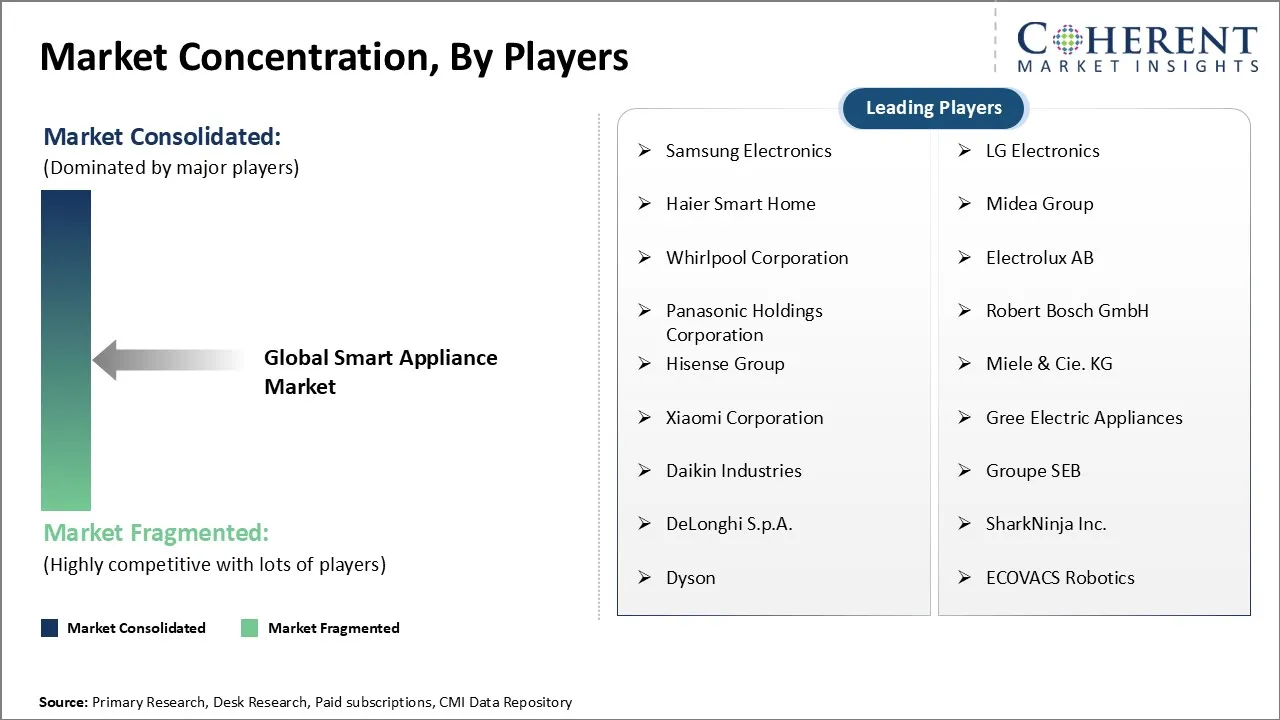
The global smart appliance market is moderately consolidated, with established multinational appliance manufacturers competing alongside regional brands and specialist product suppliers. Competition centers on product reliability, technological differentiation, pricing, manufacturing efficiency, and distribution coverage. Regional manufacturers compete through localized specifications and value-oriented products, while specialist companies target specific appliance functions. Strong quality assurance, component availability, regulatory compliance, and dependable after-sales support remain important to sustaining market position.
Key focus areas include
- Product Performance: Consistent cleaning, cooling, cooking, and drying results remain important purchase considerations.
- Pricing Strategy: Manufacturers balance advanced features against consumer affordability and production economics.
- Manufacturing Efficiency: Component standardization and production scale influence cost competitiveness.
- Component Supply: Reliable access to sensors, electronic controls, compressors, and connectivity modules supports delivery continuity.
- Distribution Coverage: Established retail relationships and regional dealer networks improve product accessibility.
- Quality Assurance: Product testing, electrical safety, and applicable certification requirements influence market access.
- After-Sales Infrastructure: Spare parts, trained technicians, and responsive warranty services contribute to customer confidence.
Global Smart Appliance Market Report Scope
Global Smart Appliance Market Report Coverage | |||
Report Coverage | Details | ||
Base Year | 2025 | Market Size in 2026: | USD 39.5 Bn |
Historical Data For: | 2020 To 2024 | Forecast Period: | 2026 To 2033 |
Forecast Period 2026 To 2033 CAGR: | 9.20% | 2033 Value Projection: | USD 73.14 Bn |
Geographies covered: |
| ||
Segments covered: |
| ||
Companies covered: | Samsung Electronics, LG Electronics, Haier Smart Home, Midea Group, Whirlpool Corporation, Electrolux AB, Panasonic Holdings Corporation, Robert Bosch GmbH, Hisense Group, Miele & Cie. KG, Xiaomi Corporation, Gree Electric Appliances, Daikin Industries, Groupe SEB, DeLonghi S.p.A., SharkNinja Inc., Dyson, ECOVACS Robotics | ||
Growth Drivers: |
| ||
Restraints & Challenges: |
| ||
Analyst Opinion (Expert Opinion)
- The global smart appliance market leadership is likely to depend increasingly on manufacturers' ability to manage the complete appliance ownership experience, from selection and installation to maintenance and replacement. Companies controlling these customer relationships could strengthen repeat purchasing and improve commercial resilience. Manufacturers relying heavily on external channels for post-purchase engagement may face greater difficulty maintaining pricing power.
- The emergence of platform-independent household AI assistants could weaken the commercial influence of proprietary appliance applications. If consumers increasingly manage appliances through universal interfaces, exclusive software ecosystems may become less effective at retaining customers. Manufacturers with accessible integration frameworks, dependable device controls, and adaptable software architecture could benefit from this transition.
- Manufacturers should prioritize reliable electronic components, localized technical support, and product features that deliver clear customer benefits. Investment decisions must account for semiconductor supply exposure, cybersecurity obligations, manufacturing costs, and consumer price sensitivity. Partnerships with component suppliers and regional service providers can strengthen operational resilience. Companies should avoid excessive investment in complex features that offer limited practical value or cannot justify higher selling prices.
Speak to the analyst
Want personalized insights?
Take the findings above to one of our principal consultants, or have the report rebuilt around the segments, geographies and competitors you actually track.
Market Segmentation
- Product Type Insights (Revenue, USD Bn, 2021 - 2033)
- Smart Washing Machines and Washer Dryer Combos
- Smart Refrigerators
- Smart Air Conditioners
- Smart Robotic Vacuum Cleaners and Vacuum Cleaners
- Smart Ovens and Cooking Appliances
- Smart Dishwashers
- Smart Dryers
- Other Smart Appliances
- Connectivity Technology Insights (Revenue, USD Bn, 2021 - 2033)
- Wi-Fi
- Bluetooth
- Zigbee and Thread
- Other Connectivity Technologies
- Functional Capability Insights (Revenue, USD Bn, 2021 - 2033)
- Connected Appliances with Remote Monitoring and Control
- AI Enabled Appliances with Intelligent Automation
- End User Insights (Revenue, USD Bn, 2021 - 2033)
- Residential
- Commercial
- Distribution Channel Insights (Revenue, USD Bn, 2021 - 2033)
- Offline Retail
- Online Retail
- Direct Manufacturer Sales
- Regional Insights (Revenue, USD Bn, 2021 - 2033)
- North America
- U.S.
- Canada
- Latin America
- Brazil
- Argentina
- Mexico
- Rest of Latin America
- Europe
- Germany
- U.K.
- Spain
- France
- Italy
- Russia
- Rest of Europe
- Asia Pacific
- China
- India
- Japan
- Australia
- South Korea
- ASEAN
- Rest of Asia Pacific
- Middle East
- GCC Countries
- Israel
- Rest of Middle East
- Africa
- South Africa
- North Africa
- Central Africa
- North America
Sources
Primary Research Interviews
- Smart appliance manufacturers, OEMs, and electronic component suppliers
- IoT connectivity providers, AI technology developers, and home automation specialists
- Appliance retailers, distributors, procurement managers, and industry experts
Stakeholders
- Smart appliance manufacturers and contract manufacturers
- Sensor, semiconductor, connectivity module, and control system suppliers
- Residential consumers, commercial buyers, retailers, and distributors
- Smart home platform providers and after-sales service companies
End-use Sectors
- Residential households and smart homes
- Commercial offices and hospitality facilities
- Institutional and commercial establishments
Regulatory and Industry Bodies
- U.S. Department of Energy (DOE)
- U.S. Environmental Protection Agency (EPA)
- European Commission
- International Electrotechnical Commission (IEC)
- International Organization for Standardization (ISO)
- Bureau of Energy Efficiency (BEE), India
Databases
- Company annual reports and investor presentations
- UN Comtrade appliance import and export datasets
- Eurostat and national appliance manufacturing databases
- ENERGY STAR and energy efficiency certification databases
- Smart appliance production, sales, pricing, and patent databases
Magazines and Journals
- IEEE Consumer Electronics Magazine
- IEEE Internet of Things Journal
- Energy and Buildings
- Applied Energy
- Journal of Building Engineering
- Home Appliances World
Associations
- Association of Home Appliance Manufacturers (AHAM)
- APPLiA – Home Appliance Europe
- Consumer Technology Association (CTA)
- Connectivity Standards Alliance (CSA)
- Wi-Fi Alliance
- Regional home appliance manufacturers associations
Public Domain Sources
- Household appliance production and consumption statistics
- Smart home adoption and connected appliance penetration data
- Appliance manufacturing capacity and international trade flows
- AI integration, IoT connectivity, and automation developments
- Energy efficiency, household electricity consumption, and sustainability data
- Product launches, regulatory updates, and technology investments
Key Standards and Regulations
- IEC 60335 – Household and similar electrical appliance safety
- IEC 62552 – Household refrigerating appliance performance
- IEC 60456 – Washing machine performance measurement
- EU Ecodesign and Energy Labelling Regulations
- U.S. DOE Appliance Energy Conservation Standards
- EU Cyber Resilience Act and ETSI EN 303 645 cybersecurity standard
- ENERGY STAR appliance efficiency certification requirements
Proprietary Elements
- CMI Data Analytics Tool
- Proprietary CMI repository containing 10+ years of smart appliance industry intelligence covering manufacturing, market demand, product pricing, IoT connectivity, AI integration, energy efficiency, technological developments, regulatory changes, and competitive intelligence.
Get access to 250+ pages report
Every segment, forecast, competitor profile and data table behind the analysis above — available for instant download.
- ESOMAR Member
- ISO 9001:2015 Certified
- D-U-N-S Registered
- GDPR & CCPA Compliant
Frequently Asked Questions
The CAGR of global smart appliance market is projected to be 9.20% from 2026 to 2033.
The global smart appliance market is estimated to be valued at USD 39.5 billion in 2026 and is expected to reach USD 73.14 billion by 2033.
The growing adoption of connected homes and AI-enabled household appliances, along with increasing demand for energy-efficient appliances offering remote monitoring and automated control, are the major factors driving growth in the global smart appliance market.
High initial purchasing costs of smart appliances compared to conventional alternatives and Data privacy and cybersecurity concerns associated with connected household devices are the major factors hampering the growth of global smart appliance market.
In terms of product type, smart washing machines and washer dryer combos are estimated to dominate the global smart appliance market revenue share in 2026.
Samsung Electronics, LG Electronics, Haier Smart Home, Midea Group, Whirlpool Corporation, Electrolux AB, Panasonic Holdings Corporation, Robert Bosch GmbH, Hisense Group, Miele & Cie. KG, Xiaomi Corporation, Gree Electric Appliances, Daikin Industries, Groupe SEB, DeLonghi S.p.A., SharkNinja Inc., Dyson, ECOVACS Robotics are the major players.
Asia Pacific is expected to lead the global smart appliance market in 2026.