

Global SMT Equipment Market Size and Forecast – 2026 To 2033
The global SMT equipment market is expected to grow from USD 6.00 Bn in 2026 to USD 14.00 Bn by 2033, registering a compound annual growth rate (CAGR) of 8.6% from 2026 to 2033. The global SMT equipment market is driven by rising electric vehicle production. On July 1, 2025, BYD announced it has officially rolled off the very first BYD Dolphin Mini manufactured in Brazil, marking a historic milestone for the automotive industry across Latin America.
Key Takeaways of the Global SMT Equipment Market
- The Placement Equipment segment is expected to account for 38.0% of the global SMT equipment market share in 2026. Increasing deployment of advanced driver assistance systems is driving the growth of the segment. On June 27, 2025, Mahindra unveiled Level 2 advanced driver assistance technologies for the premium Z8L variant of the Scorpio-N. The features expand the vehicle's electronic safety capabilities.
- The SMT Machines segment is estimated to capture 34.0% of the market share in 2026. Expanding telecommunications infrastructure is majorly driving the growth of the segment. On April 22, 2025, Ericsson announced plans to localize all passive antenna production for the Indian market by June 2025. The initiative involves manufacturing collaboration with VVDN Technologies.
- The Manual Equipment segment is estimated to capture 46.0% of the market share in 2026. Increasing adoption of high-speed component placement is majorly driving the growth of the segment. On March 11, 2025, Panasonic Connect announced the NPM-GW modular placement machine ahead of IPC APEX Expo 2025. The platform offers placement speeds up to 104,000 components per hour under specified conditions, with accuracy of ±25 micrometers.
- Asia Pacific is expected to dominate the SMT equipment market in 2026 with a market share of 43.0%. Growing demand for automated electronics assembly in Asia Pacific is driving the growth of the regional market. On May 27, 2026, Unigen announced a major expansion of its manufacturing facility in Hanoi, Vietnam. The project aims to increase maximum production output by approximately 70%.
- North America is expected to account for 28.0% share in 2026 and is projected to record the fastest growth over the forecast period. Rising investments in electronics manufacturing facilities in North America is driving the growth of the regional market. On July 14, 2026, Foxlink Group announced a new printed circuit board assembly manufacturing operation in Fort Worth, Texas, U.S. The company acquired a 147,780-square-foot facility, with production expected to begin in August 2026.
Segmental Insights
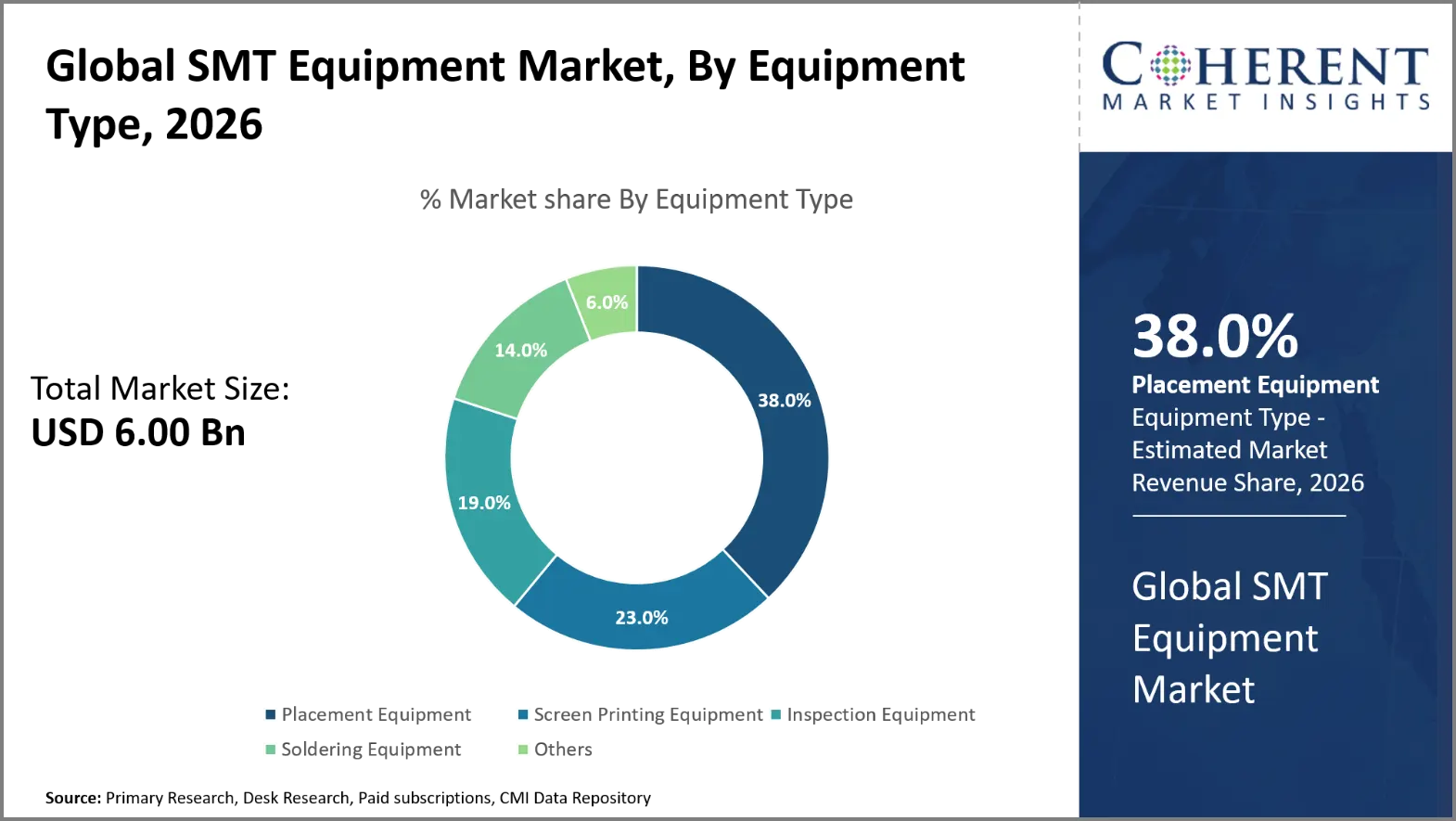
Why Does Placement Equipment Dominate the Global SMT Equipment Market?
The placement equipment segment is expected to account for 38.0% of the global SMT equipment market share in 2026. Placement equipment prevails as manufacturers demand accurate, high-speed installation of components on ever more complicated printed circuit boards. SMT placement machines mount small resistors, capacitors, integrated circuits and sophisticated semiconductor packages. With electronics getting ever smaller, the necessity for precision placement, automated inspection and production consistency is increasing. Automotive electronics, telecommunication, consumer electronics and industrial automation are driving equipment adoption. The flexible positioning platforms also accommodate numerous product designs and save manufacturing downtime.
On January 14, 2025, JUKI unveiled the RS-2 modular mounter for automated printed circuit board assembly. Under ideal conditions the machine handles 50,000 components per hour and can handle components as small as 0.3 x 0.15 millimeters and larger packages. The TAKUMI head is movable, allowing the sensor to be optimally positioned for varying component heights.
- Current Industry Events of 2026
- Market Size Estimation
- Regional Breakdown
- Competitive Landscape
- Customer Intelligence
- Segmental Analysis
- Pricing Analysis
- Key Market Drivers, Challenges & Future Trends
- Customized Insights Section
Why is SMT Machines the Most Crucial Component?
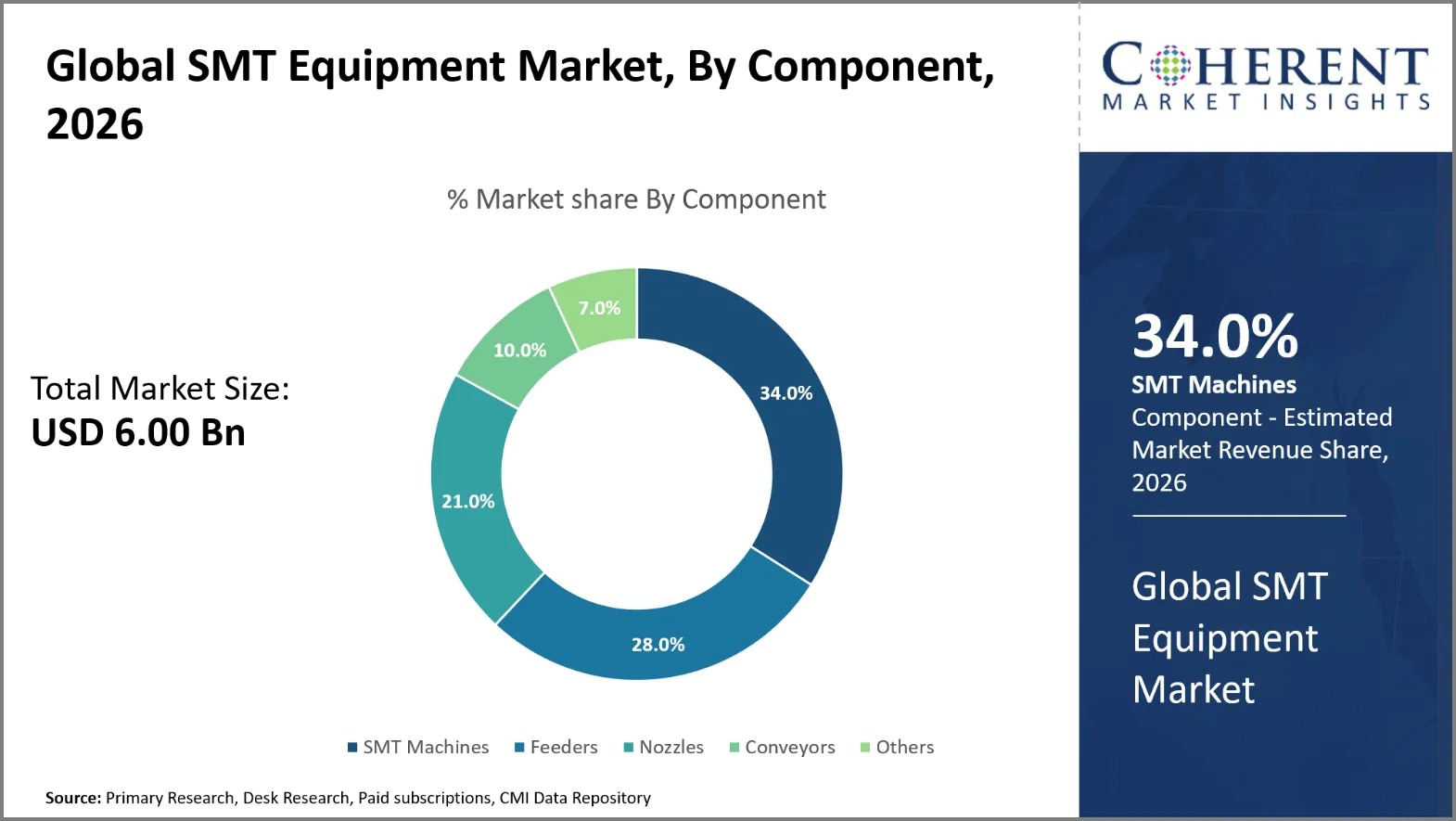
The SMT machines segment is expected to account for 34.0% of the global SMT equipment market share in 2026. SMT machines are crucial because they combine component placement, soldering, inspection, and production control. These machines allow businesses to manufacture small electrical circuits of consistent quality and reproducible performance. Their ability to automate reduces manual handling, minimizes placement errors and improves industrial throughput. Advanced machines also enable complicated geometries of components and denser circuit layouts. The systems are utilized by electronics producers to satisfy production demands for automotive, telecommunications, medical electronics and consumer gadgets. Yamaha Motor has revised their YRM-D dispenser in Jan. 2026 The company has introduced an automatic push-up pin replacement capability to save setup time and operator workload. The update supports more efficient production changeovers and reduces manual intervention during equipment preparation.
Manual Equipment Dominates the Global SMT Equipment Market
The manual equipment segment is expected to account for 46.0% of the global SMT equipment market share in 2026. Manual equipment dominates certain SMT applications because small manufacturers prioritize affordability, operational simplicity, and flexible production capabilities. These systems are cheaper to install than fully automated assembly lines. It is easy to operate, which is an advantage to small electronics workshops, maintenance facilities, educational laboratories and prototype developers. Also, manual placement addresses specific assembly duties, low manufacturing volumes and bespoke electronic goods. Manufacturers can circumvent costly automation equipment and maintain direct control over the handling of components.
On January 23, 2025, Thermaltronics announced a low cost, high accuracy soldering station. Thermaltronics U.S. launched their TMT-1000S soldering station at a price of USD 124.99. 50-watt radio-frequency system features Curie Point technology to control temperature and provide accurate soldering performance.
Current Events and their Impact
Current Events | Description and its Impact |
European Union Machinery Regulation (EU) 2023/1230 |
|
European Union Restriction of Hazardous Substances Directive 2011/65/EU |
|
SMT Equipment Market Dynamics
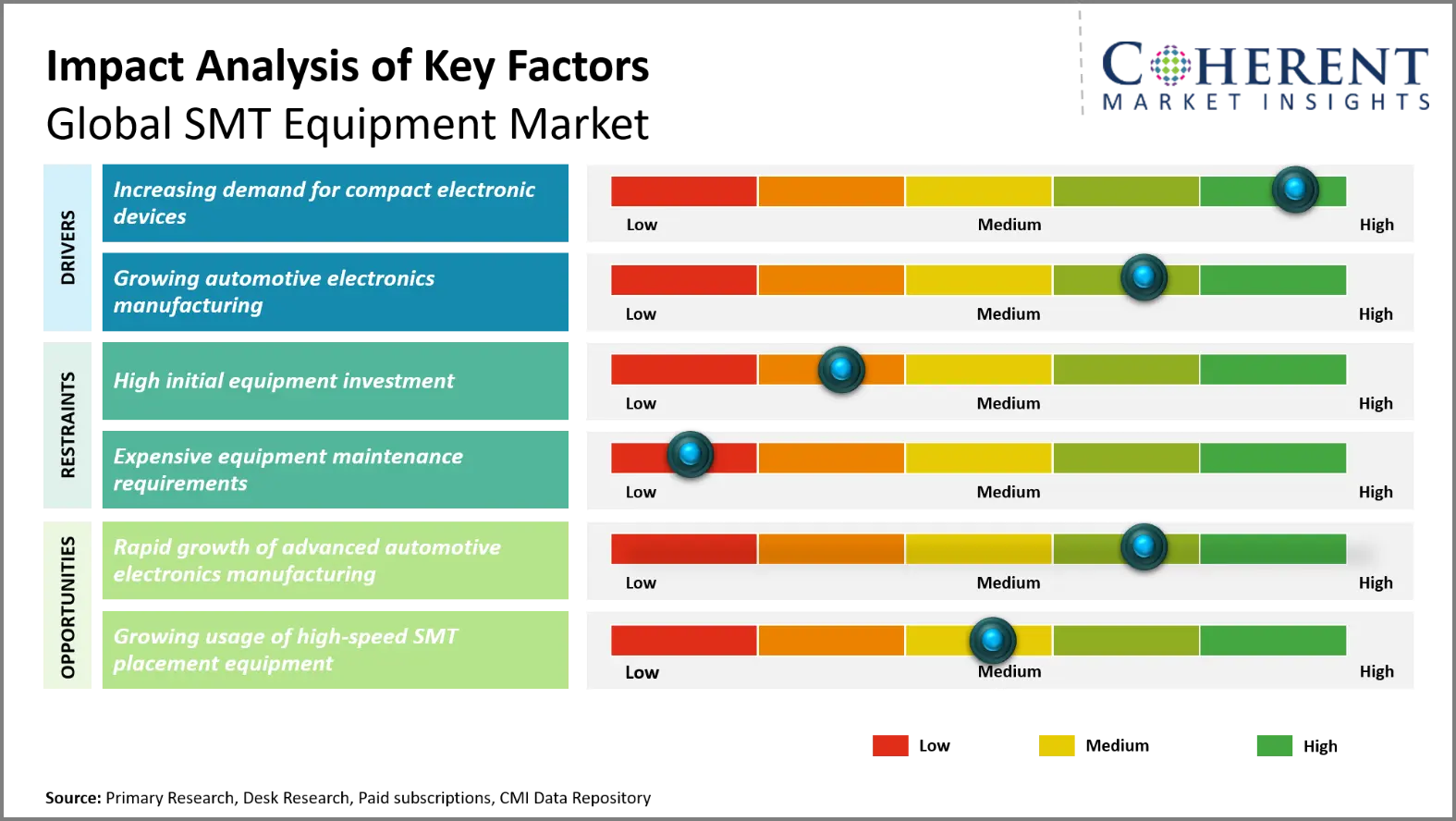
Market Drivers
- Increasing demand for compact electronic devices: Continuous shrinking of electronics due to increasing need for compact electronic devices drives the worldwide SMT equipment market. Smartphones, wearable gadgets, tablets and wireless accessories call for smaller components and denser printed circuit boards. Manufacturers use sophisticated placement devices to precisely install components in tight board spaces. High-density assembly also places demand on dependable soldering, automated inspection, and production uniformity. The consumer demand for smaller, more functional electronics is driving investment in equipment to allow reduced component geometries. These developments increase demand for superior Surface Mount Technology equipment in consumer electronics manufacturing.
- On September 30, 2026, Murata Manufacturing Co., Ltd. begun mass production of the LLD series, the world’s smallest three-terminal low-equivalent series inductance (ESL) multilayer ceramic capacitors (MLCC). Measuring just 0201-inch size (0.6 × 0.3 mm), the new products reduce mounting area by approximately 64% compared with Murata’s previous smallest 0402-inch size (1.0 × 0.5 mm.
- Growing automotive electronics manufacturing: Growing automotive electronics manufacturing strengthens demand for SMT equipment through increasing electronic integration in modern vehicles. Electric vehicles, advanced driver assistance systems, infotainment platforms, and vehicle connectivity require sophisticated electronic assemblies. Automotive manufacturers increasingly depend on reliable circuit boards supporting power management, sensing, communication, and safety functions. SMT equipment enables precise component placement and consistent assembly quality. Automated production systems also facilitate complex circuit designs and demanding manufacturing requirements. Expanding automotive electrification and electronic functionality are driving investments in advanced assembly equipment across automotive supply chains.
- On October 27, 2025, HARMAN announced an investment of USD 42 million to expand its automotive electronics manufacturing facility in Chakan, Pune, India. This investment includes USD 5.5 million for immediate expansion and USD 36.5 million over the next three years to support advanced telematics and next generation automotive connectivity programs.
Emerging Trends
- Increasing Adoption of AI-Enabled SMT Equipment: More and more SMT manufacturers are integrating artificial intelligence into inspection, defect detection and production monitoring. This functionality helps to detect assembly errors, optimize machine settings and improve manufacturing consistency across complex electronic circuit boards.
- Impact: AI improves defect detection, reduces material waste, and supports predictive maintenance. Manufacturers may detect production abnormalities sooner, reduce downtime, and improve equipment utilization in high-volume electronics assembly operations.
- Relevance to the market: This trend is fueling demand for smart placement machines, automated optical inspection systems, and connected production platforms. There are opportunities for integrated analytics solution providers in automotive, telecommunications, and consumer electronics manufacturing.
- Growing Demand for High-Speed, High-Precision Component Placement: Electronics manufacturers are placing an ever-increasing demand on high-speed placement systems to place miniature components on densely populated printed circuit boards. The trend toward compact product designs and complex electronic assemblies is driving the demand for accurate, flexible, and reliable equipment.
- Impact: High-end placement equipment improves production productivity with high component placement precision. Higher degree of automation reduces manual intervention, ensures constant assembly quality, and helps manufacturers adapt to more complex electronic designs.
- Relevance to the market: This trend supports investment in advanced placement machines, flexible assembly lines and precision handling technologies. Suppliers able to provide fast changeovers and wide component compatibility can support evolving electronics manufacturing requirements.
Regional Insights
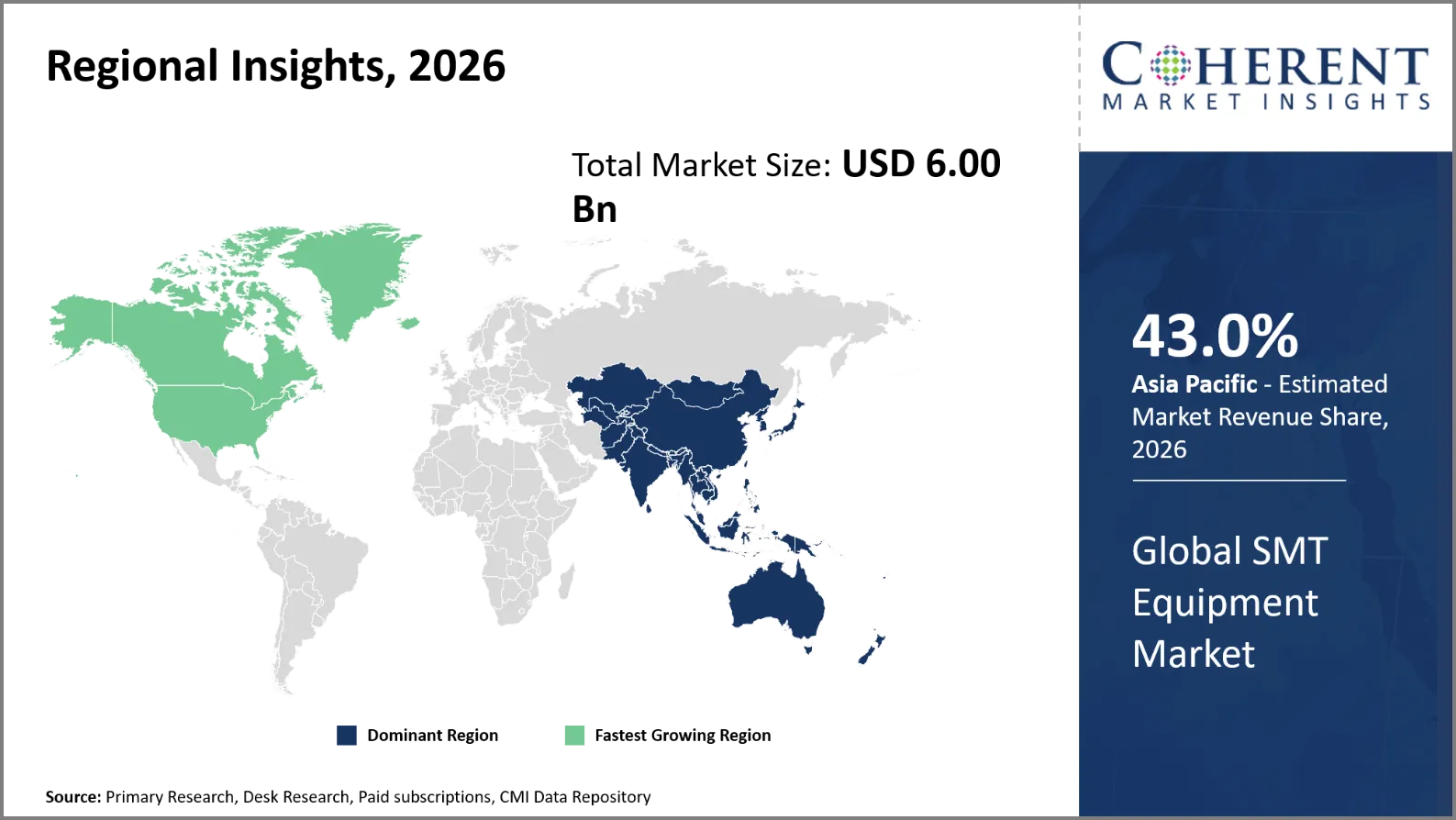
Why is Asia Pacific a Strong Market for SMT Equipment?
Asia Pacific is expected to account for a market share of 43.0% in 2026. The Asia Pacific comprises the electronics manufacturing hubs of China, Taiwan, South Korea, Japan, India, and Southeast Asia. China is fueling demand from the smartphone assembly, printed circuit board production, and consumer electronics manufacturing sectors. Taiwan’s original design manufacturers are looking for precision placement systems for computing hardware and networking equipment. South Korea’s memory manufacturers are championing their specialized electronics assembly requirements. Japan is contributing automotive electronics, industrial controls, and precision equipment manufacturing. India is building up its electronics assembly under its production-linked incentive scheme. Vietnam and Malaysia also attract electronics manufacturing investments. These developments encourage SMT equipment suppliers to offer high-speed placement, flexible production lines, automated inspection, and localized technical support.
Why Does North America SMT Equipment Market Exhibit High Growth?
North America is expected to register the fastest growth with a CAGR of 8.5% over the forecast period. It is projected to account for 28.0% of the global SMT equipment market in 2026. The region benefits from electronics production reshoring, defense electronics requirements, and investments in domestic semiconductor supply chains. The U.S. supports demand through aerospace systems, medical devices, industrial controls, and specialized electronics manufacturing. In April 2025, Incap Electronics U.S. announced approximately USD 2 million in SMT equipment investments. The package included six placement machines and two three-dimensional automated optical inspection systems. The company expected production capacity to increase approximately 110%. These upgrades demonstrate demand for faster, traceable, and flexible electronics assembly. Canadian manufacturers also support regional demand through telecommunications equipment, industrial electronics, and automotive supply chains.
Global SMT Equipment Market Outlook for Key Countries
Why is China Emerging as a Major Hub in the SMT Equipment Market?
China's SMT equipment demand is propelled by its domestic electronics supply chains, high-volume printed circuit board production and local equipment substitution. Smartphone makers, telecom vendors, electric vehicle manufacturers and consumer electronics assemblers need high-volume automated assembly lines. Local equipment vendors are increasingly competing in placement, solder-paste printing, inspection and production software. Domestic suppliers can provide local engineering support and quicker servicing for multi-shift factories. China's electric vehicle ecosystem also drives demand for assemblies used in battery management systems, charging gear, vehicle displays and driver assistance electronics. These manufacturing needs drive investment in flexible placement platforms, inspection systems and integrated production monitoring.
Is U.S. the Next Growth Engine for the SMT Equipment Market?
Reshoring efforts and a need for specialized, high-reliability electronics support the U.S. SMT equipment market. Aerospace contractors, medical technology manufacturers, defense suppliers, and industrial automation companies all need traceable assembly processes. In April 2025, Incap Electronics US announced an upgrade to its facilities with six SMT placement machines and two three-dimensional automated optical inspection systems. The investment was to increase production capacity, allow the handling of smaller components and improve material traceability. Also in December 2025, Texas Instruments began production at its new 300-millimeter semiconductor fabrication facility in Sherman, Texas. Semiconductor expansion can help boost related electronics manufacturing ecosystems, although wafer fabrication itself does not directly require SMT assembly equipment.
Taiwan SMT Equipment Market Analysis and Trends
Taiwan's SMT equipment demand benefits from its concentration of original design manufacturers, electronics contract manufacturers, and computing hardware suppliers. These companies assemble servers, networking equipment, consumer electronics, and printed circuit board assemblies for international customers. Taiwan Semiconductor Manufacturing Company produced 12,682 different products using 305 technologies in 2025, and its manufacturing network also supports high-performance computing, automotive electronics, smartphones and digital consumer electronics. While wafer fabrication differs from surface mount assembly, these semiconductor activities support Taiwan’s broader electronics ecosystem. Contract manufacturers need flexible placement machines, inspection equipment, and production traceability to cope with complex products and frequent customer design changes.
Japan SMT Equipment Market Analysis and Trends
The SMT equipment market in Japan benefits from domestic innovation in equipment, precision manufacturing, automotive electronics, and industrial automation. Local suppliers offer placement machines, solder-paste printers, inspection systems and integrated production software. In January 2025, JUKI launched its RS-2 modular mounter, which can place up to 50,000 components per hour under optimal conditions. The system handles components as small as 0.3 x 0.15 millimeters and can accommodate up to 112 feeders. Yamaha Motor also provides complete SMT production solutions, including placement, printing, dispensing, inspection, and software. These capabilities support Japanese factories seeking flexible production, faster setup times, and improved assembly consistency across a variety of product lines.
South Korea SMT Equipment Market Analysis and Trends
Memory electronics, advanced display systems, mobile devices, and automotive technology development boost SMT equipment demand in South Korea. Samsung Electronics and SK hynix support broad semiconductor ecosystems that require sophisticated electronic control boards and supporting equipment. Their manufacturing investments also create opportunities for suppliers serving adjacent electronics assembly operations. ZEISS Semiconductor Manufacturing Technology opened an innovation center in Yongin in July 2026. The center supports collaboration with local chip and photomask manufacturers, demonstrating Korea’s advanced manufacturing concentration. SMT demand also comes from power electronics, consumer devices, and industrial control assemblies. Manufacturers increasingly value precise placement, automated inspection, and consistent production quality for compact electronic products.
Global SMT Equipment Market - SMT Equipment Performance Benchmarking
Manufacturer | Model | Maximum Placement Speed (CPH) | Placement Accuracy | Smallest Supported Component | Maximum PCB Size (Mm) | Feeder Capacity |
Yamaha Motor | YRM20 | 115000 | ±25 µm | 0201 metric | 810 × 510 | Up to 128 component types with feeder carriages |
Panasonic Connect | NPM-GW | 104000 | ±25 µm | 0201 chip | 760 × 687 | Up to 136 inputs |
ASMPT | SIPLACE V | 105000 | ±25 µm at 3σ | 016008 metric | 850 × 610 | Up to 90 eight-millimeter feeders |
JUKI Corporation | RS-2 | 50000 | ±35 µm, Cpk ≥ 1 | 03015 metric | 800 × 370 | Up to 112 feeders |
FUJI Corporation | NXTR | 50000 | ±25 µm, Cpk ≥ 1 | Depends on head configuration | 750 × 610 | Depends on configuration |
How is Rapid Growth of Advanced Automotive Electronics Manufacturing Creating New Growth Opportunities in the SMT Equipment Market?
New opportunities are arising for the SMT equipment market with the rapid increase in the fabrication of modern automotive electronics, driven by growing demand for electric vehicle power electronics, improved driver assistance systems, and high voltage battery management circuits. Manufacturers need precise placement systems to manufacture silicon carbide power modules, radar control boards, battery monitoring units and vehicle communication modules. For example, Bosch manufactures silicon carbide semiconductors that are utilized in power electronics for electric vehicles. Continental’s advanced driver assistance systems also require densely packed electronic control boards incorporating sensors, computers and communication connections. These applications create demand for high accuracy placement, automated optical inspection and traceable soldering methods. Growth opportunities are there for the taking for SMT equipment suppliers to develop platforms that address heat-sensitive components, fine-pitch packages and high automotive quality requirements.
On November 13, 2025, Inteva Products LLC announced a significant expansion of its activities in India. The company will setup a second manufacturing factory in Pune and plans to launch a line-up of next gen items geared for the evolving Indian mobility landscape.
Market Players, Key Development, and Competitive Intelligence
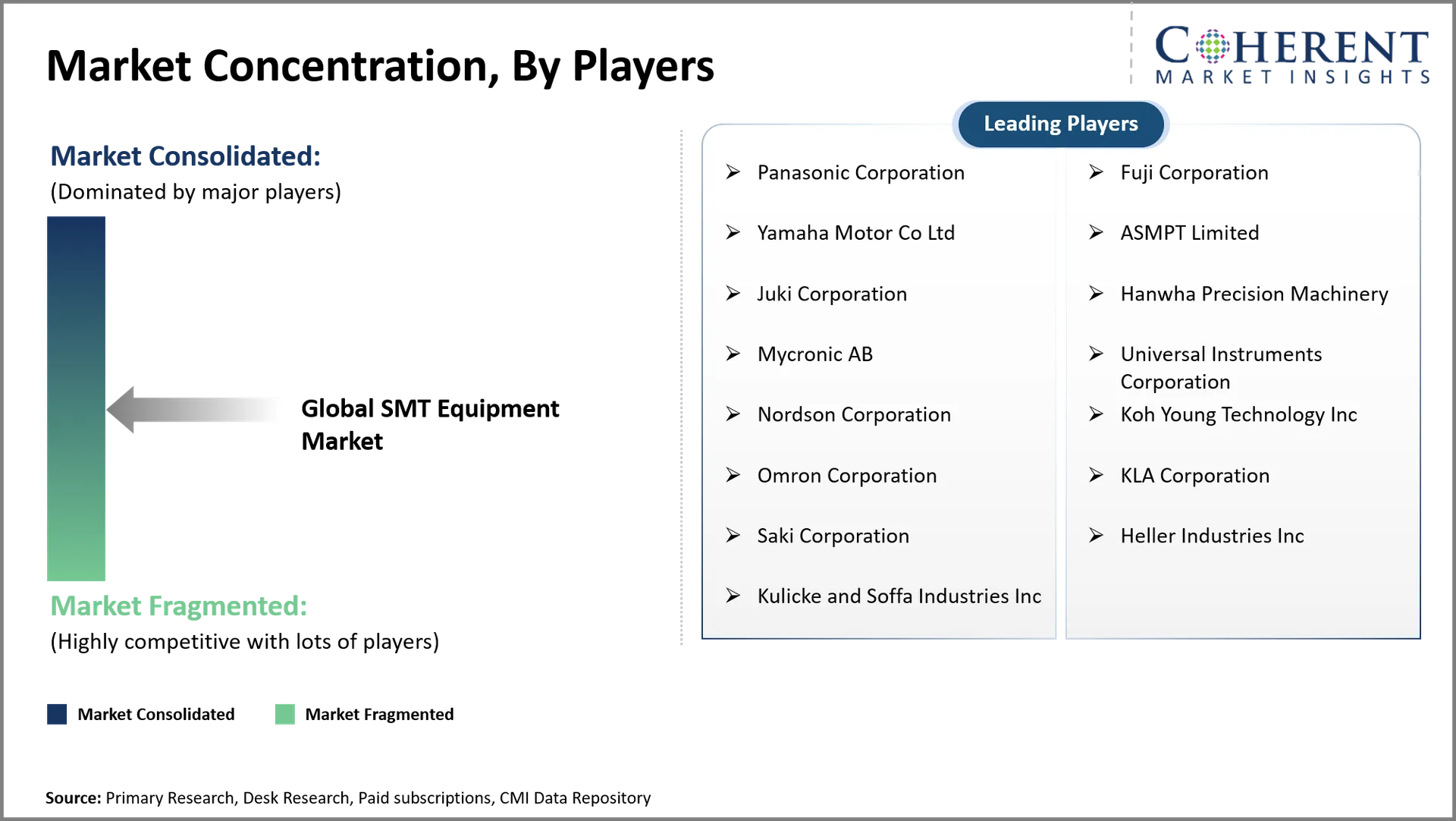
Key Developments
- On June 1, 2026, Fuji Corporation developed a new placement machine, the CLT-FG, which combines compactness with flexibility to accommodate diverse production requirements. Fuji has cultivated through its experience in developing placement machines, the CLT-FG meets a wide range of production requirements including high-mix, low-volume production to deliver flexible and stable manufacturing.
- On January 20, 2026, ASMPT SMT Solutions introduced its new SIPLACE V platform, featuring a significant performance boost of up to 30% and combining maximum speed with exceptional quality and flexibility. ASMPT’s new machine sets new standards in electronics manufacturing with its compact footprint, full compatibility with existing ASMPT solutions, and long-term investment security.
Competitive Landscape
Established manufacturers dominate the global SMT equipment market and compete on placement speed, component accuracy, flexibility of production and integrated factory software. ASMPT focuses on intelligent manufacturing technologies, including SIPLACE placement machines, DEK printers and production analytics. The SIPLACE V platform is focused on high-volume production, while its expertise in managing massive components is aimed at challenging AI server boards. Yamaha Motor provides a 1 Stop Smart Solution that integrates placement, printing, inspection and software, setting it apart from the competition. JUKI focuses on modular assembly and high-mix production and Fuji Corporation and Panasonic offer automated placement platforms. These companies increasingly target complex computing boards, automotive electronics, and manufacturing lines requiring higher traceability.
Top Manufacturers and Notable Products in the SMT Equipment Market
Manufacturer | Notable Product | Key features |
ASMPT | SIPLACE V | Up to 52500 components per hour with the CP20 head, precision placement, flexible component handling, production traceability |
Yamaha Motor | YRM20 | High-speed component placement, flexible production configurations, integration with printing and inspection equipment |
JUKI Corporation | RS-2 | Up to 50000 components per hour, supports miniature and larger components, flexible feeder configuration |
FUJI Corporation | NXTR | Modular placement architecture, scalable production lines, automated setup and flexible manufacturing |
Panasonic Connect | NPM-GW | Up to 104000 components per hour, ±25 µm placement accuracy, high-speed placement and support for varied component sizes |
Market Report Scope
Global SMT Equipment Market Report Coverage | |||
Report Coverage | Details | ||
Base Year | 2025 | Market Size in 2026: | USD 6.00 Bn |
Historical Data For: | 2020 To 2024 | Forecast Period: | 2026 To 2033 |
Forecast Period 2026 To 2033 CAGR: | 8.60% | 2033 Value Projection: | USD 14.00 Bn |
Geographies covered: |
| ||
Segments covered: |
| ||
Companies covered: | Panasonic Corporation, Fuji Corporation, Yamaha Motor Co Ltd, ASMPT Limited, Juki Corporation, Hanwha Precision Machinery, Mycronic AB, Universal Instruments Corporation, Nordson Corporation, Koh Young Technology Inc, Omron Corporation, KLA Corporation, Saki Corporation, Heller Industries Inc, Kulicke and Soffa Industries Inc | ||
Growth Drivers: |
| ||
Restraints & Challenges: |
| ||
Analyst Opinion (Expert Opinion)
- The future of the SMT equipment market will increasingly depend on processing complex electronic assemblies rather than simply increasing placement speed. Artificial intelligence server boards require accurate placement of large processors, dense memory components, and high-current power circuitry. ASMPT's SIPLACE solutions address large-component handling and intelligent production monitoring for these demanding applications. Equipment vendors should concentrate on variable placement heads, real-time process correction and integrated inspection. These capabilities will enable manufacturers to handle more complicated boards without compromising on production throughput or assembly quality.
- The largest opportunity will be in high-speed placement equipment, automated optical inspection and integrated production software. Promising applications include artificial intelligence servers, vehicle power electronics and enhanced driver assistance systems. China is an opportunity in electric car electronics and large-scale electronics assembly. Taiwan has prospects in computing hardware, and electronics manufacturing services. India also offers growth opportunities as local electronics assembly increases. Suppliers should be configuring equipment to the regional production needs rather than the same solution in every market.
- Competition between market competitors should be based on measurable gains in manufacturing, not just equipment specifications. They must show reductions in changeover time, placement problems, downtime and component waste. Yamaha Motor’s integrated approach combines placement machines, solder-paste printers, inspection equipment and software into coordinated production lines. Suppliers must also invest in local service networks, predictive maintenance, operator training and availability of spare parts. Manufacturers who can’t justify a full factory replacement may be interested in developing upgrade packages for current production lines. These tactics might help retain customers and generate recurring revenue through software, maintenance and automation services.
Speak to the analyst
Want personalized insights?
Take the findings above to one of our principal consultants, or have the report rebuilt around the segments, geographies and competitors you actually track.
Market Segmentation
- Equipment Type Insights (Revenue, USD Billion, 2021 - 2033)
- Placement Equipment
- Screen Printing Equipment
- Inspection Equipment
- Soldering Equipment
- Others
- Component Insights (Revenue, USD Billion, 2021 - 2033)
- SMT Machines
- Feeders
- Nozzles
- Conveyors
- Others
- Automation Level Insights (Revenue, USD Billion, 2021 - 2033)
- Manual Equipment
- Semi-Automatic Equipment
- Fully Automatic Equipment
- Application Insights (Revenue, USD Billion, 2021 - 2033)
- Consumer Electronics
- Automotive
- Telecommunications
- Aerospace and Defense
- Medical Electronics
- Industrial Electronics
- Energy and Power Systems
- End User Insights (Revenue, USD Billion, 2021 - 2033)
- Electronics Manufacturing Services
- Original Equipment Manufacturers
- Others
- Regional Insights (Revenue, USD Billion, 2021 - 2033)
- North America
- U.S.
- Canada
- Latin America
- Brazil
- Argentina
- Mexico
- Rest of Latin America
- Europe
- Germany
- U.K.
- Spain
- France
- Italy
- Russia
- Rest of Europe
- Asia Pacific
- China
- India
- Japan
- Australia
- South Korea
- ASEAN
- Rest of Asia Pacific
- Middle East
- GCC Countries
- Israel
- Rest of Middle East
- Africa
- South Africa
- North Africa
- Central Africa
- North America
- Key Players Insights
- Panasonic Corporation
- Fuji Corporation
- Yamaha Motor Co Ltd
- ASMPT Limited
- Juki Corporation
- Hanwha Precision Machinery
- Mycronic AB
- Universal Instruments Corporation
- Nordson Corporation
- Koh Young Technology Inc
- Omron Corporation
- KLA Corporation
- Saki Corporation
- Heller Industries Inc
- Kulicke and Soffa Industries Inc
Sources
Primary Research Interviews
- SMT Equipment Manufacturers
- Electronics Contract Manufacturers (ECMs)
- PCB Assembly Service Providers
- Semiconductor & Electronics Component Distributors
Magazines
- SMT007 Magazine
- Circuits Assembly Magazine
- Electronics Weekly
- PCB Design & Fab Magazine
Journals
- IEEE Transactions on Electronics Packaging Manufacturing
- Journal of Surface Mount Technology (SMTA)
- International Journal of Advanced Manufacturing Technology
Associations
- Surface Mount Technology Association (SMTA)
- IPC - Association Connecting Electronics Industries
- SEMI (Semiconductor Equipment and Materials International)
- Japan Electronics and Information Technology Industries Association (JEITA)
Public Domain Sources
- U.S. International Trade Administration (ITA) - Electronics Industry Reports
- European Commission - Electronics & Manufacturing Policy Reports
- World Trade Organization (WTO) - Trade Data on Electronics Equipment
- Ministry of Economy, Trade and Industry (METI), Japan
Proprietary Elements
- CMI Data Analytics Tool
- Proprietary CMI Existing Repository of Information for Last 10 Years
Get access to 250+ pages report
Every segment, forecast, competitor profile and data table behind the analysis above — available for instant download.
- ESOMAR Member
- ISO 9001:2015 Certified
- D-U-N-S Registered
- GDPR & CCPA Compliant
Frequently Asked Questions
The global SMT equipment market is expected to stand at USD 6.00 Bn in 2026 and is expected to reach USD 14.00 Bn by 2033.
The CAGR of the global SMT equipment market is projected to be 8.6% from 2026 to 2033.
Increasing demand for compact electronic devices and Growing automotive electronics manufacturing are the major factors driving the growth of the global SMT equipment market.
High initial equipment investment and Expensive equipment maintenance requirements are the major factors hampering the growth of the global SMT equipment market.
In terms of equipment type, placement equipment segment is estimated to dominate the market revenue share in 2026.
Pick-and-place machines position electronic components precisely, enabling automated assembly of compact and complex printed circuit boards.
Artificial intelligence applications increase demand for advanced servers and computing hardware requiring precise component placement and reliable circuit board assembly.