

Global Soft Magnetic Composite Market Size and Forecast – 2026 To 2033
The global soft magnetic composite market is estimated to be valued at USD 5.13 Bn in 2026 and is expected to reach USD 8.35 Bn by 2033, growing at a compound annual growth rate (CAGR) of 7.20% from 2026 to 2033. Market growth is supported by wider use of soft magnetic composites in electric motors, power electronics, industrial equipment, and electrified transportation, where manufacturers require lower magnetic losses, compact core geometries, and improved performance at higher operating frequencies.
In July 2024, the Metal Powder Industries Federation recognized research comparing soft magnetic composites with conventional laminated steel assemblies, highlighting that soft magnetic composites are particularly suited to higher-frequency operation and can enable alternative motor-core designs. This reinforces the commercial relevance of SMC technology as manufacturers pursue more efficient and compact electromagnetic systems
Key Takeaways of the Global Soft Magnetic Composite Market
- Iron Powder Based SMC is expected to register an estimated CAGR of 7.6% during 2026–2033 and hold 43.8% of the global soft magnetic composite market in 2026. Its lead reflects high saturation flux density scalable powder-metallurgy processing and suitability for complex three-dimensional magnetic circuits. In March 2025, Höganäs reported Somaloy 7P based on improved iron powder and a water-based coating entering industrial qualification with lower core-loss performance.
- Electric Motors are projected to expand at an estimated CAGR of 8.2% during 2026–2033 while accounting for 38.5% of the global soft magnetic composite market in 2026. SMCs suit compact geometries three-dimensional flux paths and high-frequency operation where eddy-current control matters. In January 2024, JFE Steel demonstrated an axial-gap motor using Denjiro insulated pure-iron powder that achieved major thickness and weight reductions versus comparison designs.
- Automotive is forecast to grow at an estimated CAGR of 8.4% during 2026–2033 and represent 36.8% of the global soft magnetic composite market in 2026. Electrified vehicles create SMC opportunities across traction motors auxiliary motors reactors pumps and compact power-conversion components. In October 2024, a peer-reviewed Metals study built and evaluated an AncorLam HR SMC stator core for an axial-flux xEV drive motor confirming manufacturing feasibility.
- Asia Pacific is estimated to post a CAGR of 7.8% during 2026–2033 and command 43.2% of the global soft magnetic composite market in 2026. The region combines large-scale electric-vehicle production motor manufacturing electronics output and mature powder-metallurgy supply chains. In July 2026, China reported first-half new-energy-vehicle output above seven million units reinforcing the scale of downstream demand for compact motors and magnetic components.
- Europe is expected to record the fastest regional CAGR estimated at 8.6% during 2026–2033 while holding 25.6% of the global soft magnetic composite market in 2026. Growth is supported by tighter motor-efficiency requirements automotive electrification and material-efficient machine design. In August 2025, the European Commission opened a review of ecodesign rules for electric motors and variable-speed drives explicitly considering technological progress and material efficiency.
Segmental Insights
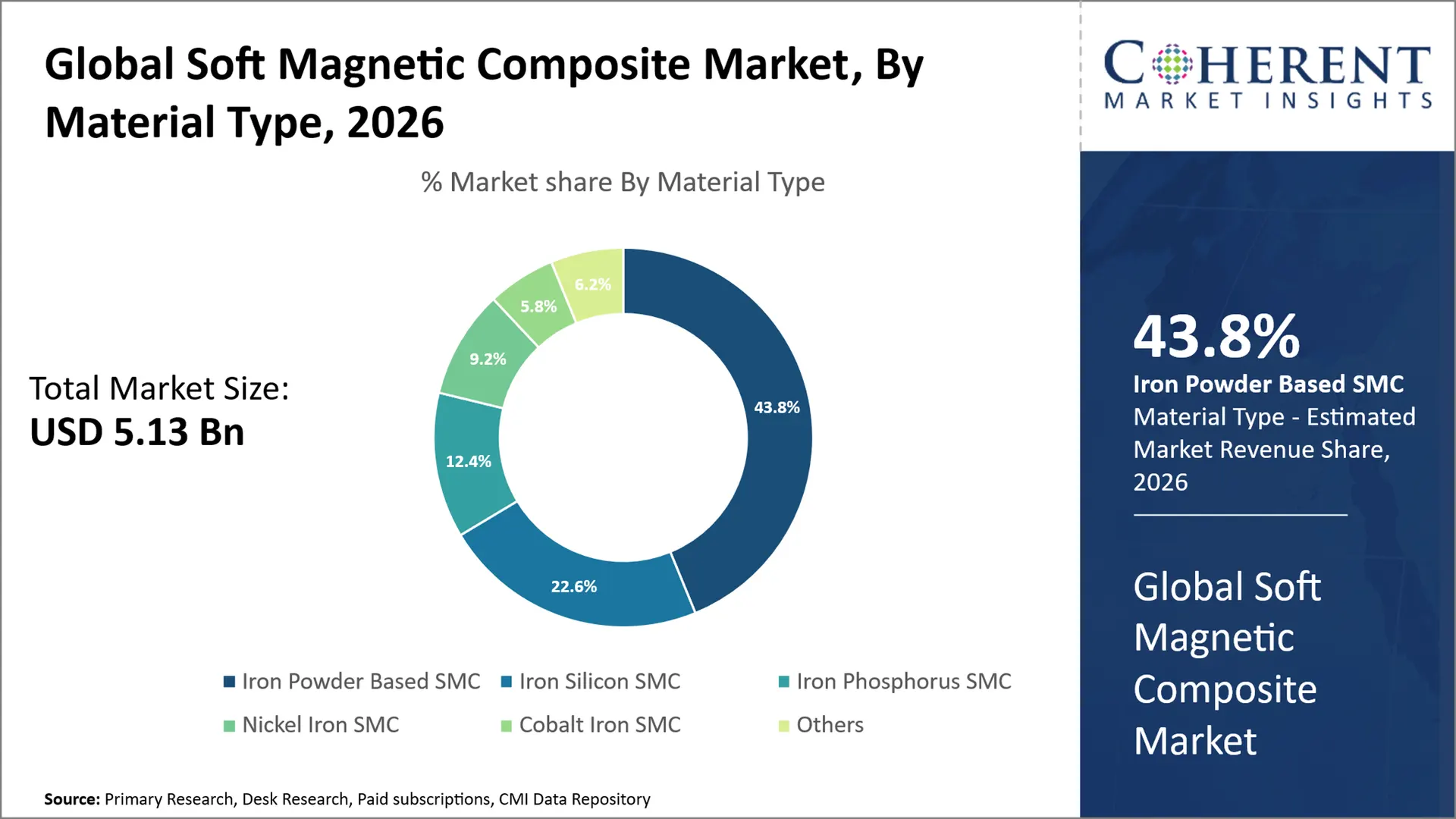
Why Does Iron Powder Based SMC Dominate the Global soft magnetic composite market?
Iron Powder Based SMC is expected to hold 43.8% of the global soft magnetic composite market in 2026 reflecting its favorable balance of magnetic performance processing flexibility and material economics. Insulated iron particles can be compacted into near-net-shape three-dimensional cores while retaining high flux capability and limiting eddy-current losses making the material practical for motors inductors actuators and other electromagnetic assemblies. Compared with nickel- or cobalt-rich alternatives iron-based formulations also provide a broader raw-material base and a more scalable route for high-volume powder metallurgy. Suppliers controlling atomization insulation coating compaction and application engineering can therefore compete on both performance and part cost. In February 2025, Kobe Steel highlighted magnetic iron powder for high-speed high-torque motors and transformers within its electrification strategy alongside simulation-based magnetic solution development for customer applications.
- Current Industry Events of 2026
- Market Size Estimation
- Regional Breakdown
- Competitive Landscape
- Customer Intelligence
- Segmental Analysis
- Pricing Analysis
- Key Market Drivers, Challenges & Future Trends
- Customized Insights Section
Why Do Electric Motors Represent the Largest Application in the Global Soft Magnetic Composite Market?
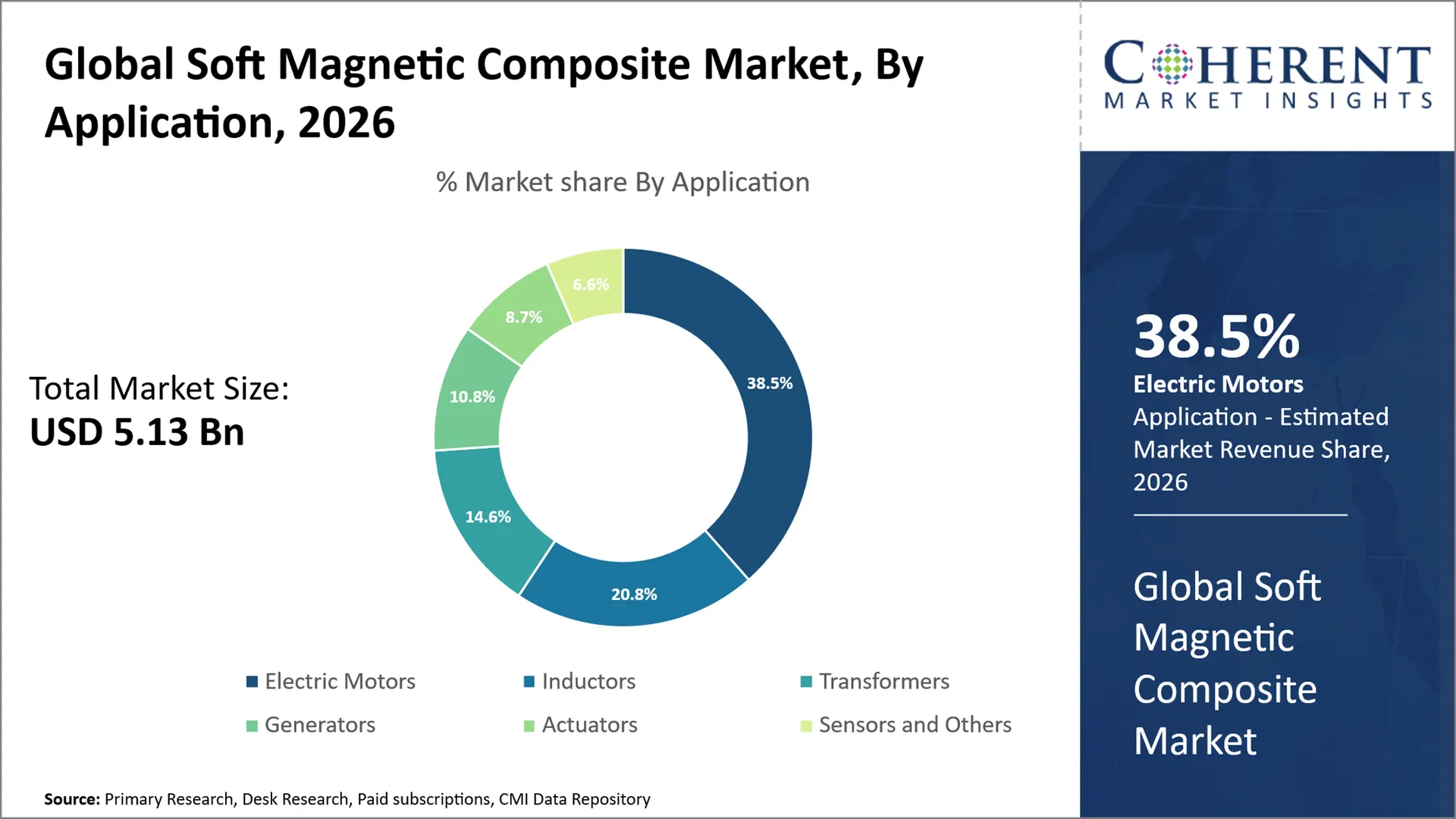
Electric Motors are expected to account for 38.5% of the global soft magnetic composite market in 2026 because SMCs allow motor designers to use magnetic paths that conventional stacked laminations cannot form efficiently. Their isotropic magnetic behavior supports axial-flux and other three-dimensional motor topologies while particle-level electrical insulation helps control losses as operating frequency increases. This gives motor manufacturers greater freedom to reduce axial length integrate complex stator geometries simplify assembly and improve thermal design. The commercial value is strongest where packaging torque density and production repeatability must be optimized together rather than separately. In December 2024, Sumitomo Electric started mass production of ultra-thin high-voltage insulation-coated powder magnetic cores for axial-flux motors; its FMCM cores use nano-insulated iron powder and support three-dimensional stator designs.
Why Does Automotive Dominate the End User Segment of the Global Soft Magnetic Composite Market?
Automotive is expected to represent 36.8% of the global soft magnetic composite market in 2026 as vehicle electrification creates multiple purchasing points for compact magnetic components across traction systems auxiliary drives pumps actuators steering functions and power electronics. Automotive buyers place unusual weight on packaging efficiency repeatable high-volume production thermal behavior and component integration conditions that favor pressed SMC geometries where design complexity would otherwise increase assembly steps. The segment also benefits from long platform programs that can convert successful material qualification into multi-year component demand. In November 2024, YASA and Automobili Lamborghini announced that three axial-flux motors would be used in the Lamborghini Temerario hybrid powertrain with two motors on the front e-axle and another integrated at the rear demonstrating automotive deployment of compact axial-flux architectures.
Current Events and their Impact
Current Event | Description and Its Impact |
U.S. DOE Expanded-Scope Electric Motor Energy Conservation Standards – November 2024 |
|
China Initiates Mandatory Revision of National Motor-Efficiency Standard – April 2026 |
|
Global Soft Magnetic Composite Market Dynamics
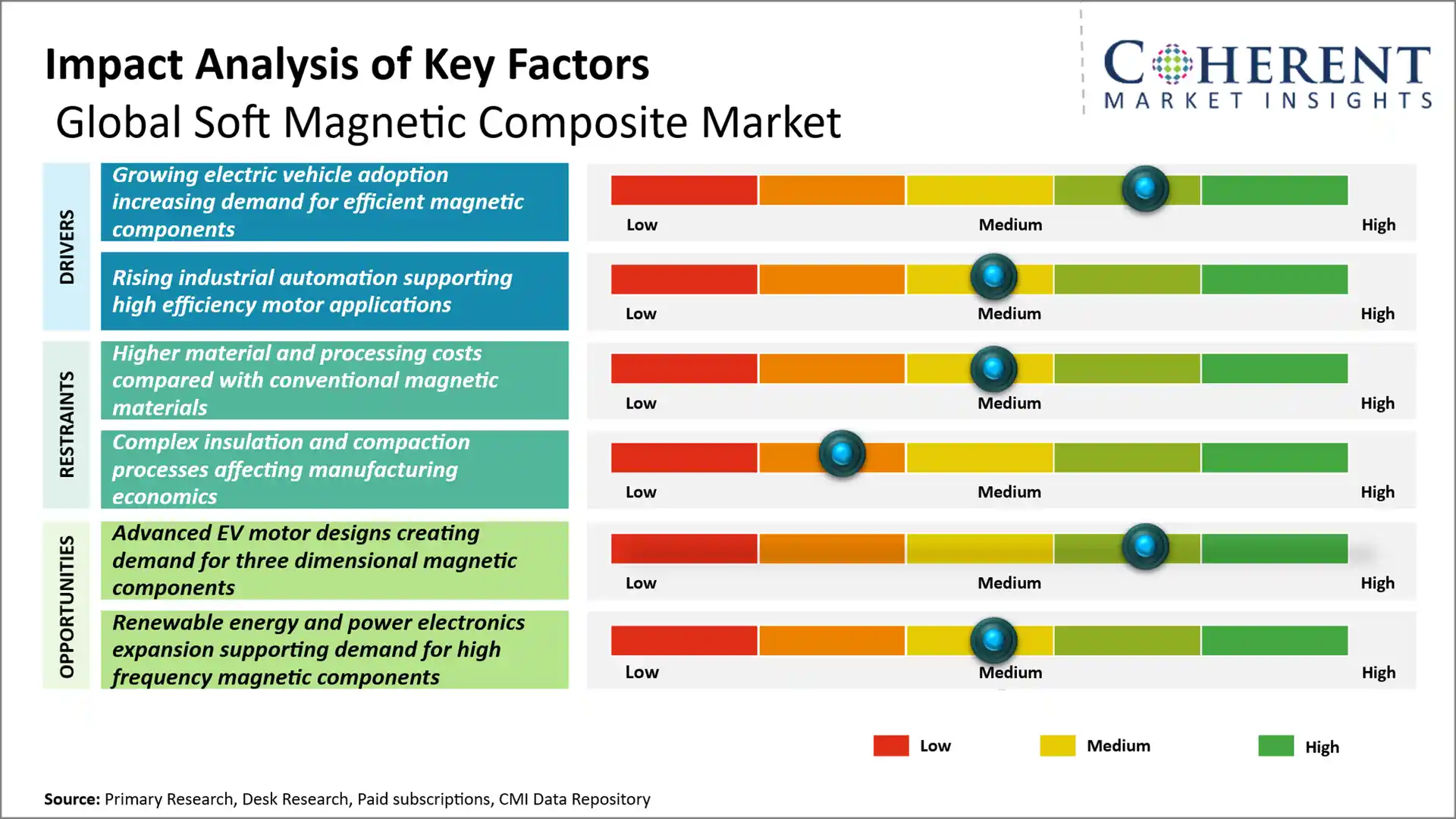
Key Market Drivers
- Growing electric vehicle adoption increasing demand for efficient magnetic components: Growing electric vehicle adoption is enlarging the addressable market for soft magnetic composites across traction motors auxiliary drives DC/DC conversion onboard charging and power-control hardware. These systems reward materials that combine high saturation capability with low eddy-current losses and three-dimensional formability especially where packaging space is constrained. Powder producers core formers and Tier-1 magnetic-component suppliers therefore gain more design-in opportunities as electric drivetrains proliferate. In May 2026, the IEA reported that global electric-car sales were expected to reach 23 million during 2026 underlining the expanding base of electrified platforms requiring efficient magnetic components.
- Rising industrial automation supporting high efficiency motor applications: Rising industrial automation is increasing the commercial value of high-efficiency motors used in pumps fans compressors conveyors and process equipment. As plants add variable-speed drives robotic systems and digitally controlled motion assets motor builders face tighter requirements for efficiency thermal control and compactness creating design opportunities for low-loss soft magnetic materials. SMC suppliers benefit when motor architectures require three-dimensional flux paths or higher-frequency operation. In July 2025, ABB introduced its IE6 magnet-free synchronous reluctance motor platform expanding high-efficiency options for industrial applications and reinforcing buyer focus on motor-loss reduction and lifecycle energy performance.
Emerging Market Trends
- Simulation-Led SMC Selection Is Moving Upstream in the Design Cycle: Simulation-led material selection is becoming a more important route to winning soft magnetic composite design-ins. Buyers increasingly expect frequency-dependent loss curves permeability behavior thermal data and manufacturability inputs that can be imported directly into electromagnetic models before tooling is committed. This shifts competition away from catalogue-grade selling toward engineering support validated datasets and rapid prototype iteration. Suppliers with strong application engineering can enter customer programs earlier while commodity powder vendors risk being specified only after architecture decisions are fixed. Over the forecast period digital material libraries should become a standard commercial interface between SMC suppliers and motor or power-electronics designers.
- Application-Specific Formulations Are Replacing One-Grade-Fits-All SMC Portfolios: Application-specific SMC formulations are replacing the one-grade-fits-all approach as operating conditions diverge across motors inductors actuators and high-frequency power systems. Customers increasingly need different balances of saturation flux permeability core loss mechanical strength insulation durability and thermal stability rather than a single maximum-performance metric. This is encouraging more segmented product portfolios and closer coordination between alloy design coating chemistry compaction and heat treatment. Specialist materials companies and vertically integrated component suppliers are positioned to benefit while low-cost undifferentiated grades face pricing pressure. The trend should deepen as OEM qualification becomes more component-specific and performance is judged under real duty cycles.
Regional Insights
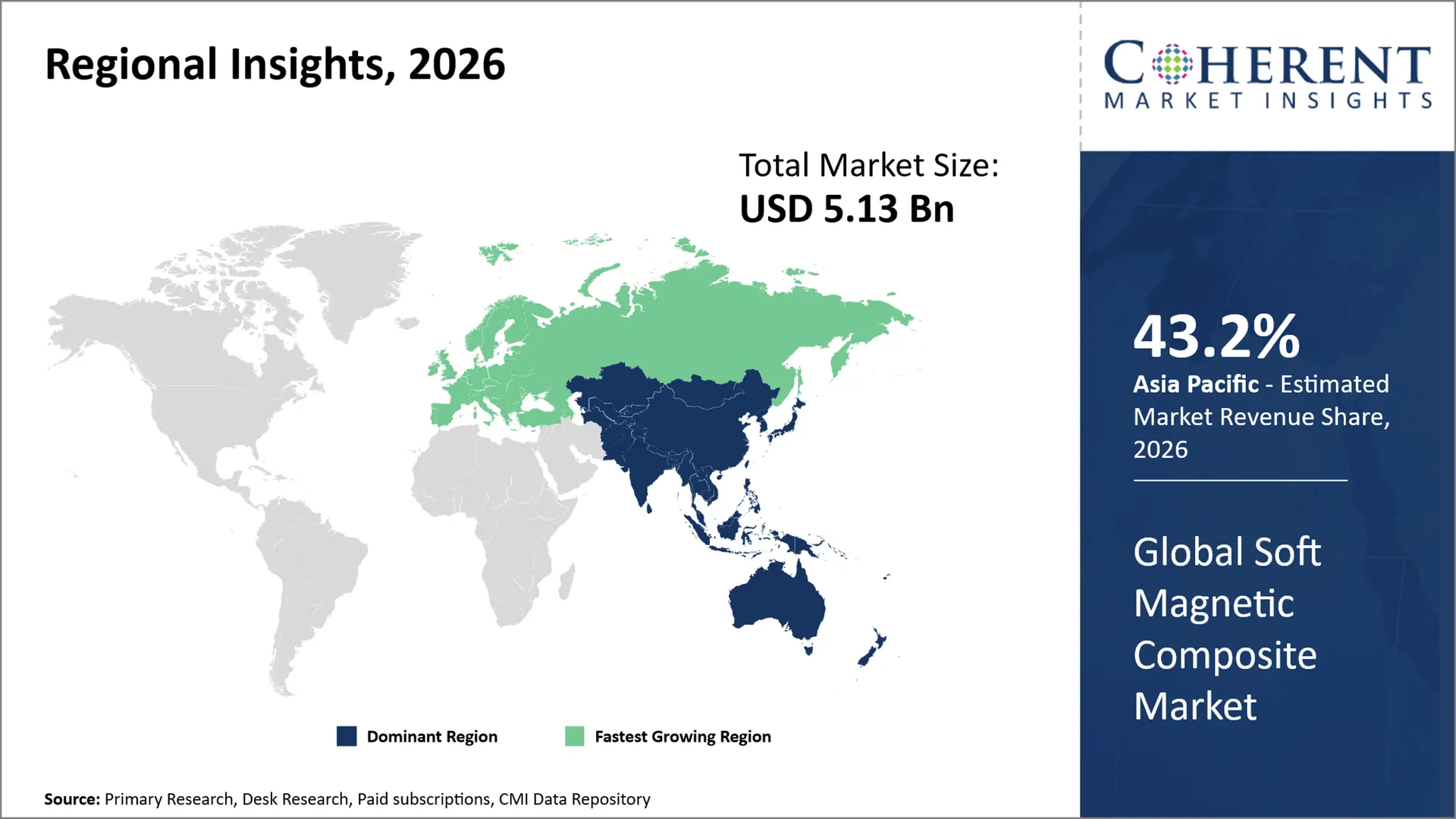
Why Does Asia Pacific Dominate the Global Soft Magnetic Composite Market?
Asia Pacific is expected to account for 43.2% of the global soft magnetic composite market in 2026, supported by its concentration of electric-motor manufacturing, automotive electrification, power electronics, industrial equipment, and powder-metallurgy capability. China, Japan, and South Korea provide a dense customer base for iron-based powder cores, inductors, motor components, and high-frequency magnetic systems. Regional suppliers also benefit from established atomization, insulation-coating, compaction, and precision-component ecosystems that shorten qualification cycles between material developers and OEMs. In October 2025, the Korea Institute of Materials Science reported that more than 80 academic and industry experts from Korea and Japan participated in its International Symposium on Soft Magnetic Materials, exchanging research findings and industrial-development approaches for electrification applications. This cross-border technical depth strengthens Asia Pacific's capacity to industrialize advanced magnetic materials.
Why Is Europe Emerging as the Fastest-Growing Region in the Global Soft Magnetic Composite Market?
Europe is expected to hold 25.6% of the global soft magnetic composite market in 2026 and emerge as the fastest-growing region as manufacturers redesign motors, inductors, and power-conversion systems around higher efficiency, compact packaging, and lower magnetic losses. The region combines automotive engineering, industrial automation, renewable-energy equipment, and a mature powder-metallurgy ecosystem, creating demand for SMC grades capable of operating effectively at higher frequencies and in complex three-dimensional geometries. European buyers also emphasize validated material behavior, manufacturability, and lifecycle efficiency. In September 2024, Euro PM2024 featured European research into amorphous soft magnetic powder cores consolidated at high pressure, examining how particle packing and processing affect permeability and power losses. Such work is expanding the performance envelope available to European magnetic-component designers.
Global Soft Magnetic Composite Market Outlook for Key Countries
Why Is the U.S. A Key Market for the Global Soft Magnetic Composite Market?
The U.S. is a key global soft magnetic composite market because electric mobility, industrial electrification, aerospace, defense, and power-electronics programs require magnetic cores that combine low losses with compact form factors. The country also maintains a strong research-to-commercialization network connecting federal laboratories, universities, motor developers, powder-metallurgy specialists, and advanced manufacturers. This supports experimentation with nanocrystalline and amorphous SMCs for axial-flux machines, transformers, chargers, and high-frequency systems where conventional laminated cores can become less attractive. In August 2025, the U.S. Department of Energy's ARPA-E program recorded completion of Stanford University's additive-manufacturing project for amorphous metal soft magnetic composites. The project targeted near-net-shape SMCs with reduced material waste and tailored properties for electric motors, EV chargers, transformers, and generators, illustrating continued U.S. investment in scalable SMC manufacturing routes.
Why Does China Support Growth in the Global Soft Magnetic Composite Market?
China supports growth in the global soft magnetic composite market through its combination of electric-vehicle manufacturing, consumer electronics, industrial power supplies, telecommunications equipment, and high-volume magnetic-component production. These industries create demand for soft magnetic powders and composite cores used in motors, inductors, converters, chargers, and high-frequency power systems. Chinese research organizations are also addressing insulation-interface stability, saturation performance, and core-loss control, which remain important technical constraints on SMC adoption. In August 2026, the Chinese Academy of Sciences' Dongguan materials institute reported progress in high-frequency amorphous soft magnetic composites using in-situ magnetic-oxide interface engineering, building on work that improved permeability and loss behavior simultaneously. This research direction is commercially significant because better particle-level insulation can reduce eddy-current losses without excessively sacrificing magnetic-phase content or component power density.
Why Is Japan Important in the Global Soft Magnetic Composite Market?
Japan remains important to the global soft magnetic composite market because its automotive, industrial machinery, robotics, electronics, and precision-materials sectors place a premium on compact magnetic components with predictable performance. Domestic material suppliers possess deep capabilities in alloy design, atomization, insulation technologies, core forming, motor simulation, and thermal validation, enabling close integration between magnetic-material development and end-use engineering. Japanese demand is particularly relevant for high-speed motors, reactors, inductors, and emerging mobility platforms where weight, heat, and magnetic losses must be controlled simultaneously. In July 2025, Proterial began full-scale proposals for its high-flux YEP-2V soft magnetic motor-core material for eVTOL applications after prototype validation. Although YEP-2V is a cobalt-iron soft magnetic alloy rather than an SMC, the program demonstrates Japan's active shift toward advanced magnetic-core technologies for compact, high-output electric machines.
Why Is Germany a Strategic Country in the Global Soft Magnetic Composite Market?
Germany is strategically important to the global soft magnetic composite market because its automotive engineering, industrial drives, machinery, robotics, and power-electronics sectors create technically demanding use cases for high-efficiency magnetic cores. German research and manufacturing networks are particularly focused on converting powder-metallurgy concepts into components that withstand mechanical loading while retaining favorable magnetic behavior, an important requirement for SMC adoption in motors and high-frequency devices. Close links among applied-research institutes, universities, component manufacturers, and vehicle engineers also accelerate prototype validation and design-for-manufacturing work. In September 2025, Fraunhofer IFAM and TU Dresden researchers presented work at Euro PM2025 examining the mechanical behavior of high-density soft magnetic composites and how coating systems, particle size, compaction, and heat treatment influence transverse rupture strength. Addressing this mechanical-performance trade-off is important for broader industrial qualification of SMC components.
Why Is South Korea an Important Growth Market for the Global Soft Magnetic Composite Market?
South Korea is an important growth market for global soft magnetic composite market because its automotive electronics, EV platforms, semiconductors, consumer electronics, batteries, and power-module industries require increasingly compact inductive and magnetic components. Korean suppliers compete heavily on miniaturization, high-current capability, thermal reliability, and automated manufacturing, creating a strong commercial fit for advanced powder-core materials with engineered insulation and controlled magnetic losses. The country's integrated electronics supply chain can also move new magnetic-material designs rapidly into vehicle and device programs. In May 2025, Samsung Electro-Mechanics launched automotive power inductors designed for operation up to 165°C using differentiated powder insulation coating and proprietary magnetic materials for high-current applications in ADAS and in-vehicle infotainment. The development illustrates how Korean customers are pushing soft-magnetic powder technologies toward smaller, hotter, and more demanding automotive electronics applications.
Technology Production & Manufacturing Landscape
Technology / Process | Adoption Position | Technical Relevance to Soft Magnetic Composites | Commercial Implication |
Nano-Scale Particle Insulation Coatings | Scaling | Electrically isolates metallic powder particles to limit inter-particle eddy currents while retaining high magnetic-material loading | Enables differentiated low-loss grades for higher-frequency motors inductors and power-conversion systems |
High-Density Warm Compaction and Controlled-Pressure Forming | Established and advancing | Improves green density dimensional control and magnetic flux capability while supporting complex near-net-shape components | Higher forming consistency can reduce machining requirements improve yield and support volume economics |
Controlled-Atmosphere Stress-Relief Heat Treatment | Established critical process | Reduces residual stresses introduced during pressing which can otherwise increase hysteresis losses while protecting insulation integrity | Process know-how becomes a meaningful differentiator because inappropriate heat treatment can compromise both magnetic performance and coating durability |
Engineered Gas and Water Atomized Alloy Powders | Advanced | Controls particle morphology chemistry and size distribution across iron silicon and specialty alloy systems | Gives suppliers greater flexibility to tailor permeability saturation behavior compressibility and loss characteristics for individual applications |
Additive Manufacturing of Soft-Magnetic Composite Cores | Pilot to early commercialization | Enables unconventional magnetic paths integrated internal structures and low-volume complex geometries without conventional tooling | Attractive for aerospace prototyping specialized motors and customized magnetic components although density surface quality and loss control remain commercialization hurdles |
Electromagnetic-Thermal Co-Simulation with Digital Material Data | Rapidly expanding design enabler | Models frequency-dependent losses permeability flux concentration and heat generation under realistic duty cycles | Shortens design-in cycles and favors suppliers able to provide validated datasets application engineering and component-level optimization |
How Are Wide-Bandgap Power Electronics Creating New Growth Opportunities in The Global Soft Magnetic Composite Market?
Wide-bandgap power electronics are creating an underdeveloped SMC opportunity in high-frequency inductors reactors EMI filters and integrated magnetic components used in fast chargers renewable-energy inverters data-center power systems and industrial converters. As switching frequencies increase buyers need core materials that control eddy-current and hysteresis losses without sacrificing saturation performance thermal stability or manufacturability. Suppliers can capture this opportunity by developing application-specific powders thinner and more durable particle insulation frequency-resolved loss data and compact core geometries co-designed with thermal and EMI requirements. Commercial success will require application laboratories rapid prototyping automated compaction thermal characterization and qualification support for power-electronics OEMs. The opportunity should favor specialist magnetic-material companies and vertically integrated core manufacturers that can translate powder chemistry into verified component performance. Established volume suppliers can also participate but only if they move beyond catalogue grades and support customer-specific electromagnetic design while new entrants will face long qualification cycles and demanding process-control requirements.
Market Players, Key Development, and Competitive Intelligence
Key Developments
- In August 2026, Sumida Corporation added the MCDMCF322520/DS high-temperature metal composite inductor to its MCDMCF series combining a magnetically shielded metal-composite core with high-current low-EMI low-core-loss performance. The launch expands commercialization of composite magnetic cores in thermally demanding compact power-electronics designs.
- In March 2026, Tamura Corporation developed a high-permeability FeSiAl powder magnetic core using high-density compaction and controlled flake-particle orientation and began applying the technology to transformers. This matters because higher permeability can support smaller lower-loss magnetic components in high-frequency power systems broadening premium SMC opportunities.
- In February 2026, Sintercom India received a purchase order from Pinnacle Mobility Solutions for central-fork and half-ring components for a commercial-bus EV motor following its SMC motor-component collaboration with Horizon Technology. The order provides a concrete pathway from SMC development activity into vehicle-program supply.
Competitive Landscape
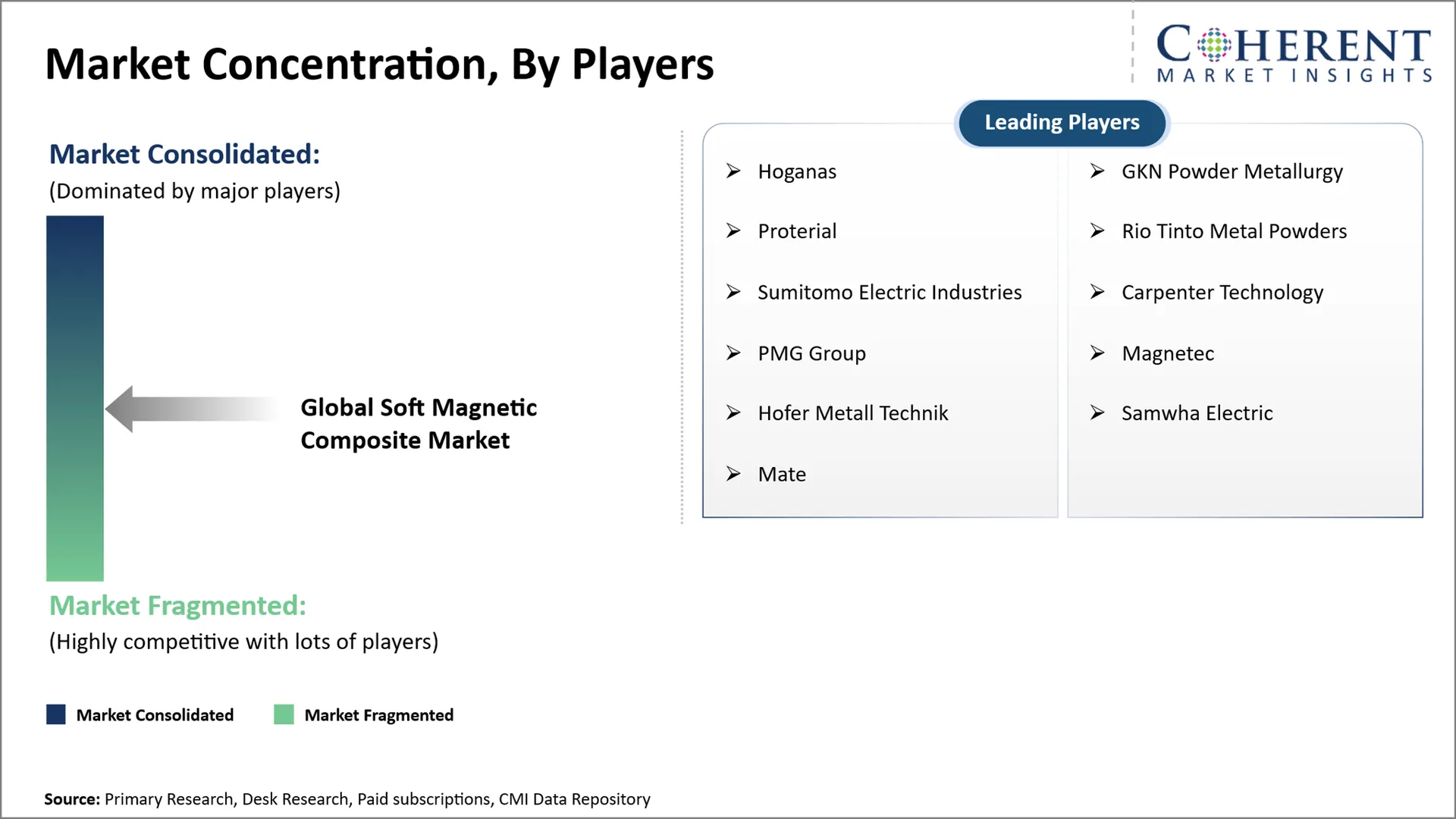
The global soft magnetic composite market is best characterized as moderately consolidated at the advanced-material level but more fragmented in core forming and application-specific component manufacturing. Large powder and magnetic-material suppliers compete with specialist SMC formulators powder-metallurgy processors and regional component makers. Advantage increasingly depends on repeatable magnetic performance insulation durability forming precision qualification support supply continuity and the ability to convert material specifications into validated component designs.
Key focus areas include
- Magnetic performance trade-offs: Suppliers compete on usable combinations of saturation flux permeability coercivity and core loss rather than on a single headline property.
- Insulation integrity: Coating systems must remain electrically effective after high-pressure compaction heat treatment machining and long operating cycles.
- Manufacturing repeatability: Tight control of powder distribution pressing density dimensional tolerance and tooling wear is critical for OEM qualification.
- Component-level economics: SMC solutions must justify their value against electrical steel ferrites amorphous materials and other magnetic-core alternatives on total part cost and performance.
- Application engineering: Material databases simulation support prototype development and motor or inductor co-design increasingly influence supplier selection.
- Quality and supply assurance: Automotive and industrial buyers favor suppliers able to maintain lot-to-lot consistency traceability and multi-region supply continuity.
- Customization capability: Competitive differentiation is strongest where powder chemistry particle insulation geometry and processing conditions can be adapted to a customer's operating frequency thermal environment and magnetic load.
Market Report Scope
Global soft magnetic composite market Report Coverage | |||
Report Coverage | Details | ||
Base Year | 2025 | Market Size in 2026: | USD 5.13 Bn |
Historical Data For: | 2020 To 2024 | Forecast Period: | 2026 To 2033 |
Forecast Period 2026 To 2033 CAGR: | 7.20% | 2033 Value Projection: | USD 8.35 Bn |
Geographies covered: |
| ||
Segments covered: |
| ||
Companies covered: | Hoganas, GKN Powder Metallurgy, Proterial, Rio Tinto Metal Powders, Sumitomo Electric Industries, Carpenter Technology, PMG Group, Magnetec, Hofer Metall Technik, Samwha Electric, Mate | ||
Growth Drivers: |
| ||
Restraints & Challenges: |
| ||
Analyst Opinion (Expert Opinion)
- The strongest soft magnetic composite suppliers are likely to move from selling magnetic powder grades toward selling design assurance. Buyers will increasingly value validated component models processing windows tooling guidance prototype support and application-specific qualification alongside the material itself. This should shift pricing power toward suppliers that can connect powder chemistry with finished-part performance and make them harder to replace once an OEM platform has been engineered around their process knowledge.
- Architecture-specific qualification could change the economics of soft magnetic composite supply more than incremental material improvements. Once a customer designs a component around three-dimensional pressed-core geometry switching back to a conventional magnetic solution may require redesign rather than simple material substitution. Early design-in winners could therefore secure longer platform relationships while late-stage commodity suppliers face weaker access. The critical capability will be proving repeatable component performance before the customer's architecture becomes fixed.
- Suppliers should concentrate investment on coating durability mechanical integrity automated compaction control high-frequency loss characterization and dual-source raw-material resilience. Customer-facing resources should prioritize applications where geometry or operating frequency creates a clear SMC advantage rather than pursuing every motor or magnetic component. Partnerships with tooling winding thermal-management and power-electronics specialists can shorten qualification cycles while capacity expansion should follow confirmed design wins to limit margin pressure from underutilized assets.
Speak to the analyst
Want personalized insights?
Take the findings above to one of our principal consultants, or have the report rebuilt around the segments, geographies and competitors you actually track.
Market Segmentation
- Material Type Insights (Revenue, USD Bn, 2021 - 2033)
- Iron Powder Based SMC
- Iron Silicon SMC
- Iron Phosphorus SMC
- Nickel Iron SMC
- Cobalt Iron SMC
- Others
- Application Insights (Revenue, USD Bn, 2021 - 2033)
- Electric Motors
- Inductors
- Transformers
- Generators
- Actuators
- Sensors and Others
- End User Insights (Revenue, USD Bn, 2021 - 2033)
- Automotive
- Industrial Machinery and Equipment
- Energy and Power
- Consumer Electronics
- Aerospace and Defense
- Healthcare
- Distribution Channel Insights (Revenue, USD Bn, 2021 - 2033)
- Direct Sales
- Indirect Sales
- Regional Insights (Revenue, USD Bn, 2021 - 2033)
- North America
- U.S.
- Canada
- Latin America
- Brazil
- Argentina
- Mexico
- Rest of Latin America
- Europe
- Germany
- U.K.
- Spain
- France
- Italy
- Russia
- Rest of Europe
- Asia Pacific
- China
- India
- Japan
- Australia
- South Korea
- ASEAN
- Rest of Asia Pacific
- Middle East
- GCC Countries
- Israel
- Rest of Middle East
- Africa
- South Africa
- North Africa
- Central Africa
- North America
Sources
Primary Research Interviews
- SMC powder manufacturers, magnetic core producers, motor manufacturers, component suppliers, and distributors
- Electrical engineers, material scientists, procurement managers, product developers, and OEM sourcing teams
Stakeholders
- Soft magnetic composite and iron powder manufacturers
- Powder metallurgy processors, insulation coating suppliers, and core manufacturers
- Electric motor, transformer, inductor, actuator, and generator manufacturers
- Automotive, industrial machinery, electronics, energy, aerospace, and healthcare OEMs
End-use Sectors
- Automotive and electric mobility
- Industrial machinery and automation
- Energy and power systems
- Consumer electronics and power electronics
- Aerospace and specialized electrical equipment
Regulatory and Industry Bodies
- U.S. Department of Energy DOE
- European Commission
- International Electrotechnical Commission IEC
- International Energy Agency IEA
- Metal Powder Industries Federation MPIF
Databases
- Company annual reports and investor filings
- Patent and material technology databases
- Motor efficiency and electrical equipment databases
- Import export and metal powder trade datasets
- Product portfolio and technical specification databases
Magazines and Journals
- IEEE Transactions on Magnetics
- Journal of Magnetism and Magnetic Materials
- Powder Metallurgy
- Materials Science and Engineering
- IEEE Transactions on Industry Applications
Associations
- Metal Powder Industries Federation MPIF
- European Powder Metallurgy Association EPMA
- Powder Metallurgy Association of India PMAI
- IEEE Magnetics Society
- International Electrotechnical Commission IEC
Public Domain Sources
- Electric motor efficiency regulations and standards
- EV and industrial motor production data
- Powder metallurgy technology developments
- Magnetic material research publications
- Energy efficiency and electrification initiatives
Key Standards and Regulations
- Electric motor energy efficiency standards
- IEC motor efficiency classifications
- Automotive material qualification requirements
- Electrical insulation and thermal performance standards
- Environmental and workplace safety requirements
Proprietary Elements
- CMI Data Analytics Tool
- Proprietary CMI repository containing 10+ years of magnetic materials, powder metallurgy, electric motor, automotive, power electronics, and industrial equipment market intelligence.
Get access to 250+ pages report
Every segment, forecast, competitor profile and data table behind the analysis above — available for instant download.
- ESOMAR Member
- ISO 9001:2015 Certified
- D-U-N-S Registered
- GDPR & CCPA Compliant
Frequently Asked Questions
The CAGR of global soft magnetic composite market is projected to be 7.20% from 2026 to 2033.
The global soft magnetic composite market is estimated to be valued at USD 5.13 Bn in 2026 and is expected to reach USD 8.35 Bn by 2033.
The major factors driving the global soft magnetic composite market growth are the increasing adoption of electric vehicles, which is creating demand for efficient magnetic components, and the expansion of industrial automation, which is supporting the use of high-efficiency motor applications.
Higher material and processing costs compared with conventional magnetic materials and Complex insulation and compaction processes affecting manufacturing economics are the major factors hampering the growth of global soft magnetic composite market.
In terms of material type, iron powder based SMC is estimated to dominate the market revenue share in 2026.
Hoganas, GKN Powder Metallurgy, Proterial, Rio Tinto Metal Powders, Sumitomo Electric Industries, Carpenter Technology, PMG Group, Magnetec, Hofer Metall Technik, Samwha Electric, Mate are the major players.
Asia Pacific is expected to lead the global soft magnetic composite market in 2026.