

Global Solvent Recycling Market Size and Forecast – 2026 To 2033
The Global Solvent Recycling Market is estimated to be valued at USD 1.12 Bn in 2026 and is expected to reach USD 1.64 Bn by 2033, growing at a compound annual growth rate (CAGR) of 5.6% from 2026 to 2033. The market expansion is supported by increasing adoption of closed-loop solvent management systems, rising industrial focus on reducing hazardous waste volumes, and growing demand for recovered solvents in chemical, pharmaceutical, electronics, and coatings applications.
Companies are increasingly investing in dedicated recycling infrastructure to secure recycled solvent supply and improve resource efficiency. In September 2025, Ragn-Sells and Vilokan Group commissioned their Solvent Recycling Solutions facility in Sweden, designed to process up to 20,000 tons of waste solvents annually and regenerate solvents such as ethanol and acetone into industrial-grade products, demonstrating the shift toward commercial-scale circular solvent recovery models.
Key Takeaways of the Global Solvent Recycling Market
- On site Solvent Recycling segment is expected to achieve an estimated CAGR of 6.0 % and account for 58.6% of the global solvent recycling market in 2026, supported by reduced logistics requirements, faster solvent reuse cycles, and greater process control for industrial users. In September 2025, Veolia reported continued expansion of solvent recycling facilities, including dedicated units for semiconductor and pharmaceutical solvent recovery.
- Distillation technology segment is projected to register an estimated CAGR of 5.8 % and hold 64.8% of the global solvent recycling market in 2026, reflecting its established industrial acceptance, high solvent recovery efficiency, and compatibility with diverse spent solvent streams. In October 2025, BASF demonstrated solvent-based recycling processes using purification and recovery approaches for complex material streams, reinforcing advanced separation adoption.
- Alcohol Based Solvents segment is anticipated to expand at an estimated CAGR of 5.5 % and represent 22.6% of the global solvent recycling market in 2026, driven by extensive usage across pharmaceuticals, chemicals, coatings, and cleaning applications where recovery improves resource efficiency. In September 2025, researchers highlighted membrane-based solvent recycling approaches that can improve recovery of high-value organic solvents used in industrial processes
- Asia Pacific region is forecast to record an estimated CAGR of 6.2 % and contribute 34.8% of the global solvent recycling market in 2026, supported by expanding chemical manufacturing, pharmaceutical production, electronics processing, and sustainability initiatives across major industrial economies. In 2025, Veolia highlighted investment in solvent recycling capabilities in Taiwan focused on pharmaceutical solvent recovery operations.
- North America region is expected to achieve an estimated CAGR of 6.4 % and account for 28.6% of the global solvent recycling market in 2026, benefiting from mature hazardous waste management infrastructure, regulatory focus on waste minimization, and industrial solvent recovery practices. In August 2025, the U.S. EPA published updates emphasizing pollution prevention and green chemistry activities involving solvent reduction and improved resource management.
Segmental Insights
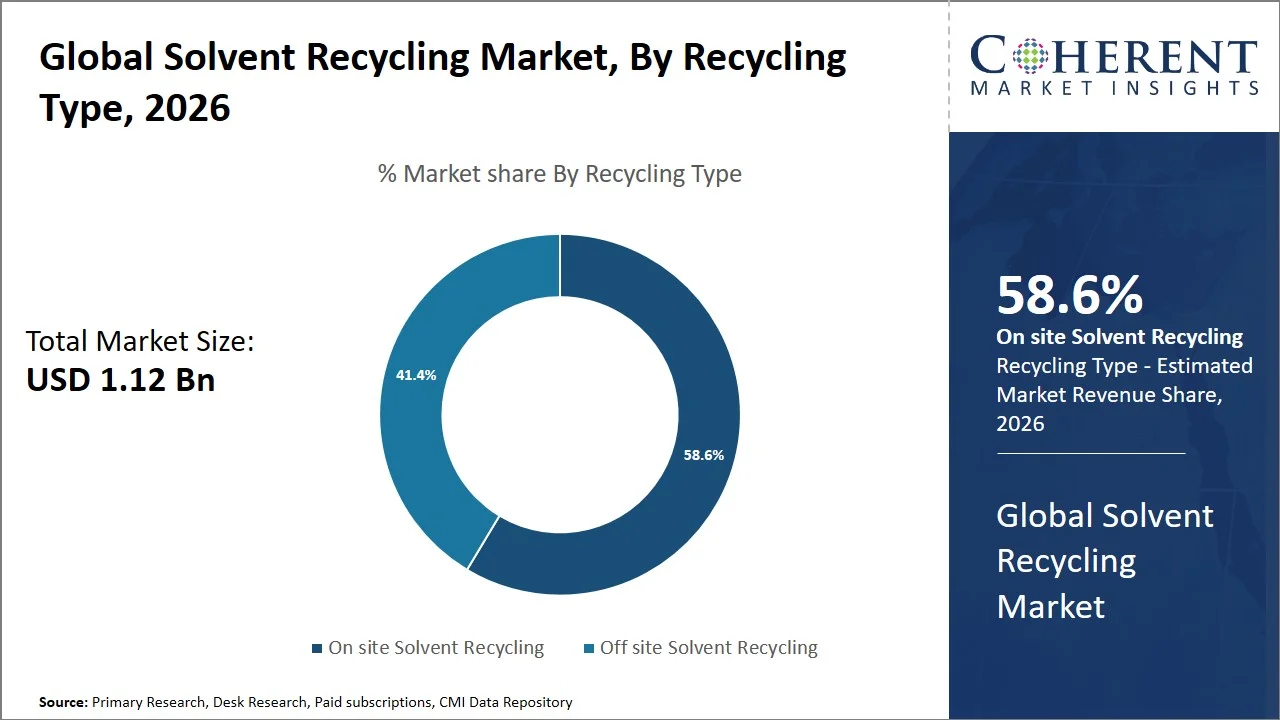
Why Does On site Solvent Recycling Dominate the Global Solvent Recycling Market?
On site Solvent Recycling is expected to account for 58.6% of the global solvent recycling market in 2026, supported by manufacturers’ preference for immediate solvent recovery within production facilities, reduced transportation requirements, and improved control over recovered solvent quality. Industries with continuous solvent consumption, including coatings, chemicals, pharmaceuticals, and electronics, increasingly adopt On site systems to integrate recycling directly into manufacturing workflows. The segment benefits from modular equipment designs that allow companies to recover solvents near the point of generation while reducing waste handling complexity. Equipment suppliers and industrial users gain from lower operating expenses and improved resource efficiency. In March 2025, Safety-Kleen expanded its parts cleaning and solvent recovery service capabilities, strengthening adoption of localized solvent management solutions for industrial customers.
- Current Industry Events of 2026
- Market Size Estimation
- Regional Breakdown
- Competitive Landscape
- Customer Intelligence
- Segmental Analysis
- Pricing Analysis
- Key Market Drivers, Challenges & Future Trends
- Customized Insights Section
Why Does Distillation Represent the Largest Technology Segment in the Global Solvent Recycling Market?
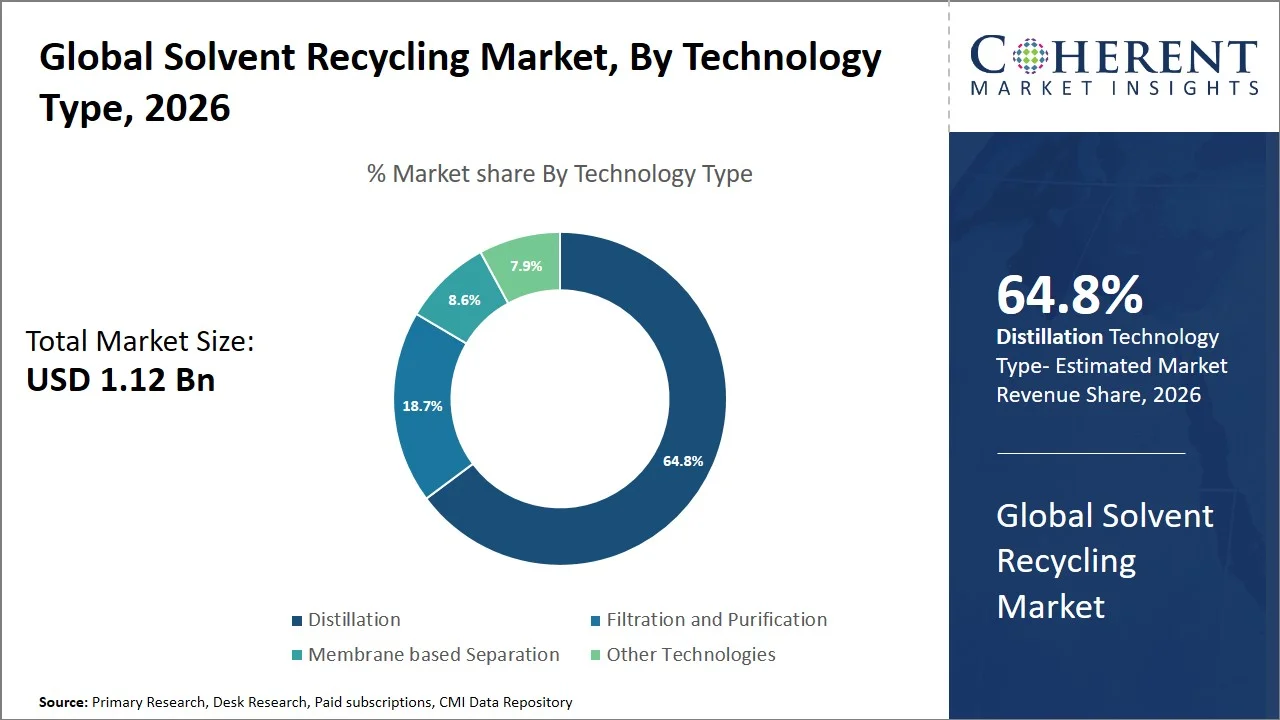
Distillation is expected to hold 64.8% of the global solvent recycling market in 2026, as it remains the most commercially established recovery method for separating and purifying used solvents across diverse industrial waste streams. The technology is widely preferred because it can process high solvent volumes while achieving consistent recovery performance across chemical, pharmaceutical, printing, and coating applications. Manufacturers benefit from proven operating principles, scalable equipment availability, and compatibility with multiple solvent compositions. Recovery equipment suppliers continue improving distillation systems through energy optimization and process automation to enhance operating economics. In June 2025, OFRU Recycling introduced updates to its solvent recycling equipment portfolio focused on efficient solvent recovery applications, supporting broader industrial deployment of distillation-based systems.
Why Do Alcohol Based Solvents Dominate the Solvent Type Category of the Global Solvent Recycling Market?
Alcohol Based Solvents are projected to represent 22.6% of the global solvent recycling market in 2026, supported by their extensive usage in pharmaceutical manufacturing, chemical processing, coatings, cleaning applications, and specialty formulations. Their broad industrial consumption creates consistent recovery opportunities, particularly where companies require regenerated solvents with controlled purity and performance characteristics. Recovery providers benefit from demand for purification systems capable of processing commonly used alcohol solvents such as ethanol, methanol, and isopropanol while meeting application-specific quality requirements. Pharmaceutical and specialty chemical manufacturers are increasingly evaluating recovered solvents as part of cost optimization and circular production strategies. In December 2025, Tradebe highlighted its solvent regeneration and purification capabilities for pharmaceutical, agrochemical, and chemical industries through its European recovery facilities, demonstrating commercial demand for recycled solvent streams across high-value applications.
Current Events and their Impact
Current Event | Description and Its Impact |
March 2024 – European Union Industrial Emissions Directive Revision |
|
October 2024 – U.S. Environmental Protection Agency Resource Conservation and Recovery Act (RCRA) Updates |
|
May 2025 – European Chemicals Agency (ECHA) Solvent Regulatory Focus |
|
Global Solvent Recycling Market Dynamics
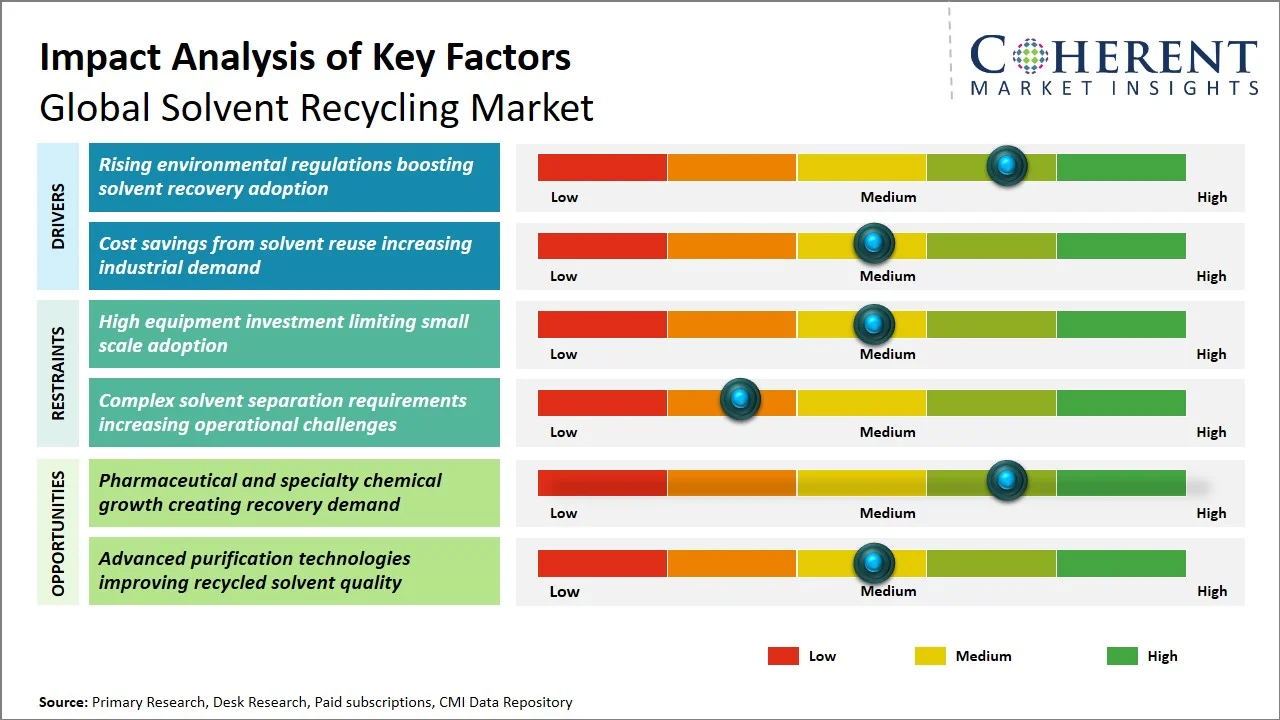
Key Market Drivers
Rising Environmental Regulations Boosting Solvent Recovery Adoption
Increasing environmental compliance requirements around hazardous waste handling, volatile organic compound (VOC) emissions, and industrial waste minimization are accelerating solvent recycling adoption across chemical, pharmaceutical, electronics, and coatings industries. Manufacturers are increasingly integrating recovery systems to reduce disposal liabilities, improve regulatory compliance, and lower dependency on virgin solvent procurement. Solvent recycling providers, waste management companies, and equipment manufacturers benefit as industries shift toward closed-loop solvent management models. In April 2025, the European Commission advanced implementation measures under the Industrial Emissions Directive framework, strengthening pollution-control expectations for industrial operators and supporting greater investment in resource recovery solutions.
Cost Savings from Solvent Reuse Increasing Industrial Demand
Economic benefits from recovering and reusing solvents are becoming a major purchasing factor as industrial users seek to control raw material expenditure and hazardous waste treatment costs. Recycled solvents can reduce procurement dependence, improve production economics, and provide greater supply stability during periods of chemical price volatility. Chemical manufacturers, pharmaceutical producers, electronics companies, and specialized recycling service providers gain from integrated recovery models that convert waste streams into reusable resources. In February 2025, Galvomaster introduced a solvent recovery system designed for industrial coating applications, highlighting growing equipment innovation aimed at reducing solvent losses and operating costs.
Emerging Market Trends
- Shift Toward Closed-Loop Solvent Management Models: The solvent recycling industry is moving from waste treatment-oriented approaches toward integrated circular solvent management systems. Companies are increasingly seeking solutions that combine collection, purification, quality monitoring, and reuse within manufacturing operations. This transition is changing supplier relationships, with customers preferring service providers capable of managing complete solvent life cycles rather than only waste disposal. Equipment suppliers and recycling specialists with capabilities in customized recovery systems are likely to gain competitive advantage, while traditional waste handlers may face pressure to expand beyond basic collection services.
- Increasing Adoption of Advanced Separation Technologies for High-Purity Recovery: Demand for higher solvent purity levels is encouraging adoption of advanced separation approaches beyond conventional recovery methods. Industries such as pharmaceuticals, electronics, and specialty chemicals require regenerated solvents with consistent specifications, creating opportunities for membrane separation, vacuum distillation, and hybrid purification systems. Technology providers that can deliver energy-efficient recovery with improved quality control are positioned to capture premium applications. The market is gradually shifting toward performance-driven recycling solutions where recovery efficiency, purity standards, and operational reliability influence purchasing decisions.
Regional Insights
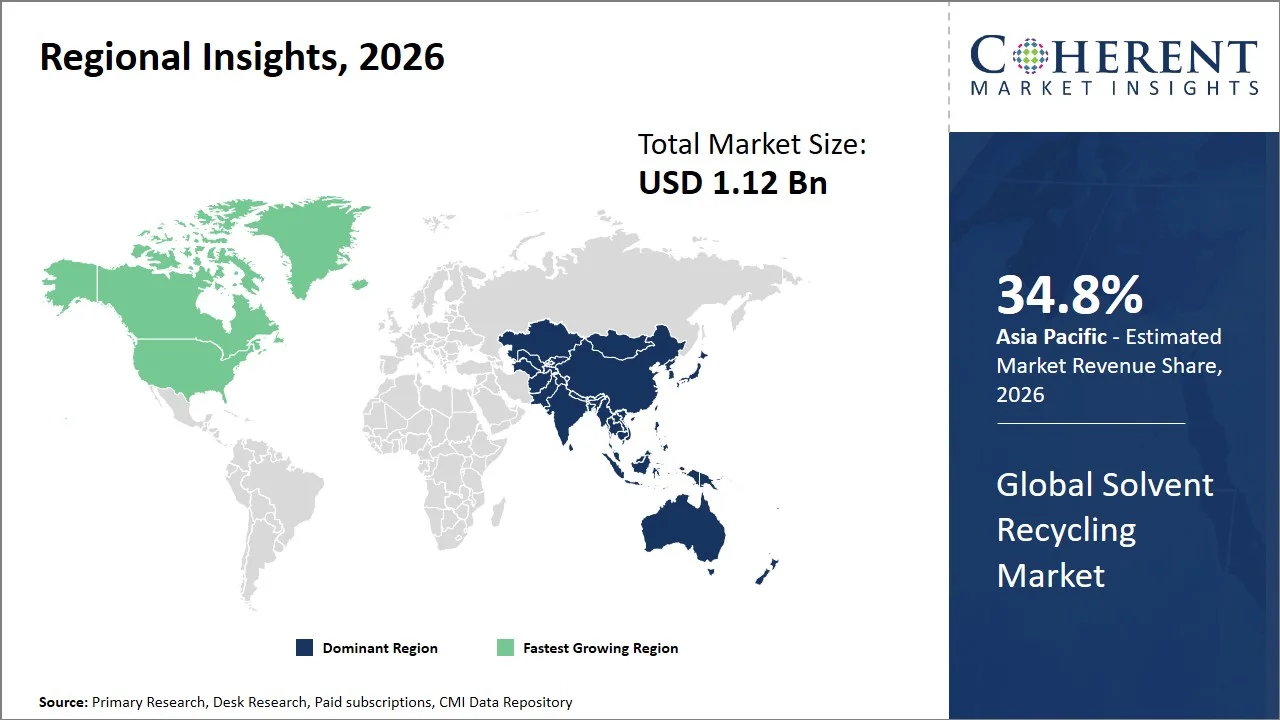
Why Does Asia Pacific Dominate the Global Solvent Recycling Market?
Asia Pacific is expected to account for 34.8% of the global solvent recycling market in 2026, supported by its large chemical manufacturing base, pharmaceutical production capacity, electronics industry, and high solvent consumption across coatings and specialty chemicals. China, India, and Japan generate significant spent solvent volumes, creating demand for recovery systems that reduce disposal costs and improve solvent reuse. The presence of local recycling providers, manufacturing clusters, and cost-efficient processing infrastructure further supports adoption. In April 2025, BASF highlighted its circular solutions initiatives in Asia Pacific, supporting industrial transition toward resource-efficient production models and strengthening opportunities for solvent recovery applications.
Why Is North America Emerging as the Fastest-Growing Region in the Global Solvent Recycling Market?
North America is projected to be the fastest-growing region in the global solvent recycling market, accounting for 28.6% share in 2026, driven by strict hazardous waste regulations, advanced chemical and pharmaceutical manufacturing, and increasing adoption of closed-loop recovery systems. Industrial users are increasingly investing in solvent recycling to reduce waste treatment costs, improve compliance, and secure recovered solvent supply. The region benefits from established environmental service networks and specialized recycling providers. In January 2025, the U.S. Environmental Protection Agency continued strengthening hazardous waste recycling guidance, improving regulatory clarity for recovery-based waste management practices.
Global Solvent Recycling Market Outlook for Key Countries
Why Is the U.S. a Key Market for the Global Solvent Recycling Market?
The U.S. is a key global solvent recycling market due to its large chemical, pharmaceutical, aerospace, automotive, and specialty coating industries that generate continuous solvent waste streams. High regulatory requirements for hazardous waste handling and strong adoption of environmental services encourage companies to implement recovery solutions. The country’s advanced recycling infrastructure and presence of specialized waste management providers support industrial-scale solvent recovery. In January 2025, the U.S. Environmental Protection Agency continued updates related to hazardous waste management and recycling practices, supporting improved compliance frameworks for industrial recovery operations.
Why Is India Important in the Global Solvent Recycling Market?
India is gaining importance in the global solvent recycling market due to expanding pharmaceutical manufacturing, chemical production, paints, coatings, and industrial processing activities. High solvent consumption in export-oriented pharmaceutical and chemical facilities creates demand for recovery systems that reduce raw material costs and improve waste management efficiency. Growing industrial compliance requirements and adoption of circular manufacturing practices are encouraging both large manufacturers and recycling service providers to invest in solvent recovery capabilities. In March 2026, India’s Ministry of Environment, Forest and Climate Change continued promoting resource recovery and circular economy practices under national environmental initiatives.
Why Does China Support Growth in the Global Solvent Recycling Market?
China supports solvent recycling market growth through its extensive chemical manufacturing clusters, electronics production, and pharmaceutical industries. High industrial solvent usage across manufacturing regions creates strong demand for recovery solutions that improve resource efficiency and reduce hazardous waste volumes. Domestic equipment availability and expanding green manufacturing initiatives further support adoption among industrial users. In 2025, China’s Ministry of Industry and Information Technology continued advancing green manufacturing programs focused on improving industrial resource utilization and cleaner production practices, supporting wider implementation of recycling solutions across manufacturing sectors.
Why Is Germany a Strategic Country in the Global Solvent Recycling Market?
Germany is strategically important due to its advanced chemical industry, automotive manufacturing base, engineering capabilities, and strict environmental compliance requirements. Industrial users increasingly require solvent recovery solutions that improve resource efficiency while maintaining quality standards for chemical and specialty manufacturing processes. Germany’s technology-driven industrial ecosystem supports adoption of advanced recycling equipment and circular production practices. In 2025, Germany continued promoting resource efficiency initiatives under its circular economy framework, encouraging manufacturers to improve material recovery and reduce industrial waste generation.
Why Is Japan an Important Growth Market for the Global Solvent Recycling Market?
Japan’s solvent recycling market is supported by its precision manufacturing, semiconductor, automotive, and pharmaceutical industries, where solvent quality and process consistency are critical. Manufacturers increasingly require recovery solutions capable of maintaining high-purity recycled solvents for sensitive applications. Strong industrial efficiency practices and emphasis on resource conservation further support adoption among advanced manufacturing facilities. In 2025, Japan’s Ministry of Economy, Trade and Industry continued promoting resource circulation initiatives aimed at improving industrial recycling and waste reduction practices.
Solvent Recycling Process Efficiency & Value Chain Impact Analysis
Value Chain Stage | Key Activities | Market Requirement | Commercial Impact |
Solvent Collection & Segregation | Collection of spent solvents from manufacturing operations, separation by solvent category, contamination assessment | Efficient waste-stream management and segregation systems | Improves recovery yield, reduces processing complexity, and enhances the economic viability of recycling operations |
Pre-Treatment & Conditioning | Removal of solids, moisture, additives, and contaminants before recovery processing | Advanced filtration, purification, and quality monitoring capabilities | Enables higher-quality recovered solvents and improves compatibility with demanding industrial applications |
Solvent Recovery Processing | Distillation, evaporation, separation, and purification of recovered solvents | Scalable recovery infrastructure with optimized energy consumption | Determines recovery efficiency, operating costs, and overall profitability of recycling facilities |
Quality Testing & Certification | Chemical analysis, purity verification, and specification matching with virgin solvents | Reliable analytical testing and compliance documentation | Supports acceptance of recycled solvents in regulated industries such as pharmaceuticals and electronics |
Distribution & Reuse Integration | Supply of recovered solvents back into industrial processes or secondary applications | Strong logistics networks and customer integration capabilities | Creates closed-loop supply chains and strengthens long-term customer relationships |
Residual Waste Management | Treatment of non-recoverable residues and disposal of remaining waste streams | Environmentally compliant waste handling solutions | Reduces regulatory risks and improves sustainability performance for industrial users |
How Are Advanced Recovery Systems and Circular Manufacturing Models Creating New Growth Opportunities in the Global Solvent Recycling Market?
Advanced recovery systems and circular manufacturing approaches are creating new commercial opportunities by transforming solvent recycling from a waste-management activity into a strategic resource optimization solution. Industrial users are increasingly seeking customized recovery systems that can integrate directly with production processes, enabling continuous solvent reuse and improved operational control. High-value applications in pharmaceuticals, electronics manufacturing, specialty chemicals, and precision industries offer attractive opportunities because they require consistent solvent quality and reliable supply. Companies can capture these opportunities by developing modular recycling equipment, offering managed recycling services, and combining recovery technologies with monitoring capabilities. Established recycling providers are likely to benefit from existing customer relationships, while technology specialists can compete through advanced purification capabilities and application-specific solutions. However, successful participation requires investment in technical expertise, compliance capabilities, and localized service infrastructure.
Market Players, Key Development, and Competitive Landscape
Key Developments
- In February 2025, Galvomaster Private Limited introduced a solvent recovery system designed for industrial coating applications with vacuum-assisted operation and integrated scraping capabilities. This development supports the global solvent recycling market by improving recovery efficiency for coating-related solvent waste streams and enabling manufacturers to reduce solvent losses.
- In July 2024, Veolia strengthened its hazardous waste management capabilities through the acquisition of SARPI Recycling Solutions, expanding its position in industrial waste recovery services. This development supports solvent recycling adoption by improving integrated collection and treatment capabilities for industrial customers.
- In September 2025, Clean Harbors continued expanding its environmental services portfolio, including solvent recycling and hazardous waste management capabilities. This strengthens its ability to provide closed-loop waste solutions for industrial customers requiring compliant solvent recovery services.
Competitive Landscape
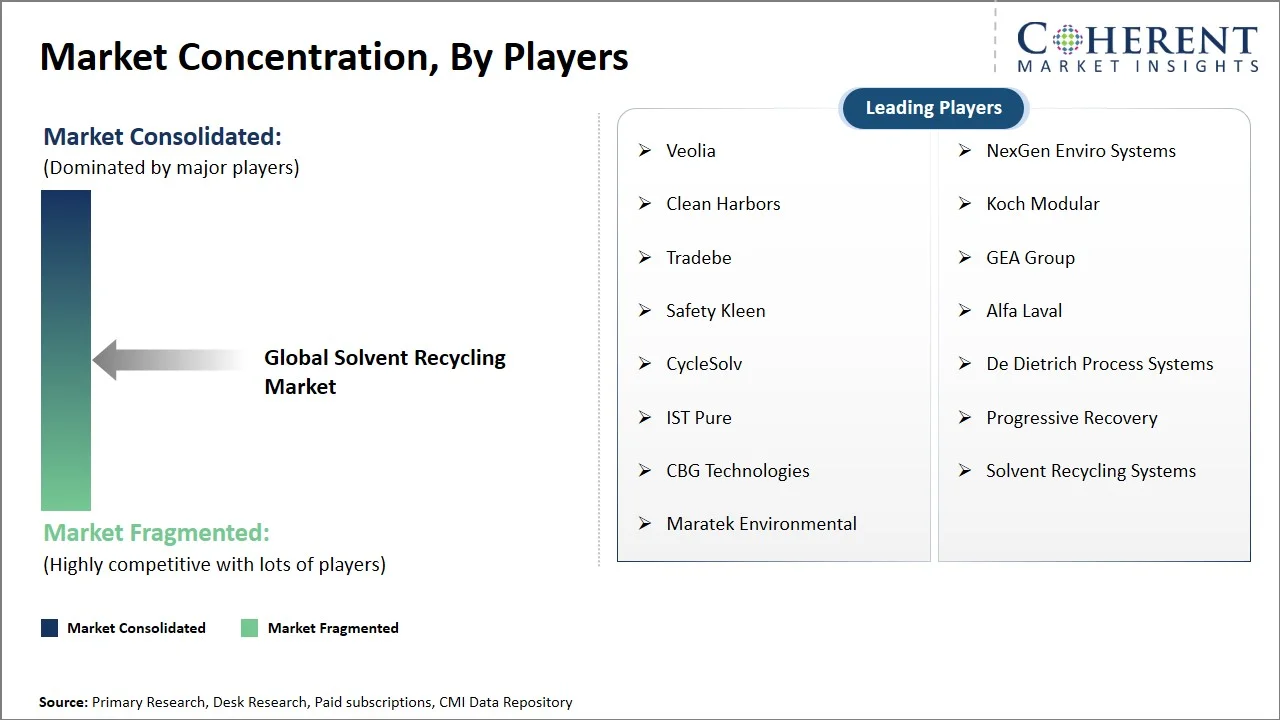
The global solvent recycling market is moderately consolidated, with large environmental service providers, specialized solvent recovery companies, and technology-focused equipment manufacturers competing across industrial applications. Competition is primarily based on recovery efficiency, solvent purity, regulatory compliance, service reliability, and customized recycling capabilities. Regional specialists maintain strong positions through local collection networks and customer relationships, while global players leverage infrastructure scale and integrated waste management expertise.
Key focus areas include:
- Advanced recovery technology capabilities and process efficiency
- Solvent purity levels and quality consistency
- Integrated collection, recycling, and reuse services
- Regulatory compliance and hazardous waste management expertise
- Customer-specific recovery system customization
- Regional infrastructure and service coverage
- Operational reliability and supply continuity
- Sustainability positioning and circular economy solutions
Market Report Scope
Solvent Recycling Market Report Coverage
| Report Coverage | Details | ||
|---|---|---|---|
| Base Year: | 2025 | Market Size in 2026: | USD 1.12 Bn |
| Historical Data for: | 2020 To 2024 | Forecast Period: | 2026 To 2033 |
| Forecast Period 2026 to 2033 CAGR: | 5.6% | 2033 Value Projection: | USD 1.64 Bn |
| Geographies covered: |
| ||
| Segments covered: |
| ||
| Companies covered: | Veolia, Clean Harbors, Tradebe, Safety Kleen, CycleSolv, IST Pure, CBG Technologies, Maratek Environmental, NexGen Enviro Systems, Koch Modular, GEA Group, Alfa Laval, De Dietrich Process Systems, Progressive Recovery, Solvent Recycling Systems | ||
| Growth Drivers: |
| ||
| Restraints & Challenges: |
| ||
Analyst Opinion (Expert Opinion)
- The global solvent recycling market is likely to evolve from a service-driven waste solution into a strategic manufacturing support function. Future market leaders will be those capable of combining recovery infrastructure, technical expertise, and customer-specific process integration rather than competing only on recycling capacity.
- The strongest disruption will come from the integration of high-purity recovery technologies with circular production models. Industries may increasingly evaluate solvent recycling suppliers based on their ability to improve resource efficiency, ensure quality consistency, and support sustainability reporting rather than simply reduce waste disposal.
- Companies should prioritize investments in advanced purification capabilities, regional collection networks, and application-focused recycling services. Key risks include inconsistent waste stream quality, regulatory complexity, and high initial equipment investment. Strategic partnerships with industrial users and localized service models will become important for maintaining long-term competitiveness.
Speak to the analyst
Want personalized insights?
Take the findings above to one of our principal consultants, or have the report rebuilt around the segments, geographies and competitors you actually track.
Market Segmentation
- Recycling Type Insights (Revenue, USD Bn, 2021 - 2033)
- On site Solvent Recycling
- Off site Solvent Recycling
- Technology Type Insights (Revenue, USD Bn, 2021 - 2033)
- Distillation
- Filtration and Purification
- Membrane based Separation
- Other Technologies
- Solvent Type Insights (Revenue, USD Bn, 2021 - 2033)
- Alcohol based Solvents
- Hydrocarbon Solvents
- Chlorinated Solvents
- Ketones
- Glycol Ethers
- Esters
- Others
- End Use Industry Insights (Revenue, USD Bn, 2021 - 2033)
- Chemicals and Petrochemicals
- Pharmaceuticals
- Paints Coatings and Adhesives
- Printing and Packaging
- Electronics
- Automotive
- Others
- Distribution Channel Insights (Revenue, USD Bn, 2021 - 2033)
- Direct Sales
- Indirect Sales
- Regional Insights (Revenue, USD Bn, 2021 - 2033)
- North America
- U.S.
- Canada
- Latin America
- Brazil
- Argentina
- Mexico
- Rest of Latin America
- Europe
- Germany
- U.K.
- Spain
- France
- Italy
- Russia
- Rest of Europe
- Asia Pacific
- China
- India
- Japan
- Australia
- South Korea
- ASEAN
- Rest of Asia Pacific
- Middle East
- GCC Countries
- Israel
- Rest of Middle East
- Africa
- South Africa
- North Africa
- Central Africa
- North America
- Key Players Insights
- Veolia
- Clean Harbors
- Tradebe
- Safety Kleen
- CycleSolv
- IST Pure
- CBG Technologies
- Maratek Environmental
- NexGen Enviro Systems
- Koch Modular
- GEA Group
- Alfa Laval
- De Dietrich Process Systems
- Progressive Recovery
- Solvent Recycling Systems
Sources
Primary Research Interviews
- Solvent recycling companies, waste management providers, chemical manufacturers, pharmaceutical companies, coatings producers, and industrial solvent users
- Process engineers, sustainability managers, procurement professionals, environmental compliance specialists, and recycling technology experts
Stakeholders
- Solvent recycling service providers, chemical companies, industrial waste management firms, recycling equipment manufacturers, and solvent recovery specialists
- Raw material suppliers, distributors, technology providers, industrial end users, and manufacturing companies using solvent-based processes
- Pharmaceutical manufacturers, chemical processors, electronics producers, automotive companies, and coatings manufacturers
End-use Industries
- Chemicals and petrochemicals
- Pharmaceuticals and healthcare manufacturing
- Paints, coatings, and adhesives
- Printing and packaging
- Electronics and semiconductor manufacturing
- Automotive and industrial manufacturing
Regulatory and Industry Bodies
- U.S. Environmental Protection Agency (EPA)
- European Chemicals Agency (ECHA)
- European Commission environmental and industrial regulations
- National environmental protection agencies
- Hazardous waste management and recycling authorities
Databases
- Company annual reports, investor presentations, and sustainability reports
- Chemical industry databases and environmental services databases
- Industrial waste management and recycling datasets
- Trade statistics and solvent import-export databases
- Regulatory filings and hazardous waste management records
- Company product portfolios and competitive intelligence databases
Magazines and Journals
- Chemical industry publications
- Waste management and recycling journals
- Environmental technology publications
- Industrial sustainability research publications
- Chemical engineering and process technology journals
Associations
- International Solid Waste Association (ISWA)
- European Solvent Recycler Association (ESRA)
- American Chemistry Council (ACC)
- Chemical industry associations
- Environmental services and recycling industry associations
Public Domain Sources
- Solvent recovery technology developments
- Industrial circular economy initiatives
- Hazardous waste management updates
- Chemical recycling and resource efficiency developments
- Industrial sustainability and regulatory compliance trends
Key Standards and Regulations
- Hazardous waste handling and disposal regulations
- Solvent storage, transportation, and safety standards
- Chemical management and environmental compliance requirements
- Industrial emission control regulations
- Circular economy and recycling policy frameworks
Proprietary Elements
- CMI Data Analytics Tool, Proprietary CMI repository containing 10+ years of chemical, industrial sustainability, environmental services, and manufacturing market intelligence.
Get access to 250+ pages report
Every segment, forecast, competitor profile and data table behind the analysis above — available for instant download.
- ESOMAR Member
- ISO 9001:2015 Certified
- D-U-N-S Registered
- GDPR & CCPA Compliant
Missing comfort of reading report in your local language? Find your preferred language:
Frequently Asked Questions
The global solvent recycling market is estimated to be valued at USD 1.12 billion in 2026 and is expected to reach USD 1.64 billion by 2033.
The CAGR of global solvent recycling market is projected to be 5.6% from 2026 to 2033.
Solvent recycling solutions are widely used across industries such as chemicals, pharmaceuticals, paints & coatings, printing, electronics, and automotive manufacturing where solvent recovery helps reduce waste and improve resource efficiency.
Solvent recycling enables manufacturers to recover and reuse spent solvents, helping reduce disposal requirements, improve operational efficiency, and support sustainable production practices.
A wide range of industrial solvents can be recycled, including Alcohol Based solvents, hydrocarbon solvents, chlorinated solvents, ketones, glycol ethers, and esters depending on contamination levels and recovery processes.
Companies typically evaluate solvent recovery efficiency, processing capability, compliance expertise, service reliability, solvent quality requirements, and the ability to support specific industrial applications.
Rising environmental regulations boosting solvent recovery adoption and Cost savings from solvent reuse increasing industrial demand are the major factors driving the growth of global solvent recycling market.