

Global Sovereign AI Cloud Orchestration Market Size and Forecast – 2026 To 2033
The global sovereign AI cloud orchestration market is expected to grow from USD 4.80 Bn in 2026 to USD 21.60 Bn by 2033, registering a compound annual growth rate (CAGR) of 23.9% from 2026 to 2033. The global sovereign AI cloud orchestration market is driven by rising adoption of cloud platforms across regulated industries. On February 16, 2026, Larsen & Toubro Vyoma announced the launch of its Sovereign Cloud Platform (SCP), an AI-first cloud infrastructure designed to meet the growing enterprise and public-sector demand for data sovereignty, regulatory compliance and secure AI adoption.
Key Takeaways of the Global Sovereign AI Cloud Orchestration Market
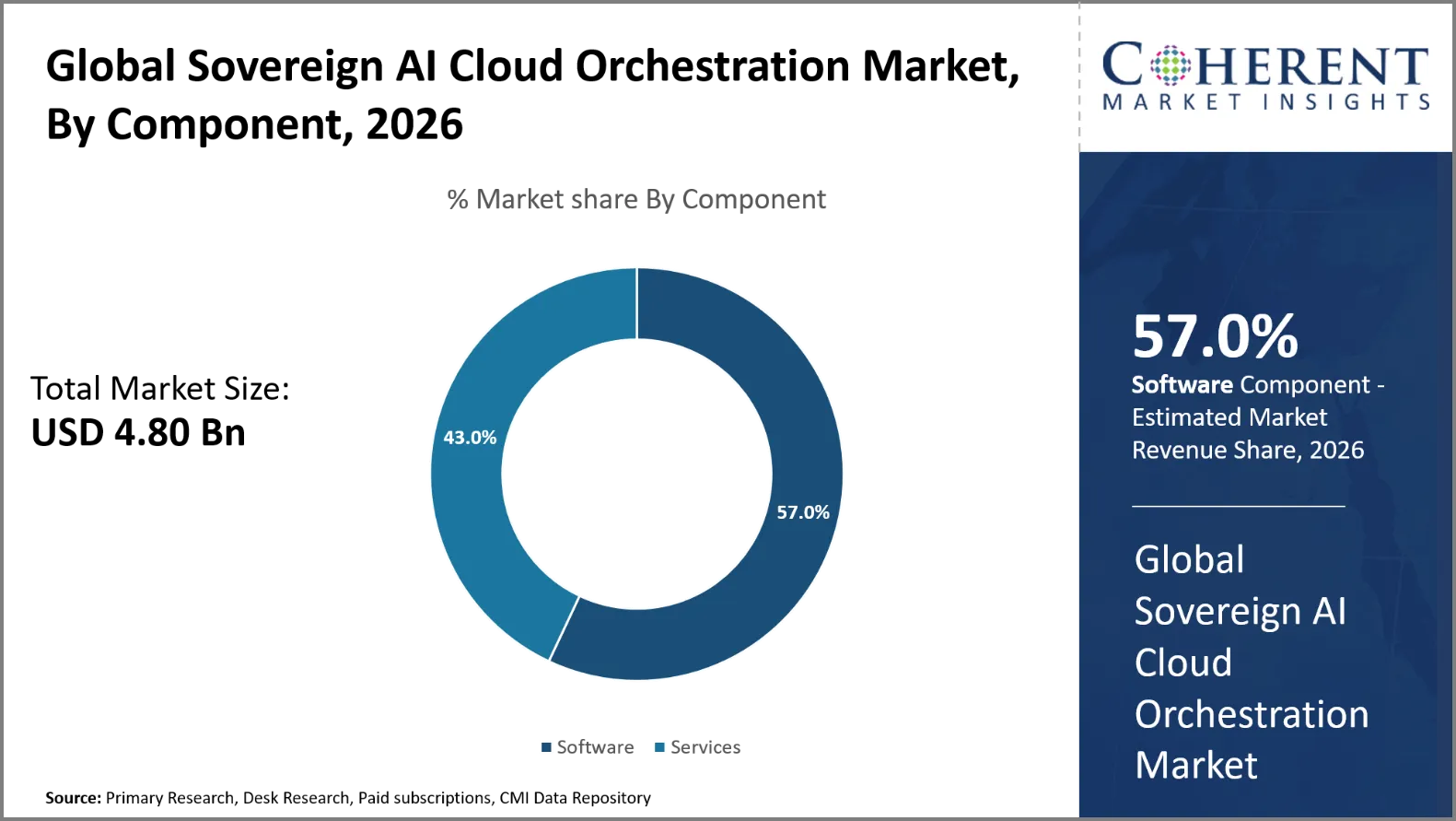
- The Software segment is expected to account for 57.0% of the global sovereign AI cloud orchestration market share in 2026. Increasing national data sovereignty and cybersecurity requirements is driving the growth of the segment. On September 19, 2025, SAP launched its Sovereign Cloud offering in India for government agencies and regulated industries. The platform addresses data, operational, technical, and legal sovereignty requirements.
- The Public Sovereign Cloud segment is estimated to capture 46.0% of the market share in 2026. Expansion of government-backed national AI initiatives is majorly driving the growth of the segment. On May 13, 2025, a subsidiary of Saudi Arabia’s Public Investment Fund, HUMAIN, announced a strategic cooperation with NVIDIA. The firms want to build AI factories with an estimated capacity of up to 500 megawatts.
- The Multi-Cloud Orchestration segment is estimated to capture 42.0% of the market share in 2026. Growing demand for centralized orchestration of distributed GPU infrastructure is driving the growth of the segment. On February 18, 2026, Larsen & Toubro announced a proposed partnership with NVIDIA to develop gigawatt-scale AI factory infrastructure in India. The project combines NVIDIA GPUs, CPUs, networking, accelerated storage, and NVIDIA AI Enterprise software
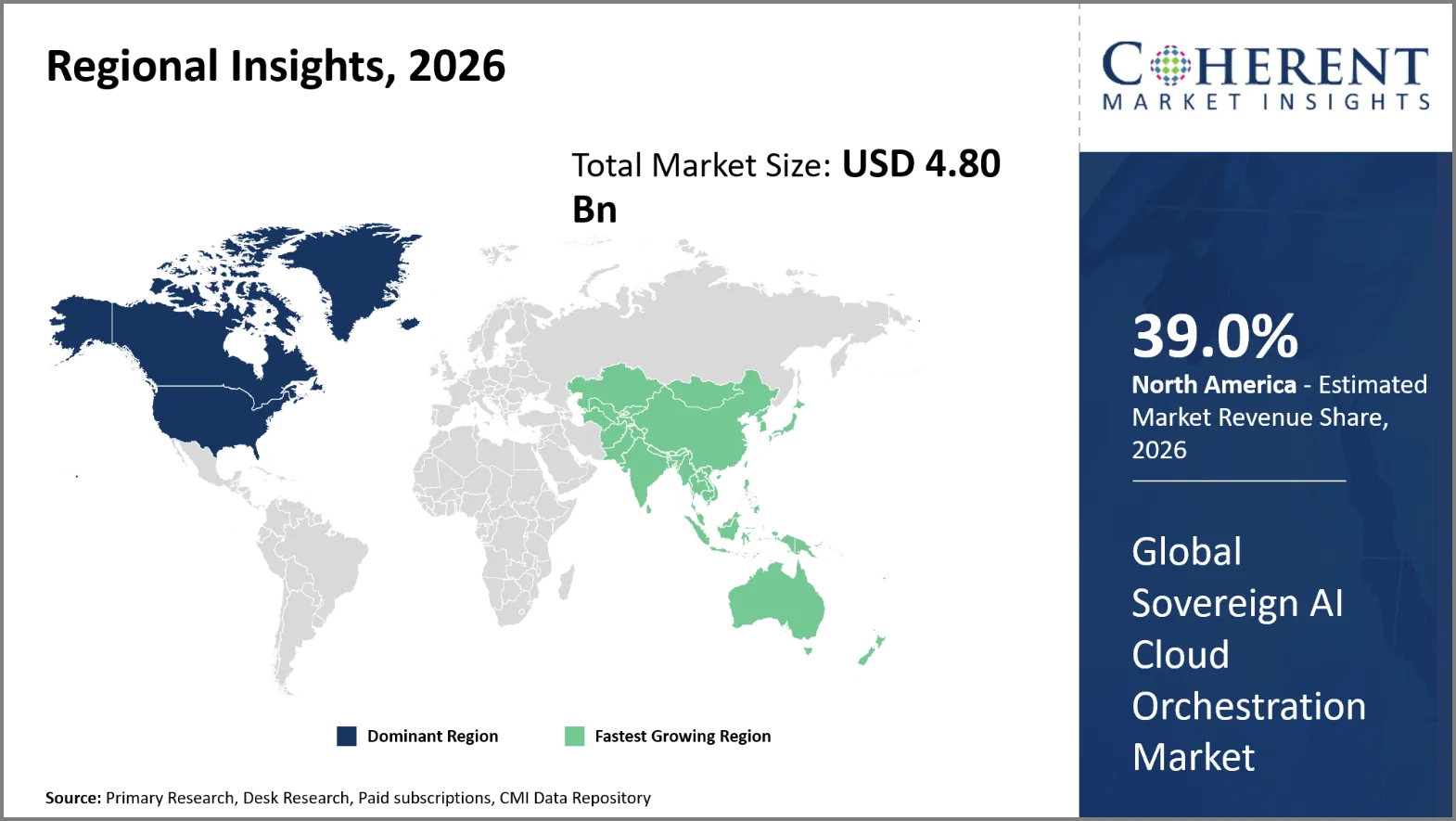
- North America is expected to dominate the sovereign AI cloud orchestration market in 2026 with a market share of 39.0%. Integration of confidential computing and advanced encryption technologies in North America is driving the growth of the regional market. On October 27, 2025, Fortanix announced a joint solution with NVIDIA for secure and sovereign agentic AI deployments. The platform combines confidential computing, composite attestation, and hardware security module-gated encryption key release.
- Asia Pacific is expected to account for 28.0% share in 2026. Development of multi-cloud orchestration platforms in Asia Pacific is driving the growth of the regional market. On April 12, 2025, Nomura Research Institute announced two services strengthening its multi-cloud strategy. The initiative combines public cloud, private cloud, and dedicated GPU environments.
Segmental Insights
Why Does Software Dominate the Global Sovereign AI Cloud Orchestration Market?
The software segment is expected to account for 57.0% of the global sovereign AI cloud orchestration market share in 2026. Organizations need to have centralized control over sovereign AI infrastructure and workloads. That’s why software is the dominant force. Sovereign orchestration software handles computing resources, AI model deployment, data access and security policies. It allows enterprises to keep data in-house, but orchestrate complicated AI activities. Software platforms also aid in compliance monitoring, workload automation and infrastructure management. The proliferation of private AI settings is driving the growth of specialist orchestration solutions.
On December 15, 2025, Nutanix announced new capabilities in its Nutanix Cloud Platform (NCP) solution that offer organizations more flexibility to deploy and govern their infrastructure across distributed environments running traditional, modern and AI applications, including fully disconnected environments.
- Current Industry Events of 2026
- Market Size Estimation
- Regional Breakdown
- Competitive Landscape
- Customer Intelligence
- Segmental Analysis
- Pricing Analysis
- Key Market Drivers, Challenges & Future Trends
- Customized Insights Section
Why is Public Sovereign Cloud the Most Preferred Deployment Type?
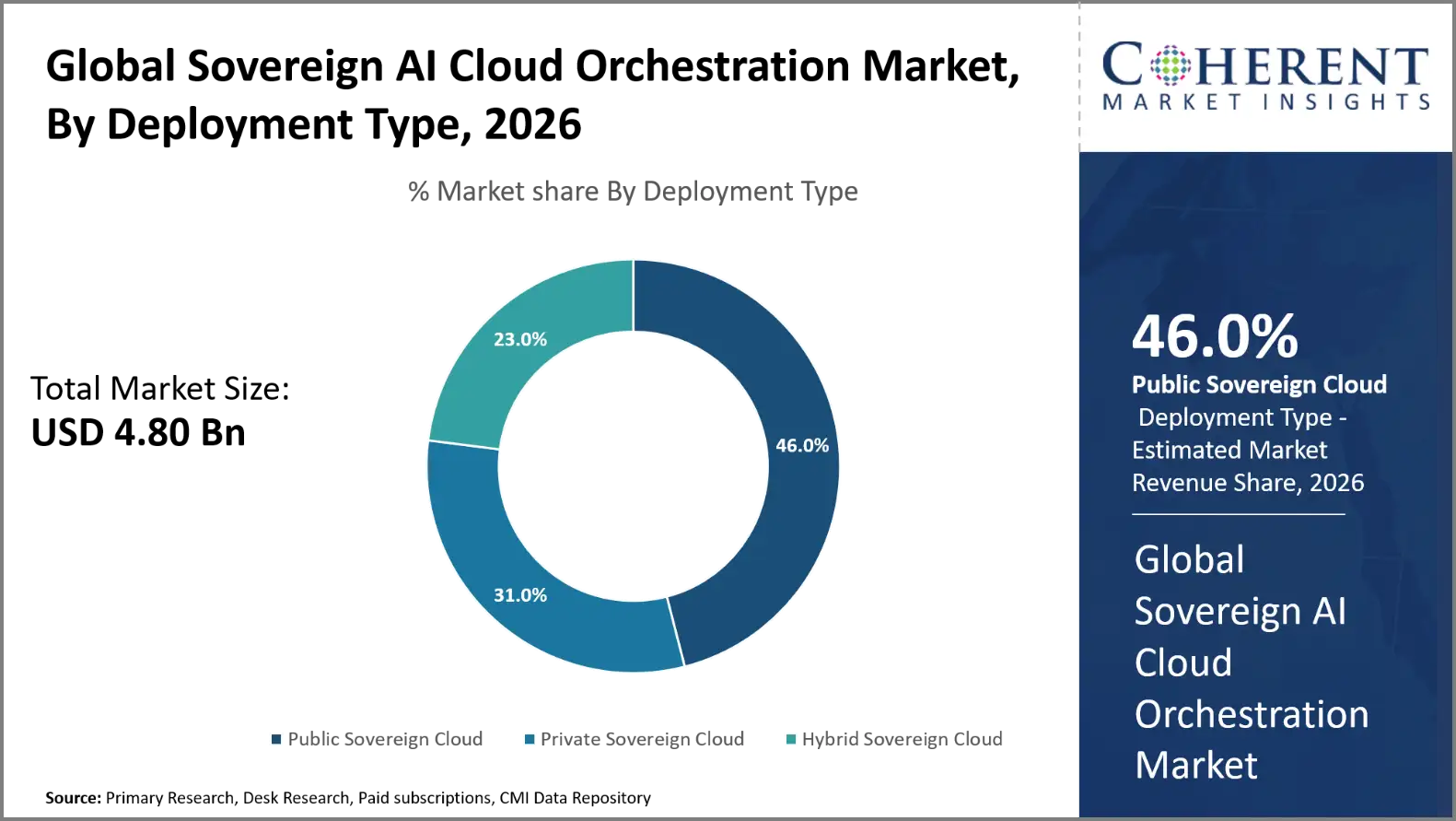
The public sovereign cloud segment is expected to account for 46.0% of the global sovereign AI cloud orchestration market share in 2026. The public sovereign cloud is advocated as it combines scalable computing infrastructure with national data protection concerns. Governments and companies want AI capabilities without giving up jurisdictional control. Sovereign cloud firms provide locally managed infrastructure, localized data storage and controlled administrative access. This method for deployment involves a lower initial capital investment in infrastructure than private data centers. Growing government digitalization and national AI initiatives further encourage public sovereign cloud adoption.
On May 18, 2026, Deutsche Telekom announced it is strengthening Germany’s digital sovereignty with its T Cloud Public platform. As a European cloud provider, Deutsche Telekom and its T Cloud Public are now officially part of the framework agreement for cloud and AI services awarded by GovTech Deutschland to Bechtle AG.
Multi-Cloud Orchestration Dominates the Global Sovereign AI Cloud Orchestration Market
The multi-cloud orchestration segment is expected to account for 42.0% of the global sovereign AI cloud orchestration market share in 2026. Multi-cloud orchestration dominates because organizations require flexibility across multiple sovereign cloud environments. Organizations can run AI workloads on licensed infrastructure providers and comply with regulations. Organizations can select cloud environments based on data residency, processing capability, security requirements and operating expenses. Multi-cloud management also lowers dependence on a single provider. More and more investment in national AI infrastructure is driving the need for interoperable orchestration platforms.
On April 2, 2025, Google Cloud announced that it will start a public preview of Multi-Cluster Orchestrator, a solution for managing Kubernetes workloads across several clusters and regions. The service brings together the coordination of resources and placement of workload.
Current Events and their Impact
Current Events | Description and its Impact |
European Union Artificial Intelligence Act Regulation (EU) 2024/1689 |
|
India Digital Personal Data Protection Act, 2023, and Rules, 2025 |
|
Sovereign AI Cloud Orchestration Market Dynamics
Market Drivers
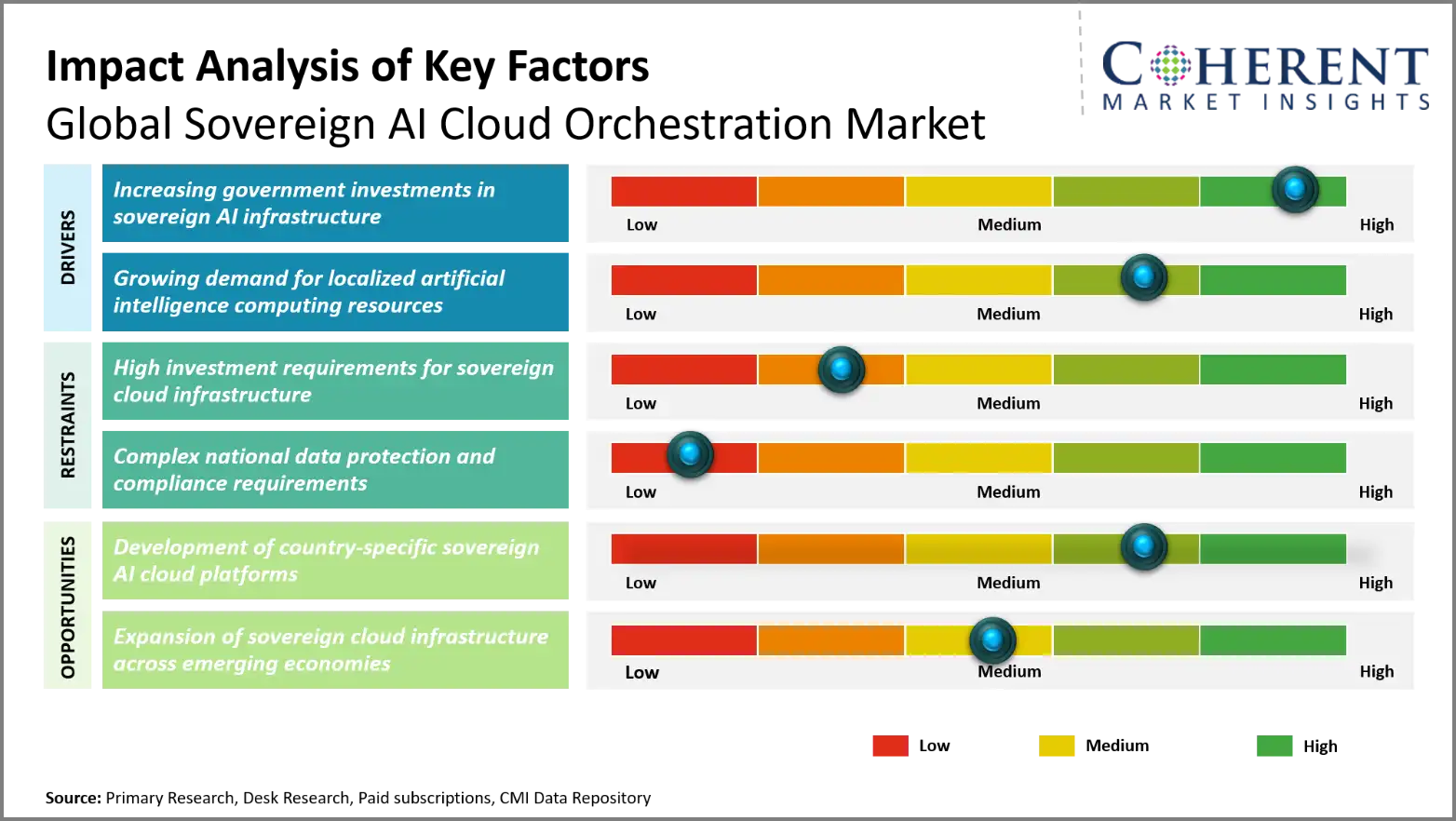
Increasing government investments in sovereign AI infrastructure
Governments are boosting their investments in sovereign AI infrastructure to enhance national technical independence and digital security. National AI policies focus on data centers, high-performance computing facilities and cloud platforms under domestic control. Public funding supports GPU clusters, innovative semiconductor infrastructure and secure AI development environments. These investments assist government agencies lessen their reliance on foreign technology suppliers. The growing procurement in the public sector is also pushing the cloud operators to develop specific orchestration platforms. Increasing need for technologies that provide infrastructure automation, task scheduling, resource optimization, and centralized AI governance.
On March 8, 2025, Abu Dhabi’s Department of Government Enablement signed a multi-year sovereign cloud deal with Microsoft and Core42. The agreement supports Abu Dhabi’s 2025-2027 Digital Strategy worth USD 3.54 billion. The initiative seeks around 200 artificial intelligence solutions in government services.
Growing demand for localized artificial intelligence computing resources
Companies are seeking localized AI computing resources to safeguard data sovereignty and comply with national regulatory standards. Controlled processing environments are necessary for sensitive government, financial, healthcare, and defense information. Domestic AI infrastructure allows enterprises to have more visibility over data storage, model training and inference activities. Localized computing also minimizes reliance on foreign cloud infrastructure. Governments are encouraging the growth of domestic data centers and the expansion of computing capability in the regions. Such trends drive demand for sovereign cloud orchestration software that includes GPU allocation, workload distribution, data residency rules and secure AI deployment.
On April 3, 2026, Microsoft announced a major investment in AI infrastructure, cybersecurity and talent development in Japan. The company has teamed with Sakura Internet and SoftBank to extend its domestic GPU computing services.
Emerging Trends
- Development of Sovereign AI Infrastructure Ecosystems: Governments are developing integrated sovereign AI ecosystems that combine domestic cloud platforms, GPU clusters, national data centers, and locally governed foundation models to boost technological independence and protect sensitive information.
- Impact: These improvements tend to drive demand for orchestration tools that allow centralized GPU scheduling, infrastructure monitoring, workload automation and secure deployment of AI models across nationally controlled computer environments.
- Relevance to the market: Initiatives like India’s IndiaAI Mission and France’s national AI infrastructure investments drive the growth of domestic computing capacity, allowing for the emergence of specialized sovereign orchestration providers.
- Increasing Adoption of Sovereign Multi-Cloud Architectures: Companies are increasingly utilizing sovereign multi-cloud architectures to distribute AI workloads between local providers to ensure regulatory compliance, operational flexibility, and infrastructure independence.
- Impact: This development creates a need for interoperable orchestration software that can manage cross-cloud workload allocation, unified security rules, consistent governance, and centralized infrastructure management.
- Relevance to the market: European cloud projects like Gaia-X are signaling a requirement for interoperable and trusted digital infrastructure, driving orchestration suppliers to create solutions that enable numerous sovereign cloud environments to be used.
Regional Insights
Why is North America a Strong Market for Sovereign AI Cloud Orchestration?
North America is expected to account for a market share of 39.0% in 2026. The North American market gains from government-sponsored scientific computing projects and a growing need for safe AI infrastructure in the public sector. The U.S. Department of Energy initiated the Genesis Mission in November of 2025. It connects national laboratories, scientific data sets, supercomputers, and secure cloud-based AI computing environments. The effort involves 17 national labs and around 40,000 scientists and technical people. Canada is building sovereign supercomputing capacity using the AI Sovereign Compute capacity Program. Its national approach focuses on Canadian ownership, operational management, and local data residency. These initiatives create demand for orchestration systems coordinating scientific workloads, classified computing environments, and institutional AI resources.
Why Does Asia Pacific Sovereign AI Cloud Orchestration Market Exhibit High Growth?
Asia Pacific is expected to register the fastest growth with a CAGR of 25.2% over the forecast period. It is projected to account for 28.0% of the global sovereign AI cloud orchestration market in 2026 and benefits from national computing infrastructure development and government-led AI research ecosystems. Japan's ABCI 3.0 supercomputer aids advanced artificial intelligence research and domestic computing independence. Singapore is also bolstering national AI research with its National AI Research and Development Plan. The government stated that it would add another USD 774.5 million to the fund in January 2026. Australia’s National AI Capability Plan is encouraging the establishment of domestic data centers and private investment in infrastructure. These kinds of developments are driving demand for orchestration platforms to manage distributed research workloads, specialized computing environments and institutional AI resources. Cooperation on regional infrastructure also enables interoperability between national cloud ecosystems.
Global Sovereign AI Cloud Orchestration Market Outlook for Key Countries
Why is U.S. Emerging as a Major Hub in the Sovereign AI Cloud Orchestration Market?
The integration of federal scientific research and the growing need for secure computational infrastructure will drive the U.S. market. The Genesis Mission offers an integrated platform that links Department of Energy supercomputers with secure, cloud-based AI settings. Applications include sophisticated nuclear research, fusion energy, grid upgrade and scientific discovery. Centralized infrastructure at the federal agencies could be used to organize specialized datasets, AI models and computing resources. The strategy also promotes relationships between national labs, universities and technological corporations. These requirements create a demand for orchestration software that can schedule scientific workloads, provide safe access to datasets, allocate computer resources, and automate research operations.
Is China the Next Growth Engine for the Sovereign AI Cloud Orchestration Market?
China’s market is aided by its inclusion into the national computing network and government-led telecoms development. The Ministry of Industry and Information Technology unveiled a three-year strategy for AI integration for 2026-2028. The approach focuses on enhanced autonomous networks, smart computing access and specialized AI applications. China also integrates computing infrastructure into its national infrastructure development framework. It has a nationwide computer network linking regional computing hubs and provincial platforms. By September 2026, there were more than 10,000 enterprise users in the national computing service marketplace. These improvements fuel orchestration solutions for scheduling computer resources, telecommunications workloads, distributed AI training, and coordination of regional infrastructures.
Germany Sovereign AI Cloud Orchestration Market Analysis and Trends
Germany benefits from industrial artificial intelligence adoption and demand for digitally controlled manufacturing environments. Deutsche Telekom and NVIDIA developed an Industrial AI Cloud with a €1 billion partnership. SAP provides the technology platform connecting industrial applications with sovereign computing infrastructure. The ecosystem includes Siemens, Agile Robots, Wandelbots, Quantum Systems, and PhysicsX. These are advancements in manufacturing automation, robotics, industrial simulation and supply chain optimization. German firms need orchestration platforms that can orchestrate computationally complex industrial applications. The integration with business software also enables workload control across manufacturing facilities, engineering environments and industrial cloud infrastructure.
France Sovereign AI Cloud Orchestration Market Analysis and Trends
The increased procurement of sovereign public cloud and the acceptance of European-controlled digital services are a boon to France. French Interministerial Directorate for Digital Affairs announced €84 million public cloud orders in 2025. 70% of these orders went to European vendors. The government had 847 active projects purchasing services through its interministerial public cloud marketplace. French authorities are likewise moving sensitive public apps to secure cloud environments. Migration of Health Data Platform is a crucial requirement of healthcare infrastructure. These advancements favor orchestration platforms that serve public administration workloads, healthcare data management, secure application deployment and integration among domestic cloud providers.
India Sovereign AI Cloud Orchestration Market Analysis and Trends
Increasing shared computing infrastructure and growing development of local foundation models boost India’s market. IndiaAI ecosystem has reported more than 45,000 available GPUs by June 2026. By August 2026, 237 projects had used subsidized computing resources. All in, the projects used 93.18 lakh hours of GPU time. Indigenous models built by Sarvam AI, BharatGen, Gnani and Socket show expanding domestic model development skills. Distributed access to infrastructure is available in Mumbai, Navi Mumbai, Hyderabad, Bengaluru, Noida and Jamnagar for computing facilities. These advancements increase the requirement for orchestration platforms that manage GPU allocation, model training, inference workloads, and globally distributed computing resources.
Global Sovereign AI Cloud Orchestration Market - Sovereign AI Computing Capacity
Country | Tracked AI GPU Clusters | Share of Global Tracked AI Compute | AI Computing Sites |
U.S. | 105 | 75.3% | 135 |
China | 175 | 8.8% | 5 |
Germany | 11 | 2.1% | 2 |
Japan | 22 | 1.5% | 4 |
France | 11 | 1.3% | 2 |
How is Development of Country-Specific Sovereign AI Cloud Platforms Creating New Growth Opportunities in the Sovereign AI Cloud Orchestration Market?
As national sovereign AI cloud platforms are developed, there will be a need for orchestration software that is specific to the country’s computing architecture, security standards and administrative requirements, which provides growth potential. The relocation of India’s BHASHINI to Yotta’s Shakti Cloud, for instance, highlights the need for platforms that can manage multilingual datasets, containerized services, databases and GPU workloads on domestic infrastructure. Similarly, the Kingdom’s Deem Cloud unifies digital infrastructure over 190 public institutions and 260 data centers. These deployments open up potential for suppliers to provide jurisdiction-specific workload scheduling, localized model hosting, infrastructure provisioning, and policy enforcement. Countries building their own AI ecosystems need orchestration platforms that can handle local languages, government apps, and computing resources controlled by the nation.
On October 8, 2025, Oracle Corporation and SoftBank Corp. announced a partnership to bring safe, compliant and scalable sovereign cloud and AI services to enterprises in Japan. SoftBank will introduce its new Cloud PF Type A, a package of proprietary cloud and AI services running on Oracle Alloy, in the Japanese market, targeting critical infrastructure industries.
Market Players, Key Development, and Competitive Landscape
Key Developments
- On May 12, 2026, Red Hat announced the expansion of its sovereign and private cloud capabilities, empowering global organizations with greater control over their technology and data. As operational independence becomes both a regulatory directive and strategic mandate, Red Hat is defining a future where choice, control and transparency are foundational. This shift provides IT decision-makers and service providers the autonomy to lead rather than react to market shifts.
- On February 10, 2026, SAP and Cohere announced an expansion of their partnership to deliver full-stack sovereign AI solutions worldwide, starting in Canada. This collaboration builds on a previous integration of Cohere’s frontier enterprise AI models and agentic platform, North, into SAP’s EU AI Cloud and Business Technology Platform.
- On January 15, 2026, IBM announced that IBM Sovereign Core will be available in preview from February 2026, with full general availability planned for mid-year 2026. IBM Sovereign Core is AI-ready sovereign-by-design software that enables enterprises, governments and service providers to deploy and operate AI-ready environments quickly and at scale.
Competitive Landscape
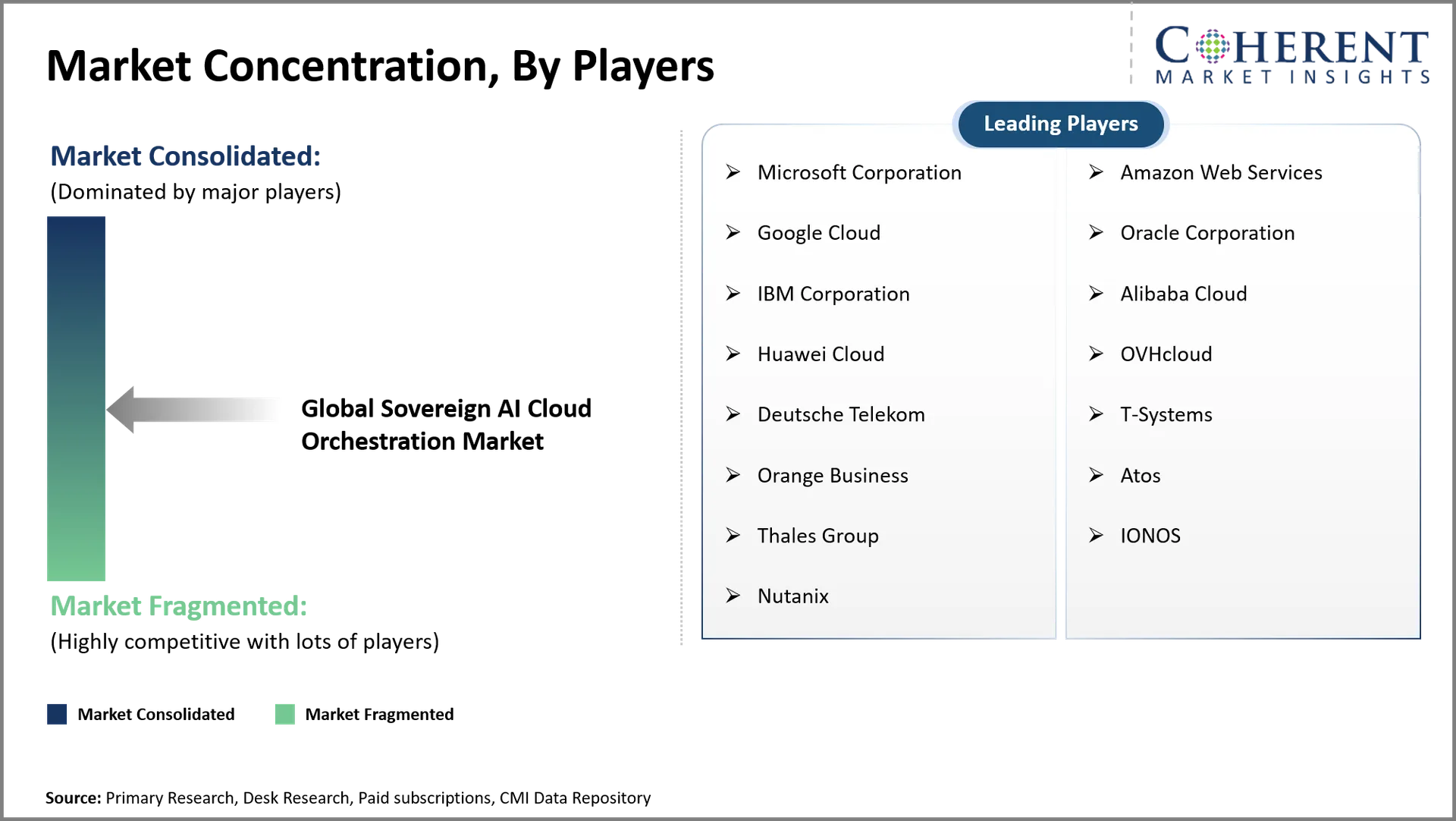
The global sovereign AI cloud orchestration market features global hyperscalers, domestic cloud operators, infrastructure providers, and enterprise software companies. Amazon Web Services focuses on independent sovereign infrastructure through its European Sovereign Cloud, with dedicated operational controls and regional governance. Microsoft Corporation is expanding sovereign AI capabilities through Azure, Cloud for Sovereignty, and partnerships with local infrastructure suppliers. It partners with Yotta Data Services to power India’s Shakti Cloud. Google Cloud provides sovereign solutions using Google Distributed Cloud and regional alliances such as S3NS with Thales. Oracle Corporation responds to government and regulated workloads with sovereign cloud regions and database services. In July 2026, Atos launched Atos Sovereign Cloud, which brings together application orchestration, modernization and sovereign controls. For European providers like OVHcloud, STACKIT, Scaleway and T-Systems, the emphasis is on locally managed infrastructure and regulatory compliance.
Top Manufacturers and Notable Products/Solutions in the Sovereign AI Cloud Orchestration Market
Manufacturer | Notable Product/Solution | Key features |
IBM | IBM Sovereign Core | Sovereign control plane, identity management, encryption, continuous compliance monitoring, governed AI execution, customer-controlled operations |
Red Hat | Red Hat OpenShift AI | Kubernetes-based AI orchestration, MLOps, GenAIOps, AgentOps, GPU workload management, disconnected deployment, hybrid-cloud portability |
NVIDIA | NVIDIA AI Enterprise with Run:ai | GPU-aware scheduling, dynamic resource allocation, workload prioritization, GPU sharing, Kubernetes integration, AI lifecycle management |
Google Cloud | Google Distributed Cloud | Air-gapped deployment, on-premises Kubernetes, local AI processing, data residency, centralized infrastructure management, sovereign AI services |
Microsoft | Azure Local with Azure Arc | Local AI inference, Kubernetes management, hybrid-cloud governance, disconnected operations, local data processing, centralized monitoring |
Sovereign AI Cloud Orchestration Market | |||
Report Coverage | Details | ||
Base Year | 2025 | Market Size in 2026: | USD 4.80 Bn |
Historical Data For: | 2020 To 2024 | Forecast Period: | 2026 To 2033 |
Forecast Period 2026 To 2033 CAGR: | 23.9% | 2033 Value Projection: | USD 21.60 Bn |
Geographies covered: |
| ||
Segments covered: |
| ||
Companies covered: | Microsoft Corporation, Amazon Web Services, Google Cloud, Oracle Corporation, IBM Corporation, Alibaba Cloud, Huawei Cloud, OVHcloud, Deutsche Telekom, T-Systems, Orange Business, Atos, Thales Group, IONOS, Nutanix | ||
Growth Drivers: |
| ||
Restraints & Challenges: |
| ||
Analyst Opinion (Expert Opinion)
- The future of the sovereign AI cloud orchestration market will depend on integrated platforms connecting national computing infrastructure with independently governed AI environments. Demand will increasingly shift toward orchestration software supporting GPU virtualization, confidential computing, model lifecycle management, and automated compliance enforcement. Providers will need to coordinate AI training and inference across domestic data centers without compromising jurisdictional restrictions. Platforms supporting portable workloads and independently verifiable administrative controls will become particularly important. Sovereign orchestration will increasingly become a distinct software layer rather than an additional feature within conventional cloud management platforms.
- The strongest opportunities will emerge in multi-cloud orchestration software, particularly for government, defense, healthcare, financial services, and critical infrastructure applications. Providers that can build AI platforms for local deployment have lucrative potential in India, France, Germany and Saudi Arabia. Specific focus is required on GPU orchestration and sovereign model hosting, as enterprises need restricted access to pricey computational resources. Providers should also work toward air-gapped deployments and confidential AI environments for sensitive applications. Integration with national cloud operators at the local level will generate further potential for specialist orchestration vendors.
- Market players must focus on alliances with national telecom carriers, local data center firms and established cybersecurity vendors. They should create modular platforms that support Kubernetes, heterogeneous GPU environments, open model frameworks and policy-based workload placement. Vendors should provide visible administrative control over access, encryption key ownership, extensive audit trails and automated data residency enforcement. Local technical support and independently verifiable security certifications can enhance government procurement opportunities. Companies should also establish migration tools that transfer AI workloads between approved cloud environments without extensive application redevelopment.
Speak to the analyst
Want personalized insights?
Take the findings above to one of our principal consultants, or have the report rebuilt around the segments, geographies and competitors you actually track.
Market Segmentation
- Component Insights (Revenue, USD Billion, 2021 - 2033)
- Software
- Services
- Deployment Type Insights (Revenue, USD Billion, 2021 - 2033)
- Public Sovereign Cloud
- Private Sovereign Cloud
- Hybrid Sovereign Cloud
- Orchestration Type Insights (Revenue, USD Billion, 2021 - 2033)
- Multi-Cloud Orchestration
- AI Workload Orchestration
- GPU Resource Orchestration
- Data Orchestration
- Model Orchestration
- End User Insights (Revenue, USD Billion, 2021 - 2033)
- Government and Public Sector
- BFSI
- Healthcare
- Defense and Aerospace
- Telecommunications
- Energy and Utilities
- Manufacturing
- Regional Insights (Revenue, USD Billion, 2021 - 2033)
- North America
- U.S.
- Canada
- Latin America
- Brazil
- Argentina
- Mexico
- Rest of Latin America
- Europe
- Germany
- U.K.
- Spain
- France
- Italy
- Russia
- Rest of Europe
- Asia Pacific
- China
- India
- Japan
- Australia
- South Korea
- ASEAN
- Rest of Asia Pacific
- Middle East
- GCC Countries
- Israel
- Rest of Middle East
- Africa
- South Africa
- North Africa
- Central Africa
- North America
- Key Players Insights
- Microsoft Corporation
- Amazon Web Services
- Google Cloud
- Oracle Corporation
- IBM Corporation
- Alibaba Cloud
- Huawei Cloud
- OVHcloud
- Deutsche Telekom
- T-Systems
- Orange Business
- Atos
- Thales Group
- IONOS
- Nutanix
Sources
Primary Research Interviews
- Cloud Infrastructure Architects & Solution Providers
- Government IT & Digital Sovereignty Policy Officials
- Enterprise AI & Cloud Orchestration Platform Vendors
- Data Localization & Compliance Specialists
Magazines
- Cloud Computing Magazine
- AI Business Magazine
- Government Technology Magazine
- IEEE Spectrum
Journals
- Journal of Cloud Computing: Advances, Systems and Applications
- IEEE Transactions on Cloud Computing
- Journal of Artificial Intelligence Research (JAIR)
Associations
- Cloud Security Alliance (CSA)
- Global Cloud Networking Association (GCNA)
- European Cloud Association (ECA)
- International Telecommunication Union (ITU)
Public Domain Sources
- European Union Agency for Cybersecurity (ENISA) – Sovereign Cloud Reports
- U.S. National Institute of Standards and Technology (NIST) – Cloud Computing Guidelines
- OECD Digital Economy Outlook Reports
- United Nations Conference on Trade and Development (UNCTAD) – Digital Policy Reports
Proprietary Elements
- CMI Data Analytics Tool
- Proprietary CMI Existing Repository of Information for the last 10 years
Get access to 250+ pages report
Every segment, forecast, competitor profile and data table behind the analysis above — available for instant download.
- ESOMAR Member
- ISO 9001:2015 Certified
- D-U-N-S Registered
- GDPR & CCPA Compliant
Frequently Asked Questions
The global sovereign AI cloud orchestration market is expected to stand at USD 4.80 Bn in 2026 and is expected to reach USD 21.60 Bn by 2033.
The CAGR of the global sovereign AI cloud orchestration market is projected to be 23.9% from 2026 to 2033.
Increasing government investments in sovereign AI infrastructure and Growing demand for localized artificial intelligence computing resources are the major factors driving the growth of the global sovereign AI cloud orchestration market.
High investment requirements for sovereign cloud infrastructure and Complex national data protection and compliance requirements are the major factors hampering the growth of the global sovereign AI cloud orchestration market.
In terms of component, software segment is estimated to dominate the market revenue share in 2026.
The market covers software and platforms managing AI workloads within nationally controlled cloud infrastructure.
GPUs provide computational capacity for AI training, inference, simulation, and large-scale model development.