

Global Space Data Center Market Size and Forecast – 2026 To 2033
The global space data center market is expected to grow from USD 1.45 Bn in 2026 to USD 4.65 Bn by 2033, registering a compound annual growth rate (CAGR) of 7.3% from 2026 to 2033. The global space data center market is driven by rising investments in space-based artificial intelligence computing. On October 28, 2026, EDGX, a Belgian spacetech company developing AI computing infrastructure for space, successfully launched its first in-orbit demonstration missions aboard SpaceX’s Transporter-16 rideshare mission in March 2026.
Key Takeaways of the Global Space Data Center Market
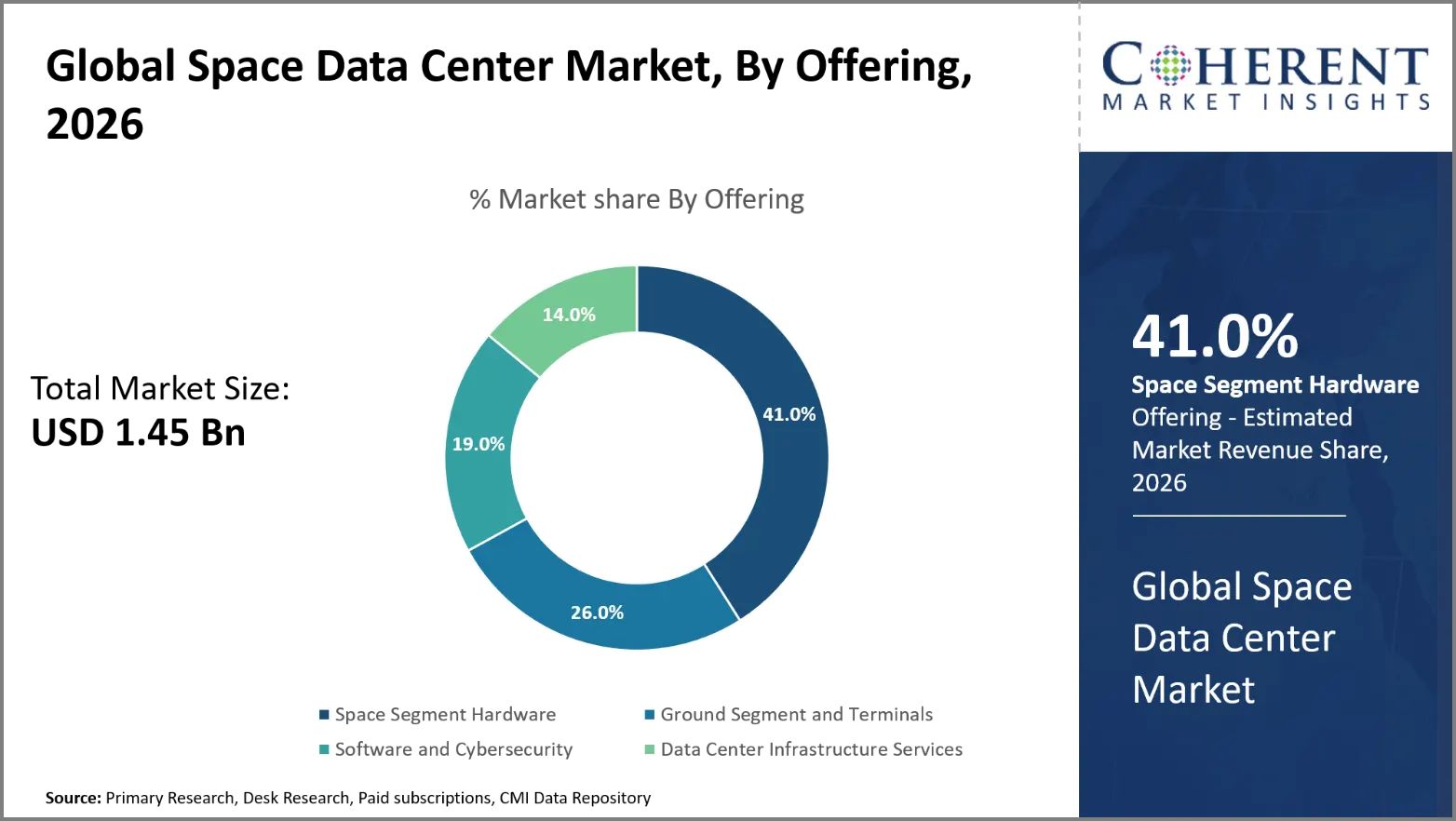
- The Space Segment Hardware segment is expected to account for 41.0% of the global space data center market share in 2026. Increasing demand for real-time in-orbit data processing is driving the growth of the segment. On September 15, 2025, Voyager Technologies launched its Space Edge platform aboard the International Space Station. Developed by its LEOcloud subsidiary, the platform provides managed cloud infrastructure directly in orbit.
- The Low Earth Orbit segment is estimated to capture 43.0% of the market share in 2026. Growing requirements for secure space-based cloud infrastructure is majorly driving the growth of the segment. On July 30, 2025, Deloitte announced Silent Shield, an intrusion detection system designed for satellites. The technology operates aboard its Deloitte-1 satellite.
- The Data Processing segment is estimated to capture 35.0% of the market share in 2026. Expansion of commercial satellite constellations is driving the growth of the segment. On February 12, 2026, Amazon Leo launched 32 satellites on board Arianespace’s Ariane 64 rocket. The French Guiana launch of LE-01 boosted Amazon’s low Earth Orbit constellation to more than 200 satellites.
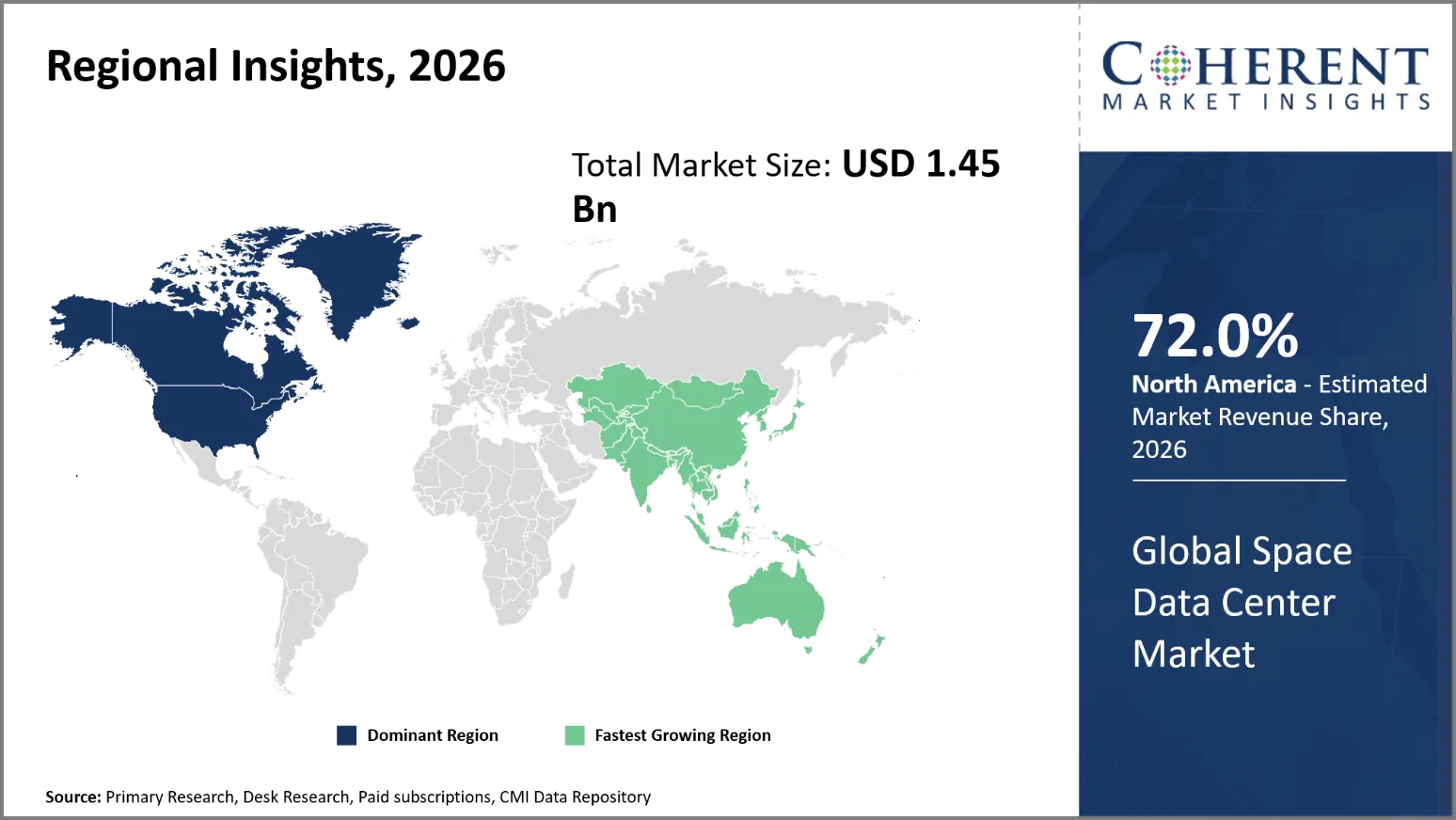
- North America is expected to dominate the space data center market in 2026 with a market share of 72.0%. Increasing investments in reusable launch vehicle technologies in North America is driving the growth of the regional market. On May 1, 2026, SpaceX disclosed that its Starship development expenditure exceeded USD 15 billion, according to its confidential initial public offering registration.
- Asia Pacific is expected to account for 12.0% share in 2026. Integration of high-performance computing with satellite constellations in Asia Pacific is driving the growth of the regional market. On September 28, 2026, TelePIX announced a satellite AI service agreement with India-based Skyserve. The partnership will enable customers to upload AI applications and Earth observation models directly onto TelePIX satellites.
Segmental Insights
Why Does Space Segment Hardware Dominate the Global Space Data Center Market?
The space segment hardware segment is expected to account for 41.0% of the global space data center market share in 2026. The space segment hardware is dominant because orbiting data centers need reliable computer infrastructure that is beyond what is available on Earth. Critical infrastructure includes satellites, processors, storage modules, communication payloads and power systems. These allow for onboard processing, storage, inter-satellite communication and autonomous operation. Radiation-hardened electronics safeguard computing systems from harsh orbital environments. Owing to sophisticated thermal management, the equipment can still operate even when the temperature changes dramatically. There is more demand for specialized hardware as there are more investments in satellite constellations.
On November 24, 2025, Space Cubics Inc. announced SC-OBC Module V1, a high-end onboard computer (OBC) for New Space applications. The product is based on the results of joint studies with the Japan Aerospace Exploration Agency (JAXA). SC-OBC Module V1 adopts AMD Versal Adaptive SoC as its main processor.
- Current Industry Events of 2026
- Market Size Estimation
- Regional Breakdown
- Competitive Landscape
- Customer Intelligence
- Segmental Analysis
- Pricing Analysis
- Key Market Drivers, Challenges & Future Trends
- Customized Insights Section
Why is Low Earth Orbit the Most Crucial Orbit?
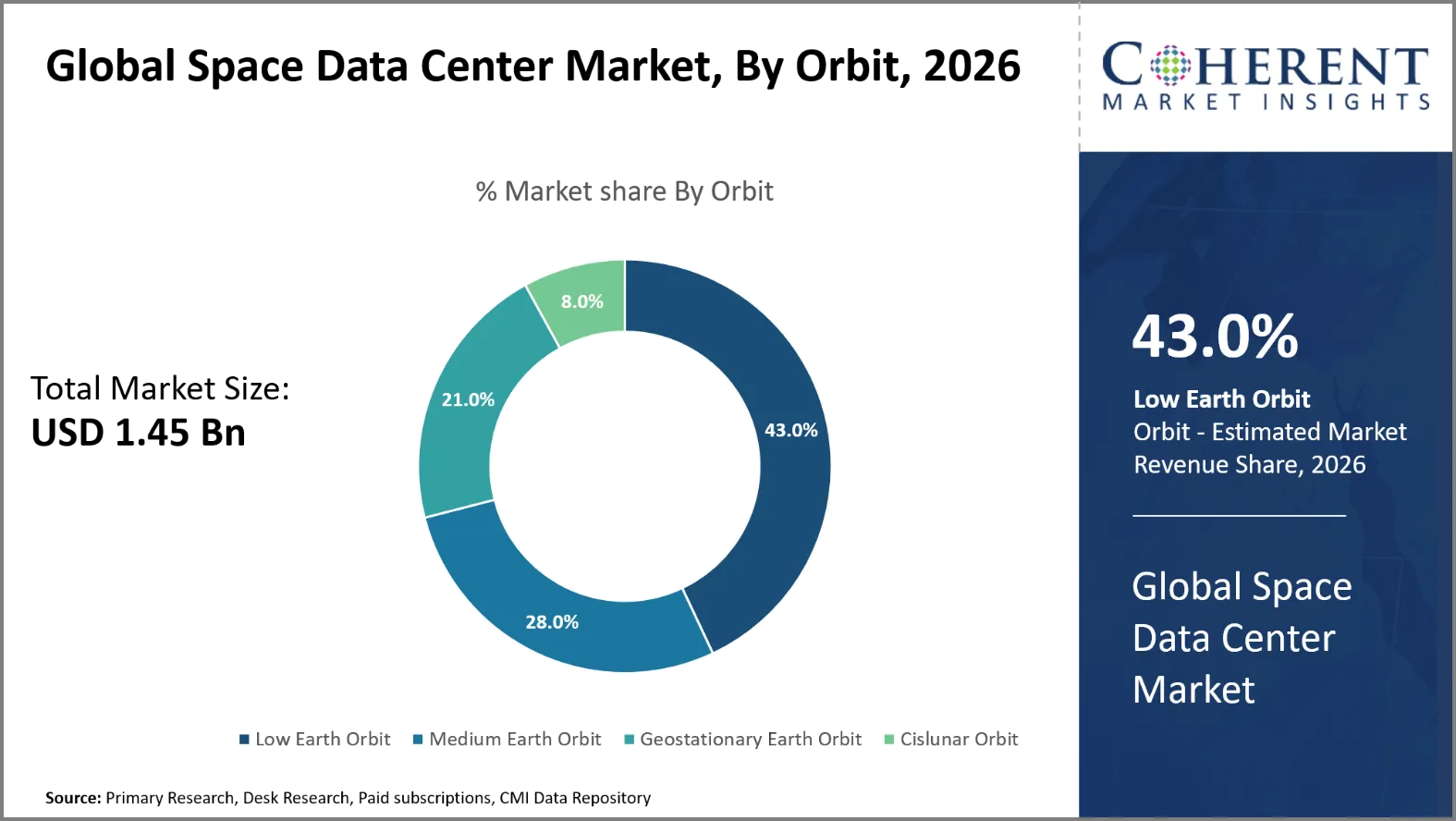
The low earth orbit segment is expected to account for 43.0% of the global space data center market share in 2026. Important factors for low earth orbit are relatively cheaper launch needs and shorter communication distances. Proximity to Earth means faster data transfer between orbital computing facilities and ground stations. The satellites are able to transfer information to terrestrial networks more efficiently. Some Sun synchronous orbits can give good solar exposure for continuous power generation. LEO supports dispersed satellite constellations with scalable computation and inter-satellite connectivity. These properties make LEO particularly well suited for earth observation processing, artificial intelligence workloads and space-based cloud infrastructure.
On November 9, 2026, Rakuten Group and AST SpaceMobile announced a Japanese LEO satellite joint venture. The proposed venture, Rakuten AST, will develop a direct-to-device satellite communications network. AST SpaceMobile will supply satellites designed to connect directly with commercially available smartphones. Japan’s Ministry of Internal Affairs and Communications selected the associated project for funding support.
Data Processing Dominates the Global Space Data Center Market
The data processing segment is expected to account for 35.0% of the global space data center market share in 2026. Data processing dominates because orbital computing infrastructure primarily aims to convert raw satellite data into actionable information. Earth observation satellites generate substantial imagery, environmental measurements, and sensor information. Processing these datasets onboard decreases the need on computational facilities on the ground. Artificial intelligence algorithms can be used in real-time for object detection, weather monitoring, disaster identification, and for surveillance. The processed information also decreases the bandwidth needs and wasteful transmission of data to Earth.
On November 27, 2025, Fujitsu Limited and Yamaguchi University developed low-power satellite edge-computing technology. The Japanese partners showed how redundant graphics processing units can handle synthetic aperture radar data in near real time. Their prototype used 20 watts of power and took about ten minutes to process.
Current Events and their Impact
Current Events | Description and its Impact |
European Union - Proposed EU Space Act, 2025 |
|
U.S. - Federal Communications Commission Orbital Debris Mitigation Rules, 2024 |
|
Space Data Center Market Dynamics
Market Drivers
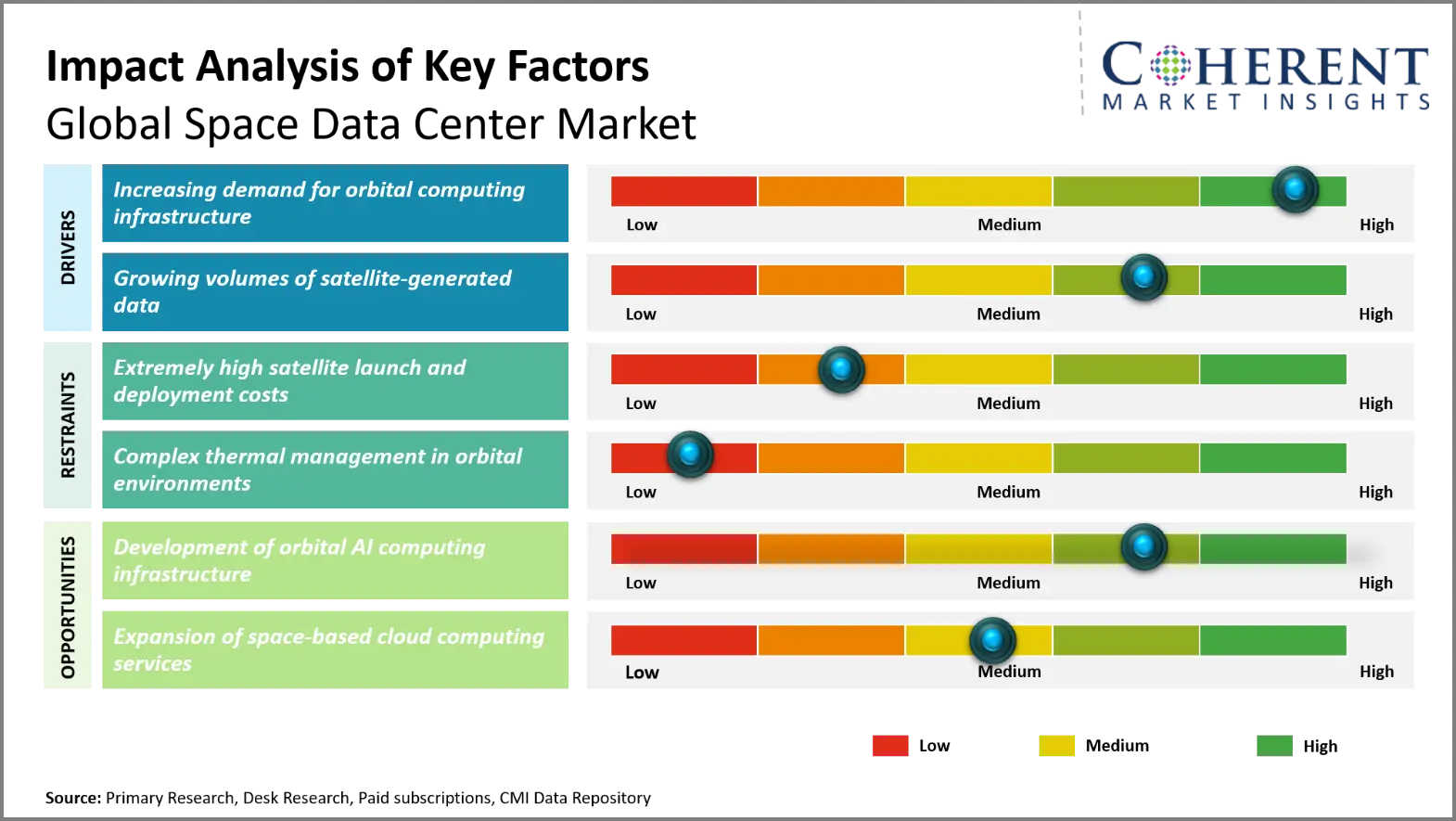
- Increasing demand for orbital computing infrastructure: Rising demand for low-latency satellite services is driving interest in orbital computer infrastructure. Satellite operators are increasingly looking for onboard processing capabilities to enable autonomous operations and faster decision making. Data centers in space might lessen reliance on constant contact with ground-based centers. These systems can enable applications in artificial intelligence, satellite navigation, defense communications and remote sensing. The demand for dedicated orbital computing hardware is being fueled by growing expenditures in commercial satellite constellations. Advances in radiation-hard processors and heat management technologies are making infrastructure more feasible. These trends are pushing aerospace businesses to consider scalable computing architectures in space.
- On February 25, 2026, Intuitive Machines secured a USD 175 million strategic equity investment. The company intends to grow its satellite communications and in-space data processing services. Its investment plan involves high power orbital processing and edge computing technologies.
- Growing volumes of satellite-generated data: The rapid growth of Earth observation and communication satellite networks are producing enormous amounts of data from space. High-resolution imaging systems are constantly gathering information on agriculture, environment, maritime domain and infrastructure. Synthetic aperture radar satellites also produce complex datasets requiring substantial computational resources. Each raw dataset can be transmitted to terrestrial facilities only within the limits of bandwidth and processing delays. Onboard processing allows satellites to filter, analyze and prioritize information before it is transmitted. Artificial intelligence applications further increase demand for specialized orbital processing capabilities. Consequently, growing satellite data generation is strengthening the commercial rationale for distributed space-based data centers.
- On May 26, 2026, Satellogic secured a contract to provide Earth observation services valued more than USD 18 million. The company has signed a one-year contract with an international defense customer. Its NewSat constellation will offer daily satellite imaging of several key places.
Emerging Trends
- Development of AI-Powered In-Orbit Data Processing: Space businesses are creating artificial intelligence-enabled satellites that process imagery, identify objects and prioritize information before transmission. It eliminates communication latency and allows the spaceship to be autonomous.
Impact: Onboard processing reduces bandwidth usage, prevents needless transmissions to the ground, and speeds up delivery of information. It also raises the necessity for radiation-tolerant computers, specialized accelerators and efficient thermal management systems.
Relevance to the market: The European Space Agency’s Φ-Sat-1 mission has showcased onboard artificial intelligence to filter cloud-covered satellite pictures. These experiments raise commercial interest in dedicated orbital computing infrastructure.
- Emergence of Space-Based Data Center Demonstration Projects: Aerospace companies are investigating orbital computing platforms that integrate satellite infrastructure, high-performance CPUs, and optical communication systems. These developments are intended to bring terrestrial cloud computing capabilities to space.
Impact: Demonstration projects could drive investment in modular computer payloads, space-qualified storage systems and inter-satellite communication technologies. They also assist assess operational feasibility and infrastructure needs.
Relevance to the market: In 2025, Axiom Space and Red Hat proposed an orbiting data center venture. Such alliances show growing commercial interest in extending cloud computing capabilities beyond Earth.
Regional Insights
Why is North America a Strong Market for Space Data Center?
North America is expected to account for a market share of 72.0% in 2026. Commercial optical communication networks and increasing demand for distributed computing on satellite constellations are a boon for North America. In March 2026, Canadian business Kepler Communications commissioned the distributed computing capabilities of their optical relay network. It has ten interconnected satellites that deliver artificial intelligence applications, multi-sensor data fusion and processing powered by NVIDIA. The network also enables real-time data transport between spacecraft. In the U.S., the Government Accountability Office identified orbital computing as an emerging technology requiring further engineering development. Regional opportunities increasingly involve optical terminals, hosted computing payloads, and specialized satellite networking infrastructure.
Why Does Asia Pacific Space Data Center Market Exhibit High Growth?
Asia Pacific is expected to register the fastest growth with a CAGR of 8.2% over the forecast period. Asia Pacific is projected to account for 12.0% of the global space data center market in 2026. Satellite manufacturing is booming; government space programs are taking off and demand for Earth observation from the region is increasing, all of which are advantages for Asia Pacific. South Korea’s Korea Aerospace Research Institute is developing AI and autonomous observation technologies based on satellites. Onboard processing research is funded by the SmartSat Cooperative Research Center in Australia, working with universities and aerospace firms. Singapore-based ST Engineering provides satellite communication and geospatial infrastructure for commercial purposes. Japan and China are also advancing orbital computing demonstrations. These developments strengthen regional demand for radiation-resistant processors, optical communication payloads, satellite storage systems, and autonomous data processing technologies.
Global Space Data Center Market Outlook for Key Countries
Why is U.S. Emerging as a Major Hub in the Space Data Center Market?
The U.S. has opportunities in commercial aerospace entrepreneurship, advanced semiconductor development and need for orbital artificial intelligence infrastructure. Three applications for huge orbital data center constellations have been filed with the Federal Communications Commission by the Government Accountability Office since January 2026. NASA also announced the extension of a contract for the procurement of commercial satellite data through June 2026. The government picked six incumbent suppliers and eight new companies to deliver increased Earth observation services. These improvements drive demand for satellite compatible computing, secure data infrastructure and powerful processing technologies. Specialized investment in things such as power generation and thermal management is also driven by the commercial interest in orbital infrastructure.
Is China the Next Growth Engine for the Space Data Center Market?
China is pushing forward with orbital computing, using dedicated satellite constellations for artificial intelligence and high-performance processing. On May 14, 2025, a Long March-2D rocket sent 12 satellites into orbit for the Three-Body Computing Constellation. Zhejiang Lab and ADA Space are building this infrastructure for distributed computing applications. The constellation showed 10 deployed artificial intelligence models with inter-satellite networking in February 2026. One remote sensing model picked out infrastructure over 189 square kilometers even with deep snow cover. Such improvements lead to need for satellite networking equipment and orbital processors and autonomous data processing systems.
Japan Space Data Center Market Analysis and Trends
Japan’s growth potential lie in smart Earth observation, improved satellite software, and the need for real-time maritime monitoring. In April 2025, Space Compass Corporation, in partnership with Microsoft, demonstrated onboard ship detection using artificial intelligence. The demonstration reduced transmitted data volumes by more than 98%. This capability enables satellites to identify relevant maritime information before transmitting results to ground infrastructure. Japan Aerospace Exploration Agency is also developing high-performance onboard computing technology for autonomous observation planning. These developments strengthen opportunities for compact computing payloads, satellite software platforms, and specialized orbital data processing infrastructure.
France Space Data Center Market Analysis and Trends
France benefits from advanced aerospace engineering and government-backed development of embedded computing technologies. In July 2025, a French partnership initiated the CEOS2030 project for AI-enabled Earth observation satellites. The partnership is composed of STEEL Electronique, ELSYS Design, IP-Maker, Tarides and Thales Alenia Space. This effort is supported by Bpifrance and the France 2030 program. It is being developed to process satellite images on board rather than sending all the raw data to the ground. This offers possibilities for embedded processors, specialized software, and secure computing modules. France's solid skills in satellite production also open the door to the development of specialized orbital infrastructure.
India Space Data Center Market Analysis and Trends
India’s growth story is backed by the development of indigenous satellite technology and increased interest in autonomous space infrastructure. In December 2025, the Department of Space published preliminary feasibility studies on orbital edge computing. The Indian Space Research Organization has recognized onboard processing and storage as a crucial next generation satellite technology. The report pointed out the necessity of developing radiation-hardened CPUs, orbital power generation and satellite security. These initiatives open up prospects for domestic semiconductor engineering and specialized spacecraft electronics. India’s burgeoning private satellite manufacturing ecosystem can also help in developing indigenous computer payloads, and lessen dependence on imported space-qualified gear.
Global Space Data Center Market - Announced Satellite Data-Center Projects and Planned Constellation Sizes
Company / Country | Project | Announcement Or Filing Date | Planned Constellation Size | Orbit And Altitude | Development Status |
SpaceX / U.S. | Orbital Data Center System | January 30, 2026 | Up to 1000000 satellites | LEO, 500–2000 km | FCC application filed |
Starcloud / U.S. | Starcloud orbital data centre constellation | February 4, 2026 | Up to 88000 satellites | LEO, 600–850 km, sun-synchronous | FCC application filed |
Blue Origin / U.S. | Project Sunrise | March 19, 2026 | Up to 51600 satellites | LEO, 500–1800 km, sun-synchronous | FCC application filed |
Cowboy Space / U.S. | Stampede | May 11, 2026 | Up to 20000 satellites | LEO, 700–1000 km, dawn-to-dusk sun-synchronous | FCC application filed |
Orbital Compute Inc. / U.S. | Distributed Data Center System | June 24, 2026 | Up to 100000 satellites | LEO, 500–850 km, sun-synchronous | FCC application filed |
How is Development of Orbital AI Computing Infrastructure Creating New Growth Opportunities in the Space Data Center Market?
Opportunities for specialized processors, high-bandwidth memory, and radiation tolerant computing modules are presented in the development of orbital artificial intelligence computing infrastructure. Companies can scan satellite images, identify items, and run prediction algorithms without transmitting complete information to ground facilities. Starcloud illustrated this opportunity in November 2025 by putting an H100 graphics processing unit on its Starcloud-1 satellite. The demo showed the ability of artificial intelligence models to function in space, demonstrating business interest in space-based computing technology. Such developments create new opportunities for modular computing payloads, liquid-free thermal management systems, autonomous software platforms, and optical inter-satellite networking.
On June 9, 2026, Orbital raised USD 5 million in seed funding. The California-based startup emerged from Andreessen Horowitz's Speedrun accelerator program. Founder Euwyn Poon plans to develop satellites capable of performing artificial intelligence inference in orbit.
Market Players, Key Development, and Competitive Landscape
Key Developments
- On July 29, 2026, Sophia Space Inc. announced the issuance of U.S. Patent No. 12,679,564, titled Space-Based Data Centers, which is jointly owned by Sophia Space and Caltech. The patent, filed in October 2024 and issued on July 14, 2026, covers architectures for the implementation of large-scale, modular data centers in space.
- On May 11, 2026, Cowboy Space Corporation announced USD 275 million in Series B financing at USD 2 billion valuation. The funding supports the company’s work to build the infrastructure needed to power and run AI compute in orbit.
- On May 4, 2026, Pixxel announced a strategic partnership with Sarvam to develop and build India’s first orbital data center satellite. Under the partnership, Pixxel will design, build, launch, and operate the Pathfinder satellite. Sarvam will provide the AI backbone, handling both training and inference directly in orbit, with full-stack language models running on board the satellite.
Competitive Landscape
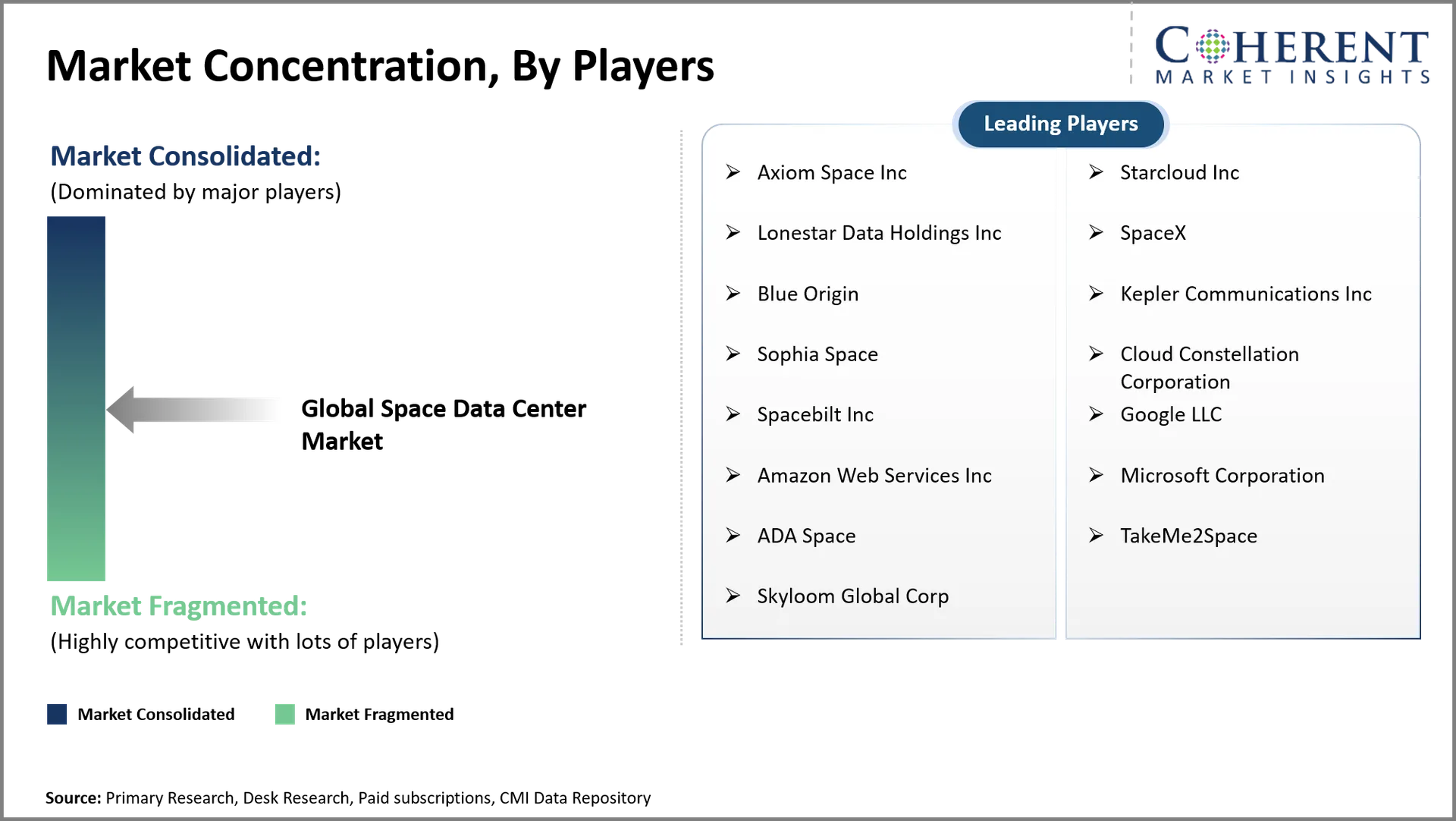
The competitive landscape includes Axiom Space, Starcloud, Kepler Communications, SpaceX and rising developers of orbital infrastructure. Axiom Space is focused on modular orbital data centers, secure cloud computing and government applications. It’s partnerships include Spacebilt, Microchip Technology, Phison Electronics and Skyloom mix computational hardware, storage and optical communication. Kepler Communications has a unique offering in distributed computing and optical satellite networking. It has an architecture powered by NVIDIA supporting artificial intelligence analytics and multi-sensor data fusion. Starcloud deals with GPU based orbital infrastructure and commercial cloud services. The relationship with Crusoe is to be used for in-orbit cloud computing workloads. SpaceX is pursuing large-scale distributed orbital computing infrastructure, emphasizing constellation-based deployment and integrated launch capabilities.
Top Manufacturers and Notable Products in the Space Data Center Market
Manufacturer | Notable Product | Key features |
Starcloud | Starcloud-1 | NVIDIA H100 GPU, high-performance AI inference, in-orbit machine learning, satellite-based computing, autonomous data processing |
Axiom Space | AxDCU-1 and Orbital Data Center Nodes | Red Hat Device Edge, cloud computing, AI and machine learning, data fusion, cybersecurity, optical inter-satellite connectivity |
Kepler Communications | Kepler Compute | NVIDIA Jetson Orin modules, distributed edge computing, optical inter-satellite links, secure containerized workloads, AI inference, space-grade storage |
Aethero | NxN-ECM and Phobos | NVIDIA Jetson Orin NX Super, up to 157 TOPS, containerized applications, onboard AI inference, compute-as-a-service, radiation-tolerant architecture |
Ramon.Space | NuPod and NuStream | High-performance edge computing, AI digital signal processing, 1 TB storage, radiation resilience, real-time onboard analytics, modular architecture |
Market Report Scope
Global Space Data Center Market Report Coverage | |||
Report Coverage | Details | ||
Base Year | 2025 | Market Size in 2026: | USD 1.45 Bn |
Historical Data For: | 2020 To 2024 | Forecast Period: | 2026 To 2033 |
Forecast Period 2026 To 2033 CAGR: | 7.30% | 2033 Value Projection: | USD 4.65 Bn |
Geographies covered: |
| ||
Segments covered: |
| ||
Companies covered: | Axiom Space Inc, Starcloud Inc, Lonestar Data Holdings Inc, SpaceX, Blue Origin, Kepler Communications Inc, Sophia Space, Cloud Constellation Corporation, Spacebilt Inc, Google LLC, Amazon Web Services Inc, Microsoft Corporation, ADA Space, TakeMe2Space, Skyloom Global Corp | ||
Growth Drivers: |
| ||
Restraints & Challenges: |
| ||
Analyst Opinion (Expert Opinion)
- The future of the Global Space Data Center Market will depend on specialized orbital computing rather than immediate replacement of terrestrial facilities. Distributed low Earth Orbit platforms will initially serve satellite operators requiring onboard analytics and secure data processing. Commercial adoption will strengthen as launch economics, radiation-resistant processors, and optical communication technologies improve. Companies should prioritize operational reliability before attempting large-scale orbital computing deployments.
- The strongest opportunities will emerge in low Earth Orbit computing nodes, artificial intelligence inference, Earth observation analytics, and defense-related data processing. The U.S. has strong potential in commercial aerospace investment and developed cloud computing capabilities. China provides prospects in dedicated computing satellite development and indigenous semiconductor manufacture. Japan and France have niche potential in autonomous spacecraft technologies and advanced aerospace electronics.
- Market participants should focus on collaborations spanning semiconductor manufacturing, satellite networking, launch services and cloud computing. Hardware developers should focus on radiation-tolerant processors, high-density storage and deployable thermal management systems. Operators should develop optical inter-satellite communication capabilities and flexible satellite design. Companies should also lock in government customers and commercial satellite operators before they scale their equipment. By creating stronger competitive distinction, reliable computing performance and sustainable orbital operations may be demonstrated.
Speak to the analyst
Want personalized insights?
Take the findings above to one of our principal consultants, or have the report rebuilt around the segments, geographies and competitors you actually track.
Market Segmentation
- Offering Insights (Revenue, USD Billion, 2021 - 2033)
- Space Segment Hardware
- Ground Segment and Terminals
- Software and Cybersecurity
- Data Center Infrastructure Services
- Orbit Insights (Revenue, USD Billion, 2021 - 2033)
- Low Earth Orbit
- Medium Earth Orbit
- Geostationary Earth Orbit
- Cislunar Orbit
- Payload Insights (Revenue, USD Billion, 2021 - 2033)
- Data Processing
- Data Storage
- Communication and Data Transfer
- AI Computing Hardware
- Networking Infrastructure
- Application Insights (Revenue, USD Billion, 2021 - 2033)
- AI and Machine Learning
- Cloud Computing
- Data Processing and Analytics
- Satellite Data Management
- Space-Based Data Storage
- Scientific Computing
- Defense and Intelligence
- End User Insights (Revenue, USD Billion, 2021 - 2033)
- Commercial Organizations
- Government Organizations
- Defense and Intelligence Agencies
- Research and Academic Institutions
- Telecommunication Companies
- Critical Infrastructure Operators
- Satellite Operators
- Regional Insights (Revenue, USD Billion, 2021 - 2033)
- North America
- U.S.
- Canada
- Latin America
- Brazil
- Argentina
- Mexico
- Rest of Latin America
- Europe
- Germany
- U.K.
- Spain
- France
- Italy
- Russia
- Rest of Europe
- Asia Pacific
- China
- India
- Japan
- Australia
- South Korea
- ASEAN
- Rest of Asia Pacific
- Middle East
- GCC Countries
- Israel
- Rest of Middle East
- Africa
- South Africa
- North Africa
- Central Africa
- North America
- Key Players Insights
- Axiom Space Inc
- Starcloud Inc
- Lonestar Data Holdings Inc
- SpaceX
- Blue Origin
- Kepler Communications Inc
- Sophia Space
- Cloud Constellation Corporation
- Spacebilt Inc
- Google LLC
- Amazon Web Services Inc
- Microsoft Corporation
- ADA Space
- TakeMe2Space
- Skyloom Global Corp
Sources
Primary Research Interviews
- Satellite Operators & Space Infrastructure Providers
- Data Center Technology Vendors & Solution Providers
- Space Agency Representatives (NASA, ESA, ISRO, etc.)
- Cloud & Edge Computing Service Providers
Magazines
- Via Satellite Magazine
- Data Center Dynamics Magazine
- Space News Magazine
- IEEE Spectrum
Journals
- Journal of Spacecraft and Rockets
- IEEE Transactions on Aerospace and Electronic Systems
- Acta Astronautica (Elsevier)
Associations
- Space Data Association (SDA)
- International Astronautical Federation (IAF)
- Satellite Industry Association (SIA)
- Data Center Alliance (DCA)
Public Domain Sources
- NASA Official Website (nasa.gov)
- European Space Agency (ESA) Public Reports (esa.int)
- U.S. Federal Communications Commission (FCC) Filings
- United Nations Office for Outer Space Affairs (UNOOSA)
Proprietary Elements
- CMI Data Analytics Tool
- Proprietary CMI Existing Repository of Information for Last 10 Years
Get access to 250+ pages report
Every segment, forecast, competitor profile and data table behind the analysis above — available for instant download.
- ESOMAR Member
- ISO 9001:2015 Certified
- D-U-N-S Registered
- GDPR & CCPA Compliant
Frequently Asked Questions
The global space data center market is expected to stand at USD 1.45 Bn in 2026 and is expected to reach USD 4.65 Bn by 2033.
The CAGR of the global space data center market is projected to be 7.3% from 2026 to 2033.
Increasing demand for orbital computing infrastructure and Growing volumes of satellite-generated data are the major factors driving the growth of the global space data center market.
Extremely high satellite launch and deployment costs and Complex thermal management in orbital environments are the major factors hampering the growth of the global space data center market.
In terms of offering, space segment hardware segment is estimated to dominate the market revenue share in 2026.
The market covers computing, storage, and networking infrastructure deployed in orbit for processing space-based data.
Orbital edge computing processes information directly aboard spacecraft instead of relying entirely on terrestrial computing facilities.