

Global Space Energy Storage, and Power Management Systems Market Size and Forecast – 2026 To 2033
The global space energy storage, and power management systems market is expected to grow from USD 3.80 Bn in 2026 to USD 7.30 Bn by 2033, registering a compound annual growth rate (CAGR) of 9.7% from 2026 to 2033. The global space energy storage, and power management systems market is driven by growing investments in lunar exploration and deep-space missions. On September 19, 2025, NASA awarded Blue Origin a task order with an option to deliver a rover to the Moon’s South Pole region. NASA’s VIPER will search for volatile resources, such as ice, on the lunar surface and collect science data to support future exploration at the Moon and Mars.
Key Takeaways of the Global Space Energy Storage, and Power Management Systems Market
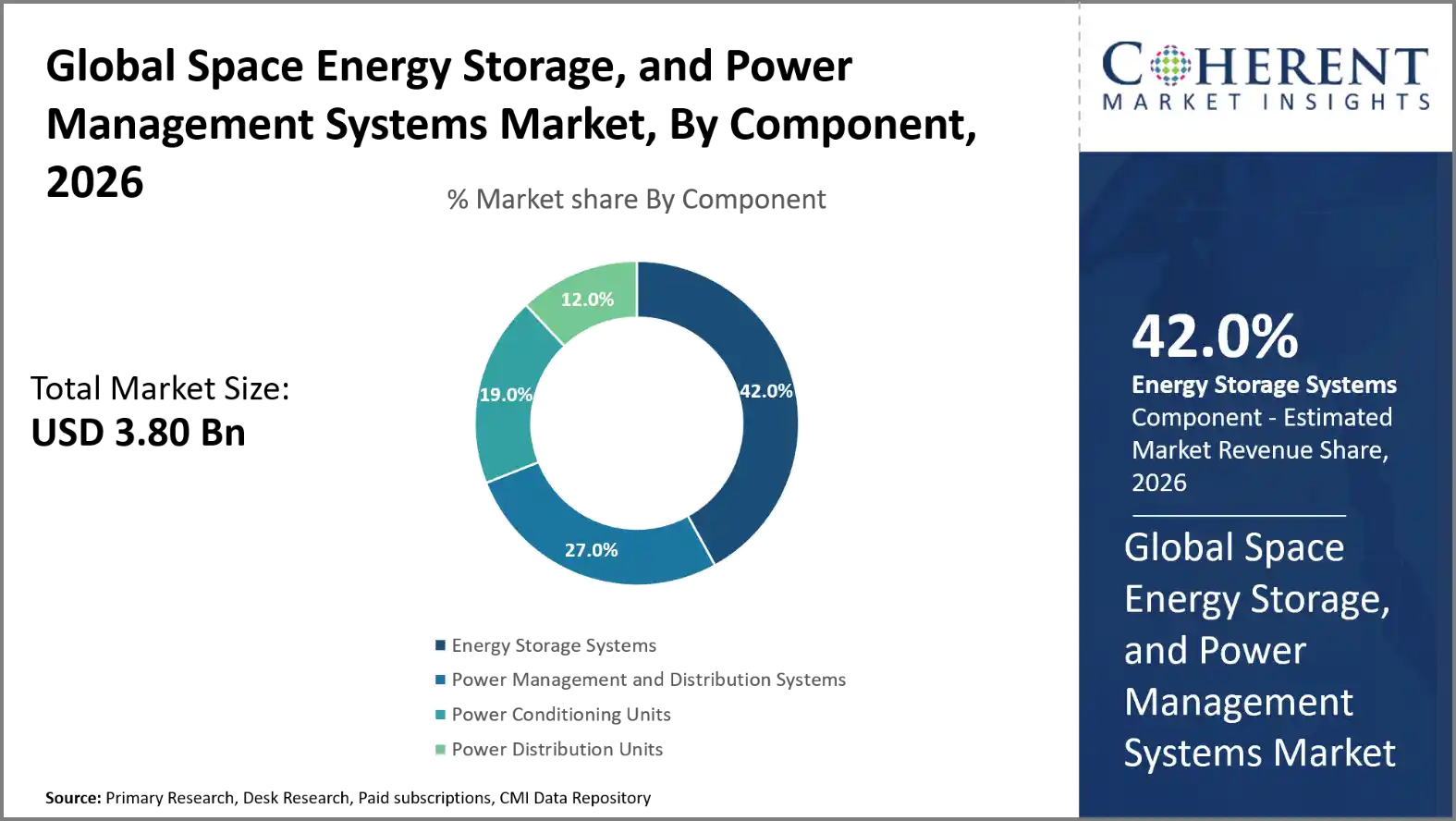
- The Energy Storage Systems segment is expected to account for 42.0% of the global space energy storage, and power management systems market share in 2026. Increasing adoption of advanced lithium-ion and solid-state battery technologies is driving the growth of the segment. On April 24, 2025, Amprius Technologies introduced its 450 Wh/kg SiCore lithium-ion battery. The cell delivers 950 Wh/L volumetric energy density using proprietary silicon-anode technology.
- The Multi-Junction Solar Cells segment is estimated to capture 39.0% of the market share in 2026. Rising demand for reliable spacecraft power distribution and fault-management systems is majorly driving the growth of the segment. On February 20, 2025, Texas Instruments introduced radiation-hardened and radiation-tolerant gallium nitride gate drivers. The portfolio includes the industry's first space-grade GaN driver supporting 200V operation.
- The Small Satellites segment is estimated to capture 34.0% of the market share in 2026. Expansion of commercial satellite manufacturing and small satellite launches is driving the growth of the segment. On August 18, 2025, SpinLaunch announced USD 30 million in additional funding for its Meridian Space broadband constellation. The financing included participation from existing investors and a strategic investment from Kongsberg Defence and Aerospace.
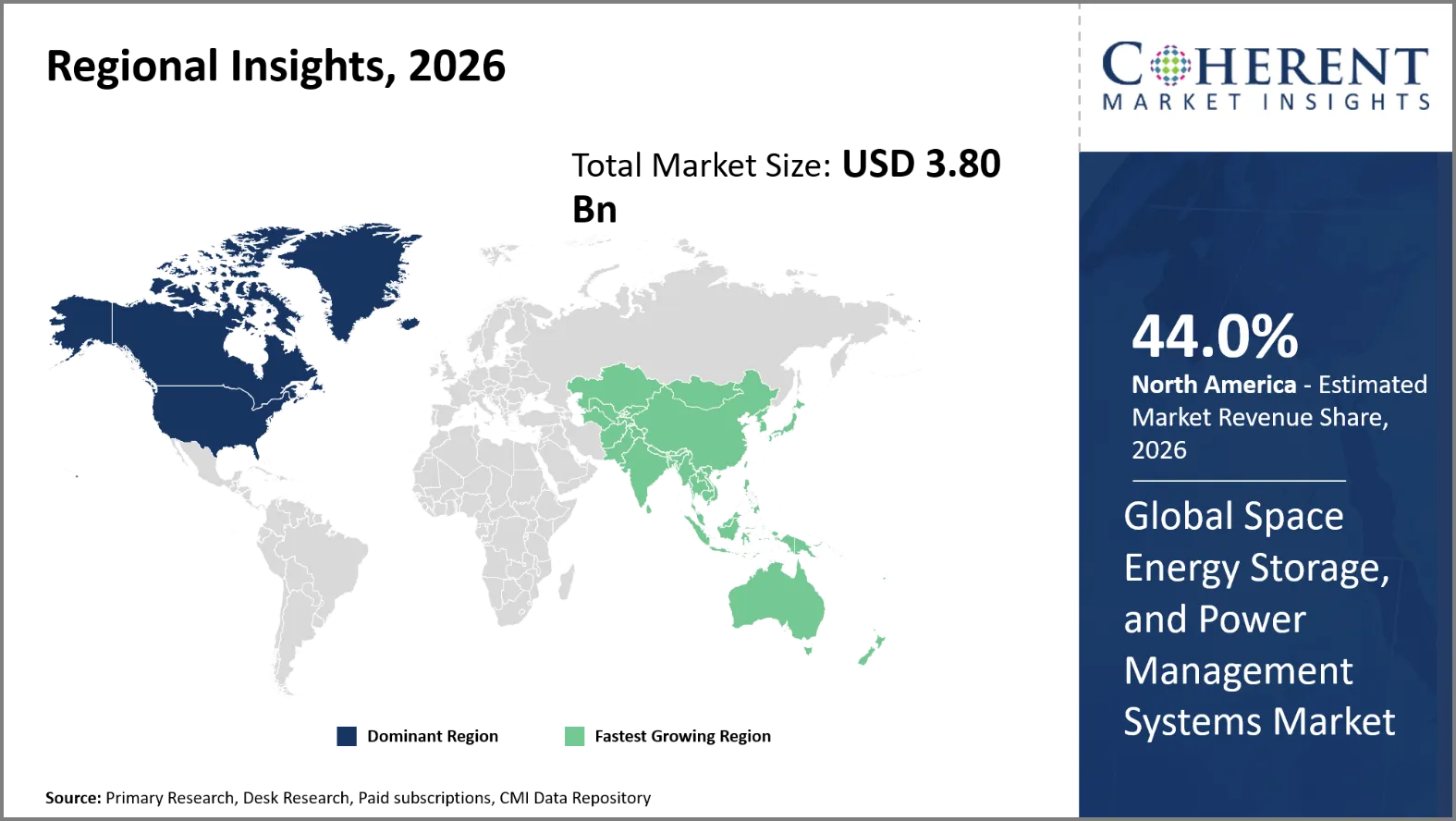
- North America is expected to dominate the space energy storage, and power management systems market in 2026 with a market share of 44.0%. Expansion of deployable solar arrays for high-power spacecraft in North America is driving the growth of the regional market. On March 12, 2025, Rocket Lab announced its selection by Airbus Constellation Satellites to supply high-efficiency solar panels for 100 next-generation OneWeb satellites operated by Eutelsat.
- Asia Pacific is expected to account for 26.0% share in 2026. Development of advanced thermal-management technologies for space batteries in Asia Pacific is driving the growth of the regional market. On March 3, 2025, Nippon Denko and Kansai University demonstrated a vanadium dioxide solid-solid phase-change material for CubeSat battery temperature stabilization.
Segmental Insights
Why Does Energy Storage Systems Dominate the Global Space Energy Storage, and Power Management Systems Market?
The energy storage systems segment is expected to account for 42.0% of the global space energy storage, and power management systems market share in 2026. Energy storage technologies are dominant because spacecraft need a constant supply of electricity when in orbital eclipses and when there is less solar exposure. Rechargeable lithium-ion batteries provide reliable backup power when the solar panels aren’t generating enough electricity. These systems also deliver peak power for communications, propulsion and research functions. Sophisticated battery management systems handle charging, discharging, temperature and voltage levels. The increasing number of satellite deployments is driving demand for lighter batteries with improved energy density and longer operating lives. So, energy storage technologies are still important for the reliability, mission continuity, and operational efficiency of spacecraft.
On July 17, 2025, GS Yuasa Technology secured selection under the Japan Aerospace Exploration Agency’s Space Strategy Fund. The project supports development of fifth-generation lithium-ion batteries for spacecraft. Its research includes higher energy density, improved safety, manufacturing processes, and battery-life prediction models. These improvements could strengthen energy storage reliability across longer satellite missions.
- Current Industry Events of 2026
- Market Size Estimation
- Regional Breakdown
- Competitive Landscape
- Customer Intelligence
- Segmental Analysis
- Pricing Analysis
- Key Market Drivers, Challenges & Future Trends
- Customized Insights Section
Why is Multi-Junction Solar Cells the Most Preferred Power Generation Technology?
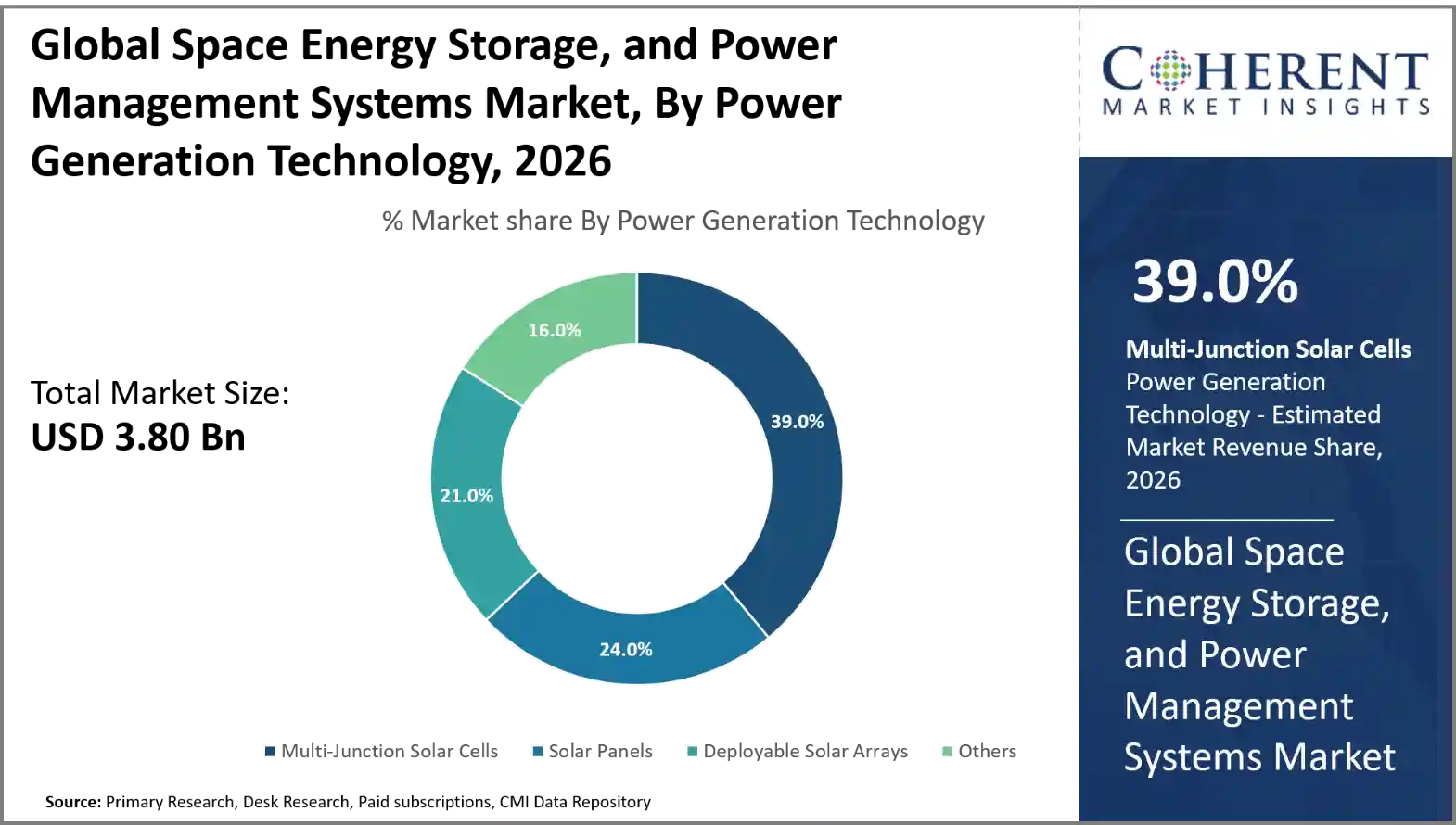
The multi-junction solar cells segment is expected to account for 39.0% of the global space energy storage, and power management systems market share in 2026. Multi-junction solar cells are preferable as they give higher conversion efficiency on limited spaceship surface area. They absorb distinct parts of the sunlight spectrum in their many semiconductor layers. This architecture can produce more energy than ordinary single-junction silicon cells. Modern space-grade designs often have three to five semiconductor junctions. These methods reach conversion efficiencies of about 30% to 34% under the right conditions. Higher power output enables spacecraft to run modern payloads without drastically changing the solar array dimensions. Their well-established aerospace applications and growing radiation resistance drive their acceptance across satellite platforms.
On August 21, 2025, Mitsubishi Electric Corporation announced that it has been selected as a representative organization for the technology development titled Development of Domestic Solar Cells, Cover Glass, and Solar Arrays under the Development/Verification of Parts/Components for the Establishment of Satellite Supply Chain, one of the technology development themes included in the 1st Phase of the Space Strategy Fund operated by the Japan Aerospace Exploration Agency (JAXA).
Small Satellites Dominates the Global Space Energy Storage, and Power Management Systems Market
The small satellites segment is expected to account for 34.0% of the global space energy storage, and power management systems market share in 2026. Small satellites dominate because commercial, scientific, and defense missions increasingly require compact and cost-efficient spacecraft platforms. Their expanding deployment creates substantial demand for lightweight batteries, compact power converters, and integrated distribution systems. CubeSats and nanosatellites require highly optimized electrical architectures because available mass and internal volume remain limited. During the orbital eclipses and short power outages, the batteries, which are rechargeable, provide the electricity. The electricity is generated by the solar panels, and the power management systems control its distribution to the instruments on board. Growing satellite constellation deployments further strengthen demand for standardized and scalable power subsystems.
On October 30, 2025, Idemitsu Kosan announced that its space-use CIGS solar cell successfully powered the BOTAN nanosatellite. Chiba Institute of Technology developed the approximately one-kilogram CubeSat. The satellite was released from the International Space Station. This demonstration validated a thin-film photovoltaic technology for compact spacecraft power generation.
Current Events and their Impact
Current Events | Description and its Impact |
European Union - European Union Space Act Proposal, 2025, COM (2025) 335 final, 2025/0335(COD) |
|
U.S. Federal Communications Commission Orbital Debris Mitigation Rules, 47 CFR §25.114(d)(14) and 47 CFR §25.283(c) |
|
Space Energy Storage, and Power Management Systems Market Dynamics
Market Drivers
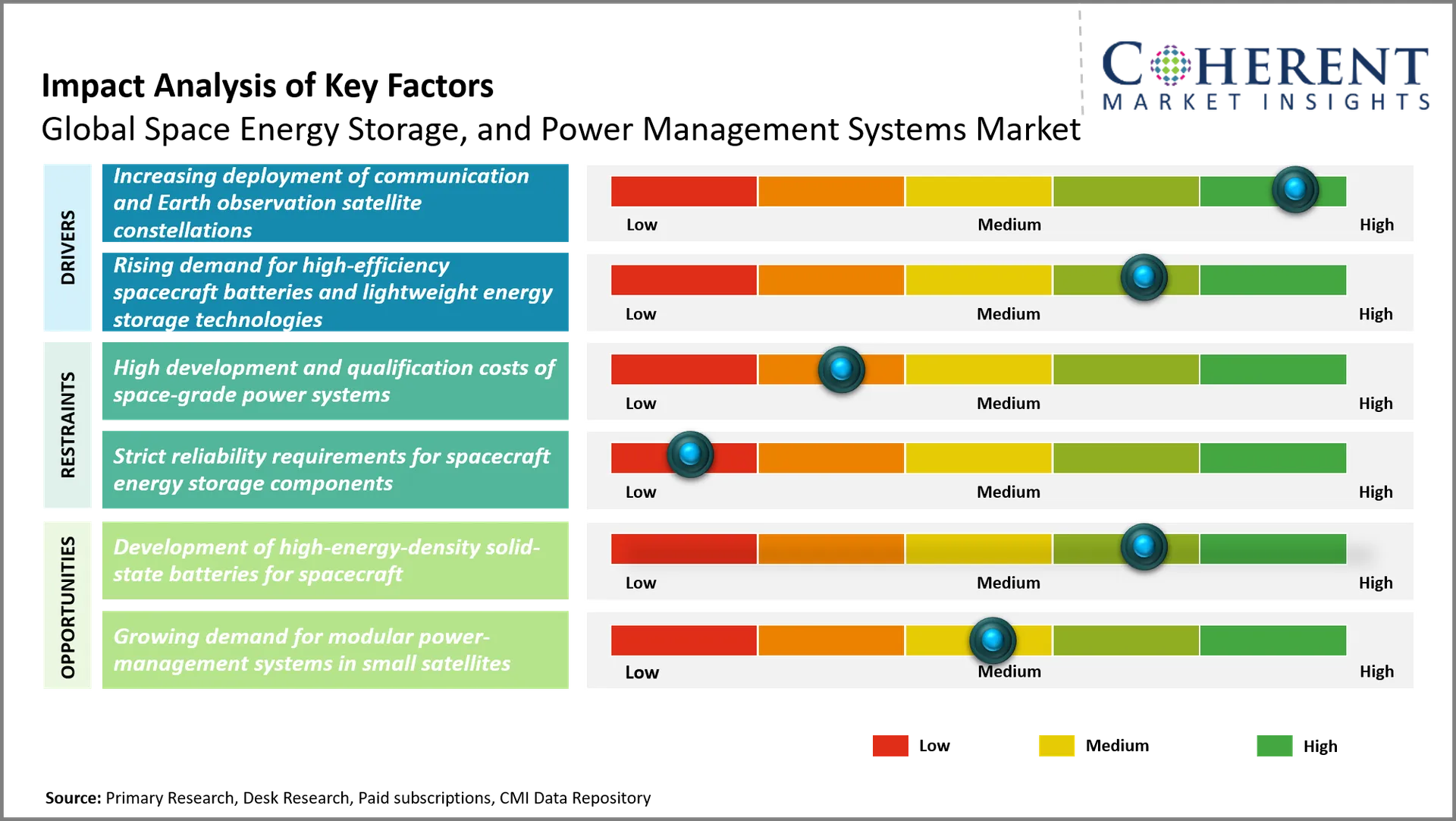
Increasing deployment of communication and Earth observation satellite constellations
Increasing deployment of communication and Earth observation satellite constellations increases demand for sophisticated spacecraft energy storage technologies. Reliable electricity is needed by satellite operators to provide continuous communications, imagery, navigation and onboard data processing. The desire for uniform power management strategies across several spacecraft is also driven by large constellations. Rechargeable lithium-ion batteries keep working during orbital eclipses and brief solar generating outages. The reliability of the spaceship operations is also enhanced by smart power distribution technologies and high-efficiency solar arrays. This demand is backed by increasing investments in broadband connectivity, climate monitoring, agricultural surveillance and disaster management. These improvements present potential for manufacturers of tiny batteries, power converters, and integrated electrical subsystems.
On November 29, 2025, ICEYE successfully launched and deployed five new SAR satellites into orbit. The satellites were integrated using Exolaunch and successfully lifted, aboard the Transporter-15 rideshare mission with SpaceX from Vandenberg Space Force Base, California, U.S.
Rising demand for high-efficiency spacecraft batteries and lightweight energy storage technologies
The increasing demand for high-efficiency spacecraft batteries and lightweight energy storage technologies is driving market growth. Satellite makers are actively seeking batteries with higher energy density, longer operating life and better thermal stability. Lithium-ion technologies continue to be relevant because they have attractive weight-to-capacity ratios and have demonstrated spaceflight performance. Sophisticated battery management systems increase charging efficiency, temperature management and protection from electrical issues. Lightweight energy storage systems also enable spacecraft to carry more research instruments and communication payloads. Compact battery solutions are especially important for small satellite makers since spacecraft size limits available installation area. These technology advances are driving demand for specialized batteries and integrated power management solutions for commercial, scientific and defense applications.
On September 17, 2026, NexTech Batteries announced successful orbital operation of its lithium-sulfur cylindrical cells aboard NearSpace Launch's SPEAR-1 mission. The three-spacecraft mission launched on July 7, 2026, aboard SpaceX's Transporter-17 rideshare mission.
Emerging Trends
- Increasing Adoption of Advanced Lithium-Ion and Solid-State Battery Technologies: Spacecraft manufacturers are exploring advanced lithium-ion chemistries and solid-state batteries that offer higher energy density, thermal stability, radiation tolerance, and operational lifetimes for demanding satellite missions.
- Impact: These technologies reduce spacecraft bulk, increase energy availability, improve battery safety, and increase operational endurance. They also handle more demanding payloads and longer satellite flight durations.
- Relevance to the market: This development may be beneficial to niche battery providers. Development of superior space-qualified batteries could boost the status of firms such as Saft and EaglePicher Technologies.
- Integration of Intelligent Power Management and Autonomous Energy Distribution Systems: More and more satellite manufacturers are integrating intelligent power management systems that include autonomous load control, predictive monitoring, fault detection, and optimized electrical distribution to spacecraft subsystems.
- Impact: Intelligent systems improve efficiency of electrical power, decrease wasteful consumption of power, and enhance reliability of spacecraft. They also allow for autonomous reactions to changing mission needs and unanticipated electrical failures.
- Relevance to the market: This advancement will raise the demand for sophisticated power electronics and integrated control technologies. Relevant suppliers developing spaceship electrical infrastructure and power management capabilities include Beyond Gravity and Airbus Defense and Space.
Regional Insights
Why is North America a Strong Market for Space Energy Storage, and Power Management Systems?
North America is expected to account for a market share of 44.0% in 2026. North America boasts advanced spacecraft engineering, modernization of defense satellites, and significant investments in next-generation space propulsion. The region’s demand is expanding for sophisticated missions demanding higher electrical loads and autonomous power distribution. There were more than 11,000 operating satellites worldwide in 2025, up from 1,400 in 2015, the U.S. Government Accountability Office reported. This growth leads to demand for robust electrical infrastructure and dedicated energy storage. NASA’s Solar Electric Propulsion program is researching propulsion technology for future missions of exploration at 12 kilowatts. These developments encourage regional suppliers to advance high-voltage power converters, radiation-resistant electronics, and integrated battery management solutions.
Why Does Asia Pacific Space Energy Storage, and Power Management Systems Market Exhibit High Growth?
Asia Pacific is expected to register the fastest growth with a CAGR of 11.5% over the forecast period. Asia Pacific is projected to account for 26.0% of the global space energy storage, and power management systems market in 2026. increasingly sophisticated lunar exploration initiatives. South Korea is developing a microsatellite constellation for rapid-revisit monitoring of its peninsula and surrounding territorial waters. The country also operates the Korea Augmentation Satellite System for aviation safety. According to the Organisation for Economic Co-operation and Development, South Korea had 64 satellites in orbit by June 2026. Its civilian space budget reached approximately USD 719.3 million in 2025. These developments encourage domestic suppliers to manufacture compact power electronics, radiation-tolerant components, and scalable electrical subsystems.
Global Space Energy Storage, and Power Management Systems Market Outlook for Key Countries
Why is U.S. Emerging as a Major Hub in the Space Energy Storage, and Power Management Systems Market?
The U.S. benefits from further investment in deep-space exploration, radioisotope power, and high-power electric propulsion. The Department of Energy has dedicated infrastructure for plutonium-238 radioisotope power system production. These technologies are meant to help missions that need electricity beyond feasible distances that can be generated by solar. NASA plans to send the Space Reactor-1 Freedom mission in 2028 to reach Mars in 2029. It will demonstrate fission-powered nuclear electric propulsion beyond Earth orbit. Such programs create demand for advanced power conversion, thermal management, radiation-resistant electronics, and reliable electrical distribution architectures. Specialized suppliers also benefit from government-supported technology qualification and spacecraft integration programs.
Is China the Next Growth Engine for the Space Energy Storage, and Power Management Systems Market?
Bold lunar exploration, deep space communication infrastructure, and indigenous spacecraft platforms help China’s market growth. In March 2024, China National Space Administration launched Queqiao-2 to facilitate communications with lunar missions. The spacecraft has reached an elliptical lunar orbit and conducted communication tests with Chang'e-4 and Chang'e-6. China’s planned Chang’e 7 and Chang’e 8 missions also require a reliable electrical infrastructure for lunar exploration. These programs increase requirements for long-duration energy storage, autonomous power regulation, and reliable communication payload electricity. Domestic spacecraft manufacturers consequently have opportunities to develop specialized power subsystems for increasingly demanding lunar missions.
Germany Space Energy Storage, and Power Management Systems Market Analysis and Trends
Germany benefits from specialized spacecraft electronics research, advanced battery engineering, and European electric propulsion development. The German Aerospace Center is developing PULSE, a modular battery platform for CubeSats and larger spacecraft. The project investigates lithium-sulphur batteries alongside conventional lithium-ion and emerging solid-state chemistries. Its integrated software monitors battery state-of-charge and state-of-health during spacecraft operations. Separately, the PLUTO CubeSat incorporates a 100-watt deployable flexible solar array and a 90-watt-hour battery. These improvements establish in-country expertise in scalable battery topologies, autonomous monitoring, and light weight spaceship electrical systems.
France Space Energy Storage, and Power Management Systems Market Analysis and Trends
France benefits from advanced electric propulsion development, high-performance satellite platforms, and domestic spacecraft battery manufacturing. The National Centre for Space Studies has supported Hall-effect thruster development with Safran since the 1990s. Its electric satellite program demonstrated substantial mass savings compared with conventional chemical propulsion. The Eutelsat 172B satellite became operational in 2017 using electric propulsion for orbital positioning and station-keeping. The European Space Agency’s Euclid mission also uses certain spacecraft infrastructure manufactured in France. It has solar panels on its service module that provide between 1,780 and 2,430 watts of power and a 300-watt-hour lithium-ion battery. These programs strengthen demand for lightweight batteries, power conditioning electronics, and electrical systems supporting electric propulsion.
Japan Space Energy Storage, and Power Management Systems Market Analysis and Trends
Japan benefits from advanced space-qualified battery manufacturing, lunar exploration programmes, and experimental lightweight solar technologies. The lithium-ion batteries were made by GS Yuasa Technology, which launched the HTV-X1 cargo spacecraft for the Japan Aerospace Exploration Agency in October 2025. These batteries supply power during orbital eclipses and enable long-term on-orbit technology demonstrations. Japan also showed out revolutionary lithium-ion batteries bonded with stainless steel on board the Smart Lander for Investigating Moon mission. These batteries assisted lunar descent and surface activities while dealing with unforeseen propulsion issues. Also, in 2026, JAXA tested satellite-bus electricity generation with lightweight perovskite solar cells aboard OrigamiSat-2. These developments strengthen demand for advanced batteries and flexible spacecraft power generation technologies.
Global Space Energy Storage, and Power Management Systems Market - Deployable Solar Array Integration
Company | Product | Deployable Configuration | Solar Cell Technology | Peak Power |
EnduroSat | 3U Deployable Solar Array | Single or double deployable | Triple-junction | 16.8 W single / 25.2 W double |
EnduroSat | 6U Deployable Solar Array | Single or double deployable | Triple-junction | 38.4 W maximum |
EnduroSat | 8U Deployable Solar Array | Deployable panel assembly | Triple-junction | 48 W maximum |
AAC Clyde Space | PHOTON Triple Deployable | Triple deployable | XTJ Prime | Up to 9 W per populated 3U face |
DHV Technologies | CubeSat Solar Panels | Rigid deployable | Triple-junction | 12 W |
DHV Technologies | CubeSat Solar Panels | Rigid deployable | Triple-junction | 57 W |
MMA Design | Hawk | Rigid deployable PCB | Triple-junction | 36–112 W |
ISISPACE | SmallSat Solar Panels | Body-mounted and rigid deployable | Triple-junction | 2.3 W per unit |
How is Growing Development of High-Energy-Density Solid-State Batteries for Spacecraft Creating New Growth Opportunities in the Space Energy Storage, and Power Management Systems Market?
Growth prospects are created by the development of high energy density solid state batteries that solve spaceship limits in weight, thermal stability and electrical safety. These batteries use solid materials for electrolytes instead of liquids, therefore there is no possibility of leaking and it is easier to contain. Joint development under the JAXA-STEPS program began in 2026 with the Japan Aerospace Exploration Agency and Maxell. The project is focused on high-heat-resistant batteries for small satellites, and the plan is to demonstrate them in space by 2029. The SPEARS project was initiated by NASA in 2026 to build a solid-state battery for use on the Moon. Such developments generate opportunity for companies specializing in batteries, thermal management and power electronics. Higher energy density would reduce the mass of spacecraft and enable greater cargo capacity.
On February 19, 2026, Galaxy Power announced successful orbital verification of its aerospace-grade solid-state battery aboard a commercial satellite. The battery uses a proprietary oxide solid electrolyte and reportedly achieves 380 Wh/kg energy density. Its operating temperature range extends from −50°C to 80°C.
Market Players, Key Development, and Competitive Landscape
Key Developments
- On April 14, 2026, Rocket Lab Corporation, a global leader in launch services and space systems, introduced a new electric satellite thruster designed for high-volume production to meet the growing demand for reliable satellite propulsion across commercial and national security constellations.
- On September 2, 2025, Kongsberg NanoAvionics, a leading small satellite bus manufacturer and mission integrator, shipped more than 50 power system components to one of its repeat constellation customers. The delivery includes CubeSat electrical power systems (EPS), battery packs, and fixed and deployable solar panels.
- On October 31, 2024, EnerSys announced that its ABSL lithium-ion space battery was successfully launched onboard NASA’s Europa Clipper spacecraft. The launch took place aboard a SpaceX Falcon Heavy Rocket from NASA’s Kennedy Space Center.
Competitive Landscape
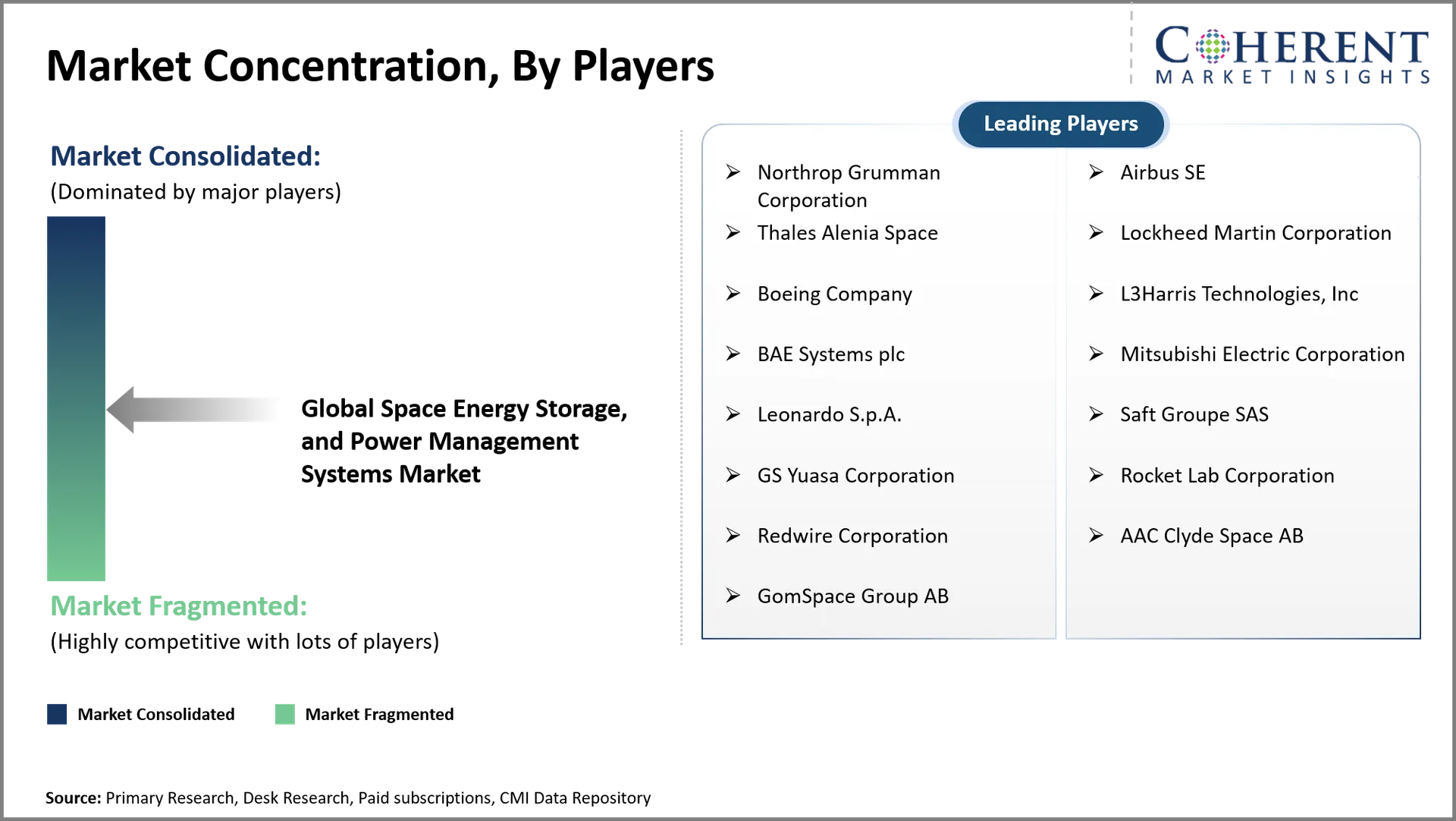
The global market features established aerospace manufacturers, specialized battery suppliers, and spacecraft power electronics developers. Airbus Defence and Space strengthens its position through modular battery platforms designed for telecommunications, navigation, and low-Earth-orbit constellations. Its ASTRO-BATT and STELLAR-BATT products address different spacecraft requirements. Saft focuses on space-qualified lithium-ion batteries and recently expanded solid-state battery manufacturing capabilities in Bordeaux. EaglePicher Technologies emphasizes customized energy storage solutions for satellites, launch vehicles, and planetary exploration missions. Thales Alenia Space focuses on integrated spacecraft electrical architectures and mission-specific power subsystems. Airbus Crisa develops battery regulators, solar array regulators, and protected power distribution units. GS Yuasa targets high-reliability rechargeable batteries for demanding Japanese spacecraft applications.
Top Manufacturers and Notable Products in the Space Energy Storage, and Power Management Systems Market
Manufacturer | Notable Product | Key features |
Redwire Space | Roll-Out Solar Array (ROSA) | Lightweight flexible blanket, compact stowage, high-power deployment, scalable architecture |
MMA Design | Next-Generation HAWK | High specific power, rigid deployable structure, scalable configurations, compact stowed volume |
Pumpkin Space Systems | Deployable Clamshell Solar Array (DCSA) | 24-panel configuration, 192 solar cells, 7U stowed volume, electrically independent array halves |
EnduroSat | 8U Deployable Solar Array | Triple-junction cells, 30%+ beginning-of-life efficiency, 29%+ end-of-life efficiency, 40 cells, integrated photodiodes |
DHV Technology | DSA-108W | Compact deployable configuration, high specific power, spacecraft photovoltaic integration |
Space Energy Storage, and Power Management Systems Market | |||
Report Coverage | Details | ||
Base Year | 2025 | Market Size in 2026: | USD 3.80 Bn |
Historical Data For: | 2020 To 2024 | Forecast Period: | 2026 To 2033 |
Forecast Period 2026 To 2033 CAGR: | 9.7% | 2033 Value Projection: | USD 7.30 Bn |
Geographies covered: |
| ||
Segments covered: |
| ||
Companies covered: | Northrop Grumman Corporation, Airbus SE, Thales Alenia Space, Lockheed Martin Corporation, Boeing Company, L3Harris Technologies, Inc, BAE Systems plc, Mitsubishi Electric Corporation, Leonardo S.p.A., Saft Groupe SAS, GS Yuasa Corporation, Rocket Lab Corporation, Redwire Corporation, AAC Clyde Space AB, GomSpace Group AB | ||
Growth Drivers: |
| ||
Restraints & Challenges: |
| ||
Analyst Opinion (Expert Opinion)
- The future of this industry will increasingly depend on higher energy density, autonomous electrical control, and longer spacecraft operating lifetimes. Lithium-ion batteries will remain important because of their established qualification history and manufacturing maturity. Solid-state batteries could gradually enter specialized missions requiring improved safety and compact energy storage. Power management companies will increasingly compete on intelligent load switching, fault isolation and efficient voltage conversion. Manufacturers who integrate batteries, battery management electronics and integrated power distribution will have a greater opportunity in complex spaceship programs.
- The biggest opportunities will arise in small satellite constellations, high power telecommunications spacecraft and deep space exploration platforms. Compact battery modules and standardized power distribution units that can be repeatedly produced will be needed for low earth orbit spacecraft. Geostationary communications satellites will have greater capacity batteries and enhanced thermal management. Deep-space missions will provide unique prospects for radioisotope power conversion and long-duration energy storage. The U.S., China, Japan, France and India provide intriguing opportunities due to their diverse priorities for satellite manufacture and exploration. Special emphasis should be given to solid-state batteries and radiation tolerant power devices.
- Market players should concentrate on mission-oriented battery certification, modular product architectures and better integration of energy storage and power electronics. Suppliers should be working closely with spacecraft makers in the early design of the platform, not just competing on the purchasing of components.” Development of battery management systems with predictive diagnostics and autonomous fault isolation can help to increase product distinctiveness. Manufacturers should also increase radiation testing, heat cycling validation and lifespan performance documentation.” Procurement access can be improved through the establishment of regional manufacturing alliances and long-term supply agreements for aerospace products. Companies with a proven flight heritage and the ability to scale up manufacturing will have more competitive advantages.
Speak to the analyst
Want personalized insights?
Take the findings above to one of our principal consultants, or have the report rebuilt around the segments, geographies and competitors you actually track.
Market Segmentation
- Component Insights (Revenue, USD Billion, 2021 - 2033)
- Energy Storage Systems
- Power Management and Distribution Systems
- Power Conditioning Units
- Power Distribution Units
- Power Generation Technology Insights (Revenue, USD Billion, 2021 - 2033)
- Multi-Junction Solar Cells
- Solar Panels
- Deployable Solar Arrays
- Others
- Spacecraft Type Insights (Revenue, USD Billion, 2021 - 2033)
- Small Satellites
- Medium Satellites
- Large Satellites
- Crewed Spacecraft
- Space Stations
- Energy Storage Technology Insights (Revenue, USD Billion, 2021 - 2033)
- Lithium-Ion Batteries
- Lithium-Polymer Batteries
- Nickel-Hydrogen Batteries
- Solid-State Batteries
- Supercapacitors
- Primary Batteries
- Application Insights (Revenue, USD Billion, 2021 - 2033)
- Communication Satellites
- Earth Observation Satellites
- Navigation Satellites
- Scientific Research Missions
- Military and Defense Satellites
- Lunar Exploration Missions
- Interplanetary Missions
- Regional Insights (Revenue, USD Billion, 2021 - 2033)
- North America
- U.S.
- Canada
- Latin America
- Brazil
- Argentina
- Mexico
- Rest of Latin America
- Europe
- Germany
- U.K.
- Spain
- France
- Italy
- Russia
- Rest of Europe
- Asia Pacific
- China
- India
- Japan
- Australia
- South Korea
- ASEAN
- Rest of Asia Pacific
- Middle East
- GCC Countries
- Israel
- Rest of Middle East
- Africa
- South Africa
- North Africa
- Central Africa
- North America
- Key Players Insights
- Northrop Grumman Corporation
- Airbus SE
- Thales Alenia Space
- Lockheed Martin Corporation
- Boeing Company
- L3Harris Technologies, Inc
- BAE Systems plc
- Mitsubishi Electric Corporation
- Leonardo S.p.A.
- Saft Groupe SAS
- GS Yuasa Corporation
- Rocket Lab Corporation
- Redwire Corporation
- AAC Clyde Space AB
- GomSpace Group AB
Sources
Primary Research Interviews
- Satellite Manufacturers & Spacecraft System Integrators
- Space Energy Storage & Battery Technology Developers
- Power Management System (PMAD) Engineers & Consultants
- Space Agencies & Government Defense Contractors
Magazines
- Space News Magazine
- Aviation Week & Space Technology
- IEEE Spectrum (Aerospace & Energy Edition)
- Satellite Today Magazine
Journals
- Journal of Power Sources (Elsevier)
- Acta Astronautica (Elsevier)
- IEEE Transactions on Aerospace and Electronic Systems
Associations
- Satellite Industry Association (SIA)
- American Institute of Aeronautics and Astronautics (AIAA)
- European Space Agency (ESA) Industry Liaison
- Space Foundation
Public Domain Sources
- NASA Official Website (nasa.gov)
- European Space Agency Official Website (esa.int)
- U.S. Department of Defense – Space Policy Reports
Proprietary Elements
- CMI Data Analytics Tool
- Proprietary CMI Existing Repository of Information for the Last 10 Years
Get access to 250+ pages report
Every segment, forecast, competitor profile and data table behind the analysis above — available for instant download.
- ESOMAR Member
- ISO 9001:2015 Certified
- D-U-N-S Registered
- GDPR & CCPA Compliant
Frequently Asked Questions
The global space energy storage, and power management systems market is expected to stand at USD 3.80 Bn in 2026 and is expected to reach USD 7.30 Bn by 2033.
The CAGR of the global space energy storage, and power management systems market is projected to be 9.7% from 2026 to 2033.
Increasing deployment of communication and Earth observation satellite constellations and Rising demand for high-efficiency spacecraft batteries and lightweight energy storage technologies are the major factors driving the growth of the global Space Energy Storage, and Power Management Systems market.
High development and qualification costs of space-grade power systems and Strict reliability requirements for spacecraft energy storage components are the major factors hampering the growth of the global space energy storage, and power management systems market.
In terms of component, energy storage systems segment is estimated to dominate the market revenue share in 2026.
Space energy storage and power management systems store, regulate, convert, and distribute electricity across spacecraft subsystems.
Rechargeable batteries maintain electrical supply during orbital eclipses and periods when solar arrays cannot generate electricity.