

Global Spare Parts Logistics Market Size and Forecast – 2026 To 2033
The global spare parts logistics market is expected to grow from USD 26 Bn in 2026 to USD 37 Bn by 2033, registering a compound annual growth rate (CAGR) of 5% from 2026 to 2033. The global spare parts logistics market is driven by growth in predictive maintenance and equipment uptime requirements. On March 24, 2025, Siemens expanded its Industrial Copilot with New Generative AI-powered Maintenance Offering. Siemens is developing a full suite of copilots to industrial-grade standards for the discrete and process manufacturing industries. (Source: Siemens)
Key Takeaways of the Global Spare Parts Logistics Market
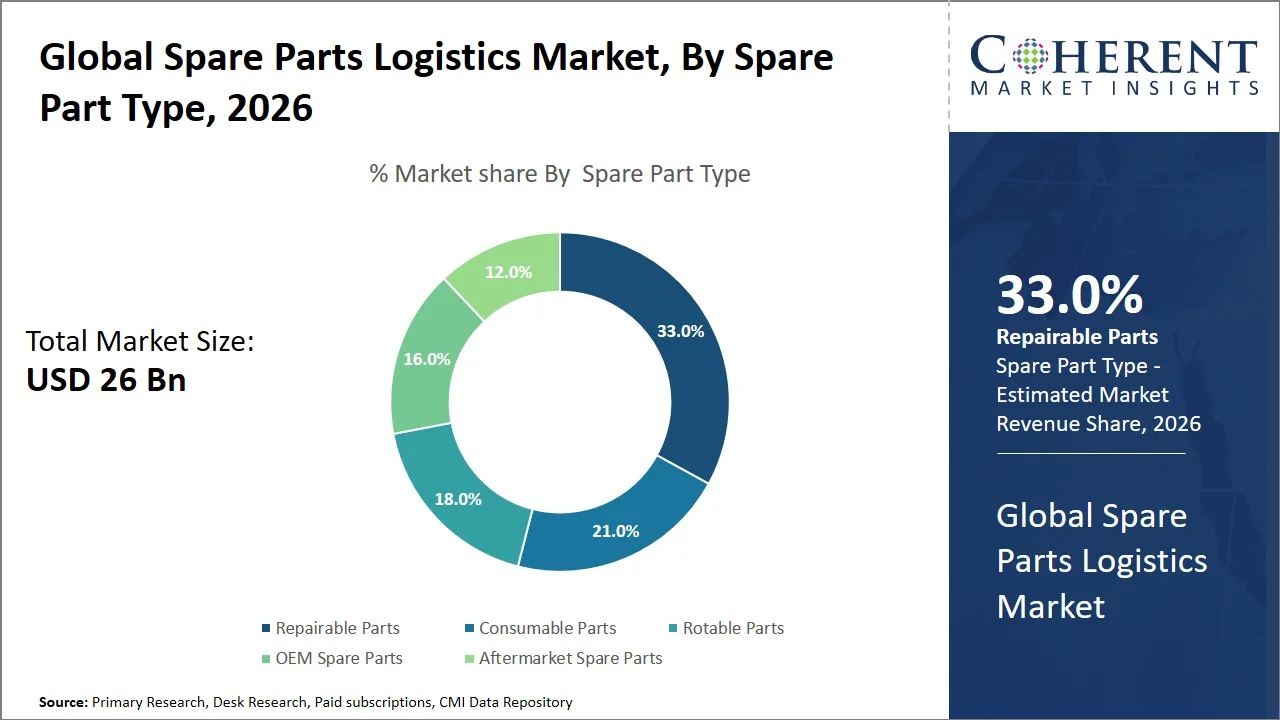
- The repairable parts segment is expected to account for 33.0 % of the global spare parts logistics market share in 2026. Expansion of aerospace and defense maintenance, repair and overhaul activities is driving the growth of the segment. On March 10, 2026, Tata Advanced Systems Limited (TASL) expanded its defense aviation MRO footprint through a dedicated facility for the Indian Air Force C-130J Super Hercules fleet, supported by digital maintenance software integration
- The air freight segment is estimated to capture 39.0 % of the market share in 2026. Increasing outsourcing of service logistics to specialized 3PL providers is majorly driving the growth of the segment. On May 4, 2026, Amazon launched a fully integrated third-party logistics offering under Amazon Supply Chain Services, allowing external companies to outsource warehousing, freight, and fulfillment operations. (Source: Amazon)
- The transportation segment is estimated to capture 28.0 % of the market share in 2026. Growth of e-commerce for industrial and automotive spare parts is driving the growth of the segment. On June 22, 2026, CARiD launched a dedicated maintenance section to enhance its multi-million parts catalog and combine the products that are typically used for routine upkeep and maintenance in one place.
- North America is expected to dominate the spare parts logistics market in 2026 with a market share of 36.0 %. Expansion of electric vehicle spare parts networks in North America is driving the growth of the regional market. On November 14, 2025, Ford expanded its Ford Pro Service network in North America, increasing the number of EV-certified dealerships capable of servicing electric F-150 Lightning and E-Transit fleets.
- Asia Pacific is expected to account for 31.0 % of the market share in 2026 and is projected to record the fastest growth over the forecast period. Increasing adoption of robotics and automated warehouses in Asia Pacific is driving the growth of the regional market. On April 27, 2026, Alibaba’s logistics arm, Cainiao expanded its smart warehouse network across China and Southeast Asia, integrating AI-driven sorting systems and autonomous robotics for high-volume e-commerce fulfillment.
- AI-Driven Predictive Inventory and Demand Planning: Artificial intelligence and machine learning are being increasingly used to predict spare parts demand based on equipment usage, maintenance history and operational data. This enables logistics providers to optimize their inventory levels, avoid stockouts, reduce excess inventory and improve service levels while reducing warehouse and inventory carrying expenses.
- Expansion of Automated Warehousing and Smart Fulfillment Centers: Robotics, automated storage and retrieval systems (AS/RS), autonomous mobile robots (AMRs) and IoT-enabled warehouse management systems are assisting in revolutionizing the distribution of spare parts. These solutions increase the accuracy of picking, speed up the processing of orders, increase efficiency in the warehouse and facilitate same day or next day delivery of mission critical spare parts.
Segmental Insights
Why Does the Repairable Parts Segment Dominate the Global Spare Parts Logistics Market?
The repairable parts segment is expected to account for 33.0% of the global spare parts logistics market share in 2026. The spare parts logistics market has a big percentage of repairable parts. These are high value components that are generally reconditioned, fixed, tested and returned to service instead of being thrown away. Repairable parts are vital for industries including aerospace, automotive, industrial machinery and energy to save maintenance costs, increase equipment life and meet sustainability goals. It provides ongoing logistics requirements for collection, transit, inspection, repair coordination, inventory management, and reverse logistics, making repairable parts a primary driver of total logistics demand. On April 8, 2025, Pratt & Whitney developed a new additive manufacturing repair for critical geared turbofan engine components that will reduce process time by more than 60%. The company is currently working to industrialize the repair, which will then be scaled and applied throughout the global GTF MRO network. (Source: Pratt & Whitney)
- Current Industry Events of 2026
- Market Size Estimation
- Regional Breakdown
- Competitive Landscape
- Customer Intelligence
- Segmental Analysis
- Pricing Analysis
- Key Market Drivers, Challenges & Future Trends
- Customized Insights Section
Why is Air Freight the Most Used Transportation Mode?
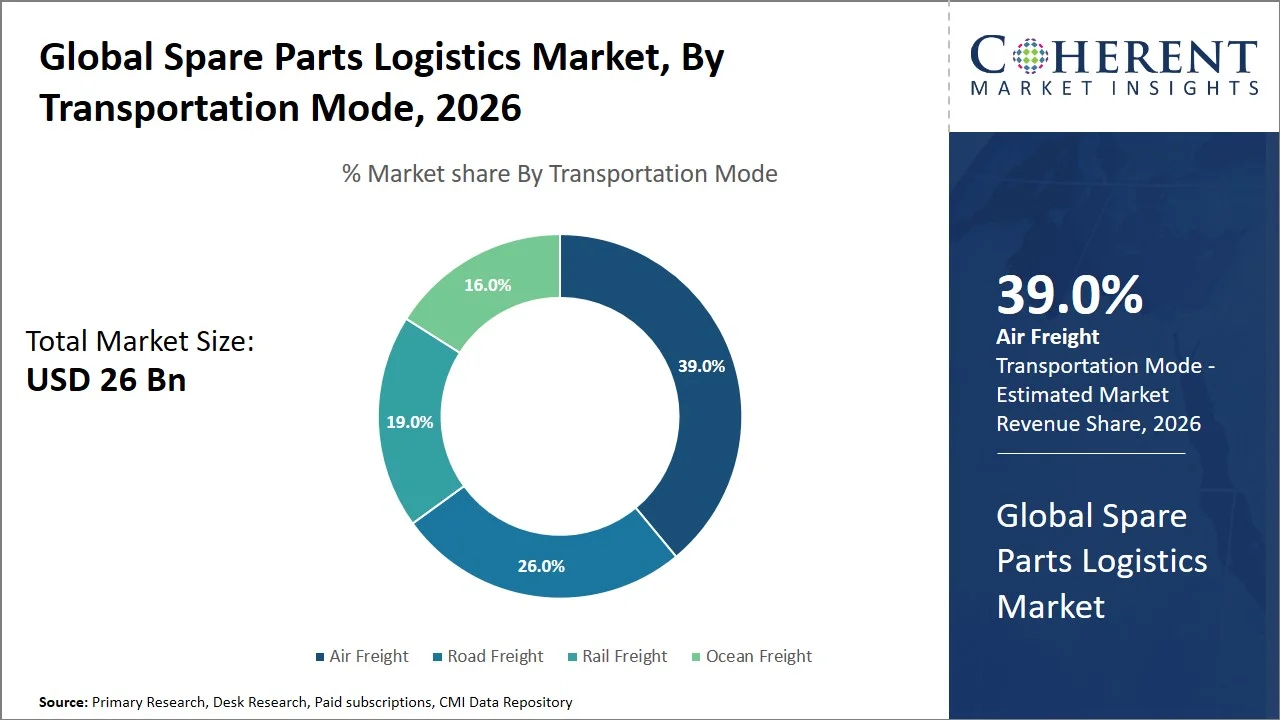
The air freight segment is expected to account for 39.0% of the global spare parts logistics market share in 2026. Most spare parts are mission-critical components that need to be delivered to customers or maintenance facilities in the quickest feasible time, to avoid costly equipment downtime, which is why air freight is favored. For example, aerospace, automotive, healthcare and industrial manufacturing firms rely on the timely delivery of high-value parts to keep operations running and to meet stringent service-level agreements. Higher shipping costs make air the more expensive mode but it is the preferred mode for urgent and time sensitive spare parts logistics, notably for emergency repairs and just-in-time maintenance operations because of its speed, reliability and worldwide connection. On January 26, 2026, DHL Supply Chain confirmed the renewal of its contract with Airbus to manage and orchestrate its global transport flows for its commercial aircraft activities. Each year, DHL Supply Chain manages nearly 350,000 shipments for around twenty Airbus sites worldwide, from its centers of expertise in Toulouse, France and Valencia, Spain. (Source: DHL)
Transportation Dominates the Global Spare Parts Logistics Market
The transportation segment is expected to account for 28.0% of the global spare parts logistics market share in 2026. Transportation represents the greatest percentage of spare parts logistics spending, as spare parts are often moved swiftly across regional and worldwide networks to support maintenance, repair and service activities. The rapid replenishment of vital components is typically required by producers, airlines, automotive firms, utilities, and industrial operators to avoid production losses and service interruptions. Accordingly, companies invests heavily in logistics services such as air, road, rail and ocean transportation that enable on-time delivery, extensive geographic reach and reliable supply chain connectivity to numerous client locations and service centers. On November 13, 2025, DHL Group announced it will invest more than USD 1 billion across all its business units in India by 2030. The investment reflects DHL's confidence in India's dynamic market and aligns with its Strategy 2030 to accelerate sustainable growth.
Currents Events and their Impact
Current Events | Description and its Impact |
EU Customs Reform Package |
|
Ocean Shipping Reform Act (OSRA) Implementation Measures |
|
Global Spare Parts Logistics Market - Hyper-Localized Spare Parts Distribution Networks (2025-2026)
OEMs are consolidating regional hubs and micro-fulfillment centers to provide hyper-local spare parts distribution, particularly inside automotive aftermarket networks. Advance Auto Parts and others are turning their supply chains into regional market hubs with 80,000+ SKUs within reach of repair facilities the same day. That reduces the need for national distribution centers and increases the response time to fleet and passenger vehicle outages. This paradigm is increasingly being enabled by AI-based inventory positioning and cross-border logistics connectivity between the U.S. and Mexico to accelerate the shipping of parts for industrial clusters. Key points include:
- 2025: Regional parts micro-fulfillment hubs typically 20,000-80,000 sq. ft., with same-day delivery to urban service areas.
- 2025: Regional parts micro-fulfillment hubs constituted 22.3% of the automotive parts fulfillment segment and are anticipated to be the fastest growing fulfillment model.
- 2025: OEMs increasingly use multi-tier distribution networks (national distribution centers, regional distribution centers, urban depots) to improve service responsiveness.
- 2025: Digital control towers and AI-based inventory optimization are used to dynamically position fast-moving spare parts based on regional demand patterns.
- 2025-2026: Logistics providers are implementing local warehouse automation and robotics to accelerate order processing and improve inventory accuracy at regional spare parts hubs.
Spare Parts Logistics Market Dynamics
Market Drivers
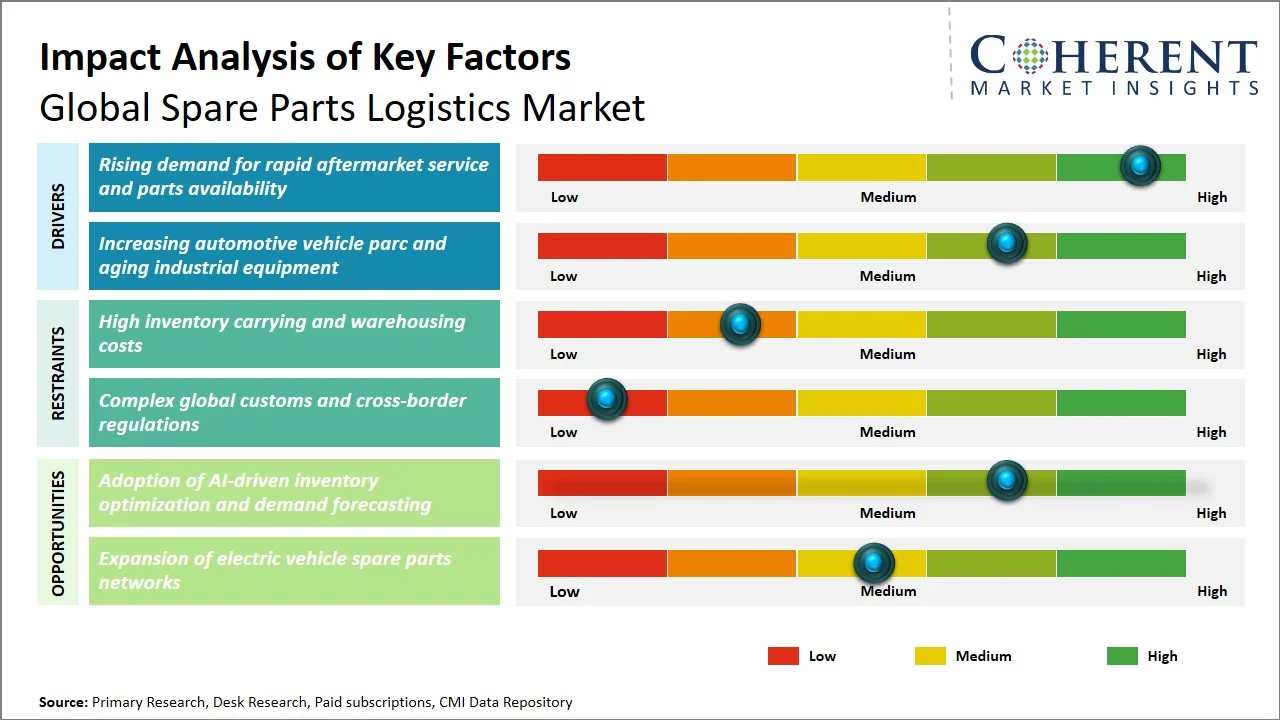
- Rising demand for rapid aftermarket service and parts availability: Rapid aftermarket service and parts availability is one of the key growth drivers for the spare parts logistics market. The automotive, aerospace, industrial machines, healthcare, and energy industries are progressively adopting on-demand availability of spare parts to reduce equipment downtime and assure operational continuity. Modern consumers demand quick resolution to maintenance and repair requirements. Therefore, manufacturers and logistics providers need to develop sophisticated distribution networks, strategically placed inventory hubs and fast transit options that guarantee rapid and efficient delivery of critical spare parts. DHL Global Forwarding said it has noticed an increasing demand for urgent air freight shipments in 2025, including automotive, aerospace and industrial replacement parts, as a result of tighter service level agreements and production continuity concerns.
- Increasing automotive vehicle parc and aging industrial equipment: The expanding automotive vehicle parc globally and the growing aging industrial equipment are the key drivers for the need of spare parts logistics services. Performance and reliability of vehicles, manufacturing machinery, construction equipment and industrial assets requires more regular maintenance, repair and component replacement due to their longer service lives. This trend is increasing the volume of spare parts that must be held, transported and supplied efficiently, prompting manufacturers and logistics providers to improve inventory networks and optimize distribution capacities to meet increasing aftermarket service requirements. For example, a recent research project by Mckinsey in 2025 highlighted substantial growth of India’s car parc with over 430 million vehicles by 2030, with aging fleets driving stronger replacement cycles.
Emerging Trends
- Growth of Predictive Maintenance and Connected Asset Logistics: Industries are increasingly deploying IoT sensors, digital twins and remote monitoring systems in spare parts logistics networks. Connected devices generate real time performance data for predictive maintenance. You can pre-position and pre-position spare parts to help reduce unplanned downtime and improve operational efficiency.
- Adoption of Sustainable and Regionalized Logistics Networks: Companies are establishing regional distribution centers, electric vehicle fleets for deliveries, optimized transportation routes and eco-friendly packaging to reduce carbon emissions and enhance supply chain resilience. The shift to local inventory centers also enables companies to safeguard against disruptions in global supply chains and allows for quicker reaction times in aftermarket service and maintenance.
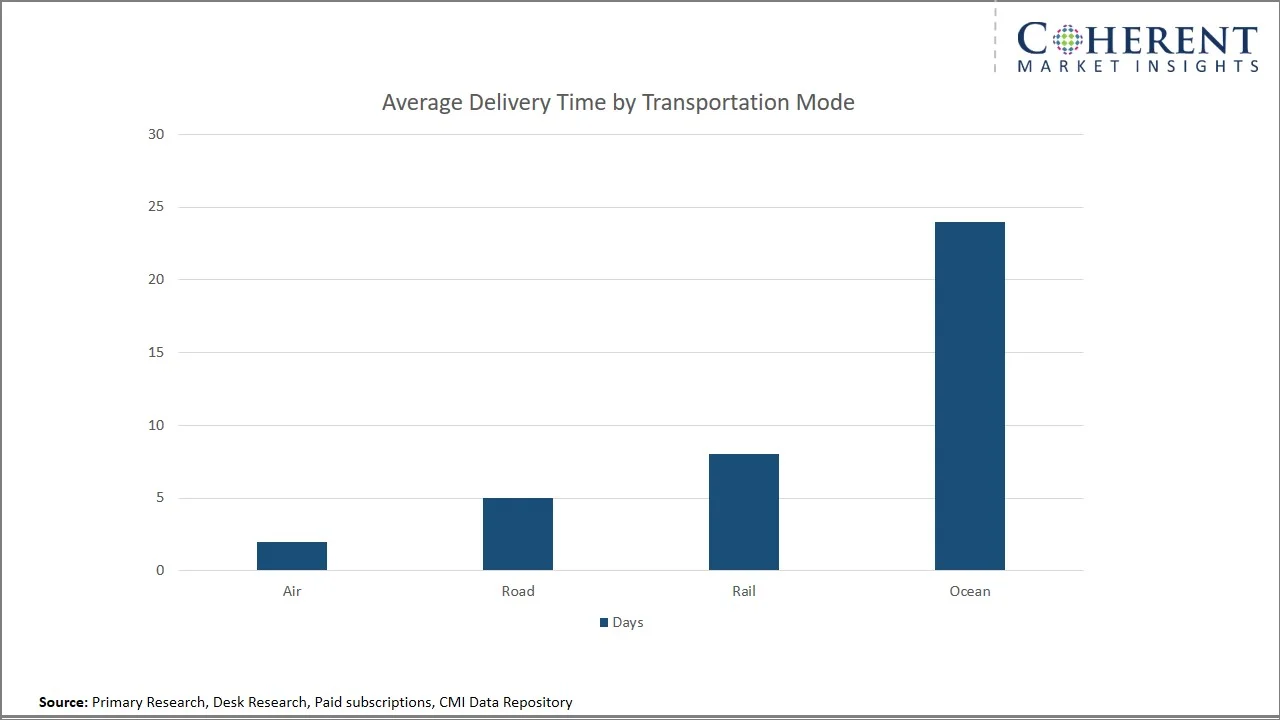
Global Spare Parts Logistics Market - Average Delivery Time by Transportation Mode
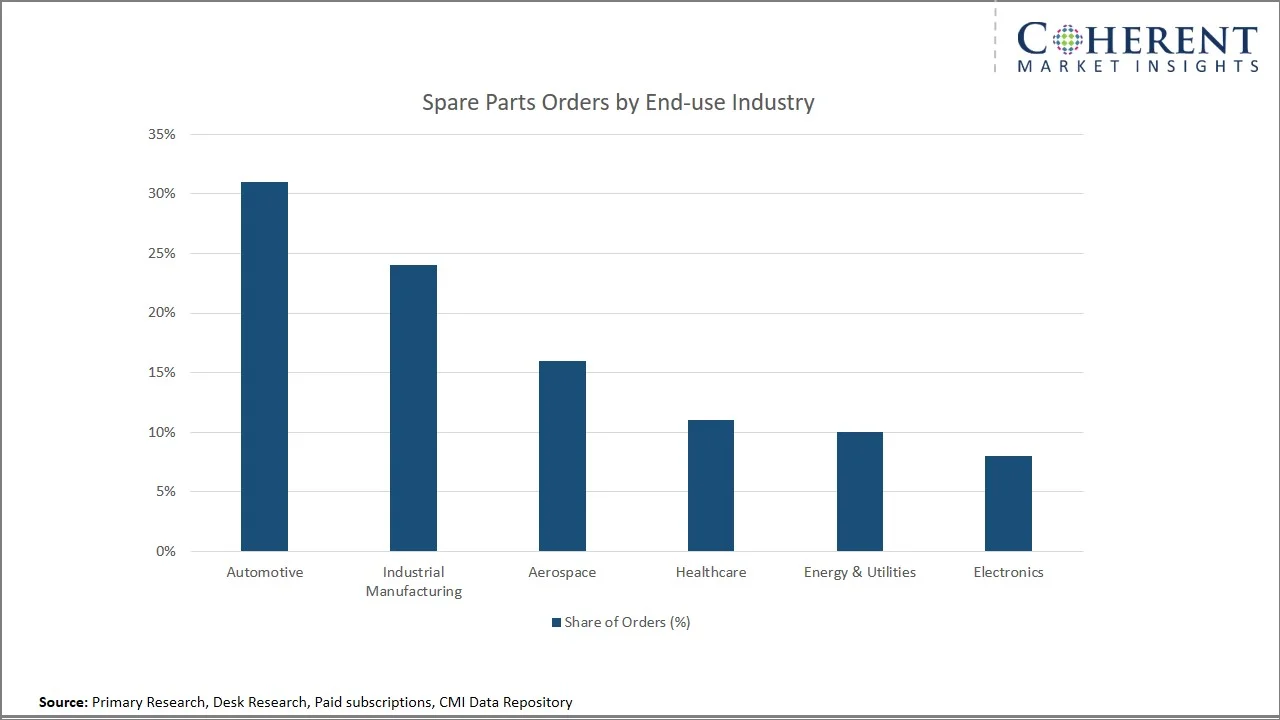
Global Spare Parts Logistics Market - Spare Parts Orders by End-use Industry
Regional Insights

Why is North America a Strong Market for Spare Parts Logistics?
North America is expected to account for a market share of 36.0% in 2026. Highly digitized aftermarket ecosystems and OEM-controlled service networks are key drivers of the North America spare parts logistics market, particularly in the automobile and aerospace industries. UPS Supply Chain Solutions and FedEx Logistics have specialized time-definite Aircraft on Ground (AOG) and critical automobile parts delivery programs, with engine modules and avionics reaching repair hubs within hours. In the U.S. automotive market, Ford and GM are examples of manufacturers that use regional micro-fulfillment centers to supply fast-moving repair parts to dealerships, while industrial OEMs use predictive maintenance platforms to automatically ship replacement parts ahead of machine breakdown. On May 29, 2026, UPS announced that it has invested nearly USD 50 million in network capabilities and dedicated industry teams to help automotive and industrial manufacturers operate with greater resilience and precision. Building on this, UPS announced the expansion of its North American Air Freight (NAAF) capabilities, introducing time-definite heavy air freight service to and from Mexico for the first time and extending coverage across North America to better support production-critical supply chains. (Source: UPS)
Why Does the Asia Pacific Spare Parts Logistics Market Exhibit High Growth?
Asia Pacific is projected to account for 31.0% of the global spare parts logistics market and is expected to register the fastest growth. The spare parts logistics market in Asia Pacific is highly influenced by high volume manufacturing clusters and fragmented distribution network for aftermarket, notably in countries such as China, Japan, South Korea and India. In nations like China, major industrial hubs such as Shenzhen and Guangzhou enable reverse logistics flows for electronics and EV components, where reconditioned components may be quickly reintegrated into supply chains. The logistics networks of Japan’s precision manufacturing ecosystem, including Toyota and Hitachi, are tightly integrated, with spare parts shipped through automated warehouses directly connected to production plants, resulting in minimal downtime for industrial and automotive equipment across domestic and export markets. On June 9, 2026, DHL Supply Chain announced the expansion of its data center logistics capabilities across the Asia Pacific region, reinforcing its role as a strategic partner for hyperscalers and data center operators as AI investment accelerates and large-scale deployments move into execution.
Global Spare Parts Logistics Market Outlook for Key Countries
Why is the U.S. Emerging as a Major Hub in the Spare Parts Logistics Market?
High-value, urgency-driven supply chains, especially in aerospace, defense and industrial manufacturing characterize the U.S. spare parts logistics ecosystem. Delta, United and others have AOG logistics programs sponsored by logistics partners such as DHL and UPS. Critical components like turbine blades or hydraulic systems are flown straight to repair facilities. In the industrial arena, Caterpillar and the like have worldwide component distribution hubs in Midwest U.S., where predictive analytics are used to decide the placement of spare parts among dealer networks in support of the heavy gear used in mining and construction.
Is China the Next Growth Engine for the Spare Parts Logistics Market?
China’s spare parts logistics market is witnessing rapid growth, primarily because it is a worldwide manufacturing and exporting hub for electronics, EVs, and industrial machinery components. Fast domestic logistics networks connected with express carriers such as SF Express are relied on by companies such as BYD and Huawei to transfer EV battery modules, circuit boards and telecom equipment parts rapidly across provinces. Additionally, China has built massive reverse logistics for such things as reconditioned electronics and automobile parts, particularly in industrial hubs such as the Pearl River Delta where remanufacturing and redistribution cycles are closely controlled and very efficient.
Germany Spare Parts Logistics Market Analysis and Trends
Germany's spare parts logistics market is intimately associated with its modern automotive and industrial engineering industries, particularly OEMs such as Volkswagen, BMW, Siemens and Bosch. These organizations have very synchronized just-in-time (JIT) spare parts systems where components such as transmission units, sensors and automation elements are spread through centralized European hubs. Logistics suppliers, like DB Schenker, assist cross-border EU spare parts flows, enabling car repair centers across Europe to rapidly obtain crucial components and keep production running and aftersales service efficient.
Japan Spare Parts Logistics Market Analysis and Trends
The spare parts logistics ecosystem in Japan is extremely precise, automated and lean in its supply chain design, especially for automotive and electronics industry. Toyota’s “Toyota Production System” is also used to spare parts distribution, with kanban-based replenishment triggering the quick shipping of essential components, such as brake systems and electronic control units. Mitsubishi Electric and Panasonic operate highly automated spare parts warehouses, coupled with robotics and AI-assisted forecasting, to keep inventory waste low yet response times fast for local service networks and worldwide export customers.
India Spare Parts Logistics Market Analysis and Trends
The market for spare parts logistics in India is evolving fast, driven by increasing automobile ownership, the need for industrial maintenance, and the growth of digital logistics infrastructure. There are companies like TVS Supply Chain Solutions that handle multi-tier spare parts distribution for automotive OEMs like Tata Motors and Mahindra, ensuring that components are available in tier-2 and tier-3 cities through regional warehouses. The growth of fast spare parts delivery, especially for repairing networks of two-wheelers and commercial vehicles, has been boosted by platforms like Delhivery and Blue Dart, where reduction of the downtime is a vital operational requirement for fleet owners and industrial users.
Global Spare Parts Logistics Market - Emergency Spare Parts Shipments
Industry | Typical Emergency Shipment Trigger | Average Response Time | Typical Delivery Window |
Automotive | Assembly line stoppage, dealer service | 30-60 minutes | 4-24 hours |
Aerospace | Aircraft on Ground (AOG) | 15-30 minutes | 2-12 hours |
Industrial Manufacturing | Equipment breakdown | 30-90 minutes | 6-24 hours |
Energy & Utilities | Power generation or grid equipment failure | 30-120 minutes | 8-36 hours |
Healthcare & Medical Devices | Diagnostic equipment failure | 15-60 minutes | 4-24 hours |
How is the Adoption of AI-Driven Inventory Optimization and Demand Forecasting Creating New Growth Opportunities in the Spare Parts Logistics Market?
AI-powered demand forecasting and inventory optimization are creating new avenues of growth in the spare parts logistics space, transforming how companies predict, store and distribute critical components across complex supply chains. AI models may leverage real-time data on equipment usage, historical failure trends, seasonal fluctuations in demand, and maintenance plans to accurately predict spare parts demand, thereby mitigating the risk of stockouts and overstocking. This enables logistics providers and OEMs to shorten the reach of spare parts to end users through optimized regional hubs, and improve speed of delivery for time sensitive repairs in industries such as automotive, aerospace and industrial manufacturing. In addition, AI technologies enhance coordination between suppliers, warehouses and transportation systems, enabling dynamic rerouting and automated replenishment decisions. This, in turn, cuts costs and improves service dependability, making spare parts logistics more predictable, efficient and scalable.
On July 17, 2025, Walmart scaled its Inventory Ledger system, which employs AI to provide billions of weekly projections for demand and stock positioning across its U.S. store network. The solution allows for near real-time identification of misplaced inventory and automates replenishment decisions, leading to a huge improvement in fast-moving products availability and reduction of manual forecasting errors across retail supply chains.
Market Players, Key Development, and Competitive Intelligence

Key Developments
- On July 1, 2026, The CMA CGM Group, a leading global player in sea, land, air and logistics solutions, announced an agreement to acquire FedEx Supply Chain, a subsidiary of FedEx Corp, at an enterprise value of USD 1.4 billion. The acquisition would nearly triple the size of the North American contract logistics operations of CEVA Logistics, a subsidiary of the CMA CGM Group.
- On March 19, 2026, DHL announced a significant expansion of its North America data center logistics (DCL) infrastructure with 10 dedicated warehouse sites totaling more than seven million square feet of capacity set to go live in 2026. Designed for hyperscale and colocation data center operators racing to deploy new capacity, the facilities will offer white-glove handling, rack configuration services, and specialized warehouse-to-site transportation.
Competitive Landscape
Integrated 3PL providers, OEM-controlled service logistics networks and digitally empowered supply chain professionals are shaping the spare parts logistics business. The level of service integration is significant, with players such as DHL Supply Chain, Kuehne+Nagel and DB Schenker positioned as end-to-end logistics partners managing inventory management, reverse logistics and time critical delivery for automotive and industrial OEMs. Companies are investing in AI-based demand sensing, automated warehouses and real-time monitoring systems to differentiate service levels, creating intense rivalry in building digital control towers and predictive logistics platforms. In areas such as aerospace MRO and electric car ecosystems, logistics providers and manufacturers are increasingly forming strategic relationships to gain long-term aftermarket contracts and exclusivity in regional distribution.
Market Report Scope
Spare Parts Logistics Market Report Coverage
| Report Coverage | Details | ||
|---|---|---|---|
| Base Year: | 2025 | Market Size in 2026: | USD 26 Bn |
| Historical Data for: | 2020 To 2024 | Forecast Period: | 2026 To 2033 |
| Forecast Period 2026 to 2033 CAGR: | 5% | 2033 Value Projection: | USD 37 Bn |
| Geographies covered: |
| ||
| Segments covered: |
| ||
| Companies covered: | DHL Supply Chain, DB Schenker, DSV, CEVA Logistics, FedEx Logistics, UPS Supply Chain Solutions, Kuehne Nagel, Nippon Express, Ryder System, GEODIS, Yusen Logistics, Expeditors International, TVS Supply Chain Solutions, Rhenus Logistics, and DACHSER | ||
| Growth Drivers: |
| ||
| Restraints & Challenges: |
| ||
Analyst Opinion (Expert Opinion)
- The spare parts logistics market is increasingly seen as reliant on predictive supply chain information, as well as integrated aftermarket ecosystems, where the focus is on service performance rather traditional transportation cost criteria. A change is being seen from reactive spare parts distribution to condition-based and predictive fulfillment models, especially in high-value industries like aerospace, automotive and industrial machinery. Operational resilience is being enhanced through the implementation of digital twins, automated warehousing systems and AI-enabled inventory orchestration platforms, it has been highlighted. Recurring global disruptions and increased need for shortened lead times in important maintenance operations are further underscoring the reliance on regionalized supply chain structures.
- The future of the spare parts logistics industry will likely be characterized by the growth of autonomous supply chain execution and the creation of highly integrated OEM-logistics ecosystems, where the movement of spare parts is increasingly coordinated with real-time equipment diagnostics. Expected growth in hyper-local distribution networks driven by micro-fulfillment centers to satisfy the ultra-fast delivery needs of mission-critical components for automotive electrification and industrial automation. Additive manufacturing is predicted to lessen the need on physical inventory for some low volume spare parts by on-demand manufacturing closer to the point of use. Sustainability-linked logistics optimization, such as carbon-aware routing and electrified freight networks, are also projected to be included into spare parts distribution plans, changing cost structures and service models across global marketplaces.
Speak to the analyst
Want personalized insights?
Take the findings above to one of our principal consultants, or have the report rebuilt around the segments, geographies and competitors you actually track.
Market Segmentation
- Spare Part Type Insights (Revenue, USD Billion, 2021 - 2033)
- Repairable Parts
- Consumable Parts
- Rotable Parts
- OEM Spare Parts
- Aftermarket Spare Parts
- Transportation Mode Insights (Revenue, USD Billion, 2021 - 2033)
- Air Freight
- Road Freight
- Rail Freight
- Ocean Freight
- Service Type Insights (Revenue, USD Billion, 2021 - 2033)
- Transportation
- Warehousing
- Inventory Management
- Order Fulfillment
- Reverse Logistics
- Value-Added Services
- End User Insights (Revenue, USD Billion, 2021 - 2033)
- Automotive
- Aerospace and Defense
- Industrial Machinery
- Electronics
- Healthcare and Medical Devices
- Energy and Utilities
- Construction Equipment
- Others
- Regional Insights (Revenue, USD Billion, 2021 - 2033)
- North America
- U.S.
- Canada
- Latin America
- Brazil
- Argentina
- Mexico
- Rest of Latin America
- Europe
- Germany
- U.K.
- Spain
- France
- Italy
- Russia
- Rest of Europe
- Asia Pacific
- China
- India
- Japan
- Australia
- South Korea
- ASEAN
- Rest of Asia Pacific
- Middle East
- GCC Countries
- Israel
- Rest of Middle East
- Africa
- South Africa
- North Africa
- Central Africa
- North America
- Key Players Insights
- DHL Supply Chain
- DB Schenker
- DSV
- CEVA Logistics
- FedEx Logistics
- UPS Supply Chain Solutions
- Kuehne Nagel
- Nippon Express
- Ryder System
- GEODIS
- Yusen Logistics
- Expeditors International
- TVS Supply Chain Solutions
- Rhenus Logistics
- DACHSER
Sources
Primary Research Interviews
- Supply Chain Directors - Automotive OEMs
- Aftermarket Logistics Managers- Automotive & Industrial Equipment Manufacturers
- Global Spare Parts Planning Managers
- Warehouse & Distribution Center Managers
Magazines
- Inbound Logistics
- Logistics Management
- Modern Materials Handling
Journals
- International Journal of Production Economics
- International Journal of Physical Distribution & Logistics Management
- Journal of Business Logistics
- Transportation Research Part E: Logistics and Transportation Review
Associations
- Council of Supply Chain Management Professionals
- Association for Supply Chain Management
- Chartered Institute of Logistics and Transport
- International Air Transport Association
Public Domain Sources
- United States Census Bureau
- Bureau of Transportation Statistics
- Eurostat
- Organisation for Economic Co-operation and Development
- World Bank
Proprietary Elements
- CMI Data Analytics Tool
- Proprietary CMI Existing Repository of information for last 10 years
Get access to 250+ pages report
Every segment, forecast, competitor profile and data table behind the analysis above — available for instant download.
- ESOMAR Member
- ISO 9001:2015 Certified
- D-U-N-S Registered
- GDPR & CCPA Compliant
Missing comfort of reading report in your local language? Find your preferred language:
Transform your Strategy with Exclusive Trending Reports
Frequently Asked Questions
The global spare parts logistics market is expected to stand at USD 26 Bn in 2026 and is expected to reach USD 37 Bn by 2033.
The CAGR of the global spare parts logistics market is projected to be 5% from 2026 to 2033.
In terms of spare part type, the repairable parts segment is estimated to dominate the market revenue share in 2026.
They offer outsourced warehousing, distribution, and time-critical delivery services.
They automate inventory tracking, order fulfillment, and stock optimization processes.
Rising demand for rapid aftermarket service and parts availability and increasing automotive vehicle parc and aging industrial equipment are the major factors driving the growth of the global spare parts logistics market.
High inventory carrying and warehousing costs and complex global customs and cross-border regulations are the major factors hampering the growth of the global spare parts logistics market.