

Global Specialized Senior Care Market Size and Forecast – 2026 To 2033
The global specialized senior care market is expected to grow from USD 312.6 Bn in 2026 to USD 516.4 Bn by 2033, registering a compound annual growth rate (CAGR) of 7.4% from 2026 to 2033. The major factor driving the growth of the global specialized senior care market is the increasing need for specialized services such as home nursing, dementia care, rehabilitation, medication management, and assisted living.
According to the World Health Organization (WHO), the worldwide population of people aged 60 years or over is expected to rise from 1 billion (in 2020) to 1.4 billion (by 2030) and 2.1 billion (by 2050). This aging demographic is likely to result in ongoing demand for professional and customized senior care services.
Key Takeaways of the Global Specialized Senior Care Market
- Home nursing and personal care is projected to hold 31.8% of the global specialized senior care market share in 2026, making it dominant service type segment. North America is a prominent market place for demand owing to proven home health services and need for customized care. For instance, as per the statistics by US bureau of labor statistics the employment of home health and personal care aides is predicted to grow by 18% between 2025 and 2035.
- In-home care is projected to account for 48.6% of the global specialized senior care market share in 2026, thus becoming the dominating care delivery model segment. Europe presents a high market demand owing to the surging demand for in-home care and short-term services, as the population gets older. For instance, according to Eurostat 22% of the European Union population is above 65 years of age in 2025, which increases the demand for long term care services.
- Chronic disease and complex medical care are expected to hold the largest share of 28.6% of the global specialized senior care market by 2026, becoming the leading care need segment. The Asia Pacific (APAC) region, specifically Japan, is the largest market demand center for the services and care support industries, as the aging population and people in need of continuous medical and daily care support continue to increase. For instance, as per the report by Japan's Cabinet Office, 29.4% of the population is 65 years or above in 2025. This highlights the demand for accurate management of long-term diseases and better care for senior citizens.
- North America is forecast to maintain its leadership position in the global specialized senior care market, accounting for 38.6% of the market in 2026. The growth in the geographical outlook is credited to the increasing demand for community-based care, home nursing, and support with daily activities. For instance, as per statistics of Statistics Canada, 10.4% of Canadians aged 65 years and above used home care in 2023.
- The Asia Pacific region is projected to register the fastest growth in the global specialized senior care market during the forecast period (2026-2033), at a CAGR of 8.6%. Long-term care, community-based services, and caregiving support, under the jurisdiction of the federal government, have gained momentum. For instance, Singapore has introduced higher subsidies up to 80% for eligible long-term care services, and funding for home caregiving and community care.
Segmental Insights
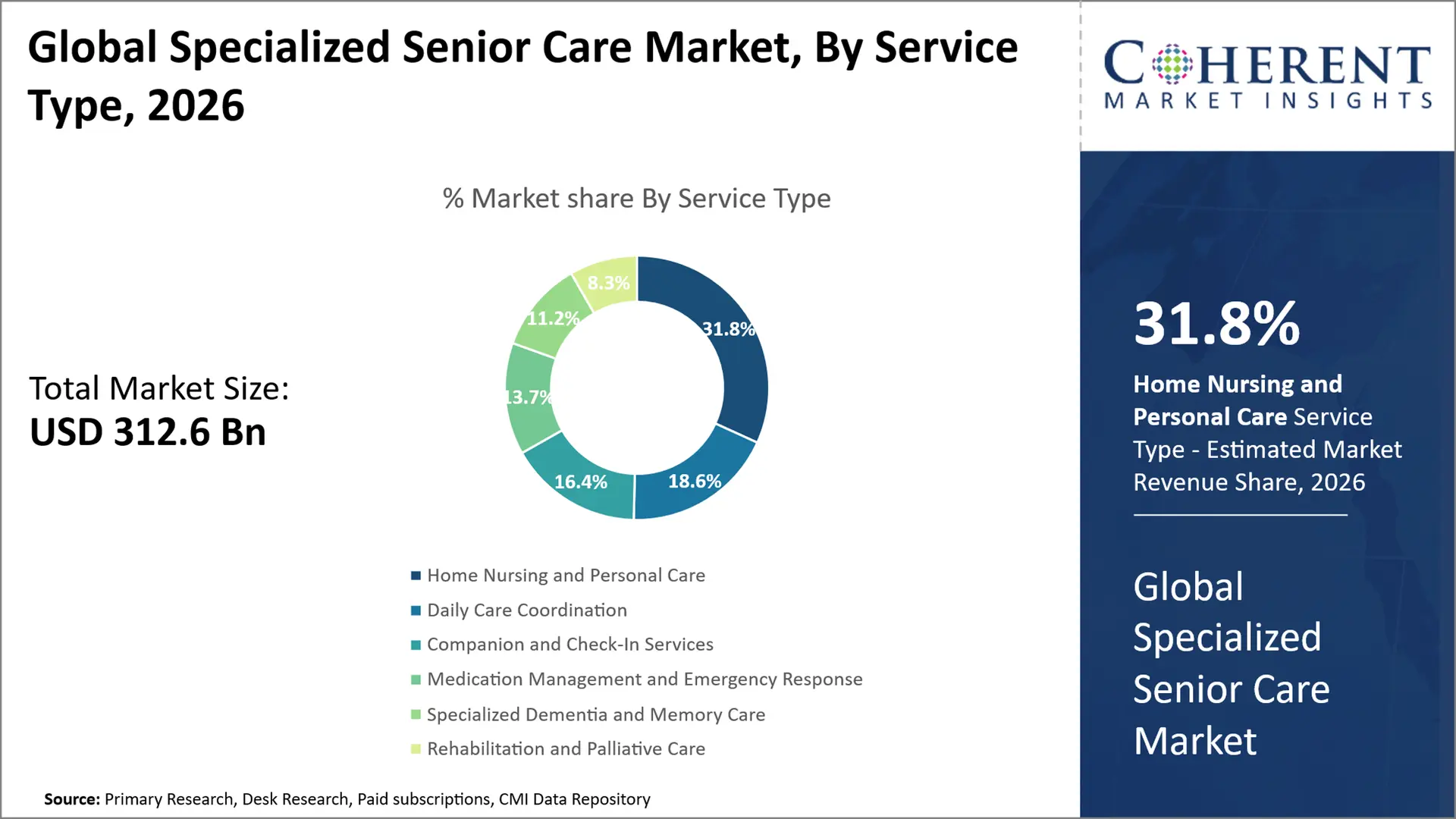
Why Do Home Nursing and Personal Care Dominate the Global Specialized Senior Care Market?
Home nursing and personal care is projected to hold the market share of 31.8% in 2026. As more families seek professional medical help and assistance to perform the activities of daily living, a larger number of seniors are choosing to stay at home rather than move to an assisted living facility. This is supported by government-sponsored initiatives that integrate clinical care and personal assistance. For instance, Ontario’s Home and Community Care program provides eligible seniors with nursing care, wound care, physiotherapy, medication assistance, and personal support for daily activities, helping them remain safely at home. (Source: Ministry of Health)
- Current Industry Events of 2026
- Market Size Estimation
- Regional Breakdown
- Competitive Landscape
- Customer Intelligence
- Segmental Analysis
- Pricing Analysis
- Key Market Drivers, Challenges & Future Trends
- Customized Insights Section
Why Does In-Home Care Represent the Largest Care Delivery Model Segment in the Specialized Senior Care Market?
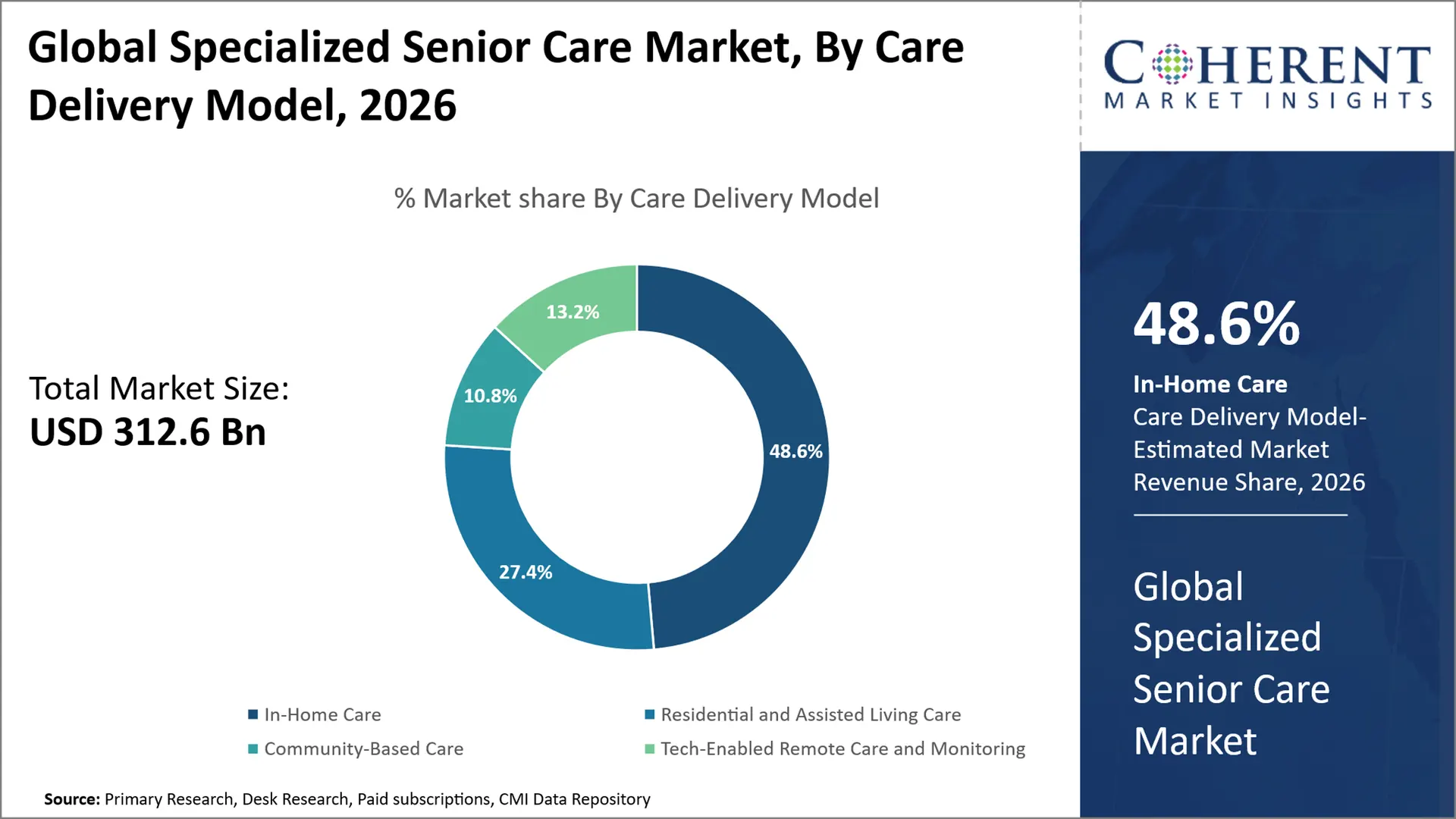
In-home care is projected to hold a market share of 48.6% in 2026, due to its favorable nature of providing medical care and assistance with daily activities to the elderly. This will enable them to live independently. For instance, Japan's Ministry of Health, Labour and Welfare promotes its community-based Integrated Care System, which efficiently integrates home medical care, nursing, preventive and daily life support systems to help older people stay in their communities. This policy framework improves the demand for flexible and home-based elderly care. (Source: Japan International Cooperation Agency)
Chronic Disease and Complex Medical Care Segment Dominates the Global Specialized Senior Care Market
The chronic disease and complex medical care segment are projected to hold a market share of 28.6% in 2026, as senior citizens more often require continuous clinical management, directed therapeutic approaches, and drug therapy for co-occurring chronic conditions. Moreover, the necessity to avert complications and unnecessary hospitalization also amplifies the requirement for integrated medical and personal care. For instance, in March 2026, the Australian Government launched its National Strategic Framework for Chronic Conditions 2026-2035 and proposed a new Chronic Conditions Prevention and Integrated Care Program to improve person-centered care, multidisciplinary care and the management of multiple chronic conditions.
Current Events and their Impact
Current Events | Description and its Impact |
Singapore Broadens Scope for Technology-Enabled Home Personal Care (March 2026) |
|
India Lays Down Long-Term Care Roadmap for Elderly (February 2026) |
|
Canada Maintains Financial Support for Home and Community Care (2025-2026) |
|
Specialized Senior Care Market Dynamics
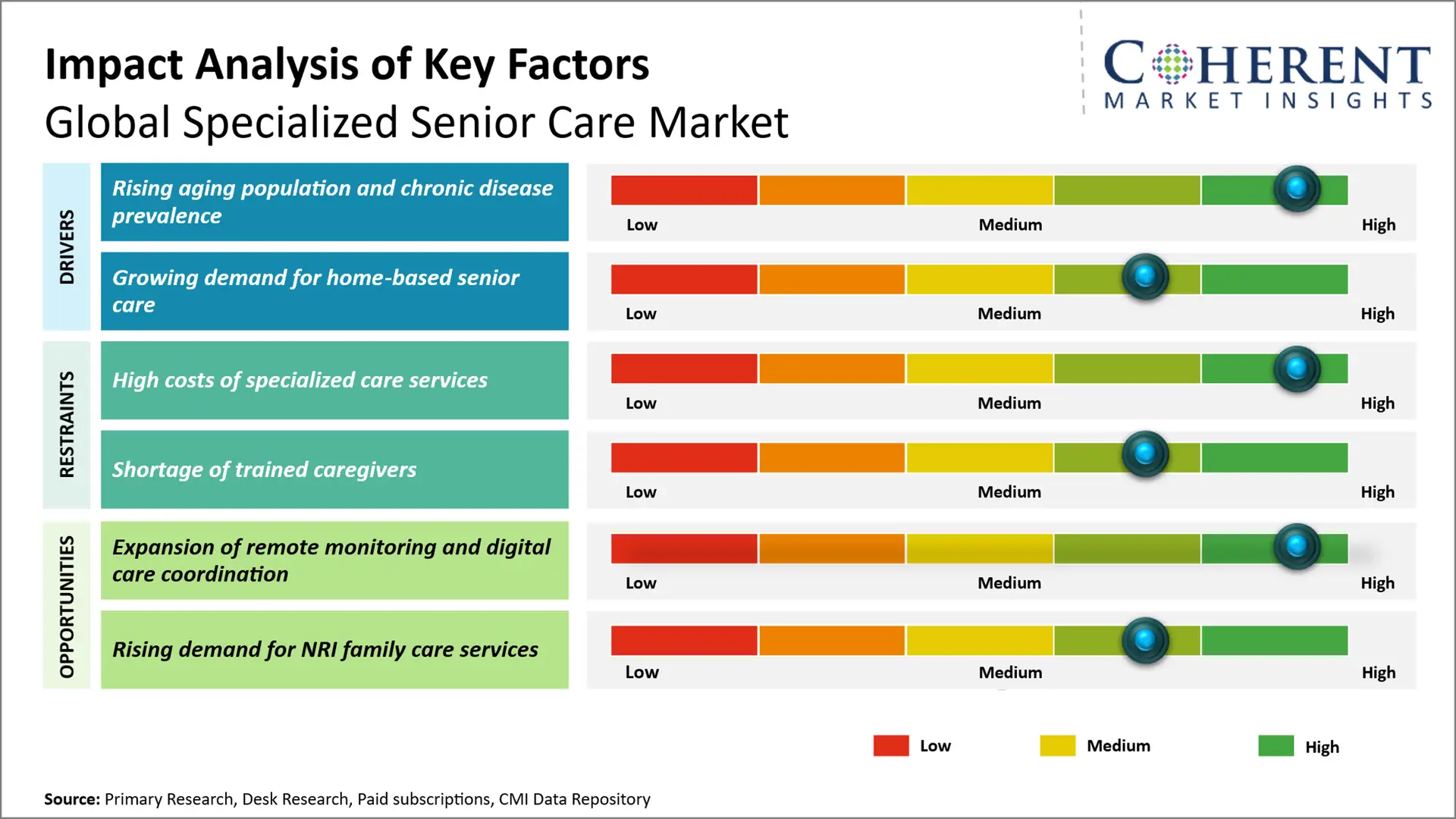
Market Drivers
- Rising aging population and chronic disease prevalence: The rising aging population along with the surging number of chronic diseases have significantly driven the demand for specialized senior care services across the globe. The rapid rise in the number of people requiring home healthcare services, medication assistance, rehabilitation and specialized long-term care is directly impacting the demand for individualized long-term care services. For instance, according to the Longitudinal Ageing Study of India (LASI) cited by NITI Aayog, 75% of the elderly population in India have one or more chronic conditions requiring life-long, personalized care.
- Growing demand for home-based senior care: The older generation's desire for in-home care options has created the additional demand for a specific, specialized senior care market. The move towards independent living for individuals and the increased popularity of one-on-one home healthcare continues to grow, giving rise to the need for in-home nursing care, help with daily activities, rehabilitation and home care assistance and coordination, with a general movement towards community-based services. For instance, in November 2025, Australia launched their Support at home program, which replaced Home Care Packages Program to provide 'coordinated individualized care, tailored to meet the needs of each older person to help them to live independently in their own homes'.
- Growing adoption of technology-enabled senior care: The global demand for specialized senior care continues to rise on the back of rising adoption of remote monitoring tools, digital care coordination systems and wearable alert systems for emergency response to lead a living independently and to avert adverse events. For instance, the active and assisted living (AAL) Programme, launched by the European Union, has supported tech-based solutions that improve elderly people's quality of life and home-based elderly care.
Emerging Trends
- Technology-enabled remote senior care: Remote patient monitoring devices, wearable safety gear, and online care coordinating platforms allow health to be constantly monitored and help to deliver faster emergency intervention. Wearable technology devices help families based overseas to keep their elderly loved ones safe.
- Growth of specialized dementia and memory care: As the demand for specialized dementia care increases, providers are creating dedicated dementia care communities, recruiting teams that have dementia expertise, and developing and implementing uniquely tailored dementia care programs. Cognitive therapies, safety monitoring, and family support are becoming essential.
- Shift toward integrated home-based care: Senior care organizations are applying home nursing, medication management, companionship, rehabilitation and emergency support services within services packages. These packages are all aimed at enabling people to live independently, fulfilling the growing demand for home-based services.
Regional Insights
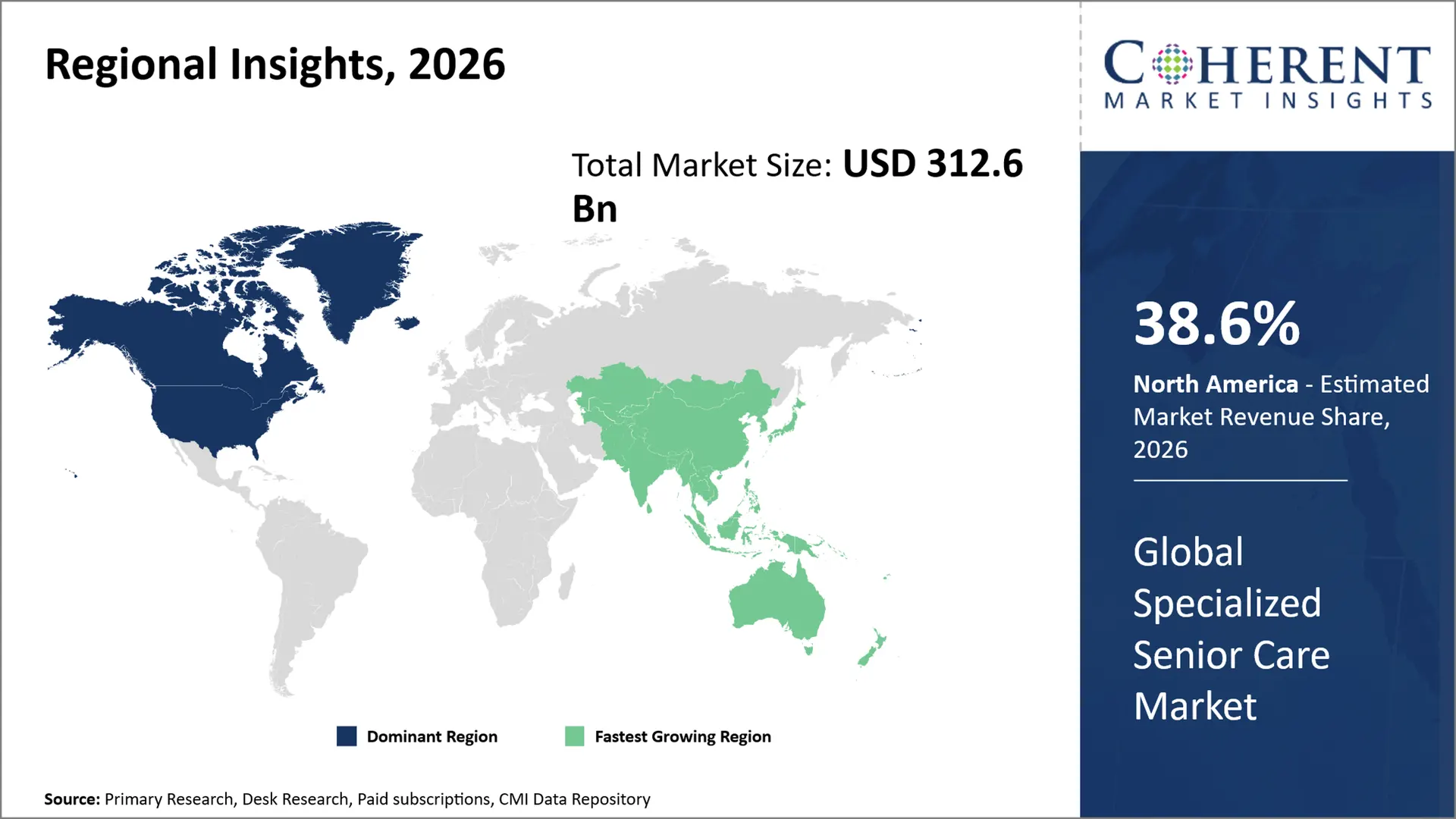
Why is North America a Strong Market for Specialized Senior Care?
North America leads the global specialized senior care market, accounting for an estimated 38.6% share in 2026, attributed to developed health systems, growing aging population, and the high demand for specialized care, both in-house as well as at home. Furthermore, the region benefits from extensive government support through health insurance schemes and reform initiatives promoting the development of customized care services, a mature care delivery system, healthcare, and insurance industries, and emerging advanced technology solutions to enhance specialized senior care services such as chronic care, dementia, and rehabilitation care. For instance, in 2025, U.S. Centers for Medicare & Medicaid Services (CMS) adopted the GUIDE Model to improve access to coordinated dementia care, including care navigation, caregiver support and care planning.
Why Does Asia Pacific Specialized Senior Care Market Exhibit High Growth?
Asia Pacific is expected to exhibit the fastest growth in the global specialized senior care market, registering an estimated CAGR of 8.6% during 2026–2033. The region is projected to account for 23.1% of the global market in 2026, owing to rapid population aging, urbanization, rising disposable income and the surging need for formal eldercare services. Moreover, the market is poised to gain from government initiatives aimed at improving eldercare infrastructure, home-based care and long-term care strengthening, investment in specialized care infrastructure, advanced technology-enabled home care, and enhancing the caregiver skillset to cater to local aging-related workforce shortages and the increasing demand for eldercare services. For instance, in March 2025, Singapore’s Ministry of Health has enhanced long-term care support, which provides subsidies for selected home and community-based care services. This allows the seniors to get affordable help, and ease the strain on families and caregivers.
Global Specialized Senior Care Market Outlook for Key Countries
Why is the U.S. Leading Innovation and Adoption in the Specialized Senior Care Market?
The U.S. is expected to hold a leading position in the specialized senior care market driven by its mature ecosystem of home health agencies, assisted living operators and memory care providers with access to Medicare and Medicaid reimbursement. The incorporation of remote patient monitoring, care management software, medication and emergency alerts from tech vendors makes services more integrated and enables a more coordinated care model. Furthermore, a combination of services that are either private-pay, insurance-supported or service-based with technology enables the commercialization of specialized senior care.
Is China a Favorable Market for Specialized Senior Care Market?
China is an attractive market for the specialized senior care due to its growing aging population, development of community-based eldercare and rising demand for dementia care, home healthcare and assisted living. There are significant growth opportunities especially in urban markets where technology-enabled monitoring and professional care can complement and compensate for quality and labor issues of family-based care. However, affordability and availability of trained caregivers remain challenges.
Is Japan Emerging as a Key Growth Hub for the Specialized Senior Care Market?
Japan is emerging as a key growth market for the specialized senior care market largely driven by the country's long-term care insurance system, high levels of demand for dementia and rehab care and home support. Additionally, the country has new robotics-enabled care offerings, as well as systems for remote health monitoring and digital care management that are designed to help compensate for caregiver shortages and support independent living among older adults.
Why Does Germany Top the European Specialized Senior Care Market?
Germany is the leader in the European specialized senior care market due to a full-fledged long-term care insurance system, widespread development of long-term care services, many residential facilities and formal home care financing. The development of dementia care, professional care, rehabilitation and other formal care benefits in Germany drives demand for specialized services at all levels of care.
Is Specialized Senior Care Market Developing in UK?
The UK specialized senior care market is changing as demand for home-based nurse-led care, dementia care, assisted living and rehabilitation following hospital discharges continues to grow. Systems of coordinated care and local authority investment in adult social care have created some potential for providers of integrated technology-enabled care services. However, workforce shortages and affordable care capacity are key issues.
Key Technology-Enabled Senior Care Services and Their Applications
Service Category | Key Applications | Market Relevance |
Home Nursing and Daily Care Coordination | Nursing visits, daily activity assistance, appointment coordination | Provides ongoing help for seniors in need at home |
Companion and Check-In Services | Scheduled visits, wellness calls, social engagement, safety checks | Reduces social isolation and supports seniors living alone |
Medication Management and Emergency Response | Medication reminders, adherence tracking, SOS alerts, emergency escalation Wearable devices, remote health dashboards, video check-ins, caregiver alerts | Improved compliance with medication schedules and, crisis response |
Remote Monitoring for NRI Families | Wearable devices, remote health dashboards, video check-ins, caregiver alerts | Allows overseas family members to monitor elderly parents and coordinate local care |
How is the expansion of remote monitoring and digital care coordination creating new growth opportunities in the specialized senior care market?
Remote patient monitoring and digital care coordination will open up huge growth opportunities for the overall specialized senior care market globally. This will enable continuous health tracking, swift emergency response and a higher degree of personalized support for older individuals living on their own. These will ensure seamless care continuity, help families and caregivers identify possible health risks earlier.
For instance, in June 2026, India’s Ministry of Social Justice and Empowerment launched JEEVAN mobile app and SHATAYU geriatric caregiver dashboard. The roll-out is expected to significantly improve digital accessibility of elderly welfare information, emergency support and trained caregivers. Further, it is also expected to provide scope for technology-enabled care coordination and access to home-based elderly care services. (Source: Press Information Bureau)
Market Players, Key Development, and Competitive Landscape
Key Developments
- In July 2026, Age Care Labs raised USD 9 million (INR 85 crore) to scale up its home-based care services and further build on the company’s technology and healthcare capabilities to scale its elder care business. It also revealed a partnership with Shrem Group to build Shremoha, a senior living platform that combines residential services, wellness, emergency response and coordinated care.
- In March 2026, KITES Senior Care announced an infusion of USD 4.6 million (INR 40 crore) with a goal to grow its specialized elder-care bed count to 1,000 beds by March 2027, and grow quickly with a focus on regenerative care, dementia care, palliative care, and long-term senior care across the country.
Competitive Landscape
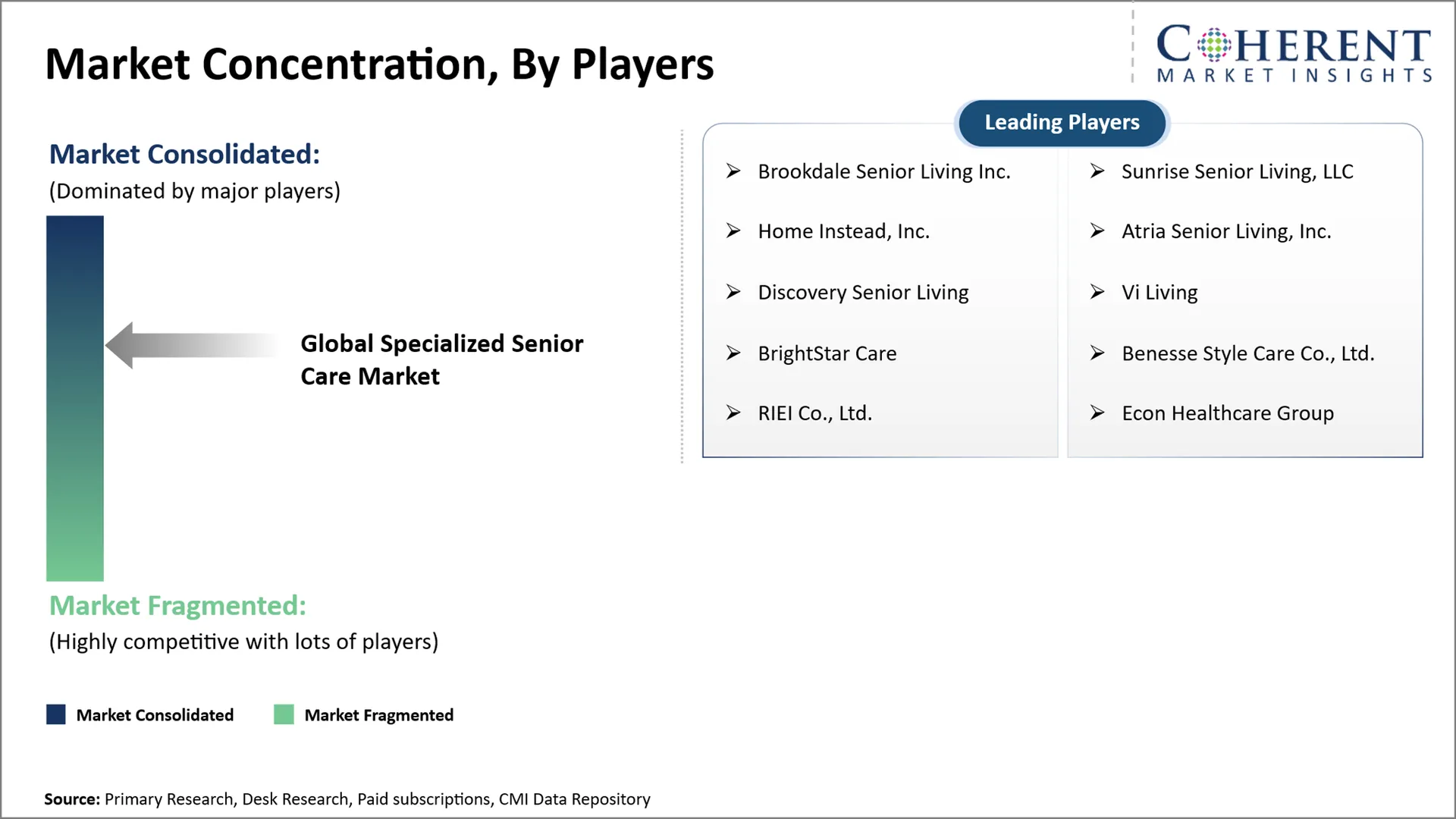
The global market for specialized senior care is competitive and somewhat fragmented where operators compete across a range of home nursing, assisted living, memory care, rehab, palliative care and remote monitoring technology categories. Caregiver availability, clinical excellence, quality of service, price, reach and home/residential care coordination are important considerations. Providers of senior care are differentiating themselves through integrated care models, technology solutions, specialized program offerings and care coordination partnerships. Key focus areas include:
- Care quality for dementia, chronic diseases and complex clinical needs.
- Technology support by means of home care remote monitoring and digital co-ordination with families.
- Recruitment/retention/training of caregivers and efficiencies in operations.
- Affordable care packages with comprehensive pricing
Market Report Scope
Specialized Senior Care Market Report Coverage | |||
Report Coverage | Details | ||
Base Year | 2025 | Market Size in 2026: | USD 312.6 Bn |
Historical Data For: | 2020 To 2024 | Forecast Period: | 2026 To 2033 |
Forecast Period 2026 To 2033 CAGR: | 7.4% | 2033 Value Projection: | USD 516.4 Bn |
Geographies covered: |
| ||
Segments covered: |
| ||
Companies covered: | Brookdale Senior Living Inc., Sunrise Senior Living, LLC, Home Instead, Inc., Atria Senior Living, Inc., Discovery Senior Living, Vi Living, BrightStar Care, Benesse Style Care Co., Ltd., RIEI Co., Ltd., Econ Healthcare Group | ||
Growth Drivers: |
| ||
Restraints & Challenges: |
| ||
Analyst Opinion (Expert Opinion)
- In the coming years, the global specialized senior care market is moving from institutional, traditional eldercare to integrated, customized and technology-enabled markets. Home-based support, dementia-specific treatments, chronic disease management and remote monitoring will become increasingly important. The ability of professionals that can combine clinical assistance for daily living and family engagement will gain a competitive edge.
- In-Home Care for chronic disease and complex care in India appears to be an exciting new opportunity, fueled by an enormous aging population, high demand for long-term care, and an imperfect organized senior care ecosystem. Providers could target urban households and families seeking reliable elderly care nursing, medication assistance and management, and care management.
- Trained caregivers, clinical oversight, digital monitoring and emergency care should be offered as part of an integrated service portfolio by players, rather than by competing solely on simple caregiving services. A focus on caregiver training, standardization of care, transparent rates and quality of services would increase consumer trust in the model. Partnerships with hospitals, diagnostic companies and technology firms would improve referral, care continuity and reach.
Speak to the analyst
Want personalized insights?
Take the findings above to one of our principal consultants, or have the report rebuilt around the segments, geographies and competitors you actually track.
Market Segmentation
- Service Type Insights (Revenue, USD Bn, 2021 - 2033)
- Home Nursing and Personal Care
- Daily Care Coordination
- Companion and Check-In Services
- Medication Management and Emergency Response
- Specialized Dementia and Memory Care
- Rehabilitation and Palliative Care
- Care Delivery Model Insights (Revenue, USD Bn, 2021 - 2033)
- In-Home Care
- Residential and Assisted Living Care
- Community-Based Care
- Tech-Enabled Remote Care and Monitoring
- Care Need Insights (Revenue, USD Bn, 2021 - 2033)
- Chronic Disease and Complex Medical Care
- Dementia and Cognitive Impairment Care
- Mobility and Activities of Daily Living (ADL) Support
- Social Companionship and Wellness
- Medication Adherence and Emergency Support
- Technology Insights (Revenue, USD Bn, 2021 - 2033)
- Remote Patient Monitoring Systems
- Wearable Safety and Emergency Alert Devices
- Telehealth and Virtual Care Platforms
- Digital Care Coordination and Family Monitoring Platforms
- Payer Insights (Revenue, USD Bn, 2021 - 2033)
- Out-of-Pocket Payments
- Public Healthcare and Long-Term Care Programs
- Private Health and Long-Term Care Insurance
- Employer, Community, and Other Third-Party Funding
- Regional Insights (Revenue, USD Bn, 2021 - 2033)
- North America
- U.S.
- Canada
- Latin America
- Brazil
- Argentina
- Mexico
- Rest of Latin America
- Europe
- Germany
- U.K.
- Spain
- France
- Italy
- Russia
- Rest of Europe
- Asia Pacific
- China
- India
- Japan
- Australia
- South Korea
- ASEAN
- Rest of Asia Pacific
- Middle East
- GCC Countries
- Israel
- Rest of Middle East
- Africa
- South Africa
- North Africa
- Central Africa
- North America
- Key Players Insights
- Brookdale Senior Living Inc.
- Sunrise Senior Living, LLC
- Home Instead, Inc.
- Atria Senior Living, Inc.
- Discovery Senior Living
- Vi Living
- BrightStar Care
- Benesse Style Care Co., Ltd.
- RIEI Co., Ltd.
- Econ Healthcare Group
Sources
Primary Research Interviews
- Geriatric Care Specialists and Senior Care Consultants
- Home Healthcare Nurses and Caregiving Professionals
- Rehabilitation and Palliative Care Specialists
- Assisted Living and Memory Care Facility Administrators
Stakeholders
- Home Healthcare and Senior Care Service Providers
- Assisted Living and Residential Care Operators
- Senior Living Developers and Care Coordination Platforms
- Remote Patient Monitoring and Digital Care Technology Providers
- End-use Sectors
- Home-Based Senior Care Services
- Assisted Living and Residential Care Facilities
- Hospitals and Post-Acute Rehabilitation Centers
- Community-Based Elderly Care and Wellness Centers
- Regulatory & Health Bodies
- World Health Organization (WHO)
- U.S. Centers for Medicare & Medicaid Services (CMS)
- Administration for Community Living (ACL), U.S.
- Ministry of Health and Family Welfare, Government of India
Databases
- United Nations World Population Prospects
- OECD Health Statistics
- WHO Global Health Observatory
Associations
- LeadingAge
- American Health Care Association / National Center for Assisted Living (AHCA/NCAL)
- National Association for Home Care & Hospice (NAHC)
- International Association of Homes and Services for the Ageing (IAHSA)
Public Domain Sources
- World Health Organization (WHO)
- NITI Aayog
- Organisation for Economic Co-operation and Development (OECD)
- United Nations Department of Economic and Social Affairs (UN DESA)
Proprietary Elements
- CMI Data Analytics Tool, Proprietary CMI Existing Repository of information for last 10 years.
Get access to 250+ pages report
Every segment, forecast, competitor profile and data table behind the analysis above — available for instant download.
- ESOMAR Member
- ISO 9001:2015 Certified
- D-U-N-S Registered
- GDPR & CCPA Compliant
Frequently Asked Questions
The global specialized senior care market is estimated to be valued at USD 312.6 Bn in 2026 and is expected to reach USD 516.4 Bn by 2033.
Home nursing and personal care dominate due to the rising demand for customized treatment, assistance with everyday home tasks, and ongoing service for senior citizens.
Specialized senior care is tailored medical, personal, cognitive, and social support services intended to meet the individual needs of older adults.
The CAGR of global specialized senior care market is projected to be 7.4% from 2026 to 2033.
Rising ageing population and chronic disease prevalence, and growing demand for home-based senior care are the major factors driving the growth of the global specialized senior care market.
High costs of specialized care services, and shortage of trained caregivers are the major factors hampering the growth of the global specialized senior care market.
In terms of care need, chronic disease and complex medical care is estimated to dominate the market revenue share in 2026.