

Global Specialty Stone Market Size and Forecast – 2026 To 2033
The Global Specialty Stone Market is estimated to be valued at USD 8.92 Bn in 2026 and is expected to reach USD 13.77 Bn by 2033, growing at a compound annual growth rate (CAGR) of 6.40% from 2026 to 2033. This growth is supported by increasing integration of specialty stones into luxury residential projects, hospitality developments, commercial interiors, and architectural surfaces where designers prioritize durability, natural aesthetics, and material uniqueness.
Beyond conventional construction applications, specialty stones are gaining relevance as premium design elements through customized finishes, large-format surfaces, and sustainable material selection. The market is also benefiting from restoration activities and renewed interest in long-life building materials that reduce replacement frequency. In May 2025, the U.S. Green Building Council continued promoting material transparency and responsible product selection through LEED building practices, supporting greater consideration of durable natural materials such as stone in sustainable construction projects.
Key Takeaways of the Global Specialty Stone Market
- Quartzite is estimated to register a CAGR of 6.8% during 2026–2033 and is expected to account for 25.8% of the global specialty stone market in 2026, supported by its high durability, premium aesthetics, and increasing use in luxury interiors and architectural surfaces. In May 2025, Cosentino expanded its Sensa natural stone portfolio with six new quartzite designs targeting high-end residential and commercial applications.
- Slabs are expected to account for 45.8% of the global specialty stone market in 2026, supported by their extensive use in countertops, large-format surfaces, and customized architectural applications. Their seamless appearance, design flexibility, and compatibility with premium interiors make slabs a preferred choice among architects, fabricators, and luxury project developers.
- Flooring and Wall Cladding are expected to represent 30.8% of the global specialty stone market in 2026, driven by their strong application across residential, commercial, and hospitality projects. Specialty stones are widely selected for these surfaces due to their durability, aesthetic appeal, and ability to create distinctive architectural environments.
- Asia Pacific is expected to expand at a CAGR of 6.9% during 2026–2033 and account for 31.7% of the global specialty stone market in 2026, supported by large-scale construction activity, urban development, stone-processing capacity, and growing premium building material adoption. In 2025, India’s Directorate General of Foreign Trade continued maintaining export classifications for marble, travertine blocks, and slabs, reflecting the region’s established natural stone supply ecosystem.
- Europe is projected to record a CAGR of 6.7% from 2026–2033 and is expected to hold 29.8% of the global specialty stone market in 2026, driven by strong renovation activity, architectural restoration, premium interior design demand, and established stone craftsmanship networks. In March 2025, Cosentino continued strengthening its European natural stone presence through expanded quartzite collections designed for contemporary architecture and interior projects.
Segmental Insights
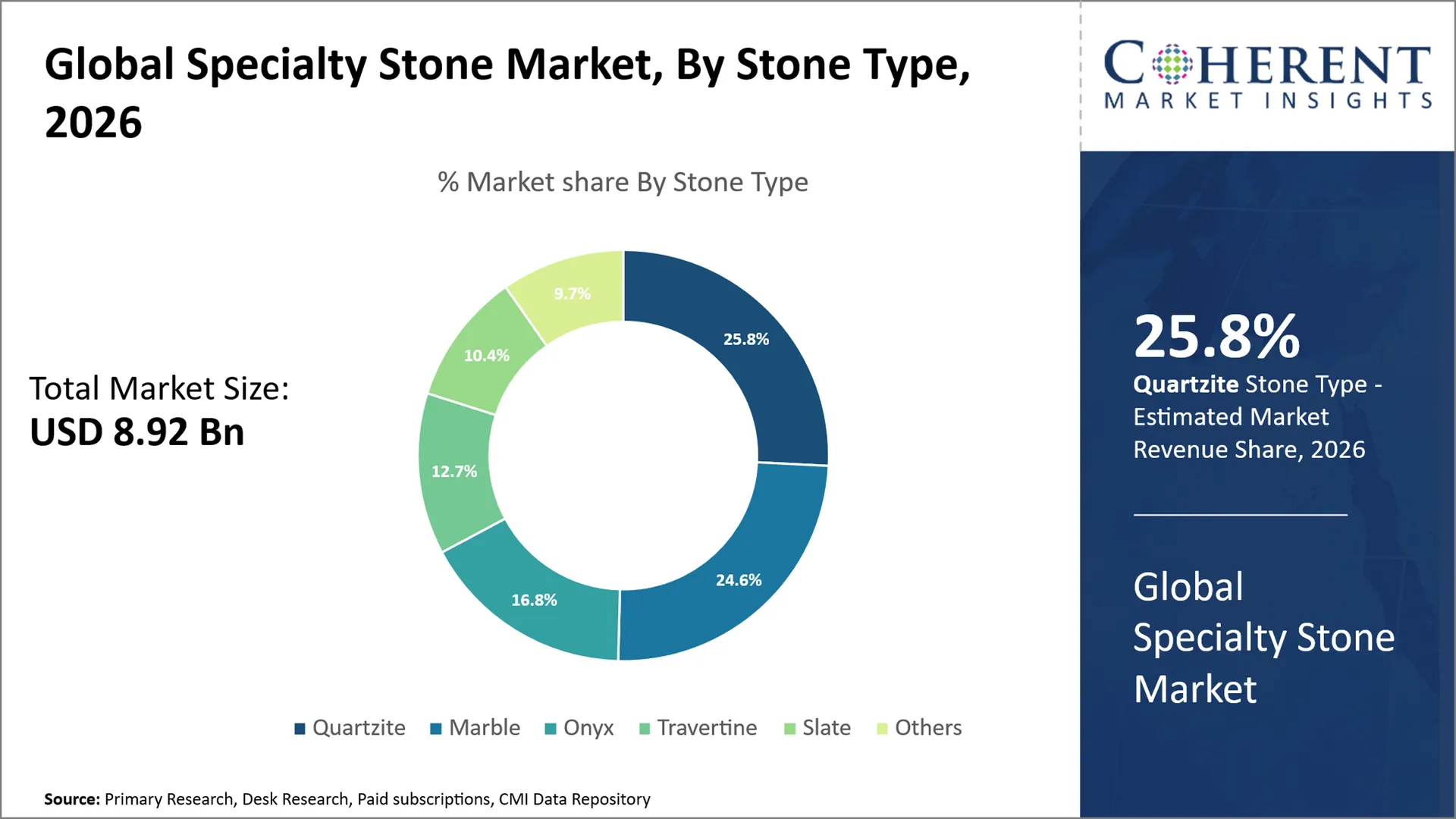
Why Does Quartzite Dominate the Global Specialty Stone Market?
Quartzite is expected to account for 25.8% of the global specialty stone market in 2026, supported by its positioning as a premium natural stone offering a combination of exceptional hardness, heat resistance, durability, and distinctive visual characteristics. The segment leads the stone type category as architects, designers, and luxury residential developers increasingly select quartzite for applications requiring both aesthetic appeal and functional performance. Quartzite slabs are widely preferred for kitchen countertops, statement walls, flooring, and premium commercial interiors where resistance to wear and long-term appearance retention are important purchasing considerations. On the supply side, improvements in quarry extraction, precision cutting, and surface finishing have expanded the availability of high-quality quartzite products. In March 2025, the Natural Stone Institute highlighted quartzite among preferred natural stone materials in architectural education resources, supporting greater awareness of its performance advantages among designers and construction professionals.
- Current Industry Events of 2026
- Market Size Estimation
- Regional Breakdown
- Competitive Landscape
- Customer Intelligence
- Segmental Analysis
- Pricing Analysis
- Key Market Drivers, Challenges & Future Trends
- Customized Insights Section
Why Do Slabs Represent the Largest Product Form Category in the Global Specialty Stone Market?
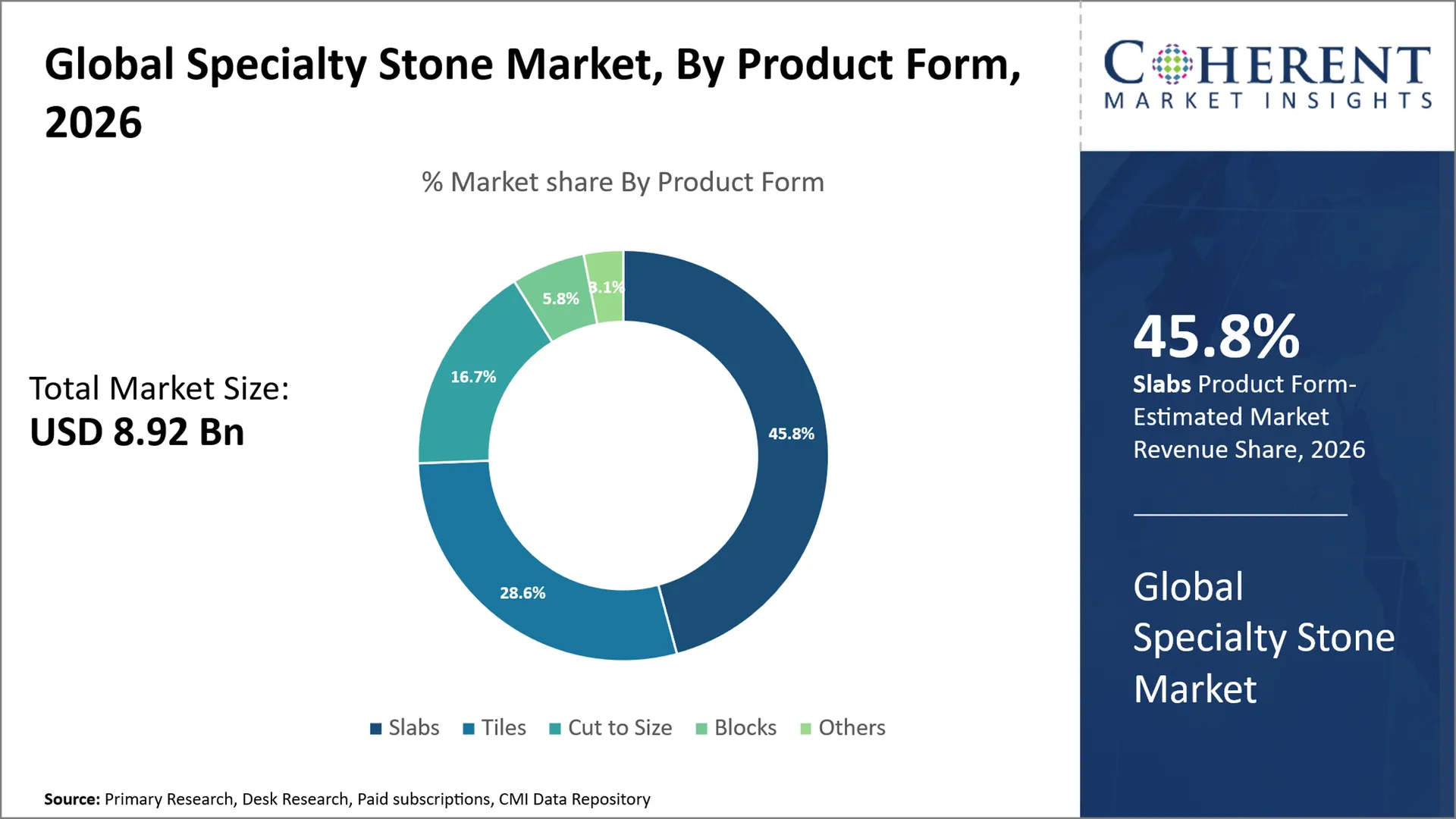
Slabs are projected to hold the largest share among product forms with 45.8% of the global specialty stone market in 2026, primarily due to their suitability for large-scale architectural surfaces requiring fewer joints, improved visual continuity, and customized fabrication. The segment benefits from strong demand from countertop manufacturers, interior contractors, hospitality developers, and commercial building projects where full-surface designs enhance premium aesthetics. Modern slab processing facilities equipped with precision cutting, polishing, and surface treatment technologies enable suppliers to deliver customized dimensions and finishes according to project requirements. The growing preference for book matched patterns and oversized stone applications has further strengthened slab adoption in luxury construction. In February 2025, Breton announced continued development of advanced stone processing technologies supporting automated fabrication and finishing solutions for natural stone slab manufacturers.
Why Does Flooring and Wall Cladding Dominate the Application Category of the Global Specialty Stone Market?
Flooring and wall cladding applications are expected to represent 30.8% of the global specialty stone market in 2026, making them the leading application segment due to the widespread use of natural stone in residential interiors, commercial buildings, hospitality properties, and architectural projects. Specialty stones provide durability, design flexibility, thermal performance, and premium visual appeal, making them suitable for flooring systems, exterior facades, feature walls, and decorative surfaces. The segment benefits from increasing demand for customized stone dimensions, advanced finishing techniques, and application-specific surface treatments that improve installation flexibility. Stone processors and fabricators with integrated cutting and finishing capabilities are positioned to capture higher-value architectural projects. In May 2025, Stone Federation Great Britain highlighted the use of natural stone in contemporary architectural projects, including flooring, cladding, and façade applications, reinforcing the role of natural stone in durable and design-focused construction solutions.
Current Events and their Impact
Current Event | Description and Its Impact |
September 2025 – India GST rationalization discussions for natural stone products |
|
March 2025 – European Union Construction Products Regulation implementation updates |
|
Global Specialty Stone Market Dynamics
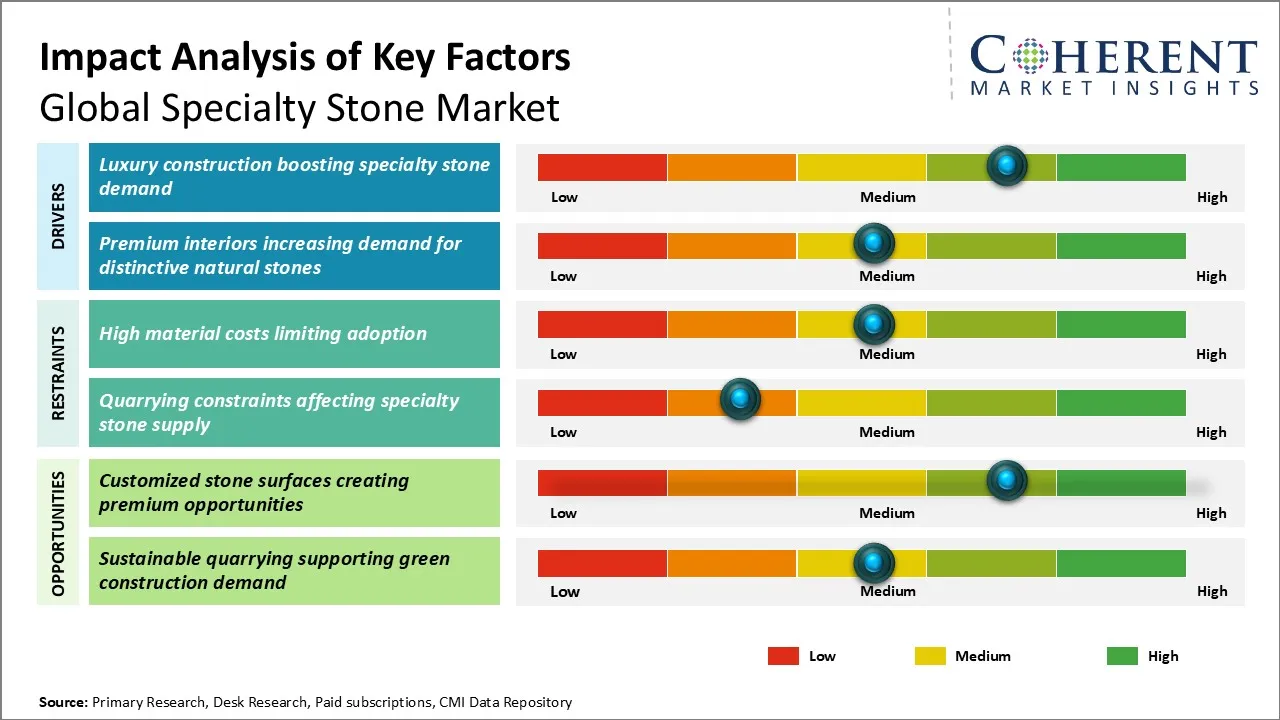
Key Market Drivers
- Luxury Construction Expanding Demand for Premium Specialty Stone Surfaces: Luxury construction is putting the specialty stone market to the test for premium stone surfaces as builders are increasingly using natural stone as a defining architectural attribute and not merely a construction material. Premium residential towers, luxury resorts and high-end commercial development projects are turning to specialty stones for entrance areas, feature walls, facades and custom interiors to enable the differentiation of the property through the use of material uniqueness. This change is advantageous to quarry owners, stone processors, and stone fabricators who can offer unique materials, quality, and finishes for a specific project. In June 2025, the Natural Stone Institute highlighted the continued role of natural stone in high-value architectural projects through its educational initiatives for architects and construction professionals, reinforcing stone’s position as a premium building material.
- Premium Interiors Increasing Demand for Distinctive Natural Stones: Premium interior applications are expanding specialty stone demand as designers and homeowners increasingly prioritize materials with unique textures, natural patterns, and customized finishes. Specialty stones are gaining preference in luxury kitchens, bathrooms, hospitality interiors, and bespoke furniture applications because they provide visual differentiation that manufactured alternatives often cannot replicate. This trend creates opportunities for stone processors and distributors that can offer curated collections, advanced finishing options, and design support services rather than standard material supply. In October 2025, the International Surface Event announced its expanded focus on natural stone, surface innovation, and architectural design solutions, reflecting the growing importance of premium surfaces in interior design decisions.
Emerging Market Trends
- Digital Fabrication Transforming Specialty Stone Customization: Specialty stone industry is becoming increasingly digitized with CNC cutting, robotic polishing, waterjet processing and automated surface inspection enhancing precision and minimizing material wastage. This shift is shifting the supplier competitiveness from ownership of the quarry to processing skills and customization. Traditional processors might be able to feel the pressure to update machinery and manufacturing processes to keep up with digital workflow, while fabricators that invest in it can create designs with complex details, personalized dimensions and quicker project timelines.
- Sustainability Requirements Reshaping Stone Sourcing and Processing: Sustainability considerations are becoming increasingly important in specialty stone procurement as architects, developers, and institutional buyers evaluate material sourcing, quarry practices, durability, and lifecycle performance. Suppliers are expected to provide greater transparency regarding extraction methods, processing efficiency, waste management, and environmental performance. This trend is likely to favor companies with certified sourcing systems, efficient production processes, and stronger documentation capabilities as green building standards influence future material selection.
Regional Insights
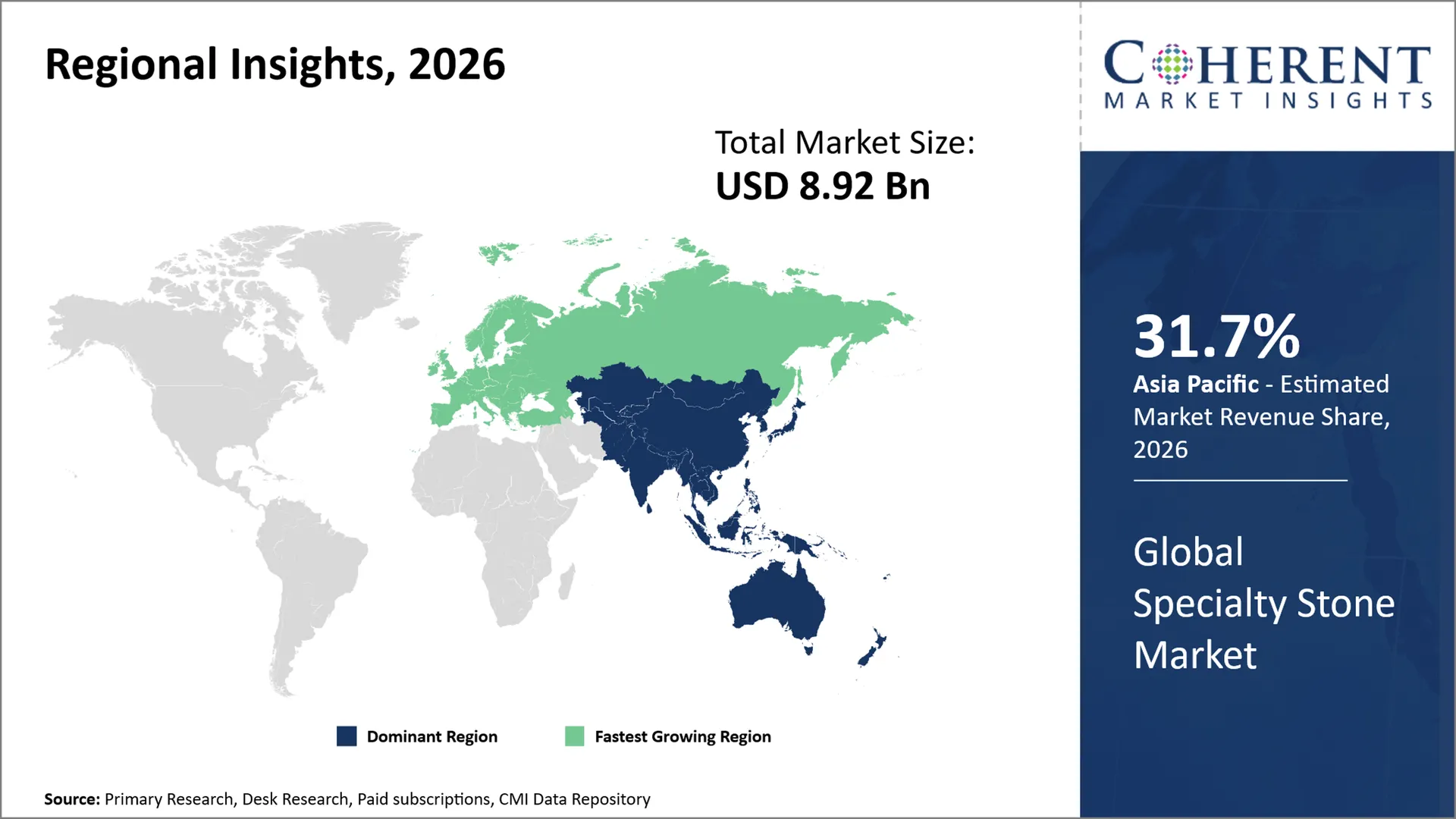
Why Does Asia Pacific Dominate the Global Specialty Stone Market?
Asia Pacific is expected to maintain its leading position in the global specialty stone market with a 31.7% share in 2026, supported by strong quarrying capabilities, extensive stone-processing infrastructure, and high consumption across residential construction, commercial interiors, hospitality projects, and architectural applications. Countries such as China and India contribute significantly through large-scale natural stone production, skilled fabrication networks, and established export channels for premium stones including marble, quartzite, granite, and decorative stones. The region benefits from rising urban redevelopment projects, luxury housing expansion, and increasing adoption of customized stone surfaces in premium buildings. In February 2025, India’s Ministry of Commerce and Industry highlighted continued growth opportunities for natural stone exports through policy support and trade facilitation initiatives for stone processing and exports.
Why Is Europe Emerging as the Fastest-Growing Region in the Global Specialty Stone Market?
Europe is projected to be the fastest-growing region in the global specialty stone market with a 29.8% share in 2026, supported by strong demand for premium architectural materials, renovation activities, heritage restoration projects, and increasing preference for natural materials in sustainable building designs. The region’s established stone craftsmanship, advanced fabrication technologies, and strong presence of luxury residential and hospitality developments create significant opportunities for specialty stone suppliers. Italy and Spain remain strategically important due to their expertise in stone extraction, processing, and design-led applications. In March 2025, the European Commission continued emphasizing sustainable construction practices through initiatives promoting circularity and resource efficiency in the construction ecosystem, supporting demand for durable materials such as natural stone.
Global Specialty Stone Market Outlook for Key Countries
Why Is Italy a Key Market for the Global Specialty Stone Market?
Italy is likely to continue as a major market for the global specialty stone value chain, benefiting from its world-leading knowledge of marble extraction, the accuracy of stone processing, design uses, and high-end architectural and design commissions. The country has a significant advantage in luxury applications of interior stone, such as in residential construction, hotels, museums and high-end commercial properties, which are a natural choice for this market as the use of Italian marble and specialty stones is the preferred choice. The Italian advanced fabrication system allows for customized slabs, complex finishing and designer stone solutions, which make higher value market opportunities possible. Its reach and impact in global markets are bolstered by the existence of known quarry business, stone processors, and design-focused manufacturers. Continuing the development of the Italian stone and marble potential, in September 2025 the Italian Trade Agency (Ita) held more exhibition events in the international design and construction sector, consolidating Italy's position as one of the world's leading suppliers of high-quality natural stone solutions.
Why Is India Important in the Global Specialty Stone Market?
The specialty stone market in India is significant on several fronts, with the country boasting a vast natural stone reserve, competitive processing facilities, an experienced workforce, and the rising demand for natural stones in the country's construction industry. Marble, quartzite, granite, sandstone and various other categories of decorative stones are produced and exported in good quantity and standard by the country. The rise in urban population, building of premium stone houses, growth in the hospitality industry and construction projects are helping to drive domestic demand for specialty stone products. Besides, the cost advantage of the Indian quarries and processors makes it feasible to supply the international market. The Federation of Indian Export Organizations (FIEO) underscored that Indian stone exporters continued to have lucrative export prospects due to growing global demand and better trade linkages in April 2025.
Why Does China Support Growth in the Global Specialty Stone Market?
China supports growth in the global specialty stone market through its large-scale processing capacity, extensive construction industry, advanced manufacturing infrastructure, and strong domestic consumption base. The country has developed a comprehensive stone supply chain covering quarrying, cutting, polishing, fabrication, and distribution, enabling efficient supply for residential, commercial, and infrastructure applications. Demand is supported by urban redevelopment, premium interior projects, and increasing use of engineered and natural stone combinations in modern architecture. China also remains a significant participant in global stone trade due to its processing expertise and export networks. In October 2025, the China Building Materials Federation continued initiatives focused on upgrading building material industries through improved manufacturing efficiency and sustainable production practices.
Why Is Spain a Strategic Country in the Global Specialty Stone Market?
Spain is strategically positioned in the global specialty stone market due to its strong marble industry, advanced quarrying technologies, and reputation for supplying premium natural stone to international architectural and construction projects. The country is particularly recognized for high-quality marble production, including distinctive decorative stones used in flooring, facades, countertops, and luxury interiors. Spain’s combination of geological resources, experienced processors, and export-oriented stone companies enables it to serve European and global markets. The country also benefits from demand for sustainable and long-lasting building materials in renovation and new construction projects. In June 2025, the Spanish Natural Stone Federation continued supporting international promotion of Spanish stone products through trade initiatives aimed at expanding global market access.
Why Is the U.S. an Important Growth Market for the Global Specialty Stone Market?
The U.S. represents an important growth market for the global specialty stone market due to strong demand from luxury residential construction, commercial real estate, hospitality developments, and renovation activities. Specialty stones such as quartzite, marble, and onyx are increasingly used in premium countertops, feature walls, flooring, and customized architectural installations where aesthetics and durability are key purchasing factors. The country’s mature distribution network, including stone fabricators, importers, and specialty retailers, supports wider availability of imported and domestic materials. Growth is further supported by consumer preference for personalized interior designs and high-value home improvements. In January 2026, the National Association of Home Builders highlighted continued homeowner investment in remodeling and premium residential upgrades, supporting demand for high-quality interior materials.
Production Innovation & Manufacturing Landscape
Technology / Process | Adoption Status | Market Application | Commercial Impact |
CNC Stone Cutting Systems | High adoption among organized processors | Precision slab cutting and customized architectural components | Improves accuracy reduces material loss and enables complex designs |
Waterjet Cutting Technology | Growing adoption | Intricate flooring patterns mosaics and decorative stone installations | Supports premium customization and higher-value applications |
Robotic Polishing Systems | Increasing adoption | Automated finishing of slabs and tiles | Enhances consistency reduces labor dependency and improves productivity |
Digital Slab Scanning and Inspection | Emerging adoption | Quality control and defect identification | Reduces wastage and improves customer confidence in premium stones |
3D Design and Visualization Tools | Expanding among designers and fabricators | Architectural planning and customer customization | Enables faster approvals and improves project coordination |
Advanced Surface Treatment Technologies | Growing adoption | Stain resistance durability enhancement and specialty finishes | Expands application potential of sensitive stones in kitchens and commercial interiors |
How Are Advanced Digital Fabrication and Customized Stone Solutions Creating New Growth Opportunities in the Global Specialty Stone Market?
Advanced digital fabrication and customized stone solutions represent a high-potential opportunity for specialty stone suppliers seeking to move beyond conventional slab and tile sales toward value-added architectural solutions. Demand is shifting toward personalized surfaces, complex patterns, integrated design elements, and project-specific stone applications across luxury residential, hospitality, and commercial developments. Companies that combine natural stone expertise with CNC processing, digital visualization, automated cutting, and design collaboration capabilities can capture higher-margin opportunities. This opportunity is particularly relevant for stone processors, fabricators, and distributors that can provide end-to-end solutions from material selection to final installation support. Market participants will require investments in advanced machinery, skilled technical teams, and designer partnerships to compete effectively. Established processors with quarry access and fabrication capabilities are likely to benefit, while smaller suppliers may need specialization strategies to remain competitive.
Market Players, Key Development, and Competitive Intelligence
Key Developments
- In September 2025, Antolini introduced the new Antolini Pavilion at Marmomac 2025 in Verona, showcasing around 50 exclusive natural stone materials through an immersive architectural experience. This development strengthens the company’s positioning in premium stone applications by connecting material innovation with designer and architect engagement.
- In September 2025, Marmomac expanded its international natural stone platform by bringing together companies, architects, designers, and technology providers across the complete stone value chain. This initiative supports market development by improving collaboration between quarry operators, processing technology suppliers, and end-use stakeholders.
- In April 2025, Antolini presented “Beyond Stone: Matter and Ingenuity” during Milan Design Week, demonstrating the integration of natural stone with artistic and design-led applications. This initiative highlights the growing commercial opportunity for specialty stone suppliers to participate in premium interiors beyond traditional construction uses.
Competitive Landscape
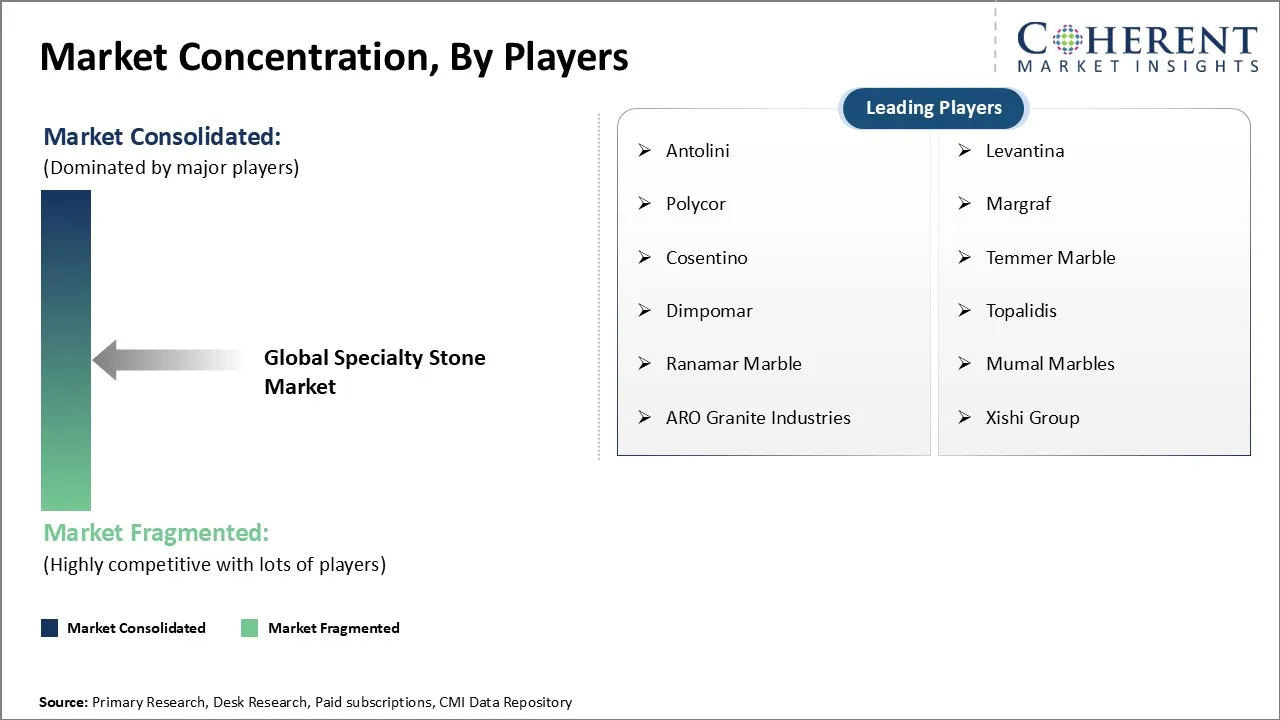
The global specialty stone market remains fragmented to moderately consolidated, with competition distributed among quarry owners, stone processors, exporters, fabricators, distributors, and premium design-focused suppliers. Market positioning depends on stone quality, access to exclusive materials, processing capabilities, customization expertise, supply reliability, and relationships with architects and contractors. Regional suppliers maintain advantages through local quarry access, while international companies compete through premium collections, advanced fabrication, and global distribution networks.
Key Competitive Focus Areas
- Premium stone quality, uniqueness of patterns, and aesthetic differentiation
- Quarry ownership, resource availability, and long-term raw material security
- Advanced processing capabilities including cutting, polishing, and surface finishing
- Custom fabrication capability for architectural and interior applications
- Supply reliability and ability to manage international stone logistics
- Relationships with architects, designers, contractors, and luxury developers
- Sustainability practices including responsible quarrying and material traceability
- Regional distribution networks and project-based customer support
Market Report Scope
Global Specialty Stone Market Report Coverage | |||
Report Coverage | Details | ||
Base Year | 2025 | Market Size in 2026: | USD 8.92 Bn |
Historical Data For: | 2020 To 2024 | Forecast Period: | 2026 To 2033 |
Forecast Period 2026 To 2033 CAGR: | 6.40% | 2033 Value Projection: | USD 13.77 Bn |
Geographies covered: |
| ||
Segments covered: |
| ||
Companies covered: | Antolini, Levantina, Polycor, Margraf, Cosentino, Temmer Marble, Dimpomar, Topalidis, Ranamar Marble, Mumal Marbles, ARO Granite Industries, Xishi Group | ||
Growth Drivers: |
| ||
Restraints & Challenges: |
| ||
Analyst Opinion (Expert Opinion)
- The global specialty stone market is likely to transition from a commodity-oriented material business toward a design-led solution ecosystem. Future competitive advantage will depend less on stone availability alone and more on the ability to combine exclusive material sourcing, digital customization, technical consultation, and project execution support. Suppliers that build stronger connections with architects, interior designers, and developers will have greater influence over material selection decisions.
- The next major transformation in the specialty stone market could come from the integration of digital design platforms with manufacturing workflows. As buyers increasingly expect visualization before purchase, companies capable of linking virtual design concepts with automated fabrication may redefine customer engagement. Traditional distributors focused only on inventory availability may face pressure as design collaboration becomes a stronger purchasing criterion.
- Market participants should prioritize investment in precision processing, sustainability documentation, and customer-specific solutions rather than competing only on stone volume. Companies should strengthen supply-chain resilience by diversifying sourcing regions and improving inventory planning. However, excessive investment in standardized capacity without understanding premium customer requirements may create margin pressure as buyers increasingly seek differentiated materials and customized applications.
Speak to the analyst
Want personalized insights?
Take the findings above to one of our principal consultants, or have the report rebuilt around the segments, geographies and competitors you actually track.
Market Segmentation
- Stone Type Insights (Revenue, USD Bn, 2021 - 2033)
- Quartzite
- Marble
- Onyx
- Travertine
- Slate
- Others
- Product Form Insights (Revenue, USD Bn, 2021 - 2033)
- Slabs
- Tiles
- Cut to Size
- Blocks
- Others
- Application Insights (Revenue, USD Bn, 2021 - 2033)
- Flooring and Wall Cladding
- Countertops and Vanity Tops
- Facades and Exterior Applications
- Landscaping
- Monuments and Decorative Applications
- Others
- End User Insights (Revenue, USD Bn, 2021 - 2033)
- Residential
- Commercial
- Hospitality
- Institutional
- Others
- Distribution Channel Insights (Revenue, USD Bn, 2021 - 2033)
- Direct Sales
- Indirect Sales
- Regional Insights (Revenue, USD Bn, 2021 - 2033)
- North America
- U.S.
- Canada
- Latin America
- Brazil
- Argentina
- Mexico
- Rest of Latin America
- Europe
- Germany
- U.K.
- Spain
- France
- Italy
- Russia
- Rest of Europe
- Asia Pacific
- China
- India
- Japan
- Australia
- South Korea
- ASEAN
- Rest of Asia Pacific
- Middle East
- GCC Countries
- Israel
- Rest of Middle East
- Africa
- South Africa
- North Africa
- Central Africa
- North America
Sources
Primary Research Interviews
- Quarry owners, specialty stone manufacturers, processors, fabricators, exporters, distributors, architects, contractors, and interior designers
- Stone procurement managers, project developers, construction companies, hospitality developers, and real estate professionals
Stakeholders
- Natural stone quarry operators, stone processing companies, slab manufacturers, tile producers, and specialty stone suppliers
- Importers, exporters, distributors, wholesalers, fabricators, architects, designers, and construction material suppliers
- Residential developers, commercial builders, hospitality groups, institutional buyers, and end-use customers
End-use Sectors
- Luxury residential construction and premium interior applications
- Commercial buildings, hospitality projects, and architectural developments
- Flooring, wall cladding, facades, countertops, and decorative stone installations
- Restoration projects, landscaping, monuments, and customized architectural applications
Regulatory and Industry Bodies
- Natural stone industry associations and construction material organizations
- Building standards authorities and construction regulatory bodies
- Environmental and sustainable quarrying compliance organizations
- Trade promotion agencies and stone export development organizations
Databases
- Company annual reports, investor presentations, and corporate filings
- Construction industry databases and building project intelligence platforms
- Trade statistics, import-export databases, and customs datasets
- Quarry production data, stone trade databases, and supplier intelligence platforms
- Product portfolio analysis and competitive benchmarking databases
Magazines and Journals
- Natural stone industry publications
- Architecture and construction design magazines
- Building materials and surface technology publications
- Interior design and luxury construction journals
- Mining, quarrying, and stone processing publications
Associations
- Natural Stone Institute
- International Federation of Building and Construction Industry Associations
- European and regional natural stone associations
- Quarrying and mining industry associations
- Architecture and construction professional organizations
Public Domain Sources
- Construction and infrastructure development trends
- Luxury residential and hospitality project developments
- Architectural design trends and material preferences
- Sustainable building practices and green construction initiatives
- International stone trade and export-import developments
Key Standards and Regulations
- Natural stone quality and performance standards
- Construction material safety and building compliance requirements
- Sustainable quarrying and environmental management regulations
- Product certification and material testing standards
- International trade regulations for natural stone products
Proprietary Elements
- CMI Data Analytics Tool
- Proprietary CMI repository containing 10+ years of construction materials, building products, specialty stone, architecture, and real estate market intelligence.
Get access to 250+ pages report
Every segment, forecast, competitor profile and data table behind the analysis above — available for instant download.
- ESOMAR Member
- ISO 9001:2015 Certified
- D-U-N-S Registered
- GDPR & CCPA Compliant
Missing comfort of reading report in your local language? Find your preferred language:
Frequently Asked Questions
The CAGR of global specialty stone market is projected to be 6.40% from 2026 to 2033.
The global specialty stone market is estimated to be valued at USD 8.92 Bn in 2026 and is expected to reach USD 13.77 Bn by 2033.
The global specialty stone market is primarily used in architectural and construction applications including premium interiors, flooring, wall cladding, facades, countertops, decorative surfaces, landscaping, and customized design projects. Specialty stones are preferred in these applications due to their aesthetic appeal, durability, and ability to enhance the visual value of residential, commercial, and hospitality spaces.
Specialty stone purchasing decisions are influenced by material quality, color and pattern uniqueness, durability, finishing options, customization capabilities, availability, supplier reliability, and project-specific requirements. Architects, designers, contractors, and developers typically evaluate both aesthetic characteristics and technical performance before selecting specialty stone materials.
Sustainability is becoming an important consideration in the specialty stone market as buyers increasingly focus on responsible quarrying practices, efficient processing methods, material durability, and environmental compliance. Stone suppliers are strengthening transparency around sourcing, production practices, and lifecycle performance to meet evolving expectations from construction and design stakeholders.
The future of the global specialty stone market is being shaped by increasing demand for customized stone solutions, advanced fabrication technologies, digital design integration, premium architectural applications, and improved supply-chain efficiency. Market participants are focusing on value-added services and differentiated product offerings to address changing preferences among architects, designers, and end users.
The growth of the global specialty stone market is primarily supported by luxury construction projects and increasing demand for distinctive natural stones in premium interior applications. Rising preference for high-quality materials in residential, commercial, and hospitality spaces is encouraging the adoption of specialty stones for flooring, wall cladding, countertops, and decorative surfaces.