

Global Spruce Wood Market Size and Forecast – 2026 To 2033
The Global Spruce Wood Market is estimated to be valued at USD 43.66 Bn in 2026 and is expected to reach USD 62.67 Bn by 2033, growing at a compound annual growth rate (CAGR) of 5.3% from 2026 to 2033. Market expansion is supported by spruce wood consumption across structural construction, furniture manufacturing, engineered wood products, packaging, and paper applications, alongside continued investment in modern sawmilling and value-added processing capacity.
Spruce remains commercially important due to its favorable strength-to-weight characteristics, machinability, and suitability for structural and industrial applications. In May 2024, Moelven Valåsen commissioned a new saw line as part of a modernization program designed to increase annual sawn timber production from approximately 350,000 m³ to 500,000 m³ by 2026. Moelven confirms that the Valåsen mill processes both spruce and pine, illustrating continued investment in Scandinavian softwood production capacity.
Key Takeaways of the Global Spruce Wood Market
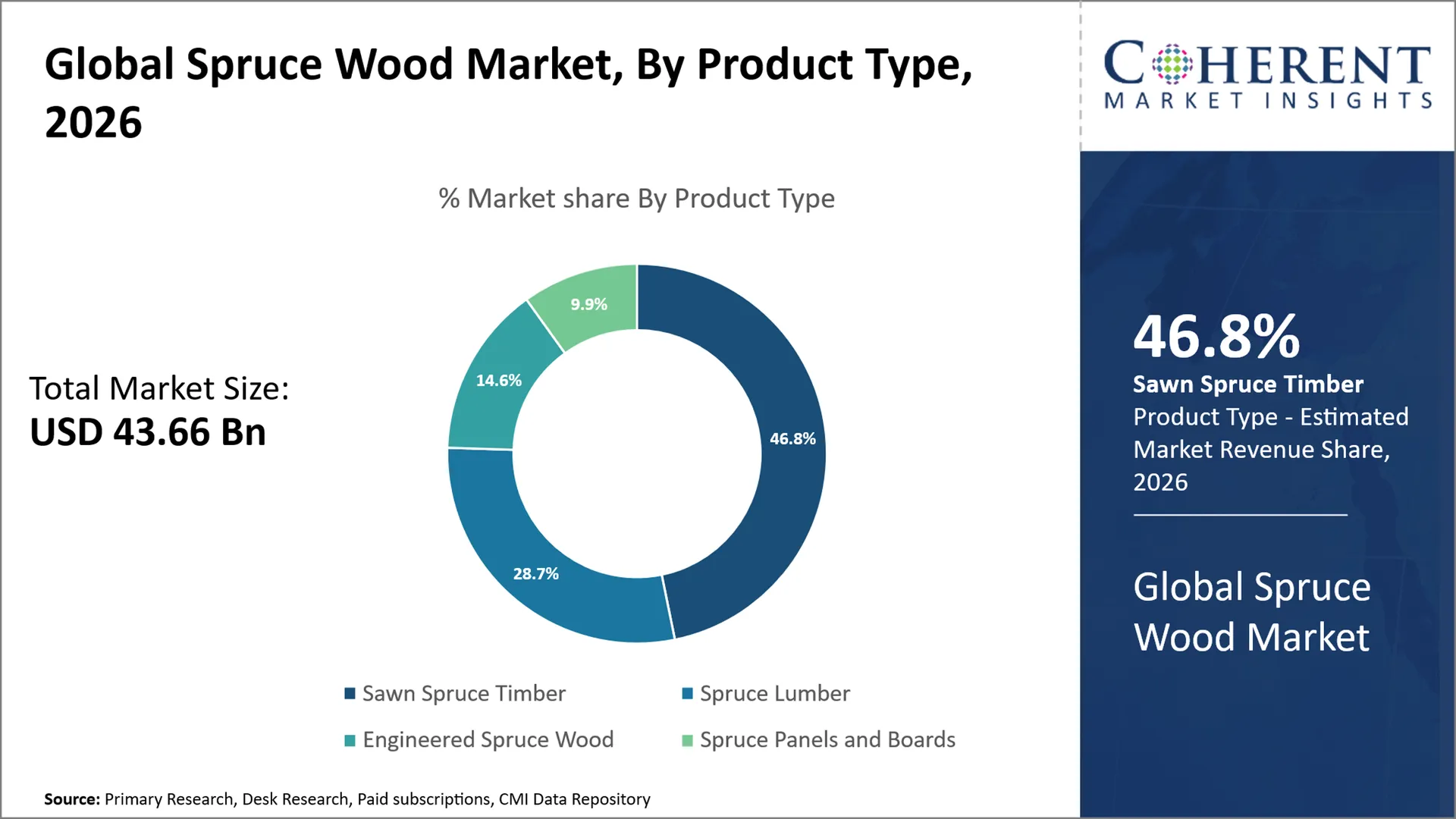
- Sawn Spruce Timber is expected to expand at an estimated CAGR of 5.5% during 2026–2033 and account for 46.8% of the global spruce wood market in 2026, supported by its broad use in framing, joinery, packaging and downstream engineered products. In May 2025, Stora Enso completed its Junnikkala acquisition in Finland, increasing group sawmilling capacity by 700,000 m³ and strengthening wood-product supply.
- Construction Grade is projected to register an estimated CAGR of 5.6% during 2026–2033 and hold 52.8% of the global spruce wood market in 2026, reflecting the importance of standardized strength, moisture and defect criteria in structural applications. In May 2026, the National Lumber Grades Authority revised Canadian lumber grading rules, including a clarification specifically affecting Construction grade requirements under the NGR framework.
- Construction and Building Materials is anticipated to grow at an estimated CAGR of 5.8% during 2026–2033 and represent 42.8% of the global spruce wood market in 2026, as spruce combines structural efficiency, machinability and suitability for prefabricated timber systems. In February 2026, Södra highlighted a Swedish coffee roastery whose structural frame used CLT manufactured from finger-jointed sawn spruce timber.
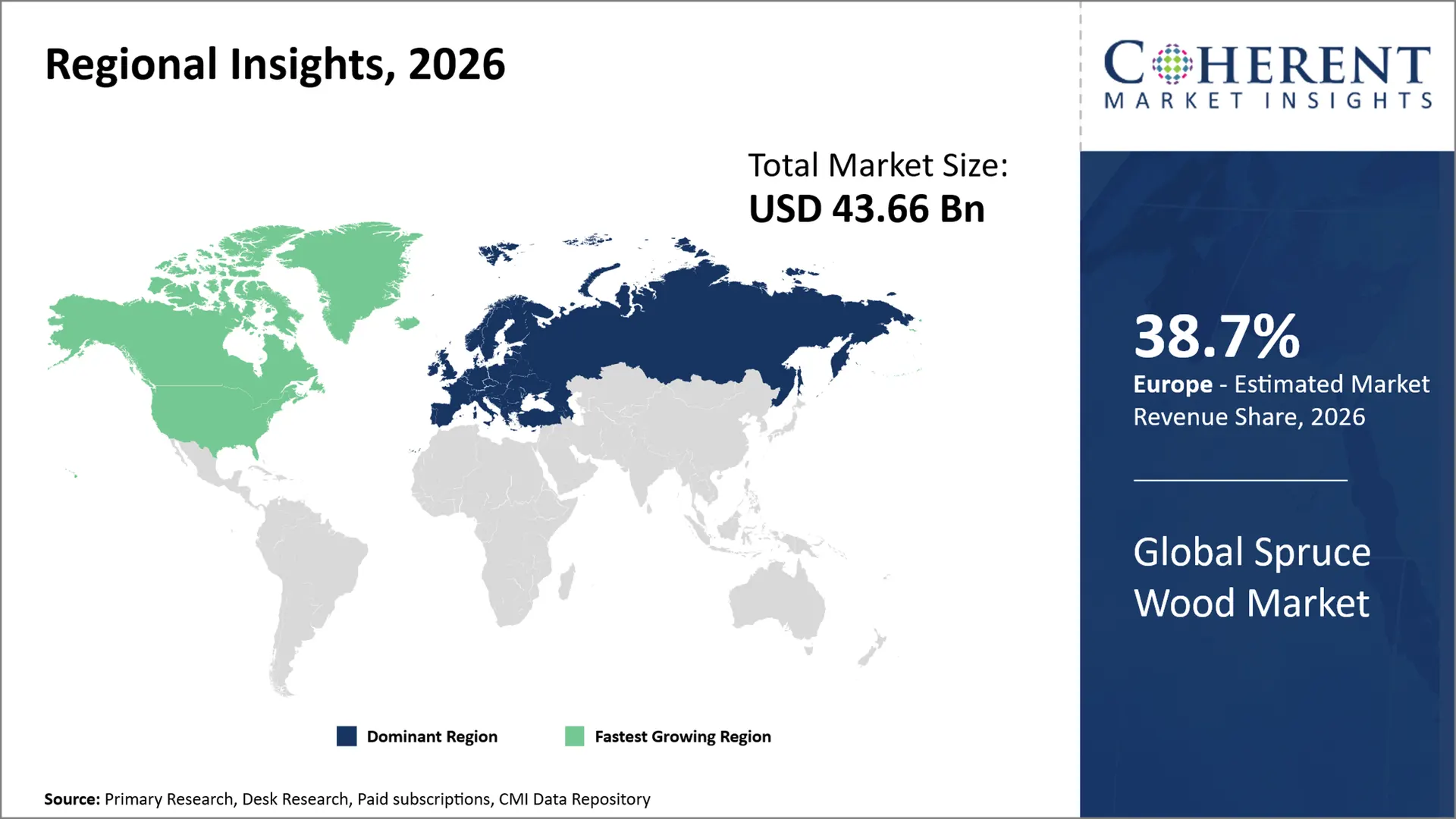
- Europe is expected to record an estimated CAGR of 4.9% during 2026–2033 while accounting for 38.7% of the global spruce wood market in 2026, supported by established Nordic supply chains, timber-construction expertise and extensive softwood processing infrastructure. In February 2026, the EU’s CINEA highlighted LIFE initiatives that are expanding wood use in housing through professional training, local supply-chain development and validated building solutions.
- North America is forecast to post an estimated CAGR of 6.2% during 2026–2033 and account for 28.6% of the global spruce wood market in 2026, reflecting opportunities in value-added lumber, prefabrication and mass-timber construction. In March 2025, Natural Resources Canada announced support for a Nova Scotia facility designed to convert eastern spruce into CLT panels and glue-laminated structural products.
Segmental Insights
Why Does Sawn Spruce Timber Dominate the Global Spruce Wood Market?
Sawn Spruce Timber is expected to account for 46.8% of the global spruce wood market in 2026, reflecting its role as the primary commercial form entering construction, joinery, packaging, and further processing. Its leadership is supported by mature sawmilling infrastructure, standardized dimensions, kiln-drying capability, and efficient conversion of spruce logs into center cuts and sideboards suited to multiple buyers. Builders and industrial processors favor sawn spruce because it can be graded, planed, finger-jointed, or converted into engineered products without complex preprocessing. This gives sawmills broad customer coverage and improves mill utilization across quality classes. In April 2025, SCA reported that its modernized sawmills had strengthened production efficiency and global market reach, while demand for sawn timber continued to be supported by housing needs and sustainable-building requirements. The development reinforces the commercial importance of scale, logistics, and processing efficiency in sawn spruce supply.
- Current Industry Events of 2026
- Market Size Estimation
- Regional Breakdown
- Competitive Landscape
- Customer Intelligence
- Segmental Analysis
- Pricing Analysis
- Key Market Drivers, Challenges & Future Trends
- Customized Insights Section
Why Does Construction Grade Represent the Largest Grade Segment in the Global Spruce Wood Market?
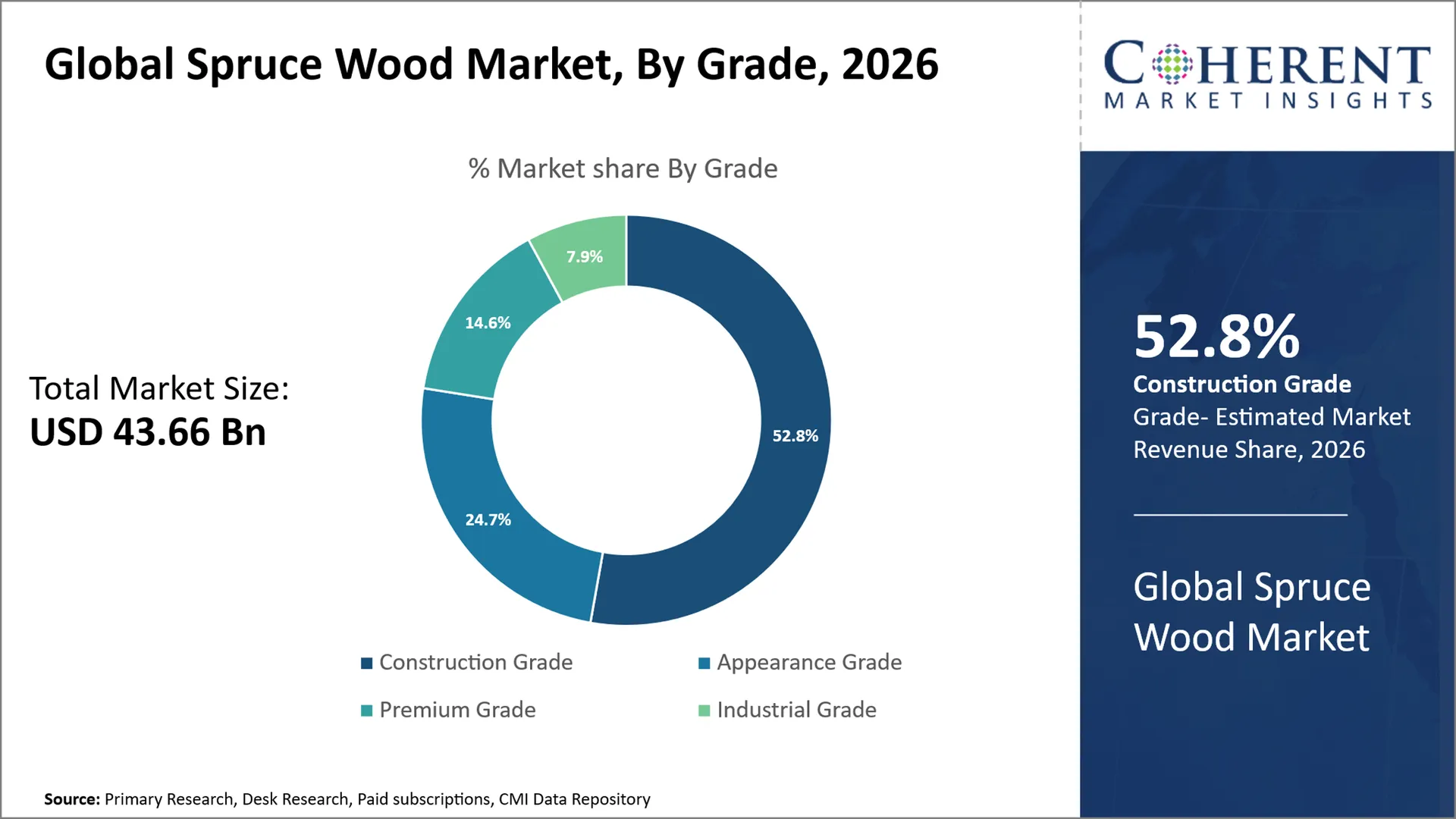
Construction Grade is expected to represent 52.8% of the global spruce wood market in 2026, as structural buyers prioritize verified strength, stiffness, moisture control, and dimensional consistency over appearance characteristics. Spruce fits this requirement particularly well because standardized grading enables mills to supply C-class structural timber for studs, roof systems, floor structures, glulam feedstock, and other load-bearing uses. The segment also benefits from established machine-grading and visual-grading systems, which reduce specification uncertainty for builders, merchants, and prefabrication companies. This makes construction grade the volume anchor for suppliers serving professional building channels. In August 2025, Swedish Wood noted that spruce and pine structural timber are classified through standardized strength classes such as C24, while spruce remains widely used in construction applications. This standardization supports predictable procurement and strengthens construction grade as the leading grade category.
Why Do Construction and Building Materials Dominate the Application Segment of the Global Spruce Wood Market?
Construction and Building Materials is expected to hold 42.8% of the global spruce wood market in 2026, supported by spruce use across framing, roof structures, wall systems, formwork, glulam, CLT, and prefabricated timber components. The application benefits from spruce’s favorable strength-to-weight profile, machining efficiency, and compatibility with industrialized timber construction. Demand is increasingly linked to off-site manufacturing, where consistent lumber dimensions and moisture levels reduce production variability and installation time. This creates commercial opportunities for sawmills that can supply structural grades as well as processors that convert spruce into higher-value engineered products. In April 2025, Pfeifer announced that its Schlitz cross-laminated timber plant was moving to three-shift production in response to stronger orders, while the company continued investing in quality, efficiency, and sustainability. The move illustrates expanding downstream pull for timber-based construction materials.
Current Events and their Impact
Current Event | Description and Its Impact |
July 2026 – European Commission updates implementation framework for the EU Deforestation Regulation |
|
August 2025 – U.S. Commerce finalizes countervailing-duty review on Canadian softwood lumber |
|
April 2024 – British Columbia expands allowable mass-timber construction under its Building Code |
|
Global Spruce Wood Market Dynamics
Key Market Drivers
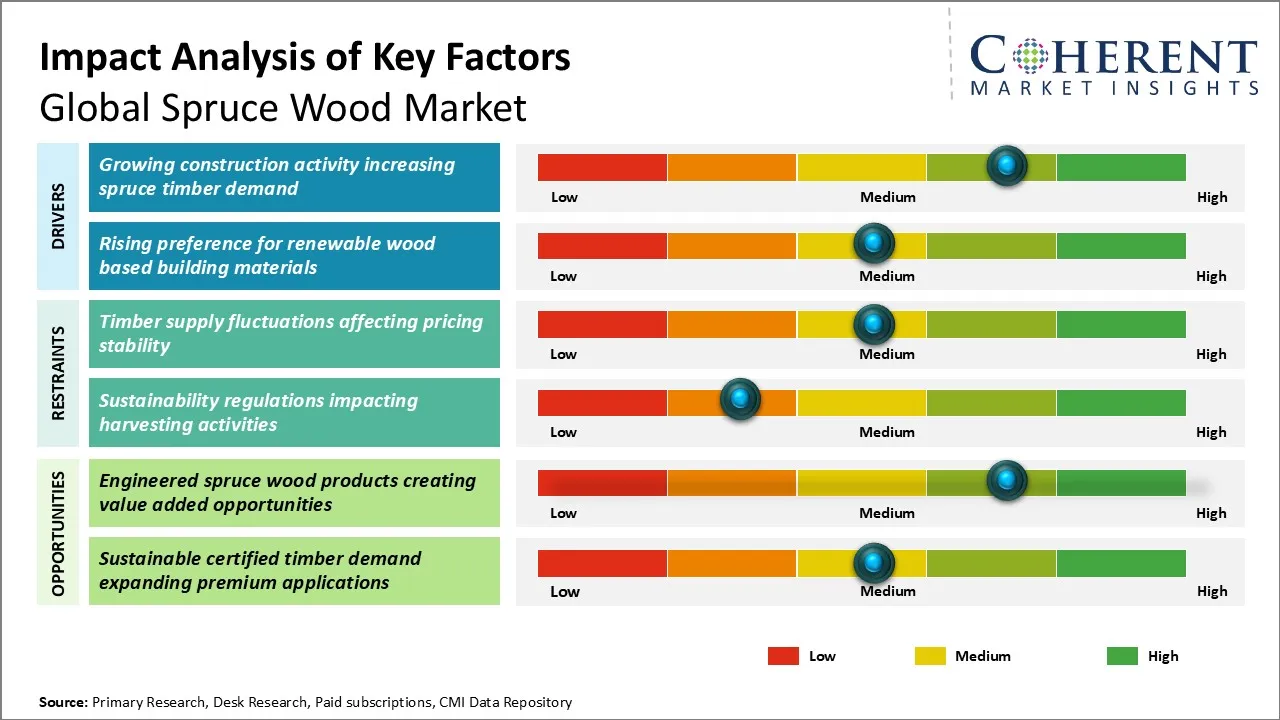
- Growing construction activity increasing spruce timber demand: Growing construction activity translates into higher spruce demand through structural framing, roof and floor systems, modular components and engineered wood feedstock, where predictable strength, low weight and machinability support efficient building. This benefits sawmills, LVL producers, prefabricators and construction-material distributors while encouraging investment in structural-grade processing capacity. In August 2024, Metsä Wood reported that its Äänekoski Kerto LVL mill had reached rooftop height; the planned mill will produce about 160,000 m³ annually, raising Kerto LVL capacity by roughly 50%, while Kerto LVL uses mainly Nordic spruce.
- Rising preference for renewable wood based building materials: Rising preference for renewable wood-based building materials is shifting specifications toward structural systems that can reduce reliance on more carbon-intensive materials while supporting prefabrication and biophilic design. Spruce-containing SPF is well positioned for CLT, glulam and other mass-timber assemblies, benefiting certified fibre suppliers, engineered-wood manufacturers, architects and specialist installers. In January 2025, Mercer Mass Timber highlighted its supply of timber elements for several buildings at Walmart’s new Home Office campus in Arkansas; Mercer states that its mass-timber wood is primarily Spruce-Pine-Fir sourced from certified forests.
Emerging Market Trends
- Performance Specifications Are Replacing Commodity-Only Spruce Procurement: Performance specifications are becoming more influential than species-only purchasing in professional spruce procurement. Builders, component manufacturers and distributors increasingly need material that arrives with predictable strength class, moisture condition, dimensional tolerance, machining quality and surface characteristics suited to a defined application. This pushes competition away from undifferentiated timber volume toward specification-ready assortments and stronger technical sales capabilities. Producers able to sort logs and lumber into tightly controlled grades can protect margins, while mills selling broad commodity mixes may face greater price pressure as buyers demand fewer downstream processing steps.
- Visible Timber Design Is Increasing the Commercial Value of Surface Quality: Visible-timber architecture is raising the commercial importance of surface quality alongside structural performance. When spruce remains exposed in ceilings, walls, beams or interior joinery, buyers place greater weight on knot pattern, colour consistency, sanding quality, edge finish and coating compatibility. This creates a clearer separation between utility-grade output and appearance-led products, encouraging mills to improve visual sorting and finishing discipline. Over the forecast period, processors that can combine structural compliance with consistent aesthetics should gain access to higher-value interior and exposed-structure applications, while poorly controlled surface variability can limit premium positioning.
Regional Insights
Why Does Europe Dominate the Global Spruce Wood Market?
Europe is expected to dominate the global spruce wood market with a 38.7% share in 2026, supported by its dense concentration of spruce resources, established sawmilling clusters, cross-border timber trade, and mature engineered-wood manufacturing base. Nordic and Central European processors supply construction timber, joinery grades, glulam, CLT, and panel feedstock to domestic and export customers. Strong grading, certification, kiln-drying, and secondary-processing capabilities also allow producers to move beyond commodity lumber into specification-led products. In March 2025, Eurostat reported that the EU produced 102 million m³ of sawnwood in 2023, equivalent to 22.9% of global production, confirming the scale of Europe’s wood-processing ecosystem. This industrial depth supports stable spruce availability and enables producers to serve construction, furniture, and engineered-wood applications efficiently.
Why Is North America Emerging as the Fastest-Growing Region in the Global Spruce Wood Market?
North America is expected to account for 28.6% of the global spruce wood market in 2026 and emerge as the fastest-growing region, supported by extensive wood-frame construction, repair and remodeling activity, and expanding use of prefabricated and mass-timber systems. Canada provides a large spruce-pine-fir supply base, while the U.S. provides substantial structural-lumber consumption and advanced engineering capabilities. The commercial opportunity is increasingly shifting from basic dimensional lumber toward value-added structural components that reduce onsite construction time. In January 2026, the U.S. Forest Service highlighted mass timber as an expanding wood-innovation pathway capable of using smaller-diameter timber and supporting prefabricated construction. Greater adoption of such systems widens the addressable market for structurally graded softwoods, including spruce, across institutional, residential, and commercial projects.
Global Spruce Wood Market Outlook for Key Countries
Why Is Sweden a Key Market for the Global Spruce Wood Market?
Sweden is estimated to account for 7.8% of the global spruce wood market in 2026, supported by abundant conifer resources, advanced sawmilling, and a strongly export-oriented wood-products industry. Swedish spruce serves construction timber, planed products, joinery, and engineered-wood manufacturing, while integrated forestry operations give major producers greater control over fibre quality and logistics. The country’s competitive advantage increasingly comes from processing precision rather than raw timber availability alone, with investments directed toward sorting, drying, planing, and yield optimization. In June 2025, Holmen completed the modernization of its Iggesund Sawmill, adding new dryers, log sorting, a planing mill, and an upgraded resaw. The investment improves product-mix flexibility and processing efficiency, illustrating how Swedish mills are strengthening value-added capabilities to serve demanding construction and woodworking customers.
Why Is Germany Important in the Global Spruce Wood Market?
Germany is estimated to represent 6.4% of the global spruce wood market in 2026, reflecting its sizeable construction sector, sophisticated timber-processing network, and central position within European wood-product trade. Spruce is commercially important in roof structures, framing, prefabricated buildings, joinery, and engineered components, supported by established technical standards and a dense base of fabricators and builders’ merchants. Germany also creates value by converting sawn softwood into higher-specification building products rather than depending solely on commodity lumber sales. In February 2026, Destatis reported that German housing permits increased 10.8% in 2025 to 238,500 units after three consecutive annual declines. An improving residential approval pipeline can support demand for structural lumber, roof systems, and factory-made timber components, strengthening domestic opportunities for spruce suppliers and processors.
Why Does China Support Growth in the Global Spruce Wood Market?
China is estimated to account for 8.8% of the global spruce wood market in 2026, supported by its large furniture, interior-products, packaging, and construction-material manufacturing base. Imported spruce remains commercially relevant where domestic fibre does not fully match processors’ requirements for consistent dimensions, machining characteristics, or particular grades. Coastal manufacturing clusters also connect imported softwood with downstream factories supplying domestic and export customers. Growth potential is broadening as modern timber construction receives greater institutional attention. In March 2025, China’s National Forestry and Grassland Administration convened a policy consultation focused on expanding wood and bamboo structural buildings and construction-material applications. The consultation identified substantial development potential for modern wood structures and the need for stronger policy and technical support, creating a more supportive environment for structural-quality softwood consumption.
Why Is the U.S. a Strategic Country in the Global Spruce Wood Market?
The U.S. is estimated to hold 15.6% of the global spruce wood market in 2026, supported by its large wood-frame housing sector, renovation spending, builders’ merchant network, and expanding engineered-timber ecosystem. Spruce-pine-fir lumber is well established in structural framing, while Canadian and European supplies complement domestic softwoods for construction and specialty applications. This creates demand across housebuilders, distributors, component manufacturers, and mass-timber fabricators rather than through a single end-use channel. In September 2026, the U.S. Census Bureau reported that August building permits reached an annualized 1.394 million units, while single-family housing starts reached 918,000. Continued residential construction activity maintains a substantial consumption base for structural lumber and reinforces the strategic importance of dependable softwood supply to U.S. building-material channels.
Why Is Canada an Important Growth Market for the Global Spruce Wood Market?
Canada is estimated to account for 10.1% of the global spruce wood market in 2026, supported by extensive boreal softwood resources, large-scale sawmilling, standardized structural grades, and close integration with U.S. construction demand. Spruce-pine-fir forms a core Canadian lumber category, giving domestic producers substantial scale in framing material and export logistics. Established kiln-drying, grading, and rail distribution capabilities further support high-volume supply to construction customers. In December 2025, Statistics Canada reported that spruce, pine, and fir represented 42.816 million m³ of Canadian softwood lumber production in 2024; more than 58% of Canadian softwood lumber was exported to the U.S. This combination of production scale and cross-border market access makes Canada a critical supply-side country for the global spruce wood value chain.
Innovation Production & Manufacturing Landscape in the Global Spruce Wood Market
Technology / Process | Role in Spruce Processing | Commercial Value | Adoption Direction |
X-ray and 3D Log Scanning | Maps internal log characteristics before primary breakdown and supports optimized cutting decisions. | Improves usable lumber recovery and helps route higher-quality spruce logs toward structural or appearance applications rather than lower-value outputs. | Adoption is expected to deepen among larger automated sawmills seeking better raw-material utilization. |
AI and Machine-Vision Lumber Grading | Identifies knots surface defects dimensional deviations and visual characteristics at production-line speed. | Enables more consistent separation of construction appearance and industrial grades while reducing dependence on purely manual inspection. | Increasingly important where customers demand repeatable specification-based products. |
Acoustic and Mechanical Strength Grading | Evaluates stiffness and structural performance without destructive testing. | Allows mills to identify lumber suitable for higher-value structural applications and improves confidence among engineered-wood manufacturers and construction buyers. | Likely to expand alongside structural timber and prefabrication requirements. |
Sensor-Controlled Kiln Drying | Continuously adjusts temperature humidity and drying cycles according to moisture behaviour. | Reduces checking deformation and moisture variability while improving dimensional stability and downstream machining performance. | Becoming a core capability for suppliers targeting specification-sensitive construction and furniture customers. |
Automated Material Handling and Robotic Processing | Automates sorting stacking planing cutting and movement between processing stages. | Raises throughput consistency lowers handling damage and supports economical production of customized dimensions and shorter order runs. | Adoption will remain strongest among high-throughput mills and integrated processors. |
Digital Production and Chain-of-Custody Systems | Connects production batches procurement documentation grading records and customer specifications. | Helps suppliers maintain product-level information respond to compliance requirements and provide buyers with stronger documentation across complex international supply chains. | Expected to become increasingly integrated with mill ERP quality-control and customer-order systems. |
How Are Design-for-Disassembly and Reuse Models Creating New Growth Opportunities in the Global Spruce Wood Market?
Design-for-disassembly and reuse can create a differentiated growth avenue for spruce suppliers beyond conventional one-time material sales. The opportunity is to develop structural members, panels and interior components that are standardized for reversible fastening, documented performance and future recovery rather than permanent installation. This approach can appeal to modular builders, commercial property owners, public-sector specifiers and circular-construction projects seeking materials that retain value after a building is altered or dismantled. Suppliers can capture the opportunity through reusable connection systems, remanufacturing services, digital component records and protocols for inspecting and regrading recovered spruce. Participation requires closer coordination with engineers, fabricators and certification bodies, plus investment in quality assurance for second-life material. The model is likely to favor vertically integrated timber companies and specialist processors that can manage both new production and recovered-product workflows. Firms establishing reliable take-back, regrading and resale channels could create service revenue while differentiating spruce from commodity softwood supplied only on an initial-project basis.
Market Players, Key Development, and Competitive Landscape
Key Developments
- In July 2026, binderholz agreed to acquire Kuhmo Oy and Juntinsalo Oy, subject to competition approval. Kuhmo produces about 500,000 m³ of sawn lumber, including 20% spruce. The transaction strengthens binderholz’s Nordic raw-material and sawmilling base and can expand international availability of spruce-containing solid wood products.
- In September 2025, Pollmeier published an updated ICC-ES evaluation report for Pollmeier Spruce LVL. The report supports code-recognized structural use under specified conditions in the U.S. market, strengthening the product’s technical documentation and helping specifiers evaluate spruce LVL for load-bearing building applications.
- In September 2025, Element5 opened an expanded St. Thomas Ontario manufacturing plant with a new glulam production line, doubling its annual CLT and glulam capacity. Element5’s CLT uses Spruce-Pine-Fir, so the expansion increases downstream manufacturing capacity for spruce-containing mass-timber products serving North American construction projects.
Competitive Landscape
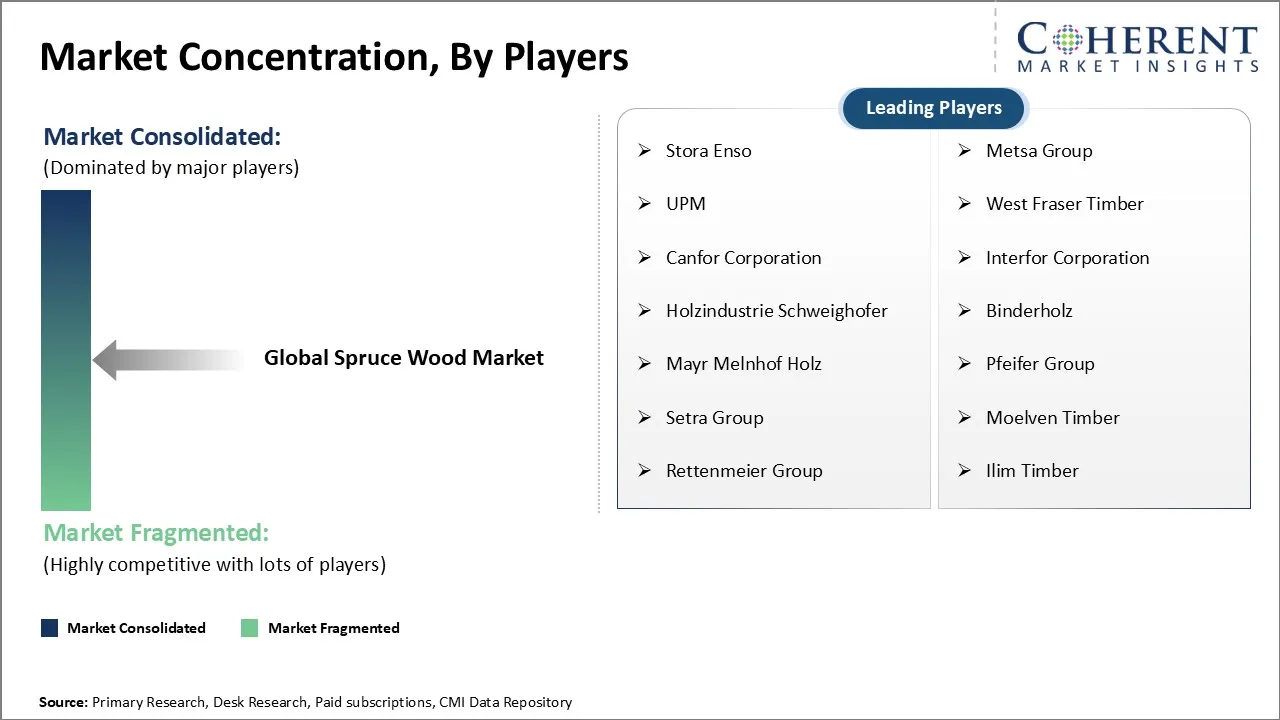
The global spruce wood market is structurally fragmented, with large integrated forest-products groups operating alongside regional sawmills, engineered-wood specialists, traders and local distributors. Competition depends on access to suitable fibre, grade consistency, processing yield, delivered price and dependable supply. Regional companies remain important where proximity reduces freight costs or enables customized dimensions, while specialists compete through technical performance, finishing quality and application-specific products.
Key focus areas include
- Fibre access and procurement security: Long-term access to suitable spruce logs influences production continuity, grade mix and exposure to raw-material price fluctuations.
- Grade consistency and recovery yield: Competitors capable of extracting a larger proportion of structural or appearance-quality lumber from incoming logs can defend margins more effectively.
- Drying and dimensional control: Consistent moisture and dimensional accuracy are increasingly important for professional construction, furniture and component-manufacturing customers.
- Manufacturing flexibility: Mills able to economically produce multiple dimensions, finishes and order sizes are better positioned to serve fragmented customer requirements.
- Delivered-cost competitiveness: Freight, duties, inventory positioning and proximity to major consumption centres can be as important as ex-mill lumber pricing.
- Certification and documentation: Product conformity, legal-origin documentation and quality assurance increasingly influence qualification for professional and institutional procurement.
- Customer integration: Technical support, predictable delivery schedules and coordination with fabricators or contractors can strengthen relationships beyond transactional timber selling.
Market Report Scope
Spruce Wood Market Report Coverage | |||
Report Coverage | Details | ||
Base Year | 2025 | Market Size in 2026: | USD 43.66 Bn |
Historical Data For: | 2020 To 2024 | Forecast Period: | 2026 To 2033 |
Forecast Period 2026 To 2033 CAGR: | 5.3% | 2033 Value Projection: | USD 62.67 Bn |
Geographies covered: |
| ||
Segments covered: |
| ||
Companies covered: | Stora Enso, Metsa Group, UPM, West Fraser Timber, Canfor Corporation, Interfor Corporation, Holzindustrie Schweighofer, Binderholz, Mayr Melnhof Holz, Pfeifer Group, Setra Group, Moelven Timber, Rettenmeier Group, Ilim Timber | ||
Growth Drivers: |
| ||
Restraints & Challenges: |
| ||
Analyst Opinion (Expert Opinion)
- The competitive focus is likely to shift from maximizing shipment volume toward extracting greater value from each fibre class. Suppliers that efficiently channel spruce into structural lumber, engineered products, appearance-grade uses, and industrial applications while meeting project-specific requirements should achieve stronger margin resilience.
- Forest-condition volatility may become a greater competitive challenge than demand fluctuations. Companies dependent on narrow sourcing areas could face pressure from pest exposure, harvest constraints, and fibre-quality variation. Flexible procurement, adaptable processing systems, and diversified sourcing are likely to become increasingly important for protecting utilization and customer continuity.
- Market participants should prioritize recovery optimization, flexible drying and finishing capacity, structural-quality assurance, and long-term fibre access rather than adding commodity capacity. Greater attention should also be given to specification-led applications, downstream partnerships, and sourcing flexibility while avoiding overinvestment in products competing mainly on volume and spot-market pricing.
Speak to the analyst
Want personalized insights?
Take the findings above to one of our principal consultants, or have the report rebuilt around the segments, geographies and competitors you actually track.
Market Segmentation
- Product Type Insights (Revenue, USD Bn, 2021 - 2033)
- Sawn Spruce Timber
- Spruce Lumber
- Engineered Spruce Wood
- Spruce Panels and Boards
- Grade Insights (Revenue, USD Bn, 2021 - 2033)
- Construction Grade
- Appearance Grade
- Premium Grade
- Industrial Grade
- Application Insights (Revenue, USD Bn, 2021 - 2033)
- Construction and Building Materials
- Furniture and Interior Products
- Paper and Pulp Production
- Packaging
- Musical Instruments and Others
- End Use Industry Insights (Revenue, USD Bn, 2021 - 2033)
- Residential Construction
- Commercial Construction
- Furniture Manufacturing
- Paper Industry
- Others
- Distribution Channel Insights (Revenue, USD Bn, 2021 - 2033)
- Direct Sales
- Timber Dealers and Distributors
- Online Retail
- Regional Insights (Revenue, USD Bn, 2021 - 2033)
- North America
- U.S.
- Canada
- Latin America
- Brazil
- Argentina
- Mexico
- Rest of Latin America
- Europe
- Germany
- U.K.
- Spain
- France
- Italy
- Russia
- Rest of Europe
- Asia Pacific
- China
- India
- Japan
- Australia
- South Korea
- ASEAN
- Rest of Asia Pacific
- Middle East
- GCC Countries
- Israel
- Rest of Middle East
- Africa
- South Africa
- North Africa
- Central Africa
- North America
- Key Players Insights
- Stora Enso
- Metsa Group
- UPM
- West Fraser Timber
- Canfor Corporation
- Interfor Corporation
- Holzindustrie Schweighofer
- Binderholz
- Mayr Melnhof Holz
- Pfeifer Group
- Setra Group
- Moelven Timber
- Rettenmeier Group
- Ilim Timber
Sources
Primary Research Interviews
- Spruce wood producers, sawmills, engineered wood manufacturers, timber traders, distributors, and construction material suppliers
- Procurement managers, forestry experts, architects, builders, furniture manufacturers, and pulp and paper industry professionals
Stakeholders
- Forest owners, logging companies, sawmills, lumber processors, engineered wood manufacturers, and timber exporters
- Distributors, wholesalers, builders merchants, construction companies, furniture manufacturers, and paper producers
- Architects, contractors, prefabrication companies, retailers, and industrial buyers
End-use Sectors
- Residential and commercial construction
- Furniture and interior applications
- Paper and pulp production
- Packaging and industrial wood products
- Engineered wood and prefabricated building systems
Regulatory and Industry Bodies
- Forestry and environmental authorities
- Timber grading and building standards organizations
- Forest certification bodies
- Trade and customs authorities
- National and regional wood industry associations
Databases
- Company annual reports, investor presentations, and corporate filings
- Forestry production and harvesting databases
- Timber trade and import-export databases
- Construction and housing statistics
- Lumber pricing, production, and capacity databases
- Product portfolio and competitive intelligence databases
Magazines and Journals
- Forestry and wood products publications
- Timber construction and mass timber journals
- Forest science and wood technology journals
- Furniture and woodworking publications
- Pulp and paper industry publications
Associations
- European Organisation of the Sawmill Industry
- Swedish Wood
- American Wood Council
- Canadian Wood Council
- National and regional forestry and timber associations
Public Domain Sources
- Forest production and harvesting trends
- Housing and construction activity
- Timber trade and pricing developments
- Mass timber and engineered wood adoption
- Sustainable forestry and certification developments
Key Standards and Regulations
- Structural timber grading standards
- Building and fire safety codes
- Forest certification and chain-of-custody requirements
- Timber legality and deforestation regulations
- International trade and customs requirements
Proprietary Elements
- CMI Data Analytics Tool and proprietary CMI repository containing 10+ years of forestry, timber, construction, furniture, paper, and wood products market intelligence.
Get access to 250+ pages report
Every segment, forecast, competitor profile and data table behind the analysis above — available for instant download.
- ESOMAR Member
- ISO 9001:2015 Certified
- D-U-N-S Registered
- GDPR & CCPA Compliant
Missing comfort of reading report in your local language? Find your preferred language:
Frequently Asked Questions
The CAGR of global spruce wood market is projected to be 5.3% from 2026 to 2033.
The global spruce wood market is estimated to be valued at USD 43.66 billion in 2026 and is expected to reach USD 62.67 billion by 2033.
Spruce wood is widely used in structural construction, furniture and interior products, paper and pulp production, packaging, engineered wood products, and selected specialty applications due to its strength-to-weight ratio, machinability, and availability.
The global spruce wood market is fragmented, with large integrated forest product companies competing alongside regional sawmills, engineered wood manufacturers, timber processors, and distributors based on product quality, supply reliability, pricing, certification, processing capability, and distribution reach.
Spruce wood pricing is influenced by log availability, harvesting costs, lumber grade, moisture content, processing requirements, freight expenses, trade duties, construction demand, currency movements, and regional supply-demand conditions.
The global spruce wood market report covers market dynamics, competitive landscape, regional and country analysis, production and processing developments, technology adoption, pricing and supply-chain considerations, regulatory developments, company strategies, and commercial opportunities across major spruce wood applications.
Growing construction activity and the increasing preference for renewable wood-based building materials are the major factors driving the growth of the global spruce wood market.