

Global Strapping Materials Market Size and Forecast – 2026 To 2033
The global strapping materials market is expected to grow from USD 7.40 Bn in 2026 to USD 10.20 Bn by 2033, registering a compound annual growth rate (CAGR) of 4.6% from 2026 to 2033. The global strapping materials market is driven by growing palletization across manufacturing industries. On March 17, 2025, Signode highlighted the advanced capabilities of its Simplimatic Autonomous Mobile Robot (AMR) operating with the Simplimatic robotic palletizer and depalletizer to handle different loads with speed and accuracy at ProMat 2025.
Key Takeaways of the Global Strapping Materials Market
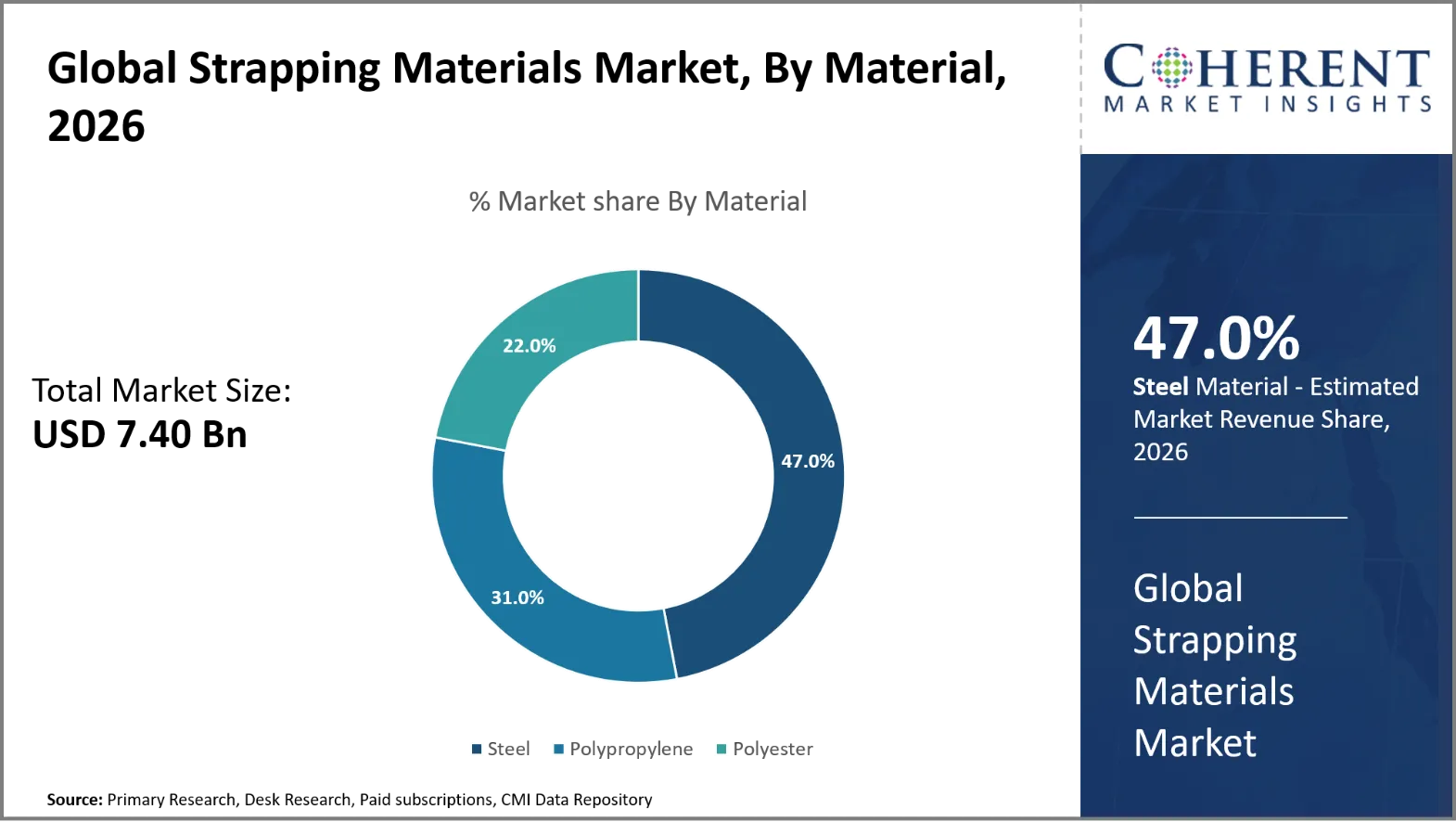
- The Steel segment is expected to account for 47.0% of the global strapping materials market share in 2026. Increasing demand for lightweight packaging materials is driving the growth of the segment.
- The Embossed segment is estimated to capture 57.0% of the market share in 2026. Growth in automated packaging systems is majorly driving the growth of the segment. On January 28, 2026, Innova launched the ODEN SMARTDRIVE universal strapping head for automatic machines.
- The Light-Duty segment is estimated to capture 51.0% of the market share in 2026. Rising use of recyclable polyester strapping is majorly driving the growth of the segment. On October 20, 2025, Mosca presented the SoniXs P7-Connect as a new fully automatic strapping machine. The system was developed for integration into automated production lines.
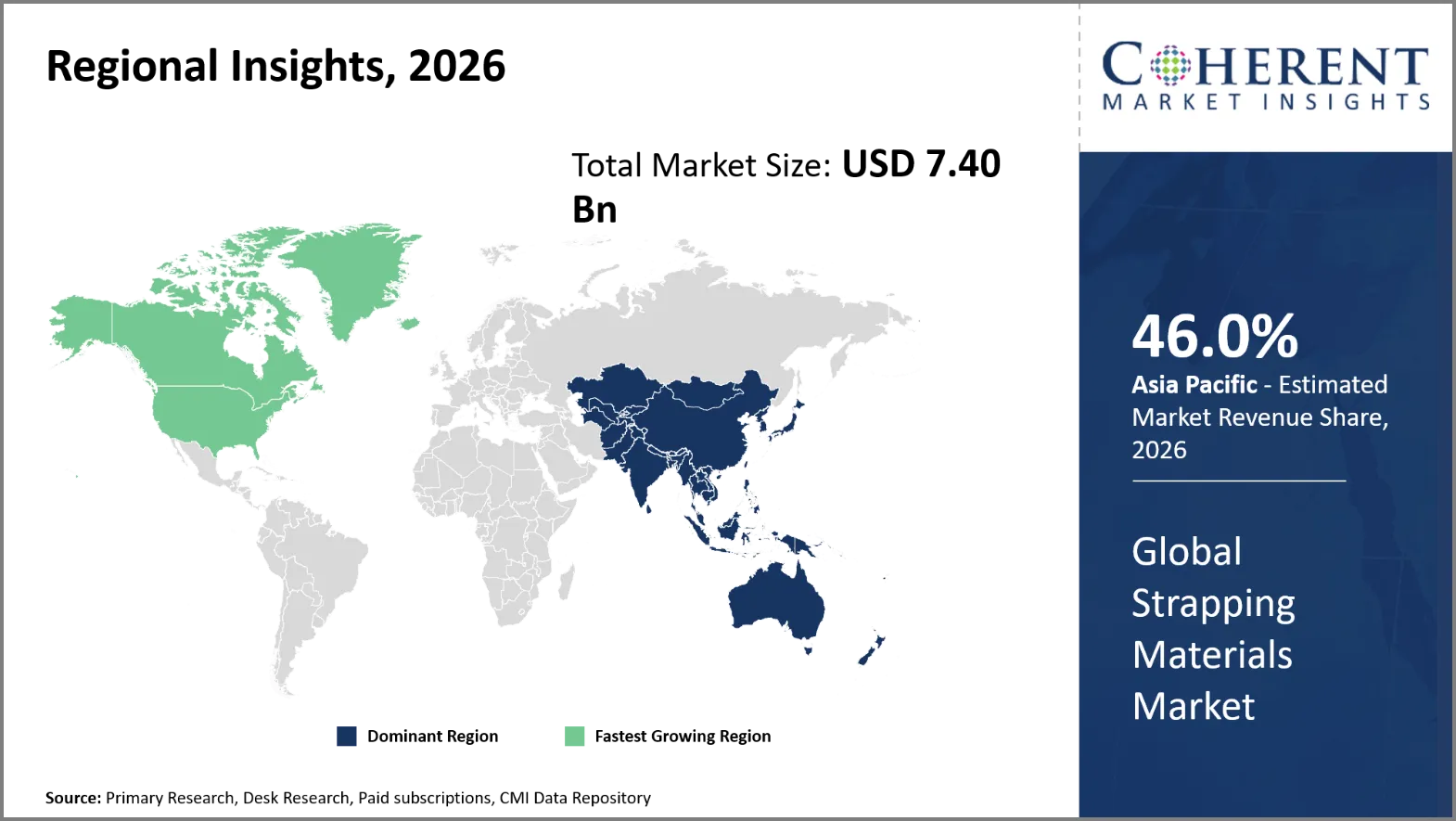
- Asia Pacific is expected to dominate the strapping materials market in 2026 with a market share of 46.0%. Growing demand for high-tensile polyester materials in Asia Pacific is driving the growth of the regional market. In May 2025, Signode India recorded exports of Tenax polyester strapping to international customers. The shipments included 10-millimeter and 16-millimeter PET straps.
- North America is expected to account for 21.0% share in 2026 and is projected to record the fastest growth over the forecast period. Development of bio-based and lower-impact strapping materials in North America is driving the growth of the regional market. On April 27, 2026, Mosca presented a recycled polypropylene strap containing at least 35% post-consumer recycled material at Interpack 2026.
Segmental Insights
Why Does Steel Dominate the Global Strapping Materials Market?
The steel segment is expected to account for 47.0% of the global strapping materials market share in 2026. Steel remains a widespread choice, due to its strong tensile strength in fastening huge industrial loads. Its stiffness contributes to stability of the load during transit and storage. Steel strapping is a good choice for harsh situations, such as high temperatures and severe handling. It is appropriate for steel coils, construction materials, heavy machines. These performance benefits support ongoing use in heavy duty packaging applications. In August 2025, Signode issued a specific steel strapping upgrade featuring their high-tensile steel offering. The company specialized in steel straps for steel coils, bundles of lumber and concrete blocks. Signode further pointed to performance in harsh temperatures and tough industrial environments.
- Current Industry Events of 2026
- Market Size Estimation
- Regional Breakdown
- Competitive Landscape
- Customer Intelligence
- Segmental Analysis
- Pricing Analysis
- Key Market Drivers, Challenges & Future Trends
- Customized Insights Section
Why is Embossed the Most Preferred Surface?
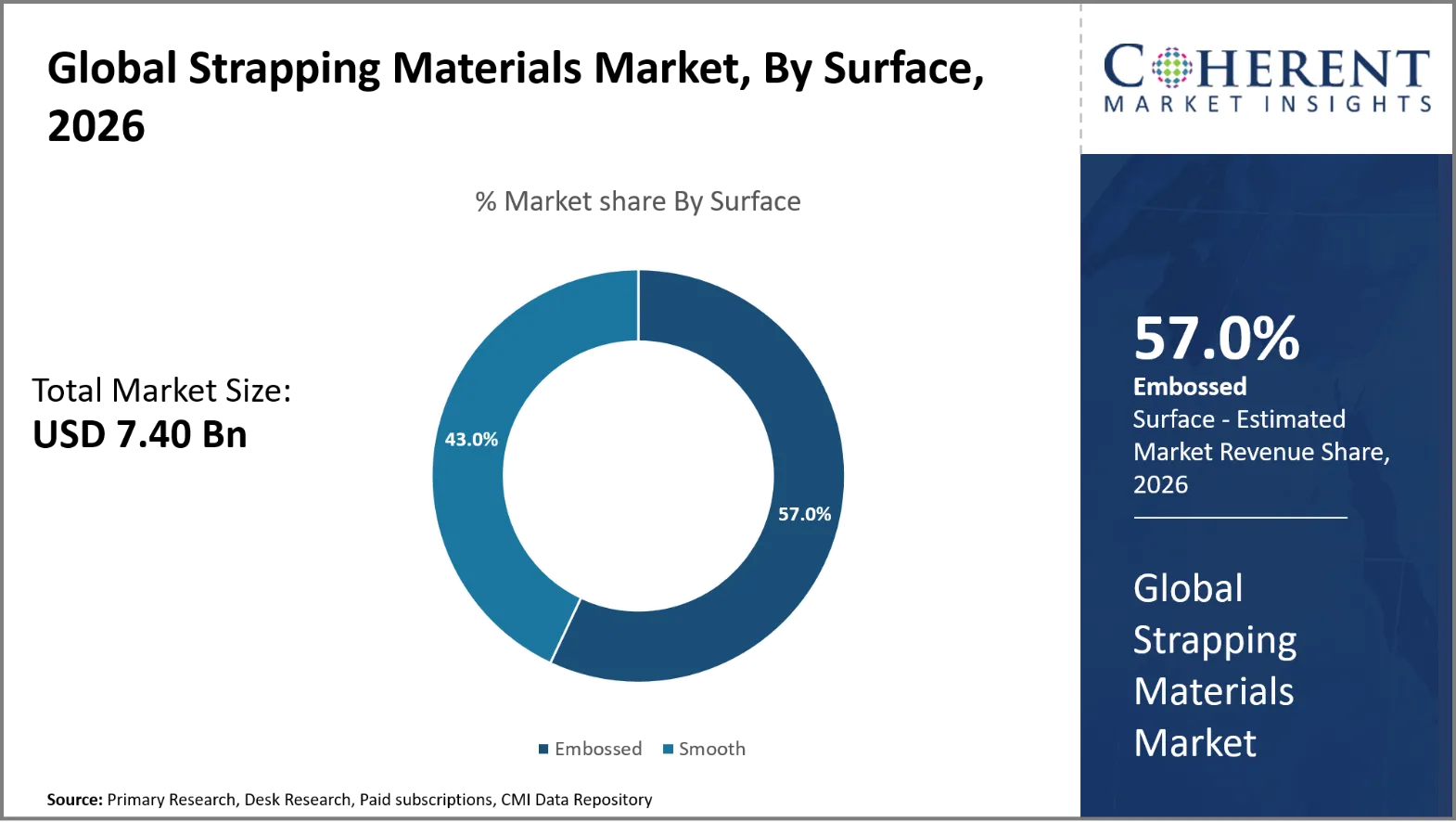
The embossed segment is expected to account for 57.0% of the global strapping materials market share in 2026. Embossed strapping improves traction between strap and packaging surfaces. Its textural profile helps decrease strap slippage in handling and shipping. Flexibility can also be added through embossing, while still providing enough tension to handle variable loads. This surface design enables uniform load securing throughout challenging packaging applications. Such features make the embossed materials appropriate for automatic and hand strapping operations. On January 2, 2026, Signode introduced its next-generation embossed polypropylene strap. The new design provides over 10% lower carbon footprint during production. Each coil can contain up to 4,000 meters of strap, reducing coil replacement frequency.
Light-Duty Dominates the Global Strapping Materials Market
The light-duty segment is expected to account for 51.0% of the global strapping materials market share in 2026. Light duty strapping is used to secure light weight cartons and consumer products. The lesser material use reduces the packaging expenses of regular shipments. Lightweight straps also allow handling during manual packaging procedures. The flexibility of these straps makes it easy to fasten objects of tiny dimensions and moderate loads efficiently. The ongoing growth in e-commerce shipments is driving demand for affordable, lightweight packing solutions. On August 15, 2025, Cyklop introduced the OmniStrap 380, a handheld, battery-operated strapping tool for plastic strap, developed to fulfill the needs of worldwide packaging operations across a wide range of sectors. The 380 is designed for general application and offers better tensioning, sealing and cutting operations in one easy to use device.
Current Events and their Impact
Current Events | Description and its Impact |
European Union Packaging and Packaging Waste Regulation (EU) 2025/40 |
|
Australia Anti-Dumping Measures |
|
Strapping Materials Market Dynamics
Market Drivers
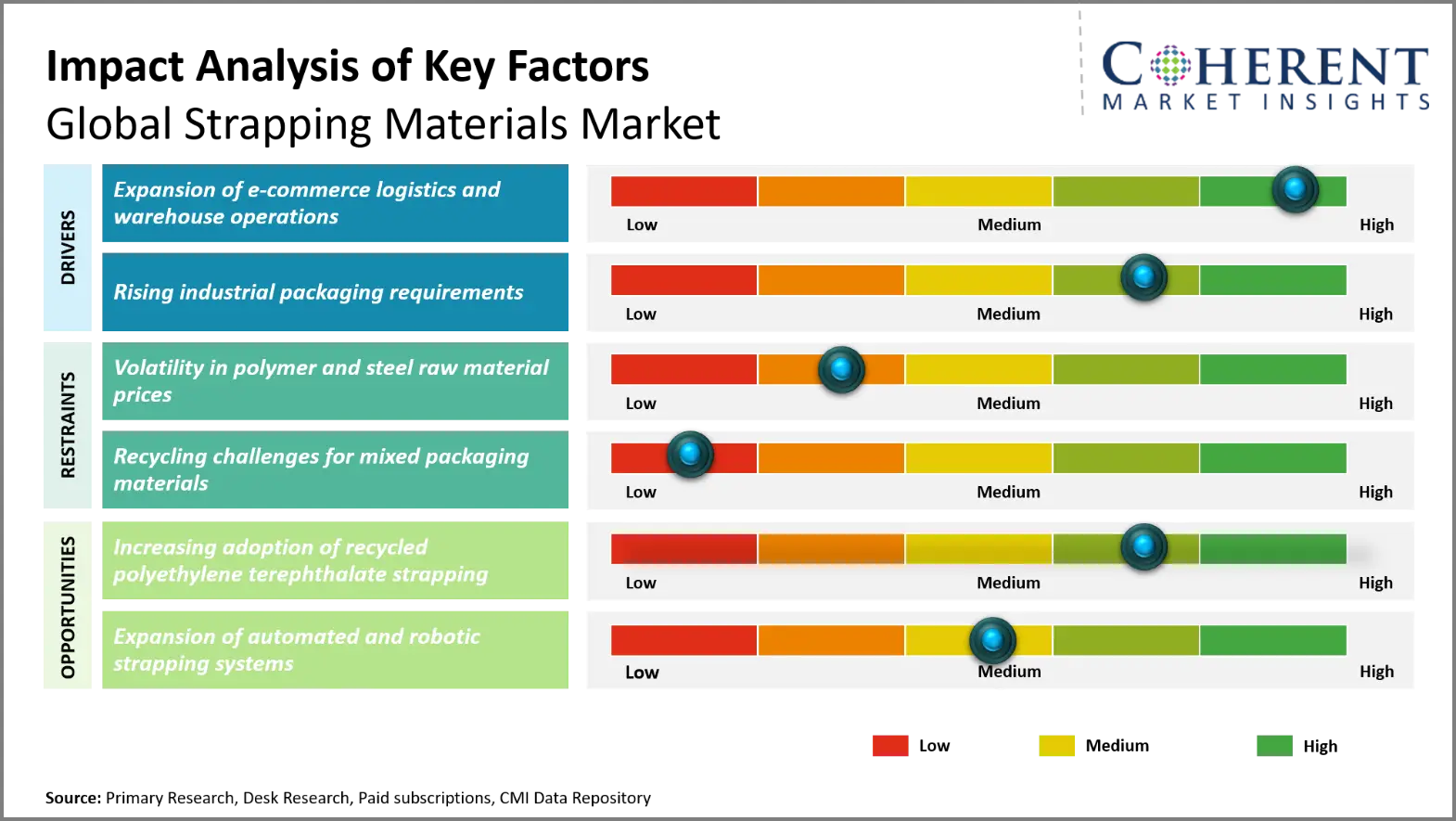
Expansion of e-commerce logistics and warehouse operations
E-commerce logistics and warehousing operations are growing, resulting in more shipments that require safe and effective packing solutions. Strapping material is used for securing cartons, pallets and grouped products during shipping. The rise of warehouse quantities also drives the need for fast and dependable packaging operations. Automated strapping systems help to achieve higher throughput in distribution facilities with high order quantities. Such advances are increasing the demand for polypropylene and polyester strapping in logistics operations.
On June 9, 2026, DHL Supply Chain announced the expansion of its data center logistics capabilities across Asia Pacific, solidifying its status as a strategic partner for hyperscalers and data center operators as AI investment accelerates and large-scale deployments move into execution.
Rising industrial packaging requirements
Industrial firms are demanding more and more secure packaging of large, bulky and irregular products. Strapping materials give load stability for handling, storage and transit. Steel strapping is still a good choice for tough jobs including strapping coils, machinery and construction products. Polyester and polypropylene choices are perfect for less heavy industrial shipments that require flexibility and ease of handling. Therefore, the expansion of manufacturing activities will increase broader utilization in industrial packaging applications.
On March 19, 2026, Teufelberger established a strategic partnership with TOSA to jointly position a validated, high-performance strapping system for industrial applications. As part of the cooperation, TOSA is launching a strapping machine that has been carefully tested, qualified and validated with Teufelberger strapping solutions.
Emerging Trends
- Shift Toward Recyclable Strapping Materials: Manufacturers are increasingly manufacturing recyclable polypropylene and polyester straps to enable circular and flexible packaging solutions. This development reflects demanding sustainability expectations of industrial clients and retailers who are seeking lower waste, better material recovery and more ecologically responsible packaging operations.
- Growth of Automated Strapping Systems: Automated packing lines are becoming increasingly common as warehouses and manufacturers are seeking faster throughput and consistent load securing. Integrated strapping equipment lowers the need for manual handling while facilitating consistent packaging procedures across high-volume logistics and industrial operations.
- Increasing Use of Recycled Content: Packaging strap makers are using recycled polymers in straps to lessen reliance on raw materials. Companies are looking for resource efficiency, waste reduction and evolving package sustainability standards and recycled polyester and polypropylene solutions are receiving attention.
- Development of High-Performance Lightweight Strapping: Thinner straps are being developed by manufacturers that will provide sufficient tensile performance with less material consumption. These solutions allow for reduced package weight, simpler handling and enhanced transportation efficiency, particularly in e-commerce, logistics, warehousing and consumer products applications.
Regional Insights
Why is Asia Pacific a Strong Market for Strapping Materials?
Asia Pacific is expected to account for a market share of 46.0% in 2026. Industrial activity in the region is mainly concentrated around the electronics, automotive, consumer goods and export industries. China's 1,990 billion express deliveries in 2025 saw a rise in the demand for secure secondary packaging. Regional firms are increasingly turning to automated strapping for palletized exports and for warehousing operations. Japan and South Korea are providers of high-end machinery and electronics supply chains which are in need of constant load protection. Southeast Asian production networks also support demand for polyester and polypropylene strapping.
Why Does North America Strapping Materials Market Exhibit High Growth?
North America is expected to register the fastest growth with a CAGR of 5.8% over the forecast period. It is projected to account for 21.0% of the global strapping materials market in 2026. North America benefits from large-scale food, beverage, automotive, construction, and distribution operations requiring dependable unit-load securing. U.S. manufacturing recorded USD 6.98 trillion in 2024 sales, with USD 4.65 trillion from shipments. Food manufacturing alone generated USD 1.05 trillion in sales. These operations create extensive requirements for pallet stabilization, carton bundling, and transport packaging.
Global Strapping Materials Market Outlook for Key Countries
Why is China Emerging as a Major Hub in the Strapping Materials Market?
China benefits from exceptionally large parcel volumes and export-oriented manufacturing. The country processed 1,990 billion express deliveries in 2025, providing substantial secondary packaging requirements. Sales of online retail of physical items were USD 1938.45 billion, or 26.1% of consumer retail sales. Container port throughput also hit 354.47 million twenty-foot equivalent units. Such logistics quantities underpin continued use of strapping for cartons, pallets and export cargoes.
Is U.S. the Next Growth Engine for the Strapping Materials Market?
The U.S. strapping materials market is benefiting from heavy supplies of manufactured goods, including food, beverages, textiles, machinery and industrial products. In 2024, U.S. sales of manufactured goods reached USD 6.98 trillion. Food production sales totaled USD 1.05 trillion, necessitating large palletized distribution needs. E-commerce activity also encourages frequent carton consolidation in fulfillment networks. Automated packaging technology is especially appropriate for high-volume distribution centers that receive uniform shipments.
Germany Strapping Materials Market Analysis and Trends
Germany’s export-oriented industrial structure, especially in automotive, machinery, chemicals and engineering products, is a plus. German exports during 2025 were USD 1,562.9 billion. Germany’s ports handled 15 million twenty-foot equivalent units, 3 million units of which come from China. Container traffic with European Union members increased 13.1%. These trade flows create sustained requirements for load stabilization across industrial exports and maritime logistics.
Japan Strapping Materials Market Analysis and Trends
Japan benefits from its concentrated automotive, electronics, machinery, and precision manufacturing ecosystems. Packaging standards for export are especially critical for parts that are moved between home manufacturing clusters and abroad assembly plants. Japanese firms are also very dependent on standardized palletization and automated industrial operations. The demand for strapping is consequently very directly connected to component protection and efficiency in industrial handling. Shipments of automotive parts, electrical equipment and machinery provide unique applications that require secure unit load preparation.
India Strapping Materials Market Analysis and Trends
Under the Make in India initiative, India benefits from increasing manufacturing capacity and modernization of logistics. The Ministry of Commerce and Industry has introduced Logistics Ease Across Different States 2025 for benchmarking logistics performance. The initiative is committed to logistics efficiency for manufacturing competitiveness. Manufacturing growth was found to be concentrated in pharmaceuticals and engineering goods. These sectors create distinct requirements for secure palletization, export packaging, and warehouse handling.
Global Strapping Materials Market - Steel Strapping Tensile Strength by Grade and Application (2025)
Steel Strapping Grade | Typical Tensile Strength | Primary Application |
Regular Duty | 770-880 MPa | Cartons, pallets, construction products, general industrial loads |
Regular Duty High Strength | 850-1,050 MPa | Heavy cartons, lumber, pallets, industrial bundles |
High Tensile | 850-1,390 MPa | Steel coils, metal products, machinery, heavy palletized loads |
High Tensile Heat-Treated | 950-1,390 MPa | Steel coils, construction materials, heavy machinery |
Ultra High Strength | Up to 1,390 MPa | Extreme-load industrial and metal applications |
How is Increasing Adoption of Recycled Polyethylene Terephthalate Strapping Creating New Growth Opportunities in the Strapping Materials Market?
Increasing adoption of recycled polyethylene terephthalate strapping creates opportunities by converting post-consumer bottles into industrial packaging material. Recycled polyethylene terephthalate can be used by manufacturers for making high-strength straps for palletized items and hefty cartons. This supports circularity in packaging and reduces the need for virgin polyester feedstock. European packaging regulations are also putting a spotlight on recycled content and the recyclability of packaging. Such developments are encouraging strapping companies to extend recycled polyethylene terephthalate grades, improve processing technology and build closed-loop supply partnerships with packaging waste recyclers.
On May 16, 2025, Mosca GmbH announced the launch of its pioneering "Loop that." project. In partnership with Interzero, a closed loop for strapping is to be established in order to make optimum use of resources, minimize waste and contribute to environmental protection. The name "Loop that" also underlines Mosca's vision of initiating an industry solution for the entire strapping industry.
Market Players, Key Development, and Competitive Landscape
Key Developments
- On February 2, 2026, Cyklop announced a significant expansion of its manufacturing footprint. The establishment of Cyklop Jade Star’s new facility reflects strong confidence in Malaysia as a place to grow and invest for long term. Spanning 46,000 sqm, the plant is designed to cater to the increasing PET needs in the Asia region.
- On July 3, 2025, Zentek and Teufelberger expanded their partnership to integrate used polypropylene (PP) strapping and used PET strapping into a recycling and material return process. At the heart of the collaboration is the return of used strapping bands. Through an established take-back system, these are collected by specialized waste management partners, compacted into bales, and delivered to Teufelberger.
Competitive Landscape
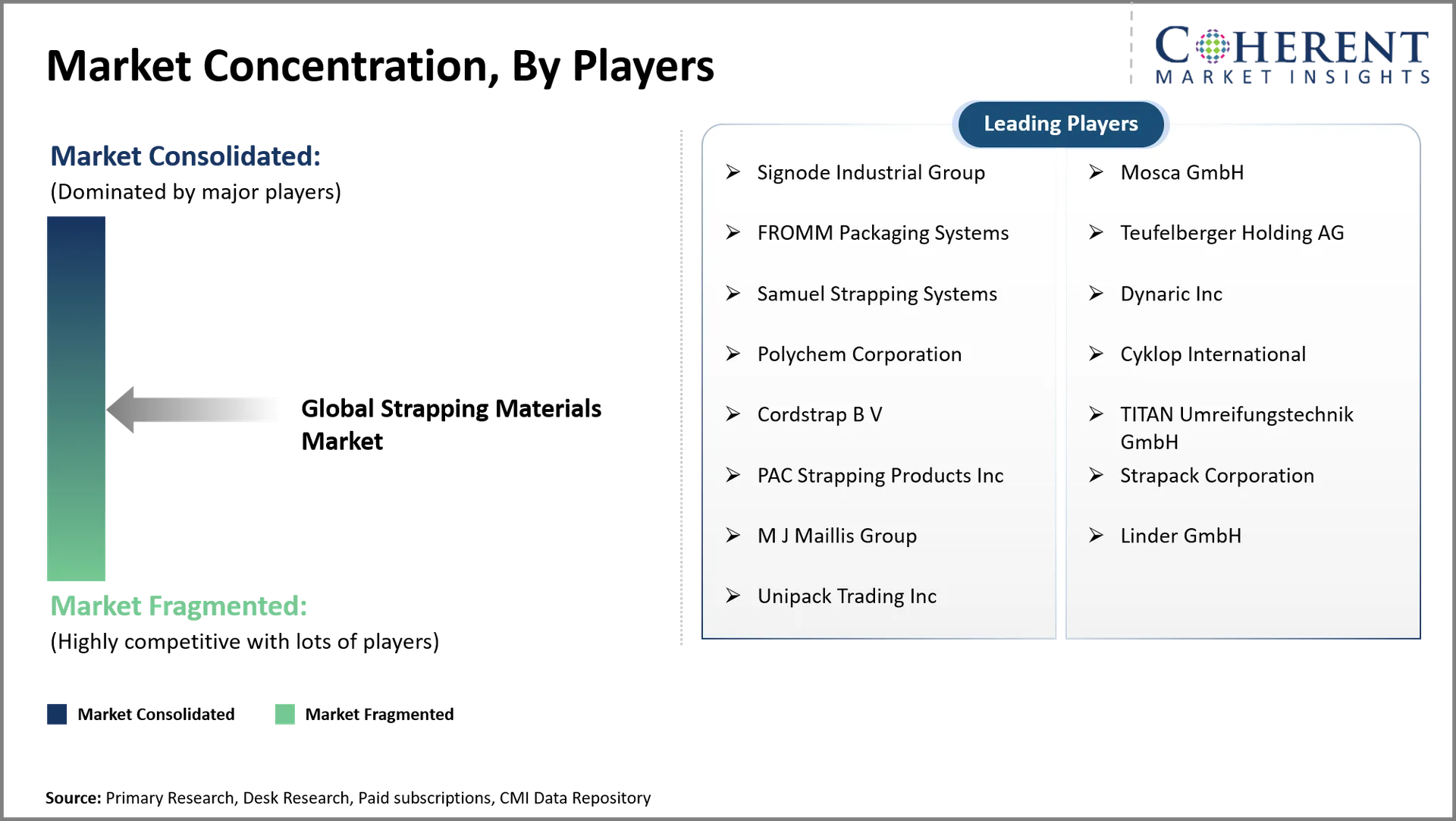
Competition is focused on integrated strapping portfolios, recycling systems, automation and application-specific load securing. Tenax polyester strapping. Apex steel strapping. Automated machinery. Tools. Closed loop recycling schemes. The recycling initiative collects used polyester strapping for recycling into recycled material. Teufelberger concentrates on recycled-content PET and polypropylene strapping for industrial logistics and automated packaging. Its PET range covers TYCOON GreenPerformance and jumbo coils for high-throughput operations. Mosca highlights recyclable PET, recycled polypropylene, closed loop collection and energy efficient ultrasonic strapping technology. FROMM focuses on recycled PET strapping, including STARstrap products containing 98% recycled material.
Market Report Scope
Global Strapping Materials Market | |||
Report Coverage | Details | ||
Base Year | 2025 | Market Size in 2026: | USD 7.40 Bn |
Historical Data For: | 2020 To 2024 | Forecast Period: | 2026 To 2033 |
Forecast Period 2026 To 2033 CAGR: | 4.6% | 2033 Value Projection: | USD 10.20 Bn |
Geographies covered: |
| ||
Segments covered: |
| ||
Companies covered: | Signode Industrial Group, Mosca GmbH, FROMM Packaging Systems, Teufelberger Holding AG, Samuel Strapping Systems, Dynaric Inc, Polychem Corporation, Cyklop International, Cordstrap B V, TITAN Umreifungstechnik GmbH, PAC Strapping Products Inc, Strapack Corporation, M J Maillis Group, Linder GmbH, Unipack Trading Inc | ||
Growth Drivers: |
| ||
Restraints & Challenges: |
| ||
Analyst Opinion (Expert Opinion)
- The industry is likely to move toward integrated material-and-equipment solutions rather than standalone strap products. Recycled PET should gain importance where manufacturers require high tensile performance alongside documented recycled content. Automation will remain closely connected with material development because high-volume facilities need consistent strap feeding, sealing, and tensioning. Closed-loop collection can become a stronger differentiator as producers connect used straps with new strap production.
- Strongest growth prospects is expected to be in recycled PET, automated strapping and medium to heavy palletized applications. PET can be used as an alternative to steel in some applications for which corrosion resistance, easier handling and fast elongation recovery are of benefit. China and India have significant prospects for application since manufacturing and logistics businesses demand enormous amounts of secured unit loads. In Europe, where growing regulatory requirements are increasingly targeting container circularity, certified recycled-content products have prospects, as well.
- Players looking for an edge should look to combine high-performance straps with proven recycled content and fast recovery mechanisms. Signode’s closed-loop PET and polypropylene initiatives are a case in point. Teufelberger plans to utilize certified recycled content and to achieve 100% recycled PET products by 2030. Manufacturers additionally should consider optimizing strap thickness, coil length, machine compatibility and automated application speed. The combination can boost material efficiency and client retention through integrated packaging solutions.
Speak to the analyst
Want personalized insights?
Take the findings above to one of our principal consultants, or have the report rebuilt around the segments, geographies and competitors you actually track.
Market Segmentation
- Material Insights (Revenue, USD Billion, 2021 - 2033)
- Steel
- Polypropylene
- Polyester
- Surface Insights (Revenue, USD Billion, 2021 - 2033)
- Embossed
- Smooth
- Load Capacity Insights (Revenue, USD Billion, 2021 - 2033)
- Light-Duty
- Medium-Duty
- Heavy-Duty
- Application Insights (Revenue, USD Billion, 2021 - 2033)
- Industrial Logistics and Warehousing
- Food and Beverage
- Corrugated Cardboard and Paper
- Building and Construction
- Metal Industry
- Automotive
- Regional Insights (Revenue, USD Billion, 2021 - 2033)
- North America
- U.S.
- Canada
- Latin America
- Brazil
- Argentina
- Mexico
- Rest of Latin America
- Europe
- Germany
- U.K.
- Spain
- France
- Italy
- Russia
- Rest of Europe
- Asia Pacific
- China
- India
- Japan
- Australia
- South Korea
- ASEAN
- Rest of Asia Pacific
- Middle East
- GCC Countries
- Israel
- Rest of Middle East
- Africa
- South Africa
- North Africa
- Central Africa
- North America
- Key Players Insights
- Signode Industrial Group
- Mosca GmbH
- FROMM Packaging Systems
- Teufelberger Holding AG
- Samuel Strapping Systems
- Dynaric Inc
- Polychem Corporation
- Cyklop International
- Cordstrap B V
- TITAN Umreifungstechnik GmbH
- PAC Strapping Products Inc
- Strapack Corporation
- M J Maillis Group
- Linder GmbH
- Unipack Trading Inc
Sources
Primary Research Interviews
- Strapping Materials Manufacturers & Suppliers
- Packaging Industry Professionals & Consultants
- End-Use Industry Representatives (Logistics, Food & Beverage, Construction)
- Distributors & Retailers of Strapping Materials
Magazines
- Packaging World Magazine
- Modern Materials Handling Magazine
- Packaging Strategies Magazine
- Supply Chain Management Review
Journals
- Journal of Packaging Technology and Research
- Journal of Applied Polymer Science
- International Journal of Advanced Packaging Technology
Associations
- Flexible Packaging Association (FPA)
- Packaging Machinery Manufacturers Institute (PMMI)
- World Packaging Organisation (WPO)
- Strapping Manufacturers Council (SMC)
Public Domain Sources
- U.S. Environmental Protection Agency (EPA) - Packaging & Sustainability Reports
- European Commission - Packaging & Packaging Waste Regulations
- U.S. Census Bureau - Manufacturing & Trade Data
- Food and Agriculture Organization (FAO) - Agricultural Packaging Data
Proprietary Elements
- CMI Data Analytics Tool
- Proprietary CMI Existing Repository of information for last 10 years
Get access to 250+ pages report
Every segment, forecast, competitor profile and data table behind the analysis above — available for instant download.
- ESOMAR Member
- ISO 9001:2015 Certified
- D-U-N-S Registered
- GDPR & CCPA Compliant
Missing comfort of reading report in your local language? Find your preferred language:
Frequently Asked Questions
The global strapping materials market is expected to stand at USD 7.40 Bn in 2026 and is expected to reach USD 10.20 Bn by 2033.
The CAGR of the global strapping materials market is projected to be 4.6% from 2026 to 2033.
Expansion of e-commerce logistics and warehouse operations and rising industrial packaging requirements are the major factors driving the growth of the global strapping materials market.
Volatility in polymer and steel raw material prices and Recycling challenges for mixed packaging materials are the major factors hampering the growth of the global strapping materials market.
In terms of material, steel segment is estimated to dominate the market revenue share in 2026.
Strapping materials are flexible or rigid bands used to bundle, stabilize, and secure products during handling, storage, and transportation.
Recycled polyester strapping is manufactured using recovered polyethylene terephthalate material from post-consumer or industrial waste streams.