

Global Sunscreen Stick Market Size and Forecast – 2026 To 2033
The Global Sunscreen Stick Market is estimated to be valued at USD 998.2 Mn in 2026 and is projected to reach USD 1,613.4 Mn by 2033, exhibiting a CAGR of 7.1% from 2026 to 2033. Market growth is supported by consumer preference for portable, easy-to-apply sun protection products and greater awareness of UV-related skin damage. Manufacturers are introducing lighter, non-greasy formulations to complement daily skincare routines, and online retail and specialty beauty stores are increasing product access.
In 2024, Unilever introduced Lakmé Sun Expert Invisible SPF 50 Sunscreen Stick, designed to provide sun protection without leaving a visible white cast and suitable for application over makeup. This development highlights how multifunctional formulations and convenient application formats are creating opportunities for sunscreen manufacturers to attract everyday skincare consumers.
Key Takeaways of the Global Sunscreen Stick Market
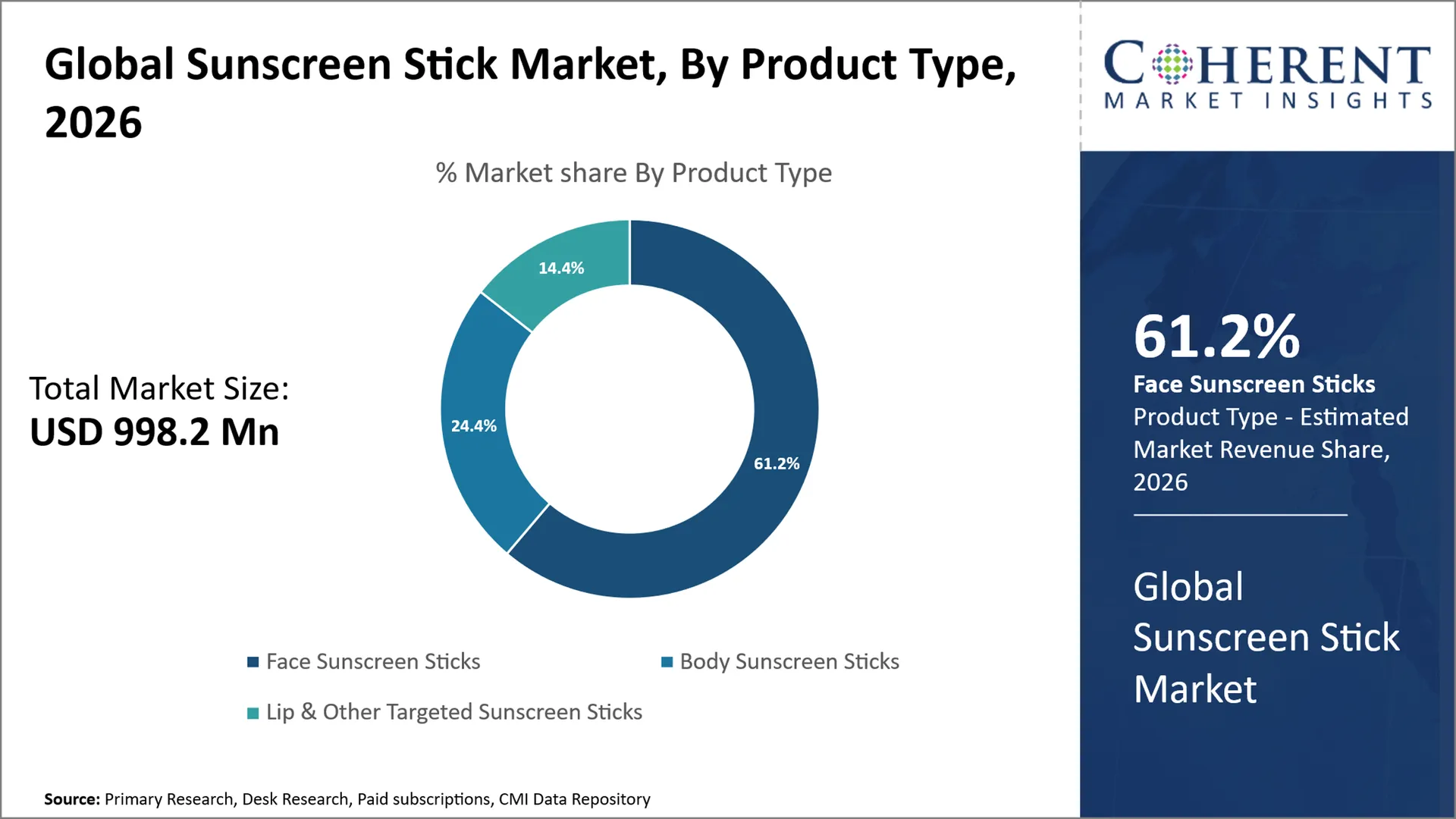
- Face Sunscreen Sticks are projected to record an estimated 7.4% CAGR through 2033 and account for 61.2% of the global sunscreen stick market in 2026. The precision-application format is perfect for facial skincare regimens and convenient touch-ups without the necessity of carrying liquid sunscreen. Launched in April 2024, ATTITUDE’s Sunly Tinted Mineral Face SPF Stick is packaged without plastic, and features a differentiated facial sun protection technology.
- Chemical-Based Sunscreen Sticks are expected to expand at an estimated 6.7% CAGR through 2033, representing 44.1% of 2026 global sunscreen stick market revenue. The transparent UV-filter formulations allow brands to deliver an invisible finish across a variety of skin tones, enabling everyday use with makeup. In January 2025, e.l.f. Cosmetics launched the Suntouchable Invisi-Stick SPF 50 with avobenzone, homosalate, octisalate, and octocrylene.
- SPF 50 & Above Sunscreen Sticks are projected to achieve an estimated 8.2% CAGR through 2033 and capture 44.2% of 2026 sales. Higher labeled protection helps premium positioning when partnered with practical reapplication and comfortable textures. In July 2025, COSRX said its SPF 50+ Airy-Light Invisible Sun Stick was number one among the new facial sunscreens on Amazon Germany.
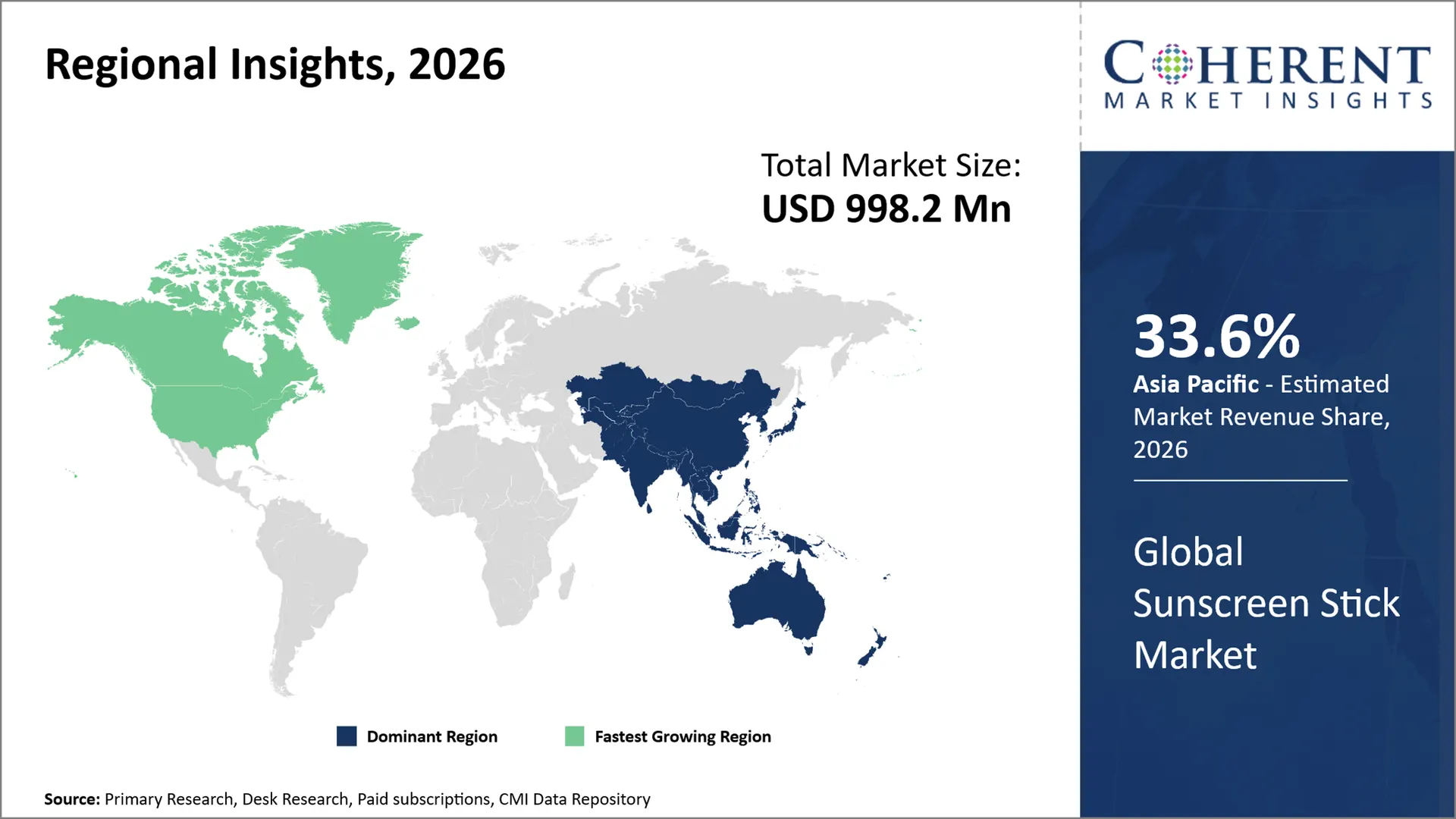
- Asia Pacific is expected to record an estimated 6.9% CAGR through 2033 and account for 33.6% of global sunscreen stick market revenue in 2026. Regional skincare brands are creating a receptive market for portable formats by infusing sunscreen into their makeup and outdoor-related rituals. In March 2024 Amorepacific, the South Korean company, launched HERA’s UV Protector Active Sun Balm, a compact stick for easy reapplication.
- North America is projected to post an estimated 8.7% CAGR through 2033, representing 31.2% of the global sunscreen stick market in 2026 and the fastest regional growth. Outdoor lifestyle brands are extending sunscreen sticks beyond traditional beauty retail. In June 2026, U.S.-based Sunski introduced its Hot Block SPF 50 Mineral Sunscreen Stick alongside a new outdoor-focused sun protection range.
Segmental Insights
Why Do Face Sunscreen Sticks Dominate the Global Sunscreen Stick Market?
Face Sunscreen Sticks are expected to dominate the product-type segment, accounting for 61.2% of the global sunscreen stick market in 2026. Specialized formulations are commercially attractive as far as sun protection of the face is compatible with the appearance of pores, oiliness of the skin and preferred cosmetic finishes. Matte textures are especially attractive to consumers who want to keep shine in check and facial skincare brands can market these products as something new to incorporate into their daily beauty regimen. Manufacturers are developing structured wax bases and oil-absorbing ingredients to improve the product’s comfort and consistency of application. These features enable beauty retailers to differentiate their sunscreen assortments by skin concern, supporting premium product positioning and repeat purchases. In June 2026, Beauty of Joseon reported continued global sales growth of its Matte Sun Stick, demonstrating the commercial relevance of specialized facial sunscreen formulations.
- Current Industry Events of 2026
- Market Size Estimation
- Regional Breakdown
- Competitive Landscape
- Customer Intelligence
- Segmental Analysis
- Pricing Analysis
- Key Market Drivers, Challenges & Future Trends
- Customized Insights Section
Why Do Chemical-Based Sunscreen Sticks Represent the Largest Formulation Segment in the Global Sunscreen Stick Market?
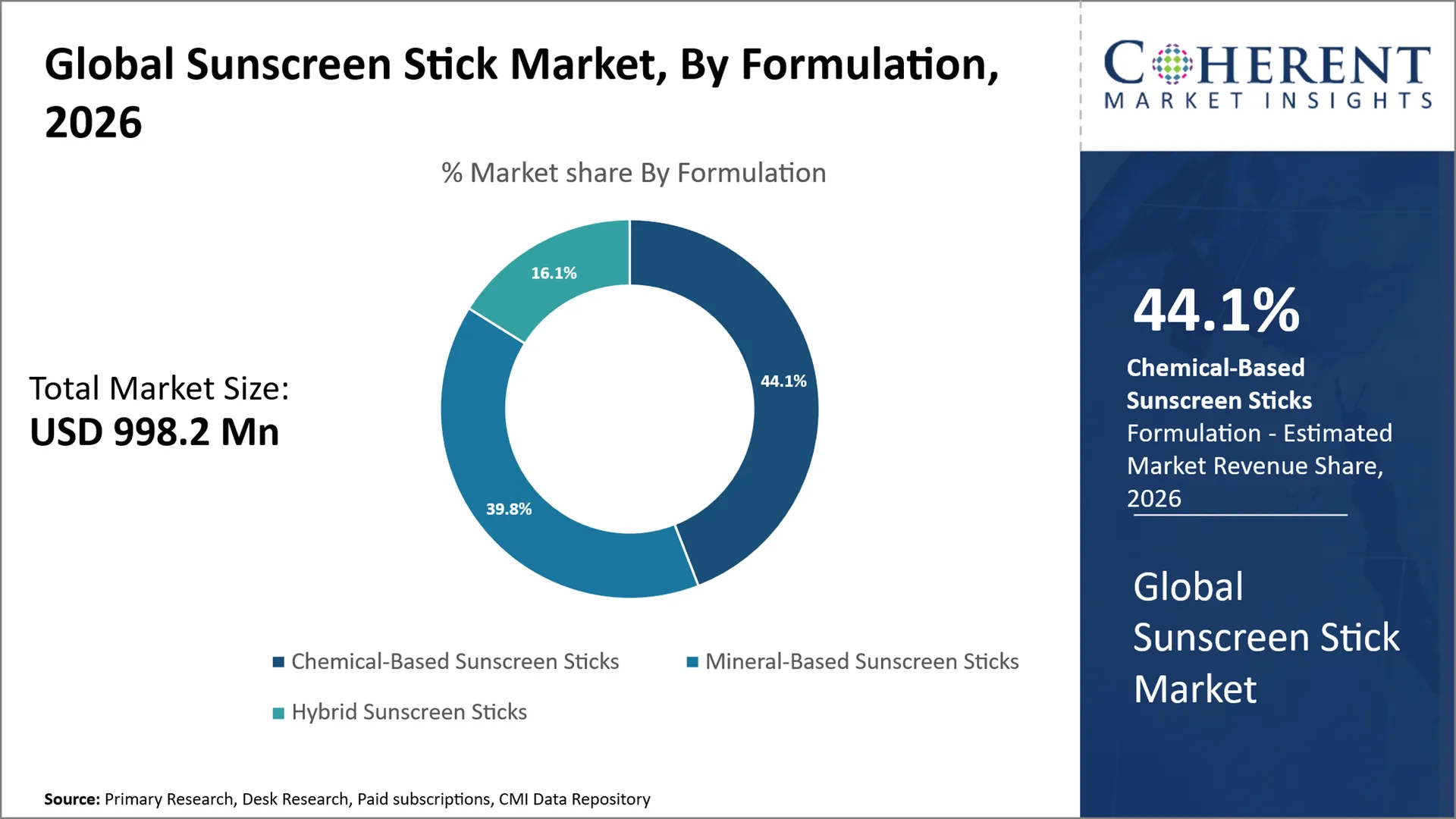
Chemical Based Sunscreen Sticks is expected to hold 44.1% revenue share of Global Sunscreen Stick Market by 2026. The complementary organic UV filters combine to allow manufacturers to control mineral-particle loading while formulating broad-spectrum protection. Formulators are able to adjust waxes, emollients and film formers to balance product firmness, application uniformity and skin comfort. This flexibility is sufficient to accommodate a wide range of product specifications in mass-market and premium sunscreen portfolios. But before manufacturers can commercialize a product, they must conduct UV-filter compatibility, ingredient restrictions, and finished-product efficacy testing. In December 2021, THANK YOU FARMER featured its Sun Project Silky Calming Sun Stick on its official website, listing multiple organic UV filters, including Diethylamino Hydroxybenzoyl Hexyl Benzoate, Ethylhexyl Triazone, Polysilicone-15, and Bis-Ethylhexyloxyphenol Methoxyphenyl Triazine. This formulation shows how different chemical UV filters can be included in solid sunscreen sticks, while also offering water-resistant protection and allowing for easy application.
Why Does SPF 50 & Above Dominate the SPF Level Segment of the Global Sunscreen Stick Market?
SPF 50 & Above Sunscreen Sticks are expected to account for 44.2% of global sunscreen stick market revenue in 2026, leading the SPF level category. Consumers selecting products for extended outdoor exposure are drawn to products with higher labeled protection as long as they apply an adequate amount of sunscreen. However, this calls for careful optimization of combinations of the UV filters, film formation and product stability to ensure that the product provides the necessary protection without compromising the performance of the application. Such formulation requirements present opportunities for specialist sunscreen brands and experienced contract manufacturers. Retailers can position higher-SPF products within premium sun-care assortments to aid product differentiation and customer acquisition. Korean skincare brand MDP+ launched its SPF 50 Peptide 9 Bio Sun Stick Pro at Nordstrom in November 2026. The development illustrates the distribution of high protection sunscreen sticks in the established U.S. department store distribution channels.
Current Events and their Impact
Current Event | Description and Its Impact |
April 2024 – European Commission Restricts the UV Filter 4-MBC |
|
June 2026 – U.S. FDA Adds Bemotrizinol as a Permitted Sunscreen Active Ingredient |
|
October 2026 – Australia Advances Sunscreen Testing and Compliance Reforms |
|
Global Sunscreen Stick Market Dynamics
Key Market Drivers
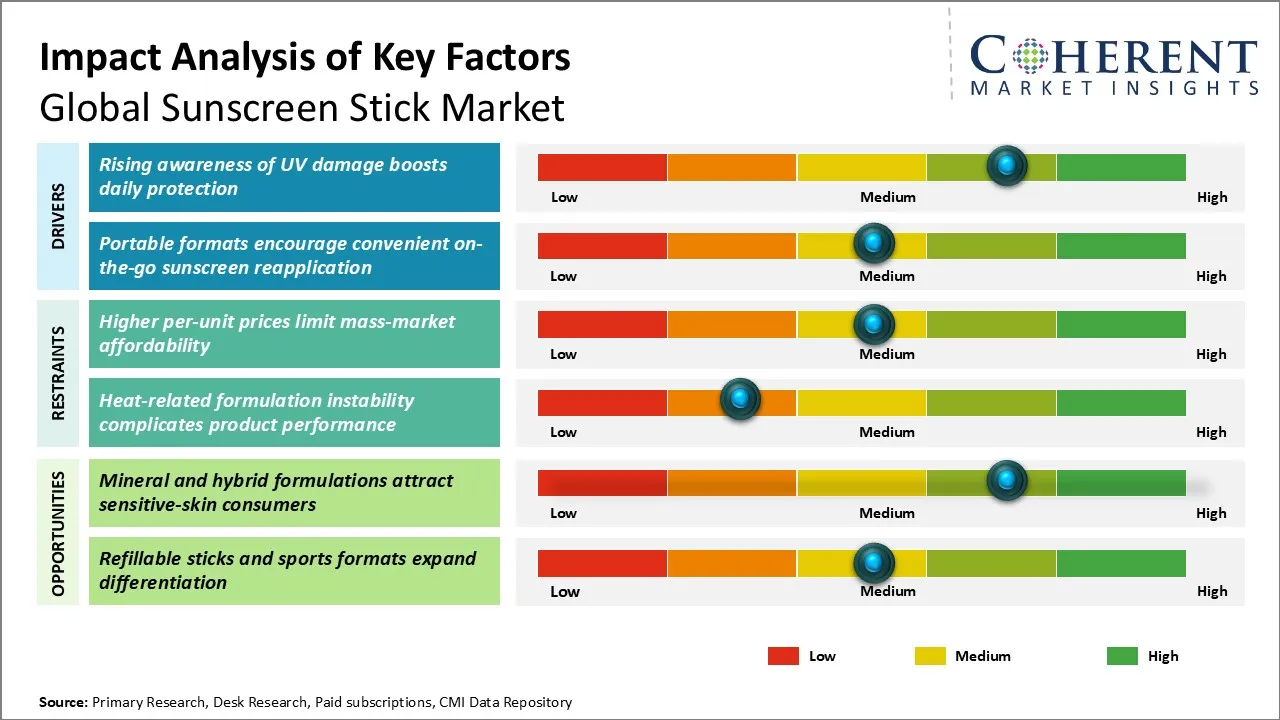
- Rising awareness of UV damage boosts daily protection: Increasing awareness of UV damage is making sun protection a more day-to-day concern than just for holidays and the beach! Sunscreen sticks are designed to provide protection for areas of the face and body that are most exposed, such as the nose, ears and cheek bones. This results in opportunities for skin care product manufacturers and pharmacy retailers to sell additional skin care products with the sunscreen. In May 2025, the International Agency for Research on Cancer (IARC) released its data showing that over 80% of all cutaneous melanoma cases worldwide in 2022 were caused by exposure to ultraviolet radiation (UV), highlighting the need for proper sun protection measures.
- Portable formats encourage convenient on-the-go sunscreen reapplication: Reapplication can be a challenge during sports, commuting and other outdoor activities, when conventional packaging is used. The use of compact sticks makes application easier without the need to pour liquid products, and helps consumers take additional protection with them. This opens up more sales avenues for the specialist outdoor brand, sports retailers and sunscreen companies. In September 2025, KINeSYS launched its direct application Pro Sport SPF 45 Clear Mineral Stick, which is water and sweat resistant for 80 minutes. The launch showcases the capabilities of performance-based packaging, and its role in meeting practical reapplication needs among active consumers.
Emerging Market Trends
- Shade-Inclusive Sunscreen Formulations with Enhanced Pigment Performance: Shade-inclusive pigmentation is shifting from the cosmetic finishing toward becoming a formulation design issue. For mineral sunscreens with iron oxides, careful shade matching is required, as is the even distribution of the pigment, to ensure that the product's appearance and protection are in balance.
- Impact: Larger color gamut can enable higher price points, but can lead to more testing, inventory and manufacturing complexity. Pigment suppliers and specialist formulators may be given more influence in product development.
- Market Relevance: Consumers will increasingly judge these sticks based on their protection claims rather than on their compatibility with different skin types. It will be good for brands that offer a user-friendly shade selection and credible product testing.
- Refillable Sunscreen Stick Packaging and Cartridge-Based Product Systems: The category could move from single-use packaging to durable dispensers and repurchase through the use of replaceable sunscreen stick cartridges. Before refill systems can be implemented at scale, product designers will need to solve compatibility, hygiene and stability challenges.
- Impact: Smaller labels may have to pay for inventory and tooling, while established brands may benefit from increased repeat purchasing and reduced packaging material per refill. Packaging manufacturers with reliable cartridge mechanisms may be able to secure new contracts.
- Market Relevance: Retailers may start to consider total cost and convenience of ownership, not just the pack price. Real, measurable consumer benefits will drive adoption.
Regional Insights
Why Does Asia Pacific Dominate the Global Sunscreen Stick Market?
Asia Pacific is expected to dominate the global sunscreen stick market with a market share of 33.6% by 2026, owing to the region’s mature sun-care manufacturing infrastructure, extensive beauty retail networks, and product innovation that caters to humid climates. Consumers in the region are increasingly looking for lightweight textures, non-sticky application and compatibility with daily skincare products. They can use their existing cosmetic formulation expertise and access to regional packaging suppliers to differentiate their products across price points. From May 2026, the Breathable UV Specialist Silky UV Stick SPF 50+ PA++++ developed with Korean stick technology will be included in NIVEA's official product portfolio. The product offers targeted facial application and a lightweight, non-greasy finish, plus sweat- and water-resistant protection. This illustrates the launch of dedicated sunscreen-stick formulations by leading skincare brands to cater to the daily sun protection, cosmetic compatibility and convenience needs across different regional markets.
Why Is North America Emerging as the Fastest-Growing Region in the Global Sunscreen Stick Market?
North America is projected to produce 31.2% of the global sunscreen stick revenue by 2026 and observe highest regional growth through 2033. The region offers brands the opportunity to innovate specific products that meet various skin types, cosmetic preferences and family protection needs. For consumers interested in sunscreen products that are focused on performance, established beauty retailers and direct-to-consumer platforms provide access. Manufacturers can differentiate their portfolios with mineral formulations, tinted finishes and sensitive-skin positioning, while also commanding higher prices for specialized applications. In May 2025, Supergoop highlighted five sunscreen-stick products covering mineral protection, invisible finishes, cosmetic highlighting, and family applications. This portfolio diversification shows the commercial upside of addressing multiple consumer needs in the same product format.
Global Sunscreen Stick Market Outlook for Key Countries
Why Is the U.S. a Key Market for the Global Sunscreen Stick Market?
The U.S. is a key market for sunscreen sticks, having a history of outdoor recreation spending, significant beauty retail distribution and consumer demand for convenient protection products. Beach goers, recreational sports and families provide market opportunities for brands with products that are appropriate to the activities they enjoy outside. Sporting-goods stores, beauty shops and e-stores are all potential avenues for specialty sun-care companies to reach customers. Sun Bum's Face Stick, which is compactly packaged and easy to apply, was recently spotted in The Quality Edit's list of sunscreen sticks with SPF 30 in August 2026. These levels of product exposure enable consumers to find these products and help specialist brands stand out with packaging, use and retail placement.
Why Is India Important in the Global Sunscreen Stick Market?
India offers opportunities for global sunscreen stick market manufacturers targeting urban consumers who prioritize affordable products compatible with hot weather and daily commuting. Greasiness, product softening and application comfort are formulation challenges in the presence of high temperatures and humidity. Localised pricing, light formulations and online distribution can help domestic beauty brands meet these needs. Product testing is also increasingly emerging as a competitive differentiator and consumers are considering SPF claims before buying a product. Dot's Strawberry Sunscreen Stick SPF 50+ PA++++ has in-vivo testing information disclosed, including a study reference from 2025-2026. This showcases the potential for Indian brands to leverage documented testing and cosmetic performance claims to build and reinforce product credibility and to be competitive with imported sunscreen products.
Why Is Japan a Strategic Country in the Global Sunscreen Stick Market?
Japan is strategically positioned for market development in sunscreen sticks due to its existing personal-care production and the focus on special function of the product. Japanese manufacturers can satisfy the market segment that is not served by conventional sunscreen products, such as children who are not easy to apply lotion on. Along with providing UV protection, ease of use, skin tolerance, and application independence are becoming more and more a part of the product development process. FANCL has launched its Clear Up UV Cut Stick specially for elementary school children in February 2025, which will be available direct through stores and online in March 2025. The formulation was developed to minimize stickiness and make it easier to apply, while avoiding contamination of hands. This is an illustration of how different age groups of sunscreen sticks can be produced, backed by the expertise to care for young skin and targeted distribution.
Why Is Australia an Important Growth Market for the Global Sunscreen Stick Market?
Australia has been identified as an important sunscreen stick market due to the level of UV exposure, and awareness and good practices in sun protection measures, as well as a high proportion of people engaging in outdoor recreation. Consumers need protection products that are appropriate for the beach, swimming, sports and normal outdoor activities. Sunscreen manufacturers need to focus on the proven effectiveness, valid water resistance labelling and conform to Therapeutic Goods Administration requirements. This December, the Australian Government announced a new investment of US$ 10.02 million for targeted skin cancer prevention campaigns with Cancer Council Australia, building on the ongoing sun protection education agenda. Australian product Wotnot also has a TGA-approved outdoor SPF 50 mineral sun stick. These conditions are conducive to suppliers who integrate secure protection, convenient packaging, and clear product testing.
Innovation and Formulation Performance Landscape in the Global Sunscreen Stick Market
Technology | Application in Sunscreen Sticks | Commercial Significance | Key Adoption Considerations |
Anhydrous Oleogel and Wax Matrix Engineering | Forms solid stick forms of anhydrous formulations that can be kept in a solid stick form. | Improves product stability, application consistency and manufacturing control. | Have to carefully select melting point and test for temperature stability. |
Surface Treated Mineral UV Filter Dispersion | Improves dispersion of zinc oxide and titanium dioxide particles in solid formulations. | Helps manufacturers reduce uneven application and visible mineral buildup. | Requires dispersion control and finished product SPF testing. |
UV Filter Photo stabilization Systems | Combines compatible filter combinations and stabilizers to maintain UV-filter performance throughout exposure. | Supports formulation differentiation and consistent broad-spectrum protection. | Must account for ingredient compatibility and regional filter regulations. |
Hydrophobic Film-Forming Polymers | Forms a water-resistant protective film that enhances the adhesion of sunscreen when it comes into contact with moisture. | Supports products for swimming, exercise and outdoor activities. | Water-resistance claims must be supported by finished product testing. |
Sensory Modification Systems and Silicone Elastomer | Alters surface texture, slip, oiliness and perceived finish. | Helps manufacturers differentiate matte, lightweight and comfortable sunscreen sticks. | Other ingredients may affect hardness, stability and cost of production. |
UV Transmittance Screening and SPF Testing Technologies | Formulations are assessed using laboratory screening and validated SPF testing protocols. | Reduces uncertainty in development. Supports proven claims of protection. | Screening is not a replacement for mandatory regulatory testing of finished products. |
How Are Occupational Sun Protection Programs Creating New Growth Opportunities in the Global Sunscreen Stick Market?
The makers of sunscreen sticks have a weak business-to-business channel in outdoor-worker protection programs. Construction contractors, logistics operators, agricultural employers and municipal maintenance teams need practical means to facilitate sun safe behavior during long outdoor shifts.
Individual sticks can be used in addition to dispensers and traditional lotions, especially on exposed areas of the face where workers need targeted reapplication. Suppliers could sell through occupational-safety distributors, workplace-health providers and centralized procurement contracts instead of only beauty retailers.
Broad-spectrum performance, adequate water resistance, clear directions for use and robust packaging that can resist heat and handling would likely be winning specifications. Manufacturers would want product efficacy data at the individual product level, reliable batch traceability, predictable replenishment logistics and competitive institutional pricing.
Training materials should also indicate that a few swipes may not offer the labeled protection and sticks should not substitute for proper whole-body coverage. This opportunity is well suited to manufacturers who can blend compliant formulations with contract supply, workplace education and consistent service across multiple sites.
Market Players, Key Developments, and Competitive Intelligence
Key Developments
- In November 2026, burnd launched its SPF 38 sunscreen stick combining zinc oxide with bemotrizinol, a newly permitted U.S. UV filter. The formulation illustrates how access to additional filter options may support differentiated hybrid protection, although ingredient licensing, efficacy testing, and manufacturing requirements remain important commercialization considerations.
- In February 2026, Anua announced a KPop Demon Hunters collaboration that included its Invisible Glow Finish Sunscreen Stick and a phased U.S. rollout through digital channels and Ulta Beauty stores. The campaign links sunscreen products to entertainment merchandising, potentially expanding awareness among younger skincare buyers.
- In January 2026, KOSÉ Cosmeport announced its SUNCUT Protect UV Stick SPF 50+ for a February rollout through Japanese drugstores and mass retailers. Its broad oval applicator targets both small facial areas and wider skin surfaces, offering an approach to product differentiation through applicator design and mainstream distribution.
Competitive Landscape
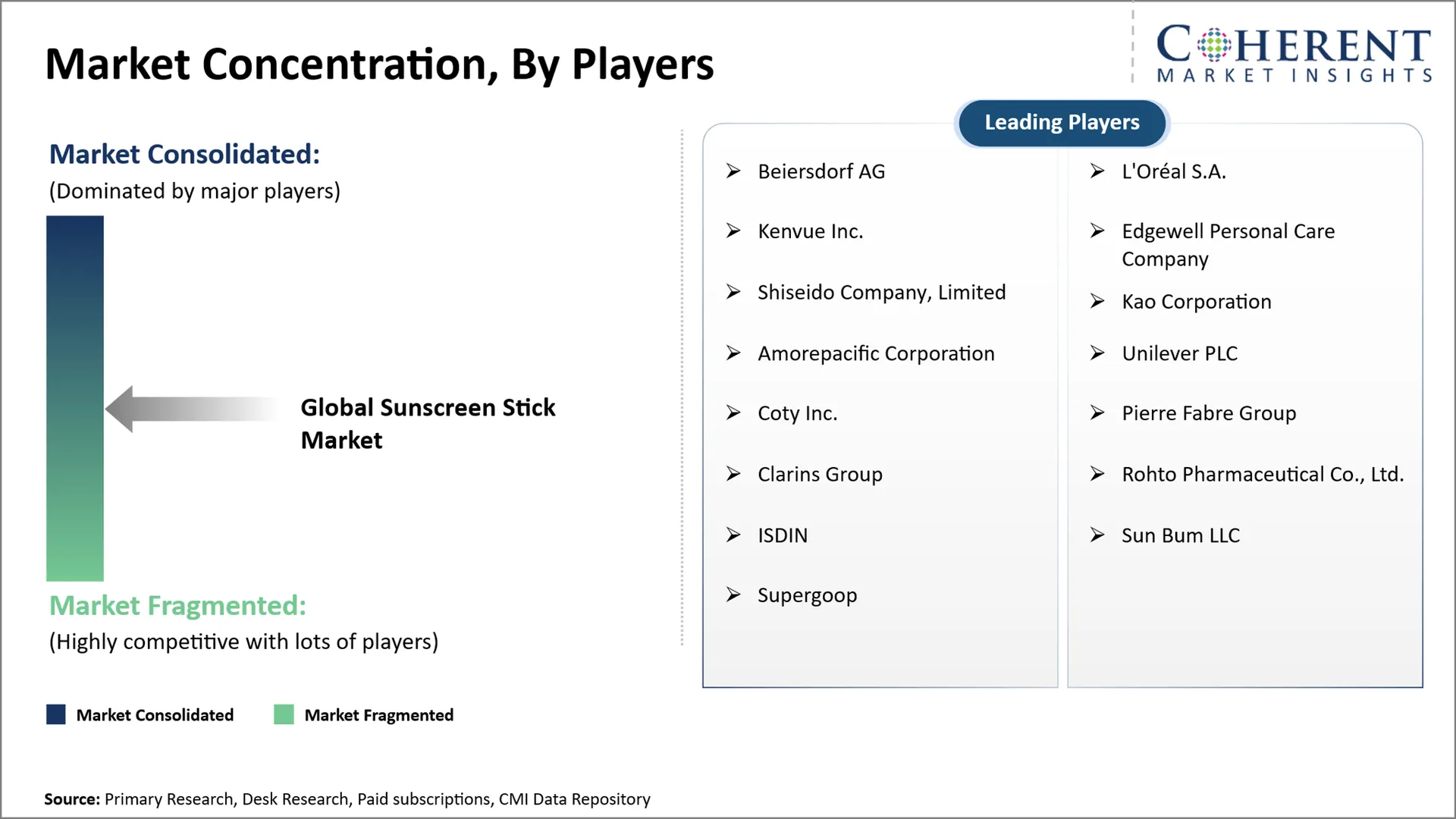
The global sunscreen stick market is fragmented, with multinational sun-care suppliers, dermatology-focused brands, Asian beauty labels and specialized outdoor firms competing in different retail niches. The advantage over competitors is not only the brand awareness, but also the reliable availability, the price positioning, the comfortable application and the proven protection. Larger suppliers can capitalize on their regulatory capabilities, multichannel distribution and economies of scale in manufacturing, while regional specialists can target particular consumer demographics.
Key focus areas include
- Product Performance: Credibility is dependent upon delivering consistent broad spectrum protection and SPF performance.
- Manufacturing Quality: Product uniformity, thermal stability, and reliable batch production influence supply performance.
- Pricing Pressure: The cost per gram for these lotions is higher than that for regular lotions, which may restrict purchases by value-conscious consumers.
- Regulatory Compliance: Regional UV-filter restrictions complicate formulation and market entry.
- Application Effectiveness: Consumer confidence and real-world protection may be jeopardized if not used in large enough amounts.
- Distribution Strategy: Consistent product launches are possible because UV-filters and packaging are available.
- Supply Chain Management: Reliable UV-filter sourcing and packaging availability support consistent product launches.
Market Report Scope
Global Sunscreen Stick Market Report Coverage | |||
Report Coverage | Details | ||
Base Year | 2025 | Market Size in 2026: | USD 998.2 Mn |
Historical Data For: | 2020 To 2024 | Forecast Period: | 2026 To 2033 |
Forecast Period 2026 To 2033 CAGR: | 70.10% | 2033 Value Projection: | USD 1613.4 Mn |
Geographies covered: |
| ||
Segments covered: |
| ||
Companies covered: | Beiersdorf AG, L'Oreal S.A., Kenvue Inc., Edgewell Personal Care Company, Shiseido Company, Limited, Kao Corporation, Amorepacific Corporation, Unilever PLC, Coty Inc., Pierre Fabre Group, Clarins Group, Rohto Pharmaceutical Co., Ltd., ISDIN, Sun Bum LLC, Supergoop | ||
Growth Drivers: |
| ||
Restraints & Challenges: |
| ||
Analyst Opinion (Expert Opinion)
- Future Market Direction: The global sunscreen stick market competition is likely to shift toward formulation development platforms capable of supplying multiple brands with market-specific sunscreen sticks. Contract manufacturers offering validated formulations, efficient product customization, and regulatory documentation may capture greater value as smaller brands seek faster product development without building extensive internal manufacturing capabilities.
- Transformative Trend or Disruption: Integration between personalized UV-exposure information and sunscreen purchasing could alter consumer engagement. UV-exposure guidance could be made more accessible through wearable devices and digital health platforms, enabling sunscreen manufacturers to offer personalized replenishment and application-support services. Brands that are able to forge credible digital partnerships may see advantages, whereas brands that rely solely on product visibility may find customer retention more difficult.
- Strategic Priorities, Risks, and Recommendations: Manufacturers should focus on the consistency of the SPF of the finished product, the stability of the formulation, and the flexibility of the UV-filter sourcing. They defend operating margins by investing in regulatory paper work, heat resistant packaging and strong distribution. Companies should be cautious about spending too much on narrowly differentiated variants of product where there is no evidence of repeat purchasing.
Speak to the analyst
Want personalized insights?
Take the findings above to one of our principal consultants, or have the report rebuilt around the segments, geographies and competitors you actually track.
Market Segmentation
- Product Type Insights (Revenue, USD Mn, 2021 - 2033)
- Face Sunscreen Sticks
- Body Sunscreen Sticks
- Lip & Other Targeted Sunscreen Sticks
- Formulation Insights (Revenue, USD Mn, 2021 - 2033)
- Chemical-Based Sunscreen Sticks
- Mineral-Based Sunscreen Sticks
- Hybrid Sunscreen Sticks
- Spf Level Insights (Revenue, USD Mn, 2021 - 2033)
- SPF Below 15
- SPF 15–29
- SPF 30–49
- SPF 50 & Above
- Target Consumer Group Insights (Revenue, USD Mn, 2021 - 2033)
- Adults
- Sports & Outdoor Enthusiasts
- Children & Babies
- Distribution Channel Insights (Revenue, USD Mn, 2021 - 2033)
- Online Retail
- Specialty Beauty Stores
- Supermarkets & Hypermarkets
- Regional Insights (Revenue, USD Mn, 2021 - 2033)
- North America
- U.S.
- Canada
- Latin America
- Brazil
- Argentina
- Mexico
- Rest of Latin America
- Europe
- Germany
- U.K.
- Spain
- France
- Italy
- Russia
- Rest of Europe
- Asia Pacific
- China
- India
- Japan
- Australia
- South Korea
- ASEAN
- Rest of Asia Pacific
- Middle East
- GCC Countries
- Israel
- Rest of Middle East
- Africa
- South Africa
- North Africa
- Central Africa
- North America
- Key Players Insights
- Beiersdorf AG
- L'Oreal S.A.
- Kenvue Inc.
- Edgewell Personal Care Company
- Shiseido Company, Limited
- Kao Corporation
- Amorepacific Corporation
- Unilever PLC
- Coty Inc.
- Pierre Fabre Group
- Clarins Group
- Rohto Pharmaceutical Co., Ltd.
- ISDIN
- Sun Bum LLC
- Supergoop
Sources
Primary Research Interviews
- Sunscreen stick manufacturers, formulators, and contract manufacturers
- Skincare brands, product development specialists, and UV-filter suppliers
- Cosmetic chemists, dermatologists, and sun-care researchers
- Beauty retailers, pharmacy chains, and e-commerce distributors
- Packaging manufacturers and regulatory consultants
Stakeholders
- Chemical and mineral UV-filter suppliers
- Sunscreen and sun-care product manufacturers
- Cosmetic formulation and private-label companies
- Stick packaging, applicator, and dispensing-system manufacturers
- Beauty retailers, wholesalers, and online marketplaces
End-use Sectors
- Individual Consumers: Daily facial and body sun protection
- Sports & Outdoor Enthusiasts: Outdoor activities, swimming, and sports protection
- Children & Babies: Age-appropriate sun protection products
- Beauty & Personal Care Retailers: Sunscreen product sales and distribution
Product Applications
- Facial and body UV protection
- Lip and targeted-area sun protection
- Daily skincare and makeup-compatible protection
- Outdoor sports and recreational sun protection
- Water-resistant and sweat-resistant sun protection
- Children's and sensitive-skin sun-care applications
Regulatory and Industry Bodies
- U.S. Food and Drug Administration (FDA)
- European Commission and Scientific Committee on Consumer Safety (SCCS)
- Therapeutic Goods Administration (TGA), Australia
- Health Canada
- Central Drugs Standard Control Organization (CDSCO), India
- National Medical Products Administration (NMPA), China
- Ministry of Food and Drug Safety (MFDS), South Korea
- Ministry of Health, Labour and Welfare (MHLW), Japan
Databases
- UN Comtrade and ITC Trade Map
- Eurostat – Cosmetics and Retail Trade Statistics
- U.S. Census Bureau – Retail Trade Data
- FDA – OTC Sunscreen Monograph and Product Regulations
- EU CosIng – Cosmetic Ingredients Database
- Google Trends – Sunscreen and Sun-care Product Searches
- PubMed – Sunscreen Efficacy and Dermatological Research
- Company Annual Reports and Investor Presentations
- E-commerce Product Listings and Pricing Databases
Magazines and Journals
- International Journal of Cosmetic Science
- Journal of Cosmetic Dermatology
- Photodermatology, Photoimmunology & Photomedicine
- Journal of the American Academy of Dermatology
- Cosmetics & Toiletries
- Global Cosmetic Industry
- CosmeticsDesign
- Happi Magazine
Associations
- Personal Care Products Council (PCPC)
- Cosmetics Europe
- Cosmetic, Toiletry and Perfumery Association (CTPA)
- Society of Cosmetic Chemists (SCC)
- International Federation of Societies of Cosmetic Chemists (IFSCC)
- Japan Cosmetic Industry Association (JCIA)
- Korea Cosmetic Association (KCA)
- Cancer Council Australia
Public Domain Sources
- Sunscreen stick product catalogues and ingredient disclosures
- UV-filter formulation patents and technical datasheets
- SPF, UVA protection, and water-resistance testing studies
- Consumer sun-care preferences and purchasing trends
- Product launches, retail partnerships, and distribution expansions
- Company financial reports and manufacturing disclosures
- Sunscreen pricing, e-commerce listings, and import-export statistics
- Cosmetic safety assessments and packaging sustainability studies
Key Standards and Regulations
- EU Regulation (EC) No. 1223/2009 – Cosmetic Products
- U.S. Modernization of Cosmetics Regulation Act (MoCRA), 2022
- U.S. FDA 21 CFR 201.327 – Sunscreen Drug Products
- Australia Therapeutic Goods (Sunscreens) Regulations 1998
- Health Canada – Sunscreen Monograph
- India Cosmetics Rules, 2020
- China Cosmetics Supervision and Administration Regulation (CSAR)
- ISO 24444 – In Vivo Determination of SPF
- ISO 24442 – In Vivo UVA Protection Testing
- ISO 24443 – In Vitro UVA Protection Testing
- ISO 16217 – Water Resistance Testing
- ISO 18861 – Water Resistance Percentage
- ISO 22716 – Cosmetics Good Manufacturing Practices
Proprietary Elements
- CMI Data Analytics Tool
- Proprietary research repository, supported by primary interviews, sunscreen-stick formulation analysis, UV-filter benchmarking, SPF and UVA performance assessment, product pricing and ASP analysis, consumer purchasing behavior, distribution-channel evaluation, country-level market sizing, import-export assessment, regulatory analysis, manufacturer benchmarking, product launch tracking, and competitive intelligence.
Get access to 250+ pages report
Every segment, forecast, competitor profile and data table behind the analysis above — available for instant download.
- ESOMAR Member
- ISO 9001:2015 Certified
- D-U-N-S Registered
- GDPR & CCPA Compliant
Frequently Asked Questions
The CAGR of the global sunscreen stick market is projected to be 70.10% from 2026 to 2033.
The global sunscreen stick market is estimated to be valued at USD 998.2 Mn in 2026 and is projected to reach USD 1,613.4 Mn by 2033.
Chemical-based sunscreen sticks represent the leading formulation segment supported by flexible UV-filter combinations and greater formulation versatility.
SPF 50 & Above is the leading category, reflecting consumer preference for higher levels of labeled UV protection.
Online retail is the leading distribution channel, supported by purchasing convenience, wider product selection, customer reviews and digital product discovery.
North America is expected to be the fastest growing regional market, propelled by specialized sun care products, well-established beauty retail networks, and consumer demand for premium sunscreen formulations.
The global sunscreen stick market is primarily driven by increasing awareness of UV-related skin damage and growing consumer preference for convenient, portable sun protection products that simplify daily sunscreen reapplication.