

Global Superconducting Wire Market Size and Forecast – 2026 To 2033
The global superconducting wire market is expected to grow from USD 2.45 Bn in 2026 to USD 4.90 Bn by 2033, registering a compound annual growth rate (CAGR) of 4.2% from 2026 to 2033. The global superconducting wire market is driven by the expansion of the superconducting power transmission cable infrastructure. On July 6, 2026, Nexans and Hydro signed a five-year long-term agreement (LTA) for the supply of approximately 85,000 tons of low-carbon aluminum wire rod. The aluminum will be used across Nexans’ European operations in power cable solutions supporting medium-voltage power grids, overhead transmission lines and subsea high-voltage infrastructure projects.
Key Takeaways of the Global Superconducting Wire Market
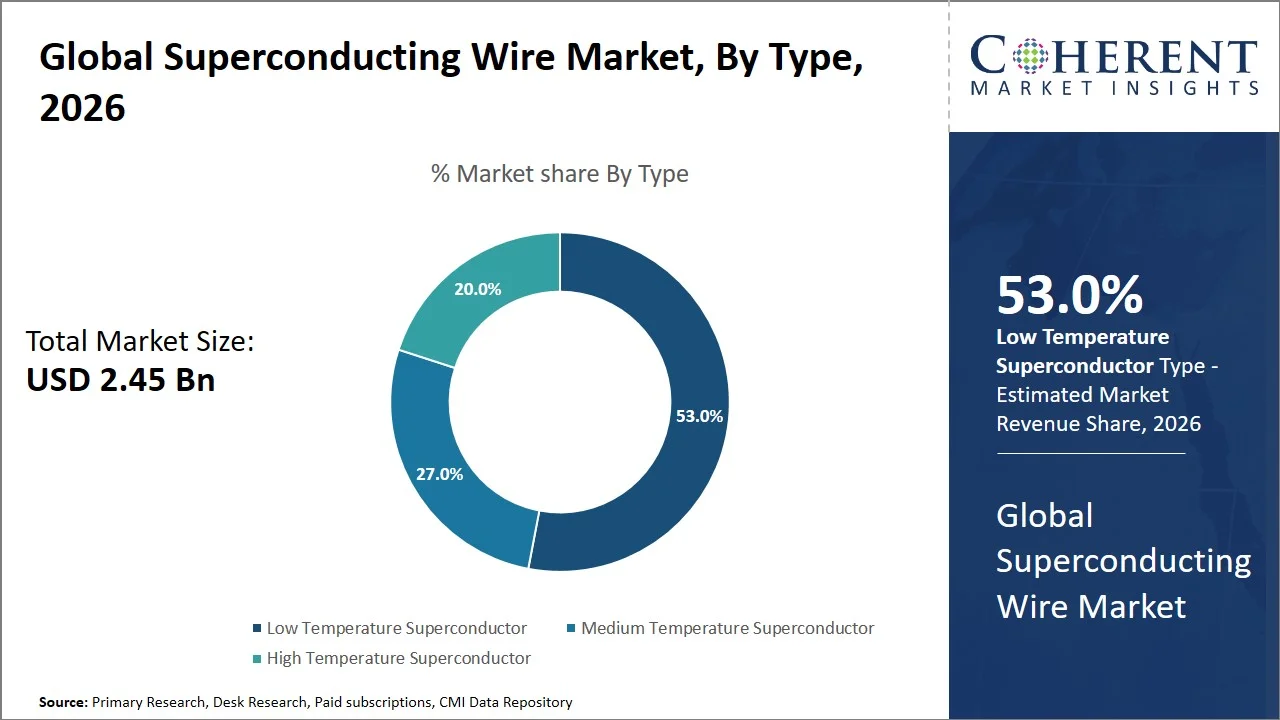
- The low temperature superconductor segment is expected to account for 53.0 % of the global superconducting wire market share in 2026. Increasing demand for high field magnets in scientific research is driving the growth of the segment. On April 7, 2025, Bruker Corporation announced the successful development and testing of the world’s first high-resolution 1.3 GHz NMR spectrometer with a stable, standard-bore 54 mm superconducting magnet.
- The niobium titanium segment is estimated to capture 32.0 % of the market share in 2026. Rapid development of quantum computing and cryogenic electronics is majorly driving the growth of the segment. On June 2, 2026, IBM announced plans to invest more than USD 10 billion in quantum computing over the next five years. The investment will span research and development, capital expenditure, manufacturing scaling, ecosystem partnerships, and M&A.
- The MRI systems segment is estimated to capture 27.0 % of the market share in 2026. Increasing global installation of advanced 1.5T, 3T, and ultra-high-field MRI scanners is driving the growth of the segment. On February 26, 2025, GE HealthCare unveiled Freelium, a next-generation sealed magnet platform, that aims to enable high-quality Magnetic Resonance (MR) imaging with less than 1% of helium used in conventional magnet technology to help support diagnostic accuracy and sustainability goals.
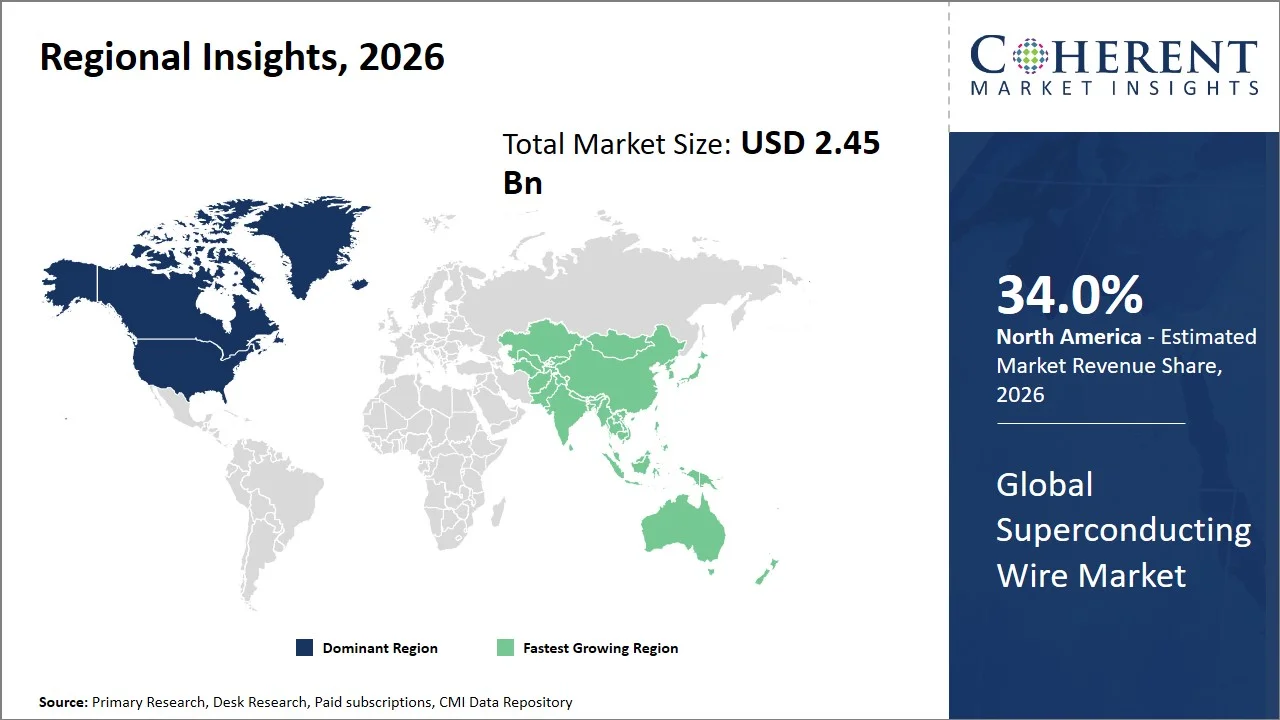
- North America is expected to dominate the superconducting wire market in 2026 with a market share of 34.0 %. Rising investments in fusion reactor demonstration projects in North America is driving the growth of the regional market. On January 13, 2026, Thea Energy became the first awardee in the U.S. Department of Energy’s Milestone-Based Fusion Development Program to complete its design review for a fusion pilot plant.
- Asia Pacific is expected to account for 30.0 % of the market share in 2026 and is projected to record the fastest growth over the forecast period. Expansion of smart grid and resilient power infrastructure across Asia Pacific is driving the growth of the regional market. On July 11, 2025, LS Cable & System expanded collaboration with the Korea Electric Power Corporation (KEPCO) to accelerate commercialization of HTS power cable systems for resilient underground transmission networks supporting South Korea's smart grid modernization strategy.
- Rapid commercialization of second-generation high-temperature superconducting (2G HTS) wires: Manufacturers are increasing the production of REBCO-based 2G HTS wires with higher current density, improved mechanical strength and lower operating costs, allowing for broader use in power grids, healthcare and industrial applications.
- Growing investments in fusion energy demonstration projects: Large-scale fusion programs’ high-field magnet systems are driving the demand for superconducting wires, with commercial fusion developers and national labs increasing purchases of advanced HTS conductors for next-generation reactors.
Segmental Insights
Why Does the Low Temperature Superconductor Segment Dominate the Global Superconducting Wire Market?
The low temperature superconductor segment is expected to account for 53.0% of the global superconducting wire market share in 2026. Due to the lengthy history of commercial use of low temperature superconductors in high field magnet applications, such as magnetic resonance imaging equipment and particle accelerators, this is the most commonly used material. Its demonstrated operational reliability, mature manufacturing processes, and large installed base have allowed healthcare providers, research institutions and industrial users to continue to select low temperature superconducting wires for critical applications where performance consistency and mature supply chains are required. For instance, CERN is developing powerful 16-tesla superconducting magnets using Nb₃Sn (niobium-tin) conductor technology to bend high-energy particle beams inside a proposed 91-kilometre tunnel for the Future Circular Collider program.
- Current Industry Events of 2026
- Market Size Estimation
- Regional Breakdown
- Competitive Landscape
- Customer Intelligence
- Segmental Analysis
- Pricing Analysis
- Key Market Drivers, Challenges & Future Trends
- Customized Insights Section
Why is Niobium Titanium the Most Preferred Material?
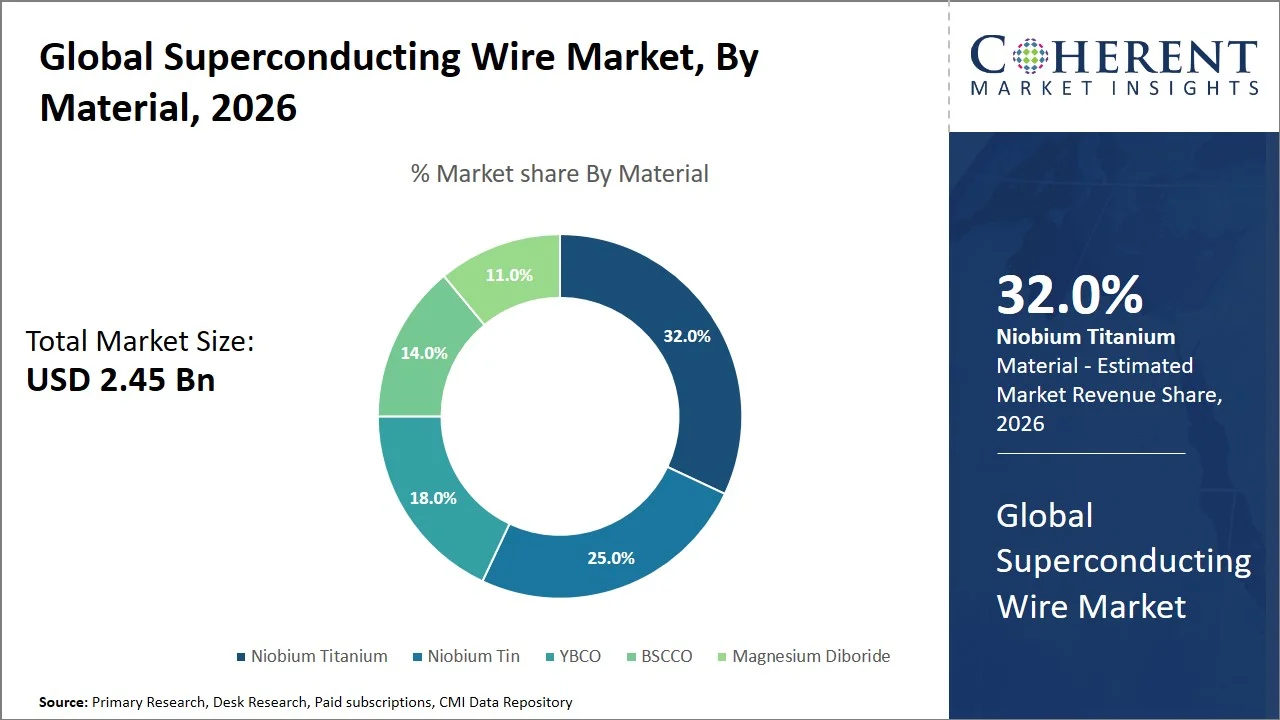
The niobium titanium segment is expected to account for 32.0% of the global superconducting wire market share in 2026. The most used material is niobium-titanium, which provides the best compromise between high current-carrying capacity, mechanical flexibility and proven performance in strong magnetic fields. Due to its mature manufacturing process, low cost manufacture, and widespread use in magnetic resonance imaging systems, particle accelerators and research magnets, it has become the industry standard for applications of superconducting wire that require dependable and constant performance. In September 2025, Siemens Healthineers continued to install its MAGNETOM 1.5T and 3T MRI systems in healthcare networks, with the superconducting magnet assemblies still using niobium titanium wire because of its mature manufacturing technology and long-term operational stability in clinical MRI applications.
MRI Systems Segment Dominates the Global Superconducting Wire Market
The MRI systems segment is expected to account for 27.0% of the global superconducting wire market share in 2026. Superconducting wire is often used in magnetic resonance imaging systems because the technology can provide steady, high-intensity magnetic fields required to create high-resolution diagnostic images. The growing installation of high-field MRI scanners in hospitals and diagnostic centers, the rising need for sophisticated diagnostic imaging and consistent growth in the healthcare infrastructure have supported significant demand of superconducting wires in this application. On May 12, 2025, GE HealthCare unveiled SIGNA Sprint, an FDA 510(k) pending1 ultra-premium wide bore 1.5T high-performance gradient MRI system, at the International Society for Magnetic Resonance in Medicine (ISMRM) 2025. This innovative technology is designed to unlock advanced imaging possibilities in cardiology, oncology and other clinical and research areas.
Current Events and their Impact
Current Events | Description and its Impact |
U.S. High-Temperature Superconductivity Program |
|
European Union Dual-Use Export Control Regulation (EU Dual-Use Regulation) |
|
Global Superconducting Wire Market Dynamics
Market Drivers
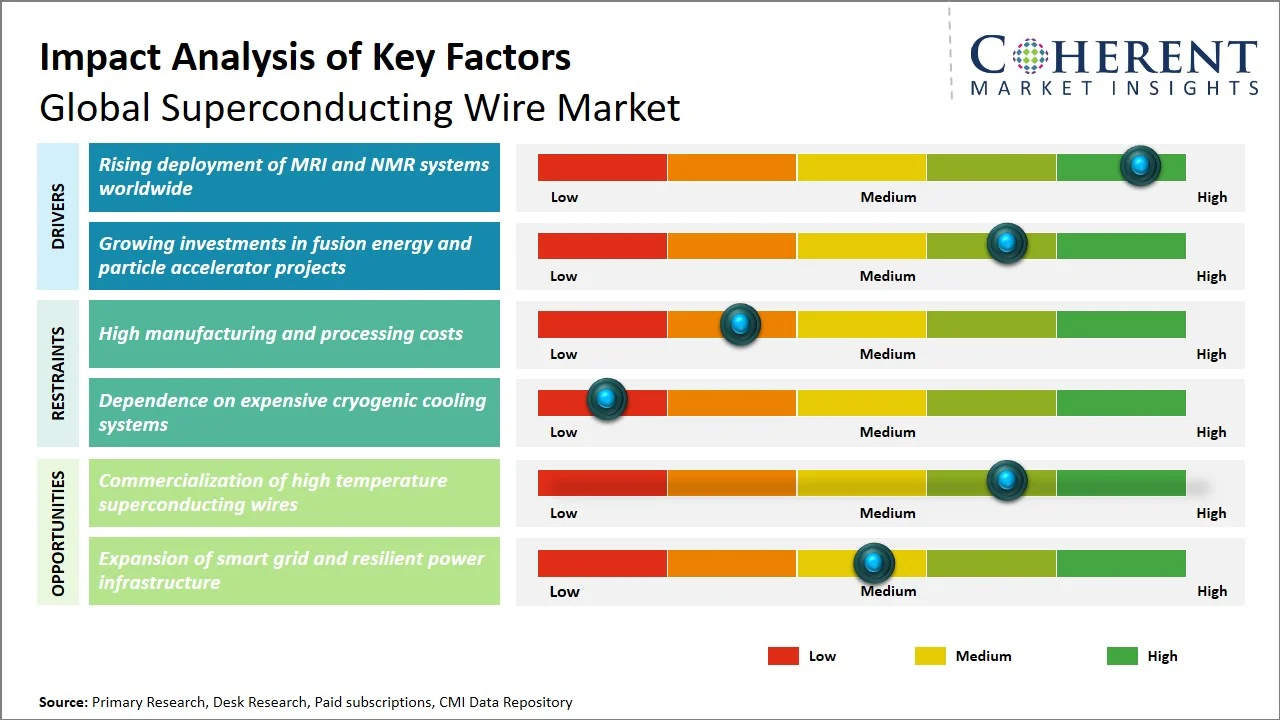
- Rising deployment of MRI and NMR systems worldwide: The growing installation of magnetic resonance imaging and nuclear magnetic resonance systems in hospitals, diagnostic centers, pharmaceutical laboratories, and research centers is significantly driving the requirement of superconducting wires. Superconducting wire is an essential element for generating strong and steady magnetic fields with low energy loss, which is the basis for the expansion of sophisticated healthcare and life science infrastructure all over the world to provide high-resolution imaging, accurate molecular analysis, and stable long-term operation. On November 30, 2025, Royal Philips, a global leader in health technology, unveiled BlueSeal Horizon, an entirely new 3.0T MRI innovation platform that includes the world’s first helium-free 3.0T magnet at RSNA 2025. A pivotal advance in MRI innovation, helium-free 3.0T is a major scientific achievement set to have significant impact for health providers and patients.
- Growing investments in fusion energy and particle accelerator projects: Significant public and private investment in fusion energy demonstration plants and next-generation particle accelerator facilities is driving robust demand for high-performance superconducting wires utilized in powerful magnet systems. They enable the generation of the ultra-high magnetic fields needed for plasma confinement, beam steering and experimental research. Advanced superconducting conductors are needed for large-scale scientific infrastructure projects and to accelerate the commercialization of future clean energy technologies. On February 13, 2026, Helion announced that its Polaris prototype has set new fusion industry benchmarks, becoming the first privately developed fusion energy machine to demonstrate measurable deuterium-tritium (D-T) fusion and achieve plasma temperatures of 150 million degrees Celsius (MºC). Both milestones mark significant breakthroughs in Helion’s vision to make commercially viable fusion energy a reality and are firsts for the private fusion industry.
Emerging Trends
- Expansion of superconducting power transmission infrastructure: Utilities are introducing superconducting cables and fault current limiters to enhance grid efficiency, augment transmission capacity in urban networks, and facilitate renewable energy integration with low transmission losses.
- Rising adoption in quantum computing and advanced scientific research: Investments in quantum computing, particle accelerators and high-field research magnets are increasing the demand for ultra-high-performance superconducting wires that operate reliably in cryogenic conditions.
Regional Insights
Why is North America a Strong Market for Superconducting Wires?
North America is expected to account for a market share of 34.0% in 2026. North America will dominate the superconducting wire market because of the high investment in health care, scientific research, defense and fusion energy, making it the most technologically advanced superconductor wire region. The U.S. has the largest installed base of MRI equipment in the world and hospitals are rapidly upgrading from 1.5T to 3T scanners that utilize niobium titanium superconducting wire. The U.S. Department of Energy continues to support the development of high temperature superconducting wire through national facilities like Oak Ridge National Laboratory, Brookhaven National Laboratory, Lawrence Berkeley National Laboratory. High-temperature superconducting magnets made from REBCO are being used by Commonwealth Fusion Systems, a company based in Massachusetts, in the SPARC fusion project, while demand is being driven for advanced superconducting conductors by Type One Energy and Tokamak Energy USA. Canada’s contribution is through TRIUMF in Vancouver, which uses superconducting accelerator magnets, and utilities are looking at superconducting transmission technology to make the grid more resilient.
Why Does the Asia Pacific Superconducting Wire Market Exhibit High Growth?
Asia Pacific is projected to account for 30.0% of the global superconducting wire market in 2026 and is expected to register the fastest growth. The fastest growing regional market is the Asia Pacific owing to the concentration of superconducting wire manufacturers and huge investments in healthcare, power infrastructure and fusion research. The bulk of the regional production capacity of low-temperature and high-temperature superconducting wires is in Japan, China and South Korea. Japan maintains its leadership in the global superconducting wire industry through established manufacturers such as Sumitomo Electric Industries, Fujikura, Furukawa Electric, and Japan Superconductor Technology, while China is rapidly expanding its domestic manufacturing capabilities, led by Western Superconducting Technologies and a growing number of indigenous superconducting material producers. It is also home to numerous large fusion projects, including China’s EAST tokamak, Japan’s JT-60SA and South Korea’s KSTAR reactor, all of which use superconducting magnet systems. Growing installation of MRI scanners, growth of semiconductor research facilities and upgrade of national electrical grids keep regional demand strong.
Global Superconducting Wire Market Outlook for Key Countries
Why is the U.S. Emerging as a Major Hub in the Superconducting Wire Market?
The U.S. has a sophisticated healthcare system, world class research institutes and significant investments on fusion energy, resulting in the adoption of superconducting wire across the globe. The country performs about 40 million MRI tests per year, which generates a sustained need for superconducting magnets that are mostly based on niobium titanium wire. Commonwealth Fusion Systems is building the SPARC fusion facility using high-temperature REBCO superconducting magnets, and Oak Ridge National Laboratory, MIT Plasma Science and Fusion Center, General Atomics, and Princeton Plasma Physics Laboratory are expanding their research on superconducting magnets. Fermilab and Brookhaven National Laboratory run big particle accelerator facilities that depend on superconducting magnet technologies. The Department of Energy also increased financing for local manufacturing of high-temperature superconducting conductors to build vital supply chains for energy and defense applications.
Is China the Next Growth Engine for the Superconducting Wire Market?
China is among the major buyers and producers of superconducting wire, owing to coordinated government investment in medical imaging, scientific infrastructure and clean energy technology. The Experimental Advanced Superconducting Tokamak (EAST) in Hefei, which uses superconducting magnet systems, is continuing to set new plasma operation records, boosting domestic demand for advanced conductors. Superconducting magnets are also needed for the accelerator operation of the China Spallation Neutron Source and the High Energy Photon Source. Western Superconducting Technologies has enhanced its manufacturing capacity for niobium titanium and niobium tin superconducting materials to support the domestic and overseas markets. In addition, China is speeding up the installation of MRI equipment in provincial hospitals and State Grid China has undertaken demonstration efforts using superconducting power transmission technologies.
Germany Superconducting Wire Market Analysis and Trends
Germany has a very strong market for superconducting wires due to its leadership in industrial research, accelerator science and advanced medical technology. The Karlsruhe Institute of Technology, Helmholtz Association research centers and DESY run sophisticated superconducting accelerator facilities for particle physics and materials research. German companies also provide technologies for superconducting magnets to the fusion project ITER and work closely with CERN on accelerator modifications. Siemens Healthineers continues to be one of the world’s top manufacturers of MRI systems, generating ongoing local demand for high-performance superconducting wire. The emphasis on energy transition and hydrogen infrastructure in Germany has also fueled research into superconducting power cables and fault current limiter technology for future power grids.
Japan Superconducting Wire Market Analysis and Trends
Japan is a technological leader in both low- and high-temperature superconductors and one of the world’s most mature manufacturing centers for superconducting wires. Sumitomo Electric Industries, Fujikura, Furukawa Electric and Japan Superconductor Technology sell superconducting wires for MRI equipment, fusion reactors, particle accelerators and power applications to the world. Here is the JT-60SA , one of the world ’s largest superconducting tokamaks. It employs massive superconducting magnet systems . Many accelerator facilities in the country are operated by the High Energy Accelerator Research Organization (KEK) and superconducting magnets are indispensable to these facilities. Demand for sophisticated medical imaging equipment in Japan remains robust and government backing for next-generation energy technology continues to bolster the country’s leadership position.
South Korea Superconducting Wire Market Analysis and Trends
With expenditures in fusion research, semiconductor manufacturing and advanced medical technology, South Korea has become a major market for superconducting wire. The Korea Superconducting Tokamak Advanced Research (KSTAR) reactor operated by Korea Institute of Fusion Energy is one of the world’s premier superconducting fusion research facilities and has achieved long-term high temperature plasma operation using superconducting magnets. LS Cable & System and Kiswire Advanced Technology are bolstering indigenous capabilities in superconducting materials and unique cables. Major healthcare players like Samsung Medical Center, Seoul National University Hospital and others continue to build high-field MRI capacity, while government-backed quantum computing and semiconductor research programs are driving new demand for cryogenic superconducting technology.
Global Superconducting Wire Market - Fusion Reactor Pipeline and Superconducting Wire Demand By Project (2025)
Fusion Project | Developer / Organization | Country/Region | Reactor Type | Superconducting Wire / Magnet Technology | Development Status (2025) |
SPARC | Commonwealth Fusion Systems | U.S. | Tokamak | REBCO High-Temperature Superconducting (HTS) Tape | Under Construction |
ITER | ITER Organization | France | Tokamak | Nb₃Sn and NbTi Low-Temperature Superconductors | Assembly and Subsystem Integration |
JT-60SA | QST (National Institutes for Quantum Science and Technology) | Japan | Tokamak | NbTi Low-Temperature Superconductors | Experimental Operations |
EAST | Fusion for Energy (F4E) | China | Tokamak | NbTi Superconducting Magnets | Advanced Plasma Experiments |
KSTAR | Institute of Plasma Physics, Chinese Academy of Sciences (ASIPP) | South Korea | Tokamak | Nb₃Sn and NbTi Superconductors | Experimental Upgrades |
CFETR | Korea Institute of Fusion Energy (KFE) | China | Tokamak | REBCO HTS and Nb₃Sn | Engineering Development |
STEP | China National Fusion Program | U.K. | Tokamak | REBCO High-Temperature Superconducting (HTS) Tape | Engineering Design |
ARC | UK Industrial Fusion Solutions (UKIFS) | U.S. | Tokamak Power Plant | REBCO High-Temperature Superconducting (HTS) Tape | Engineering Design |
JT-60SA Upgrade Program | EUROfusion | Japan | Tokamak | NbTi Superconducting Coils | Upgrade Activities |
DEMO | Commonwealth Fusion Systems | European Union | Demonstration Tokamak Power Plant | REBCO HTS and Nb₃Sn | Concept Engineering |
How is the Commercialization of High Temperature Superconducting Wires Creating New Growth Opportunities in the Global Superconducting Wire Market?
The commercialization of high temperature superconducting wires is opening up new growth avenues, allowing uses that were not previously possible with conventional low temperature superconductors due to their complex liquid helium cooling needs. Second-generation REBCO wires are now being used in high-field fusion magnets like the SPARC reactor of Commonwealth Fusion Systems, compact fusion systems by Tokamak Energy and high-capacity superconducting power lines being laid by utilities such as National Grid and American Superconductor. SuperOx, Sumitomo Electric, Fujikura and THEVA are all ramping up commercial production of REBCO conductors for fault current limiters, offshore wind power integration, hydrogen electrolyzers and next-generation industrial motors. They can run at greater temperatures with liquid nitrogen cooling, helping to reduce operating costs, increase the dependability of the system and speed commercial adoption in the areas of power transmission, quantum computing, advanced manufacturing and large-scale scientific infrastructure.
On March 19, 2026, MetOx International launched a next-generation (2G) HTS tape with roughly 25% higher current density, expediting commercialization for grid infrastructure, fusion reactors and high-field magnet applications.
Market Players, Key Development, and Competitive Landscape
Key Developments
- On July 14, 2026, Ms. Petra Sigmund, the Ambassador Extraordinary and Plenipotentiary of the Federal Republic of Germany to Japan, visited the power cable factory at the Osaka Works of Sumitomo Electric Industries, Ltd. This visit reflects the expansion of Sumitomo Electric’s power cable business in Germany, where Sumitomo Electric have been actively pursuing growth in recent years, as well as the growing international interest in strengthening energy cooperation between Japan and Germany.
- On February 9, 2026, Fujikura Ltd. announced its capital investment of USD 34 million in production expansion facilities for high temperature superconductors (hereafter HTS), for which demand is expected to grow in line with advancements in fusion energy development. This investment aims to secure a stable future supply system.
Competitive Landscape
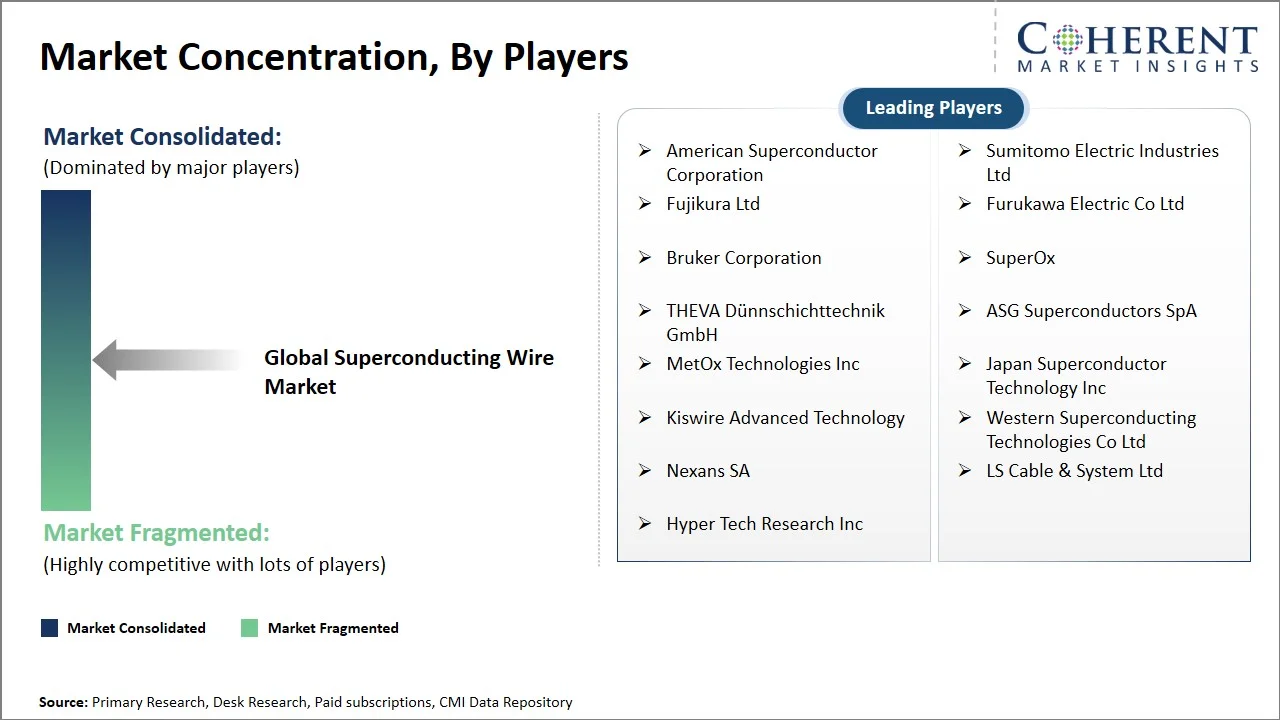
The global superconducting wire market is led by Sumitomo Electric Industries, Fujikura, American Superconductor Corporation, Bruker Corporation, Furukawa Electric, SuperOx, Western Superconducting Technologies, and THEVA Dünnschichttechnik. Sumitomo Electric is ramping up the production of second-generation REBCO high-temperature superconducting wires for fusion energy, power cables and fault current limiters, while Fujikura is focusing on high-performance conductors for medical imagining and next-generation energy systems. American Superconductor expands its portfolio with grid renovation projects and superconducting cable technologies for resilient power networks.
SuperOx and THEVA are developing commercial scale REBCO coated conductors for fusion reactors and industrial magnets. Western Superconducting Technologies has boosted the domestic production of niobium titanium and niobium tin wires to serve China’s fusion, accelerator and MRI sectors. Most leading companies are prioritizing manufacturing scale-up, higher critical current density, and strategic partnerships with fusion developers, national laboratories, and utility companies rather than competing solely on product pricing.
Market Report Scope
Superconducting Wire Market Report Coverage
| Report Coverage | Details | ||
|---|---|---|---|
| Base Year: | 2025 | Market Size in 2026: | USD 2.45 Bn |
| Historical Data for: | 2020 To 2024 | Forecast Period: | 2026 To 2033 |
| Forecast Period 2026 to 2033 CAGR: | 4.2% | 2033 Value Projection: | USD 4.90 Bn |
| Geographies covered: |
| ||
| Segments covered: |
| ||
| Companies covered: | American Superconductor Corporation, Sumitomo Electric Industries Ltd, Fujikura Ltd, Furukawa Electric Co Ltd, Bruker Corporation, SuperOx, THEVA Dünnschichttechnik GmbH, ASG Superconductors SpA, MetOx Technologies Inc, Japan Superconductor Technology Inc, Kiswire Advanced Technology, Western Superconducting Technologies Co Ltd, Nexans SA, LS Cable & System Ltd, and Hyper Tech Research Inc | ||
| Growth Drivers: |
| ||
| Restraints & Challenges: |
| ||
Analyst Opinion (Expert Opinion)
- The strongest long-term growth is expected to come from the transition of superconducting wire from conventional MRI applications to high-temperature superconducting technologies supporting commercial fusion energy and modern electricity infrastructure. As demonstration fusion plants move toward commercial deployment, the demand for REBCO conductors capable of generating magnetic fields above 20 tesla is expected to increase substantially, shifting industry investment toward high-value engineered superconducting materials.
- The most attractive opportunity is expected to be high-temperature superconducting wire, particularly REBCO conductors for fusion reactor magnets, grid-scale power cables, and fault current limiters, with the U.S., Japan, and China offering the highest potential. Ongoing procurement possibilities for manufacturers who can deliver improved conductors in commercial volumes are expected to be provided by projects like SPARC, JT-60SA, EAST, and growing superconducting transmission demonstrations.
- Manufacturers should explore ways to increase the production capacity for coated conductors, improve current density while reducing manufacturing cost per kiloampere-meter, and secure long-term supply agreements with fusion developers, MRI manufacturers, and national research laboratories. Companies that establish vertically integrated production of superconducting tapes and collaborate early with fusion energy and utility projects are expected to gain a significant competitive advantage as commercial deployment accelerates.
Speak to the analyst
Want personalized insights?
Take the findings above to one of our principal consultants, or have the report rebuilt around the segments, geographies and competitors you actually track.
Market Segmentation
- Type Insights (Revenue, USD Billion, 2021 - 2033)
- Low Temperature Superconductor
- Medium Temperature Superconductor
- High Temperature Superconductor
- Material Insights (Revenue, USD Billion, 2021 - 2033)
- Niobium Titanium
- Niobium Tin
- YBCO
- BSCCO
- Magnesium Diboride
- Application Insights (Revenue, USD Billion, 2021 - 2033)
- MRI Systems
- Power Cables
- Fault Current Limiters
- Magnets
- Fusion Reactors
- Particle Accelerators
- Quantum Computing
- Research Equipment
- End User Insights (Revenue, USD Billion, 2021 - 2033)
- Healthcare
- Energy and Power
- Research Institutions
- Defense
- Transportation
- Industrial Manufacturing
- Regional Insights (Revenue, USD Billion, 2021 - 2033)
- North America
- U.S.
- Canada
- Latin America
- Brazil
- Argentina
- Mexico
- Rest of Latin America
- Europe
- Germany
- U.K.
- Spain
- France
- Italy
- Russia
- Rest of Europe
- Asia Pacific
- China
- India
- Japan
- Australia
- South Korea
- ASEAN
- Rest of Asia Pacific
- Middle East
- GCC Countries
- Israel
- Rest of Middle East
- Africa
- South Africa
- North Africa
- Central Africa
- North America
- Key Players Insights
- American Superconductor Corporation
- Sumitomo Electric Industries Ltd
- Fujikura Ltd
- Furukawa Electric Co Ltd
- Bruker Corporation
- SuperOx
- THEVA Dünnschichttechnik GmbH
- ASG Superconductors SpA
- MetOx Technologies Inc
- Japan Superconductor Technology Inc
- Kiswire Advanced Technology
- Western Superconducting Technologies Co Ltd
- Nexans SA
- LS Cable & System Ltd
- Hyper Tech Research Inc
Sources
Primary Research Interviews
- Vice Presidents of Research & Development (R&D)
- Directors of Superconducting Materials Engineering
- Product Managers for MRI and NMR Magnet Systems
- Fusion Reactor Program Managers
Magazines
- Superconductor Week
- Physics World
- IEEE Spectrum
- CERN Courier
- Medical Design & Outsourcing
Journals
- Superconductor Science and Technology
- IEEE Transactions on Applied Superconductivity
- Physica C: Superconductivity and its Applications
Associations
- IEEE Council on Superconductivity
- Cryogenic Society of America (CSA)
- European Society for Applied Superconductivity (ESAS)
- International Superconductivity Technology Center (ISTEC)
Public Domain Sources
- U.S. Department of Energy (DOE)
- National Institute of Standards and Technology (NIST)
- CERN
- ITER Organization
- EUROfusion
Proprietary Elements
- CMI Data Analytics Tool
- Proprietary CMI Existing Repository of Information for the Last 10 Years
Get access to 250+ pages report
Every segment, forecast, competitor profile and data table behind the analysis above — available for instant download.
- ESOMAR Member
- ISO 9001:2015 Certified
- D-U-N-S Registered
- GDPR & CCPA Compliant
Missing comfort of reading report in your local language? Find your preferred language:
Transform your Strategy with Exclusive Trending Reports
Frequently Asked Questions
The global superconducting wire market is expected to stand at USD 2.45 Bn in 2026 and is expected to reach USD 4.90 Bn by 2033.
The CAGR of the global superconducting wire market is projected to be 4.2% from 2026 to 2033.
Rising deployment of MRI and NMR systems worldwide and growing investments in fusion energy and particle accelerator projects are the major factors driving the growth of the global superconducting wire market.
High manufacturing and processing costs and dependence on expensive cryogenic cooling systems are the major factors hampering the growth of the global superconducting wire market.
In terms of type, the low temperature superconductor segment is estimated to dominate the market revenue share in 2026.
They are used in superconducting magnets that guide and focus charged particle beams with high precision.
They enable compact transmission cables with minimal electrical losses and high current carrying capacity.