

Electronic Chemicals Market Size and Forecast: 2026 to 2033
Electronic Chemicals Market is estimated to be valued at USD 81.98 Bn in 2026 and is expected to reach USD 128.23 Bn in 2033, exhibiting a compound annual growth rate (CAGR) of 6.6% from 2026 to 2033.
Key Takeaways
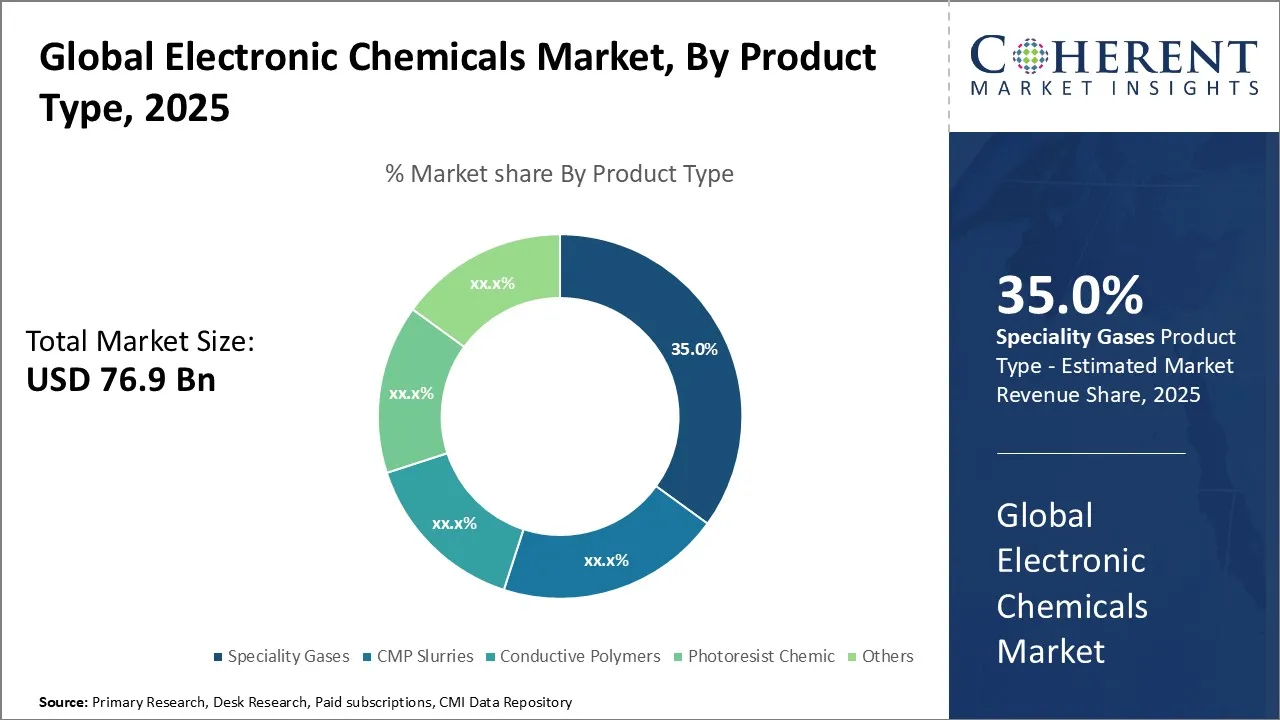
- By Product Type, Speciality Gases hold the largest market share of 36% in 2026 owing to the rapid growth of the semiconductor industry.
- By Application, Semiconductor expected to hold largest market share in 2026 owing to the rapid growth in chip production.
- By Region, North America dominates the overall market with an estimated share of 30% in 2026 owing to the strong growth in semiconductor manufacturing.
Market Overview
Rising semiconductor production, advanced packaging requirements, and increasing demand for high-performance electronics across consumer, automotive, and industrial sectors actively propel the electronic chemicals market. The growing use of AI, 5G, IoT devices, and cloud computing drives higher consumption of ultra-pure chemicals for wafer processing, cleaning, etching, and deposition. New fabrication facilities and advances in materials science further stimulate market expansion, while strong regional investments reinforce supply chains and accelerate the development of innovative specialty chemical formulations.
Current Events and Its Impact on the Electronic Chemicals Market
Current Events | Description and its impact |
Geopolitical Tensions and Trade Policies |
|
Technological Advancements in Semiconductor Manufacturing |
|
Economic Factors Impacting Raw Material Supply |
|
Segmental Insights
- Current Industry Events of 2026
- Market Size Estimation
- Regional Breakdown
- Competitive Landscape
- Customer Intelligence
- Segmental Analysis
- Pricing Analysis
- Key Market Drivers, Challenges & Future Trends
- Customized Insights Section
Electronic Chemicals Market Insights, By Product Type - Speciality Gases contribute the highest share of the market owing to its technological advancement & shrinking process nodes
Speciality Gases hold the largest market share of 36% in 2026. Expanding semiconductor manufacturing drives the specialty gases segment in the electronic chemicals market, as chip producers rely on ultra-high-purity gases for etching, deposition, doping, and chamber cleaning. Advancing technologies such as AI, 5G, and high-performance computing increase the need for precise gas formulations used in complex architectures. The move toward smaller process nodes and advanced packaging further boosts consumption. Growing production of displays, LEDs, and solar cells also broadens the use of specialty gases across multiple electronic applications. For instance, in October 2025, Inox Air Products (Inox AP) has begun building a ₹500-crore electronic specialty gas hub at Dholera, Gujarat, to serve India’s expanding semiconductor manufacturing sector.
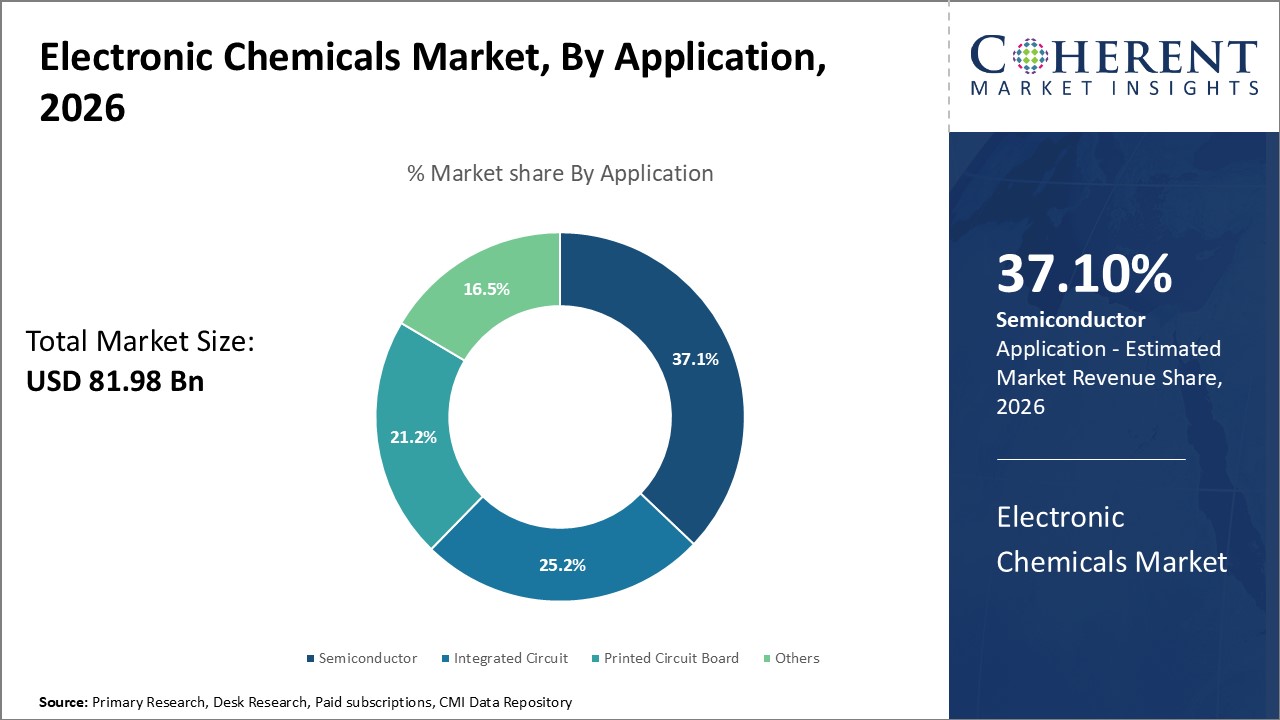
Electronic Chemicals Market Insights, By Application - Semiconductor contribute the highest share of the market owing to its growth of advanced packaging technologies
Growing demand for advanced chips in consumer electronics, automotive systems, data centers, and emerging technologies like AI and 5G actively drives the need for electronic chemicals in the semiconductor sector. As chip architectures become more complex, manufacturers use larger quantities of high-purity chemicals for cleaning, etching, deposition, and lithography. The move toward smaller nodes and innovative designs increases reliance on specialized materials. Expanding fabrication facilities and wider adoption of advanced packaging further intensify demand for these essential electronic chemicals. For instance, in December 2025, Rigaku Corporation, part of Rigaku Holdings, has launched the XTRAIA MF-3400, an instrument for measuring wafer thickness and composition in semiconductor manufacturing.
Regional Insights
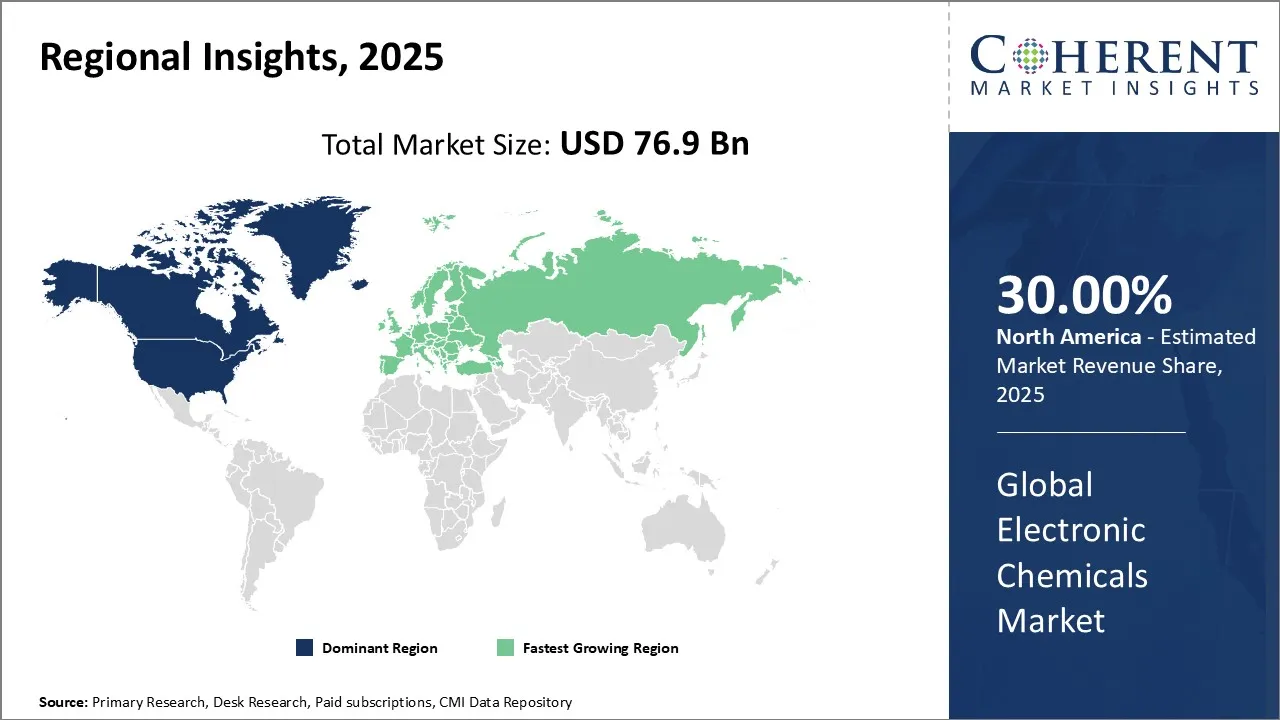
North America Electronic Chemicals Market Trends
North America dominates the overall market with an estimated share of 30% in 2026. Expanding semiconductor manufacturing drives the North America electronic chemicals market, supported by significant investments in new fabrication facilities and advanced chip technologies. Increasing adoption of AI, cloud computing, and electric vehicles raises demand for high-purity chemicals in complex wafer processing. The region strengthens local production of critical materials through reshoring initiatives and enhanced supply chains. Advances in packaging technologies and materials innovation further propel market growth, supporting the steady development of electronic chemicals across a wide range of applications.
In March 2024, the U.S. Department of Energy (DOE) has launched the Electronics Scrap Recycling Advancement Prize (E-SCRAP), offering up to $4 million to boost the recovery and use of critical materials from electronic scrap.
Europe Electronic Chemicals Market Trends
Manufacturers are driving the Europe electronic chemicals market by focusing on high-tech semiconductor production and specialty materials for electronics. Governments actively support innovation, sustainability, and supply chain reshoring, promoting local chemical production. Increasing demand for electric vehicles, renewable energy technologies, and industrial automation raises the use of high-purity chemicals in wafer fabrication, etching, and deposition processes. Ongoing investments in research and development, along with the adoption of advanced packaging and next-generation chip architectures, further accelerate the growth of electronic chemicals across diverse European applications. For instance, in November 2026, Wevo-Chemie, a German specialty chemicals company, has expanded its materials portfolio by launching WEVOSIL 23010 and WEVOSIL 23030, two liquid silicone rubbers designed for textile coatings and high-precision sealing.
United States Electronic Chemicals Market Trends
Semiconductor manufacturers are expanding production in the United States to meet growing demand from consumer electronics, data centers, and the automotive sector, driving the electronic chemicals market. Companies actively use high-purity chemicals for etching, deposition, cleaning, and lithography, supported by strategic investments in new fabrication plants and advanced chip technologies. Increasing focus on AI, 5G, and electric vehicles further raises chemical consumption, while government initiatives promoting domestic manufacturing, supply chain resilience, and innovations in materials and packaging actively strengthen the market across diverse U.S. electronic applications.
United Kingdom Electronic Chemicals Market Trends
Domestic manufacturers and research institutions are driving the United Kingdom electronic chemicals market by focusing on advanced semiconductor production and specialty electronic materials. Increasing investments in innovation, sustainable manufacturing, and localized supply chains promote the production and use of high-purity chemicals for etching, deposition, and wafer cleaning. Rising demand from automotive electronics, renewable energy, and industrial automation sectors further boosts consumption. Companies are also adopting advanced packaging technologies and next-generation chip designs, actively supporting the continued growth of electronic chemicals throughout the UK market.
End-user Feedback and Unmet Needs in the Electronic Chemicals Market
- Demand for Higher Purity and Consistency: End-users report that maintaining ultra-high purity and consistent quality remains a critical challenge. Variations in chemical composition can impact yields and device reliability. Manufacturers seek suppliers that guarantee stringent purity standards and reproducibility to minimize defects and improve wafer-level performance across increasingly complex semiconductor processes.
- Need for Customized Chemical Solutions: Users often require chemicals tailored to specific processes, nodes, or materials. Off-the-shelf products may not meet the demands of advanced packaging, EUV lithography, or novel materials. Suppliers are expected to provide flexible formulations and process-specific solutions to enhance efficiency, throughput, and device performance.
- Faster Delivery and Supply Chain Reliability: Semiconductor and electronics manufacturers highlight delays and supply interruptions as major pain points. Timely availability of electronic chemicals is essential to prevent production bottlenecks. End-users demand robust supply chains, local production options, and better logistics to ensure uninterrupted operations and avoid costly downtime.
Electronic Chemicals Market Trend
Growth of Advanced Semiconductor Fabrication
The market is increasingly influenced by the expansion of advanced semiconductor fabrication technologies. Manufacturers are adopting smaller process nodes, EUV lithography, and 3D integration, which demand high-purity chemicals for etching, deposition, cleaning, and photolithography. This trend encourages suppliers to develop specialized formulations, improve consistency, and provide solutions that support multi-layered chip architectures, enabling higher device performance and yield across next-generation electronics.
Rising Demand from Consumer and Automotive Electronics
Electronic chemicals are experiencing growing consumption due to the surge in smart devices, wearables, and connected automotive technologies. The proliferation of EVs, ADAS, IoT sensors, and high-performance consumer electronics drives increased usage of specialty chemicals in wafer processing, packaging, and surface treatment. Companies are focusing on solutions that enhance reliability, reduce defects, and support high-volume production to meet the evolving demands of electronics manufacturers across diverse applications.
Electronic Chemicals Market Opportunity
Expansion in Advanced Semiconductor Nodes
The shift toward smaller and more complex semiconductor nodes presents a significant opportunity for electronic chemicals suppliers. As chip designs incorporate finer features, manufacturers require ultra-high-purity chemicals for precise etching, deposition, and cleaning processes. Companies can develop specialized formulations to support EUV lithography, 3D NAND, and advanced logic devices, enabling higher yields and improved performance. Providing tailored solutions for these sophisticated applications positions suppliers as critical partners in next-generation semiconductor fabrication.
Market Report Scope
Electronic Chemicals Market Report Coverage
| Report Coverage | Details | ||
|---|---|---|---|
| Base Year: | 2025 | Market Size in 2026: | USD 81.98 Bn |
| Historical Data for: | 2020 To 2024 | Forecast Period: | 2026 To 2033 |
| Forecast Period 2026 to 2033 CAGR: | 6.6% | 2033 Value Projection: | USD 128.23 Bn |
| Geographies covered: |
| ||
| Segments covered: |
| ||
| Companies covered: | BASF SE, Air Products and Chemicals Inc., The Dow Chemical Company, Merck KGaA (known as EMD Performance, Materials in North America), SUMCO Corporation, JSR Corporation, Shin-Etsu Chemical Co., Ltd., Cabot, Microelectronics Corporation, Tokyo Ohka Kogyo Co., Ltd., and Honeywell International Inc. | ||
| Growth Drivers: |
| ||
| Restraints & Challenges: |
| ||
Electronic Chemicals Market News
- In September 2025, Solvay inaugurated a major expansion at its Zhenjiang, China facility, doubling its annual production capacity of electronic-grade hydrogen peroxide.
- In March 2025, Sumitomo Chemical announced to begin commercial sales of polymethyl methacrylate (PMMA) produced using methyl methacrylate (MMA) monomer derived from chemical recycling. Early adopters of this recycled material include LG Display of South Korea and Nissan Motor of Japan.
Analyst Opinion (Expert Opinion)
- The current trajectory of the electronic chemicals market signals a structural shift — not simply growth, but strategic redefinition — driven by escalating demands from next‑generation semiconductor manufacturing. As leading chipmakers scale production and transition to sub‑5 nm nodes and complex 3D IC and packaging architectures, the need for ultra‑high‑purity chemicals, specialty gases, and next‑level process materials becomes indispensable.
- Additionally, the growing complexity of fabrication — more layers, smaller feature sizes, and advanced packaging — demands far tighter tolerances in chemical purity. Suppliers who can deliver consistently at parts-per-billion contamination levels or better dramatically reduce defect rates and help maintain high wafer yields, giving them a competitive edge. This demand for precision is echoed in increased adoption of elite photoresists optimized for EUV lithography and ultra-pure wet and dry process chemistries.
- Environmental, regulatory, and sustainability imperatives are reshaping supplier strategies as well. As fabs expand globally and regulators tighten emissions and waste mandates, there is mounting pressure on chemical suppliers to innovate low-toxicity solvents, recycle by‑products, and adopt closed‑loop chemical systems. This shift is creating a powerful opportunity for responsible suppliers to differentiate on sustainability — appealing to both public‑policy imperatives and corporate ESG targets.
- Apart from this, the widening adoption of non‑traditional applications — such as power semiconductors for electric vehicles, compound‑semiconductor for 5G, and advanced packaging materials — is broadening demand beyond traditional logic and memory chips. This diversification reduces cyclical risk and positions the electronic chemicals market as a stable, long-term backbone of the broader electronics ecosystem.
Speak to the analyst
Want personalized insights?
Take the findings above to one of our principal consultants, or have the report rebuilt around the segments, geographies and competitors you actually track.
Market Segmentation
- By Product Type
- Speciality Gases
- CMP Slurries
- Conductive Polymers
- Photoresist Chemic
- Others
- By Application
- Semiconductor
- Integrated Circuit
- Printed Circuit Board
- Others
- Regional Insights (Revenue, USD Bn, 2021 - 2033)
- North America
- U.S.
- Canada
- Latin America
- Brazil
- Argentina
- Mexico
- Rest of Latin America
- Europe
- Germany
- U.K.
- Spain
- France
- Italy
- Russia
- Rest of Europe
- Asia Pacific
- China
- India
- Japan
- Australia
- South Korea
- ASEAN
- Rest of Asia Pacific
- Middle East
- GCC Countries
- Israel
- Rest of Middle East
- Africa
- South Africa
- North Africa
- Central Africa
- North America
- Key Players Insights
- BASF SE
- Air Products and Chemicals Inc.
- The Dow Chemical Company
- Merck KGaA
- SUMCO Corporation
- JSR Corporation
- Shin-Etsu Chemical Co., Ltd.
- Cabot
- Microelectronics Corporation
- Tokyo Ohka Kogyo Co., Ltd.
- Honeywell International Inc.
Sources
Primary Research interviews
- Industry experts and stakeholders
- Chemical manufacturers and suppliers
- Electronics manufacturing companies
- Research and development heads in electronics chemicals
Databases
- Scopus
- Web of Science
- PubChem
- Chemical Abstracts Service (CAS)
- IEEE Xplore
Magazines
- Chemical & Engineering News
- Electronics For You
- Semiconductor Today
- IC Insights Magazine
Journals
- Journal of Electronic Materials
- Journal of Materials Chemistry C
- Advanced Electronic Materials
- Journal of Applied Polymer Science
Newspapers
- The Wall Street Journal (Technology & Chemicals Section)
- The Financial Times (Technology Sector)
- The New York Times (Business & Technology)
Associations
- American Chemical Society (ACS)
- Institute of Electrical and Electronics Engineers (IEEE)
- Semiconductor Industry Association (SIA)
- International Electrotechnical Commission (IEC)
Public Domain sources
- U.S. Environmental Protection Agency (EPA) reports
- U.S. Food & Drug Administration (FDA) databases
- United Nations Comtrade database
- World Bank open data
Proprietary Elements
- CMI Data Analytics Tool
- Proprietary CMI Existing Repository of information for last 8 years
Get access to 250+ pages report
Every segment, forecast, competitor profile and data table behind the analysis above — available for instant download.
- ESOMAR Member
- ISO 9001:2015 Certified
- D-U-N-S Registered
- GDPR & CCPA Compliant
Missing comfort of reading report in your local language? Find your preferred language:
Transform your Strategy with Exclusive Trending Reports
Frequently Asked Questions
The Electronic Chemicals Market is estimated to be valued at USD 81.98 Bn in 2026, and is expected to reach USD 128.23 Bn by 2033.
Environmental concerns and regulatory constraints are the key factors hampering growth of the electronic chemicals market.
Miniaturization of electronic devices and advancements in semiconductor technology are the major factors driving the market growth.
The leading application segment in the market was semiconductor and IC.
BASF SE, Air Products and Chemicals Inc., The Dow Chemical Company, Merck KGaA (known as EMD Performance, Materials in North America), SUMCO Corporation, JSR Corporation, Shin-Etsu Chemical Co., Ltd., Cabot, Microelectronics Corporation, Tokyo Ohka Kogyo Co., Ltd., and Honeywell International Inc. are the major players operating in the market.
North America leads the market.
The CAGR of the Electronic Chemicals Market is projected to be 6.6% from 2026 to 2033.