

Global Team Communication Tool Market Size and Forecast – 2026 To 2033
The Global Team Communication Tool Market is expected to grow at a CAGR of 11.8% during the forecast period of 2026 to 2033. It will reach USD 34.25 Bn in 2026 and USD 74.77 Bn by 2033. This growth is attributed to the increasing adoption of digital collaboration platforms across numerous industries, propelled by the global demand for remote employment facilitation, enhanced productivity, and smooth communication.
There is growing interest among organizations in integrated platforms that bring together messaging, document sharing and real-time collaboration in secure digital workspaces. Launched in March 2026, Wire Drive integrates secure file management and real-time document collaboration directly into the enterprise messaging platform. The move highlights the industry’s shift to unified communication environments that help improve coordination among distributed teams, make it easier to share information and reduce the need to switch applications.
Key Takeaways of the Global Team Communication Tool Market
- Instant Messaging and Team Chat is expected to register an estimated CAGR of 12.3% through 2033 and account for 45.5% of the global team communication tool market in 2026. Persistent messaging channels allow remote employees to solve problems fast and have searchable decision histories. Slack said it will pilot a program in September 2026 that will let teams have collaborative AI-assisted discussions with Slackbot in shared channels.
- Cloud-Based deployment is forecast to grow at an estimated CAGR of 12.6% through 2033, capturing 85.1% of global team communication tool market revenue in 2026. With subscription pricing, centralized administration and flexible access, managing communication infrastructure across distributed offices is easy. In June 2026, Google Workspace shipped data-import capabilities that included support for Microsoft Teams migrations and improved interop capabilities, removing operational barriers to the adoption of cloud-native collaboration platforms.
- Large Enterprises are expected to account for 60.6% of the global team communication tool market spending in 2026 and are expected to register a CAGR of 10.9% through 2033. The purchasing priorities are centered around the coordination of complex business divisions, secure access to knowledge, and centralized governance. In October 2025, Mercedes-Benz integrated Rovo with internal systems, giving around 35,000 users the ability to query organizational knowledge using natural language, Atlassian said.
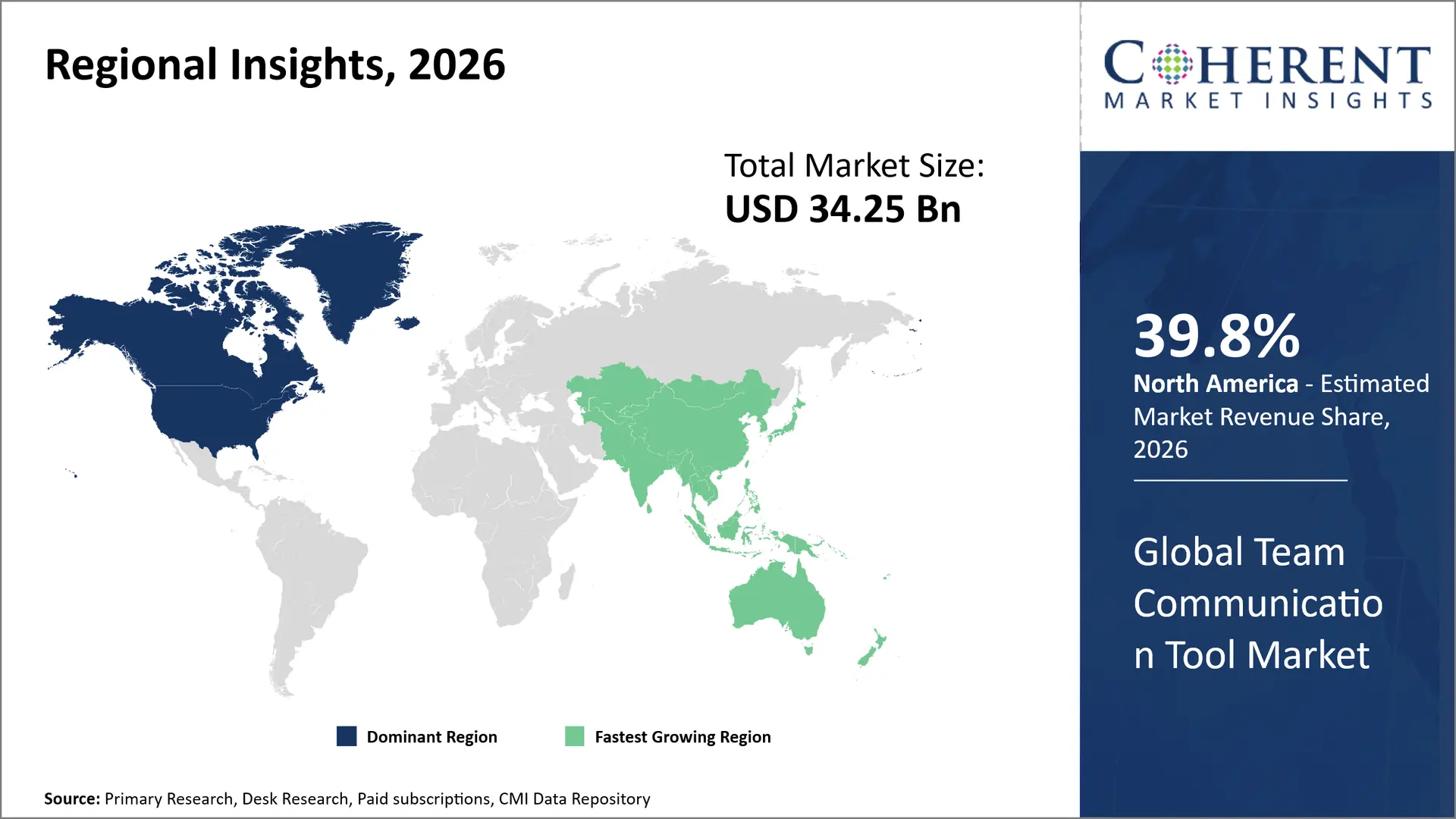
- North America is anticipated to expand at an estimated CAGR of 10.5% through 2033 while maintaining 39.8% of the global mark global team communication tool market et in 2026. Established enterprise software budgets, advanced IT infrastructure and strict government security requirements bolster regional leadership. In December 2025, Zoom announced that the U.S. Defense Information Systems Agency approved Zoom for Defense for secure collaboration at Impact Level 4.
- The Asia Pacific region is expected to witness the highest CAGR of 15.0% from 2026 to 2033 and contribute 25.3% of the revenue in the global team communication tool market. Retail, logistics and frontline services are going mobile-first in communications outside the traditional office environment. Japan-based LINE WORKS said in February 2026 that its smartphone walkie-talkie application had been adopted by more than 2,000 companies in one year of its operation
Segmental Insights
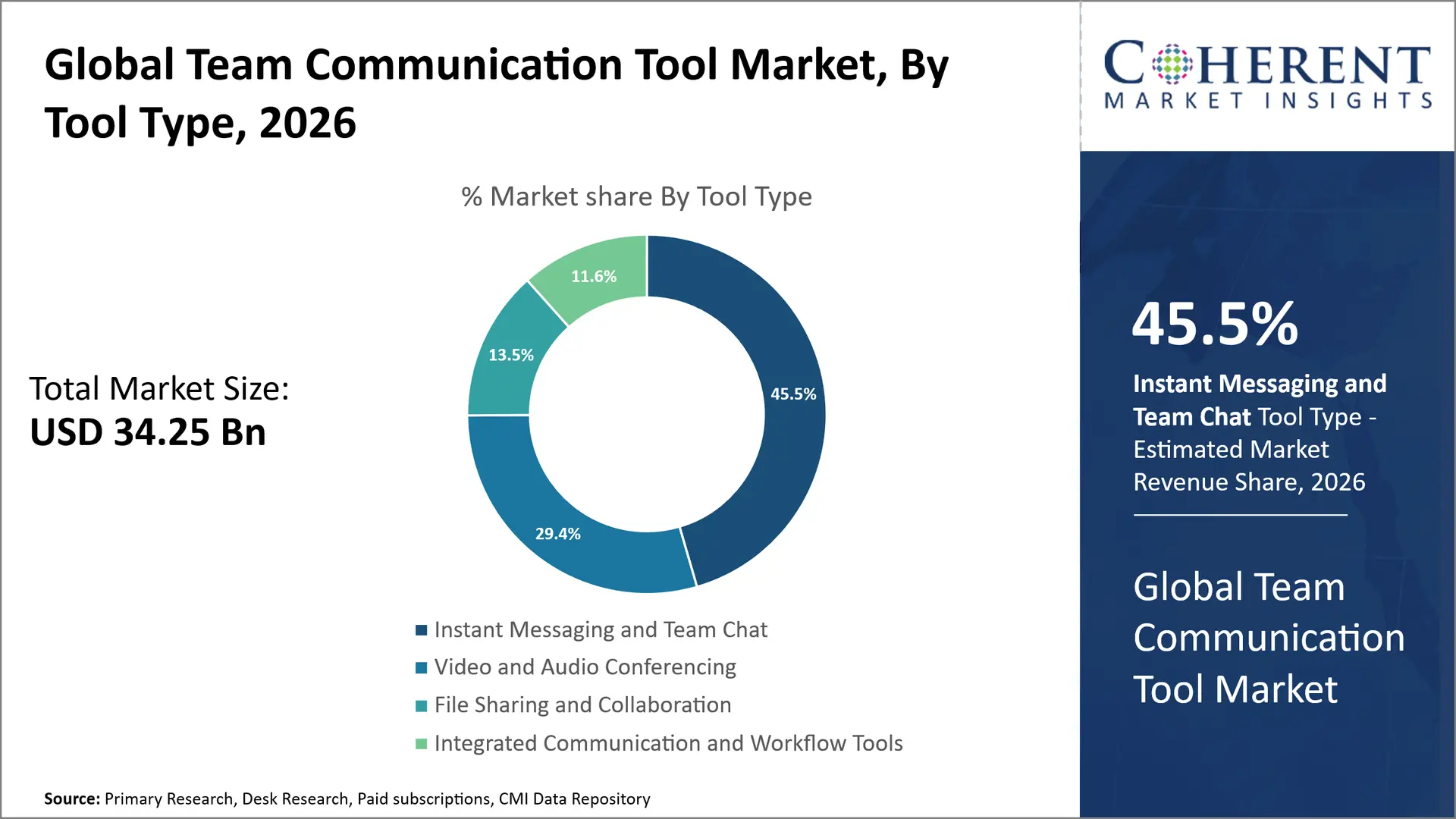
Why Do Instant Messaging and Team Chat Dominate the Global Team Communication Tool Market?
Instant Messaging and Team Chat is expected to command 45.5% of the global team communication tool market in 2026. This category is the biggest one because operational teams need to focus on continuous streams of small, time-sensitive requests without holding separate meetings. IT support desks, sales operations and product teams can direct questions to the right colleagues with topic-specific channels, mentions and message filters. Effective message triage can protect employee attention while making established platforms harder to replace. In May 2025, Microsoft made its redesigned Teams chat and channels experience generally available to commercial users, bringing conversations into a more customizable workspace with tools for filtering and organizing discussions. The development illustrates how practical message management underpins the segment's commercial appeal.
- Current Industry Events of 2026
- Market Size Estimation
- Regional Breakdown
- Competitive Landscape
- Customer Intelligence
- Segmental Analysis
- Pricing Analysis
- Key Market Drivers, Challenges & Future Trends
- Customized Insights Section
Why Does Cloud-Based Deployment Represent the Largest Deployment Segment in the Global Team Communication Tool Market?
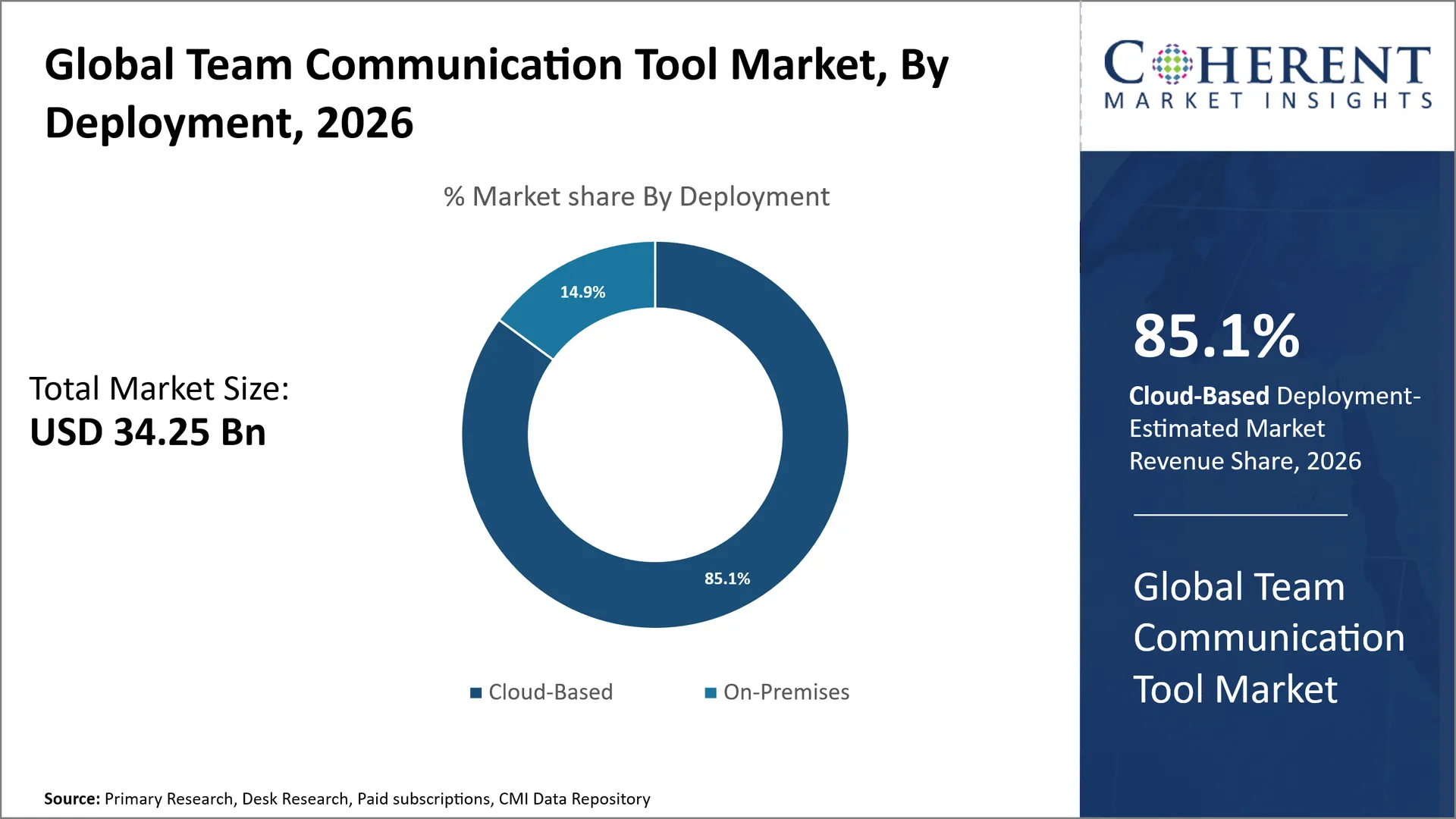
The cloud-based deployment is estimated to hold a share of 85.1% of the global team communication tool market by 2026. Organizations that open branches or change staffing can provision communication services from a central location, rather than installing and maintaining separate systems at each location. This ability to change capacity without having to constantly buy new hardware is especially useful to retail chains, education providers and customer-service operators. Hosted delivery offers suppliers coordinated upgrades and recurring service relationships, but customers still need contractual uptime protections and reliable network access. In May 2026, GoTo announced GoTo Connect CX Complete, a unified cloud communications offering for smaller businesses that combines phone, text, web chat, WhatsApp, webinars and AI-powered customer-experience capabilities. This approach illustrates how centrally delivered software can enable the growth and management of communication capabilities within operational teams.
Why Do Large Enterprises Dominate the Organization Size Segment of the Global Team Communication Tool Market?
Large Enterprises are expected to account for 60.6% of the global revenue of team communication tools in 2026, suggesting that the purchasing power of organization-wide transformation programs, rather than just employee numbers, is to blame. Managing these simultaneous client relationships requires multinational technology and professional-services groups to use common planning methodologies, collaborative visual workspaces, and consistent project handovers. Implementation complexity elevates service expectations, but vendors able to provide training, phased deployment and repeatable collaboration practices can convert limited team usage into larger enterprise contracts. Endava announced a partnership with Miro in February 2026 to roll out Miro across the enterprise to facilitate collaborative AI workflows within its Dava.Flow delivery model. The arrangement shows how large employers use collaboration software to standardize project execution and roll out common working practices to international delivery teams.
Current Events and their Impact
Current Event | Description and Its Impact |
The EU Digital Operational Resilience Act (DORA) applies from January 2025. |
|
September 2025 – European Union Data Act Takes Effect |
|
June 2026 – U.S. FedRAMP Introduces Consolidated Certification Rules |
|
Global Team Communication Tool Market Dynamics
Key Market Drivers
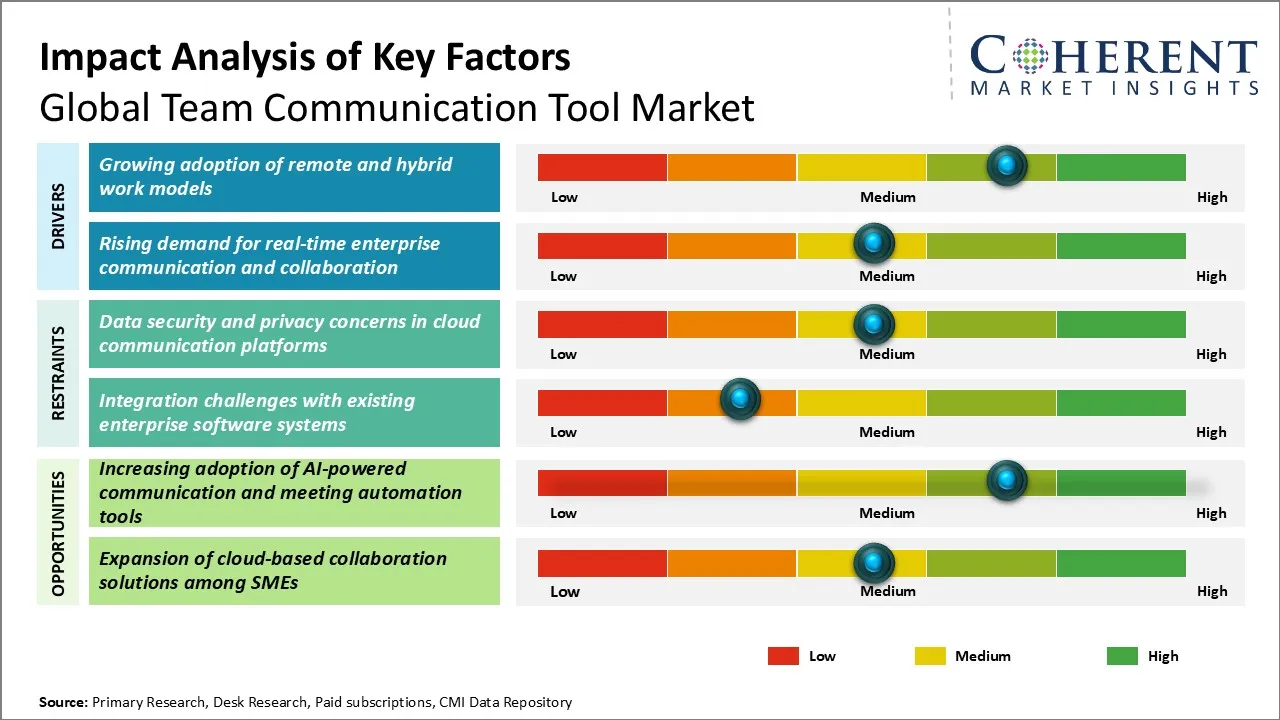
- Growing Adoption of Remote and Hybrid Work Models: Organizations that combine office attendance with remote work must make meeting participation consistent across rooms, laptops, and mobile devices. Uneven audio capture, restricted room compatibility, and weak handovers between meetings and chat can slow decisions, making integrated collaboration software and meeting-room equipment recurring IT investments. Providers of conferencing platforms, workplace devices, and deployment services benefit when employers modernize shared spaces rather than purchasing licenses alone. In September 2025, Cisco introduced RoomOS 26 and new intelligent meeting-room functions for its collaboration devices, with availability planned from late 2025.
- Rising Demand for Real-Time Enterprise Communication and Collaboration: customer-facing teams needing an operational conversation, not separate support records, messages and phone calls. Delayed context transfer during incident handoffs between engineers, supervisors and frontline agents increases the time to resolve the incident and erodes accountability. This is good news for communication vendors that integrate live interactions with records, searchable threads and escalation workflows and for system integrators that can gain implementation opportunities. In April 2025, 8x8 unveiled enhancements to 8x8 Work, including AI-powered chat summarization and message composition, designed to help employees manage ongoing conversations without losing critical context.
Emerging Market Trends
- Shift Toward Decision-Oriented Collaboration Records: Communication platforms are changing from storing conversations to storing decisions as structured, verifiable workplace outputs. Buyers are increasingly looking for shared workspaces to distinguish between casual discussion and commitments, approvals, and unanswered questions, instead of requiring employees to reconstruct context later. This might move product roadmaps toward configurable decision logs, role-based visibility, and integrations with systems of record. Basic messaging services risk becoming interchangeable and specialist developers providing reliable workflow capture may become more relevant. Measuring follow-through is likely to matter more than the raw volume of messages over the duration of the forecast.
- Flexible Licensing Based on Communication Usage: Uniform per-seat subscription models are increasingly out of sync with mixed patterns of communication usage. Project contractors, seasonal staff and occasional collaborators often require limited access compared to employees who spend their workday in meetings and channels. Vendors may respond with transparent billing to external participants, short-term access, and modular entitlements. This would lower the initial resistance to purchase, but also pressure providers that rely on fully provisioned licenses. During the forecast period, customer retention is likely to be driven more by the fair pricing architecture than high feature counts.
Regional Insights
Why Does North America Dominate the Global Team Communication Tool Market?
North America is expected to account for 39.8% of the global team communication tool market by 2026, supported by a robust ecosystem of cloud telephony, conferencing and managed-service providers and mature enterprise communications procurement policies. In the United States and Canada, businesses typically have dispersed customer support, healthcare administration and professional services teams that need reliable voice-to-meeting continuity. Increasingly, purchasing decisions take into account the cost of maintaining overlapping communications contracts, operational resilience, and service integration. Regional vendors may improve their standing by integrating productivity capabilities into current unified communications setups, rather than having to replace entire systems. Sangoma, based in Canada, expanded its business communications offerings in January 2025 with Sangoma GenAI enhancements that featured conversation summaries, meeting transcription and other capabilities. The announcement is proof of the increasing commercial value of established communications infrastructure from North American suppliers.
Why Is Asia Pacific Emerging as the Fastest-Growing Region in the Global Team Communication Tool Market?
Asia Pacific is expected to be the fastest-growing region during the forecast period. Asia Pacific is expected to account for 25.3% of the global team communication tool market in 2026. This growth is a reflection of the diverse communication needs of digitally connected cities, public agencies, and commercial entities that manage staff across national boundaries. Buyers are increasingly seeking tools that allow for communication between far-flung offices without complex administrative processes, mobile accessibility and language flexibility. Demand for secure shared workspaces is also driven by public-sector modernization, although procurement regulations differ widely from country to country. In July 2025, the Australian Department of Finance made GovAI available to the Australian Public Service, a platform that includes a collaboration space for officials to share use cases and lessons across agencies. This is yet another indication of the region’s growing focus on organized, cross-institutional digital communication, rather than isolated department-level tools.
Global Team Communication Tool Market Outlook for Key Countries
Why Is the U.S. a Key Market for the Global Team Communication Tool Market?
The U.S. is a big global market for team communication tools as its software, consulting, media and professional services businesses deal with complex projects with specialized departments and outside contractors. Buyers are increasingly questioning whether project messages can stay connected to documents, deadlines and responsibilities rather than being kept in separate chat applications. That preference creates an opportunity for providers that combine communication with work management and measurable completion of tasks. Proximity to enterprise buyers and established software distribution networks also benefit domestic software developers. In December 2025, ClickUp, a U.S.-based company, unveiled ClickUp 4.0, offering a workspace that integrates Chat, meetings, documents, and tasks into a unified interface. The release points to a shift in the U.S. collaboration market toward product designs that connect conversations directly to project execution.
Why Is India Important in the Global Team Communication Tool Market?
India is an important growing global market for team communication tools as government agencies, IT services companies and large outsourced operations need to communicate with employees spread out over vast regional networks. Public institutions are more interested in authenticated users, auditability and controlled exchange of official information. Commercial buyers, in contrast, are more focused on mobile access and practical implementation costs. This leaves room for local platforms and providers that can tailor workflows to the specific needs of local institutions. The Gov.in Secure Intranet was listed as an integrated government workspace with meeting scheduling, task assignment, notifications and links to approved conferencing services by the National Informatics Center of India in January 2026. The publication cited deployment in ministries and departments as an illustration of how structured collaboration systems are embedded in public administration. This procurement environment may be conducive to demand for implementation and maintenance services.
Why Does China Support Growth in the Global Team Communication Tool Market?
China has been a major player in the global Team Communication Tool market due to its large domestic digital platforms and vast networks of manufacturers, merchants, logistics companies and service providers. Business buyers often want collaboration environments that tie staff communication to approvals, supply-chain updates and existing enterprise applications. Domestic suppliers have an edge in that they can support Chinese language interfaces and integrate into local commercial ecosystems. In March 2026, Alibaba launched Wukong, an enterprise AI workspace that was open only to beta testing by invitation and is intended to be integrated into its existing workplace collaboration platform, DingTalk. The announcement indicates Chinese vendors are moving from just message exchange to coordinating business operations. Enterprises, especially those with many operating locations, may use providers that can combine communication, permission management and merchant workflows.
Why Is Germany a Strategic Country in the Global Team Communication Tool Market?
Germany is strategically important for the global team communication tools market, as industrial engineering groups, public institutions and business services companies require collaboration systems that can handle confidential technical information and provide tightly controlled access. There are a lot of concerns from prospective buyers about where their hosting will be, who they will be reliant on as a supplier and whether they will still be able to keep control of their workplace data. This gives rise to a different market for self-hosted or sovereign collaboration solutions in addition to the usual subscription services. German software provider Nextcloud released Hub 25 Autumn in September 2025 with threaded discussions in Nextcloud Talk, live transcription and simplified guest-account management. The release is a reflection of the commercial focus on communication features in independently managed digital workplaces. Vendors with transparent deployment architecture and dependable support may find themselves in a good position to win over security-conscious public and industrial customers.
Why Is Brazil an Important Growth Market for the Global Team Communication Tool Market?
Brazil is a major growth market for global team communication tools because multi-site retailers, service operators and industrial businesses need to coordinate decisions from headquarters with employees working in geographically dispersed facilities. Integration with existing local business software and Portuguese-language interfaces may be more practically useful than adding another standalone messaging channel. For vendors, partnerships with enterprise resource planning providers give them access to customers who are already standardizing internal processes. In September 2025, Brazilian software company TOTVS announced the update of its Fluig Voyager 2.0 platform, which features AI-assisted process creation and new components for corporate workflows. The development shows how collaborative functions are being embedded into the operational systems that domestic buyers are familiar with. Little retraining would be required for adoption by providers that combine team updates with document approvals and administrative processes.
Digital Transformation and Platform Evolution Landscape in the Global Team Communication Tool Market
Technology | Application in Team Communication | Adoption Landscape | Commercial Impact |
Real-Time Messaging and Presence Synchronization | Enables instant message delivery, conversation synchronization, employee availability indicators, and persistent group channels. | All the enterprise messaging platforms have had constant improvements in the synchronization of devices and reliability. | Enhances communication continuity and facilitates timely coordination of distributed employees. |
WebRTC & Adaptive Video Technology | Enables bandwidth-aware communications, screen sharing, audio and video conferencing and browser-based meetings. | Widely deployed, with improvements to favor media quality and stability of connections across a variety of networks. | It keeps you up to date on your meetings and requires no special client software. |
AI-Driven Translation & Speech Recognition – Live | Allows you to participate in multilingual meetings by converting spoken discussions to transcripts and captions. | As vendors make their transcriptions more accurate, broaden their language coverage and make their features more accessible, it is growing. | Designs customized collaboration experiences and offers support to international organizations with multilingual workforces. |
Zero-Trust Access and Identity Management | Secures enterprise conversations using identity verification, single sign-on, role-based permissions and device controls. | This is increasingly important in secure environments with multiple user groups. | Makes administration secure and provides better suitability for customers with complex access needs. |
Integration and Workflow Automation, Enabled by API | Helps integrate business applications, CRM, ERP, help desk and project management with communication channels. | It is a given in enterprise platforms, with growing emphasis on configurable integration capabilities. | Extends the platform functionality to existing business processes, generates opportunities for recurring integration services. |
Enterprise Encryption and Data Governance Technology | This includes encryption, enterprise key management, audit logs, message retention and controlled access to information. | How fast you adopt depends on your deployment architecture, industry obligations and enterprise security policies. | Helps suppliers differentiate their premium products and meet the demanding procurement needs of corporations. |
How Are Controlled Supplier and Partner Workspaces Creating New Growth Opportunities in the Global Team Communication Tool Market?
Most collaboration products are optimized for employees inside a single organization, leaving procurement teams, contract manufacturers, logistics partners, and franchise operators to coordinate through email chains and consumer messaging. A dedicated partner workspace could bridge this gap, letting businesses share instructions, handle exceptions, and resolve disputes without giving outsiders broad network access.
The opportunity is for manufacturing, retail distribution, healthcare supply chains and construction projects with third parties that change frequently. Optional modules could include verified guest identities, project-specific channels, document permissions, and time-limited access, all of which providers could monetize.
Successfully entered, it must be federated with customer identity systems, be easily onboarded, have interfaces in the local language, have tamper-evident records and contractually clear rules on who owns what data. Integration specialists and security-focused vendors may find a foothold in the mid-market while large platform providers can use existing account relationships to drive adoption Poor access governance could undermine trust, so support for product design and implementation may be essential to commercial success.
Market Players, Key Development, and Competitive Landscape
Key Developments
- In June 2026, Mattermost announced a collaboration with archTIS to combine mission-critical team communication with attribute-based access control for defense organizations and allied coalitions. The proposed integration strengthens the commercial case for specialist platforms where classification rules must accompany information across operational conversations and shared documents.
- In October 2024, RingCentral announced that it had obtained a pan-India telecommunications license supporting its Global RingEX Select communications offering. This broadened its ability to serve multinational organizations connecting Indian offices with international teams through compliant calling, messaging, and video services, reinforcing regional enterprise market access.
Competitive Landscape
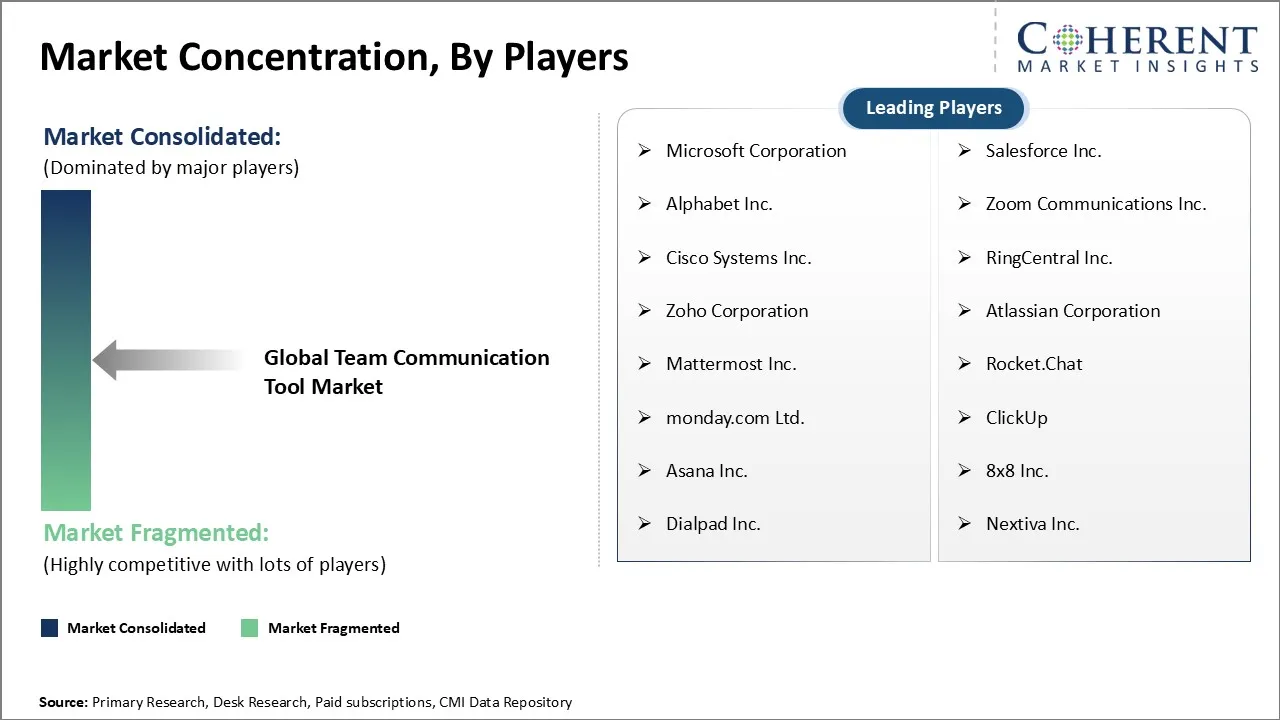
The global team communication tool market is moderately consolidated, with major productivity ecosystems and unified communications vendors accounting for much of enterprise purchasing, alongside numerous specialist and regional suppliers. Competition increasingly turns on service reliability, integration depth, contractual flexibility, and administrative control rather than messaging functionality alone. Smaller vendors compete through specialized deployment models and implementation services, while local partners remain important for procurement and support.
Key focus areas include
- Platform Reliability: Critical selection criteria are reliable uptime, call quality and message delivery.
- Product Differentiation: Vendors compete on advanced conferencing, custom interfaces, and administrative features.
- Pricing Strategies: Subscription flexibility, bundling services, and predictability of ownership costs impact buying decisions.
- System Compatibility: By integrating with existing enterprise applications, it helps to increase the adoption of the platform and build customer relationships.
- Security Features: Encryption, access control and compliance documentation to qualify for the enterprise.
- Regional Market Access: Localized interfaces, billing arrangements and regional support provide increased customer access.
- Customer Support: Technical onboarding, training, and responsive service management influence contract renewals.
Market Report Scope
Team Communication Tool Market Report Coverage | |||
Report Coverage | Details | ||
Base Year | 2025 | Market Size in 2026: | USD 34.25 Bn |
Historical Data For: | 2020 To 2024 | Forecast Period: | 2026 To 2033 |
Forecast Period 2026 To 2033 CAGR: | 11.8% | 2033 Value Projection: | USD 74.77 Bn |
Geographies covered: |
| ||
Segments covered: |
| ||
Companies covered: | Microsoft Corporation, Salesforce Inc., Alphabet Inc., Zoom Communications Inc., Cisco Systems Inc., RingCentral Inc., Zoho Corporation, Atlassian Corporation, Mattermost Inc., Rocket.Chat, monday.com Ltd., ClickUp, Asana Inc., 8x8 Inc., Dialpad Inc., Nextiva Inc. | ||
Growth Drivers: |
| ||
Restraints & Challenges: |
| ||
Analyst Opinion (Expert Opinion)
- The global team communication tool market enterprise procurement decisions are likely to place greater emphasis on communication platform exit costs, migration assurance, and measurable service commitments. Vendors that can simplify transitions from competing products while maintaining operational continuity may secure stronger renewal positions. Commercial leadership could increasingly depend on contractual accountability and implementation quality rather than the breadth of available communication features.
- Autonomous software agents could fundamentally change how collaboration platforms are consumed and monetized. As digital agents begin exchanging instructions and completing routine coordination tasks, traditional employee-based licensing may face pressure. Providers capable of authenticating machine identities, limiting delegated permissions, and maintaining clear records of automated actions may establish an important advantage in enterprise communication infrastructure.
- Market participants should prioritize resilient communication architecture, efficient media processing, and stronger integration with enterprise operations. Investment decisions must account for AI processing costs, regulatory differences, and potential pressure on subscription margins. Partnerships with telecommunications providers and implementation specialists can improve distribution efficiency. Vendors should avoid excessive spending on interchangeable features that offer limited customer value or meaningful differentiation.
Speak to the analyst
Want personalized insights?
Take the findings above to one of our principal consultants, or have the report rebuilt around the segments, geographies and competitors you actually track.
Market Segmentation
- Tool Type Insights (Revenue, USD Bn, 2021 - 2033)
- Instant Messaging and Team Chat
- Video and Audio Conferencing
- File Sharing and Collaboration
- Integrated Communication and Workflow Tools
- Deployment Insights (Revenue, USD Bn, 2021 - 2033)
- Cloud-Based
- On-Premises
- Organization Size Insights (Revenue, USD Bn, 2021 - 2033)
- Large Enterprises
- Small and Medium Enterprises
- End User Insights (Revenue, USD Bn, 2021 - 2033)
- IT and Telecommunications
- BFSI
- Manufacturing
- Retail and E-Commerce
- Healthcare
- Education
- Government
- Other Industries
- Sales Channel Insights (Revenue, USD Bn, 2021 - 2033)
- Direct Vendor Sales
- Resellers and Channel Partners
- Online Marketplaces
- Regional Insights (Revenue, USD Bn, 2021 - 2033)
- North America
- U.S.
- Canada
- Latin America
- Brazil
- Argentina
- Mexico
- Rest of Latin America
- Europe
- Germany
- U.K.
- Spain
- France
- Italy
- Russia
- Rest of Europe
- Asia Pacific
- China
- India
- Japan
- Australia
- South Korea
- ASEAN
- Rest of Asia Pacific
- Middle East
- GCC Countries
- Israel
- Rest of Middle East
- Africa
- South Africa
- North Africa
- Central Africa
- North America
- Key Players Insights
- Microsoft Corporation
- Salesforce Inc.
- Alphabet Inc.
- Zoom Communications Inc.
- Cisco Systems Inc.
- RingCentral Inc.
- Zoho Corporation
- Atlassian Corporation
- Mattermost Inc.
- Rocket.Chat
- monday.com Ltd.
- ClickUp
- Asana Inc.
- 8x8 Inc.
- Dialpad Inc.
- Nextiva Inc.
Sources
Primary Research Interviews
- Team communication software providers, SaaS developers, and cloud service providers
- Enterprise IT managers, CIOs, technology consultants, and system integrators
- Unified communications vendors, distributors, and industry experts
Stakeholders
- Team communication platform developers and software vendors
- Cloud infrastructure providers and technology suppliers
- Enterprise IT departments, system integrators, and channel partners
- Corporate enterprises, SMEs, government organizations, and end users
End-use Sectors
- IT and telecommunications and BFSI
- Manufacturing, retail, and e-commerce
- Healthcare, education, and government
- Professional services and other industries
Regulatory and Industry Bodies
- U.S. Federal Trade Commission (FTC)
- European Commission and European Data Protection Board (EDPB)
- National Institute of Standards and Technology (NIST)
- International Organization for Standardization (ISO)
- Ministry of Electronics and Information Technology (MeitY), India
Databases
- Company annual reports and investor presentations
- International Telecommunication Union (ITU) ICT statistics
- OECD digital economy and enterprise ICT databases
- Eurostat enterprise cloud computing and ICT usage statistics
- Enterprise software pricing, adoption, and technology patent databases
Magazines and Journals
- IEEE Transactions on Professional Communication
- Journal of Computer-Mediated Communication
- International Journal of Human-Computer Studies
- Computerworld
- CIO
- Network World
Associations
- Cloud Security Alliance (CSA)
- Computing Technology Industry Association (CompTIA)
- Information Systems Audit and Control Association (ISACA)
- Institute of Electrical and Electronics Engineers (IEEE)
- SIP Forum
Public Domain Sources
- Enterprise communication software adoption and cloud deployment statistics
- Remote and hybrid workforce collaboration data
- Unified communications, AI integration, and workflow automation developments
- Enterprise cybersecurity, data privacy, and compliance updates
- Product launches, strategic partnerships, acquisitions, and technology investments
Key Standards and Regulations
- ISO/IEC 27001 – Information security management systems
- EU General Data Protection Regulation (GDPR) – Regulation (EU) 2016/679
- EU Digital Operational Resilience Act (DORA) – Regulation (EU) 2022/2554
- EU Data Act – Regulation (EU) 2023/2854
- HIPAA – U.S. healthcare information privacy and security requirements
- FedRAMP – U.S. federal cloud security authorization framework
- Digital Personal Data Protection Act, 2023 – India
Proprietary Elements
- CMI Data Analytics Tool and proprietary CMI repository covering enterprise communication software, cloud collaboration, platform adoption, subscription pricing, technology innovation, regional demand, regulatory developments, and competitive intelligence.
Get access to 250+ pages report
Every segment, forecast, competitor profile and data table behind the analysis above — available for instant download.
- ESOMAR Member
- ISO 9001:2015 Certified
- D-U-N-S Registered
- GDPR & CCPA Compliant
Frequently Asked Questions
The CAGR of global team communication tool market is projected to be 11.8% from 2026 to 2033.
The global team communication tool market is estimated to be valued at USD 34.25 billion in 2026 and is expected to reach USD 74.77 billion by 2033.
The report provides market sizing, growth forecasts, regional analysis, competitive intelligence, technology adoption trends, and strategic insights into the global team communication tool industry.
The report supports market entry planning by examining regional market potential, competitive positioning, customer requirements, and opportunities for strategic partnerships.
The report examines leading companies, product portfolios, competitive strategies, technology capabilities, and recent developments to support vendor benchmarking and business planning.
The report is relevant to communication software providers, enterprise IT decision-makers, technology investors, system integrators, and consulting firms evaluating market opportunities and competitive positioning.
The growing adoption of remote and hybrid work models, along with the increasing need for real-time enterprise communication and collaboration, is driving growth in the global team communication tool market.