

Global Tertiary Amines Market Size and Forecast – 2026 To 2033
The Global Tertiary Amines Market is estimated to be valued at USD 4.91 Bn in 2026 and is expected to reach USD 7.33 Bn by 2033, growing at a compound annual growth rate (CAGR) of 5.90% from 2026 to 2033. The market growth is supported by increasing utilization of tertiary amines as intermediates in surfactants, cleaning formulations, agrochemicals, pharmaceuticals, water treatment chemicals, and personal care products. Expansion of specialty chemical manufacturing, rising demand for performance-based formulations, and capacity investments across emerging chemical hubs are strengthening supply availability.
In addition, manufacturers are increasingly focusing on customized amine grades and sustainable production approaches to address evolving customer requirements. In November 2024, Evonik announced the expansion of its specialty amine production facility in Nanjing, China, strengthening its manufacturing capabilities for amine-based additives used in polyurethane and epoxy applications. This investment highlights the continued shift toward advanced amine solutions and regional production expansion to support future industrial demand.
Key Takeaways of the Global Tertiary Amines Market
- Aliphatic Tertiary Amines are expected to grow at an estimated CAGR of 5.7% and capture 42.6% of the global tertiary amines market in 2026. Their leading position is supported by extensive usage as chemical intermediates in surfactants, cleaning agents, and industrial formulations due to their versatile functional properties. In August 2025, Kao Corporation started operations at its new tertiary amine production facility in Texas to enhance global supply capabilities.
- Fatty Tertiary Amines are projected to expand at an estimated CAGR of 5.5% and account for 31.8% of the global tertiary amines market in 2026. These products remain important for manufacturing fabric softeners, disinfectants, personal care ingredients, and specialty surfactants due to their compatibility with multiple formulations. In 2025, Kao Corporation continued promoting its fatty amine technologies for consumer and industrial applications.
- C12 to C14 Tertiary Amines are estimated to register a CAGR of 5.8% and represent 34.8% of the global tertiary amines market in 2026. This carbon chain range is widely preferred because it provides an effective balance of performance, stability, and cost efficiency in surfactants, household cleaners, and industrial chemical applications. In August 2025, Kao Corporation expanded its tertiary amine manufacturing footprint in the U.S. to improve regional supply availability.
- Asia Pacific is expected to grow at an estimated CAGR of 6.2% and hold 32.3% of the global tertiary amines market in 2026. The region benefits from strong chemical manufacturing infrastructure, expanding consumer product production, and increasing demand for surfactant-based solutions across emerging economies. In 2025, Kao maintained its Asian production network, including facilities in Japan and the Philippines, supporting regional and international customers.
- North America is projected to achieve an estimated CAGR of 6.3% and account for 30.5% of the global tertiary amines market in 2026. Growth is supported by domestic chemical production, supply-chain strengthening, and investments toward sustainable manufacturing practices. In September 2025, BASF announced that its Geismar site would produce amines using renewable electricity, supporting lower-carbon chemical operations in the region.
Segmental Insights
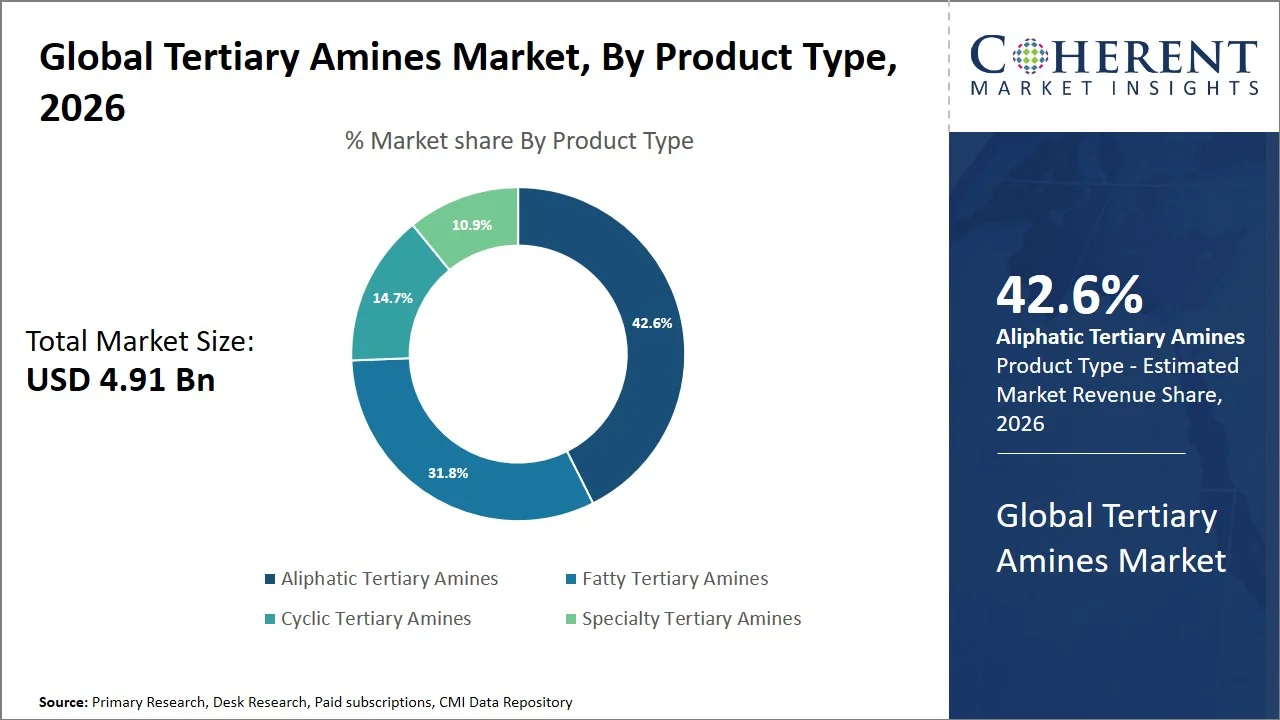
Why Do Aliphatic Tertiary Amines Dominate the Global Tertiary Amines Market?
Aliphatic Tertiary Amines are expected to account for 42.6% of the global tertiary amines market in 2026, owing to their broad compatibility across industrial formulations and their role as versatile intermediates for surfactants, agricultural chemicals, water treatment solutions, and specialty chemicals. Their dominance is supported by established manufacturing processes, availability of raw materials, and the ability to produce multiple grades for different downstream requirements. Chemical manufacturers benefit from the segment’s flexible production economics, while end users value consistent performance and formulation adaptability. The segment also benefits from strong integration between amine producers and downstream chemical industries. In April 2025, Indo Amines introduced new products under its aliphatic amines portfolio, expanding its specialty chemical offerings for domestic and international markets.
- Current Industry Events of 2026
- Market Size Estimation
- Regional Breakdown
- Competitive Landscape
- Customer Intelligence
- Segmental Analysis
- Pricing Analysis
- Key Market Drivers, Challenges & Future Trends
- Customized Insights Section
Why Does C12 to C14 Represent the Largest Carbon Chain Length Category in the Global Tertiary Amines Market?
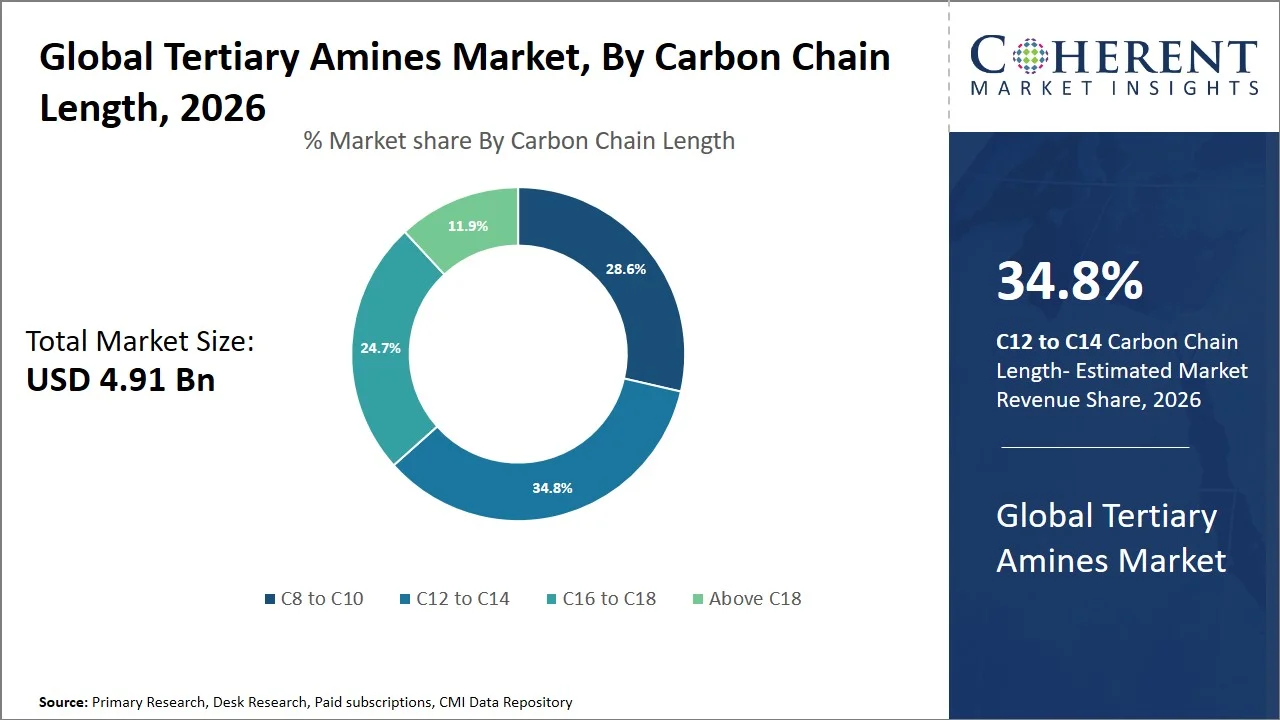
C12 to C14 Tertiary Amines are expected to represent 34.8% of the global tertiary amines market in 2026 due to their balanced chain-length characteristics that provide effective surface activity, conditioning properties, and formulation stability. This carbon range is widely preferred by manufacturers producing surfactants, fabric care ingredients, personal care formulations, and industrial cleaning chemicals because it delivers suitable performance without excessive processing complexity. Suppliers with strong fatty chemical integration can efficiently manufacture these grades by utilizing established oleochemical value chains. The segment creates commercial advantages for producers focusing on customized solutions for household, institutional, and specialty applications. In March 2025, KLK OLEO highlighted its integrated oleochemical capabilities supporting specialty chemical ingredients used across personal care and home care applications.
Why Do Surfactants and Cleaning Products Dominate the Application Category of the Global Tertiary Amines Market?
Surfactants and Cleaning Products are expected to hold 26.8% of the global tertiary amines market in 2026, supported by the essential role of tertiary amines as intermediates for surface-active agents, disinfectant formulations, fabric softeners, and industrial cleaning solutions. The segment benefits from established distribution networks, large-scale formulation industries, and continuous demand from household, institutional, and commercial cleaning users. Manufacturers supplying tertiary amines to this application segment benefit from recurring consumption patterns and long-term relationships with detergent and specialty formulation producers. The commercial importance of this segment is further strengthened by increasing requirements for efficient cleaning performance and multifunctional formulations. In April 2025, Nouryon launched Armocare Aqua 12, a surfactant solution supporting advanced personal care and formulation applications where amine-based chemistry plays an important role.
Current Events and their Impact
Current Event | Description and Its Impact |
EU Chemicals Strategy for Sustainability Implementation Updates – 2025 |
|
U.S. EPA Risk Management Activities under TSCA – 2025 |
|
Global Tertiary Amines Market Dynamics
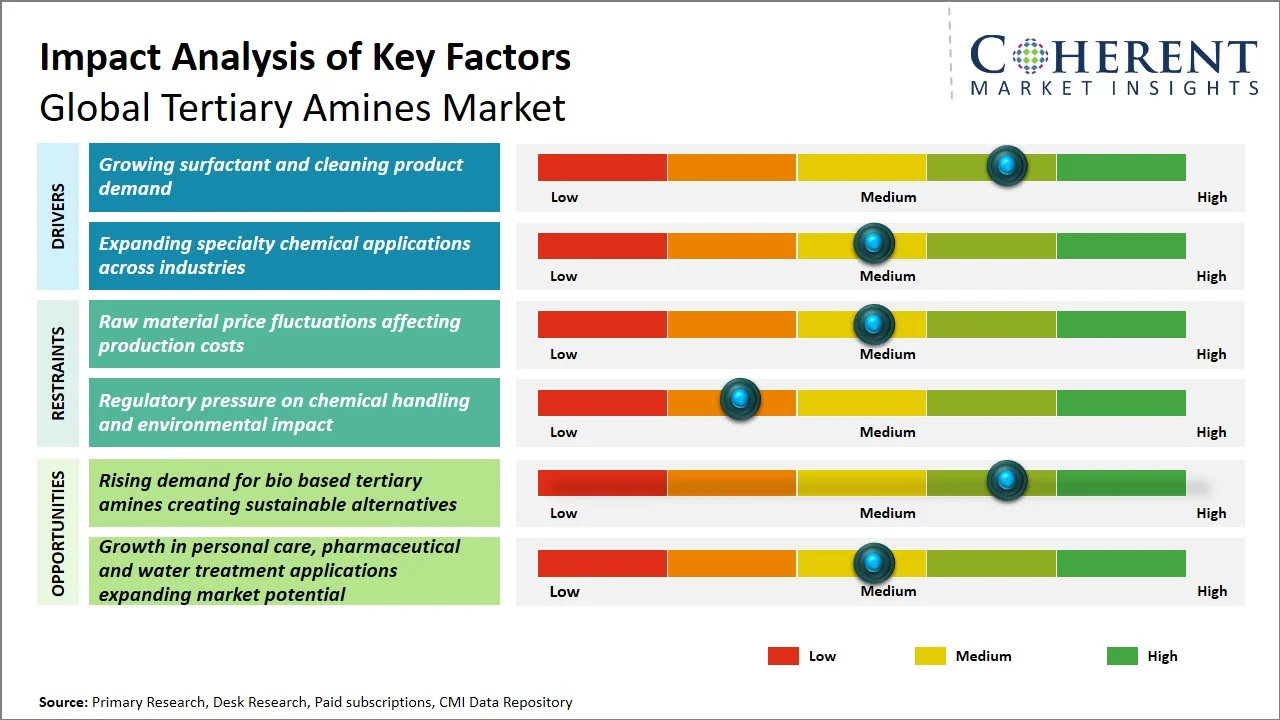
Key Market Drivers
Growing Surfactant and Cleaning Product Demand
The expanding use of tertiary amines as intermediates for surfactants, disinfectants, fabric softeners, and industrial cleaning formulations continues to strengthen market demand. Manufacturers of household care products, institutional cleaners, and specialty chemicals benefit from tertiary amines because they enable improved emulsification, conditioning, and surface-active performance. Growth in hygiene-focused consumption and industrial sanitation requirements is encouraging chemical suppliers to secure reliable amine supply chains. In August 2025, Kao Corporation commissioned a new tertiary amine production facility in Pasadena, Texas, to improve supply reliability for global customers and support increasing demand from cleaning and surfactant applications.
Expanding Specialty Chemical Applications Across Industries
The increasing adoption of tertiary amines in specialty chemical applications is broadening market opportunities beyond traditional surfactants. These compounds are used as intermediates, catalysts, and functional additives in areas such as pharmaceuticals, agrochemicals, polyurethane systems, water treatment chemicals, and industrial formulations. Specialty chemical producers benefit from demand for application-specific grades requiring consistent purity and performance characteristics. In April 2025, Evonik highlighted continued portfolio development in specialty amine solutions designed for industrial applications, supporting the shift toward higher-value chemical intermediates and customized formulations.
Emerging Market Trends
Shift Toward Sustainable and Lower-Impact Amine Manufacturing
Tertiary amine producers are increasingly evaluating sustainable manufacturing approaches as customers place greater importance on environmental performance and supply-chain transparency. The market is gradually moving toward processes that improve energy efficiency, reduce emissions, and optimize raw material utilization. This shift is influencing investment decisions, technology upgrades, and supplier selection criteria among chemical manufacturers and downstream users. Companies with capabilities in cleaner production methods and responsible sourcing are likely to gain stronger positioning as sustainability requirements become more integrated into chemical procurement decisions.
Increasing Demand for Customized High-Purity Tertiary Amine Grades
Customer requirements are becoming more application-specific, encouraging tertiary amine suppliers to develop customized grades with controlled purity, chain-length distribution, and performance characteristics. Downstream industries such as personal care, pharmaceuticals, and advanced industrial formulations increasingly require materials optimized for specific product performance rather than standard commodity supply. This trend is changing competitive dynamics by rewarding companies with technical support capabilities, formulation expertise, and flexible production systems. Suppliers able to provide tailored solutions are expected to strengthen customer relationships and improve value capture.
Regional Insights
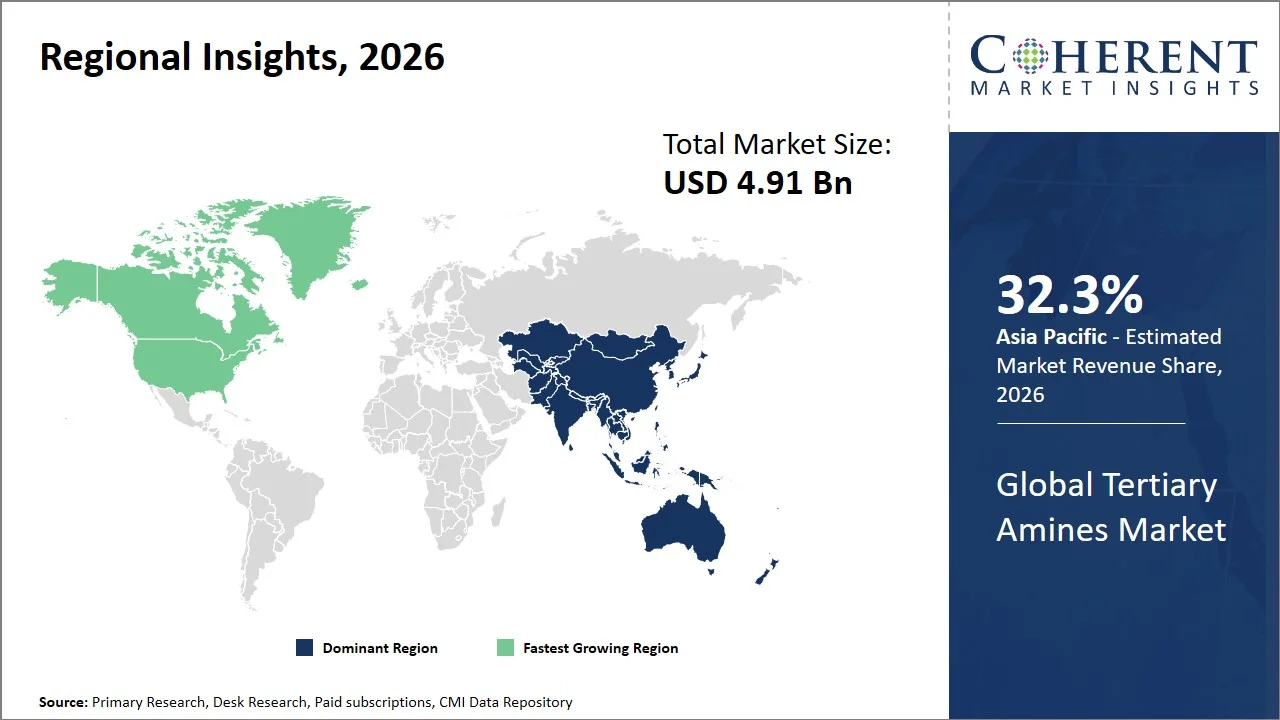
Why Does Asia Pacific Dominate the Global Tertiary Amines Market?
Asia Pacific is expected to account for 32.3% of the global tertiary amines market in 2026, supported by its strong chemical manufacturing ecosystem, large surfactant production base, and expanding downstream industries. Countries such as China, India, and Japan have established value chains for specialty chemicals, household cleaning products, personal care ingredients, and industrial formulations, creating consistent demand for tertiary amines. The region also benefits from integrated raw material availability, cost-efficient manufacturing capabilities, and growing exports of chemical intermediates. Increasing urbanization and rising consumption of formulated cleaning and hygiene products further strengthen regional demand. In March 2025, BASF announced investments to expand specialty chemical production capabilities at its Zhanjiang Verbund site in China, reinforcing Asia Pacific’s position as a major global chemical manufacturing hub.
Why Is North America Emerging as the Fastest-Growing Region in the Global Tertiary Amines Market?
North America is projected to represent 30.5% of the global tertiary amines market in 2026, with growth supported by domestic chemical production, increasing demand for high-performance surfactants, and stronger focus on supply chain resilience. The region has a well-developed industrial base across cleaning chemicals, personal care, agriculture, and specialty formulations, which supports stable tertiary amine consumption. Demand is also influenced by manufacturers’ efforts to strengthen local production networks and reduce dependence on international supply chains. The U.S. chemical industry’s advanced infrastructure, innovation capabilities, and focus on sustainable manufacturing practices provide additional momentum for market expansion. In April 2025, the American Chemistry Council highlighted continued investments in U.S. chemical manufacturing facilities aimed at improving domestic production competitiveness.
Global Tertiary Amines Market Outlook for Key Countries
Why Is the U.S. a Key Market for the Global Tertiary Amines Market?
The U.S. is expected to remain a key market for tertiary amines due to its advanced chemical manufacturing sector, strong presence of specialty chemical producers, and high consumption across cleaning, personal care, agriculture, and industrial applications. The country benefits from established production infrastructure, availability of feedstocks, and a mature downstream market requiring performance-based chemical intermediates. Growing emphasis on sustainable formulations and improved product efficiency is encouraging manufacturers to develop higher-value tertiary amine solutions. The presence of major chemical companies and strong distribution networks further supports market accessibility. In January 2025, the U.S. Environmental Protection Agency continued implementation activities under chemical management programs to strengthen oversight of industrial chemical substances, influencing responsible chemical production practices.
Why Is India Important in the Global Tertiary Amines Market?
India represents an important growth market in global tertiary amines market due to expanding chemical manufacturing, rising consumption of household and industrial cleaning products, and increasing demand from personal care and agricultural applications. The country’s growing specialty chemical sector, improving domestic production capabilities, and cost-competitive manufacturing environment are attracting investment across chemical value chains. Tertiary amines are increasingly relevant as intermediates for surfactants, emulsifiers, and formulation chemicals used in multiple industries. India’s growing pharmaceutical, agrochemical, and consumer goods sectors also provide additional demand opportunities. In February 2025, India’s Department of Chemicals and Petrochemicals continued promoting domestic chemical manufacturing through initiatives focused on strengthening the specialty chemicals ecosystem and reducing import dependence.
Why Does China Support Growth in the Global Tertiary Amines Market?
China plays a central role in the global tertiary amines market due to its extensive chemical manufacturing capacity, integrated supply chains, and large downstream consumption base. The country has a strong position in producing chemical intermediates, surfactants, and specialty formulations used across household care, industrial applications, agriculture, and personal care industries. Availability of raw materials, established industrial clusters, and export-oriented production capabilities enable China to serve both domestic and international markets. The expansion of advanced chemical parks and technology-focused manufacturing further strengthens its competitive position. In December 2024, China’s Ministry of Industry and Information Technology released guidance supporting high-quality development of the chemical industry, encouraging innovation, efficiency improvement, and advanced manufacturing capabilities.
Why Is Germany a Strategic Country in the Global Tertiary Amines Market?
Germany holds strategic importance in the tertiary amines market because of its advanced chemical industry, strong research capabilities, and concentration of high-value manufacturing sectors. The country’s demand is supported by specialty chemicals, industrial cleaning solutions, automotive-related formulations, and personal care applications that require consistent product quality and technical performance. Germany’s focus on sustainable chemistry, regulatory compliance, and efficient production processes encourages development of improved chemical formulations and environmentally responsible manufacturing methods. Its position within Europe’s chemical trade network also supports regional supply and distribution activities. In June 2025, the German Chemical Industry Association (VCI) emphasized the importance of innovation and sustainable transformation within Germany’s chemical sector to maintain global competitiveness.
Why Is Saudi Arabia an Important Growth Market for the Global Tertiary Amines Market?
Saudi Arabia is emerging as an important tertiary amines market due to its expanding chemical industry, strong petrochemical foundation, and increasing downstream manufacturing activities. The country’s access to hydrocarbon-based feedstocks provides advantages for chemical production, while investments in industrial diversification are supporting growth beyond traditional energy sectors. Demand for tertiary amines is linked with applications including surfactants, industrial cleaning chemicals, water treatment formulations, and specialty chemical manufacturing. Saudi Arabia’s strategic location also supports regional chemical trade across the Middle East. In October 2025, Saudi Aramco highlighted continued development of its chemicals portfolio through investments aimed at expanding value-added chemical production and strengthening downstream integration.
Innovation, Production & Manufacturing Landscape
Technology | Description | Commercial Impact | Adoption Stage |
Advanced Catalytic Synthesis Processes | Improved catalytic routes enhance reaction efficiency, selectivity, and production consistency during tertiary amine manufacturing. | Helps producers reduce operating costs and improve product quality. | Commercial adoption |
Bio-Based Feedstock Integration | Use of renewable raw materials such as bio-derived fatty components supports lower-impact chemical production. | Enables sustainability-focused product differentiation. | Early commercial adoption |
High-Purity Separation Technologies | Advanced purification systems improve control over impurities and product specifications. | Supports pharmaceutical, personal care, and specialty applications. | Commercial adoption |
Digital Process Monitoring and Automation | Data-driven manufacturing systems improve process control, safety, and productivity. | Enhances operational efficiency and reduces production variability. | Growing adoption |
Energy-Efficient Chemical Processing | Optimized reactors and heat-management systems reduce energy consumption during production. | Improves cost competitiveness and sustainability performance. | Expanding adoption |
Application-Specific Formulation Technologies | Customized tertiary amine formulations are developed for specific end-use requirements. | Supports premium products and stronger customer partnerships. | Growing adoption |
How Are Sustainable Chemistry and Customized Specialty Formulations Creating New Growth Opportunities in the Global Tertiary Amines Market?
The shift toward sustainable chemical solutions and application-specific formulations is creating new opportunities for tertiary amine manufacturers to move beyond conventional commodity supply. Downstream industries are increasingly seeking products with improved performance, lower environmental impact, and compatibility with evolving formulation requirements. This creates opportunities in specialty amines designed for advanced cleaning systems, personal care formulations, water treatment chemicals, and high-performance industrial applications. Companies that invest in flexible production capabilities, process optimization, and technical customer support can capture higher-value opportunities compared with standard-volume suppliers. The opportunity is expected to favor manufacturers with strong research capabilities, integrated supply chains, and the ability to develop customized grades according to customer specifications. Smaller specialty producers can also compete by focusing on niche applications requiring faster product adaptation and technical expertise.
Market Players, Key Development, and Competitive Intelligence
Key Developments
- In April 2026, Evonik started operation of its expanded specialty amine production facility in Nanjing, China. The investment strengthens regional manufacturing capacity for advanced amine-based additives used in polyurethane and epoxy applications, improving supply security and supporting specialized chemical solutions.
- In April 2025, Eastman Chemical Company expanded its sustainable specialty amine capabilities by introducing DMAPA ES production using renewable raw materials at its Louisiana manufacturing site. The initiative supports demand for lower-impact chemical ingredients and provides customers with sustainability-focused alternatives for formulation development.
Competitive Landscape
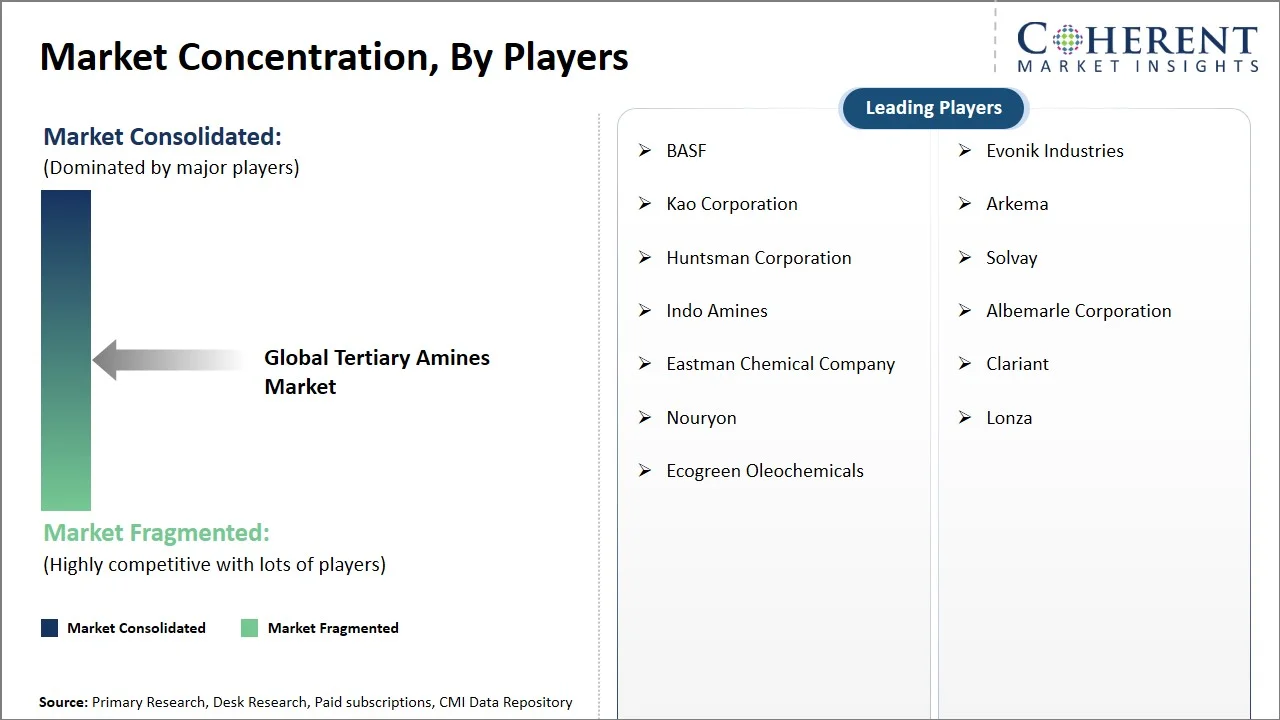
The Global Tertiary Amines Market is moderately consolidated, with competition shaped by multinational chemical producers, specialty amine manufacturers, and regional suppliers. Market positioning depends on product consistency, manufacturing scale, raw material access, application expertise, and supply reliability. Large producers benefit from integrated chemical operations and global distribution networks, while specialized companies compete through customized formulations, technical support, and regional customer relationships.
Key Focus Areas Include
- Product quality, purity level, and consistency across different tertiary amine grades
- Manufacturing capacity and reliability of supply for industrial customers
- Access to raw materials, including fatty alcohols and oleochemical feedstocks
- Development of application-specific solutions for surfactants, cleaning, and specialty chemicals
- Regulatory compliance, product stewardship, and environmental performance
- Regional production capabilities to reduce logistics risks and improve customer service
- Technical support capabilities for formulation optimization and customer collaboration
- Ability to provide customized grades for high-value applications
Market Report Scope
Tertiary Amines Market Report Coverage
| Report Coverage | Details | ||
|---|---|---|---|
| Base Year: | 2025 | Market Size in 2026: | USD 4.91 Bn |
| Historical Data for: | 2020 To 2024 | Forecast Period: | 2026 To 2033 |
| Forecast Period 2026 to 2033 CAGR: | 5.90% | 2033 Value Projection: | USD 7.33 Bn |
| Geographies covered: |
| ||
| Segments covered: |
| ||
| Companies covered: | BASF, Evonik Industries, Kao Corporation, Arkema, Huntsman Corporation, Solvay, Indo Amines, Albemarle Corporation, Eastman Chemical Company, Clariant, Nouryon, Lonza, Ecogreen Oleochemicals | ||
| Growth Drivers: |
| ||
| Restraints & Challenges: |
| ||
Analyst Opinion (Expert Opinion)
- The global tertiary amines market is likely to move from volume-oriented competition toward value-driven differentiation. Manufacturers with strong formulation capabilities, regional production flexibility, and customer collaboration models will have greater influence as buyers increasingly evaluate suppliers based on technical support and long-term reliability rather than only product availability.
- The most significant market transformation will come from the integration of sustainability requirements into chemical purchasing decisions. Suppliers that combine conventional tertiary amine performance with improved environmental profiles, transparent sourcing, and efficient manufacturing processes are likely to redefine competitive standards across industrial and specialty applications.
- Companies should prioritize specialty-grade development, supply-chain resilience, and application-focused innovation. Investment should be directed toward flexible manufacturing systems and customer-specific solutions rather than only capacity expansion. Key risks include raw material volatility, stricter chemical regulations, and increasing pressure from customers for lower-impact production methods.
Speak to the analyst
Want personalized insights?
Take the findings above to one of our principal consultants, or have the report rebuilt around the segments, geographies and competitors you actually track.
Market Segmentation
- Product Type Insights (Revenue, USD Bn, 2021 - 2033)
- Aliphatic Tertiary Amines
- Fatty Tertiary Amines
- Cyclic Tertiary Amines
- Specialty Tertiary Amines
- Carbon Chain Length Insights (Revenue, USD Bn, 2021 - 2033)
- C8 to C10
- C12 to C14
- C16 to C18
- Above C18
- Application Insights (Revenue, USD Bn, 2021 - 2033)
- Surfactants and Cleaning Products
- Chemical Intermediates
- Personal Care and Cosmetics
- Agrochemicals
- Pharmaceuticals
- Water Treatment and Others
- End User Insights (Revenue, USD Bn, 2021 - 2033)
- Household and Industrial Cleaning
- Chemical Manufacturing
- Personal Care
- Agriculture
- Pharmaceuticals
- Others
- Distribution Channel Insights (Revenue, USD Bn, 2021 - 2033)
- Direct Sales
- Indirect Sales
- Regional Insights (Revenue, USD Bn, 2021 - 2033)
- North America
- U.S.
- Canada
- Latin America
- Brazil
- Argentina
- Mexico
- Rest of Latin America
- Europe
- Germany
- U.K.
- Spain
- France
- Italy
- Russia
- Rest of Europe
- Asia Pacific
- China
- India
- Japan
- Australia
- South Korea
- ASEAN
- Rest of Asia Pacific
- Middle East
- GCC Countries
- Israel
- Rest of Middle East
- Africa
- South Africa
- North Africa
- Central Africa
- North America
Sources
Primary Research Interviews
- Tertiary amine manufacturers, specialty chemical producers, surfactant companies, distributors, and chemical traders
- R&D experts, formulation specialists, procurement managers, chemical engineers, and downstream industry professionals
Stakeholders
- Specialty amine manufacturers, chemical suppliers, raw material providers, distributors, and import-export partners
- End users including cleaning product manufacturers, personal care companies, agrochemical producers, pharmaceutical companies, and water treatment providers
End-use Sectors
- Surfactants and cleaning products
- Personal care and cosmetics
- Agrochemicals and crop protection
- Pharmaceuticals and healthcare chemicals
- Water treatment and specialty chemical applications
Regulatory and Industry Bodies
- Chemical regulatory authorities and environmental agencies
- Chemical industry associations and specialty chemical organizations
- Sustainability and chemical safety compliance bodies
Databases
- Company annual reports, investor presentations, and corporate filings
- Chemical industry databases and product portfolio records
- Import-export trade databases and supply-chain intelligence platforms
- Competitive intelligence and pricing databases
Magazines and Journals
- Specialty chemical publications
- Surfactant and detergent industry journals
- Chemical engineering and process technology publications
- Green chemistry and sustainability research publications
Associations
- American Chemistry Council (ACC)
- European Chemical Industry Council (Cefic)
- International Council of Chemical Associations (ICCA)
- Regional specialty chemical and surfactant associations
Public Domain Sources
- Chemical production expansions and capacity developments
- Specialty chemical innovation trends
- Sustainability initiatives and regulatory developments
- Global chemical trade and supply-chain updates
Key Standards and Regulations
- REACH chemical compliance requirements
- TSCA chemical management regulations
- Chemical handling, safety, and transportation standards
- Environmental and sustainability regulations
- Product labeling and documentation requirements
Proprietary Elements
- CMI Data Analytics Tool
- proprietary CMI repository containing 10+ years of chemical, specialty materials, and industrial market intelligence
Get access to 250+ pages report
Every segment, forecast, competitor profile and data table behind the analysis above — available for instant download.
- ESOMAR Member
- ISO 9001:2015 Certified
- D-U-N-S Registered
- GDPR & CCPA Compliant
Missing comfort of reading report in your local language? Find your preferred language:
Frequently Asked Questions
The CAGR of global tertiary amines market is projected to be 5.90% from 2026 to 2033.
The global tertiary amines market is estimated to be valued at USD 4.91 Bn in 2026 and is expected to reach USD 7.33 Bn by 2033.
Tertiary amines are mainly used as intermediates in surfactants, cleaning formulations, personal care products, agrochemicals, pharmaceuticals, water treatment chemicals, and specialty chemical applications.
Major end users of tertiary amines include chemical manufacturers, household and industrial cleaning companies, personal care producers, agricultural chemical companies, pharmaceutical manufacturers, and water treatment providers.
Manufacturers are focusing on process optimization, improved production efficiency, customized formulations, and sustainable manufacturing approaches to meet changing customer requirements and regulatory expectations.
Companies should consider product quality, purity specifications, supply reliability, regulatory compliance, technical support, customization capabilities, and supplier manufacturing capabilities when sourcing tertiary amines.
Growing demand for surfactants and cleaning products, along with expanding applications of tertiary amines in specialty chemicals, personal care, agrochemicals, and industrial formulations, are the key factors supporting the growth of the global tertiary amines market.