

Cleaning Products Market Size and Forecast
The global cleaning products market is estimated to be valued at USD 174.50 Bn in 2026 and is expected to reach USD 275.22 Bn by 2033, exhibiting a compound annual growth rate (CAGR) of 6.7% from 2026 to 2033.
Key Takeaways
- By Product Types, Surface Cleaners segment is estimated to account for 38.4% of the market share in 2026 owing to heightened hygiene awareness.
- By Application, Toilet segment is projected to represent 20.6% of the market share in 2026 as increased hygiene awareness.
- By End Users, Commercial segment is anticipated to comprise 57.5% of the market share in 2026 owing to the growing demand for sustainability and green cleaning.
- By Distribution Channel, Supermarket/Hypermarket hold the largest market share in 2026 owing to consumer preference for one-stop shopping.
- By Region, Asia Pacific is projected to lead the global market with a 32.2% share in 2026 owing to its rapid urbanization and infrastructure development.
Market Overview
Consumers are increasingly demanding convenient cleaning products that can efficiently clean and disinfect surfaces. Technological advancements in cleaning product formulations that kill more germs in less time along with the launch of multifunctional products will continue to drive the cleaning products market growth. Increased health and hygiene awareness among consumers along with busy lifestyles has boosted the demand for easy-to-use cleaning formulas. Looking ahead, the market is expected to continue expanding driven by innovations that offer more effective yet gentler cleaning solutions. Sustainable packaging and formulas made from natural ingredients will also contribute to the trends shaping the future of the industry.
Current Events and their Impact
Current Events | Description and its impact |
Stringent PFAS Regulations in U.S. States |
|
EU Sustainable Products Initiative (SPI) |
|
Technology Adoption |
|
End-user Feedback and Unmet Needs in the Cleaning Products Market
End-user Feedback and Unmet Needs
- Demand for Gentle Yet Effective Formulas: Many users report irritation or allergic reactions from harsh chemicals. Consumers want cleaning products that are strong on dirt but gentle on skin, surfaces, and indoor air quality. There's a growing call for hypoallergenic, fragrance-free, and dermatologically tested options that maintain effectiveness without compromising health.
- Need for Transparent Ingredient Labeling: End-users increasingly seek clarity about what's in their cleaning products. Consumers express frustration with vague or misleading labels. They want full disclosure of ingredients, especially regarding allergens, environmental impact, and chemical safety—driving demand for clean-label certifications and simple, understandable language on packaging.
- Dissatisfaction with Packaging Waste: Many consumers are concerned about excessive plastic waste and non-recyclable packaging. They’re asking for refillable options, biodegradable containers, and bulk-buy solutions. End-users want brands to reduce environmental impact not only through formulas but also through sustainable, user-friendly packaging that aligns with zero-waste lifestyles.
- Current Industry Events of 2026
- Market Size Estimation
- Regional Breakdown
- Competitive Landscape
- Customer Intelligence
- Segmental Analysis
- Pricing Analysis
- Key Market Drivers, Challenges & Future Trends
- Customized Insights Section
Export Analysis of Household Cleaning Products
From July 2023 to June 2024, India exported 71 shipments of Household Cleaning Products, representing a 78% increase compared to the previous twelve months. These shipments were carried out by 36 Indian exporters to 31 different buyers. In June 2024 specifically, India recorded 5 export shipments of Household Cleaning Products.
Segmental Insights
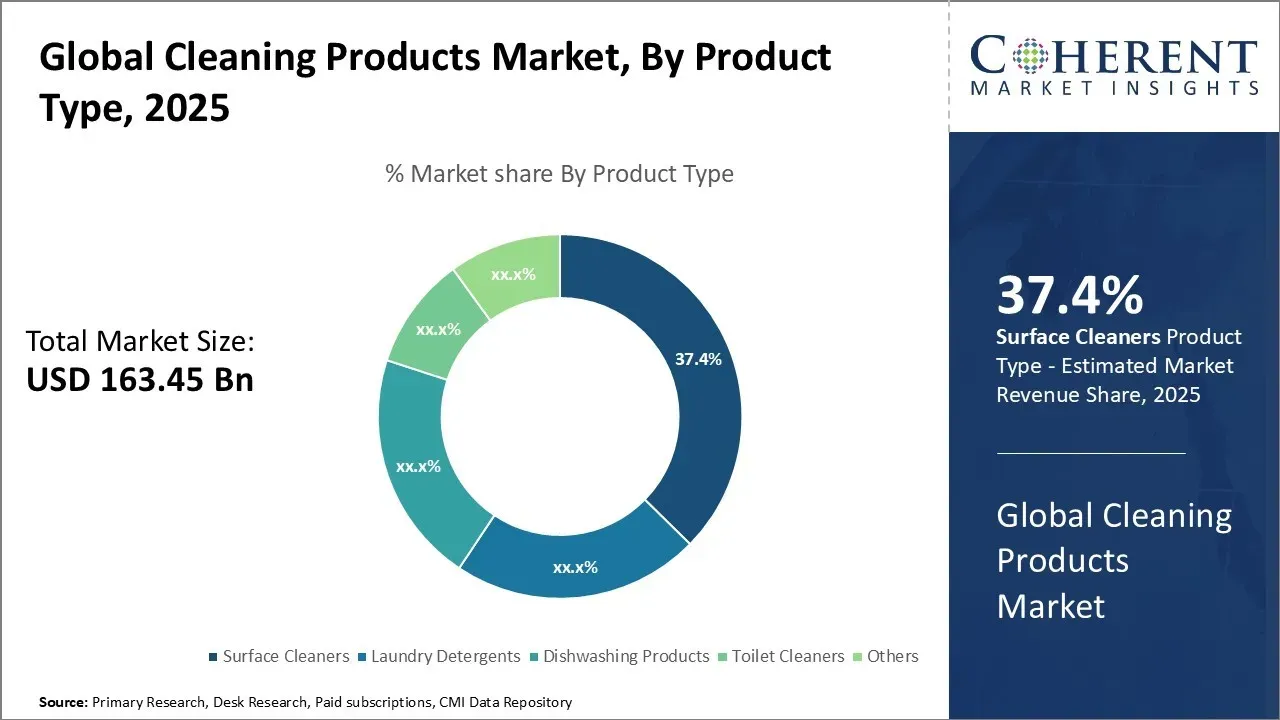
Cleaning Products Market Insights, By Product Type
Surface Cleaners contribute the highest share of the market owing to its urbanization and changing lifestyles
The surface cleaners’ segment is estimated to contribute 38.4% share of the market in 2026. Surface cleaners can be used to swiftly clean a variety of surfaces found in both household and commercial settings such as countertops, floors, appliances, windows, and more. The ability of surface cleaners to tackle dirt and grime across multiple area types makes them very versatile cleaning tools. Modern consumers have busy lifestyles and appreciate products that can simplify cleaning tasks. Surface cleaners require little effort to use as they come pre-mixed with cleaning formula in spray bottles or wipes. With a quick spray or wipe, surfaces can be disinfected leaving them sparkling clean. For instance, in April 2025, UK-based eco-friendly cleaning company Astonish launched seven new household cleaning innovations. The latest additions include powerful multi-surface cleaners, fabric refreshers with new scents, and versatile disinfectants.
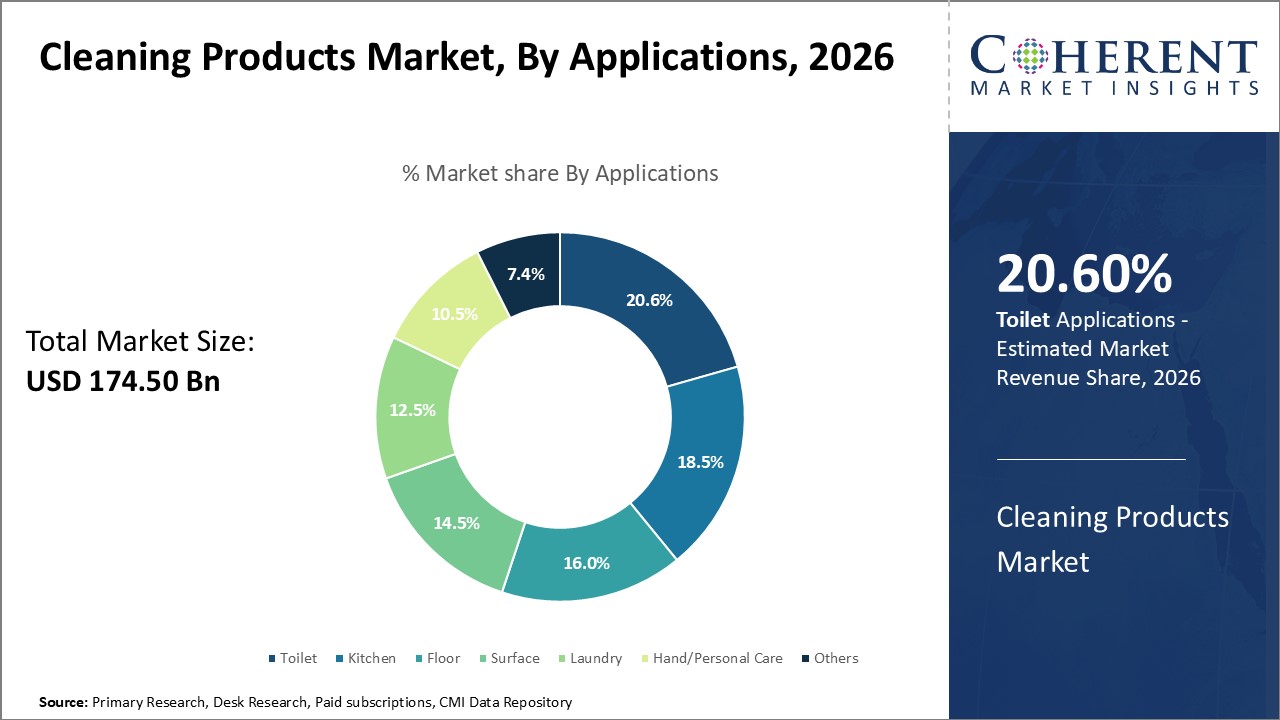
Cleaning Products Market Insights, By Applications
Toilet contribute the highest share of the market owing to its product innovation and convenience
The toilet segment is estimated to hold 20.6% share in the market in 2026. This dominance is attributed to the increasing focus on maintaining hygiene in restrooms, the rising awareness of diseases caused by poor sanitation, and the consistent demand for specialized cleaning solutions. Products such as toilet bowl cleaners, disinfectant sprays, and stain removers have gained significant traction, especially with the introduction of eco-friendly and chemical-free alternatives. The segment's growth is further supported by urbanization and the increasing availability of innovative toilet cleaning products that are easy to use and effective. For instance, in September 2024, Cleancult introduced innovative foaming toilet bowl cleaner sheets. Known for reducing single-use plastic, the company has launched a range of energizing toilet bowl cleaners that eliminate the need for plastic bottles.
Cleaning Products Market Insights, By End User
Commercial contribute the highest share of the market owing to its customization and specialized solutions
The commercial segment is estimated to account for 57.5% of the market share in 2026, driven largely by the need for strict hygiene compliance and varied cleaning demands across numerous industries. Public spaces such as hospitals, schools, offices, and food service establishments must adhere to rigorous sanitation standards. Professional-grade cleaning products are specifically designed to eliminate microbes and allergens at high levels of efficiency, meeting these stringent requirements. Additionally, their robust formulations effectively handle heavier dirt and grime typically found in high-traffic commercial environments.
Cleaning Products Market Insights, By Distribution Channel
Supermarket/Hypermarket contribute the highest share of the market owing to its competitive pricing and promotions
The supermarket and hypermarket segment in the cleaning products market is driven by consumer preference for one-stop shopping, offering a wide variety of cleaning items in a single location. Competitive pricing, bulk buying options, and attractive promotions make these products more affordable and accessible. Additionally, heightened hygiene awareness has increased demand, with supermarkets and hypermarkets serving as reliable sources for essential cleaning supplies. Strategic partnerships with manufacturers ensure consistent product availability, enhancing customer satisfaction and boosting sales.
Regional Insights
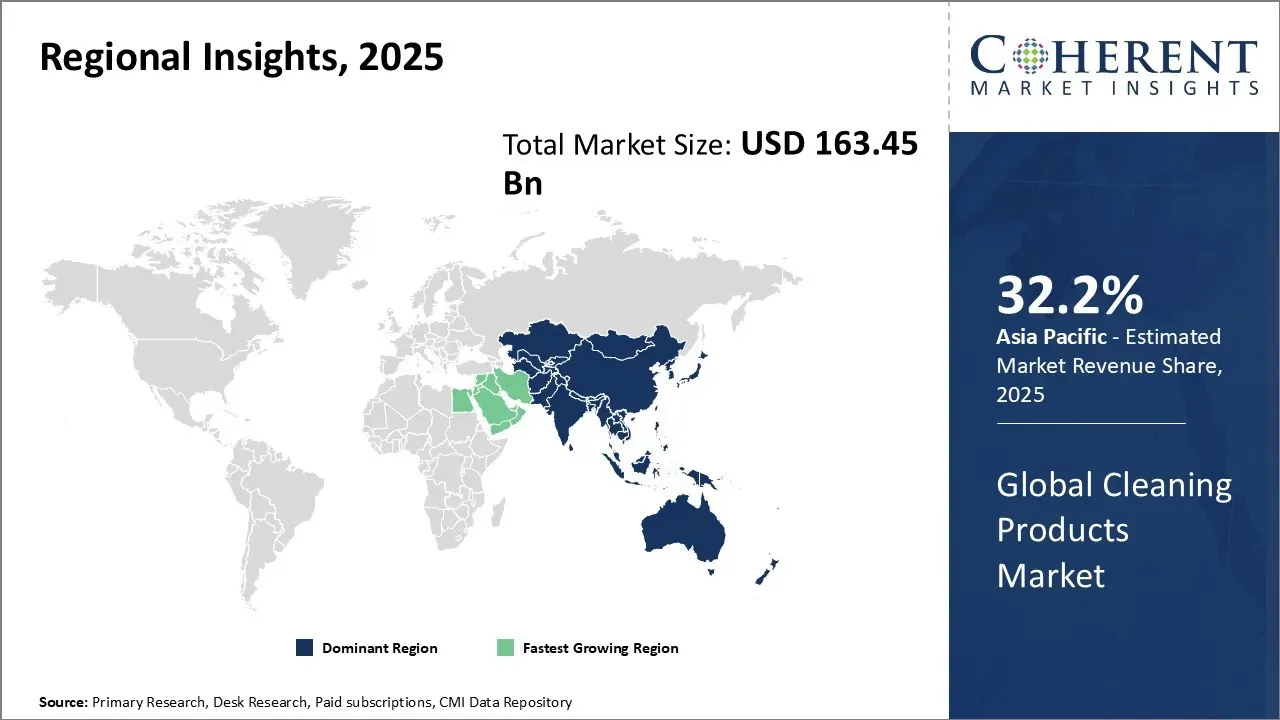
Asia Pacific Cleaning Products Market Trends
Key regional trends are actively shaping the Asia-Pacific cleaning products market. Regulatory bodies are enforcing strict standards on ingredients and environmental safety, pushing companies to innovate their products. Consumers, driven by heightened hygiene awareness, continue to buy more disinfectants and sanitizers. Rapid urbanization and increasing incomes are driving demand for convenient, multipurpose cleaning solutions. Additionally, the growing expansion of e-commerce, including subscription services, is improving product accessibility, intensifying market competition, and prompting brands to adopt targeted marketing strategies. For instance, in June 2026, DJI, a Chinese drone manufacturer, introduced DJI ROMO, its first robotic vacuum cleaner. The device is expected to feature both mopping and vacuuming capabilities, further boosting the cleaning products market revenue.
North America Cleaning Products Market Trends
Consumers are increasingly adopting smart gadgets such as app-controlled dispensers, robotic vacuums, and AI-powered scrubbers. These advanced technologies offer efficiency and convenience, meeting the needs of busy, urban households. Manufacturers are actively developing sensor-compatible cleaning supplies and automated equipment. As environmental awareness grows, more people are seeking non-toxic, plant-based, and biodegradable cleaners with reusable packaging. In response, companies are designing low-waste, eco-friendly products and securing green certifications to appeal to environmentally conscious customers. For instance, in February 2026, Dawn®, the nation’s #1 dish liquid*, has improved how America washes dishes by launching Dawn PowerSuds, its best liquid dish soap designed for handling lots of dishes.
China Cleaning Products Market Trends
Brands are adopting recyclable flexible packaging and eco-friendly materials—like Dow’s BOPE film with recycled content—to meet stricter environmental regulations and rising consumer demand for sustainable solutions. Since the pandemic, urban consumers have placed higher value on disinfectants, multifunctional cleaners, and gentle yet effective formulas. In response, manufacturers are developing biodegradable, specialized, and fragrance-enhanced products. Online platforms such as Tmall, JD, Douyin, and Xiaohongshu now dominate the market, where influencer-led livestreams and brand houses actively drive product trials and boost sales. For instance, in June 2026, China-based company Pudu Robotics, a global leader in service robotics, today launched the PUDU CC1 Pro, an AI-powered autonomous cleaning robot.
United States Cleaning Products Market Trends
American consumers are increasingly choosing touch-free dispensers, motion-activated cleaners, and app-controlled devices that enhance both hygiene and convenience. Brands are integrating sensor-based technology to reduce direct contact and elevate the user experience. Shoppers actively seek products labeled “clean,” “plant-based,” and “free from harsh chemicals.” To meet these expectations and comply with regulations, manufacturers are using essential oils, naturally derived surfactants, and transparent ingredient labeling. For instance, in April 2026, LG Electronics USA, in collaboration with the Marriott Design Lab, has introduced a commercial-grade autonomous vacuum cleaning device. After successful implementation pilots at Marriott International properties, LG now offers the Robotic Vacuum Cleaner to the hospitality industry.
Market Report Scope
Cleaning Products Market Report Coverage
| Report Coverage | Details | ||
|---|---|---|---|
| Base Year: | 2025 | Market Size in 2026: | USD 174.50 Bn |
| Historical Data for: | 2020 To 2024 | Forecast Period: | 2026 To 2033 |
| Forecast Period 2026 to 2033 CAGR: | 6.7%2033 Value Projection: | USD 275.22 Bn | |
| Geographies covered: |
| ||
| Segments covered: |
| ||
| Companies covered: | Procter & Gamble Co., Unilever PLC, Henkel AG & Co. KGaA, Reckitt Benckiser Group PLC, Colgate-Palmolive Company, SC Johnson & Son, Inc., Ecolab Inc., Clorox Company, Kimberly-Clark Corporation, Kao Corporation, Church & Dwight Co., Inc., S.C. Johnson Professional, Diversey Holdings, Ltd., Amway Corporation, and 3M Company | ||
| Growth Drivers: |
| ||
| Restraints & Challenges: |
| ||
Cleaning Products Market Trend
Growing Demand for Eco-Friendly and Sustainable Products
Consumers are increasingly prioritizing sustainability, seeking cleaning products made from biodegradable ingredients, plant-based surfactants, and recyclable or refillable packaging. This shift is driven by environmental awareness, health concerns, and pressure on brands to reduce their ecological footprint. Manufacturers are responding by developing green-certified solutions that are free from harsh chemicals and safe for both people and the planet. Retailers also support this trend by offering dedicated shelf space for eco-conscious brands and cleaner-label products.
Rise of Multi-Purpose and Time-Saving Solutions
Modern consumers prefer versatile cleaning products that simplify their routines. All-in-one sprays, disinfectant wipes, and concentrated pods allow users to clean multiple surfaces efficiently, saving both time and storage space. This trend is particularly strong among urban households and working professionals. Brands are capitalizing on this by formulating products that combine cleaning, sanitizing, and deodorizing functions, catering to fast-paced lifestyles and smaller living environments where convenience and practicality are highly valued.
Cleaning Products Market Opportunity
Expansion into Emerging Markets
Rapid urbanization, rising disposable incomes, and increasing awareness of hygiene in emerging regions like Asia-Pacific, Latin America, and Africa present significant growth opportunities. These markets are underserved compared to mature regions, with growing demand for both basic and premium cleaning products. Companies can capitalize by tailoring formulations to local preferences, investing in distribution networks, and educating consumers on product benefits and safety to build brand loyalty and expand market presence.
Cleaning Products Market News
- In June 2025, Castrol India Limited, a leading name in automotive and industrial lubricants, launched a Throttle Body Cleaner, a Fuel Injector and Carburettor Cleaner, and a Brake Cleaner.
- In June 2025, The American Cleaning Institute launched its new Cleaning for Health initiative to empower individuals and communities with the knowledge and tools to practice smart, targeted cleaning strategies that maintain health and create healthier living environments.
- In January 2025, At CES 2025, Dreame Technology, a prominent sub-brand of Xiaomi, unveiled an exciting new range of smart home cleaning products. These advanced devices simplify household chores and enhance cleaning efficiency.
- In November 2024, OZONO, the eco-conscious brand leading the movement toward chemical-free cleaning solutions, announced its official launch in Australia.
Analyst Opinion (Expert Opinion)
- The cleaning products market is undergoing a profound transformation driven by evolving consumer priorities and technological innovation. One clear indicator is the accelerating shift toward sustainability, which is no longer a niche but a dominant force shaping product development and purchasing behavior. For instance, Unilever’s 2023 sustainability report highlighted that their “green” cleaning products portfolio grew by over 40%, underscoring how eco-conscious formulations directly translate into sales growth. This trend signals that brands ignoring environmental credentials risk obsolescence in increasingly discerning markets.
- Moreover, the integration of AI and IoT into cleaning solutions marks a paradigm shift in how consumers interact with household maintenance. The rise of smart robotic vacuums, such as iRobot’s Roomba j7+, which leverages AI to map homes and avoid obstacles, is indicative of demand for convenience coupled with efficiency. This technological pivot demands that traditional cleaning product manufacturers rethink their R&D strategies to embed digital capabilities alongside chemical innovation. Failure to adapt may leave legacy players vulnerable to disruption from tech-centric entrants.
- The surge in e-commerce and digital marketing, exemplified by P&G’s partnership with influencers on TikTok, is reshaping brand-consumer engagement. Digital-first campaigns have demonstrated remarkable conversion rates; a P&G livestream campaign reported a 30% lift in sales within 24 hours post-broadcast. Such data validates that agility in digital strategies, including real-time consumer interaction and personalized product recommendations, is no longer optional but essential.
- In sum, the cleaning products market is bifurcating: success hinges on a dual commitment to sustainability and digital innovation. Companies that can seamlessly blend green chemistry with smart technology, supported by data-driven marketing, will secure competitive advantage and long-term relevance.
Speak to the analyst
Want personalized insights?
Take the findings above to one of our principal consultants, or have the report rebuilt around the segments, geographies and competitors you actually track.
Market Segmentation
- Product Type Insights (Revenue, USD Bn, 2021 - 2033)
- Surface Cleaners
- Laundry Detergents
- Dishwashing Products
- Toilet Cleaners
- Others
- Application Insights (Revenue, USD Bn, 2021 - 2033)
- Toilet
- Kitchen
- Floor
- Surface
- Laundry
- Hand/Personal Care
- Others
- End-user Insights (Revenue, USD Bn, 2021 - 2033)
- Household
- Commercial
- Distribution Channel Insights (Revenue, USD Bn, 2021 - 2033)
- Supermarkets/Hypermarkets
- Online Retail
- Convenience Stores
- Others
- Regional Insights (Revenue, USD Bn, 2021 - 2033)
- North America
- U.S.
- Canada
- Latin America
- Brazil
- Argentina
- Mexico
- Rest of Latin America
- Europe
- Germany
- U.K.
- Spain
- France
- Italy
- Russia
- Rest of Europe
- Asia Pacific
- China
- India
- Japan
- Australia
- South Korea
- ASEAN
- Rest of Asia Pacific
- Middle East
- GCC Countries
- Israel
- Rest of Middle East
- Africa
- South Africa
- North Africa
- Central Africa
- Key Players Insights
- Procter & Gamble Co.
- Unilever PLC
- Henkel AG & Co. KGaA
- Reckitt Benckiser Group PLC
- Colgate-Palmolive Company
- SC Johnson & Son, Inc.
- Ecolab Inc.
- Clorox Company
- Kimberly-Clark Corporation
- Kao Corporation
- Church & Dwight Co., Inc.
- S.C. Johnson Professional
- Diversey Holdings, Ltd.
- Amway Corporation
- 3M Company
Sources
Primary Research interviews
- Industry experts from leading cleaning product manufacturers
- Supply chain managers and distributors in FMCG sector
- Retail buyers from major supermarket chains
- End-users and consumers via focus groups and surveys
Databases
- National statistics bureaus (e.g., U.S. Census Bureau, Eurostat)
- Trade databases (e.g., Import/Export records, customs data)
- Patent databases for innovation tracking
Magazines
- Chemical & Engineering News
- Household & Personal Products Industry (HAPPI) Magazine
- Cleanlink Magazine
Journals
- Journal of Surfactants and Detergents
- Environmental Science & Technology
- Journal of Cleaner Production
Newspapers
- The Wall Street Journal
- Financial Times
- The New York Times (Business Section)
Associations
- American Cleaning Institute (ACI)
- European Cleaning Products Industry Association (CPIA)
- International Sanitary Supply Association (ISSA)
Public Domain sources
- Government regulatory agencies (EPA, FDA)
- Patent and trademark offices
- Industry trade fairs and conference proceedings
- University research publications and case studies
Proprietary Elements
- CMI Data Analytics Tool, and Proprietary CMI Existing Repository of information for last 8 years
Get access to 250+ pages report
Every segment, forecast, competitor profile and data table behind the analysis above — available for instant download.
- ESOMAR Member
- ISO 9001:2015 Certified
- D-U-N-S Registered
- GDPR & CCPA Compliant
Missing comfort of reading report in your local language? Find your preferred language:
Transform your Strategy with Exclusive Trending Reports
Frequently Asked Questions
Global cleaning products market is estimated to be valued at USD 163.45 Bn in 2025 and is expected to reach USD 254.54 Bn by 2032.
The CAGR of the global cleaning products market is projected to be 6.53% from 2025 to 2032.
Growing awareness of hygiene and sanitation and increasing demand for eco-friendly cleaning products are the major factors driving the market growth for cleaning products.
High competition leading to price wars and regulatory challenges regarding chemical usage are the major factors hampering the market growth for cleaning products.
In terms of product type, the surface cleaners’ segment is estimated to dominate the market revenue share in 2025.
Procter & Gamble Co., Unilever PLC, Henkel AG & Co. KGaA, Reckitt Benckiser Group PLC, Colgate-Palmolive Company, SC Johnson & Son, Inc., Ecolab Inc., Clorox Company, Kimberly-Clark Corporation, Kao Corporation, Church & Dwight Co., Inc., S.C. Johnson Professional, Diversey Holdings, Ltd., Amway Corporation, and 3M Company are the major players.
Asia Pacific is expected to lead the global cleaning products market in 2025.