

Global Travel Pillow Market Size and Forecast – 2026 To 2033
The Global Travel Pillow Market is estimated to be valued at USD 580.8 Mn in 2026 and is expected to reach USD 837.1 Mn by 2033, growing at a compound annual growth rate (CAGR) of 5.36% from 2026 to 2033. The growth is supported by the increased demand for ergonomic neck and head support during long-distance travels, the expansion of international tourism and the increasing consumer preference for enhanced travel comfort.
Additionally, high purchasing power of middle-income travelers is anticipated to drive the demand for premium, lightweight and portable travel accessories. In January 2026, Japan National Tourism Organization (JNTO)said that 1,058,300 Australian visitors came to Japan in 2025 – up 15% on 2024. The increasing popularity of long distance leisure travel illustrates the growing potential customer base for travel comfort accessories, including memory foam and adjustable neck support pillows.
Key Takeaways of the Global Travel Pillow Market
- Neck support pillows are expected to register a compound annual growth rate (CAGR) of 5.2% from 2026 to 2033, and they are expected to hold 72.8% of the global travel pillow market in 2026. They can be used for long periods of time in cars and planes because they can sleep on their feet and keep their heads up. In May 2025, Cabeau advertized its Evolution X pillow, which has a secure closure, adjustable neck circumference and height.
- Memory foam is expected to dominate the global travel pillow market with a share of 51.6% in 2026 and a CAGR of 5.9% during 2026-2033. Its pressure-distributing, shape-retaining and cushioning abilities only add to its appeal for travelers who prioritize comfort. In September 2025, Be Relax launched its Comfy Cloud travel pillow, which has an ergonomic flat-back design, premium memory foam and adjustable fit.
- Leisure travelers are expected to hold around 59.7% of the global travel pillow market in 2026, with an estimated CAGR of 5.5% from 2026 to 2033. Trips and family vacations and holiday travel all provide opportunities to reuse portable comfort accessories again and again. UN Tourism reported 1.52 billion international tourist arrivals in 2025 in January 2026, meaning a large potential customer base for travel accessories.
- North America is estimated to hold the largest share of 31.4% in the global travel pillow market and is expected to grow at a CAGR of 4.5% during the forecast period from 2026 to 2033. Established distribution networks for travel accessories and frequent domestic travel make replacement and upgrading of products easy. That's a lot of air travel, a lot of road travel. AAA predicted 45 Mn Americans will be traveling over the Memorial Day weekend in May of 2026.
- Asia Pacific is estimated to account for 30.6% of the global travel pillow market in 2026, growing at a CAGR of 6.7% between 2026 and 2033. The rising demand for cheap travel accessories and the expansion of regional air links are creating opportunities for manufacturers. Passenger demand for Asia Pacific airlines increased 11.5% year-on-year in March 2026, according to a report to be published in April 2026 by IATA.
Segmental Insights
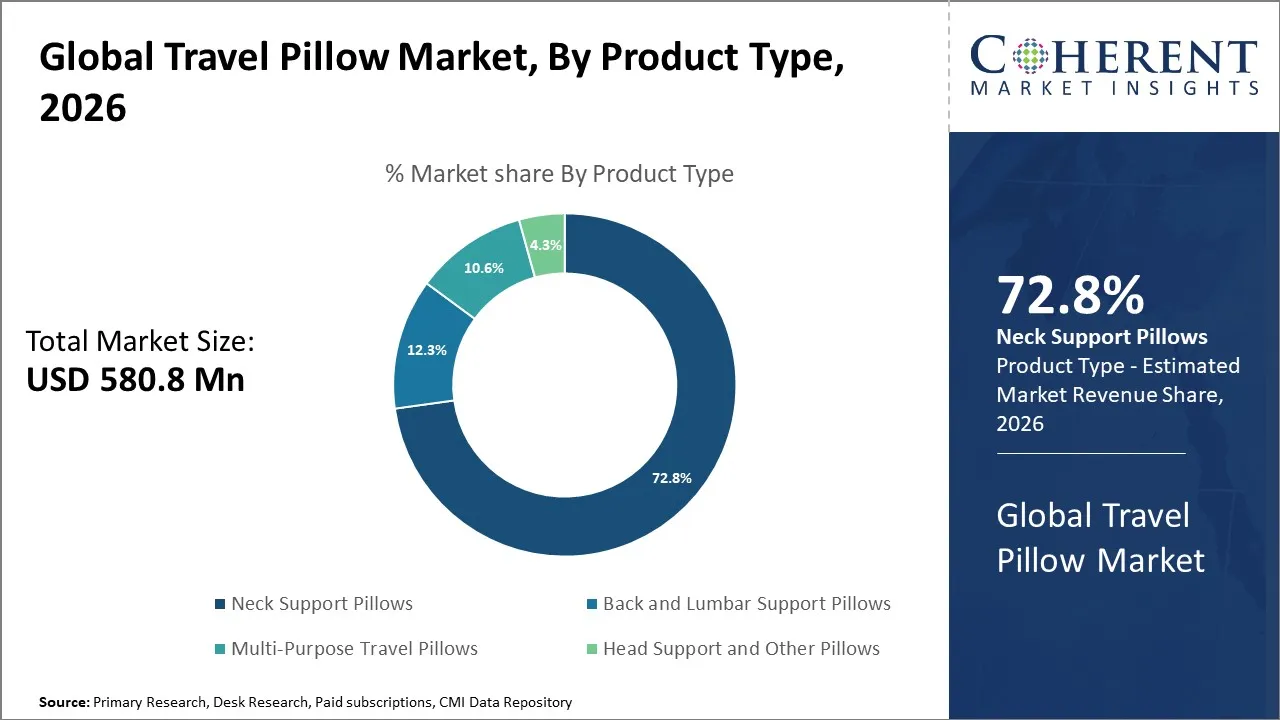
Why Do Neck Support Pillows Dominate the Global Travel Pillow Market?
Neck Support Pillows are expected to account for 72.8% of the global travel pillow market by product type in 2026. Their broad appeal comes from a practical purchase decision: travelers can use a compact neck pillow without changing their seat, carrying additional bedding, or depending on operator-provided amenities. Wraparound and structured designs serve aircraft cabins, passenger trains, and intercity coaches, giving retailers a recognizable product category with multiple price points. For manufacturers, a familiar format also permits differentiated fabrics, sizes, and branded collections without rebuilding the entire product architecture. In January 2026, Trtl reported that it had expanded its licensed travel-product portfolio during 2025 through collaborations with the All Blacks, British & Irish Lions, and Major League Baseball. This initiative illustrates how neck-support accessories can reach sports-oriented customers beyond conventional luggage retail, supporting broader merchandising and customer acquisition.
- Current Industry Events of 2026
- Market Size Estimation
- Regional Breakdown
- Competitive Landscape
- Customer Intelligence
- Segmental Analysis
- Pricing Analysis
- Key Market Drivers, Challenges & Future Trends
- Customized Insights Section
Why Does Memory Foam Represent the Largest Filling Material Segment in the Global Travel Pillow Market?
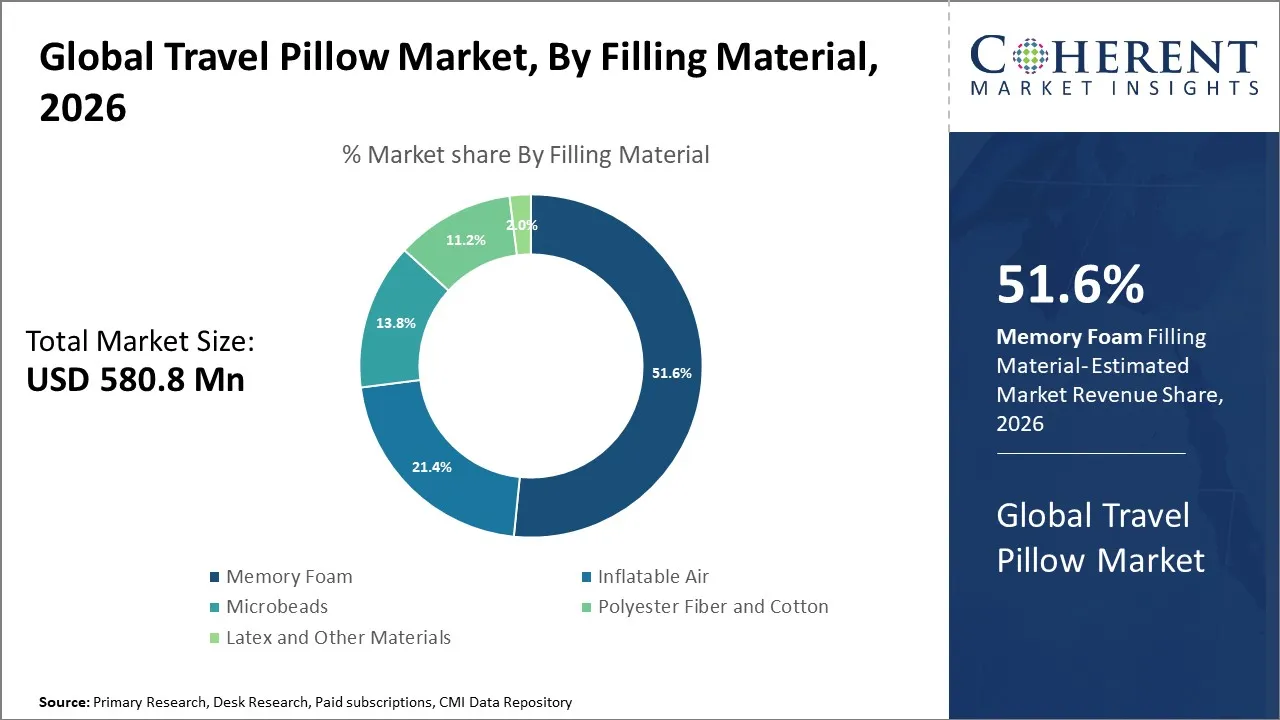
Memory Foam is expected to account for 51.6% of the global travel pillow market by 2026, in terms of filling material. The commercial advantage is that the manufacturer can control the firmness of the cushioning, its recovery and product specs from one production run to the next. These properties allow brands to provide standardized shapes for bulk orders and private-label programs while offering differentiated firmness levels. In March 2026, Haomu International Trading announced a portable memory foam U-shaped pillow weighing 260 grams, with foldable construction and customizable logos, colors, and packaging for business customers. This introduction highlights the rightness of the material for cross-border retail programs and contract manufacturing, enabling suppliers to satisfy the needs of diverse brands with a flexible product platform.
Why Do Leisure Travelers Dominate the End-User Segment of the Global Travel Pillow Market?
Leisure Travelers are anticipated to contribute 59.7% of the global travel pillow market by end user in 2026. Company travel policies tend to constrain business travelers. Holidaymakers will often buy comfort accessories out of their own pockets and may make up their minds at departure time. This emphasizes the significance of retailers’ seasonal promotions, clear value propositions and convenient travel bundles. Families and occasional travelers also have different preferences on product size, storage space and washable covers, which is why diversified assortments are promoted over a single standard design. VisitEngland's bank holiday Trip Tracker in August 2026 estimated that 10.6 million Brits were planning to take overnight holiday trips within the UK, with a further set of prospective travelers still undecided due to affordability and other factors. The results demonstrate the importance of competitively priced, timely offers in periods of concentrated leisure travel.
Current Events and their Impact
Current Event | Description and Its Impact |
December 2024: General Product Safety Regulation (GPSR) – EU |
|
The EU Packaging and Packaging Waste Regulation will enter into force in August 2026. |
|
October 2024: The Federal Trade Commission (FTC) put out a rule on consumer reviews and testimonials |
|
Global Travel Pillow Market Dynamics
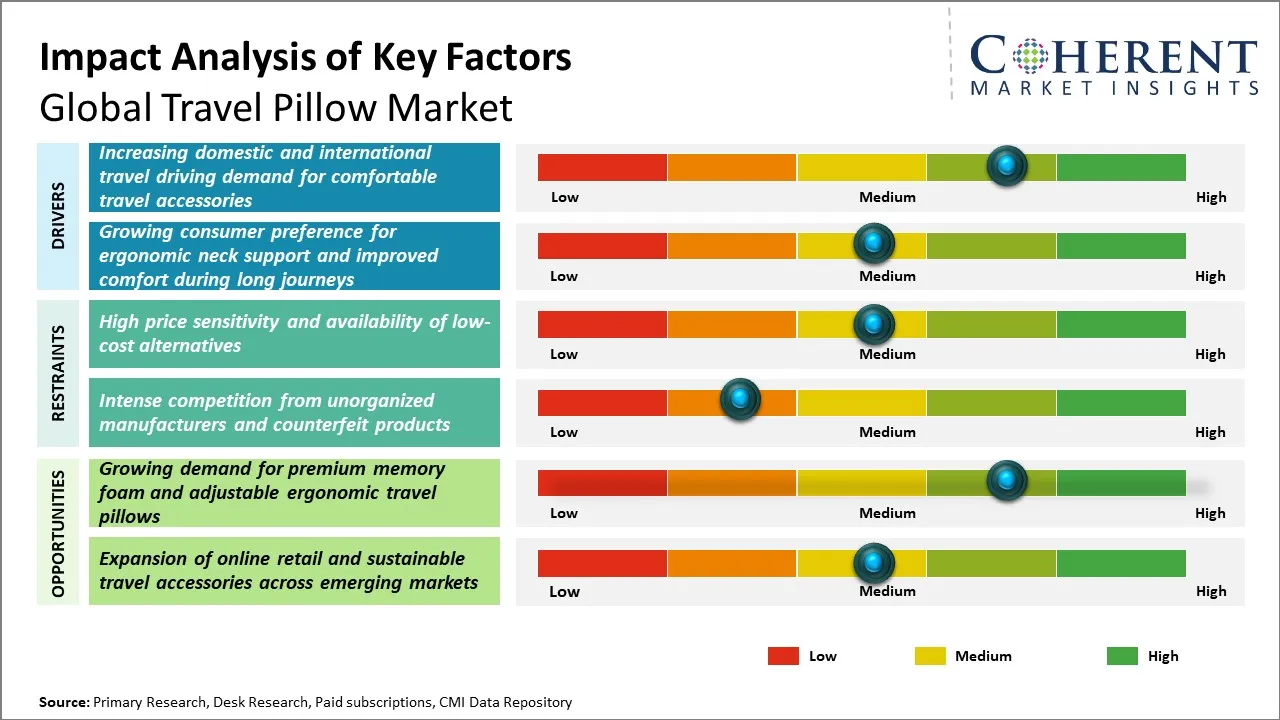
Key Market Drivers
- Increasing domestic and international travel driving demand for comfortable travel accessories: Expanding passenger movement across domestic and international routes is increasing the number of purchase occasions for portable comfort products, especially for travelers on connecting flights and long itineraries. Travel pillow manufacturers gain increased distribution opportunities through luggage retailers, airports, and pre-trip shopping channels. Retailers can also increase accessory revenue per transaction by adding compact designs to their bundled sales with other travel essentials. Air passenger traffic in the European Union in 2024 was over 1.1 billion passengers, a growth of 8.3% compared with 2023, according to Eurostat data published in December 2025.
- Growing consumer preference for ergonomic neck support and improved comfort during long journeys: Travelers seeking improved seated-rest experiences are emphasizing cervical positioning, adjustable fit and head stabilization more than cushioning thickness alone. This has led manufacturers to create structured support systems that can accommodate different neck sizes and sleeping positions. The distinction allows the company to charge premium prices and avoid direct competition with basic foam cushions. In January 2026, ProGlobe launched its Luxe Travel Pillow with ErgoLine Technology to improve pressure distribution on travel and to follow the natural alignment of the neck and shoulders.
Emerging Market Trends
- Washable and Replaceable Components Are Reshaping Travel Pillow Design: Washability is now considered a key design factor in products, rather than a secondary convenience feature. The exposure to shared seating environments, luggage compartments and prolonged contact with skin, among others, is making more and more people consider their cleaning requirements when they are choosing their travel pillow. Manufacturers are considering removable covers, separable cushioning inserts, and quick-drying fabrics that maintain their qualities after many washes. This may be good for suppliers and manufacturers of textiles with durable, easy to clean, constructions. Products that are hard to clean may face more resistance. It is anticipated that product hygiene and convenience of maintenance will impact customer satisfaction and replacement decisions over the forecast period.
- Seat-Compatibility Engineering Is Emerging as a Product Differentiator: The evolution of travel pillows is slowly moving from the traditional cushioning properties to compatibility with different passenger seating environments. The different reclining angles, available space and attachment surfaces of airplane headrests, railroad seats and intercity coaches require flexible support structures. Seat-specific testing, adjustable anchoring systems and low-profile designs can help manufacturers improve the usability of their products across multiple modes of transportation. This could lead to a more collaborative relationship between the ergonomic testing specialists and the accessory designers. The showcased seating compatibility may become a major purchase driver for frequent travelers in the forecast period.
Market Restraint Factors
- Limited Product Differentiation and Price Sensitivity: Basic travel pillows remain relatively easy to reproduce, creating strong competition between Basic travel pillows are relatively easy to replicate, leading to intense competition among established brands, private-label manufacturers and low-cost suppliers. When competing products are functionally similar, consumers may prefer the price to the quality of the material. This constrains the pricing flexibility of manufacturers who do not have unique designs or apparent performance differences.
- Storage, Shipping, and Product Return Costs: The warehousing and transportation costs of bulk cushioning materials can be disproportionately high relative to their sale price. Some foam constructions may also have their recovery characteristics affected by excessive compression. Manufacturers have to balance the need for compact packaging with the need for durability. Online retailers face additional margin pressure from returns associated with perceived product-quality issues, fit or comfort .
Regional Insights
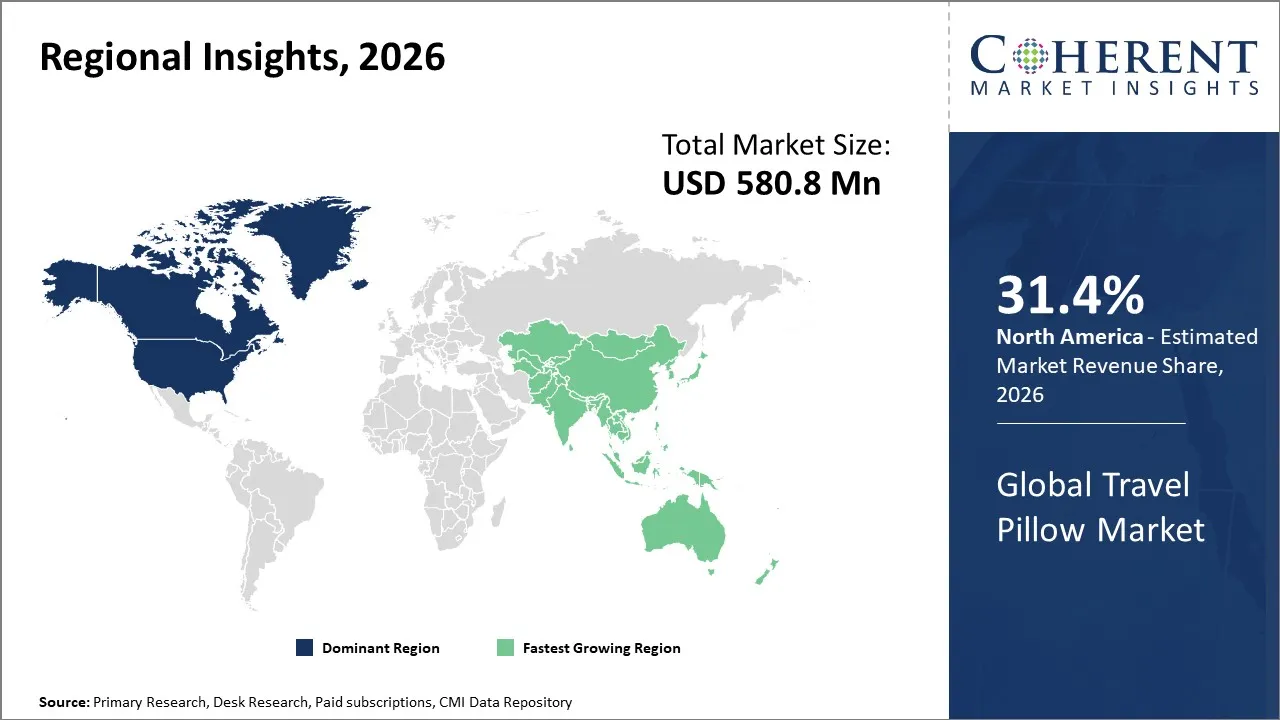
Why Does North America Dominate the Global Travel Pillow Market?
The North America travel pillow market is expected to account for 31.4% of the global travel pillow market by 2026, supported by the well-established branded-accessory ecosystem and a tendency among consumers to compare comfort performance across price tiers. The opportunity for customers to check shape, fabric and fit prior to purchase is provided by large retail networks and manufacturers can place specialized neck cushions next to luggage and wellness products. The region’s mature fulfillment infrastructure also supports differentiated sizes and reliable returns which are commercially important for products with subjective comfort preferences. In July 2026, Airports Council International North America reported that four U.S. airports ranked among the world's ten busiest for total passenger traffic in 2025. This concentration of travel activity reinforces the commercial value of airport-adjacent merchandising and broad consumer access, although passenger totals do not directly measure pillow purchases.
Why Is Asia Pacific Emerging as the Fastest-Growing Region in the Global Travel Pillow Market?
Asia Pacific is expected to contribute 30.6% to the global travel pillow market in 2026, and is the fastest-growing region of the market. Its opportunity differs from mature markets where large consumer bases can enter the category through affordable compact products and then trade up to specialized support designs. Local textile and accessory manufacturing can deal with localized sizing and packaging, and can produce cost-efficient product ranges; mobile commerce can extend access beyond the major metropolitan retail outlets. In September 2026, Airports Council International Asia Pacific & Middle East reported that Asia-Pacific airports handled an estimated 3.6 billion passengers in 2025 and urged capacity planning for further growth. For travel pillow suppliers, expanding transport access creates additional purchasing occasions, particularly when products are offered through accessible price points and locally relevant channels.
Global Travel Pillow Market Outlook for Key Countries
Why Is the U.S. a Key Market for the Global Travel Pillow Market?
The U.S. is a major country for global travel pillow market owing to the repeated domestic air journeys that offer opportunities for portable accessories that are purchased by consumers independent of airline amenities. Brand owners can meet different needs, such as business-trip packing, overnight connections, and comfort products for seated rest. U.S. buyers also have wide access to direct-to-consumer offerings, so accurate fit information and credible product demonstrations are important in reducing purchase uncertainty. In September 2026, the U.S. Bureau of Transportation Statistics reported that U.S. airlines carried 87.5 million scheduled passengers in June 2026, of which 75.5 million were on domestic flights. The volume was down on the previous year, but the substantial domestic passenger base provides recurring opportunities for manufacturers seeking replacement purchases and niche travel-comfort customers.
Why Does China Support Growth in the Global Travel Pillow Market?
China has a special position in the global market for travel pillows, being a huge travel consumption market and a potential source of supply for international brands. Original equipment and private-label suppliers can offer different specifications without relying on a single product format, because they have access to fabric processing, foam conversion, sewing and packaging capabilities. At home, intercity and international air travel fuels sales of packable cushions, while cross-border sellers can compete on customization and fulfillment efficiency. Chinese airlines carried an estimated 770.1 million passengers in 2025, an increase of 5.5 percent from 2024, the Civil Aviation Administration of China said in April 2026. China has a high volume of travel and flexible manufacturing, making it an important player in the product development and global sourcing picture for manufacturers.
Why Is India Important in the Global Travel Pillow Market?
Connectivity beyond the established metropolitan airports opens up the possibility of converting casual travelers into accessory buyers, which is where India’s relevance to the global travel pillow market comes in. Accessibility of the product is still paramount, with foldable, inflatable and entry-level cushioning formats practical for those buyers with their eye on the price tag. Suppliers that can offer reliable quality at affordable price points can supply regional luggage stores, online marketplaces and organized travel retailers. India's diverse passenger transport system allows manufacturers to offer pillows not just for air travel but also for bus and rail travel. India’s airport network has grown to 164 airports in 2025 from 74 in 2014, the Ministry of Civil Aviation said. More people flying can gradually expand the market beyond the frequent urban fliers.
Why Is Germany a Strategic Country in the Global Travel Pillow Market?
Germany is a strategic market for travel pillows as it has an extensive long-distance railroad network that offers a different seated comfort use case compared to air travel. Rail passengers may want low-profile cushions that fit upright seats, pack in smaller bags and remain comfortable on trips with transfers. This benefits manufacturers who test the compatibility of shapes and durability of textiles rather than relying on decorative design only. The long established German engineering and consumer product testing environment also provides clear performance specifications that are relevant for a premium positioning. In March 2026 Deutsche Bahn presented its annual report for 2025 with 135.8 million long-distance passengers, an increase of 1.8 % compared to 2024. Such rail travel activity offers meaningful settings for compact support accessories sold via stations, travel retailers and digital channels.
Why Is the U.K. an Important Growth Market for the Global Travel Pillow Market?
The U.K. plays an important role in the global travel pillow market as the outbound international travel creates planned purchase occasions before holidays and family visits. Budget travelers packing for budget flights may prefer cushions that pack down well and do not add extra carry-on bulk. Retailers can reply with clear measurements, material details and product photos to help customers make an informed decision before they go. Travel accessory brands can also time seasonal stock with school holiday and destination-driven travel seasons rather than relying solely on airport impulse buys. In October 2026 the Office for National Statistics estimated that in 2025 there were 99.9 million visits abroad by UK residents. The figure shows significant outbound travel activity, but does not measure travel pillow ownership or sales.
Consumer Preference and Purchase Behavior Landscape in the Global Travel Pillow Market
Consumer Preference Factor | Market Position in 2026 | Purchasing Behavior and Market Relevance | Commercial Implications |
Ergonomic Comfort and Support | Neck support pillows account for 72.8% of the product-type market. | For long journeys, travelers prioritize practical support and comfortable head positioning. | Fit options, comfort performance and user-focused product design provide manufacturers with the opportunity to differentiate products. |
Filling Material Preference | Memory foam occupied 51.6% of the filling material segment. | Consumers evaluate cushioning consistency, softness, durability, and appropriateness for repeat travel. | Suppliers can improve product positioning through material quality, consistent performance, and different levels of comfort. |
Leisure Travel Purchasing Patterns | Leisure travelers account for 59.7% of end-user demand. | Holidaymakers often buy travel accessories when getting ready for their vacations, family trips and international travel. | Seasonal merchandising, travel accessory bundles, and family-oriented product ranges can help increase customer acquisition. |
Price and Value Considerations | Mid-range products priced at USD 20–50 account for 47.1% of the market. | Buyers seek a practical balance between affordability, product durability, and comfort features. | Brands offering clearly differentiated products at competitive prices can attract value-conscious customers and protect margins. |
Digital Purchasing Preferences | 47.1% of the market consists of mid-range products priced between USD 20 and USD 50. | Buyers are looking for a practical balance between price, product durability and comfort features. | Value-driven customers will turn to brands with differentiated products at competitive prices – and that will help protect margins. |
Airport and Last-Minute Purchases | Airport and travel retail Sales in airport and travel retail are 24.7%. | Prior to boarding, travelers buy little comfort items, especially if they anticipate longer flights. | Travel retailers can improve sales through accessible displays, portable product formats, and convenient point-of-sale placement. |
How Are Customized Travel Comfort Programs Creating New Growth Opportunities in the Global Travel Pillow Market?
Travel pillow makers have not yet ventured into business-to-business comfort programs for premium intercity motor coach services, overnight rail and managed corporate travel. These buyers want standardized products that will stand up to frequent handling, in limited sizes to fit limited spaces, and that can be used for predictable replenishment rather than seasonal impulse selling.
Under operator branding, suppliers could offer compact pillow and cover kits with replaceable covers, documented cleaning instructions and an optional purchase option to customers at the time of booking or onboard. The product’s commercial success will depend on: clear product safety documentation; small-batch customization; stable fabric and filling specifications; and cost models that take into account cleaning, loss and restocking.
Pilot contracts could be entered into with selected operators to determine the take-up of passengers and service requirements prior to a wider roll-out. Specialists with responsive logistics and flexible contract manufacturing may have an advantage over sellers who only target consumer marketplaces. However, it is advised that companies avoid pre-committing to large inventories until operators have established acceptable unit economics, passenger participation and accountability for the maintenance and replacement of accessories throughout their service networks.
Market Players, Key Development, and Competitive Intelligence
Key Developments
- In September 2026, SpineCradle launched a Kickstarter campaign for its full-spine travel support product, integrating head, upper-back, and lumbar support. The initiative indicates potential consumer interest in multi-zone seated comfort solutions. The company anticipated beginning backer shipments in January 2027 rather than reporting completed commercial deliveries.
- In December 2025, Authenticity50 launched its A50 Travel Pillow with an adjustable shredded-foam filling system and portable design. The development extends the company's domestic bedding expertise into travel accessories, illustrating how established home-comfort manufacturers can diversify their product portfolios through adaptable, smaller-format cushions.
Competitive Landscape
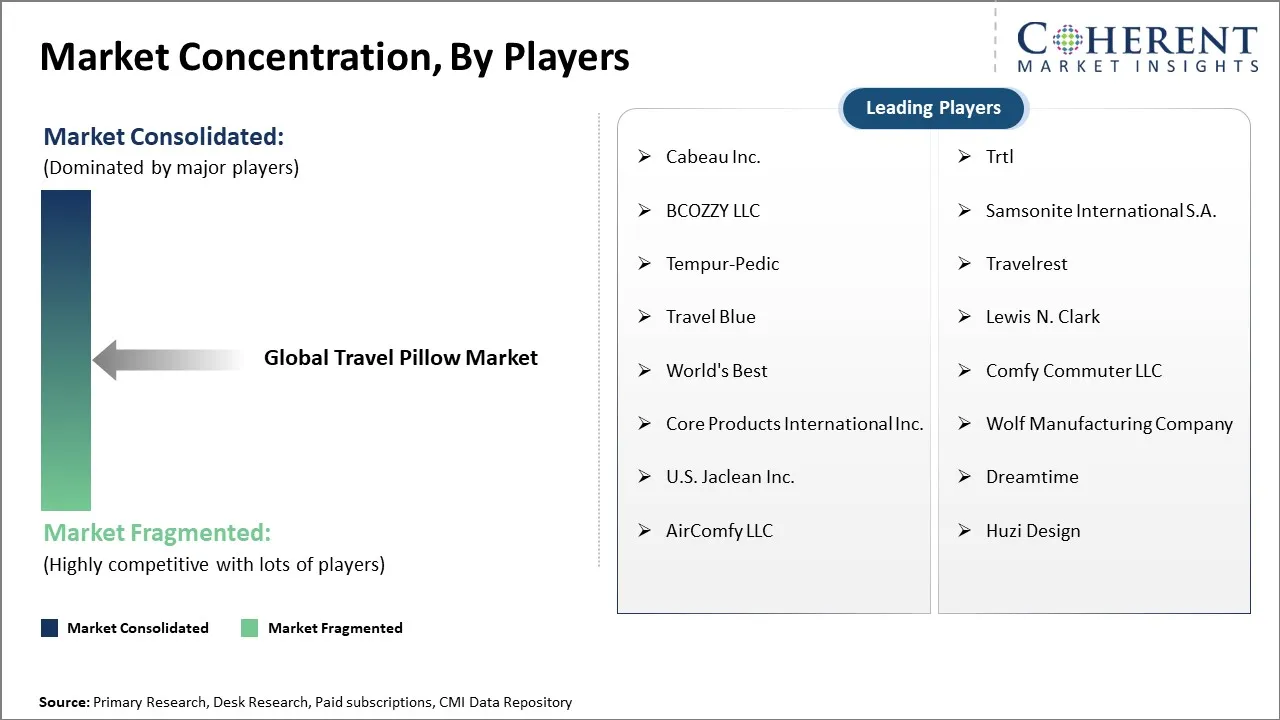
The global travel pillow market is best described as fragmented, with private-label suppliers, luggage-accessories firms, bedding makers and specialist comfort brands. Entry barriers for basic cushioned products are fairly low and differentiation is based on proprietary designs and consistent manufacturing quality. Regional suppliers compete based on localized sourcing and retail relationships while internationally established brands benefit from wider distribution, standardized specifications and reliable supply arrangements.
Key competitive focus areas include
- Quality Assurance of Product: Consistent foam density, filling distribution, strength of stitching and durability of structure lead to fewer defective rates.
- Product Design Protection: Unique product lines can be protected with proprietary pillow shapes, registered designs and unique methods of construction.
- Private-Label Manufacturing: Contract manufacturers have opportunities due to the flexibility of production volumes and retailer-specific specifications.
- Cost and Margin Management: Product profitability is driven by packaging efficiency, material usage and production yield at varying price points.
- Distribution Partnerships: Existing relationships with regional distributors, airport concessionaires and luggage chains ensure ongoing access to the market.
- After Sales Reliability: Manufacturers can maintain retailers’ confidence by offering clear product warranties, practical replacement policies and defect monitoring.
Market Report Scope
Global Travel Pillow Market Report Coverage | |||
Report Coverage | Details | ||
Base Year | 2025 | Market Size in 2026: | USD 580.8 Mn |
Historical Data For: | 2020 To 2024 | Forecast Period: | 2026 To 2033 |
Forecast Period 2026 To 2033 CAGR: | 5.36% | 2033 Value Projection: | USD 837.1 Mn |
Geographies covered: |
| ||
Segments covered: |
| ||
Companies covered: | Cabeau Inc., Trtl, BCOZZY LLC, Samsonite International S.A., Tempur-Pedic, Travelrest, Travel Blue, Lewis N. Clark, World's Best, Comfy Commuter LLC, Core Products International Inc., Wolf Manufacturing Company, U.S. Jaclean Inc., Dreamtime, AirComfy LLC, Huzi Design | ||
Growth Drivers: |
| ||
Restraints & Challenges: |
| ||
Analyst Opinion (Expert Opinion)
- The global travel pillow market long-term competitive leadership will increasingly depend on developing recognizable travel-comfort product systems rather than maintaining large assortments of interchangeable cushions. Manufacturers that establish consistent product architecture, reliable customer service, and clearly communicated ownership benefits may create stronger brand loyalty. This shift could be good for companies that can retain product value after the initial sale.
- Future improvements in passenger seat design may one day compete with the need for separately purchased support accessories. The functional benefits of conventional travel pillows might be diminished by integrated headrests and adjustable seat surfaces. We believe suppliers that make complementary products, license intellectual property or partner with transportation equipment designers will be better positioned to handle such substitution risks.
- Manufacturers should focus on durability validation, disciplined inventory management, flexible sourcing arrangements and differentiated products for the frequent traveler. Careful monitoring of retail returns and manufacturing costs will be essential to protecting margins. Investments in unproven electronic comfort features or highly specialized hardware should remain selective, particularly were product complexity, maintenance costs, or compliance obligations could outweigh commercial benefits.
Speak to the analyst
Want personalized insights?
Take the findings above to one of our principal consultants, or have the report rebuilt around the segments, geographies and competitors you actually track.
Market Segmentation
- Product Type Insights (Revenue, USD Mn, 2021 - 2033)
- Neck Support Pillows
- Back and Lumbar Support Pillows
- Multi-Purpose Travel Pillows
- Head Support and Other Pillows
- Filling Material Insights (Revenue, USD Mn, 2021 - 2033)
- Memory Foam
- Inflatable Air
- Microbeads
- Polyester Fiber and Cotton
- Latex and Other Materials
- End User Insights (Revenue, USD Mn, 2021 - 2033)
- Leisure Travelers
- Business Travelers
- Regular Commuters
- Price Range Insights (Revenue, USD Mn, 2021 - 2033)
- Economy (Below USD 20)
- Mid-Range (USD 20–50)
- Premium (Above USD 50)
- Sales Channel Insights (Revenue, USD Mn, 2021 - 2033)
- Online Retail
- Airport and Travel Retail
- Specialty Stores
- Supermarkets and Hypermarkets
- Regional Insights (Revenue, USD Mn, 2021 - 2033)
- North America
- U.S.
- Canada
- Latin America
- Brazil
- Argentina
- Mexico
- Rest of Latin America
- Europe
- Germany
- U.K.
- Spain
- France
- Italy
- Russia
- Rest of Europe
- Asia Pacific
- China
- India
- Japan
- Australia
- South Korea
- ASEAN
- Rest of Asia Pacific
- Middle East
- GCC Countries
- Israel
- Rest of Middle East
- Africa
- South Africa
- North Africa
- Central Africa
- North America
Sources
Primary Research Interviews
- Travel pillow manufacturers, OEM suppliers, and ergonomic product designers
- Airport retailers, travel accessory distributors, and e-commerce sellers
Stakeholders
- Travel pillow brands, private-label manufacturers, and raw material suppliers
- Airlines, airport retailers, luggage stores, and online marketplaces
End-use Sectors
- Leisure travelers, business travelers, and regular commuters
- Aviation, railways, intercity buses, and tourism
Regulatory and Industry Bodies
- U.S. Consumer Product Safety Commission (CPSC)
- European Commission and European Chemicals Agency (ECHA)
- International Air Transport Association (IATA)
- International Organization for Standardization (ISO)
Databases
- UN Tourism, IATA, and Airports Council International passenger statistics
- UN Comtrade, Eurostat, and U.S. Bureau of Transportation Statistics
- Official import-export, travel retail, and consumer expenditure databases
Magazines and Journals
- Travel Goods Showcase
- Travel Weekly
- Applied Ergonomics
- Textile Research Journal
Associations
- Travel Goods Association (TGA)
- Polyurethane Foam Association (PFA)
- International Sleep Products Association (ISPA)
- Airports Council International (ACI)
Public Domain Sources
- Travel pillow product specifications, retail pricing, and distribution data
- Passenger traffic, tourism expenditure, and travel frequency statistics
- Trade flows, consumer purchasing patterns, and material cost indicators
Key Standards and Regulations
- EU General Product Safety Regulation (EU) 2023/988
- EU REACH Regulation (EC) No. 1907/2006, where applicable
- ASTM D3574 – Flexible polyurethane foam testing
- ISO 3758:2023 – Textile care labelling
Proprietary Elements
- CMI Data Analytics Tool
- Proprietary research repository, supplemented by manufacturer interviews, product pricing benchmarks, consumer preference analysis, distribution channel mapping, and competitive intelligence.
Get access to 250+ pages report
Every segment, forecast, competitor profile and data table behind the analysis above — available for instant download.
- ESOMAR Member
- ISO 9001:2015 Certified
- D-U-N-S Registered
- GDPR & CCPA Compliant
Frequently Asked Questions
The CAGR of global travel pillow market is projected to be 5.36% from 2026 to 2033.
The global travel pillow market is estimated to be valued at USD 580.8 Mn in 2026 and is expected to reach USD 837.1 Mn by 2033.
Key opportunities include customized travel comfort products, private-label manufacturing, airline and travel retail partnerships, and differentiated travel accessories targeting specific customer needs.
Manufacturers face challenges related to product differentiation, fluctuating raw material costs, maintaining consistent product quality, protecting profit margins, and managing distribution expenses.
Consumers look for travel pillows that offer ergonomic comfort, portability, filling material, durability, ease of cleaning, product reviews, and value for money.
Distinctive product designs, competitive pricing, reliable sourcing, strategic retail partnerships and strong brand positioning can help new entrants improve their position in the market.
Increasing domestic and international travel, along with a growing preference for ergonomic neck support and greater comfort during long journeys, are the major factors driving the growth of the global travel pillow market.