

U.S. PACS and RIS Market Size and Forecast – 2026 To 2033
The U.S. PACS and RIS market is expected to grow from USD 4,862.3 Mn in 2026 to USD 7,328.6 Mn by 2033, registering a compound annual growth rate (CAGR) of 6.0% from 2026 to 2033. The market for U.S. PACS and RIS is poised for significant expansion, fueled by the rapid adoption of digital and interoperable healthcare systems.
According to the U.S. Office of the National Coordinator for Health Information Technology (ONC), 99.4% of U.S. non-federal acute care hospitals had adopted electronic health records (EHRs) in 2024, highlighting the country’s highly digitized healthcare infrastructure and supporting demand for integrated PACS and RIS solutions.
Key Takeaways of the U.S. PACS and RIS Market
- Picture Archiving and Communication System (PACS) are projected to hold 68.5% of the U.S. PACS and RIS market share in 2026, making it dominant product type segment, supported by the widespread regulatory recognition of digital medical-image communication systems. The U.S. Food and Drug Administration (FDA) specifically lists “system, digital image communications, radiological” under product code LMD and Regulation 21 CFR 892.2020, directly covering technologies used for electronic transfer of radiological images.
- Software is projected to hold 58.2% of the U.S. PACS and RIS market share in 2026, making it dominant component segment, driven by regulatory emphasis on interoperable digital health technologies. The U.S. Centers for Medicare & Medicaid Services (CMS) requires eligible hospitals participating in the Medicare Promoting Interoperability Program to use Certified Electronic Health Record Technology (CEHRT) and report measures covering health information exchange and clinical data exchange, supporting demand for interoperable imaging software.
- Hospitals are projected to hold 48.5% of the U.S. PACS and RIS market share in 2026, making it dominant end user segment, supported by federal interoperability requirements for hospital information systems. The U.S. Centers for Medicare & Medicaid Services (CMS) requires eligible hospitals and critical access hospitals to report measures covering electronic prescribing, health information exchange, provider-to-patient exchange, and public health and clinical data exchange under its Medicare Promoting Interoperability Program.
Segmental Insights
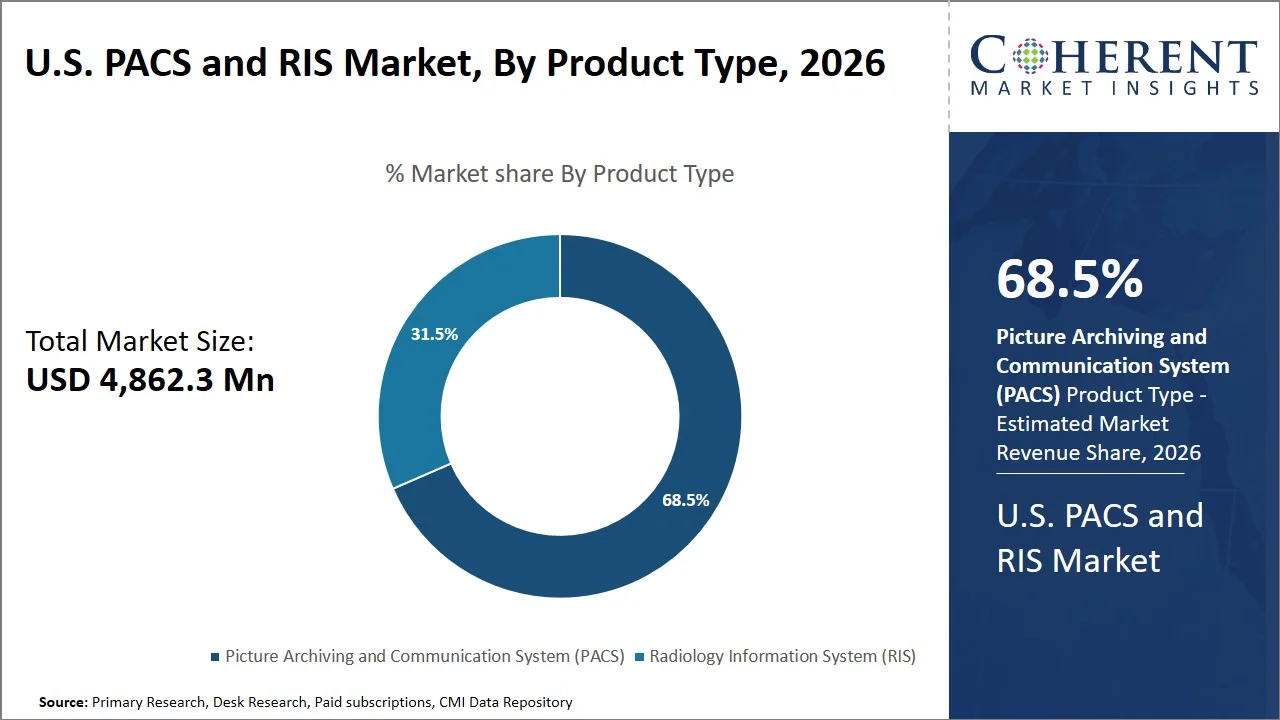
Why Do Picture Archiving and Communication System (PACS) Dominate the U.S. PACS and RIS Market?
Picture Archiving and Communication System (PACS) is projected to hold the market share of 68.5% in 2026, due to the surging demand from health organizations for an effective way to store, retrieve, manage, display and distribute rapidly increasing quantities of digital diagnostic images. Future demand is expected to rise as the adoption of newer imaging technologies increases and the need for faster image access increases within different clinical environments. PACS are moving beyond the simple storage of images, with vendors adding image manipulation, visualization, segmentation, and reporting tools for even further integration into clinical workflow. For instance, in June 2025, FUJIFILM Healthcare Americas Corporation announced their Synapse PACS (7.5), a Class II medical image management and processing system (21 CFR 892.2050), has received 510(k) approval from the U.S. Food and Drug Administration (FDA) in the U.S.
- Current Industry Events of 2026
- Market Size Estimation
- Regional Breakdown
- Competitive Landscape
- Customer Intelligence
- Segmental Analysis
- Pricing Analysis
- Key Market Drivers, Challenges & Future Trends
- Customized Insights Section
Why Does Software Represent the Largest Component Segment in the U.S. PACS and RIS Market?
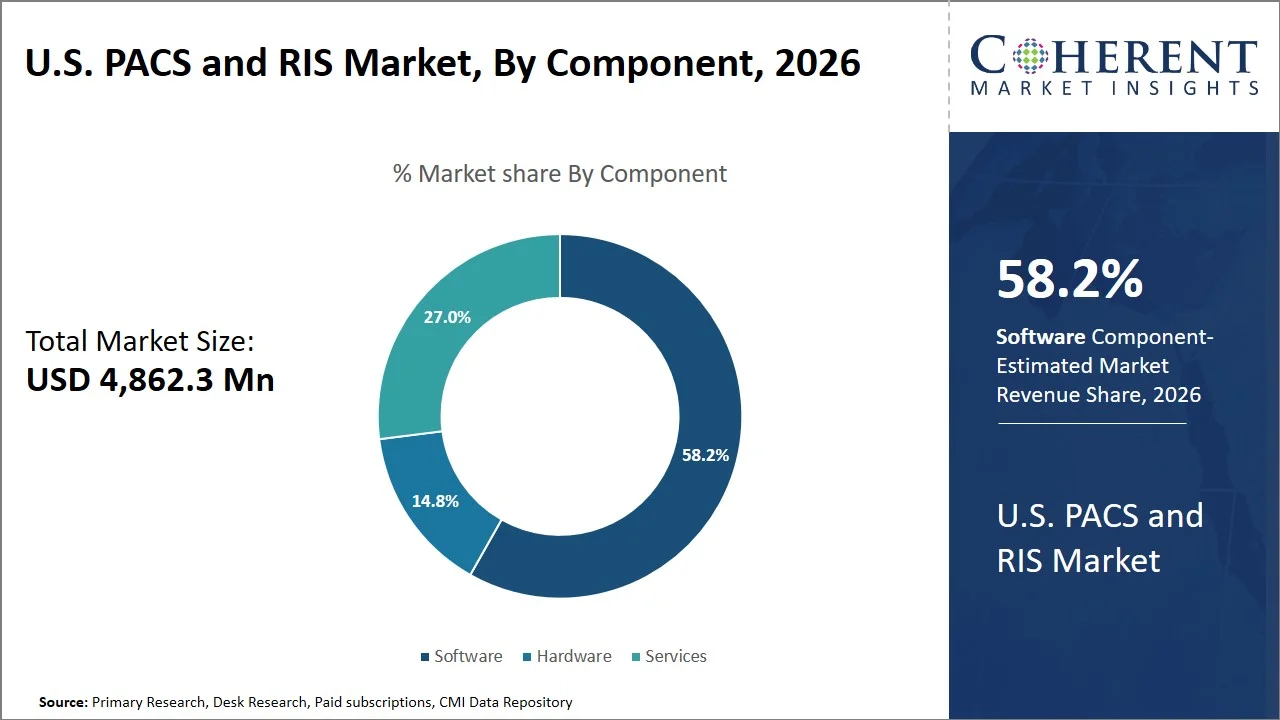
Software is projected to hold a market share of 58.2% in 2026, boosted by the surging demand in new image management systems, work-flow automation and interoperability, and scalable digital imaging infrastructure. Increases in image data volumes are forcing vendors to enhance its software with some enhanced imaging features such as enhanced visualization, report and image processing tools. The web and cloud-based solution provide greater flexibility. For instance, in April 2025, Konica Minolta Healthcare Americas, Inc. released its “next generation” Exa Platform solution, featuring an upgraded Exa PACS|RIS with an API-centric platform, along with the debut of automated 3D reconstructions and segmentation tools as well as embedded workflow functionalities.
Hospitals Segment Dominates the U.S. PACS and RIS Market
The hospitals segment is projected to hold a market share of 48.5% in 2026, driven by high imaging volumes, sophisticated radiology operations and a need to bridge the gap between diagnostic imaging and other clinical workflows. Massive hospital networks increasingly demand scalable and comprehensive PAC/RIS solutions that allow for consistent imaging management among numerous sites and provide rapid access to patient imaging studies. Radiologist workloads and productivity concerns are on the rise making hospital organizations further necessitate the integration of their imaging operations. For instance, in September 2025, GE HealthCare announced the availability of its True PACS SaaS –cloud-enabled enterprise imaging software solution on the Amazon Web Services (AWS) marketplace, empowering hospitals and health systems to consume and implement this in a cloud-based model.
Currents Events and their Impact
Current Events | Description and its Impact |
U.S. Centers for Medicare & Medicaid Services (CMS) Expanded Interoperability Framework to Diagnostic Imaging (August 2026) |
|
U.S. Centers for Medicare & Medicaid Services (CMS) Finalized Standards for Electronic Exchange of Imaging and Clinical Documentation (March 2026) |
|
Office of the National Coordinator for Health Information Technology (ONC) Updated U.S. Interoperability Standards Advisory (March 2026) |
|
U.S. PACS and RIS Market Dynamics
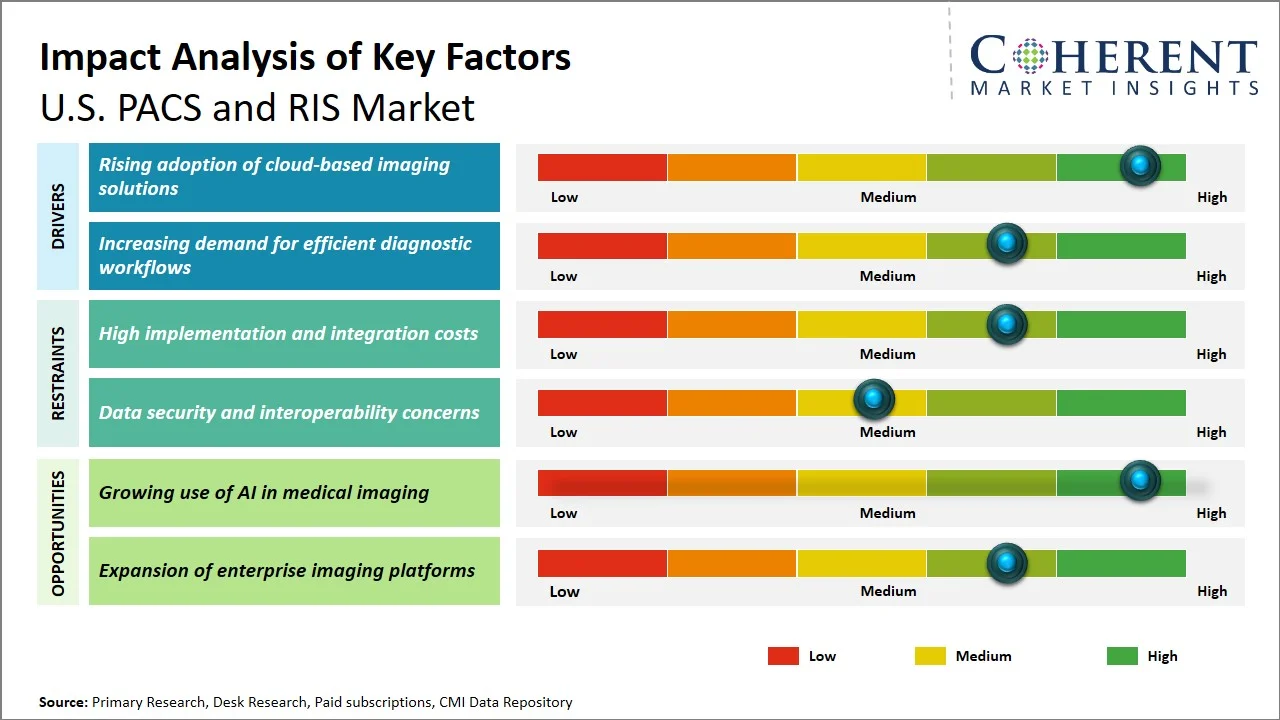
Market Drivers
Rising adoption of cloud-based imaging solutions
U.S. healthcare providers are increasingly transitioning from on-premise imaging infrastructure toward cloud-based PACS to improve scalability, reduce infrastructure requirements, and support access across large provider networks. Cloud deployment also enables imaging systems to accommodate rising examination volumes without proportional expansion of local IT infrastructure. For instance, in June 2025, MultiCare Health System expanded its agreement with Merative to include cloud-based PACS, following its initial deployment of cloud VNA, universal viewer, and image-sharing solutions across its 13 hospitals and more than 300 clinics.
Increasing demand for efficient diagnostic workflows
Rising imaging volumes and radiologist workforce shortages are increasing pressure on U.S. healthcare providers to streamline diagnostic workflows and improve turnaround times. PACS and RIS solutions are therefore increasingly being used to automate case prioritization, workload distribution, and reporting processes. For instance, in May 2025, GE HealthCare announced the integration of its Pace and Balance workload-management solution with True PACS and Centricity PACS to optimize radiologist workloads and increase reading capacity.
Increasing diagnostic imaging volumes
Growing utilization of CT, MRI, ultrasound, and other diagnostic imaging modalities is generating larger volumes of medical images and radiology data, increasing the need for efficient systems to store, manage, retrieve, and distribute imaging studies. The trend is further supported by the aging U.S. population and rising imaging utilization. For instance, according to a study published by the American College of Radiology (ACR) in the Journal of the American College of Radiology, imaging examinations increased 31% between Q1 2018 and Q1 2024 across 167 U.S. radiology practices, highlighting the growing diagnostic imaging workload and need for efficient imaging management systems.
Emerging Trends
Expansion of Enterprise Imaging Infrastructure
Healthcare providers are consolidating imaging data across departments and facilities, enabling centralized access to diagnostic studies and more efficient image management.
Adoption of Zero-Footprint Imaging Solutions
Browser-based diagnostic viewers are gaining traction by enabling clinicians to access and review medical images without dedicated workstation installations, supporting flexible workflows.
Advancement of Automated Radiology Workflows
PACS and RIS platforms are incorporating automated worklist management, study routing, protocoling, and reporting processes to streamline radiology operations and improve productivity.
U.S. Radiology Examination Volume, 2020–2024
Year | Radiology Exams (Million) |
2020 | 75.1 |
2021 | 94.4 |
2022 | 128.1 |
2023 | 164.2 |
2024 | 191.2 |
How is the growing use of AI in medical imaging creating new growth opportunities in the U.S. PACS and RIS market?
AI in PACS and RIS is being leveraged to enable the automation of image analysis, provide clinical assistance to support clinical decision-making and increase the efficiency of radiologists through the development of AI-enabled solutions that can increase the diagnostic value of images. These will improve workflow through automated image analysis and the ability to extract and report meaningful quantitative data. For instance, in January 2026, Siemens Healthcare GmbH’s AI-Rad Companion Brain MR obtained 21 CFR 892.2050 approval from the U.S. Food and Drug Administration (FDA) to automatically process radiological images, continuing the regulatory progress of the AI-powered imaging portfolio.
Market Players, Key Development, and Competitive Intelligence
Key Developments
- In June 2026, PACS Group announced an agreement to acquire the operations of 34 healthcare facilities across Texas, Montana, New Mexico, North Dakota, South Dakota, and Utah. The expansion increases PACS Group’s healthcare facility footprint across the U.S. and could support greater demand for digital imaging and information systems, including PACS and RIS.
- In November 2025, Sectra AB introduced its built-in AI-driven reporting solution in the U.S., integrating image review and reporting within a single diagnostic workflow. The solution uses AI for automated impression generation and integrates imaging data, measurements, and external AI results. This launch strengthens Sectra’s U.S. PACS offering by improving reporting efficiency and reducing workflow complexity.
- In June 2024, InsiteOne secured six new contracts following its acquisition of BRIT Systems, expanding its cloud-native RIS/PACS/VNA solutions across U.S. healthcare providers. The contracts highlight increasing adoption of cloud-based imaging platforms and strengthen InsiteOne’s position in the U.S. PACS and RIS market.
Competitive Landscape
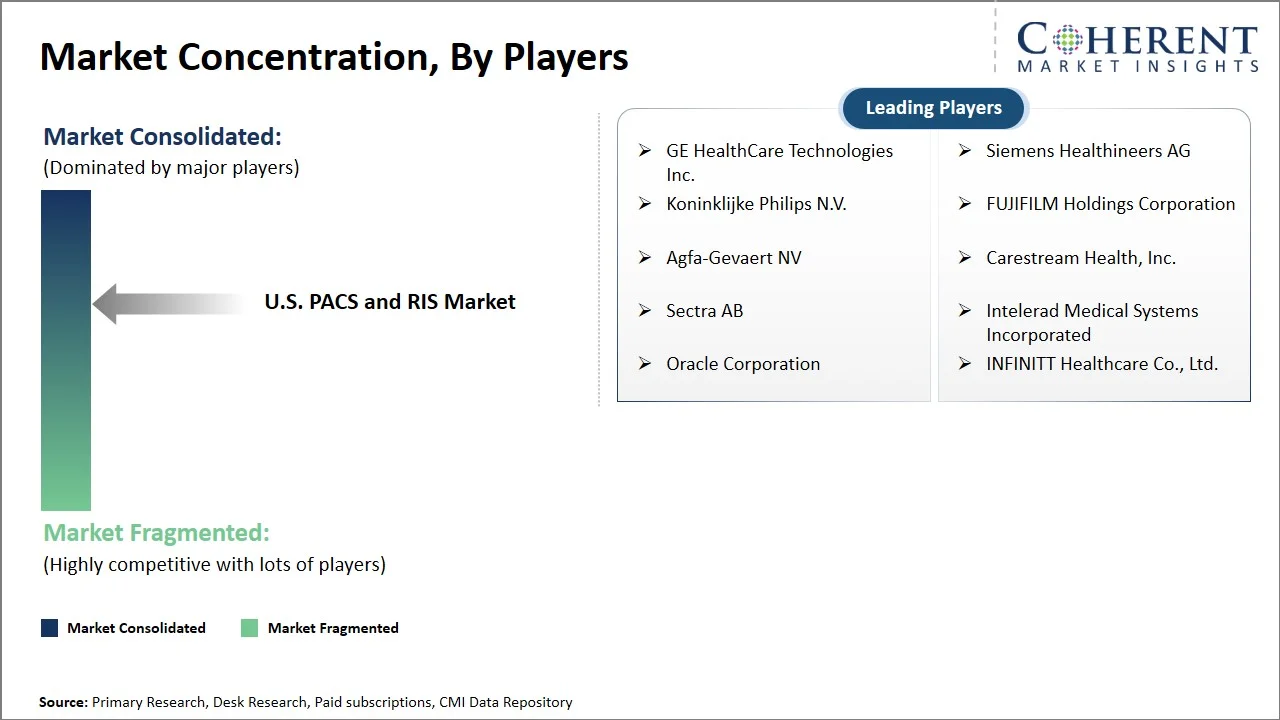
The U.S. PACS and RIS market is moderately fragmented, with competition centered on imaging workflow efficiency, enterprise imaging capabilities, cloud deployment, interoperability, cybersecurity, and scalable data management. Leading market participants are strengthening their offerings through platform modernization, broader clinical integration, and technology-enabled imaging workflows. Regulatory emphasis on secure medical-device interoperability and standardized health-data exchange is also shaping product development. Key focus areas include
- Expansion of enterprise imaging capabilities
- Adoption of cloud-based imaging infrastructure
- Advancement of radiology workflow automation
- Strengthening of imaging interoperability through standards such as Digital Imaging and Communications in Medicine (DICOM) and Fast Healthcare Interoperability Resources (FHIR)
- Increasing focus on PACS cybersecurity
- Integration of advanced imaging technologies
Market Report Scope
U.S. PACS and RIS Market Report Coverage
| Report Coverage | Details | ||
|---|---|---|---|
| Base Year: | 2025 | Market Size in 2026: | USD 4,862.3 Mn |
| Historical Data for: | 2020 To 2024 | Forecast Period: | 2026 To 2033 |
| Forecast Period 2026 to 2033 CAGR: | 6.0% | 2033 Value Projection: | USD 7,328.6 Mn |
| Segments covered: |
| ||
| Companies covered: | GE HealthCare Technologies Inc., Siemens Healthineers AG, Koninklijke Philips N.V., FUJIFILM Holdings Corporation, Agfa-Gevaert NV, Carestream Health, Inc., Sectra AB, Intelerad Medical Systems Incorporated, Oracle Corporation, INFINITT Healthcare Co., Ltd. | ||
| Growth Drivers: |
| ||
| Restraints & Challenges: |
| ||
Analyst Opinion (Expert Opinion)
- In the coming years, U.S. PACS and RIS market will evolve from standalone image archiving and radiology workflow systems toward unified, intelligent enterprise imaging platforms. Future solutions will increasingly combine PACS, RIS, image exchange, reporting, workflow orchestration, and AI capabilities within a single environment, while cloud deployment will become increasingly important for multisite healthcare networks.
- The maximum opportunities will probably exist within cloud-based PACS/RIS for hospitals and multisite health systems in the U.S. Large healthcare networks offer substantial scope for centralized imaging management, cross-facility access, workflow standardization, and migration from fragmented legacy systems. We believe vendors that can address the complete imaging lifecycle
- In order to obtain a competitive advantage, market participants should prioritize integrated, scalable platforms rather than competing solely on PACS/RIS functionality. The differentiation will come from seamless EHR integration, automated workflow orchestration, cybersecurity, flexible cloud deployment, and AI capabilities that demonstrably reduce radiologist workload and turnaround times.
Speak to the analyst
Want personalized insights?
Take the findings above to one of our principal consultants, or have the report rebuilt around the segments, geographies and competitors you actually track.
Market Segmentation
- Product Type Insights (Revenue, USD Mn, 2021 - 2033)
- Picture Archiving and Communication System (PACS)
- Radiology Information System (RIS)
- Component Insights (Revenue, USD Mn, 2021 - 2033)
- Software
- Hardware
- Services
- End User Insights (Revenue, USD Mn, 2021 - 2033)
- Hospitals
- Clinics
- Diagnostics Centers
- Others
Sources
Primary Research Interviews
- PACS and RIS software vendors and product specialists
- Radiologists and radiology department directors
- Chief Information Officers (CIOs) and healthcare IT administrators
- Enterprise imaging and health information technology specialists
- Hospital and diagnostic imaging center administrators
Stakeholders
- Hospitals and integrated healthcare networks
- Independent diagnostic imaging centers
- Radiology practices and teleradiology providers
- Ambulatory healthcare facilities
- Electronic health record (EHR) and health IT providers
- Medical imaging equipment manufacturers
- PACS, RIS, and vendor-neutral archive (VNA) providers
- Cloud infrastructure and healthcare technology providers
- End-use Sectors
- Hospitals
- Clinics and ambulatory healthcare facilities
- Diagnostic imaging centers
- Radiology practices
- Other healthcare facilities
- Regulatory & Health Bodies
- U.S. Food and Drug Administration (FDA)
- Centers for Medicare & Medicaid Services (CMS)
- Office of the National Coordinator for Health Information Technology (ONC)
- U.S. Department of Health and Human Services (HHS)
- National Institute of Standards and Technology (NIST)
- State Departments of Health and medical-device regulatory authorities
Databases
- FDA Medical Device Databases – PACS and medical imaging device classifications
- FDA 510(k) Database – PACS/RIS regulatory clearances
- CMS Medicare Data – healthcare utilization and imaging-related data
- ONC Health IT Data – EHR adoption and interoperability data
- ClinicalTrials.gov – medical imaging and radiology-related clinical studies
- NIST Cybersecurity Resources – PACS and healthcare IT security data
Associations
- Radiological Society of North America (RSNA)
- American College of Radiology (ACR)
- Healthcare Information and Management Systems Society (HIMSS)
- Society for Imaging Informatics in Medicine (SIIM)
- Medical Imaging & Technology Alliance (MITA)
- Digital Imaging and Communications in Medicine (DICOM) Standards Committee
Public Domain Sources
- U.S. Food and Drug Administration – medical device regulations, PACS classifications, and imaging guidance
- Centers for Medicare & Medicaid Services – Medicare imaging, hospital, and healthcare data
- Office of the National Coordinator for Health Information Technology – interoperability and health IT data
- National Institute of Standards and Technology – PACS cybersecurity and healthcare IT standards
- U.S. Department of Health and Human Services – healthcare technology and interoperability initiatives
- U.S. Census Bureau – healthcare facility and demographic statistics
- National Center for Health Statistics – healthcare utilization and demographic data
Proprietary Elements
- CMI Data Analytics Tool
- Proprietary CMI Existing Repository of information for last 10 years.
Get access to 250+ pages report
Every segment, forecast, competitor profile and data table behind the analysis above — available for instant download.
- ESOMAR Member
- ISO 9001:2015 Certified
- D-U-N-S Registered
- GDPR & CCPA Compliant
Missing comfort of reading report in your local language? Find your preferred language:
Frequently Asked Questions
The U.S. PACS and RIS market is estimated to be valued at USD 4,862.3 Mn in 2026 and is expected to reach USD 7,328.6 Mn by 2033.
Software dominates due to the increasing demand for cloud-based platforms, workflow automation, interoperability, and AI-enabled imaging capabilities.
PACS (Picture Archiving and Communication System) and RIS (Radiology Information System) are healthcare IT solutions used to manage medical images and radiology workflows, respectively.
The CAGR of U.S. PACS and RIS market is projected to be 6.0% from 2026 to 2033.
Rising adoption of cloud-based imaging solutions, and increasing demand for efficient diagnostic workflows are the major factors driving the growth of the U.S. PACS and RIS market.
High implementation and integration costs, and data security and interoperability concerns are the major factors hampering the growth of the U.S. PACS and RIS market.
GE HealthCare Technologies Inc., Siemens Healthineers AG, Koninklijke Philips N.V., FUJIFILM Holdings Corporation, Agfa-Gevaert NV, Carestream Health, Inc., Sectra AB, Intelerad Medical Systems Incorporated, Oracle Corporation, and INFINITT Healthcare Co., Ltd. are the major players.