

U.S., Western Europe & APAC Fake Wedding Party Market Size and Forecast – 2026 To 2033
The U.S., Western Europe & APAC Fake Wedding Party Market is estimated to be valued at USD 38.20 Mn in 2026 and is expected to reach USD 483.35 Mn by 2033, exhibiting a compound annual growth rate (CAGR) of 43.7% from 2026 to 2033. The expansion responds to growing consumer interest in immersive wedding-themed entertainment, particularly among younger audiences looking for alternative social experiences.
Nightlife venues and event management companies are finding new ways to generate revenue by including simulated ceremonies, live music, traditional celebrations and interactive activities into ticketed entertainment formats. In October 2025, Jai Ho!, operated by Bollywood Dreams Entertainment, organized a fake Indian wedding-themed event at The Dahlia in Denver, featuring a simulated baraat, mehndi activities, Bollywood DJ performances, and wedding-inspired photography, illustrating the commercialization of culturally themed entertainment in the U.S. market.
Key Takeaways of the U.S., Western Europe & APAC Fake Wedding Party Market
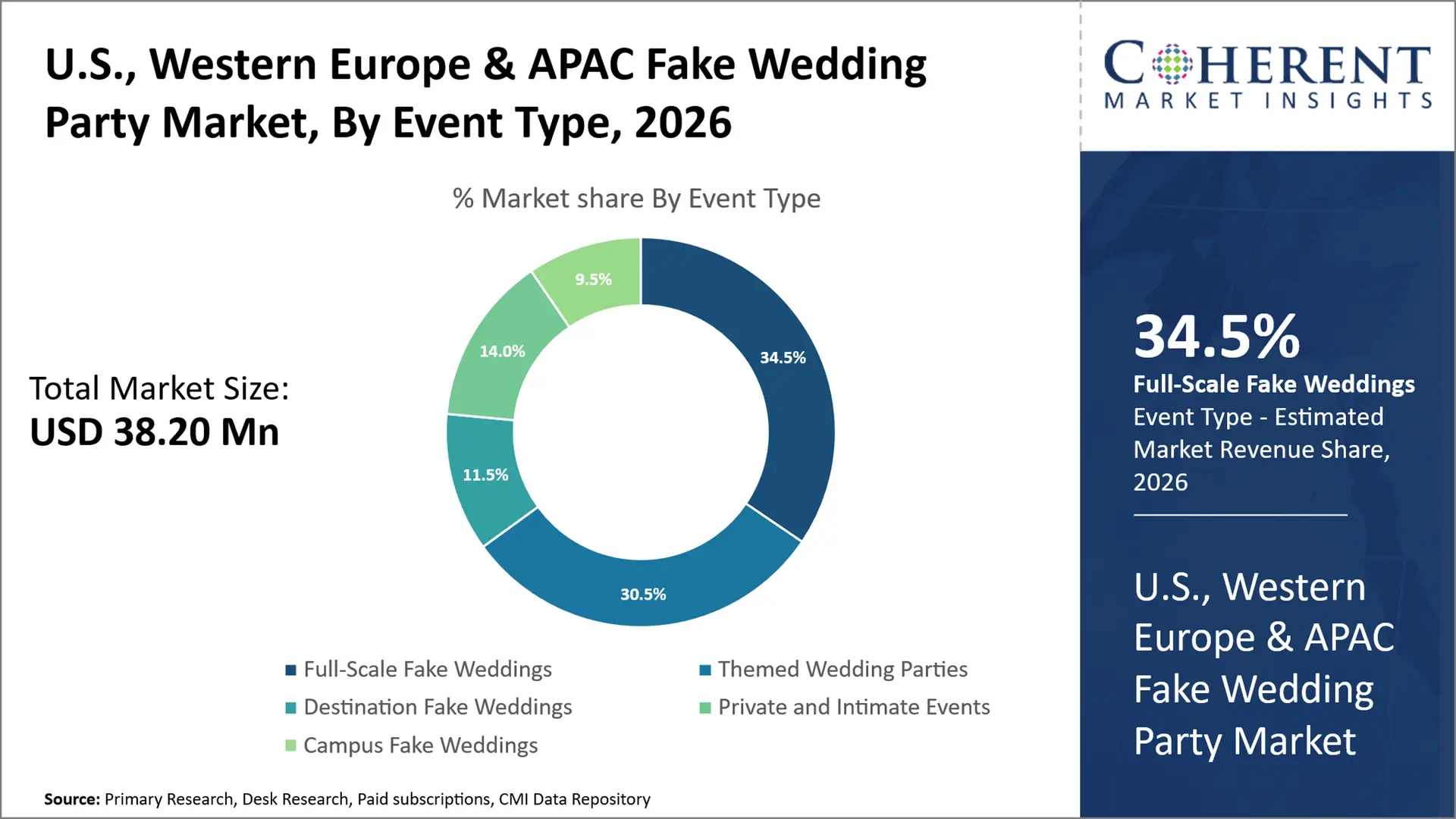
- Full-Scale Fake Weddings are estimated to experience a 42.0% CAGR through 2033 and account for 34.5% share of the U.S., Western Europe & APAC fake wedding party market in 2026. Combining theater staging, catering, music, and photography into comprehensive experiences helps increase the revenue per attendee. In October 2025, Rude Powai hosted a fake wedding complete with pyrotechnics, ceremonial props, live entertainment and inclusive refreshments.
- 18-26 years is the leading consumer age category, which is expected to grow at a 46.5% CAGR through 2033 and account for 38.4% of U.S., Western Europe & APAC fake wedding party market spends in 2026. Interactive cultural programming and peer-led participation reinforce engagement among younger attendees. In May 2025, The Creightonian covered a mock African wedding, with ceremonial performances and group participation, organized by university student associations.
- The Mid-Range (USD 25-75) tickets are anticipated to grow at a CAGR of 44.0% till 2033 and shall have 44.5% of the revenue share of U.S., Western Europe & APAC fake wedding party market in 2026. This level of pricing lets the organizer recoup his production costs while providing the customers with differentiated entertainment packages. In July 2025, The New Indian Express reported USD 42.36 Bn male admission for 8club's fake-wedding event at JW Marriott Bengaluru.
Segmental Insights
Why Do Full-Scale Fake Weddings Dominate the U.S., Western Europe & APAC Fake Wedding Party Market?
Full-scale fake weddings will generate 34.5 percent of event-type revenue in the U.S., Western Europe and APAC fake wedding party market. The commercial advantage they have is that they provide a structured celebration, not just a dance-floor attraction. The event offers unique participation opportunities through processions, simulated rituals, staged receptions, providing extended guest involvement and additional sources of income. Large event halls and professional production teams allow for elaborate execution, but venue and staffing commitments require advance ticket sales. In November 2025, Mumbai's Band Baja Baraat was advertised at NESCO Centre, featuring a staged ceremony, baraat procession, mehendi activities, mandap setup, reception arrangements, and a performance by Daler Mehndi. This illustrates how comprehensive event programming can support differentiated entertainment offerings while creating business opportunities for production companies, performers, and hospitality service providers.
- Current Industry Events of 2026
- Market Size Estimation
- Regional Breakdown
- Competitive Landscape
- Customer Intelligence
- Segmental Analysis
- Pricing Analysis
- Key Market Drivers, Challenges & Future Trends
- Customized Insights Section
Why Does the 18–26 Years Age Group Represent the Largest Consumer Segment in the U.S., Western Europe & APAC Fake Wedding Party Market?
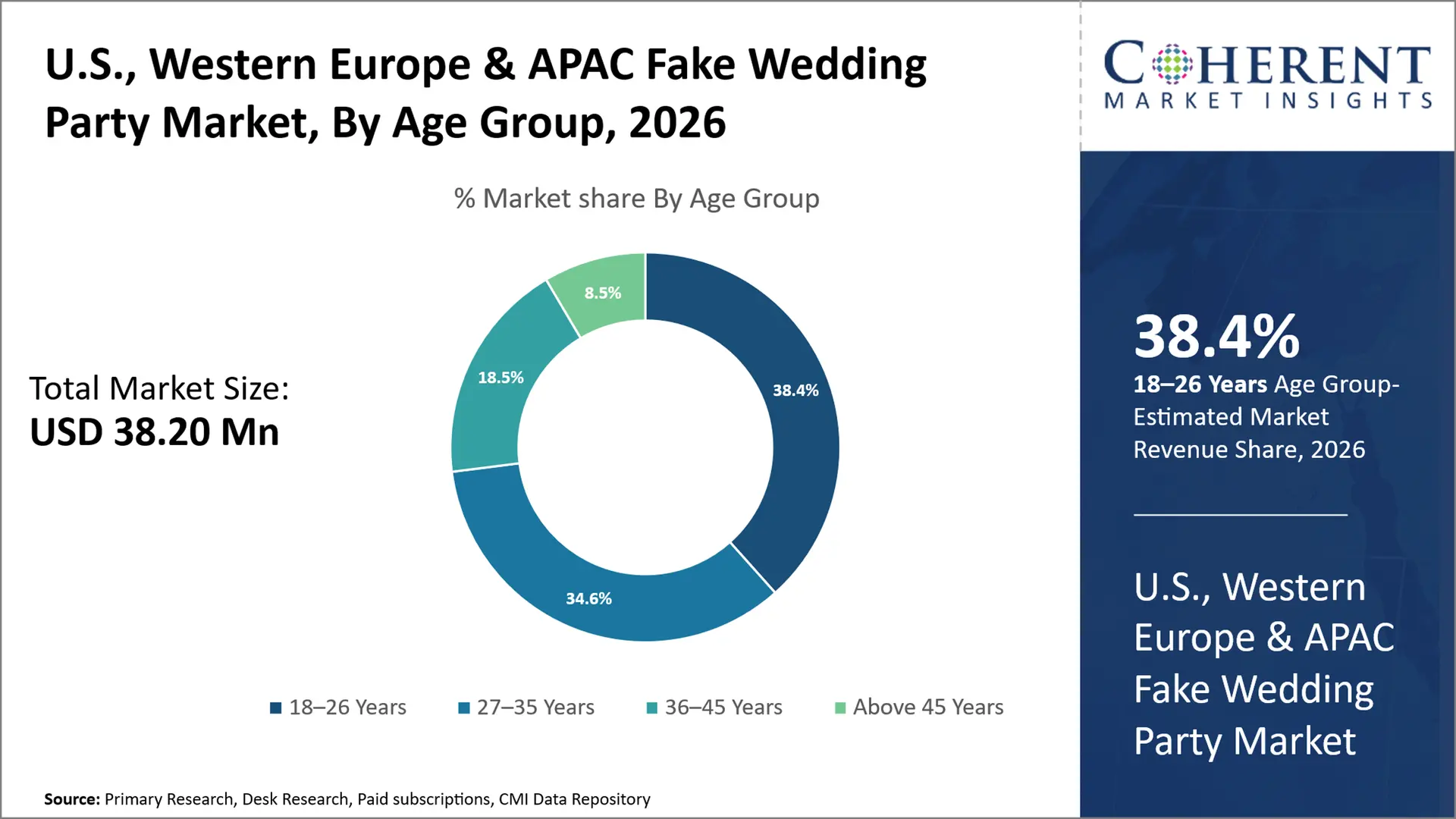
18-26 Years segment is projected to hold 38.4% share of U.S., Western Europe & APAC fake wedding party market revenue by 2026. Established networks exist through university societies and student-led cultural associations, where younger audiences can find and participate in mock wedding celebrations. Campus ballrooms, collaborative dance groups, and institutional event facilities lower the barriers to organizing while introducing students to cultural traditions outside of traditional family celebrations. These networks also offer commercial event organizers ways to reach potential consumers in the young adult market. In May 2026, Towson University reported that its South Asian Student Association's annual My Big Fat Desi Wedding attracted a sold-out audience, with multiple student organizations contributing performances. This points to organized engagement from university audiences and suggests opportunities to use campus familiarity to create future paid entertainment experiences, though the specific ages of attendees were not available.
Why Do Mid-Range (USD 25–75) Tickets Dominate the Ticket Price Category in the U.S., Western Europe & APAC Fake Wedding Party Market?
Mid-range (USD 25-75) tickets are expected to contribute 44.5% of revenue in the U.S., Western Europe & APAC fake wedding party market in 2026 by ticket price. Organizers also benefit from the added certainty in bookings that prepaid admissions bring, enabling them to forecast attendance before making final arrangements for venue security, entertainment and staffing. Fans can enjoy a clear entertainment experience, without having to buy premium hospitality packages or reserved tables. Venue operators also are able to generate extra revenue from optional food, beverage and merchandise sales, providing for more flexible event economics. In April 2026, Brooklyn's 3 Dollar Bill hosted a Queer Fake Shaadi event, with a contemporary event guide listing admission price between USD 34.95 and USD 45.26, including fees. This pricing illustrates the commercial application of mid-range admission for specialized wedding-themed entertainment without establishing market-wide sales volumes.
Current Events and their Impact
Current Event | Description and Its Impact |
U.S. Federal Trade Commission Ticket Pricing Rule – May 2025 |
|
New South Wales Night-Time Economy Reforms – January 2026 |
|
U.S., Western Europe & APAC Fake Wedding Party Market Dynamics
Key Market Drivers
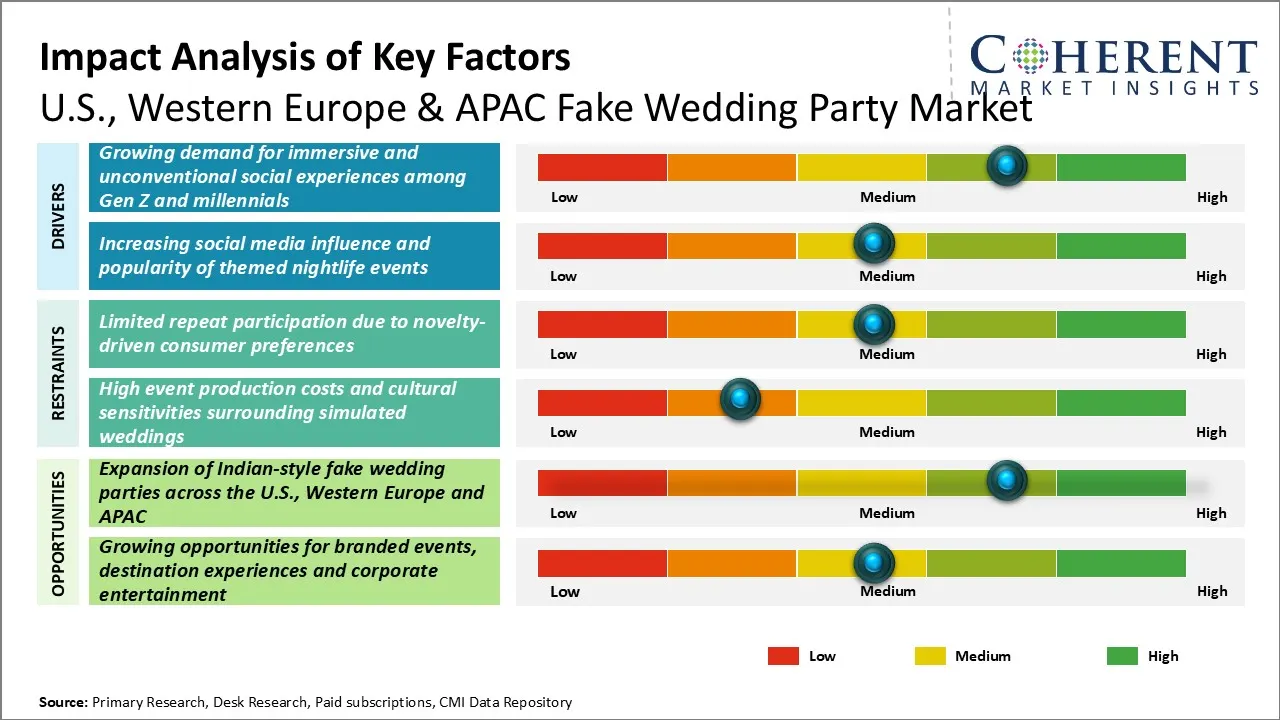
- Growing Demand for Immersive and Unconventional Social Experiences Among Gen Z and Millennials: The growing demand for participatory entertainment is opening commercial opportunities for the fake wedding party market, geared toward Gen Z and millennials. Mock ceremonies, traditional dress, choreographed performances and interactive wedding games allow attendees to take part in the celebrations without the obligation of marriage. The format enables event production companies, performers and hospitality operators to create unique experiences that are different from the typical nightlife. In April 2025, a fake sangeet celebration at Zylo in Delhi attracted attendees through wedding-inspired decorations, mehendi activities, and traditional entertainment, demonstrating consumer interest in participatory social gatherings.
- Increasing Social Media Influence and Popularity of Themed Nightlife Events: The organizers of fake wedding parties are increasingly using social media as a channel to attract customers, especially short videos, visually distinct event promotions, and peer recommendations. The wedding-themed celebrations generate shareable content that can be used to create publicity without the need for traditional advertising. It enhances the commercial visibility of independent organizers and generates sponsorship opportunities for lifestyle brands targeting a younger demographic. In July 2025, The Economic Times reported that Saddi Galli’s viral Scam Sangeet events resulted in a sold-out event and attracted sponsors, highlighting the potential for commercial opportunities to come from digital visibility.
Emerging Market Trends
- Development of Recurring Fake Wedding Entertainment Formats: Fake wedding celebrations are expected to evolve from occasional novelty events to recurring entertainment formats with recognizable identities and changing storylines. The general idea of the event can be kept by organizers, but new fictional couples, ceremonial sequences, cultural themes and activities for guest participation can be introduced. This could also encourage repeat visits and add to the commercial value of original event formats. While specialist production companies could benefit from the development of reusable creative assets and pre-existing networks of performers, however, organizers using similar programming may find customer interest waning as the concept becomes increasingly familiar.
- Shift Toward Customizable Wedding-Themed Entertainment Packages: As audiences become clearer on what a fake wedding ticket includes, customization is likely to become an increasingly important purchase consideration. Instead of mass celebrations, organizers can offer differentiated packages with selected performances, thematic dining, interactive games, photography or exclusive participation options. Moving to this would enable entertainment providers to more accurately match the cost of events to consumer tastes. Modular service contracts can benefit catering businesses, creative agencies and specialist performers, while poorly defined packages may be under even more pressure from customers comparing what is promised with the reality of delivery.
Key Market Restraints
- Limited repeat-attendance potential and novelty fatigue: Fake wedding parties rely in part on the appeal of an unfamiliar entertainment concept. Once they’ve seen the format, organizers who recycle the same ceremonies, decorations and performances may have a hard time keeping people coming. Frequent changes in creativity can also raise the cost of production and make profitability less predictable.
- Cultural sensitivity and operational uncertainty: In places where marriage ceremonies are deeply religious or culturally significant, recreational readings of wedding ceremonies may come in for criticism. In addition, event organizers need to navigate venue permissions, occupancy limits, music licensing, crowd safety, and cancelation risks. The requirements differ across the US, Western Europe and Asia Pacific, adding to the complexity of multi-city operations.
Fake Wedding Party Experience and Event Operations Landscape
Solution | Market Application | Commercial Significance | Adoption Considerations |
QR-Code Ticketing and Digital Check-In | Digital admission passes, guest verification, and entry management | Reduces manual registration work and supports more efficient crowd handling | Reliable connectivity, secure ticket validation, and backup admission procedures |
Event Customer Relationship Management (CRM) | Customer records, repeat invitations, guest segmentation, and booking follow-ups | Helps organizers build direct customer relationships and assess repeat participation | Consent-based marketing and personal data protection requirements |
Interactive Digital Photo Booths | Wedding-style photographs, branded frames, and digital souvenir generation | Provides an optional paid experience and potential event sponsorship inventory | Equipment rental costs, operating space, and guest image-consent practices |
Programmable LED Lighting and Projection Mapping | Simulated wedding stages, entrance displays, and coordinated ceremonial effects | Allows the same venue to support different event identities without permanent redesign | Installation expenses, electrical safety, and technical staffing |
Integrated Point-of-Sale and Cashless Payment Systems | Food, beverage, merchandise, and optional experience purchases | Helps operators reconcile event-related transactions and monitor supplementary spending | Payment processing costs, system integration, and transaction security |
Event Planning and Vendor Coordination Software | Scheduling performers, managing production tasks, tracking suppliers, and coordinating venue requirements | Improves production consistency and reduces the risk of missed operational commitments | Staff training, supplier participation, and software subscription costs |
These solutions represent relevant commercial applications rather than verified market-wide adoption levels. Event operators are likely to prioritize technologies according to venue size, event frequency, and production complexity.
How Are Private Group Booking Models Creating New Growth Opportunities in the U.S., Western Europe & APAC Fake Wedding Party Market?
For fake wedding party organizers looking to improve revenue predictability, private group bookings are an under-tapped commercial opportunity. Rather than relying on individuals to purchase tickets, operators could offer private communities, social clubs, alumni groups and corporate teams bespoke wedding-themed events.
These customers may enjoy the exclusivity of participation, entertainment and activities that are coordinated and shared so that the group members can interact with each other. The event planners can create packages at fixed prices that include venue arrangements, performers, catering, decorations and event management.
Commercially, the company would have to ensure minimum booking commitments, build reliable supplier networks and control its production costs by standardizing service components. Financial exposure could be reduced further by putting in place advance deposits and clearly defined cancelation terms.
This opportunity will be ideal for specialist event management companies that can combine operational flexibility with creative planning. But successful expansion will depend on the ability to customize experiences without hurting the bottom line of events, consistent service delivery and robust corporate sales capabilities.
Market Players, Key Development, and Competitive Landscape
Key Developments
- In October 2026, It's a Fake Wedding partnered with Nite Society to announce its upcoming Washington, D.C. edition on November 6 at SAX. The purpose of the event is to demonstrate the commercial viability of taking an established immersive wedding-party concept to another metropolitan market via a local entertainment partnership while preserving an identifiable event identity.
- In October 2026, House of Ora announced a ticketed fake wedding experience in London on October 10, 2026. The event will feature a fictional bridal couple, traditional games, reserved seating and wedding-style dining. The event is a demonstration of a different style of hospitality which packages structured entertainment and food service into a combined event experience.
Competitive Landscape
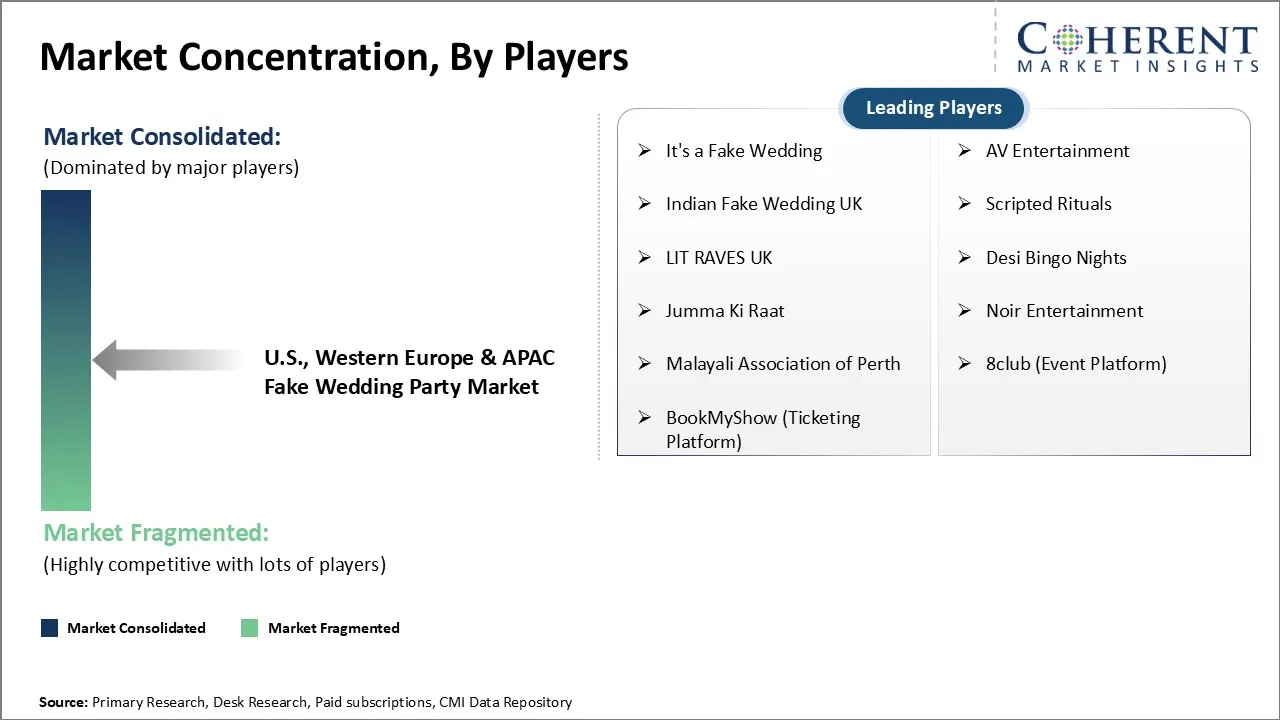
The US, Western Europe and APAC fake wedding party market seems to be fragmented with independent event planners, nightlife promoters, experiential entertainment specialists and hospitality operators. The key areas for competition are creative execution, event reliability, customer experience and access to suitable venues. Specialist organizers can stand out through their special event concepts and production expertise, whereas regional companies can benefit operationally from their cultural familiarity and established relationships with suppliers.
Key focus areas include
- Ownership of Creative Concepts: A unique event identity and innovative entertainment sequences enable organizers to stand out from their competitors.
- Production Quality: Consistency in décor, performers, scheduling and guest interaction is necessary to keep guests satisfied.
- Supplier Reliability: Reliable arrangements with decorators, entertainers, caterers and production crews will minimize last-minute disruptions.
- Venue Contracting: Clear, commercial agreements covering capacity, staffing, equipment and cancelation liabilities can help safeguard event margins.
- Pricing Discipline: Accurate assessment of fixed production costs and expected attendance is essential for maintaining profitability.
- Customer Service: Clarity about which events are covered, fast support and clear refund policies increase buyer confidenc.
- Operational Scalability: With trustworthy local contractors and repeatable production processes it is easy to manage the growth of operations into new cities.
Market Report Scope
U.S., Western Europe & APAC Fake Wedding Party Market Report Coverage | |||
Report Coverage | Details | ||
Base Year | 2025 | Market Size in 2026: | USD 38.20 Mn |
Historical Data For: | 2020 To 2024 | Forecast Period: | 2026 To 2033 |
Forecast Period 2026 To 2033 CAGR: | 43.7% | 2033 Value Projection: | USD 483.35 Mn |
Segments covered: |
| ||
Companies covered: | It's a Fake Wedding, AV Entertainment, Indian Fake Wedding UK, Scripted Rituals, LIT RAVES UK, Desi Bingo Nights, Jumma Ki Raat, Noir Entertainment, Malayali Association of Perth, 8club (Event Platform), BookMyShow (Ticketing Platform) | ||
Growth Drivers: |
| ||
Restraints & Challenges: |
| ||
Analyst Opinion (Expert Opinion)
- The U.S., Western Europe & APAC fake wedding party market leadership is likely to shift toward organizers that can manage repeatable event concepts as commercially recognizable entertainment properties. Businesses with documented production standards, dependable local operators, and clearly defined commercial rights may be better positioned to expand beyond individual events. The strategic advantage will increasingly depend on the ability to reproduce a consistent customer experience across multiple locations without losing the distinctive character of each celebration.
- The rise of low-cost, independently produced imitation events may fundamentally challenge the economics of established fake wedding party concepts. As cheap wedding-themed décor and entertainment become easier to emulate, it may be difficult for organizers to justify premium admission on visual presentation alone. Operators, relying on traditional event styling, may find it hard to differentiate themselves from those developing proprietary audience participation formats, original scripts and a unique creative identity.
- Organizers should focus on finding reliable local operating partners before committing to aggressive expansion, and plan finances based on attendance and flexible production contracts. Risk mitigation can be helped through investments in reliable vendors, standardized safety procedures, and flexible event equipment.
Speak to the analyst
Want personalized insights?
Take the findings above to one of our principal consultants, or have the report rebuilt around the segments, geographies and competitors you actually track.
Market Segmentation
- Event Type Insights (Revenue, USD Mn, 2021 - 2033)
- Full-Scale Fake Weddings
- Themed Wedding Parties
- Destination Fake Weddings
- Private and Intimate Events
- Campus Fake Weddings
- Age Group Insights (Revenue, USD Mn, 2021 - 2033)
- 18–26 Years
- 27–35 Years
- 36–45 Years
- Above 45 Years
- Ticket Price Insights (Revenue, USD Mn, 2021 - 2033)
- Budget (Below USD 25)
- Mid-Range (USD 25–75)
- Premium (Above USD 75)
- Venue Insights (Revenue, USD Mn, 2021 - 2033)
- Nightclubs and Lounges
- Hotels and Banquet Halls
- Outdoor and Destination Venues
- Campus and Community Halls
- Other Venues
- Booking Channel Insights (Revenue, USD Mn, 2021 - 2033)
- Online Ticketing Platforms
- Direct Organizer Bookings
- Venue and Event Partners
- Key Players Insights
- It's a Fake Wedding
- AV Entertainment
- Indian Fake Wedding UK
- Scripted Rituals
- LIT RAVES UK
- Desi Bingo Nights
- Jumma Ki Raat
- Noir Entertainment
- Malayali Association of Perth
- 8club (Event Platform)
- BookMyShow (Ticketing Platform)
Sources
Primary Research Interviews
- Fake wedding event organizers, nightlife promoters, event management agencies, and experiential entertainment providers.
- Venue operators, ticketing platforms, event production companies, and industry experts.
Stakeholders
- Fake wedding organizers, entertainment agencies, and event production companies.
- Nightclubs, hotels, banquet halls, ticketing providers, performers, sponsors, and attendees.
End-use Sectors
- Nightlife and themed entertainment events.
- Hospitality, private celebrations, and destination events.
- University events, cultural gatherings, and experiential marketing.
Regulatory and Industry Bodies
- U.S. Federal Trade Commission (FTC)
- European Commission
- U.K. Competition and Markets Authority (CMA)
- Local event licensing, fire safety, and municipal authorities.
Databases
- Eventbrite, BookMyShow, Fatsoma, and Ticket Tailor event listings.
- U.S. Census Bureau, Eurostat, and national tourism statistics.
- Event ticket pricing, attendance, venue capacity, and organizer revenue databases.
Magazines and Journals
- Event Industry News
- Access All Areas
- Event Marketer
- International Journal of Event and Festival Management
Associations
- International Live Events Association (ILEA)
- Meeting Professionals International (MPI)
- Events Industry Council (EIC)
- Association of Event Organisers (AEO)
Public Domain Sources
- Fake wedding event schedules, ticket prices, and venue listings.
- Consumer entertainment preferences and nightlife participation.
- Event launches, social media promotions, and organizer partnerships.
- Tourism, hospitality, and live entertainment industry statistics.
Key Standards and Regulations
- U.S. FTC 16 CFR Part 464 – Live-event ticket price transparency.
- EU General Data Protection Regulation (GDPR) 2016/679.
- U.K. Licensing Act 2003 – Venue and entertainment licensing.
- Applicable regional event safety, music licensing, consumer protection, and crowd management requirements.
Proprietary Elements
- CMI Data Analytics Tool and proprietary CMI research repository, supplemented by historical event-industry intelligence covering ticket pricing, consumer participation, event economics, venue operations, competitive positioning, regulatory developments, and regional entertainment trends.
Get access to 250+ pages report
Every segment, forecast, competitor profile and data table behind the analysis above — available for instant download.
- ESOMAR Member
- ISO 9001:2015 Certified
- D-U-N-S Registered
- GDPR & CCPA Compliant
Frequently Asked Questions
The CAGR of U.S., Western Europe & APAC fake wedding party market is projected to be 43.7% from 2026 to 2033.
The U.S., Western Europe & APAC fake wedding party market is estimated to be valued at USD 38.20 million in 2026 and is expected to reach USD 483.35 million by 2033.
The report provides insights into market dynamics, event business models, competitive positioning, consumer booking behavior, and commercial strategies across the covered regions.
Event management companies, nightlife operators, hospitality businesses, ticketing platforms, entertainment agencies, and investors seeking strategic market intelligence.
Market estimates are developed through analysis of event activity, ticket sales assumptions, organizer revenues, consumer participation patterns, and validation using available primary and secondary research.
The report examines event organizers, entertainment companies, and ticketing platforms, covering their business models, geographic presence, service offerings, partnerships, and competitive positioning.
The report assesses ticket pricing strategies, event production expenses, venue partnerships, revenue models, and commercial economics to support business planning and investment decisions.